
SK海力士 · 905

Korean retail investors flocked to US stocks to bet on SK Hynix ADR, and 1.16 trillion won capital inflows triggered a sharp premium

Comparative news, according to data from the Korea Securities Depository and Settlement Agency, South Korean retail investors are buying up their ADR (American Depositary Receipts) listed on the US NASDAQ in a big way, causing ADR to have a large premium compared to local Korean stocks. Since SK Hynix ADR was listed on NASDAQ on July 10 to August 19, Korean investors have accumulated a net purchase of SK Hynix ADR of about US$835 million (approximately 1.16 trillion won), ranking second among US stocks bought by Korean investors during the same period, accounting for 16.4% of the total net purchase amount of US stocks by Korean investors. This trend triggered the price gap between SK Hynix ADR and local Korean stocks to continue to widen. SK Hynix Korea's shares closed down 9.75% to 1.5 million won on August 19; ADR in the US market rose 0.35% to close at $156.16. Since 1 SK Hynix ADR corresponds to 0.1 shares of the Korean capital stock, theoretically, the share value after converting the ADR price should be about 10 times the ADR price. However, as of the 19th, the Korean stock price was only 6.82 times the ADR conversion price, which meant that ADR formed a premium of about 46.67% compared to the capital stock. (NATE)
1m ago

Korean retail investors are frantically betting on the recovery of the memory chip sector: 118.5 billion won in a single week to buy US memory ETFs

According to data from the Korea Securities Depository and Settlement Agency, Korean retail investors made net purchases of the “Roundhill Memory ETF” between August 14 and 20 this week, making it the second-largest net purchase of the country's overseas individual stocks and ETF investments (after Alphabet, Google's parent company). This ETF is an actively managed product, mainly investing in major memory chip companies such as Samsung Electronics, SK Hynix, and Micron. Recently, memory chip stocks have clearly picked up. The stock prices of SK Hynix and Samsung Electronics rose 21.6% and 21.8% respectively from August 10 to 21, both exceeding the 10.4% increase of the Korea Composite Index (KOSPI) during the same period. In the US market, Micron rose about 11% over the same period, and SanDisk increased by about 32%. South Korea's domestic ETF market also saw capital inflows. The data shows that the net inflow of the “TIGER US S&P500 ETF” tracking the S&P 500 index from August 14 to 20 was 1709 billion won, and the net inflow of the “KODEX US NASDAQ 100 ETF” tracking the NASDAQ 100 index was 132.3 billion won. Market participants believe that as expectations for the recovery of the semiconductor cycle heat up, investors are increasing their allocation to the AI chip and memory chip industry chain. (Daum) This article is sponsored by GENG, Build Your Fortune on GENG (https://geng.one)

1m agoburnking

Review of this week's macro hot topics: the US debt crisis, AI infrastructure, and geopolitical conflicts are the main lines of the market this week

Comparing news, the global market this week focused on US debt pressure, AI capital expansion, and the US-Iran economic game. After the US Treasury expanded the scale of long-term treasury bond repurchases, US bond yields declined briefly, but the market feared that fiscal deficits and debt growth pressure would be difficult to ease through liquidity tools. The US federal government debt surpassed 40 trillion US dollars for the first time. The yield on 30-year US bonds once rose to a high level since 2007, and the global long-term bond market was under pressure simultaneously. The minutes of the Federal Reserve's July meeting show that internal hawkish forces are growing, and there are more than three voting members supporting interest rate hikes. Some officials are concerned that tariffs, energy prices, and AI infrastructure investments could drive up inflation. Meanwhile, Federal Reserve Chairman Walsh suggested that in the future, consideration could be given to reducing the number of annual meetings from 8 to 6. Driven by the weakening dollar and risk aversion, gold broke through the 4,600 US dollars/ounce mark this week and rose for the third week in a row; crude oil was higher, supported by the risk of the Strait of Hormuz and expectations of US sanctions against Iran. Geographically, the US-Iran relationship is shifting to putting pressure on the economy. The US plans to weaken Iran's economy by expanding sanctions and economic isolation, while Iran is studying countermeasures against energy transportation nodes, and the safety of the Strait of Hormuz has become the focus of market attention. In the field of technology, AI infrastructure competition continues to escalate. Nvidia guarantees up to $105 billion for the OpenAI data center project, and Broadcom is also planning an AI financing plan of up to $100 billion. Meanwhile, Anthropic's revenue surpassed OpenAI for the first time, and plans to advance IPOs, further intensifying AI companies' commercialization competition. On the capital market side, Yushu Technology skyrocketed on the first day it landed on the Science and Technology Innovation Board. At one point, its market capitalization exceeded 44 billion yuan, and founder Wang Xingxing's net worth increased dramatically. South Korean semiconductor giant SK Hynix announced a repurchase plan of approximately 40 trillion won, and Samsung is also planning to increase shareholder returns. Furthermore, trade negotiations between the US and Canada ushered in a critical window. The US suspended the imposition of up to 50% tariffs on Canadian goods for three days, and the two sides continued to seek trade agreements. The core logic of the market this week still revolves around three themes: whether US fiscal pressure worsens further, whether AI capital investment is forming a new round of asset bubbles, and whether global geopolitical risks are driving safe-haven assets to continue to rise.

8h ago

SK Hynix says no decision has been made on whether to build semiconductor production facilities in Japan

Comparing news, SK Hynix (SKHY.O) stated in the document that it has not yet decided whether to build semiconductor production facilities in Japan. The company responded to media reports that it might go to Japan to build a factory. SK Hynix said, “In order to enhance the competitiveness of the memory chip business, the company is evaluating various solutions, including the establishment of additional production sites, but no matters have been decided so far.” The company said it will further disclose relevant information when specific details are confirmed, or within one month after the publication of this report.

23h ago
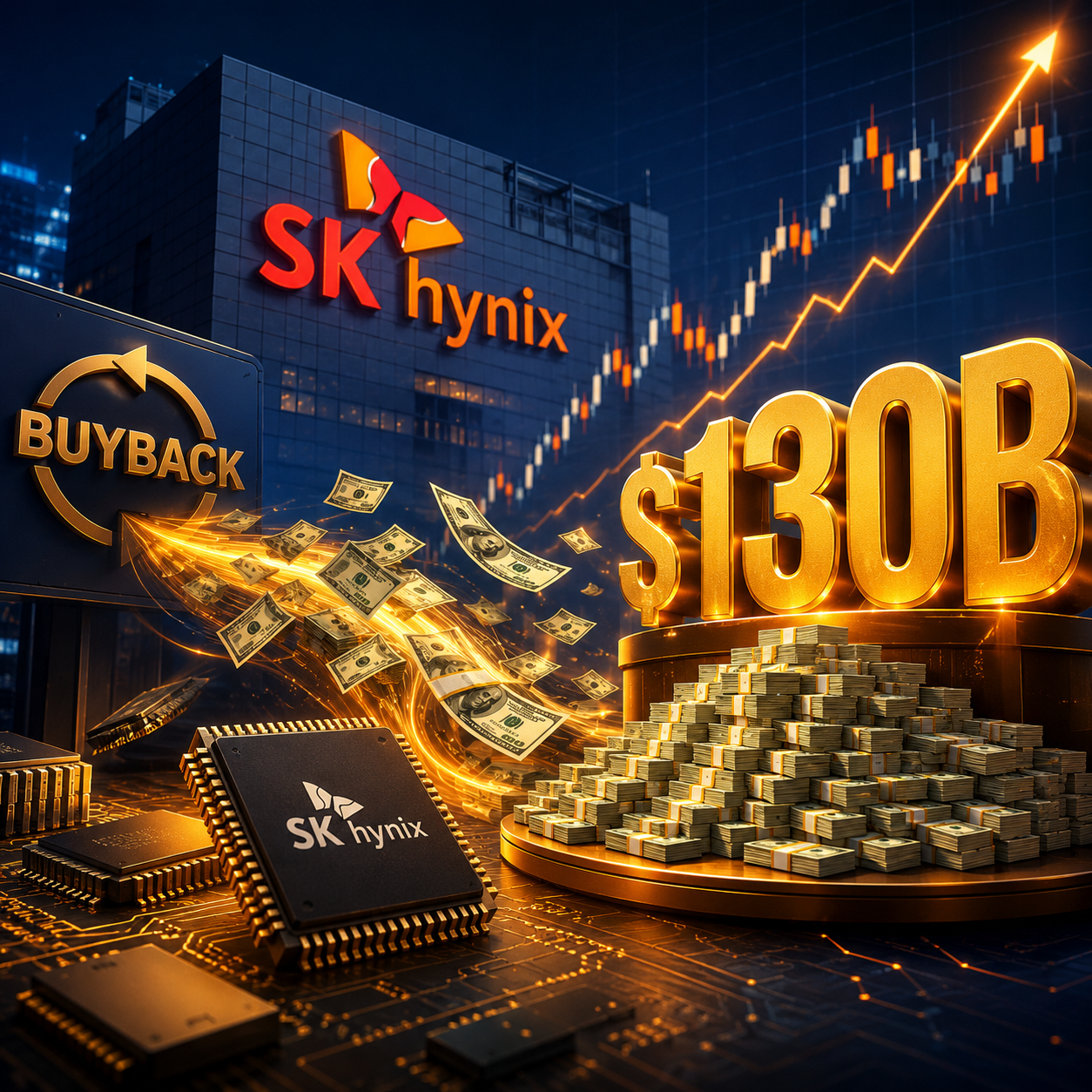
Is 40 trillion just an “appetizer”? The Hynix buyback landed ahead of schedule. Is 130 billion US dollars still ahead?

Is 40 trillion just an “appetizer”? The Hynix buyback landed ahead of schedule. Is 130 billion US dollars still ahead?

Source: Wall Street News Editor: Dong Jing Original title: Wall Street interprets Hynix's repurchase plan: Shareholder return of up to 8% next year, or return at least $130 billion to shareholders by 2027 Summary: J.P. Morgan believes that the shareholder return policy was upgraded from “no more than 50% free cash flow” to “no less than 50%”, changing from the upper limit to the lower limit, sending a clear signal to the market: future shareholder returns will only be greater, not less. Goldman Sachs predicts an 8% shareholder return in 2027, and expects an additional repurchase of approximately 7 trillion won in the future. J.P. Morgan expects additional return of over 16% of its market value by the end of 2027. Follow-up focus will be on the results meeting at the end of October. While the market was still debating the continuation of the AI storage cycle, and SK Hynix's stock price plummeted from a June high, the storage giant suddenly threw a huge bomb on the market. A historic repurchase, which was implemented early, reshaped the market's valuation logic for Hynix! SK Hynix officially announced the market's long-awaited shareholder return policy after closing on August 19, 2026 — it plans to repurchase and cancel 40 trillion won worth of shares, involving 24.07 million shares (3.3% of the shares issued as of the end of the second quarter of 2026), equivalent to about US$28.9 billion. This scale is not only the largest share repurchase in the history of a Korean listed company, but also exceeds the approximately 26.5 billion US dollars that Hynix raised through ADR financing in the US in early July this year. According to Chase Trading Desk, the two top Wall Street agencies, J.P. Morgan Chase and Goldman Sachs, both gave highly positive comments on the announcement in their latest research report on August 20. J.P. Morgan believes that the shareholder return policy has been substantially upgraded from “no more than 50%” to “no less than 50%”, and the policy ceiling has become the policy floor. Following the announcement of a 40 trillion won ($29 billion) share repurchase plan, SK Hynix may return at least $130 billion to shareholders by 2027, according to J.P. Morgan Chase. Goldman Sachs predicts a shareholder return of up to 8% in 2027, and expects an additional repurchase of approximately 7 trillion won in the future. Both J.P. Morgan Chase and Goldman Sachs maintain buying ratings: J.P. Morgan's target price is 2.75 million won (about 84% upside compared to the current price), and Goldman Sachs's target price is 3.5 million won (implying an upward margin of about 133%). The next key catalyst is the third quarter results conference call at the end of October 2026, when the company will reveal a more complete roadmap for shareholder returns. Analysts believe that this aggressive capital action directly proved to Wall Street that the company is “printing money” faster than market expectations. For the stock price, which has plummeted 49% since its high on June 22, this not only completely offset the dilution effect of the recent ADR issuance, but also established a valuation bottom (current annualized price-earnings ratio of only 3.8 times). The scale of the repurchase: The largest in history and earlier than expected. J.P. Morgan analyst Jay Kwon clearly stated that the 40 trillion won repurchase announcement “landed earlier than expected” — previously, the market generally expected the announcement to be released around the end of September, but the company chose to directly disclose it after closing on August 19, showing management's high level of confidence in the company's cash flow situation. In terms of scale, this repurchase has multiple historical significance: 40 trillion won is the largest share repurchase announced by a Korean listed company so far; equivalent to US$28.9 billion, higher than the approximately US$26.5 billion raised by Hynix's US ADR offering in early July, which means that the company actually used the repurchase to “hedge” the previous equity dilution; this amount is equivalent to 63% of the rolling FCF (operating cash flow minus capital expenses) over the past 12 months, & nbsp; It is higher than the previous “no more than 50%” FCF allocation limit policy. At the same time, J.P. Morgan Chase pointed out that if viewed from a valuation perspective, the price-earnings ratio corresponding to Hynix's current stock price is 6.4 times (based on adjusted earnings per share for the past 12 months) or 3.8 times (based on annualized adjusted earnings per share for the first half of 2026). This valuation level can be regarded as a reference benchmark for management to initiate repurchases. Policy upgrade: From “ceiling” to “floor”, the core policy change in this announcement is that the shareholder return ratio statement was upgraded from “up to 50% (no more than 50%)” to “50%”...

1d ago22#SK Hynix #J.P. Morgan Street

Serenity: Leveraged traders turn to the crypto market and biotech, AI stocks may recover faster

Comparing the news, Serenity wrote that leveraged traders have switched back from AI stocks to Hyperliquid (crypto market) and biotech targets, which they believe may help AI stocks recover faster. The rise in South Korea's ETF EWY was mainly driven by SK Hynix stock repurchases, while Samsung's foundry price increased by about 10% to 15%. According to Serenity, SK Hynix disclosed the CPO roadmap. The relevant solution involves a photonic intermediary layer connected to memory, which may expand the addressable market in the future and drive supply chain demand for lasers, photonic integrated circuits, and packaging. Furthermore, following the successful listing of Changxin Storage (CXMT), Changjiang Storage (YMTC) is seeking an IPO in the next quarter. Optoelectronics manufacturer Tyntek went up and down, and the visibility of its orders has been extended to 2028, reflecting the imbalance between supply and demand for photodiodes in the photonic industry. Furthermore, the shortage of high-end PCB drills continues, AI data centers, servers, and optical communications are driving demand for PCBs, HDI, and packaging substrates, and tungsten prices are rising.

1d ago

SK Hynix plans to spend tens of trillion won to build a semiconductor factory in Miyagi Prefecture, Japan

Comparatively, according to Yonhap News Agency's Infomax report, SK Hynix is advancing plans to build a semiconductor factory in Miyagi Prefecture, Japan, with an investment scale of tens of trillion won. SK Group Chairman Choi Tae-won recently personally visited the region. Miyagi Prefecture is one of the three major semiconductor industry bases supported by the Japanese government. According to the report, the plant is an overseas production base established by SK Hynix outside of the Yongin and Hunan clusters in South Korea to meet the continuing tight global memory supply and demand situation. If the plan is implemented, SK Hynix will become the third foreign semiconductor company to set up a factory in Japan after Micron and TSMC. The report pointed out that as the US continues to pressure South Korean companies to expand their investment in the US, this investment in Japan may further increase the pressure on the US side. At the same time, the Japanese government's subsidy policy is also an important factor to consider. SK Hynix has yet to officially respond to this news. Earlier, on August 20, SK Hynix just announced a 40 trillion won share repurchase and cancellation plan.

1d ago

US stocks closed, and the storage and optical communications sectors strengthened

Comparative news, according to MSX.COM data, US stocks closed, and the storage and optical communication sectors strengthened. SK Hynix rose more than 4%, Micron Technology rose more than 3%, and Sandisk rose more than 2%. Additionally, Applied Optoelectronics rose more than 5%, and Lumentum rose more than 6%. Walmart shares closed down 9.2%, the biggest one-day decline since May 2022.

1d ago

South Korean President Lee Jae-myung met with SK Group Chairman Choi Tae-won or discuss the “three major projects” of semiconductors and AI

According to Yonhap News Agency, South Korean President Lee Jae-myung had a dinner meeting with SK Group Chairman Choi Tae-won on Thursday. It is reported that the two sides may discuss South Korea's “three major projects” in the semiconductor and artificial intelligence (AI) fields, including SK Hynix's investment plans in southwestern Korea. This meeting comes at a time when the market is speculating that the US may ask South Korea to increase investment in the US semiconductor industry. South Korea's Minister of Trade and Industry Kim Jong-kwan said earlier in the day that Seoul and Washington have not yet begun negotiations on related issues. Lee Jae-myung and Choi Tae-won also met at the AI summit in San Francisco last month. South Korea's presidential office said it was inconvenient to comment on the details of Thursday's meeting since it was not possible to confirm the undisclosed schedule.

1d ago