


From Savage Growth to Institutional Narrative: An Annual Review of 11 Top Crypto Projects
By Nancy, PANews
Original title: When the crypto industry wears a suit, how many points can the annual questionnaire of the 11 leading projects score?
The curtain of 2025 is slowly falling. Looking back on this year, the crypto world has undoubtedly ushered in a watershed. The industry officially bid farewell to the wild gold mining era in the past, took off T-shirts and put on suits, and opened the doors to mainstream financial halls.
In this annual exam from crypto to the mainstream world, this article PanNews reviewed the yearly responses of 11 leading projects, covering public chains, DeFi, stablecoins, cross-chain, and AI tracks. They are not only satisfied with an arms race that is satisfied with performance indicators, but invariably switched to deep cultivation of compliance, practical use, and scale. However, the completion of infrastructure has not directly brought about great prosperity in cryptographic applications, and the industry still faces problems such as homogenized internal volume, value capture problems, and insufficient product market fit. Looking ahead to 2026, these projects are targeting the ability to integrate liquidity, break through fragmented scenarios, and a sustainable economic model.
Circle: The “transformation” of identity and the three major strategies
Since this year, as regulations in major global markets have been clarified, Circle has promoted programmable currencies and on-chain commerce from the edge of experiments to the mainstream of global finance around the three core strategic components of assets, applications and services (such as Circle Payment Network CPN and Circle StableFX), and infrastructure Arc.
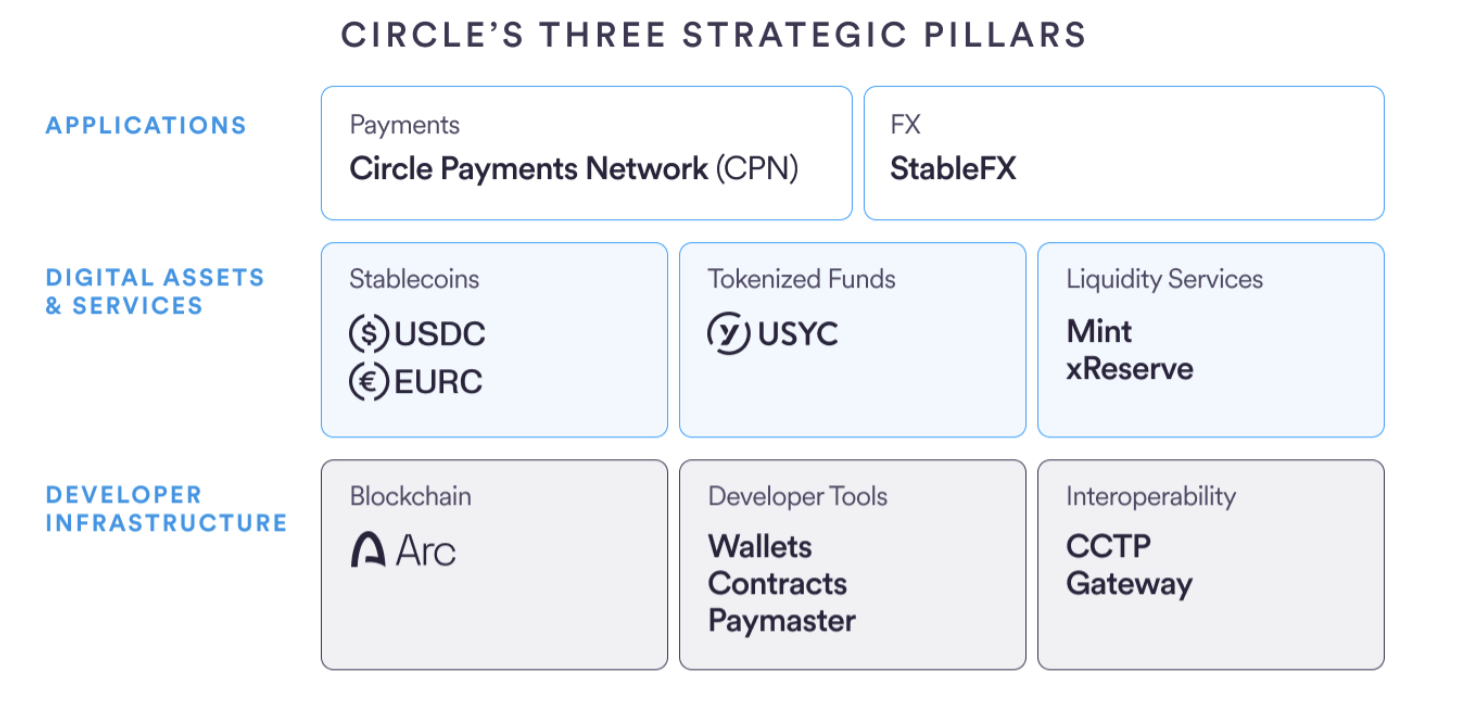
In terms of assets, Circle's subsidiary includes USDC, EURC, and USYC. Among them, USDC's market capitalization increased from 44 billion US dollars at the beginning of the year to 77 billion US dollars, with on-chain transactions exceeding 50 trillion US dollars, with native support of 30 blockchains; EURC's market value rose from 70 million euros at the beginning of the year to more than 300 million euros, making it the largest euro stablecoin; and USYC's asset management scale increased to 1.54 billion US dollars, making it the second largest TMMF (tokenized money market fund) in the world.
Faced with the single risk of profit models, Circle began exploring diversified applications and services this year, and launched CPN, CCTP, Gateway, Circle xReserve, Mint, StableFX, Circle Wallets, etc. For example, the payment network CPN has more than 25 design partners, and can use stablecoins such as USDC and EURC to facilitate predictable, internet-native settlement without traditional intermediaries; CCTP enables users to transfer native USDC on 17 supported blockchains, which have processed more than 126 billion US dollars in cumulative transaction volume and more than 6 million cross-chain transfers; and Circle Wallets directly embed the USDC wallet into the application, supporting two modes of developer control and user control.
At the same time, Circle is targeting infrastructure. The L1 blockchain Arc launched this year aims to be an open, institutional-level native infrastructure for the Internet, tailored for lending, capital markets, foreign exchange, and payments, attracting more than 100 startup and design participants.
Currently, Circle's institutional and commercial adoption is accelerating, involving consumer banking, cross-border payments, payroll, small business finance, and remittance. Cooperating institutions include Intercontinental Exchange, Deutsche Börse, Visa, Mastercard, BlackRock, HSBC, Goldman Sachs, Nubank, Binance, etc. Additionally, Circle is developing an AI proxy economy to enable AI to own funds and pay for APIs, computing power, etc. through wallets and the Arc blockchain.
What is more worth mentioning is that Circle completed its IPO in June of this year. The market capitalization has now fallen back to 19.4 billion US dollars after reaching a maximum of 77 billion US dollars, and has received conditional approval from the US Monetary Supervisory Service (OCC) to establish a National Trust Bank, which will greatly enhance the security and regulatory compliance of USDC reserves.
Arbitrum: Institutions are fully on the chain, breaking 2.1 billion historical transactions
This year, the focus of Arbitrum's narrative is shifting to institutional-grade financial infrastructure. From powering the world's largest retail trading platform to settling tokenized funds from the world's largest asset management companies, Arbitrum says it has become the platform of choice for major global institutions.
Ecologically, Arbitrum is evolving into a huge economy, with more than 100 chains online or under development, including Ethereal Perps DEX, Zama, and Blackbird. At the same time, more than 1,000 projects are supported by Arbitrum, making it one of the top three public chains based on the number of agreements. Currently, the Arbitrum network has generated more than 600 million US dollars of ecosystem GDP, an increase of more than 30% over the previous year. Meanwhile, Arbitrum One surpassed 2.1 billion historical transactions in 2025, and the total guarantee value exceeded 20 billion US dollars. It is worth mentioning that it took less than a year to complete the second 1 billion transaction, while the first 1 billion transaction took 3 years.
In terms of stablecoins, the supply increased by 82% year on year, and the market capitalization reached more than 8 billion US dollars. For example, DRIP plans to boost stablecoin growth of more than 229% within a few months; in terms of RWA tokenization, the scale surpassed 1.1 billion US dollars in October, 18 times the same period in 2024. Cooperating institutions include Robinhood, Franklin Templeton, Blackrock, Spiko, etc.; active loans increased by 109% to 1.5 billion US dollars, of which new loan products from teams such as Fluid grew by more than 460 billion US dollars %
On the financial side, Arbitrum has demonstrated extremely high profit margins and diversified hematopoietic capabilities. The estimated gross profit for Q4 2025 is about 6.5 million US dollars (annualized about 26 million US dollars), an increase of more than 50% month-on-month, and gross margin of more than 90%. Meanwhile, revenue streams expanded from 2 last year to 4, such as Timeboost, which generated more than $5 million in revenue in the 7 months before launch. Additionally, Arbitrum has a large balance sheet and holds more than $150 million in non-native assets, including cash equivalents and ETH, laying the foundation for continued and strategic expansion of its ecosystem.
Looking ahead to 2026, Arbitrum aims to apply open programmable finance to the global economy. However, Arbitrum is still facing internal competition on the L2 circuit and token incentives and subsidies have raised questions about its ability to capture value.
Aave: The Year of Absolute Reign and the Troika
The Aave Protocol has become the largest and most liquid lending protocol ever, accounting for 59% of the DeFi lending market and covering 61% of all active DeFi loans. Right now, Aave is facing a battle for internal governance rights. (Related reading:The price of the currency fell, and the giant whale smashed the market and left the market. Looking at the difficult situation of DeFi governance from the Aave battle for power)
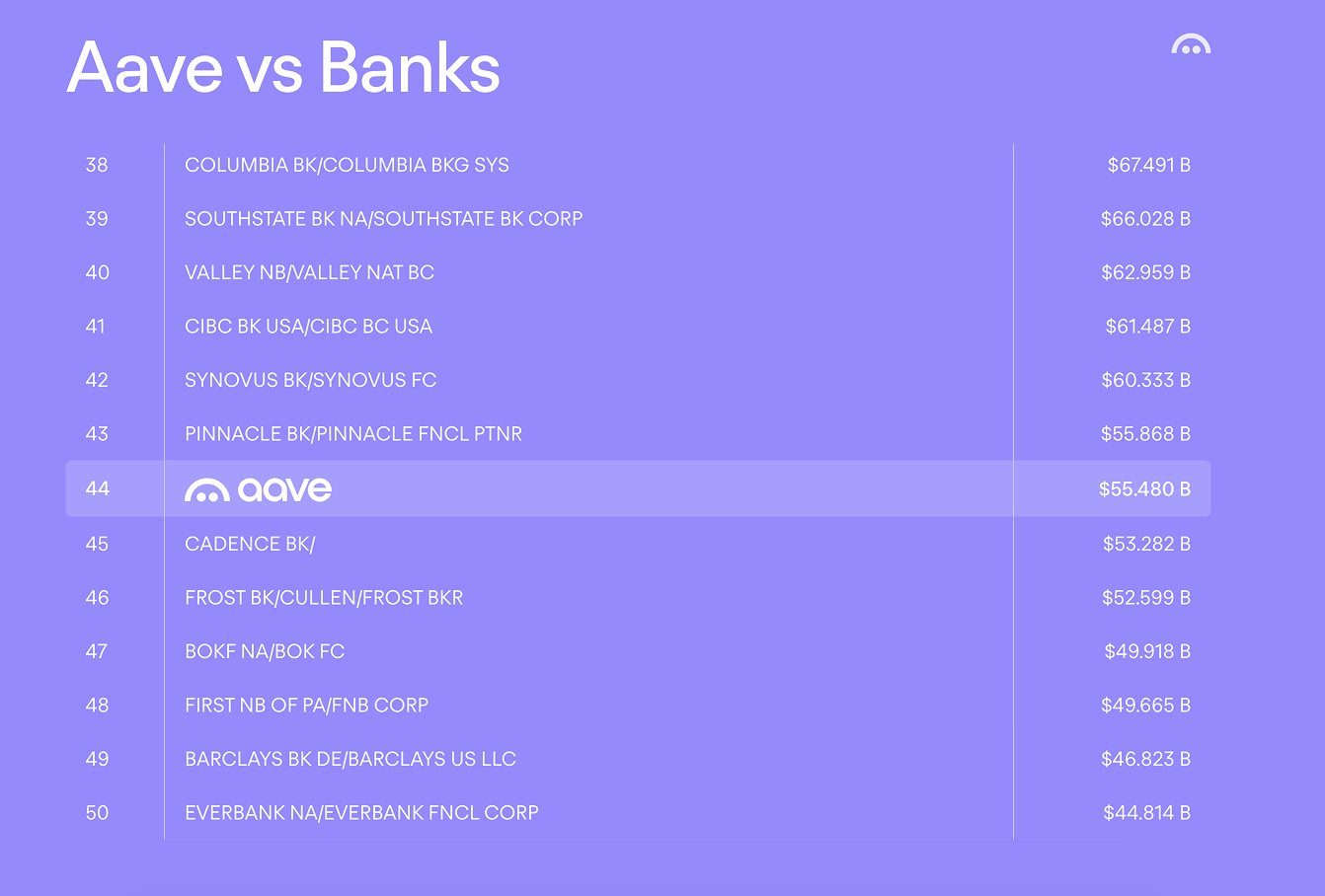
Over the past year, Aave has shown remarkable resilience and expansion capabilities, with all core metrics reaching record highs. In 2025, the peak net deposit surpassed 75 billion US dollars. Historically, it processed a total of 3.33 trillion US dollars in deposits and issued loans of nearly 1 trillion US dollars, which is comparable in size to the top 50 US banks. At the same time, Aave is currently the only agreement with a TVL exceeding 1 billion US dollars on all four different networks.
As a result, Aave has a strong hematopoietic ability. It generated $885 million in fees throughout the year, accounting for 52% of the costs of all loan agreements, which is more than the five competitors behind it combined. Strong cash flow directly supports large-scale AAVE token repurchase programs.
Looking ahead to 2026, Aave's strategy focuses on Aave V4, Horizon, and Aave App. Among them, Aave V4 uses the Hub & Spoke model to unify liquidity, which will allow Aave to handle trillions of dollars of assets, making it the first choice for any institution, fintech company, or enterprise seeking Aave's deep and reliable liquidity; Horizon is an RWA lending market for institutions, which aims to expand net deposits from US$550 million to over US$1 billion; the Aave App is a mobile portal for the public that can cover 70% of the global capital market, with the aim of driving millions of new users online.
Starknet: Year of execution, bets on BTCFi to attract $160 million
Starknet has supported $1.5 trillion in transactions and executed more than 1 billion transactions. However, this year, Starknet experienced many outages, which raised questions, and its high language threshold also caused that there is still a big gap between its ecosystem construction and the EVM compatibility chain.
Starknet says 2025 is the “year of execution,” and it has made significant progress in performance, decentralization, interoperability, BTCFi, privacy, and ecology.
In terms of performance, Starknet has implemented a number of key technologies, particularly the integration of v0.14.0 (Grinta) and S-two. Among them, v0.14.0 (Grinta) made Starknet the first Rollup driven by a centralized sequencer architecture and significantly improved the user and developer experience; the next-generation prover S-two means lower cost and faster, and the efficiency is 100 times higher than previous generation products (Stone). Currently, TPS capacity has increased to over 1,000, gas fees remain below $0.001, transaction delays have dropped from 2 seconds to 500 ms, and throughput recently peaked at 2,630 UOPS (user operations per second). The processing capacity is approaching the needs of Web2 giants such as Stripe or Nasdaq, and plans to increase the capacity to more than 10,000 TPS in the future.
In terms of the economic model, StarkNet introduced the STRK+BTC dual token security model. Bitcoin stakers can earn the governance token STRK, thereby improving economic security. In just three months, Starknet's BTC staking volume surpassed $160 million. Meanwhile, STRK's staking volume has doubled 11 times since the beginning of the year (1.1 billion cards), and the pledge rate has reached 23%.
In terms of interoperability, Starknet has made up for shortcomings in and out of capital, such as the launch of Circle CCTP and the native USDC to open up institutional funding channels; it will soon fully integrate LayerZero and Stargate, as well as integrate Near Intents to support the seamless exchange of more than 120 types of assets with STRK.
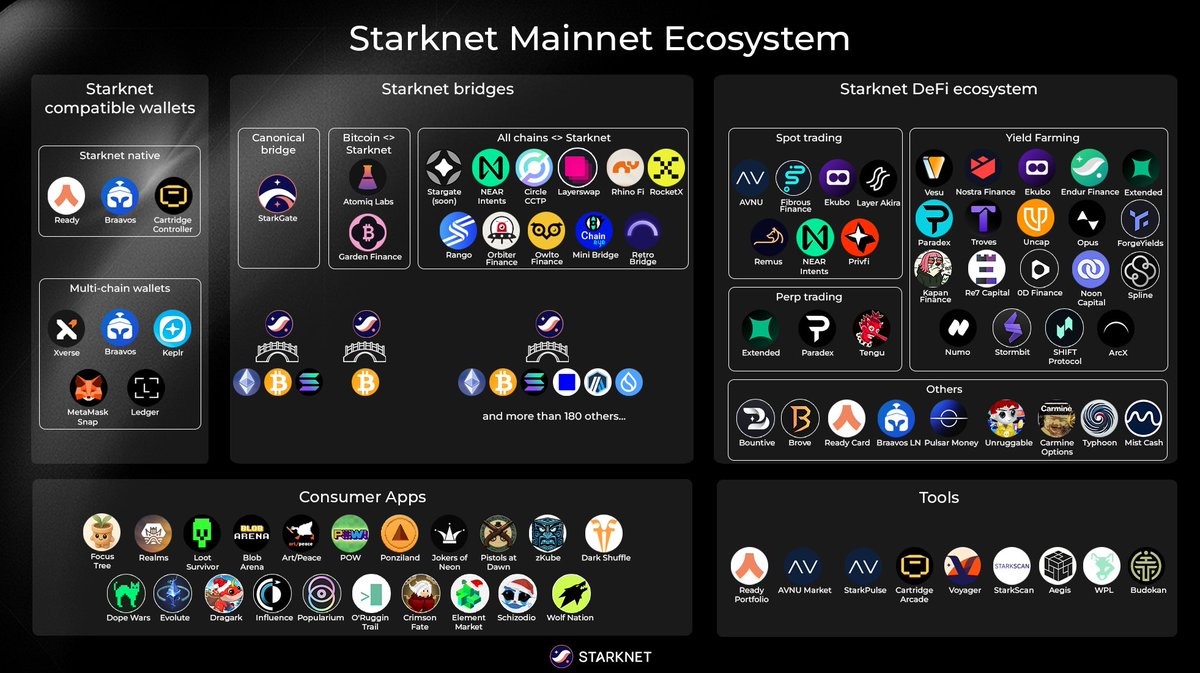
In terms of application implementation, around 50 new teams have joined Starknet's main network throughout the year, covering DeFi, payment, gaming, and consumer application tracks. For example, Perp DEX Extended, created by the former Revolut team, achieved a TVL breaking $100 million in 3 months; Ready launched to achieve a closed loop between on-chain USDC and real-life payments (Mastercard channels); full-chain games such as Realms and Blob Arena landed in mobile app stores, using account abstraction to achieve senseless interaction.
In terms of privacy, Starknet is promoting a “expand first, privacy later” strategy. Among them, Starknet-based L2 Ztarknet is an important proposal that brings scalability and programmability, and is a programmable layer for Zcash. Meanwhile, Starknet is building a complete privacy ecosystem, including core infrastructure, private payments, private transactions, privacy pools, new private banks, and data protection agreements.
In 2026, Starknet aims to further commercialize and scale. For example, the plan is to directly link network revenue to the value of STRK tokens; deepen the “Bitcoin smart contract layer” positioning, set a hard target of 10,000 BTC stakes and a STRK pledge rate of at least 35%; promote at least a 3-fold increase in the number of privacy products and launch exclusive products combining BTCFi+ privacy; and integrate EVM wallets to greatly improve distribution and user experience.
NEAR: Shard Scaling, Cross-Chain Execution, and Private AI
NEAR has gone through multiple bull-and-bear cycles, and many narrative adjustments have been made. This year, NEAR is driving its transformation into a common execution layer for cross-chain DeFi and proxy economies through the three key technologies of sharded blockchain infrastructure, intent-driven cross-chain execution, and hardware-supported private AI.
In terms of technical infrastructure, NEAR has achieved a qualitative leap in underlying technology, laying a solid foundation for carrying large-scale AI agents and high-frequency financial services. For example, NEAR achieved a public benchmark of 1 million TPS on consumer-grade hardware, and the throughput far exceeds that of traditional payment networks. At the same time, network performance was further optimized, and NEAR achieved final confirmation of 1.2 seconds and a block generation time of 600 ms, and has the ability to compete with traditional financial systems for settlement speed; NEAR has also launched a sharded smart contract on the main network, enhancing decentralization and execution capabilities.
NEAR Intents became the fastest growing cross-chain infrastructure this year, enabling universal execution from DeFi to AI markets through chain abstraction technology. The core data of Intents is also quite impressive. The total historical cross-chain transaction volume has exceeded 7 billion US dollars, and the cumulative number of exchanges has exceeded 13 million times; connected to more than 25 major blockchains, supporting one-click swaps and unified liquidity for more than 125 types of assets; and supporting more than 1.6 million independent users, making it a core hub connecting the multi-chain ecosystem.
NEAR AI has introduced a new category of privacy-first intelligence for enterprises and consumers. By supporting the deployment of models that encrypt user data from end to end, NEAR AI solves the data leakage problems faced by enterprises when using AI. Currently, deep cooperation has been reached with Brave Nightly, OpenMind, Travai, etc. Notably, the digital asset vault and confidential AI cloud platform SovereignAI received $120 million in Pipe investment and launched NEAR Digital Treasury.
In terms of the economic model, NEAR has completed a key halving upgrade, reducing the maximum annual inflation rate by 50%; the digital asset vault and confidential AI cloud platform SovereignAI received 120 million US dollars in PIPE investment and launched NEAR Digital Treasury; Bitwise also launched a pledged NEAR ETP and officially entered the asset allocation list of traditional financial institutions.
In terms of the developer ecosystem, NEAR developer resources grew significantly in 2025, covering seamless wallet entry innovation, multi-language support expansion, and tool chain improvement, providing a unified and convenient path for developers to build applications on NEAR.
Looking ahead to 2026, NEAR will aim to accelerate adoption and strengthen the token economy's ability to capture value. On the one hand, NEAR will deepen the adoption of intents, continue to expand the scope of integration and transaction volume, broaden distribution channels, and consolidate its position as a general executive layer for the entire chain. On the other hand, NEAR will accelerate the application of NEAR AI in actual scenarios and push the agency economy from concept to reality. Furthermore, Near has developed a new ecosystem sustainability framework, and plans to introduce fees generated by NEAR Intents into the community governance treasury, thereby directly enhancing the NEAR token's ability to capture value and aligning agreement revenue with the interests of token holders.
Celo: Rejecting empty talk, payments are emerging
Celo defines 2025 as a year that rejects empty talk, and has completed a number of key technology upgrades and ecological expansions this year, making positive progress in the field of real-world payments. However, Celo still has to face challenges such as a single distribution channel and heated competition.
This year, Celo made four hard forks, relinquished its independent L1 status, completed the migration to Ethereum L2, and further upgraded to ZK Rollup. Judging from the results orientation, this bold decision achieved good breakthroughs at both the technical and commercial levels. The data shows that its on-chain costs have been reduced by 99.8%, and on-chain revenue has increased tenfold.
In terms of user and transaction data, Celo's cumulative number of transactions surpassed the 1 billion mark, reaching 790,000 active users on the peak day, ranking first among all L2s. More importantly, of the 5.2 million new users added throughout the year, up to 79% were first-time users of the chain. This data side confirms that Celo's main increase was not due to the migration of existing users on the chain.
The core driver of this achievement is the MiniPay wallet, which is deeply linked to the Opera browser. By integrating Apple Pay with local payment systems in Nigeria, Brazil, etc., MiniPay delivered more than 11 million users to Celo this year, covering more than 60 countries around the world. This payment scenario based on actual demand has directly contributed to the explosion of the stablecoin business on the Celo chain. From the beginning of the year to date, its stablecoin transaction volume has exceeded 65.9 billion US dollars, an increase of 142% over the previous year. Among them, the peak number of USDT weekly active users exceeded 3.3 million, and the activity level even surpassed that of Tron.
In addition to the payment business, Celo also increased its infrastructure-level layout in 2025. For example, in terms of the identity layer, the explosion of Self Protocol and its support for Google Cloud and India's Aadhaar ID solved the problem of on-chain authentication, which is essential for the subsequent introduction of regulated financial services (RWA, unsecured loans); in terms of privacy, Celo's L3 test network Nightfall, cooperated with EY (EY) to solve the privacy pain points of enterprises when making payments and settlements on the public chain.
It is worth mentioning that in order to solve the problem of token price capture, Celo also proposed a restructuring of the token economy model in December, and plans to introduce destruction and repurchase mechanisms in an attempt to establish a healthier closed economic loop.
Looking ahead to 2026, Celo aims to make stablecoin payments as simple as native payments anywhere, and to make every effort to expand the “mini-app (mini-app)” economy while strengthening trust and security (identity and user protection) based on large-scale expansion.
Aptos: Optimizing performance and developer experience
This year, Aptos's smart contract programming language Move continues to advance aspects such as expressiveness, high performance, and security, with the aim of building a next-generation smart contract language. However, in the construction of a high-performance public chain circuit, Aptos has yet to be applied in a phenomenal manner, and the token is facing selling pressure from early institutions and teams.
On the language side, Move 2 continues to expand the expressive power of the language this year, including introducing higher-order functions and on-chain storage, signed integer types and details; in terms of performance, the Move technology stack has been optimized, including the Rest API, indexer, Move compiler, and Move VM. Next year, Move VM will be redesigned to improve parallelism, single-threaded performance, and security; in terms of developer experience, Aptos has made a number of major feature enhancements, including IDE support, transaction simulation sessions, new decompilers, and mutation tests.
Next year, Aptos plans to redesign the Move VM and execution stack to bring parallelism, single threading performance, and security to a new level, and make the development experience more mainstream and convenient by introducing the TypeScript framework.
Sui: Year of implementation of the technology stack
In 2025, Sui will move from a battle of speed to a full-stack platform. By providing a complete suite of technology, Sui Stack will solve the problems of computing, storage, privacy, identity, and mobility, so that developers no longer need to rely on centralized services. Sui also faces competition from high-performance chains, ecological and adoption challenges, and token unlocking pressure.
This year, Sui completed several key puzzles and achieved native interoperability:
Storage layer: Walrus's decentralized storage built for scale, integrity, and programmability allows large-scale data such as video, audio, and AI models to be stored inexpensively and in a decentralized manner. Walrus Sites, on the other hand, provides a model for hosting decentralized front-ends without relying on centralized hosting infrastructure.
Privacy and security layer: Seal brings programmable access control to the stack, allowing the construction of complex Web2-like permission management systems, all of which are verifiable on-chain, and will drive the entry of enterprise-grade applications.
Data layer: The verifiable computing layer Nautilus uses TEE (Trusted Execution Environment) for on-chain verification and off-chain computation, allowing applications to process heavy computational or private data without putting all the burden on the main chain while maintaining data verifiability.
Liquidity layer: DeepBook V3 becomes a liquidity infrastructure shared by the Sui ecosystem, supporting unlicensed liquidity pools and serving all DeFi applications.
Identity and governance: The identity and naming system SUInS was upgraded to infrastructure this year, and Move Registry (Sui's NPM package manager) was launched to make code packages human-readable.
Additionally, Sui has optimized the infrastructure and user experience. For example, Mysticeti v2 further improves the performance of the basic layer; PassKeys supports direct FaceID/fingerprint signature transactions without mnemonics; Slush Wallet & Enoki 2.0 allows users to use apps without being aware of the existence of blockchain, etc.
Sui's full-stack capabilities are driving the construction of more innovative applications, including cross-chain hubs, full-chain gaming, full-chain finance, and AI payments. At the same time, Sui is also accelerating its entry into mainstream markets, including Canary, 21Shares, and Grayscale, which have submitted spot ETF applications; included in the Bitwise 10 Index; and NASDAQ listed leveraged SUI ETFs.
Looking back at the tail of 2025, Sui said the foundation has been built, and the next development will depend on how the community chooses to build on it.
Hedera: Targeting AI and tokenization to reshape brands and architectures
If previous years were to prove that public distributed ledger technology (DLT) can handle actual commercial workloads, Hedera believes 2025 has proven to be a layer of trust that institutions can trust. However, its development is still being questioned by centralized governance and problems such as the relatively weak ecology due to fierce competition in the public chain market.
In the field of tokenization, Hedera showcased a shift from theory to practice. For example, the tokenized shares of money market funds and UK treasury bonds issued by Archax on Hedera are used as collateral for foreign exchange transactions between Lloyds Bank Group and Aberdeen; Canary HBAR ETF (HBR) was listed on the NASDAQ Stock Exchange in October 2025; the Australian digital dollar was launched on Hedera using Stablecoin Studio; the Hedera Foundation invested in Fidelity International MMF tokens issued by Archax on Hedera chemical products, etc.
On the AI circuit, Hedera entered the verifiability segment, including launching AI Studio, an open source modular toolkit, and collaborating with Accenture and EQTY Labs to create verifiable AI governance solutions.
On the architecture side, Hedera launched HashSphere in 2025, which allows organizations to deploy private licensing networks while simultaneously settling and interoperating through the Hedera main network to meet the privacy requirements of regulators and the public's need for transparency. For example, the Bank of Australia (RBA)'s Project Acacia and the Qatar Financial Center project all adopted this model.
In terms of internal governance and structure, Hedera has completed a remodeling. For example, the HBAR Foundation was transformed into the Hedera Foundation, which established a closer and more consistent brand system; partners such as Arrow Electronics and Repsol joined the board and launched the Hedera Enterprise Application Team (HEAT); in 2025 Hedera also launched multiple builder tools to lower the developer threshold and held multiple hackathons.
Additionally, Hedera received the attention of the government and regulators in 2025. For example, the Wyoming Frontier Stablecoin (FRNT) chose Hedera as the first US state candidate blockchain to issue a stablecoin; the Bank of England and Bank for International Settlements (BIS) Innovation Center DLT Challenge chose Hedera as one of only two L1 networks.
Hedera said bluntly that 2026 will no longer be about starting a new story, but rather expanding the story that began in 2025.
zkSync: ZK Technology Moves Towards Production-Level Deployment
Looking back at 2025, zkSync is driving ZK technology towards production-level deployment. However, it is still facing multiple challenges such as a crisis of community trust caused by the airdrop crisis, uneven project quality within the ecosystem, and increasingly fierce competitive pressure on technology.
zkSync achieved three major breakthroughs in technology and products this year: in terms of privacy products, zkSync launched Prividium, which enables institutions to run private systems and natively connect to Ethereum under the premise of complying with regulations; in terms of liquidity interoperability, L1 Interop has achieved bridgeless and native interconnection aspects of ZK Chain and Ethereum liquidity (such as Aave), establishing a new model of “private system+public market”; in terms of performance, through Atlas upgrades and Airbender technology, it has greatly improved proof speed and reduced costs and reshaping ZK's performance standards have been met.
In terms of ecological expansion, zkSync has completed a number of heavyweight collaborations, covering fields such as finance and consumption, including UBS (UBS), Deutsche Bank, Abstract, Sophon, etc. At the same time, zkSync launched zkSync Managed Services, a managed service to provide enterprises with production-level infrastructure support and lower the deployment threshold.
At the same time, zkSync made strategic upgrades to the token and brand. Among them, the ZK token changed from simple governance to utility, clarifying interoperability and off-chain licensing as core pillars of value capture; the brand was also repositioned as an “immutable financial infrastructure.”
As regulators such as the SEC begin to acknowledge the role of ZK technology in promoting compliance, zkSync said it will increase construction in 2026 using a unified architecture for privacy, performance, and public mobility access.
LayerZero: Over $50 billion in asset adoption, interoperability in action
In 2025, LayerZero is accelerating its evolution from a cross-chain tool to the underlying operating system in the crypto world. This means that the main challenge is how to achieve efficient cross-chain interoperability while ensuring security, and how to develop an effective economic model.
Currently, LayerZero has three technical pillars:
OFT standard: Allows tokens to be issued and transferred on more than 150 blockchains, maintains uniform supply and contract addresses, enables zero-slippage transfers (only gas fees), and eliminates the risk of double payments. Currently, more than $50 billion of assets (such as USDT, PYUSD, WBTC, etc.) use this standard. Publishers no longer need to develop each chain separately, but use it as a distribution channel. For example, Ondo Finance tokenized more than 100 stocks using OFT standards, and 61% of stablecoins moved through LayerZero; Pengu expanded to Solana, Abstract, and Hyperliquid through OFT standards.
Decentralized authenticator network DVN: Applications can independently choose who will verify cross-chain messages, such as Google Cloud, Polyhedra, or run their own verification nodes. Security is no longer one-size-fits-all; it's configurable, programmable, and immutable. The app has full sovereignty over its security.
Full chain message and data OApp & LZRead: supports sending arbitrary data (messages) across chains and pull/reading data from multiple chains. In addition to transfers, it can also implement cross-chain governance, complex DeFi logic (such as EtherFi cross-chain staking), authentication, etc.
Currently, the three major practical areas of LayerZero interoperability are: new chains, which solve early liquidity cold start problems and share users and liquidity through interconnection; institutional tokenization, such as PayPal (PYUSD), BlackRock (USDTB), and Ondo Finance, use LayerZero to issue stablecoins and tokenized assets on multiple chains; providing AI agents with tools to “read and write” full-chain data on their own, enabling AI to independently carry out complex cross-chain arbitrage, payments, and Asset rebalancing.
According to LayerZero's outlook, the end is to be as invisible as the Internet's TCP/IP protocol: critical, but invisible. The foundation is in place, and a truly global, open, and programmable financial system that surpasses any single blockchain is accelerating. The goal is to drive the explosion of the Internet-scale cryptography sector.
Twitter:https://twitter.com/BitpushNewsCN
Compare the TG exchange group:https://t.me/BitPushCommunity
Compare TG subscriptions:https://t.me/bitpush
