


From Selling Stuff BTC to Binance Storm Center: CZ's Complete Record of Ups and Downs
Organize & compile:One fish CoolFish
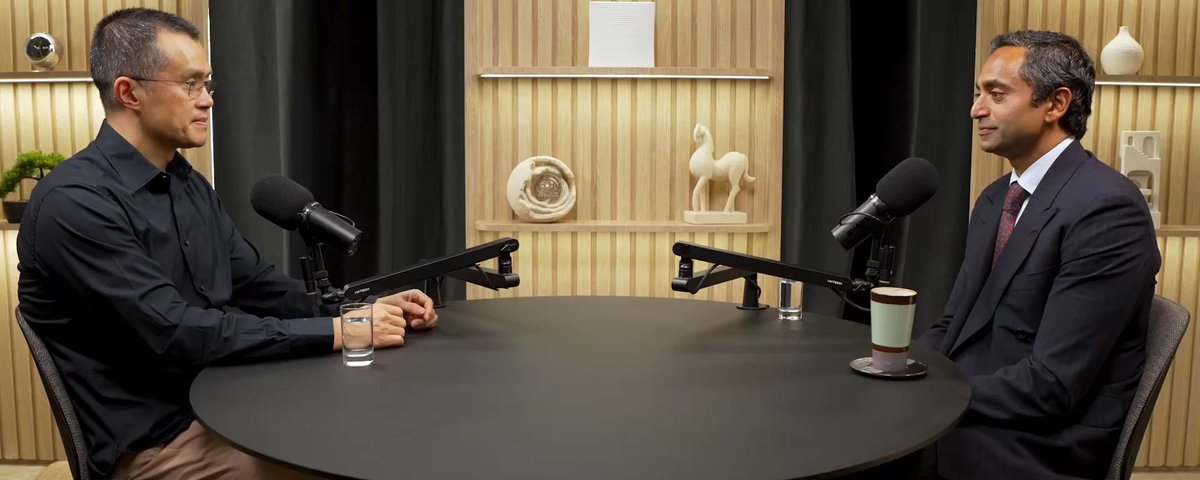
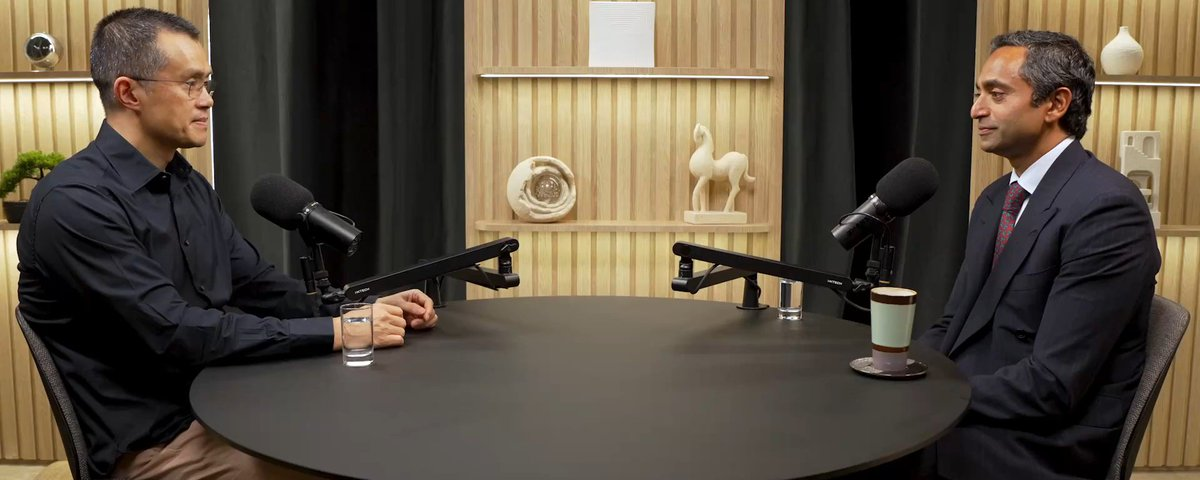
Guest: CZ (Zhao Changpeng@cz_binance)
Presenter: Chamath Palihapitiya (@chamath)
Podcast: All In Podcast (@theallinpod)
Original title: CZ's Untold Story: The Rise, Fall, and Redemption of Binance's Founder
Air Date: February 10, 2026
Summary of key points
In this episode of the All In Podcast, Binance founder CZ dives into his personal growth journey, his entrepreneurial path from working part-time at McDonald's to founding the world's largest cryptocurrency exchange, and the valuable lessons he learned while facing challenges. He also shared his vision for the future of cryptocurrencies and his deep insight into success, wealth, and the meaning of life.
Summary of exciting ideas
Early experience and education: CZ spent her teenage years in Canada, working part-time at McDonald's, then studying computer science at McGill University and working in financial transaction system development in Tokyo and New York.
All-in cryptocurrency: After coming into contact with Bitcoin in 2013, CZ firmly believed in its potential, sold Shanghai apartments, and wholeheartedly invested in the crypto industry, holding firm even in a bear market.
Entrepreneurship and challenges: The experience of founding Binance was challenging, and he emphasized the importance of resilience, adaptability, ability to handle uncertainty, and adherence to principles.
Definition of success: Success is more than money; it includes health, family, freedom of time, values, contributions, and a positive impact on the world. Money is only one dimension of happiness. After reaching a certain level, more money does not bring more happiness.
Life advice: You can't be too stupid, but you don't need to be particularly smart. There are many other factors, such as principles, values, emotional intelligence, etc., that are just as important. The only thing you can do is change yourself. Just break through a little bit every day to keep yourself in the 120%, 110%, and 130% state ranges. If you keep up for 30 years and have good luck, you're likely to be quite successful.
...
1. From China to Canada
Chamath: CZ, welcome to the All In podcast. I wanted to go back to the beginning because I think a lot of people don't know your background as they should. One thing I'm very concerned about is that your early years growing up in Canada were very similar to mine. You used to work at McDonald's, and I'm at Burger King. But before that, your parents immigrated from China around 1989. How did that happen?
CZ: My dad actually went to Canada to study back in 1984. He usually comes back to see us twice a year, but he's in Canada most of the time.
He was a professor at the time. He first went to the University of Toronto as an exchange student and then transferred to the University of British Columbia (UBC) in Vancouver a few years later. We were applying for immigration at the time. In those days, getting a passport was actually very difficult; it usually took three to four years. We started applying around 1985, and it took us about two or three years to get a passport.
Chamath: You mean a Chinese passport?
CZ: Yes, a Chinese passport. Once you get a passport, it will take a few more years to get a visa. The process was just that long at the time. After 1989, getting a visa became easier. But the hardest part is always the passport, and after that, it's hard for the government to issue a new one. But we're very lucky because we got our passports before. So after that, with the relaxation of the visa policy, we successfully obtained a visa. I remember very well that my mother took me to the US Consulate to line up — either the US Consulate was handling Canadian affairs at the time, or they were working together.
It was August 6, 1989, and we lined up for three full days outside the U.S. Consulate. We even camped there to line up, and we had to rotate people every three hours. My mom, my sister, and I took turns lining up. It was the kind of long line that couldn't be seen at a glance.
Chamath: You were only 12 years old at the time. Did those events and discussions shape your worldview to some extent?
CZ: Honestly, on a conscious level, it probably wasn't there at that moment. But I was living on a university campus (China University of Science and Technology), which was one of the top four universities in China. I'm surrounded by college students who are seven, eight, or nine years older than me, and I often hear them discuss all kinds of things. Although I'm only 12 years old and not deeply involved, these voices definitely left a mark on my unconscious mind.
Chamath: What was it like to move to Vancouver? Were you able to speak English at the time?
CZ: Vancouver is amazing; it's a completely different world for me. A brand new country, full of green meadows, extremely open spaces, a very high standard of living, and even the fruits seem fuller. I spent two years studying English in high school, but at the time I wasn't fluent at all, so I hardly spoke it.

Chamath: How were your parents working at the time? Have they had a hard time?
CZ: My dad was a PhD student at the time, and he had a monthly stipend of about $1,000. We were living in low-rent faculty and staff housing provided by UBC for students with families at the time. It was a very small apartment with only 2 bedrooms. My mother used to be a math and history teacher in China, but on the third day she arrived in Canada, she went to work as a sewing worker in a garment factory because she didn't understand the language. She worked there for a long time, about seven to ten years, and always received the minimum wage.
Chamath: That sounds exactly like the situation my family was in back then. I got my first job when I was 14, are you too?
CZ: Yes, I started working at McDonald's when I was 14 or 15. I remember very well that the minimum wage in Vancouver was $6 at the time, but McDonald's had a special exemption for hiring young people; they only had to pay $4.5. I applied for it on my 14th birthday, and a week later I started cooking burgers in the back kitchen. It was the first time in my life that I earned money.
2. CZ's Early Career: Surprisingly Ordinary
Chamath: Aren't you the kind of precocious tech genius who spent the whole day studying computer science in programming? Or are you the only one?
CZ: No, I wouldn't describe myself that way. I consider myself a technical guy; I study computer science. I was interested in programming when I was in high school, but I'm not that kind of programming genius, I'm not really a genius programmer. I think I'm a good programmer, and I've written some good code in my career. Around the age of 28 to 30, I moved away from pure code work and started doing more business development, sales, etc. That took about eight years of my career.
Chamath: So you're just an ordinary immigrant kid trying to get used to Canada. Do you have many friends?
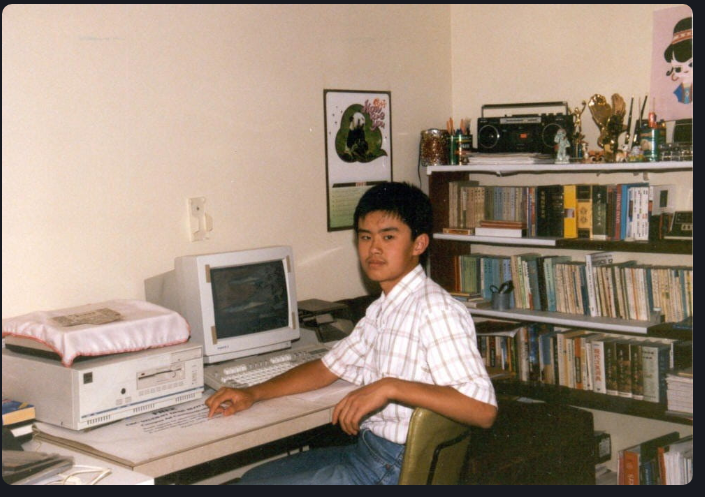
CZ: Yes, I have lots of friends.
Chamath: Are there only Asian friends?
CZ: Yes, both Asian and non-Asian friends. Actually, at our school, most Asians only play with Asians, but I'm an exception. I also have white friends, and I have all kinds of friends. My teenage years in Canada were amazing. Those were the best years of my life, and I think those years really shaped me and made me a happy person. I'm usually a happy person.
Chamath: How did you feel when you didn't get into the University of Waterloo and had to “succumb” to McGill? Does that make you think you're stupid?
CZ: Actually, my sister went to Waterloo. I was torn between Waterloo and McGill at the time, but I knew I didn't want to stay in Vancouver at UBC; I wanted to go to a different city. UBC actually gave me an acceptance letter, but I just knew I didn't want to go there. The mother of a friend I respected at the time suggested to me that you might want to become a doctor because of the doctor's good life and high social status. I took her advice and went to biology, and Waterloo isn't the kind of school that specializes in biology.
So I went to McGill. But after a semester, I decided: No, biology isn't for me. I want to switch to computer science
Chamath: Is your college life typical? Will you be looking for a great job during the summer, or just an ordinary college student? By the way, how do you pay for tuition?
CZ: I work part-time every summer. I work part-time during the summer, and I also work part-time during the semester. So I'm not in debt, and I insist that I can't get into debt when I graduate. I took about 6000 Canadian dollars from my dad the first year, and the second year was still a little short; my sister gave me 3000. Since then, I haven't taken any money from my family, am completely self-sufficient, and had no student loans when I graduated. I'm very lucky, but I do work every summer.
Chamath: Did you graduate from McGill's computer department?
CZ: Actually, I didn't graduate from McGill. I read there for four years. I got an internship opportunity in my junior year, and got another one in my senior year, and then the internship period continued to be extended, extended, and extended. I never went back to McGill. I later discovered that applying for a Japanese work visa required a bachelor's degree. It was 2000, at the peak of the internet bubble. So I participated in an online education program called the American College of Computer Science and got my degree there. So technically speaking, I'm a graduate of that school.
Chamath: Which internship did you start working there for a long time?
CZ: My internship was in Tokyo. I've been programming since college, and I've written simulation software for a company called OriginalSim. In my junior year, I joined a company called Fusion Systems Japan in Tokyo, Japan. They are developing Order Execution Systems (Order Execution Systems) for Tokyo Stock Exchange brokers.
Chamath: Is that a Japanese company with an office in Canada?
CZ: No, I went to Tokyo. It was actually a company founded by a group of Americans in Tokyo.
Chamath: What you were thinking at the time was that it was an adventure; I was going to Tokyo for a summer.
CZ: Yes, I was a college student at the time, and living in Tokyo was like a dream. It was fun, and Tokyo felt like I came from the future.
Chamath: What kind of software do you write?
CZ: Mainly order execution software. In other words, software that transfers orders and drives transactions. It's basically in line with the style of software that drives Binance's operation today. In fact, all software development I'm involved in doesn't involve decision-making.
Chamath: So when you first came into contact, didn't you feel like “wow, this is so cool, this is so interesting”? Or is it more like “OK, the company made me write this code, I understand the principle, then just do it”? Are you attracted to this field, or is it simply because of the needs of the job?
CZ: At first it was just a job requirement. I was too young at the time, and I didn't understand the differences in all walks of life at the time. The project assigned by the company after joining the company was to develop a digital image storage system — not an iPhone album, but Nikon's medical imaging system. However, it was soon discovered that the company's core product was actually an order execution system.
I participated in this project, and it later became the mainline of my career. I love this field because it requires a deep technical background. Everything revolves around efficiency — the pursuit of extreme speed and minimum latency. This pursuit is deeply appealing to me, and efficiency is a driving force in my subconscious mind.
Chamath: In high-frequency trading, how is this pursuit of low latency reflected in the code?
CZ: There are a few levels. The first layer is to make the software itself efficient and fast, remove all database queries, and complete them all in memory. It also reduces any kind of additional computation and streamlines risk checks. More advanced ones use network chip cards such as FPGAs, so round trip latency can be reduced from 100 microseconds to 20 microseconds without having to go through a processor.
Chamath: The company you work for in Japan, was it successful?
CZ: It worked. That company was bought by a NASDAQ listed company 2000 years ago. The amount is about 52 million US dollars, which is quite impressive.
Chamath: So, did you realise then — wait, there's an opportunity here? Or is there something else going on?
CZ: No, I was too young at the time. I was only in my early twenties. According to Japan, I was an “office worker.” After that company was bought, there was a serious cultural conflict between the parent company and the original company. This is the first time I've experienced that mergers and acquisitions may not always be successful. The management of the two companies clashed constantly. These partners later set up a new stove and founded Building 2. However, I didn't get a penny this time, but the other partners made quite a bit of money. They rented a luxury office, and as a result, the company went out of business after only one year. This shows that past success is no guarantee of future success. In fact, they spent huge sums of money to build luxury offices without any source of revenue. The company eventually went out of business in 2001.
3. The first company in Shanghai
CZ: At the beginning of 2001, I was looking for a new job. Bloomberg was hiring at the time, and this happened before 9/11. I actually received my job offer before 9/11. I was still in Tokyo at the time, and Bloomberg was in New York. After 911 happened, I called and asked: Is the job still there? Do you guys still want me to go? They said, “Do you still want to come? I said, “I want to. So I went to New York in November 2001. I worked there for 4 years and still do the same thing.
I joined as a senior developer and was assigned to a team called Tradebook Futures. The team was just formed, and they developed a system that allows users to trade futures on Bloomberg terminals. However, previously these functions were scattered across different systems, and later integrated into this team.
Chamath: What were you looking for at the time? stability? Why Bloomberg? Is it because of New York or what?
CZ: I was just a young man at the time, probably 24 or 25 years old. I want to experience different fields and explore the direction of life. I know I'm inexperienced and can't start my own business. At the time, I was working for a small company in Tokyo with only about 200 people. And Bloomberg had 3,000 people at the time. It's already a big business for me. The company has various benefits such as luxury offices, fish tanks, free meals, etc. I joined as a senior developer, met several excellent bosses, and was promoted three times in two years. I initially led a team of 60 people, then expanded the team to around 80 people, and I began a management position. I stopped writing code and started managing.
Chamath: Then you quit your job and went to China? How did it happen?
CZ:: At the beginning of 2005, friends I met in Japan wanted to start a new fintech company. They were in Asia at the time and discussed Tokyo, Shanghai, or Hong Kong. They say Shanghai is likely to be the most active place for fintech in the future. We should have chosen Hong Kong; Hong Kong was indeed more lively later. A total of six of us went to Shanghai. Four white people, one Japanese, and me. I'm the only one who can speak Chinese.
Chamath: What are your thoughts?
CZ: Our idea is to bring Wall Street trading technology to China to serve Chinese brokers and exchanges.
Chamath: So when you started your company — this was your first startup. Did you guys have a “OK, it's done” attitude at the time?
CZ: That's basically it.
Chamath: Did you consider allocating shares at the time? For example, questions such as the shareholding structure list? Or do you just think “great, act now”? What is the actual situation?
CZ: Actually, not one-sixth. At the time, the core members held about 39% or 40% of the shares, and the remaining five people shared equally. So at the time, I had only 11% of the shares. I had no idea, and I couldn't figure out the difference between common stock and preferred stock. But that's how it went, and I was the team's junior partner at the time. After arriving in China, I began to approach potential customers — after all, I can speak Chinese, so I started negotiations with potential customers. I went to a broker and found out later that we had registered a Wholly Foreign-Owned Enterprise (WFOE), and Chinese financial institutions were not allowed to cooperate with wholly foreign-owned enterprises at the time.
We only discovered this situation after starting our company in Shanghai, so the company transformed to provide any company with any IT system and do anything. We initially had quite a few customers in the automotive industry: Shanghai GM, Shanghai Volkswagen, and SAIC Motor Group were all our customers. After about three or four years, we set up an office in Hong Kong and began serving financial institutions such as Morgan Stanley, Deutsche Bank, and Credit Suisse. This is how the company grew in size. The company had reached the size of 200 people, and it was still very stable when I left. I worked there for eight years until I left in 2013.
Chamath: As a junior partner, do you pay direct dividends?
CZ: Yes. However, there aren't many actual dividends. I have invested most of my savings back into the company, and not a single penny has been repaid. However, after the company stabilized a few years later, the partner's salary was enough for the children to attend international schools, and we all received a six-figure annual salary.
4. Discover Bitcoin
Chamath: These experiences so far don't suggest that you're going to start Binance.
CZ: Absolutely not. I didn't even know it myself at the time.
Chamath: So how old were you in 2013 and 2014?
CZ: I was 36 in 2013
Chamath: So, you're still a salaried office worker, a junior partner on that project, everything is going well, and the kids are attending private schools. So what happened next?
CZ: Then I came into contact with Bitcoin. A friend of mine told me, “CZ, you have to look at this thing called Bitcoin.” I started looking into it, and it took me about six months to fully understand it. That started around July 2013.
Chamath: Is that because you read the white paper and thought “I have to read it again, read it again”, or something else?
CZ: That's pretty much it. Also, there was Bitcoin Talk (Bitcoin Talk) at the time. It's basically through these.
Chamath: Is that friend who showed you Bitcoin your colleague or a random friend you met in Shanghai?
CZ: It's a friend. We have no business dealings. His name is Ron Cao. I'm guessing he now runs Sky9 Capital (Sky9 Capital), where he was the managing director of Lightspeed Ventures (Lightspeed Ventures) in China.

Ron Cao
We have a private poker game where everyone doesn't play very much. A group of struggling entrepreneurs play against venture capital. VCs have money and time. This is a really fun game. In a hand game, Ron Cao said, “CZ, you should look at this thing called Bitcoin.” I said, “OK, Bitcoin,” so we chatted for a while.
Bobby Lee (Bobby Lee) was also present at the time. He was working at Walmart at the time and was about to resign as CEO of BTC China (Bitcoin China). As part of that deal, Li Qiyuan invited Ron Cao to invest as a representative of Lightspeed Venture Capital. That was in July 2013. I thought to myself, it seems like these two are very serious about Bitcoin.
CZ: I had lunch with Li Qiyuan the next day. He said, “Put 10% of your net worth into Bitcoin. Although there is a small chance that it will return to zero, then you will lose 10%; but the more likely probability is that it will increase tenfold, doubling your net worth.” I thought, “Sounds pretty reliable.” So I began to carefully study the white paper, which took a full half year. It wasn't until the end of 2013 that I really made up my mind to get in. But that's when the price of Bitcoin soared from $70 in mid-2013 to $1,000 at the end of 2013. It has increased more than 15 times.
Chamath: How did you feel at the time?
CZ: I think I came too late. I thought, “I really wish I could get in early.” But the truth is, no matter when you enter the Bitcoin space, you always feel like you're late. Because every industry insider you talk to bought in earlier than you did.
Chamath: While you were studying it, did you interact with the Shanghai community?
CZ: Shanghai had a very small circle at the time. Basically, I was willing to talk to anyone in the world who was interested in Bitcoin at the time. I have a few friends in Taiwan. They worked for TSMC at the time, then quit their jobs to try out Bitcoin mining chips. Although that startup project didn't work, they were a group of people I was communicating with at the time.
There is another group of people, mostly miners. There is a person called “Kamiyu”. He is very famous in China and is a big miner. He still runs F2Pool (Fish Pond) to this day. They are often in Hangzhou and Shanghai to communicate with me.
CZ: One of the most important things was the Bitcoin conference in Las Vegas around December 2013. I flew there to meet everyone. At the time, all the industry's elites were present; there were about 200 people. Vitalik (founder of Ethereum) is there, as are Matt Roszak and Charlie Lee (Charlie Lee, founder of Litecoin). They're still in this group today.
It coincided with the arrest of “Silk Road” founder Ross Ulbricht (Ross Ulbricht). The media is raving that Bitcoin is just a tool used by drug lords. But when you go to that conference, you see a bunch of young people, a bunch of geeks. They are all very nice people, like you can communicate with Vitalik, he is very easy-going.
Chamath: When you did all this, were you still working part-time at your old company?
CZ: Yes, that was in the final stages.
Chamath: You can tell your partner, “Hey guys, I'm going to Vegas for a few days and coming back soon.”
CZ: That's basically it. When I got back, I said to my partners, “We should make a Bitcoin payment system.” Because BitPay was a big player in the industry at the time, they just raised $4 million in 2013.
Chamath: So you wanted to make a Chinese version of BitPay. Your partner must be thinking, “What nonsense are you talking about?” At that point, you still haven't bought any bitcoins?
CZ: I didn't buy it. At that time, I probably only had 1 bitcoin. At the time, it was worth 1000 dollars.
Chapter 5: Desperate to Invest in Cryptocurrency
Chamath: So, what happened next?
CZ: So I told my partner that I think this is the biggest opportunity I've ever faced in my life. At the time, I realized that I had encountered two fundamental technologies in my life: the first was the internet, when I was too young to participate much; the second was Bitcoin. I was 35 or 36 at the time and I didn't want to miss it. I think it might take 15 years for this kind of opportunity to reappear, which is the current AI. So for me, the goal is very clear: I have to do something in this industry.
I told my partner I wanted to quit my job and work in the Bitcoin industry. I also need to buy bitcoin, but I don't have much cash. So I said, “I'm going to sell my apartment in Shanghai and buy them all for Bitcoin.” Selling the house took months.
Chamath: So after you sold your house, did you rent a house?
CZ: I sold my house at the time, and my family moved back to Tokyo. We are renting a house in Tokyo, and I am often on business trips in Shanghai, which is also when I started to separate from my family. That home sold for about $900,000, close to $1 million. The room payment is paid in installments, and I buy one for every time I get paid. The first purchase price was $800, then the price of Bitcoin dropped over and over again, falling to $600 or $400. My average purchase cost was about $600.
Chamath: Unbelievable. So now you have a Bitcoin position, but you still don't have a job
CZ: Actually, I was also looking for a job at the time, and my goals were very clear; I was only looking for jobs in the Bitcoin industry. It was probably only two or three weeks between when I quit my job and finalized my job.
Chamath: Who hired you?
CZ: I first talked about it with Bobby Lee (Bobby Lee). He wants to hire me. But then Blockchain.info appeared, and Roger Ver introduced me to them. I'm the 3rd member of the Blockchain.info team. The top two members at the time were founder Ben Reeves and newly hired CEO Nicholas Carey. Since Ben wanted to keep his CTO title, my position was Vice President of Engineering. I joined them and flew to York (York), three hours north of London, for a while to figure out what to do.
Chamath: Is it going well?
CZ: It didn't go very well. We've expanded our team to 18 people. Peter Smith later joined as CFO looking for financing. At the time, Coinbase had just closed a $30 million funding round, which was big news at the time. Peter Smith later managed to become CEO and promoted Nicholas Carey to the position of product manager. The company culture changed, so I quit my job, and so did many of the developers I hired. Ben Reeves sold most of his shares and left after a few months. I only stayed there for six or seven months, and although the results were not ideal, I learned a lot.
CZ: For example, Ben Reeves said we don't need a company, we don't need an office, we all work remotely, and we all pay our wages in Bitcoin. I later applied these experiences to Binance in depth. I also learned guerrilla marketing. At the time, Blockchain.info was the industry's largest user platform, with 2 million wallets, more than Coinbase at the time. And all of their marketing efforts were a post on the BitcoinTalk.org forum, and Ben Reeves responded to the user in that post. This made me realize that guerrilla marketing can also be hugely successful.
CZ: After I left, Ho Yi recruited me into OKCoin. Ho Yi said to me at the time, “Why are you working for a wallet company? Your experience should be handling order execution and exchanges”. So I joined OKCoin as CTO
Chamath: Was there competition back then?
CZ: In the process of starting my job, BTC China found me again. At the time, OKCoin gave me 5% of the shares, and Li Qiyuan offered 10%. As a result, OKCoin followed up on this offer within three hours. I finally decided to go to Beijing to join OKCoin. Ho Yi had only 1% of the shares at the time, and she invited me in as a higher-level partner. I've only been with OKCoin for about eight months, and it didn't last long.
Chamath: Why?
CZ: It's still a cultural difference; there are practices I don't agree with. For example, a simple promotion method: they advertise discounts on processing fees, but users must actively apply to enjoy them. This type of propaganda doesn't work for everyone, even though they do. Little issues like that.
6. Founding of Binance
Chamath: So how did we get from there to Binance?
CZ: In 2015, a few old colleagues wanted to set up a Bitcoin exchange in Tokyo because it was Mentougou (Mt. Gox) A year after it went out of business, there was a vacuum in the Japanese market. On the same day I decided to leave OKCoin, two developers came to me and said they had quit their jobs too. So the three of us decided to do something.
CZ: As CEO, I take a large share, be responsible for financing, and use my savings to pay them wages. I don't get a cent myself. We quickly made a demo, downloaded an open source exchange system, and slightly modified the UI.
Chamath: Are you directly forking open source projects? Is this Binance?
CZ: No, we didn't say it was Binance; this happened before Binance. I was transparent throughout the process and made it clear: This demo was kicked out in two days, and currently only shows a proof of concept, not the final product. That's it. At the time, we had a script to scrape Bitfinex's market data. Bitfinex was considered a major exchange at the time. We directly copied their order book. The order book flashes in real time to show transaction dynamics, and the demo effect is very vivid.
Investors were amazed: Wow, this technology is amazing. But it's not just a demo. When they ask questions, I can give in-depth answers. For example, if you ask me “how to build a high-speed exchange architecture”, I can explain in detail all the technical principles I've learned, such as memory matching and database recognition. So when I ask questions, I can analyze them thoroughly. My expertise is there. Right. They said at the time: “This technology is cool, but running a Bitcoin exchange in Japan won't work because you don't speak Japanese.” They suggested that I sell this set of technology to existing exchanges because many Japanese exchanges have bad technology.
Two weeks later, we signed a contract with an exchange, and they paid $180,000 upfront (total price 360,000). It finally freed me from having to pay my own salary. So we became a software service provider, or “Exchange as a Service” (SaaS)
Chamath: Many people think that great companies are born in an instant, but your story is more like a continuous run-in, learning, and experimentation. This kind of non-explicit iteration eventually led to results.
CZ: Yes, I think most people idealize the startup process. They hate the hardships, yet they yearn for the results, like the story of Facebook or Microsoft, where they dropped out of college to write code in their garage and then suddenly succeeded. However, in reality, the growth process of Binance or Tesla is also full of hardships. You have to try a myriad of different paths, and success doesn't start with an obvious direction. So I think those three are a special case; they have had a smooth journey since they were founded.
Chamath: So let's go back to the startup phase, you authorized the software
CZ: We did a good job in the software outsourcing business, signing up about 30 exchange clients in two years, a SaaS model with a very stable revenue. But in March 2017, the Chinese government shut down most of our customers. By May, we realized we had to transform.
CZ: At the end of May, three of my staff wanted to imitate a cryptocurrency trading platform. I saw a guy named Yang Linke at the time. He was a partner of Bitcoin China. He launched an ICO and raised $15 million in 10 days, and he only had one document and website at the time, not even a product. I think if he can do it, so can I.
CZ: We originally planned to go the venture capital route, but after seeing the ICO boom, I decided in mid-June: we will do ICO too. I went to the conference in mid-June 2017, and the whole audience was talking about ICOs. Everyone said to CZ: You have to do an ICO, you have to do an ICO. So in mid-June, specifically on June 14, I summoned the group team to decide to launch an ICO and start writing a white paper.
Chamath: Were you already a bit famous in the Bitcoin or cryptocurrency world at the time — whether in China, Japan, or elsewhere?
CZ: I do have some popularity. I was working at the Blockchain Information Network at the time, and many people knew me. That platform was the hottest at the time. During my time at OKCoin, I was the CTO, very active on social media, and was responsible for managing international operations in non-English/non-Chinese markets—after all, no one on the team spoke English better than me. So I'm really a bit famous in my circle.
Chamath: At the time, doing an ICO really required fame or background.
CZ: Exactly. But that's an advantage for early entrants — attend a few 200-person meetings, and people will know you the second time you attend. By the third time, everyone will say “Oh, you're an expert” and “you're already an industry veteran”.
Chamath: Who bought Binance's ICO?
CZ: To be honest, until today I didn't know who the exact buyer was. Judging from the distribution of users, 80% to 90% of ICO buyers are probably Chinese. There are also some international buyers involved. The data shows that about 20,000 people participated in the ICO
Chamath: So even if the Chinese exchange was banned, were ICOs still allowed at the time?
CZ: No, ICOs weren't banned back then. Let me be clear: the exchange clients we serve are mainly stamp trading platforms, not cryptocurrency exchanges. Cryptocurrency exchanges weren't banned in March; they were only suspended after we launched them.
Chamath: You're really a tightrope walker. How many shares in the company have you sold?
CZ: We just launched the BNB token and are not involved in equity distribution. There is no equity involved at all. We sold 60% of our tokens and raised around $15 million.
Chamath: What was the initial token economy model you designed for the BNB token?
CZ: We have proposed many solutions, but the most important one that can be implemented quickly is that users who hold BNB can enjoy a 50% discount on fees when trading on the Binance platform. But we also promise that BNB will eventually have an independent blockchain and decentralized ecosystem, and has planned three or four features.
Chamath: You must have been ecstatic at the time? Thought: Wow, we raised $15 million. Now we're going to launch an exchange. But by September, everything had changed, so what do you guys do?
CZ: Yes, on September 4, seven different departments of the Chinese government jointly issued a notice. The first rule is that China will no longer allow cryptocurrency exchanges, ICOs will no longer be allowed, and mining will not be allowed. We decided right away that we had to move our positions. Although the proportion of Chinese users was as high as 30% at the time, users from other regions of the world still accounted for 70%. After evaluation, we determined that even if we lost 30% of our users, we could still survive. In fact, we're surviving pretty well. Finally, we returned to Tokyo.
I know Japan, I know Tokyo. It wasn't an unfamiliar country for me. So I suggested, let's move to Tokyo. There were about 30 of us at the time, and they all moved out.
Chamath: When Binance first went live, it instantly became popular? Or is it necessary to spend effort to find a suitable point in the product market and rely on word of mouth from the first group of enthusiastic users? How did the spread of the virus begin? How exactly is liquidity established?
CZ: Binance's product itself developed quite well, but the token price dropped 30-40% from the ICO launch price, and it took three weeks to recover. The cryptocurrency market was still hot at the time, and there was a degree of product market compatibility — this was not a new concept; it was just a trading platform between cryptocurrencies.
Chamath: So ICOs are critical, right? Because holders will think: now that I have tokens, I can get a discount on processing fees. That's why I chose Binance. But is the platform architecture better? Are speed and stability significantly ahead?
CZ: When it went live at the time, you could clearly see that the speed of placing orders on Binance far surpassed that of competing platforms, and the performance of the exchange system was obvious.
Chamath: In 2017, who were your main competitors?
CZ: The biggest ones at the time were Polonex and Bittrex. There are also several Chinese platforms. At the time, there were Huobi, OKEx, and OKCoin. There is Coinbase in the Western market. Gemini was not established at the time; it only appeared later. Bitstamp and Bitfenix were also there at the time, but now they have both shrunk a lot
Chamath: You're now in your 40's. Binance is experiencing crazy growth. How did you internalize this success? You'll say to yourself, “What's going on? What happened?” This kind of thing?
CZ: Yes, there are some really surreal moments where you think “is this real?” For example, once I asked how much our income was, she reported a figure. I said, “This is crazy, we can't make this much money. Are you sure?” “I'm sure,” she said. I said, “This number is definitely wrong; we must be an order of magnitude behind.” Then we checked it over and over again two or three times, and the results were correct. That's crazy.
There is another period, in three weeks when the price of BNB rebounds. At the time, the issue price of BNB was around 10 cents, but at one point it dropped to 6 cents. Then we announced the addition of Ho Yi. Over the next two or three weeks, every time I woke up from bed, the token increased 20%; after a meeting, the token increased by another 20%; and even when I went back to the bathroom, it increased by 20%.
Chamath: That must have quickly dazed you: Wait, I'm suddenly rich?
CZ: This one actually came a little late. At the beginning of 2018, when Binance had been in operation for about seven or eight months, Forbes (Forbes) put me on its cover.
Chamath: How did they find you back then? Get you on the cover
CZ: Actually, I don't know. But at the time, “Forbes” was working on a cryptocurrency special, and they were already using Vitalik to make cool gestures. So they invited us and contacted the department responsible for PR — it was actually a team of four or five girls at the time. He said “Forbes” wants to do a special report and take photos; I think you should go. I was very resistant at the time, but they said we were a new brand. Forbes can also help us increase our brand awareness. I said OK, go, so I took pictures. It was the first set of photos in my life. Of course, someone applied makeup to me, my first time wearing makeup.
Chamath: So CZ, what is money? Is it important? What does money mean when you make big money in your 40s?
CZ: I think I was old enough at the time to experience a few things. First, I'm older. Over forty years old. Unlike young people in their early twenties, they run Lamborghinis and party all day long. I'm old and don't fit those. Also, I have a fairly stable personality, and I don't get overexcited about foreign things. One more thing (not a brag), I went from being barely financially free to being on the cover of Forbes.
At the time, I was like: Wait, how rich am I? I don't even know myself. There was no change in feeling when I opened my wallet. Forbes cover? Nothing changed for me. But people say, “Look, now you're probably a billionaire. I thought, “Do I really have a net worth of hundreds of millions? It doesn't feel like it.” Even a month ago, probably less than a month ago, when we left China for Japan, I booked economy class. But he said, “No, we should upgrade our business class so we can lie back and sleep.” I thought, “Well, that makes sense.” That's it.
That's why I have this habit. When you keep making money, say from 1 million to 10 million, you might want to buy a luxury car; when you reach 100 million, you might want to buy a yacht or something. But at the time of 1 billion — I haven't experienced that gradual process. I just went from being relatively OK to suddenly being on the cover of Forbes. Yachts and stuff. By the time of the billion — I haven't experienced this kind of stepped process. I jumped straight from a relatively normal life to being on the cover of Forbes. So I haven't developed much of that kind of spending habit.
Chamath: What does that mean now? Are you a billionaire or a 10 billionaire, what does all this mean?
CZ: I think money has two effects: First, take care of yourself and have food and shelter. This actually only requires a small amount of money. Really, it doesn't take much to satisfy these at all. People are often confused by complicated concepts, but life doesn't have to be luxurious. So I do own these, and I live a very comfortable life, although not luxurious.
Chamath: Sorry, what does that mean?
CZ: Look at my house, the living room leaks almost every month because the house is too old. But for now, this house is the right size for me. If water leaks, just fix it. This kind of thing is actually still happening; it was missed last month. People always think I live in a mansion, and there are even crazier ones. The house I live in is the right size to accommodate all members of the family. I bought a second-hand house. It's an old house that I've changed hands about three or four times, but the location is excellent, the size is just right, and it's fully functional, and it doesn't matter if things break once in a while.
Chamath: Do you think this is because they are pragmatic, or are they simply not motivated by appearance?
CZ: I only value features. Just the functionality is in place; don't want to be flashy, I don't care about the style. The color doesn't matter, and the shiny gold jewelry doesn't matter. As long as it's practical, that's fine.
Chamath: Are you suddenly uneasy?
CZ: Not at all. I know my weaknesses and learned to deal with them. I hope I'm not an arrogant person. I'm usually very calm and have very few mood swings. This mentality has enabled me to deal with a lot of issues.
Chamath: Do you think you've had an addiction to growth at some point?
CZ: I wouldn't say I'm addicted to growth, but I'm really fascinated by work. The job itself is truly rewarding and rewarding. I usually attend more than 20 meetings every day, including scheduled conference calls or offline meetings, plus all kinds of unexpected matters, and respond to questions from users on Twitter. But this job is extremely valuable — that indescribable sense of accomplishment comes from neither money nor growth.
Chamath: So, what exactly? Some people keep staring at lagging indicators. For example, revenue is a lagging indicator, right? Revenue and profit are just results; they reflect the situation six months or even a year ago. What are your leading indicators? What are the Polaris indicators that really reflect the health of the system?
CZ: I think the core metric is the number of daily active users. It's not trading volume, it's not revenue. As long as we continue to serve more users, we are creating value. I strongly believe that the value of a product is reflected in the needs of users — as long as someone is willing to use it, it is valuable even if the revenue is zero. The larger the user base, the higher the value of any product that is widely used. This has always been my core philosophy. Although you can optimize short-term earnings and pursue short-term profits, you may lose your long-term growth potential as a result. I strongly believe that in the long run, value is only really formed when a large number of users use your platform — not just to create value for yourself. You're also creating value for users. People choose to use your product because of the value it contains, right? This is the North Star I always follow. More importantly, we really helped hundreds of millions of users when they chose us. So I think: if users are willing to pay, it must be because we have created higher value.
Chamath: This rapid growth also has its costs; for example, it involves bad people. When did you realize this would be a serious problem?
CZ: I remember New Year's Day 2018, when we were only five months old, but we were already at the top of the exchange list. A US Homeland Security agent contacted me and sent an email saying they needed our help tracking down the hackers — criminals who might have transferred the stolen funds from EtherDelta. EtherDelta is a decentralized exchange that operated in 2017, but later went out of business due to hacker attacks. When this US government employee e-mails us, I don't know how to respond — after all, no one is familiar with the process of dealing with law enforcement. So I brought a few people together to discuss how to provide information. Afterwards, I asked him if he could recommend someone who could connect with law enforcement in the future. He recommended a candidate, but the other party was based in the US. We didn't have a US entity at the time, so we couldn't hire people in the US. So we have no choice but to drop this candidate. But that's the point. It was just like New Year's Day. I realized that this kind of thing is bound to happen more often, and we need to hire someone with experience in cooperating with law enforcement.
Chamath: That pressure gradually escalated. Fast forward to later, the core of the Biden administration's accusation of you is that organizations like Hamas are using the Binance platform and that you are not well-regulated.
CZ: Yes. Regarding this, I may be restricted by law from detailing details such as plea agreements. Although I'm not a lawyer, I've always avoided getting involved in legal issues. Overall, though, the Biden administration is quite hostile to cryptocurrencies — they have publicly stated that they want to go to war on cryptocurrencies. So it's really nice to see the new government's 180-degree transformation. This is good for America, and good for the world. I wouldn't blame the previous administration, but they really lacked awareness.
Chamath: Why do you think they're so hostile to cryptocurrencies?
CZ: It all boils down to fear the unknown. I'm guessing they have some kind of concern deep in their hearts: don't shake the existing financial system, banks, and other vested interests. The lobbying pressure these industries are also presumably putting a lot of pressure on them.
7. The FTX Story: Grudge and Collapse with SBF
Chamath: From 2018, 2019 to 2020, you gradually gained a foothold. You later set up an entity in the US in 2019. Why was this necessary at the time?
CZ: There was news in 2019 that the US government — in my layman's terms — is tracking BitMEX. Both BitMEX and Bitfinex were in the news at the time. I remember that the US government froze about $600 million to $800 million in assets — their market value was only $4 billion at the time, which represented quite a bit of money. The US government later sued them for insufficient reserves. After reading this news, we realized that the US government is watching the industry and must complete registration as soon as possible. I have consulted with many friends with legal backgrounds, and everyone generally believes that they should operate as a registered entity in the US.
So we signed up for Binance US. This is an independent entity, independent deployment, independent matching engine, and independent liquidity pool. Binance US has been regulated since its inception. The overall operation was smooth in 2019, 2020, and 2021.
Chamath: In 2019 and 2020, some other characters began to emerge. SBF and FTX are starting to rise. How did you meet him? You used to own a large amount of shares in his company
CZ: We used to own 20% of their shares, but we withdrew after a year, and we haven't held them for long. I remember first meeting at the Binance Singapore conference in January 2019. FTX had not yet been established at the time, and SBF operated Alameda. They hosted a celebration at the Singapore Aquarium, and there were also divers holding placards in the tank. They were Binance's big customers and big traders at the time. A few months later, they proposed to cooperate to set up a futures platform. They proposed 60%, and we took the majority. I thought about alternatives at the time — after all, we had our entire user base, and they had nothing at the time. I wanted to suggest a 95-5 split, but I don't think it's polite. After all, they are still traders and VIP customers. So we turned down the offer.
They were large traders, but Binance was also a new platform at the time, not an established exchange that had been active for many years. They only operated for about half a year to a year, and I can't remember the exact time. Then they came back with better terms — probably in the summer, and we still refused.
They later came back again in November with extremely attractive conditions, and FTX went live. When the trading volume reaches a certain size, they said: We can basically give you 20% of the share at this price. As a result, a token exchange was carried out - BNB was exchanged for FTT tokens. We got our first batch of FTT tokens.
But soon after the deal was completed, I kept hearing from my friends that SBF slandered us in Washington circles in the US. I thought at the time: OK. They also did other irritating things. They pay five times as much as account managers who have access to our VIP database. As a result, the day after the girl moved to work, our VIP customer received a phone call saying they could get a more favorable rate at FTX or something. I immediately contacted Sam: Can you stop doing this? We are your shareholders. But at the same time, he proposed: “CZ, can you arrange one-on-one interviews at cryptocurrency events?” OK, we are investors and would like to help promote it. I actually want many exchanges in the industry to succeed, so we won't always be targeted. But there are always people who say no. I hear all kinds of negative reviews all the time, that sort of thing. So a year later, probably in early 2021, we found out that they claimed financing at a valuation of $32 billion. We thought at the time: Why don't you quit?
In fact, there is a veto on subsequent financing in our investment terms. Understood? So we can totally stop them from financing. But I don't want to use that right. So I proposed: Why don't we quit and start competing? So we discussed the exit plan. The deal was finalized and the share transfer was completed in July 2021. That was a full year and a half before they had problems. We didn't know it at the time.
Chamath: Rumor has it that many of their problems only came up after you sold your shares, and it seems like the two are related. You've definitely heard these rumors.
CZ: This statement is completely untrue. Also, due to the competitive nature of the industry, I never asked them to provide financial statements, even as a shareholder. I am a very passive investor and I never interfere with each other's business when investing. We have futures platforms, and they have futures platforms too. So I kept my distance as much as possible and let them run their own business.
Chamath: As for the FTX incident, there are two main points of discussion: one is that the compensation plan is not ideal for some FTX coin holders (especially users holding cash); the second is the question of evaluating the value of these investments after the incident. What do you think of the subsequent impact of the incident? Does this reflect an entire industry or a general problem with cryptocurrencies?
CZ: I don't really understand if the whole bankruptcy process is fair. There is a lot of information online. Also, frankly speaking, the state government is filing a lawsuit with us to try to recover some of the funds we received a year and a half ago. Therefore, the content that can be commented on may be limited. But again, I'm not an expert in this field. However, I did hear some complaints, such as some Chinese users being ineligible, etc. However, as far as I know, due to the appreciation of cryptocurrencies, they are now well-funded in dollar terms. Even those who originally held cryptocurrencies are likely to earn more now.
8. Negotiating with the Department of Justice in the face of the Biden administration's hostility
Chamath: At Binance, when did things start getting complicated? I mean the relationship with the US government.
CZ: They started asking us for information, and we've been cooperating to provide it. That was probably around 2021 or 2022. By the end of 2022, the atmosphere had become more hostile. At the beginning of 2023, it became clear: either we reach some kind of agreement, or they'll sue us. Things turned into negotiations.
Chamath: As a client, how do you handle this kind of pressure? How do you feel when your lawyer tells you that you might face prosecution?
CZ: I don't have a legal background, so I have to rely on advice from many people. The hardest part for me is my lack of experience. No one has experienced this kind of thing, and once you've experienced it, you won't want to experience it again for the rest of your life. If you hire a bunch of expensive lawyers, each with their own expertise and opinions, everyone wants to show that they are the smart ones who make decisions. Moreover, they are used to spending a lot of time analyzing; after all, they are billed for the length of time.
I'm not saying they're immoral; they really want to do a good job. But the result is that it involves various branches and drags you in different directions. This is the most troublesome thing for me. If anyone can clearly state that these three things must be focused on, this is our strategy. Our legal team was weak at the time, the members were young, and lacked experience in dealing with such issues, which was always a difficult issue.
Chamath: Where was the whole team at that stage?
CZ: We're scattered all over the place. I spent most of my time in the UAE in 2023, traveling back and forth between Abu Dhabi and Dubai. It's very stressful. My way of dealing with stress is to look at the best and worst. The best case scenario is to pay a fine to reach a stay of prosecution agreement (DPA), and the matter is over. The worst case scenario is that they try to throw you in jail.
Chamath: But you could actually stay in the UAE back then; that was a non-extradition country, right?
CZ: Yes, this is another worst-case scenario: if you can't reach an agreement, you choose to fight and stay in the UAE. Then your travel will be restricted, and even if you go to another non-extradition country, you may face secret deals between countries. I don't want to be the kind of person who lives in fear all the time, and I don't want to cause trouble for the UAE government where I am a citizen. The worst case scenario is if you don't go there, they sue you and put you on a red notice list.
Chamath: How was the final agreement reached?
CZ: Negotiations have been going on for over a year, and we have basically had to meet with 12 to 20 lawyers every day. What I've heard the most from lawyers is: “We've never seen them (the Department of Justice) show such hostility to this kind of case”.
Chamath: Will you get numb later? Or will you keep taking it to heart? Do you think “why me?” No resentment, or more thinking about how to deal with it?
CZ: This requires a gradual process, and some of the stages are particularly difficult. For example, when you encounter some critical points in negotiations, you must say “we can only refuse”. It's like -- we just can't accept this plan. The other party refused to compromise, and I really couldn't agree, so I had to say no.
A few weeks were left undecided, and you had no idea what would happen — like hell. They could sue at any time, it's up to them to choose, and you've clearly declined. There have been several such stages. For a few weeks, you've been thinking: OK, I can't go anywhere. You may have to get used to this kind of life where you only stay in one country and be careful everywhere. Maybe some border will stop an undisclosed sealed indictment. The funny thing is, after two weeks, they suddenly came back and said: We can renegotiate. At this point, you can't help but wonder: What kind of fame is that place? Actually — in retrospect, this is simply a negotiation strategy.
For me or anyone in a similar situation, silence is the key.
For those who have endured all of this, this kind of thing will only happen once in a lifetime. You have no experience; this is about your life. They may issue a sealed red notice for you. And this will be the life you'll have to face forever. They won't — these kinds of warrants could go unresolved for decades. For them, it's everyday work. But I think they're smart enough to know that two weeks is the best time. Because after this period, you'll get used to this state of affairs. By the time they come back to negotiate, you'll definitely say no. It's like saying, “Look, I'm used to it. If the person concerned is left in this situation for a long time.. (Interesting) So it can be seen that they are quite skilled in psychological warfare.
Chamath: It's very psychologically challenging. How did you convince yourself to accept the final terms?
CZ: After many rounds of negotiations, I have confirmed one allegation of breaching bank secrecy rules, that is, improper registration is a federal felony. Serious in nature. But no one in history has been imprisoned for this.
Chamath: Sorry, this allegation is more technical. How does it relate to perceptions presented by the media (at least in the US)? Media reports emphasized money laundering, aiding others to commit crimes, failure to comply with KYC obligations, and lack of anti-money laundering measures, but the actual charges were completely different? Are the two related and similar in nature? Or is there a disconnect between public perception and actual accusations?
CZ: I am not a lawyer. This statement is an outsider's opinion and may be biased. My understanding is:
The first level is a violation of bank secrecy laws, that is, failure to fulfill registration obligations. Simply put, you provide services to US users and are not registered as a financial services company in the US. Your failure to report “will accept US customers” to the relevant supervisory authority is the first level of violation.
Additionally, you have issues with inadequate KYC (Customer Due Diligence) and AML (Anti-Money Laundering) processes. All operating procedures are flawed. This poses another layer of issue—AML processes such as KYC must be established even if not registered. People often think this is a black-and-white standard, but that's not actually the case.
The key is the quality of execution: What kind of system is used? How to conduct a risk assessment? How many manpower is it equipped with? What are the standard operating procedures? The details are actually quite complicated. What's more critical — as I understand it — is whether they knew about and facilitated the malicious transaction. For example, there is a loophole in the anti-money laundering program that fails to intercept all the money, but you don't know about it. Right? This is not deliberate assistance to crime; rather, the system is not strict enough and relatively loose. Yes. But this does exist.
Another situation is when they know there is a problem with the transaction but they still support it. Charlie Schramm, for example, handled deals for Rose on the Silk Road, right?
I don't handle any transactions myself at all. This isn't my field at all. So they said: Binance, KYC, and AML audits are lax. We all agree with these accusations. The Department of Justice also wanted to add two more serious charges (charges 3 and 4), alleging that I personally assisted in illegal transactions. But they couldn't come up with any proof. As a result, these two aggravating circumstances were directly dismissed by the court. But before we went to the US, we decided to agree to debate this in court. I don't want to cover the confidential conversation, but what I knew before I left was that no one was in jail. BitMax founder Arthur Hayes, the most severely punished, was only jailed at home for six months. Compared to this case, he had a more direct interaction with the client, and my level of participation was far less than that. Basically, I don't directly contact customers on Binance. I interact with users through Twitter, but I'm not involved in running the Binance back office. So I am quite confident that we should be in a very good position.
9. Court Judgments and Judgments
Chamath: You fly to America and walk into the courtroom. WHAT HAPPENED?
CZ: I went to the courthouse in downtown Seattle that morning. The judge asked me, “Do you understand this passage?” I just need to answer: “Understand, understand, understand.”
CZ: The real game is about bail conditions. My lawyer tried to let me go back to the UAE and wait for the verdict to be handed down in three months. The local judge initially approved it, but the government actually appealed the bail conditions. Two weeks later, the court ruled that I had to stay in the US and couldn't go home. My lawyer said that in his 40 years of practice, he has never seen bail conditions appealed. Two weeks later, the court ruled in favor of the government, and I was detained in the US. I just left home for three months.
I was given the freedom to travel within the US. I thought since I'm stuck in the US, I'd better walk around. My sister lives in the US, so I stayed with her for a while. Then I started wandering around, just to calm myself down. After three months, the government requested an additional three-month extension. So I had to wait three more months in the US.
Chamath: Will your kids at least be able to visit you then?
CZ: No, I didn't let them come.
Chamath: So you haven't seen them in half a year?
CZ: Yes. Actually, I haven't seen him in a year. By the day my sentence was handed down on April 30, 2024, the government actually requested a 36-month prison sentence, which is more than double the maximum sentence recommended in all legal guidelines. Even five days before the verdict was handed down, Senator Elizabeth Warren (Elizabeth Warren) publicly “declared war” on cryptocurrencies on TV and wrote an open letter to the Department of Justice. In court, the judge first said a lot of good things about me. But then he said a “But (But),” and at that moment I knew the situation wasn't good. In the end, those two serious additional charges were dismissed by the court because I had really not been involved in a specific deal, yet the judge sentenced me to 4 months in prison.
Chamath: What do you think when you hear you're going to jail?
CZ: It was hard to accept at first; my biggest concern was safety. The media are reporting that I am the richest person in American prison history. The prison adviser told me that due to the high level of attention, I might be the number one target for extortion. How to keep myself safe became my only consideration at the time
CZ: You'll get in touch with a lot of prison advisors — they're usually former prison guards or former prison directors. There is another category of people who did go to jail, but they were working in prison at the time. They're not prisoners. There is also a category of people who did go to prison but served their sentences as prisoners. Once you've talked to these people, you'll be able to understand what a prison is like. Should I make friends? Shouldn't we make friends? You'll get all kinds of suggestions, such as someone who was very passionate about you on the first day, don't take their stuff because they'll ask for ten times more in return later. If you refuse, they'll stab you or something. I've heard all kinds of suggestions, but at the end of the day, I had to face it myself.
I learned that the US prison system is extremely large — 2 million people are incarcerated, and the US government spends more on the prison system every year than it spends on education. It can be seen from this that the US prison population is huge. Each of the 50 states in the US has an independent prison system, including both a state prison and a federal prison. Each prison is like a miniature city. The prison I once held had 2,200 inmates. It's like a small city. Every prison has its own rules and regulations, etc. I've received a number of suggestions, but most of them aren't useful. After being imprisoned, you can only relax as you see fit.
Chamath: You said you were sentenced on April 30, so when will he start serving his sentence?
CZ: You didn't know which prison you'd be assigned to when the sentence was handed down. The court will make two suggestions, and you will usually receive a notice. Whether you're at the hotel or anywhere else, you must check in on the specified date. For example, in my case, the judge ruled that there is no need to monitor the residence, which is very special. So I don't need to check in. Just wait for the letter to be sent to my sister's house—that's the address I registered with the court.
In fact, in the application, the Ministry of Justice requested that I be “pre-detained”, that is, escorted in handcuffs. I'm guessing they want to use this to take pictures for publicity. However, the judge said that this person had no risk of escaping, no risk of absconding, and no harm to society. I wouldn't do that. In fact, the judge also added: He doesn't need supervision — only then did I understand that this is a very interesting legal provision. Because of this, after serving my sentence, I had neither probation nor parole, let alone been supervised.
Chamath: How were those days? Did something bad happen?
CZ: Luckily nothing too bad happened. The overall experience was terrible, but there were no physical injuries, no fights, and no real blackmail. I found out that the prison adviser told me never to join a gang once in jail. Keep a low profile. You know, keep a low profile. Be quiet. It's unobtrusive. As soon as I walked through the prison gate, the prison guard said, “You have to find someone to protect me. I heard that Pacific Islander gangs are recruiting people; maybe you should join them. This was the first thing I heard as soon as I walked through the door. I was dumbfounded: What does this mean?
The first day was like torture, and various processes followed one after another. First, strip search — I mentioned this on CNBC before, just the kind of thorough search. They were then taken to the prison area, where 200 inmates were held. Three rows of cells, 20 in each row, are three stories high. The cells are opposite each other. There is a common area on the ground floor. 200 tough guys are staring at you. When you walk into the cell, I actually found out that they run the prison by race and group them by ethnic group. If you're Chinese, you're locked up with Chinese people; white people are tied to white people. Blacks are mixed with Mexicans and Hispanics. This can indeed avoid a lot of conflict. After all, cultural customs are similar, so it's easier to get along with people of the same ethnic group. However, there are one or two Arabs. They have different work and rest hours, so they are grouped by ethnic group. Prison guards and prison authorities actually encourage this practice because it reduces brawls.
Also, once you join a group, if you have conflicts with members of another group, group representatives will come forward to coordinate. Delegates communicate; just like trade union representatives, there is some kind of hierarchy. They'll say, “Listen, don't worry, we've already dealt with it.
So this system does exist. But I had no idea then, right? I just went in, and someone who looked like an Asian came up to me and said, “My name is Chino, welcome to our car team (Car). I was dumbfounded: Should I shake hands? Does that count as joining a gang?
And this guy is Fide's mixed race. There are too few Asians, so they put all Asian faces in one category. Native Americans and Pacific Islanders — such as Hawaiians — were also mixed into the same group. In a 200-person unit, we only had 6 people in our group. I was imprisoned in a low security prison, and I clearly should go to the minimum security level prison — that is one level lower than that, where all white-collar crimes are held. But since I'm not an American citizen, they put me in a low-security prison full of drug offenders. My upcoming book will describe this experience in detail
Chamath: What was the first thing you did after getting out of jail?
CZ: Took a good bath and had a nice meal. The shower room in the prison is extremely small, and the door only covers the middle part, so it's hard not to touch the wall when you take a bath. Being able to take a bath without touching the wall after coming out is a real luxury. There's also fruit. There is almost no fresh fruit in prison. It's all carbohydrate, fried food, and almost no protein. When I got out of prison and saw a plate of fruit, I thought, Wow, this is just a luxury item.
Chamath: Did you go straight back to the UAE after getting out of jail?
CZ: Yes, it only took me 26 minutes from walking out of the prison gates to boarding a plane and flying out of the US.
Chamath: What were you thinking at the time? Are you telling yourself “I understand their position”?
CZ: I remember when I was first released, the Biden administration was still in power. The general election has yet to be held, the outcome is uncertain, and the direction of US policy is undecided. I haven't seen my kids in a year, so at that point, I just want this to end as soon as possible. I thought if the policy didn't change, then the anti-cryptocurrency policy would continue. Anyways, just go with it. We will always find a way to survive. So that was the mentality at the time.
10. The post-Binance era and a new chapter
Chamath: So when you came back, did you accept the fact that you couldn't continue running Binance? Is this also part of the plea agreement?
CZ: Actually, I can accept this result. The process of leaving office was really difficult, and I cried bitterly about it. I've never cried this much in my life except when my father died a few years ago.
But after coming back, I'm glad I'm no longer in charge of Binance. Now I have more free time. If I quit my job voluntarily, people would say “this guy is out of his power”. But now I can't keep running Binance, so it's not my fault, it's not your problem, and it's not my choice. Right. But then I realized there are other more valuable things to do in life. Overall I'm very lucky, right? I have the resources and sufficient funds to support all kinds of projects and undertakings, such as free education programs like Giggle Academy.
Chamath: I'd like to talk about AI, but before we get started, let's take a quick look. Tell me about the process of applying for a pardon, what exactly are the steps you need to go through?
CZ: When it comes to pardons, I don't think anyone really understands the process. There doesn't seem to be a clear procedure at all. I'm not even sure about the exact process. The actual practice is to get a lawyer to write a petition listing all the reasons why you should be pardoned — like you've been overcharged, etc., right? You also need to prove you're a good person
Chamath: What's the point of pardon? Is it an admission of excessive prosecution?
CZ: A pardon should completely erase everything in your past. Now you're a normal person.
Chamath: But the reason for the application can be anything, anything is fine. It all depends on the President's discretion when reviewing the petition.
CZ: I think so too. As far as I understand it, the Constitution grants the US government or president the power to pardon, and that seems to be the only details.
Chamath: Some might jump to the question: they want to know what exactly did CZ do to get an amnesty? Would you like to clarify this?
CZ: Actually, I didn't do anything, I didn't do anything. But I think without an amnesty, it would be very difficult for Binance to properly enter the US market. I am the ultimate beneficiary of Binance and the Binance US platform. Without an amnesty, Binance's development in the US will be severely limited. If the US wants to become the global cryptocurrency capital, it must accept the biggest players. Americans must not be denied access to the biggest liquidity pool in the crypto space. Furthermore, we are also one of the largest crypto ecosystems. I think the president is pro-cryptocurrency.
Furthermore, he faced 34 criminal charges. Although I'm not sure about the details. When I was watching prison TV while in prison, I saw that he was charged with 34 charges. One of the charges was that it was ridiculous that he brought documents into the bathroom to read. So I think he has experienced persecution by Biden's Department of Justice, which may be very helpful to me in getting a pardon. Because the president would feel the same. He knows how aggressive the Department of Justice was at the time.
Chamath: Where are you spending your time right now?
CZ: I'm still pretty busy. I'm working on Giggle Academy, which is a free education platform. I've also advised several governments to help them develop sound cryptocurrency regulatory policies. It is also involved in the investment sector, focusing on blockchain, artificial intelligence, and biotechnology.
Chamath: Are these investments internal or external to Binance?
CZ: YZi Labs project outside of Binance. Additionally, I have mentored several founders and investors in the BNB chain ecosystem.
Chamath: Please talk about the Giggle Academy project
CZ: I think it's possible to completely digitize all educational content, and its importance is reflected in the data level: around 700 million to 800 million adults worldwide are illiterate, and two-thirds of them are women. In addition, about 500 million children are out of school. Taken together, there are about 1.2 billion uneducated people in the world, accounting for 12-13% of the world's population. These groups all live in extremely poor areas, and there are no schools in the surrounding area, or they cannot afford tuition fees at all. And the quality of existing schools is also generally poor — the education system only lowers overall standards. I want everyone to learn through an app.
Chamath: This app pays great attention to the reward mechanism and badge system. There is an obvious question. When I looked at it, I found that badges are like traces of breadcrumbs, guiding the direction of tokenization, revenue generation, and payments. Am I thinking too much?
CZ: I've seriously considered this, but I will be boycotting Giggle Academy from issuing tokens for a long time. The trade-off between pros and cons is that issuing tokens can achieve a reward mechanism and support the “learn by learning” model. Yes, it also motivates teachers to create content. These are all great. But I personally want to avoid tokenizing because -- right? Because once tokens are issued, everyone is scrambling to buy them. Users on the platform — people will start hyping up tokens. People will be hyping up the token. I won't be able to tell by then: are these users really learning kids, or are they just speculators mining tokens? If Giggle issues tokens, everyone sells them off. But I want Giggle to be a real free education platform, not a token platform, let alone a cryptocurrency project. Once there is a token, people will focus their attention on the token.
Chamath: So your goal is to continue expanding through deficit financing?
CZ: Exactly. This was originally my goal. But the reality is that a community project donated $12 million. $12 million? $12 million from meme coins. And I've only spent $3-4 million on the entire project so far. As you know, donating money is difficult; it's even harder to make a donation with real benefits. My plan is to continue investing until we achieve a fully digital, gamified, and sticky education delivery model.
Chamath: Let me ask you a question about AI. As commercial participants, AI agents naturally need payment functions. You mentioned that this is probably the biggest application scenario for cryptocurrencies. Please describe this vision
CZ: I think that's pretty clear. In the near future, each of us will have hundreds, thousands, or even millions of smart contracts working in the background. They will conduct transactions and transfer funds between different accounts. Agents can trade 1 million times more than ours, and they don't use banks at all because banks can't support them at all.
Chamath: What is the most viable payment solution that agents can rely on right now?
CZ: Actually, I'm not sure; there aren't any particularly prominent plans right now.
Chamath: Which crypto project do you think will do the job?
CZ: Oh, you mean cryptocurrencies. I would like to repeat that this field is still in its early stages. I don't want to name specific projects to avoid causing token price fluctuations. But it is true that quite a few people are developing it. In particular, a concept similar to an AI smart social network has recently emerged, and its popularity continues to rise. I think this will eventually come true.
Chamath: Tell me about your book. How is it progressing? These kinds of projects always take longer than expected, right? What was the original purpose of writing? Is it a vent of emotion or an expression of opinion? Or tell a story?
CZ: It's a bit complicated. The cause is boredom. I started thinking about it while in prison, just to pass the time. Because I don't want to deal with those things, and I don't want to chat with people, it would be nice if I could keep myself busy in prison. So I started writing a draft on my humble terminal and sent it to the assistant. After getting out of prison, I found enough material, and it took a little more effort to make it into a book. But editing a book is too time-consuming.
Each revision takes two to three weeks. After all, the manuscript now has 95,000 words, which is equivalent to 300 pages. Also, I have to revise the English version and Chinese version at the same time, which naturally takes longer. But right now, the core meaning of this book, I think, is to tell the story. I think there are many misunderstandings about my personal experience from the outside world.
Chamath: What misconceptions do you think are most common?
CZ: The cryptocurrency space is full of negative press, and CZ, Binance, and the entire industry are under fire. To some extent, Trump and his party are also facing a great deal of negative public opinion. However, this content doesn't make up much of my book. But I want people to understand — to some extent, by getting to know me, they can also understand the essence of Binance from my perspective.
Chamath: What do you expect from your child?
CZ: I want them to live a healthy and happy life, no matter how they define happiness. If they are satisfied with their ordinary lives, I am satisfied. If they want to start a company, that's great; if they want to get involved in the arts, it's great; if they want to do humanitarian work or philanthropy, it's also commendable. No matter what path they choose in the end, I just want to always stand in a position to support them
Chamath: How similar or different is this to how you grew up from your parents?
CZ: Pretty similar. My parents never pressured me or forced me to be what kind of person I was. They don't even ask you to be a doctor or engineer — or a lawyer engineer — like normal Chinese parents, always saying “you can do whatever you want”. They just said: don't hurt yourself, don't hurt others. So stay away from drugs, don't commit crimes, let alone hurt others. That's all I've learned from my parents.
CZ: I'm just an ordinary person. I know I'm not particularly smart, but success doesn't require extraordinary intelligence. You can't be too stupid, but you don't need to be particularly smart either. There are many other factors, such as principles, values, emotional intelligence, etc., that are just as important. The element of luck also plays a large part. But for most people, the environment you're in is often impossible to change. So the only thing you can do is change yourself. As long as you break through a little bit every day, you don't have to overpressure yourself — overpressure can only lead to collapse. You won't last long. But keep yourself in the 120%, 110%, and 130% state range, which is the range you can last. If you keep up for 30 years and have good luck, you're likely to be quite successful. You may not be a billionaire, but you will be quite rich in life.
Chamath: Do you think it's necessary to dispel the myth that “billionaires aren't as beautiful as they say”?
CZ: Of course, it's absolutely necessary. Life is like a spider web map; money is just one of the tangents. Right? When you have enough, it becomes a thread — that's all. More money won't help. In fact, health and family are the key. There are other things that bring happiness, such as values, contributions, and positive influence. It is these inner satisfactions that make you truly happy. All of these elements are extremely important. When you reach enough in terms of money, more money won't bring happiness. Sometimes you have more, sometimes less.
Twitter:https://twitter.com/BitpushNewsCN
Compare the TG exchange group:https://t.me/BitPushCommunity
Compare TG subscriptions:https://t.me/bitpush
