


The popular “colleague.skill”, crushed workers
Text丨Beijing News reporter Guo Yimeng
Editor丨Chen Xiaoshu
Proofreading 丨 Mu Xiangtong
original title丨The burgeoning “colleague.skill”, an anxious workplace
Imagine a picture: You're sitting at your desk, and your colleague Lao Zhang from the desk next door hasn't come today. You opened the work app and received a message from him: “Hello, I am the digital alter ego of Lao Zhang, a former employee. You can ask me questions, and I will answer your questions based on documents from my time at work.”
Cool your back — Lao Zhang has left his job; this is his digital alter ego that has been “distilled”.
This picture sounds a lot like a bridge in a sci-fi drama, but in the spring of 2026, it actually blew up on social media.
The story is like this. A project called “Colleague.skill” went viral on “GitHub”, the world's largest social programming platform. By providing information such as a colleague's Feishu messages, DingTalk documents, emails, screenshots, etc., you can encapsulate your colleague's experience into AI, and then form a “cyber colleague.”
This creation quickly spread from programmers' circles, and even became popular.
Everyone suddenly realizes that this is no joke — your experiences, your processes, and the “crafts” you rely on to survive can all be packed little by little into a folder called “skill.” The AI then starts doing the work for you. Then, the company began to settle accounts: Now that efficiency has increased several times, why should so many people do?
Although “colleague.skill” is more like a “trick” circulating on social media, the sense of crisis brought about by “skill” is growing in the hearts of more people.
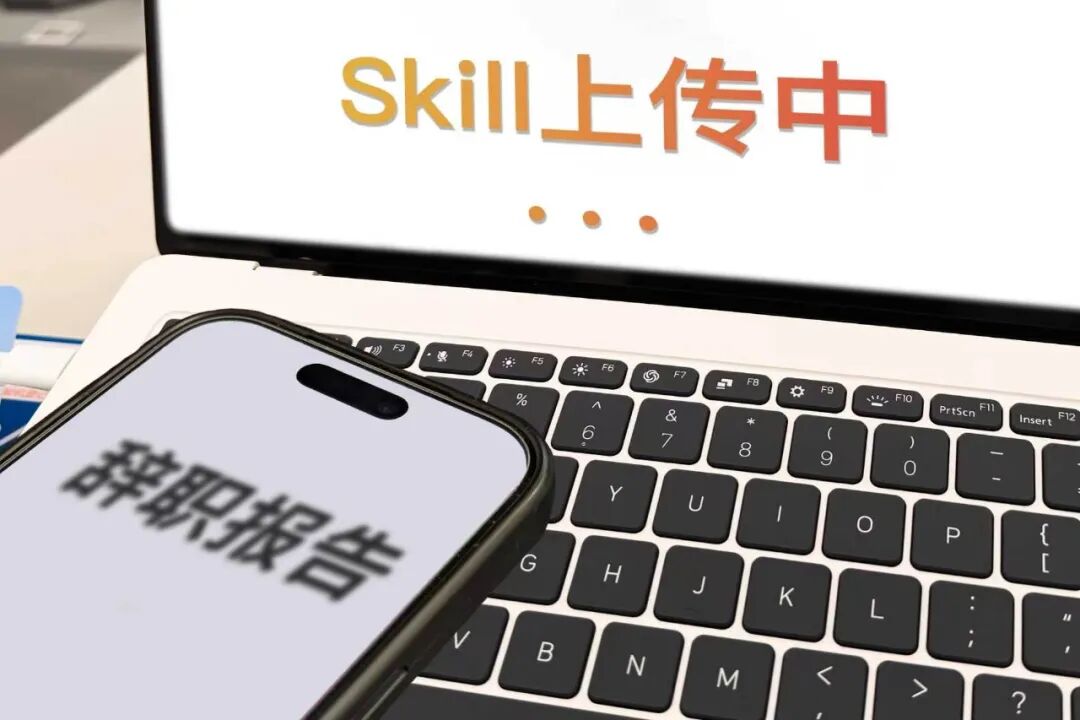

“We are feeding AI while waiting to be eliminated”
Li Yanqing has been working for an electronic equipment manufacturing company for 6 years. He manages 15 programmers and is a typical “old master in the workplace” — business savvy, experienced, and trusted by leaders. However, in recent months, the foundation of his workplace has begun to loosen.
The cause is something called “skill.”
“Skill” refers to an ability module that is packaged and can be reused, which is equivalent to a skill package that AI can directly use without relearning.
Li Yanqing's company began promoting AI tools last year. This year, departments that did a good job were set up as AI transformation pilot teams, requiring that all work experience be turned into skills. Li Yanqing's department is one of them.
This incident made Li Yanqing feel a sense of crisis. “It's like an undergraduate student who just graduated from the department. With the skills I've compiled, I can use AI to make the exact same product as me. So what is the value of my existence?”
While feeling pressured, Li Yanqing also had to communicate “skill writing” instructions to his department. The programmers under them have mixed attitudes: some are very confused and haven't used the skill; some are very resistant and speculate about when the company will start layoffs; others actively write and submit.
Li Yanqing noticed that since the company's skill library was set up, every day several large or small skills have been stored by various departments. This means that more people's experiences are being disassembled, standardized, and may be replaced by skills at any time.
Product architect Pan Lei's sense of panic came earlier and more directly. His company is a manufacturing company with annual revenue of over 100 billion yuan. At the end of last year, soon after the skill appeared, senior management of the company noticed it and held a meeting to encourage employees to use it.
At first, everyone was excited. There are AI enthusiasts sharing their ideas and skills in group chats. This kind of behavior was also appreciated by the leaders. Pan Lei himself has written quite a few skills, solidified his daily workflow, and his efficiency has indeed improved.
The changes began the day the company began to “settle accounts.” The leadership began to pay attention to each department's token (computer term: translated as “word element”) consumption and statistical development cycleShortened from a few days to a few daysHow much efficiency has everyone improved by using AI. And it only took three or four months for all of this to change.
Excitement soon turned to anxiety. A message is starting to spread internally: 30% to 40% of people are likely to be optimized because AI is improving too much efficiency.
The employees' concerns are not without reason, because the process of layoffs has already begun abroad. Global software giant Oracle announced the beginning of a new round of layoffs on March 31. 30,000 employees will be affected, and large-scale layoffs are in response to surging AI capital expenses.
Similarly, the tech company Amazon also laid off about 30,000 people in the past six months. Its CEO once stated bluntly in an internal letter: “In the context of the company's extensive application of AI products, the total number of employees is expected to decrease in the next few years.”
Li Yanqing also saw this news. He found a friend who works in data analysis at Amazon to confirm that AI has indeed greatly improved work efficiency, but for big tech companies, “she feels like her job will die out sooner or later.”

As for skills, the image that pops up in one programmer's mind is that the human brain is extracted by an invisible straw and transmitted to the AI context created by humans.
“My job doesn't have much technical content, and others can apply my skills to 85% of my level. I think I'm really not far from being judged.” the programmer said.
The lessons of the past are right around the corner. His friend, who is also a programmer, shared his skills. The leader directly asked the younger, less experienced colleague in the group to run it. As a result, the results of his work surpassed that friend. My friend was so angry that he left his job.
In order not to be laid off, Pan Lei felt that his colleagues started “performing work.” The R&D department is developing technical solution automation skills, the product department is creating competitive product analysis skills, the operation department is building activity planning skills, the strategy department is building industry research skills, the design department is making poster skills... the company's skill library quickly piled up thousands of skills.
“Everyone is doing this for the leaders to see, and I'm working hard to use my skills.” Pan Lei feels that these experiences used to be technical barriers for employees in various departments, but now, after being packaged into skills, anyone can use them to complete other people's jobs.
The blurring of the border led to a dispute over the ground, and Pan Lei saw that various departments began to scramble. He met an inexperienced product manager who used skills written by programmers to piece together unqualified programs to get credit. Pan Lei felt that the starting point for these matters was not to solve actual business problems, but rather to let the leaders know, “I used AI to do things.”
At the same time, the title of articles within the company often appears: “Who spent 500 million tokens to accomplish what in a few hours.” As a result, internal affairs intensified.
Pan Lei manages 10 people. Now he doesn't need to push the following employees to do their skills; everyone will take the initiative to do it. But he's still worried. From time to time, he will look at the number of skills in other departments and compare them with his own department. If there aren't enough numbers, he is worried about whether all his departments will be cut.
After “colleague.skill” became popular, some people ridiculed “in order not to have my experience settled down, I will go to work and feed garbage to the skill later”. However, Li Yanqing felt, “If we make the skills within the department useless, then this department may fall behind or even be cut down.”
There are still two months until the June mid-year report, and the boss urged Li Yanqing to see results. They had a deep conversation, and Li Yanqing also heard the boss's idea: let everyone write skills not to lay off employees and save money, but to improve productivity. If companies don't embrace AI in a timely manner, they will be squeezed out of the market by competitors that embrace AI.
Li Yanqing promised his boss that he would use these AI tools to improve the department's efficiency by 15%, but he hopes to apply for double vacation benefits. They are currently working in a “996” “big and small week” work model. “I'm using AI to improve my efficiency, can I get my time back?”
The boss's response was, “You can reward the person who did the best work and take an extra half day off every month.”
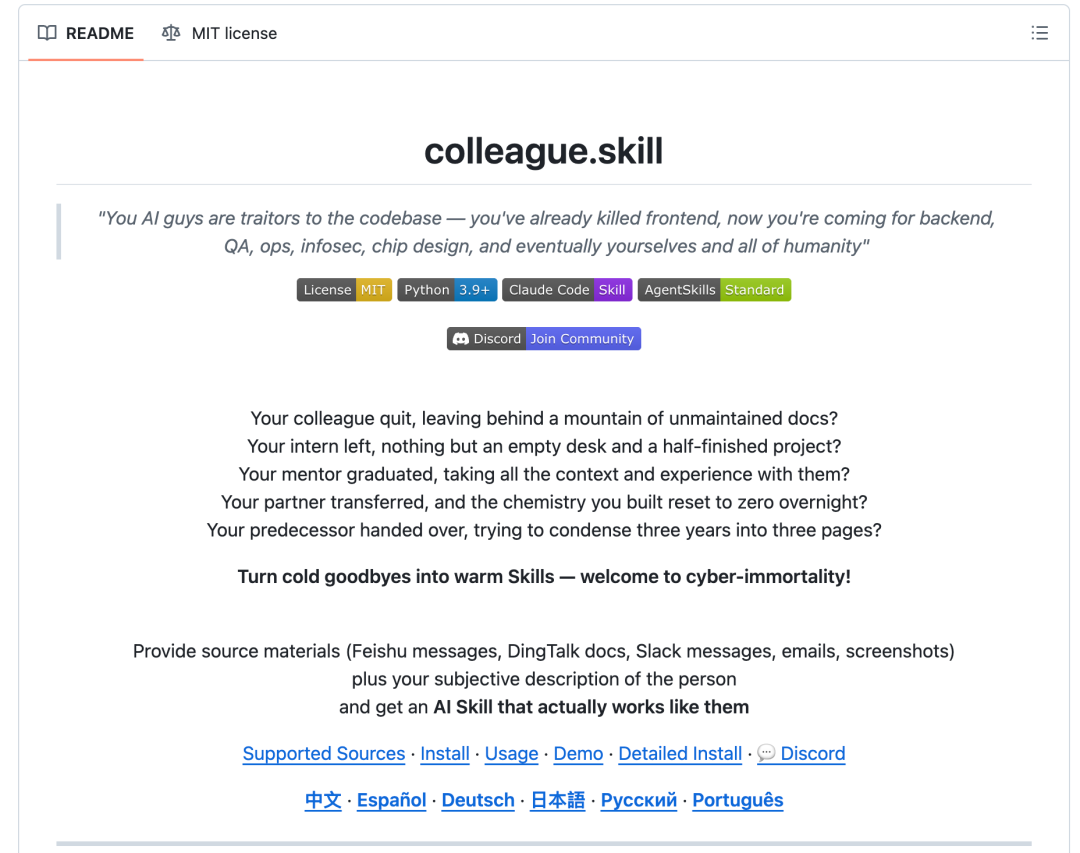
Colleague.skill went viral on the social programming platform GitHub (screenshot of the webpage). Photo provided by the interviewee

Can skill really “distill” humans?
The emergence of skills is just a small node in the AI process.
AI product manager Deng Xiaoxian used an example: the original big language model was like a magic mirror. People ask it, “Magic Mirror, who is the most beautiful woman?” It will say an answer, but it can only talk; it can't directly help people do things. Similar to GPT and DeepSeek's most important abilities.
Later, the magic mirror slowly transformed into a human figure and “walked” out of the mirror. It no longer just answers “who is the most beautiful”, but it can help people arrange things and perform tasks. This is an agent (agent) in the AI industry.
But this magic mirror isn't born to be proficient at everything. It's the first time it's doing a lot of things, and it's not doing it accurately, so it requires a skill pack. This skill pack is a skill.
According to Deng Xiaoxian, the skill itself is not a highly technical thing; it is just an assistant that appears at a certain stage of AI development. But I saw people claiming to be able to “distill” a colleague into a digital twin and continue to work for the company.”Colleague skills” At the time, Deng Xiaoxian felt a strong sense of discomfort.
She recalled many of her white-collar friends' complaints. Some companies include skills in performance assessments and rank within the company; some companies increase token usage in employee KPIs. Unfinished teams can only meet the standards by letting AI perform complex but useless tasks.
As a result, Deng Xiaoxian developed an “anti-distillation skill.” Running this program can “clean” the skills done by migrant workers and replace core knowledge with correct but useless professional nonsense. This operation is known by some as “using magic to defeat magic.”
Someone also asked her, what's the use of doing this? Feed the AI trash, and it will still get smarter. But she felt that what she was fighting against was not technology, but rather capital's contempt for humanity. “There is nothing wrong with technology, but the way companies force employees to accumulate and hand over their experiences is disgusting. Humans are not replaceable parts; this confrontation can at least show our subjective activism as humans.”
Deng Xiaoxian studied law with both her undergraduate and master's degree. She is not a programmer from a science class, but she is a fan of all kinds of AI products. “The skill is very user-friendly. Even if one has never learned to code, they can create a skill by following online tutorials.”
Similarly, Chen Yunfei, who created the “Nu Wa Skill,” is not a programmer. He previously did user research at major Internet companies.
After seeing “Colleague.Skill,” Chen Yunfei first wrote a review article, stating that people are not so easily distilled. “Distilled people or skills are immutable, and people themselves are constantly evolving, changing, and growing.”
Chen Yunfei noticed that after “Colleague.Skill” became popular, an entire distillation universe popped up on the platform: previous skills, anti-distillation skills, boss skills... It took him one night to brush all of these, and the more he brushed it, the more absurd and interesting it became.
He decided to do an “Empress Skill.” “If one can actually be distilled, then why only distill colleagues? Why not distill those really great, really great people?” Immediately after that, he “distilled” Zhang Xuefeng, Jobs, Musk, etc. with “Nu Wa Skill” and made it free and open source for everyone.
The source of “distillation” is their public speeches, autobiography, etc. Chen Yunfei believes that it is impossible for people to become experts in every field, but they can turn the way of thinking of the strongest person in every field into their own tool — like inviting a super foreign aid.
However, he also acknowledged that the suggestions given by these foreign aid workers were benevolent. “I believe that even with Buffett's skill, it's hard for everyone to become a stock god. Before there was AI, many people had studied Buffett, and he had expressed his ideas many times, but few people were able to become him. It's really not that easy to learn alone.”
Since people can't be completely “distilled” into digital people now, why does the emergence of skills cause anxiety and resistance among so many migrant workers?
According to Li Yanqing, Skill can be roughly understood as an AI version of a standardized workflow (SOP). Many companies have multiple standardized work processes, and they also require employees to document their own processes and hand them over to the department when they leave their jobs. The difference, however, is that people used to perform tasks according to standardized workflows, and now AI tools.
“I acknowledge that the code I wrote is the property of the company, but after the code becomes a product launch, you have to go to me if you need to modify your requirements. But now that AI has learned how to think, I'm no longer needed.” Li Yanqing said.

Using skill, one person can complete the work of 340 people
Eliminating the anxiety caused by possible unemployment, Li Yanqing is very excited about the emergence of skills as a technician.
Shortly after the skill came out, Li Yanqing spent her time researching, writing skills every day at work and after work, and didn't even touch her favorite games; she just wanted to achieve the inspiration in her head. “It used to take a long time to write code, but now you can make a prototype with skill in two or three minutes. The project is growing at a speed visible to the naked eye, and it's very rewarding.”
After skills appeared, there were also people who saw business opportunities in them.
Xu Houchang founded his own company last year. The company has only 4 people. The core business is to use AI to transform business processes for enterprises, that is, to create skills that can be easily used by enterprises.
“The big model has developed rapidly in the past two years. Everyone wants to use AI tools to reduce costs and increase efficiency, but I found that there aren't many companies that can use them well.” According to Xu Houchang, this is a new place to start a business. The clients he serves include media, financial institutions, e-commerce, etc.
Last year, Xu Houchang built a full-process skill for a media client, from finding topics, planning, and writing a manuscript, using it as a “big plug-in”inserttheir original system. He calculated that it used to take an hour for a skilled editor to complete an article; now, this set of skills only takes a few minutes to complete an article. When the AI has finished writing the article, the role of the editor changes to the reviewer.
Xu Houchang once calculated an account for a customer. Previously, the editorial office produced up to 20 articles a day, but now this number has reached 200, and 85% of these articles can be directly published without any human intervention. “This number is not the upper limit of our system; it is the upper limit for editorial office reviewers.”
In the process of working on this set of skills, Xu Houchang went to the editorial office for many meetings to help the editor extract his many years of experience. At the same time, he also searches for excellent articles on the Internet, deconstructs them sentence by sentence and “hello” to the AI, extracts content such as text and image expressions, and allows the AI to learn their style of expression, broken sentences, and writing ideas.
In the process of converting the editor's experience into a skill, Xu Houchang also felt their resistance. “People aren't sure if this thing will be cut once it's done.”
According to Xu Houchang's understanding, the intention of those responsible was not to replace editors, but rather to allow them to cover their energy and experience on more valuable topics that require in-depth interviews. In fact, after using the editing skills, the media did not lay off people, but instead opened more accounts.
Chen Ping, who works for a medium-sized internet company, also got a taste of sweetness from it. A few months ago, the company set up a skills library, which now contains skills summarized by various departments. Chen Ping discovered that comprehensive application of these skills can indeed improve efficiency.
Chen Ping is a product reviewer. Previously, to evaluate a product, four or five team colleagues were brought into a group, and everyone worked together using an online form. It took at least two or three days. Now she has built a system using the skills of various departments, and it only takes half a day to automatically complete a product evaluation using AI.
While she uses skills as a system, the company also has another team using previous methods to develop similar systems: product requirements, programmer development, and post-test launch. The team had 340 people working together to complete this work, and she only needed one person.

AI can “reduce costs and increase efficiency” and can also make the “cake” bigger
Chen Ping spent more time focusing on research skills, but soon she “touched” the skill boundary. It can replace less experienced employees, outsourcers, or interns, but for experts and company executives, it's less replaceable — many of those decision-making ideas and creative ideas are tacit knowledge, and it's hard to write clearly with a few skills.
“In an enterprise, it is one thing for employees to accumulate experience and skills; how an enterprise can turn these skills into a stable and controllable system is another matter. There is still a lot to explore behind this.” Having figured this out, Chen Ping is no longer anxious.
But in the enterprise, another question arises: “Who owns the skill? Can companies obtain skills free of charge and automatically?”
Chen Tianhao, an associate professor at the Tsinghua University School of Public Administration and assistant director of the Tsinghua University Science and Technology Development and Governance Research Center, feels that this is a vacuum between labor law, intellectual property law, and digital governance. Some experiences, such as human thinking habits and logical judgment, can be deposited into skills. Previously, these experiences were attached to the workers themselves. Now, some companies force employees to hand over, which Chen Tianhao thinks is unreasonable.
“I think future companies will need to agree on the ownership of skills and experience with workers through contracts. At the same time, relevant legal researchers should also pay attention to this issue and follow up and improve regulations in a timely manner.” Chen Tianhao said.
In addition to this, Chen Tianhao also felt that companies don't need to rush to acquire the skills of every worker. Skills are very scenario-based. They are not generic abilities. Skills developed by a specific worker in a specific position often require close integration with this worker to achieve maximum effectiveness.
In December of last year, the Beijing Municipal People's Social Affairs Bureau released a case where an “employee was fired due to AI”.
A company abolished employee Liu's department and position due to the introduction of AI technology to replace the labor business, and terminated the labor contract on the grounds that “the objective circumstances at the time the labor contract was concluded have changed significantly.” The Labor Arbitration Commission found that the technological innovation voluntarily implemented by the company was not irresistible or unforeseeable, and did not constitute a “major change in objective circumstances” under the law, so it found that the company had illegally terminated the labor contract.
Bao Ran, vice chairman of the Interactive Media Standards Promotion Committee of the China Communications Standardization Association, believes that enterprises should not always think about how to “reduce costs and increase efficiency,” but should think about how to use AI to make the “cake” bigger. Bao Ran's friend owns a marketing company with more than 1,000 people. They inject AI into the whole process, “using AI to do the work done by 2,000 people instead of saving the cost of 500 people.”

Li Yanqing can clearly sense that AI is evolving faster and faster. At first, he and his friends laughed at it and thought it would always have all kinds of illusions and talk nonsense like a kid. Now, it can always do something far beyond human power.
Recently, the system developed by Li Yanqing's department showed an alarm. If you rely on manual troubleshooting, it might take a few hours because there are too many steps involved.
Li Yanqing exported the system file, about 200,000 lines of code, and directly threw it to the AI. He didn't tell the AI how to check it, but after a few minutes, the AI gave the reason. Li Yanqing asked the programmers in the department to review, and the results were exactly the same.
“It used to take me a year or two to train such a young programmer to help him talk about business and serial logic. But right now, all it takes is a big AI model.” Li Yanqing felt that they probably won't hire interns again in the future because interns are more expensive than AI.
But another potential question is: if no one needs interns in the future, how can young people grow?
Chen Tianhao felt that this is indeed a question that needs to be considered by the education system and university teachers and students. However, from another perspective, young people can directly learn a lot of knowledge and experience through AI, and the value of the internship itself is also discounted.
According to Bao Ran, the experiences that can currently be fixed by skills are all relatively simple and repetitive tasks. “AI seems to have drawn a passing line for all industries. If individuals are engaged in occupations that can be replaced by AI, they need to think about how to transform.”
However, it must be acknowledged that with the development of technology, AI is slowly raising the “pass line”. Some occupations with strong processes are disappearing, and barriers between occupations are blurring.
A front-end development programmer working at a central enterprise realized in March of this year that on recruitment platforms, average front-end programmers can no longer find jobs. Because now AI can easily create a website that takes a few days for front-end programmers to complete. Currently, the only front-end recruiters are experts.
According to public reports, 50% of Tencent's new code was generated with AI assistance last year; Alibaba Cloud's internal AI-assisted code generation ratio was nearly 40%; Baidu's 52% new code was generated by AI. CEO Li Yanhong said, “I hope 80% and 90% of the code will be generated by AI.”
The development of technology is like two sides of a coin. When the first industrial revolution Jeanne textile machine was invented, a group of female textile workers lost their jobs. But some of them entered the factory and became skilled workers who operated early machines.
AI is also creating jobs. According to information released by the World Economic Forum in February this year, more than 1.3 million new jobs have been added in the AI field in the past two years, including more than 600,000 data center related jobs, as well as rapidly growing jobs such as AI engineers and data labelers.
For Li Yanqing, switching careers or starting a business is still too far away. He is 38 years old and is a mainstay in the company. The salary is good, the leadership is important, and the employees trust him. Immediate transformation is not economical for him.
But he's also confused: the more you do, the faster you lose this job. His nearly 10 years of programming experience, as long as it takes time to settle down, can be written into a skill to replace everything he's doing. “I can eliminate myself by myself without having to upgrade the big model.”
Meanwhile, thousands of the best programmers are making big AI models smarter and smarter. In less than a few months, the new big model may be able to cover the weaknesses of current skills.
Li Yanqing loves this industry. He began to love computers when he was in high school and has been studying on his own. He likes the sense of accomplishment of breaking down a complicated problem into code and watching it run; he also likes the relaxation of resting on the back of a chair after solving a stubborn bug...
He admits he's a little afraid of AI, but he's not planning to stop. He's still holding back his energy — he wants to see what AI can't replace.
(At the interviewee's request, Li Yanqing, Pan Lei, Deng Xiaoxian, and Chen Ping are pseudonyms)
Twitter:https://twitter.com/BitpushNewsCN
Compare the TG exchange group:https://t.me/BitPushCommunity
Compare TG subscriptions:https://t.me/bitpush
