


Kelp-Aave crisis: 290 million losses, who pays for it?

Source: Blockworks Research
Author: Shaunda Devens
Compiled and organized by: bitPushNews
Kelp deployed itsLayerZeroThe cross-chain bridge uses a “1-of-1” decentralized validator network (DVN) setup, which means that only one verification node is required to verify cross-chain transactions.
An attacker managed to hack into the private key of this independent node and forged a cross-chain message claiming that RsETH has been destroyed on the L2 network. Since only one signature was required, the cross-chain bridge accepted forged instructions and directly minted 116,500 unsecured RSetH worth approximately $292 million into the attackers' wallets on the Ethereum mainnet.
Instead of immediately selling these unsecured tokens on decentralized exchanges (as this would crush the spot price), the attackers used them to attack using Aave's lending mechanism. At the time, Aave V3 allowed users to borrow WETH as collateral under the E-Mode (Efficient Mode) framework, with a loan-to-value ratio (LTV) of up to 93%.
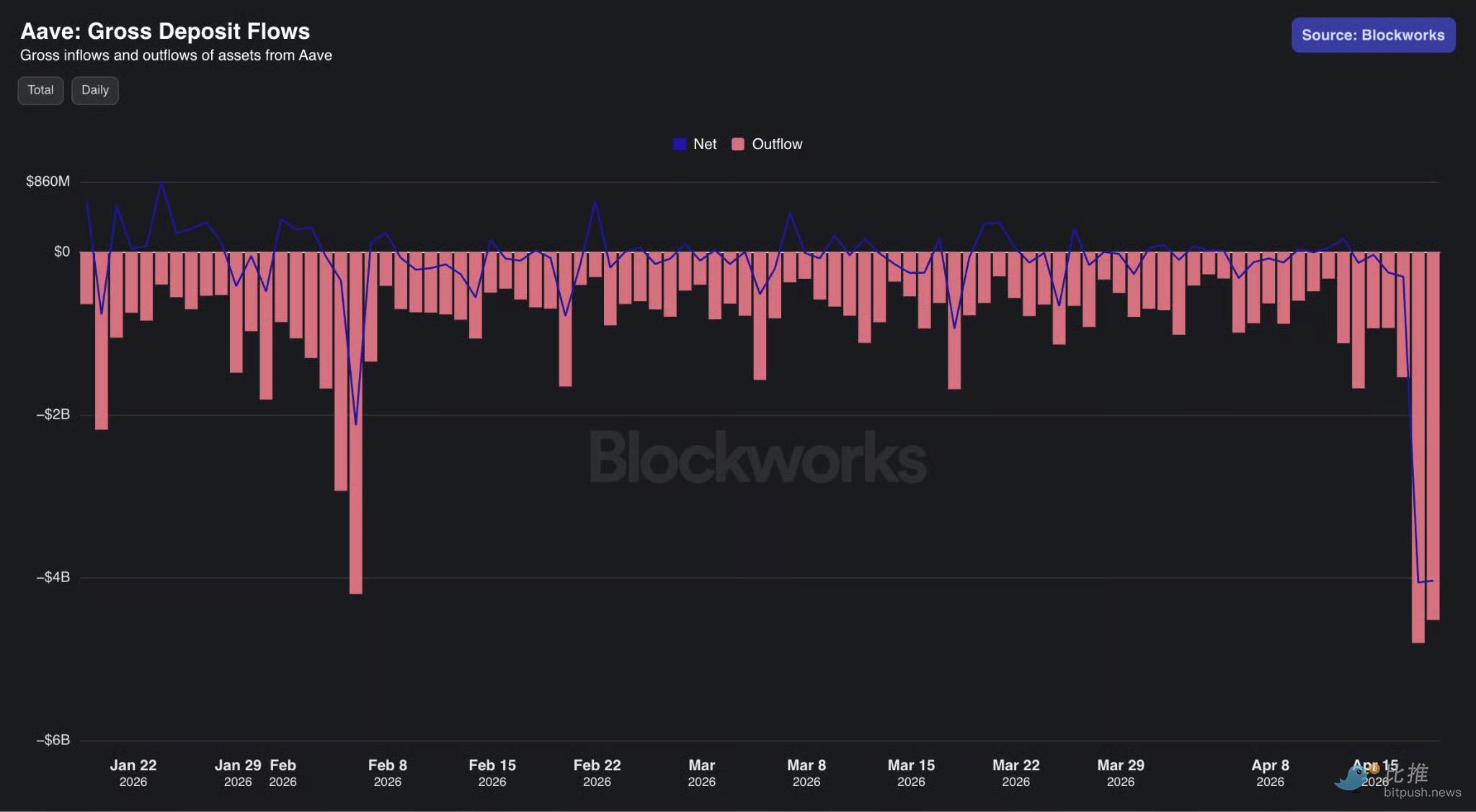
The attackers deposited these questionable RSetH collateral into Aave and borrowed huge amounts of WETH, ultimately leaving Aave with a bad debt of around $196 million. As exploits and bad debt news spread, users poured in to withdraw assets and withdrew more than $8 billion from the agreement within 24 hours, causing Aave's WETH utilization rate to soar to 100%, effectively freezing the remaining depositors' liquidity.
Before we dive deeper into recovery plans, I think this is an excellent case showing the risks associated with Aave looping strategies (looping strategies) driven by risk teams. As a reference, we've previously outlined the strategy of revolving through USdE and how it can achieve almost “risk-free” (as opposed to holding the underlying asset without revolving) returns. The process is as follows:
Revolving borrowers (Loopers) deposit high-yield assets, such as RSetH, into Aave.
Revolving borrowers use E-Mode to borrow related assets (ETH) using RsETH as collateral and earn the interest difference between staked income plus points and borrowing costs.
However, the risk assumption stems from Aave's lenders, as their ETH was loaned out of the agreement and used by the borrowers to accumulate more rSetH (or whatever related asset they were borrowing). In this way, Aave's depositors actually became the third tier of the strategy (the first tier is a revolving borrower, the second tier is Umbrella, and the third tier is Aave's lender because their ETH has already been loaned). In return, ETH depositors received slightly higher interest rates as demand for ETH increased utilization of ETH reserves and increased borrowing costs. However, large reserves of ETH are at risk.
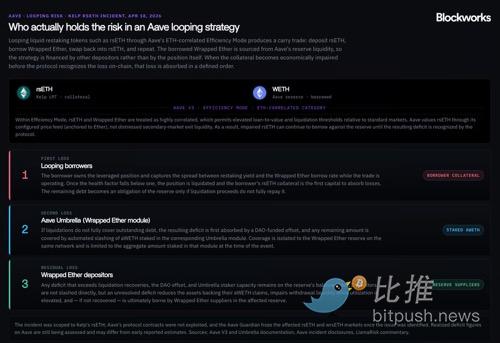
This is exactly what happened here: ETH depositors were harmed, and although they had no direct exposure to RsETH, their ETH was an asset that was loaned against RsETH collateral and flowed back into circulation. This is the core risk embedded in Aave's pool model. Although modular lending is often criticized for contributing to high leverage and potentially unsafe strategies, this is actually one area where modularization provides better solutions because lenders can choose the type of collateral they are willing to finance and demand compensation accordingly.
That's why Aave supports revolving borrowing far more than Morpho. On Morpho, lenders often require substantially higher annualized returns (APR) to fund these deals, which naturally limits their size. By contrast, on Aave, the risk framework is set centrally by curators (curators), so all ETH providers are actually forced to participate in funding the strategy, regardless of whether they actively choose this exposure or not.
Blockworks Advisory's Silvio Busonero suggests two possible outcomes:
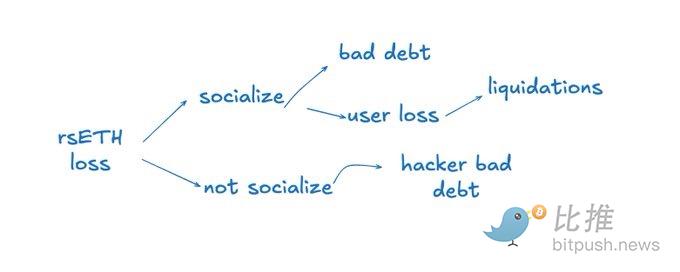
1) Kelp DAO allocates losses
The actual value of RsETH is currently around 18% lower than ETH. Currently 17% of ETH on Aave is backed by RsETH, so the value of aETH should drop by about 3%, causing losses to aETH depositors. Notably, ETH borrowers (revolving borrowers) will actually profit from it.
Additionally, the hackers borrowed approximately $113 million, which should directly count towards the bad debts of the agreement. Approximately $50 million of this should be covered by the Umbrella security module.
The situation is even worse on Arbitrum: 27% of aETH's collateral is rsETH, which means aETH will depreciate by about 5%. Also, there is no Umbrella module on Arbitrum to cover the additional $70 million in loans left by the hackers.
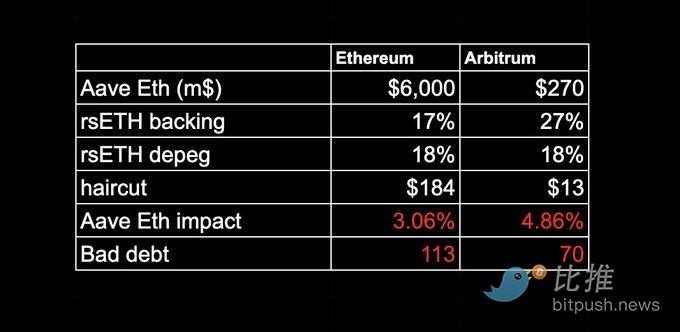
Preliminary data on Kelp DAO's impact on Aave
2) Kelp DAO does not allocate losses
In this scenario, Aave only needs to absorb bad debts caused by hackers, and ETH depositors will not be affected in any way.
If Aave and Kelp can realize that the total cost of this plan is lower than the loss allocation plan and act together to save it, then this scenario makes sense.
Secondary effects
In practice, there are two very different direct effects:
Bad debts left by hackers: This portion of the money will not be repaid and will be covered by the Aave agreement (which happens in both scenarios).
aEth's value reduction (haircut): This harms depositors' interests (this only happens in the first scenario).
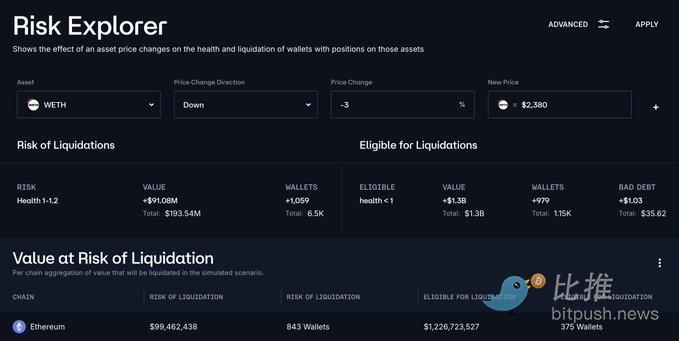
The secondary effect of allocating RsETH losses would be a liquidation triggered by a reduction in value (for example, users borrowing using WETH as collateral). According to Chaos Labs' emulator, this would result in an additional liquidation of around $100 million.
The price of waiting
Aave users are in a “prisoner's predicament”: liquidity is extremely scarce, and users are motivated to borrow money to protect collateral (which is contrary to the operation of closing and deleveraging positions).
By controlling interest rates, the team managed to prevent liquidation from occurring while waiting for Kelp to act.
The problem is that with current utilization levels, liquidation is impossible. And once the price of ETH falls, it could further worsen the bad debt situation and trigger other ripple effects throughout the DeFi ecosystem.
Ultimately, this could mark the end of Aave's era of aggressive leverage and accelerate progress towards Aave V4's “hub-and-spoke” (hub-and-spoke) architecture, which is equipped with specially designed branch-specific circuit breakers to isolate collateral risk and prevent infected liquidity and re-pledge tokens from running out of core liquidity again.
Twitter:https://twitter.com/BitpushNewsCN
Compare the TG exchange group:https://t.me/BitPushCommunity
Compare TG subscriptions:https://t.me/bitpush
