


From Meme Chain to “US Stock Chain”: Solana Quietly Enters Tokenized Stock Trading Battle
Author: Cookie
Original title: Let's not talk about the US chain, Solana is becoming a “US stock chain”
US stock trading has become a new major trend in the cryptocurrency industry, and there is no question about it. When we mention US stock trading in the coin industry, we tend to focus on, “This is a series of CEXs andHYPERLIQUIDrivalry between them”.
Solana, a public chain with meme coins as its core competitiveness in the eyes of many players, has received little attention in the US stock trading circuit. However, they have quietly entered this latest cryptocurrency market battle.
Solana is fighting to win the on-chain tokenized stock market
From recent trends in Solana's official tweets, we can clearly see that a large number of recent tweets are related to US stock trading on its chain. The night before, Solana officially announced the official launch of tokenized MU shares on Solana.
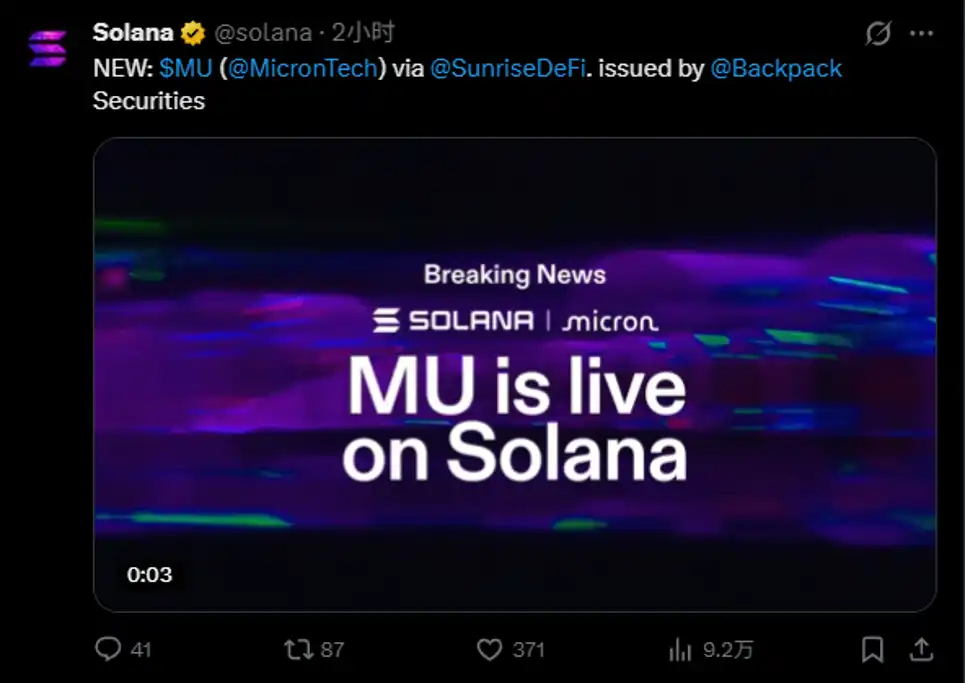
Obviously, as a public chain, Solana has also taken US stock trading as the most important development point in the recent past. Judging from the data, they have also done a pretty good job and are in an absolute leading position in the competition for US stock trading between public chains.
One week after SpaceX's IPO, Solana set a record of $1.04 billion in one-week tokenized stock trading volume. Among them, $SPCX's trading volume reached $439 million, which is 91.7% of all SpaceX tokenized stock trading volume.
In the past week (6.15-6.21), tokenized stock trading volume on Solana reached nearly $1.3 billion, while after that, Base and BNB were about $14.45 million and $129.54 million, respectively, and only about $312,800 on the Ethereum mainnet.
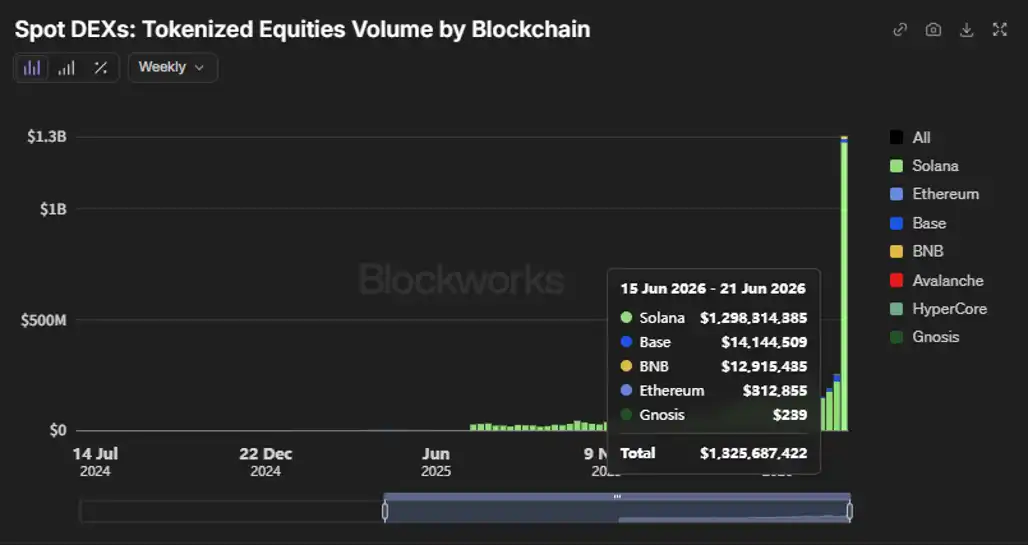
Compared to various CEXs, Binance traded nearly $500 million in tokenized stocks over the past week, followed by Gate's nearly $220 million and Bybit's $107 million, respectively. In May of this year's data, Solana also ranked only behind Binance (about 1.1 billion US dollars), Gate (about 1.088 billion US dollars), and Bitget (about 800 million US dollars) with a turnover of about 870 million US dollars.
ProPAMM has also made an important contribution to this achievement. Taking the past week's data as an example, ProPAMMs such as Zerofi, Goonfi, and Tessera ranked only behind Orca and Raydium in terms of volume.
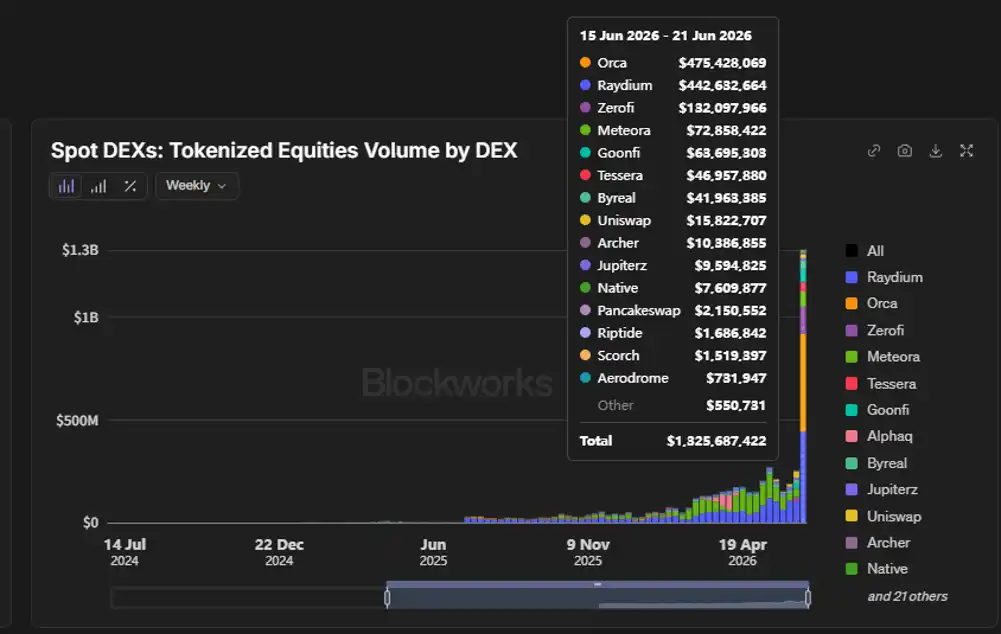
These self-operated AMMs, managed by professional market makers, are 100% self-funded by market makers, and unlike traditional simple x*y=k, open source passive AMMs. These ProPAMMs are actively priced. They are closed source, their liquidity is not disclosed to the outside world, and they usually have no front-end but are routed through aggregators. Each block can even update quotes more than every 50ms, and can also avoid MEV attacks.
In terms of price discovery efficiency for spot assets, Solana is already very small compared to mainstream CEXs. With this advantage of spot efficiency, Solana's main trading volume sources for each DEX are already tokenized stocks.
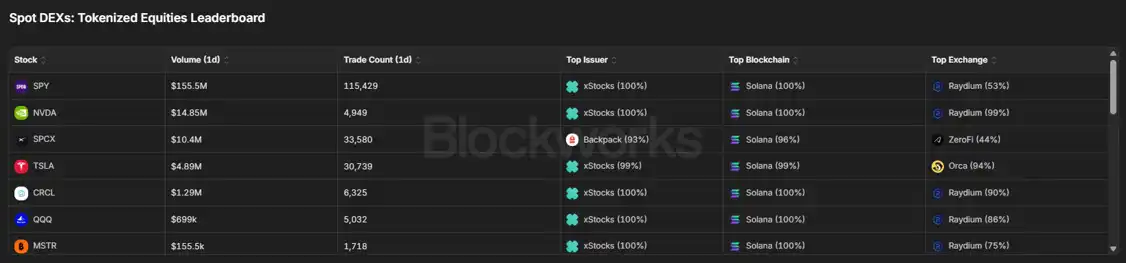
“US Stock DeFi”
Although Solana is gaining momentum in the tokenized stock spot market, the trading volume of perpetual contracts is still far greater than spot trading for US stocks in the cryptocurrency industry. Perp DEX's stock trading volume over the past week was at the level of 10 billion US dollars:
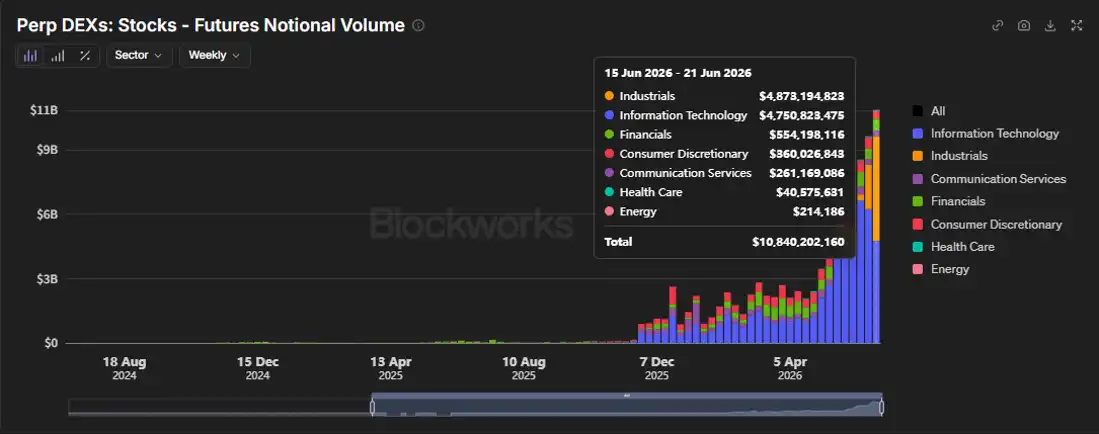
Solana will probably try hard to catch up in this area after that. However, in addition to trading, tokenized stock stocks still have room for development. The composability of tokenized stock spots is Solana's potential advantage.
Compared to simply trading stocks to earn profits, on-chain DeFi provides more diverse and flexible revenue channels for tokenized stock positions. On platforms such as Jupiter, Raydium, and Kamino, users can use their tokenized shares to borrow or provide liquidity. Users can implement some combination strategies for their tokenized stocks, such as partial borrowing, partly to provide liquidity.
In addition to these regular DeFi strategies, there have also been relatively fresh ways to play on Solana recently. Nest allows users to mint the stablecoin nUSD by tokenizing stocks or USDC.
nUSD can be pledged to receive snUSD, and receive revenue from the agreement (expected to be 6% annualized) as well as dividends.
Once the revenue from the agreement is distributed, the remaining portion will be used to repurchase and destroy the governance token $NEST.
While looking forward to more fresh gameplay, it is also worth looking forward to Solana promoting stock DeFi-based gameplay in a more prominent way (such as more intuitive guidance in mobile apps) to the on-chain player base through collaboration with various projects within the ecosystem. Combined with cross-chain asset portals such as Sunrise, a network effect was formed, which had a surprising differentiated competitive effect in the tokenized stock derivatives market.
Twitter:https://twitter.com/BitpushNewsCN
Compare the TG exchange group:https://t.me/BitPushCommunity
Compare TG subscriptions:https://t.me/bitpush
