


The “Everything Is Possible World Model”: How can a vague concept support the $10 billion financing narrative?
Author: Beating
Original title: Everything Is Possible World Model
The term world model is almost being sold out by investors.
Li Feifei's World Labs completed financing of 1 billion US dollars in February this year, with a valuation of 5 billion US dollars. A year ago, it was only valued at 1 billion dollars.
Yang Likun's new company, AMI Labs, raised around a billion dollars in seed round, setting the record for the largest seed round in the history of European AI startups.
There were 25 cases of financing related to the World Model in the first quarter in China. Some companies took two consecutive rounds of 2.5 billion dollars in one month, and the valuation jumped from 5 billion to 10 billion dollars.
What's even more surprising is that don't look at investor FOMO like this. Currently, the entire AI industry has yet to agree on what the four words “world model” actually mean. It's a word that hasn't even been defined, and it's already worth tens of billions. Every day they shouted slogans to find an anti-consensus, and in the end, they invested their money in the absence of consensus, and then called it an outlet.
However, I recently heard from a few big VC investors that they could clearly see the bubble in this direction themselves, and it wasn't that no one had taken a picture of the table during the internal rehearsal session and discussed it back and forth. The conclusion was that they still had to vote. If you don't vote, next year's LP will ask you why you missed the world model; if you vote, even if you make a mistake in the end, it will be the whole industry's fault.
However, when the money is hot enough, it is time to ask an impolite question. Since no one can say exactly what it is, what exactly is everyone voting for?
One step process
First off, let's be fair. There was something about this concept originally.
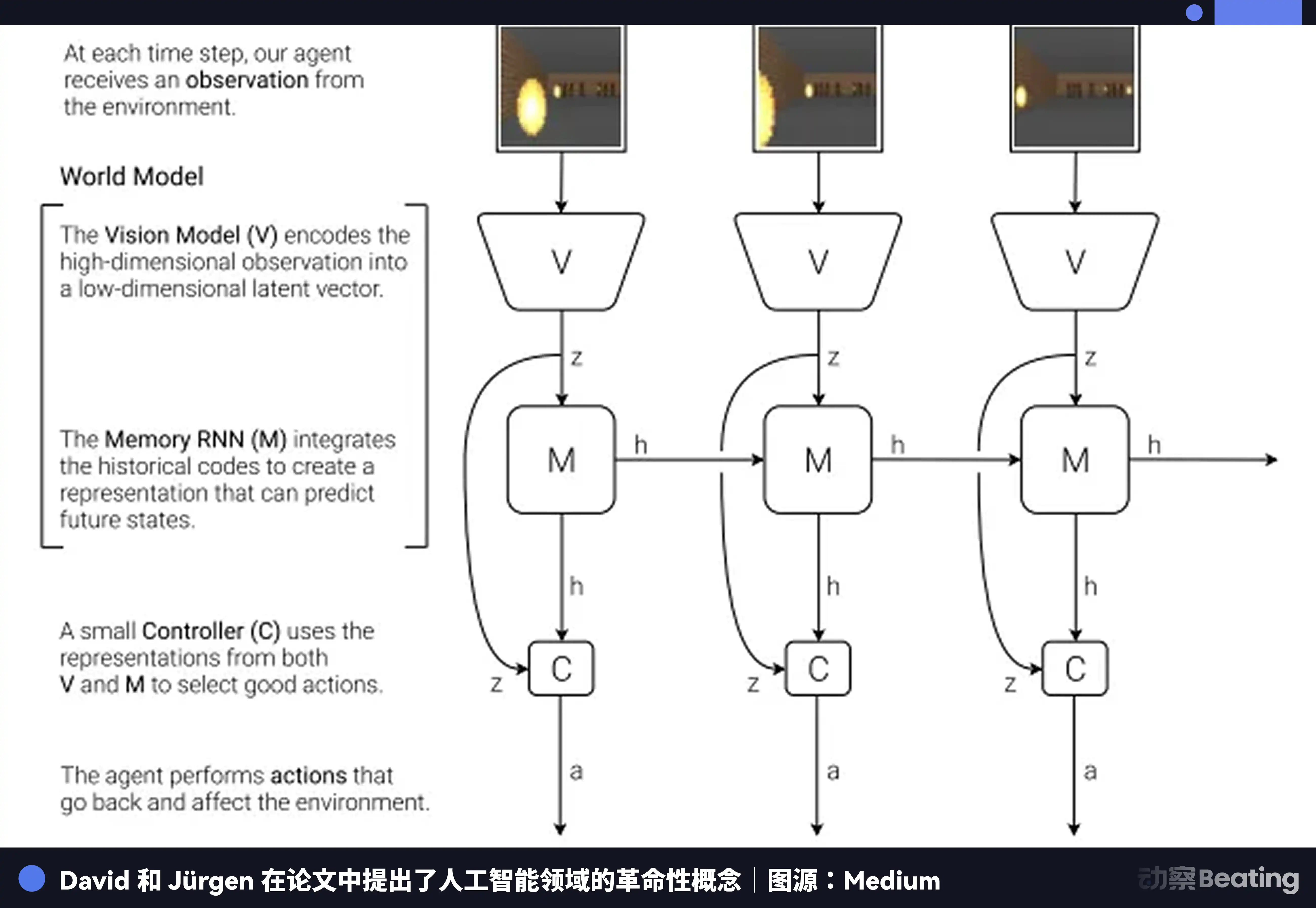
In 2018, two researchers published a paper titled “World Models.” They let AI create a dream for themselves in a racing game. First, master the car in the dream, and then run back in the game. At the time, ChatGPT didn't exist, and this paper was only circulating in a small circle of researchers.
Yang Likun has actually been adhering to this research direction for a long time. In the years when all of Silicon Valley bet money on the big language model, he repeatedly reiterated his view that by predicting the next word, machines would never be able to touch human intelligence, so it must be made to understand the physical world.
I've been saying this for almost ten years, but the wind hasn't blown this way for him. People like him didn't turn away after hearing the wind; in their perception, there really is something about the world model.
However, when “something really does” enter the venture capital industry, it usually has to go through a process first.
This process will process a research direction into a term that can be wholesale. The venture capital community's favorite has never been a technical concept; it's the franchisability of a technical concept.
The world model is a child of choice in this regard. It is more technological than the “metaverse,” sexier than “spatial intelligence,” broader than “embodied intelligence,” and fresher than “multi-modal.”
Most importantly, it's very difficult to falsify. In BP, the harder it is to prove falsification, the more valuable it is, because not being able to falsify means that new investors can be found to take over in the next round. What the story earns is money that cannot be falsified.
World model folding
As a result, there was the current splendor.
If you make a game, say you are a model of the world; if you make a short story, you say you are a model of the world; if you make a video tool, you say you are a model of the world; if you make a simulation robot, you say you are a model of the world.
Further on, those who make advertising materials, educational courseware, metaphysics fortune-telling, and virtual people to chat with will be able to enter the world model circle as long as they dare to blow it.
Earlier, at an event, I heard investors share in a round table. Each field of medicine, finance, and law can be viewed as an independent world. According to this usage, my car repair master downstairs also has a world model in his mind. It specifically predicts when the Third Ring Road will be blocked. The accuracy rate is higher than most assisted drivers I've ever used.
Not long ago, I also saw a robotics company announce that it is building a model of the industrial world and a model of the home world at the same time. I realized that the world used to be countable terms; they can be sold individually.
It's not that no one has anticipated this grand event; the identity of the person who anticipated it is quite special. In March of this year, on the day AMI Labs funded that billion dollars, the company's CEO told the media that I predict “world model” will be the next buzzword. Within six months, every company will call itself World Model to finance.
He was right. The only thing that wasn't accurate was the time; it didn't take six months at all.
habitual narrative
Chasing narratives has long been a habitual act of investors and entrepreneurs.
On May 10, 2015, a listed company whose main business is floor tiles and real estate issued an announcement stating that it wants to become the first Internet finance company in China, change its name to “Pitumpi”, register the English name directly as P2P Financial Information Service, and then open and stop the next day.
The company lost 100 million dollars that year. The actual controller was later fined 3.4 billion dollars and sentenced for manipulating stock prices.
In the same group, the company that opened the restaurant was renamed Zhongke Cloud Network, the one that made fireworks was called Panda Financial Holdings, and the one that sells pants was called Cross-border Tongbao.
There's also the metaverse from a few years ago. In 2021, those who make games say they are in the metaverse, and those who sell NFTs say they want to make a metaverse, and there are projects that sell virtual real estate in the metaverse. Even liquor was sold in the metaverse. Facebook simply changed its name.
The median transaction price for virtual land on Decentraland dropped from $45 to $5. Lin Junjie spent 123,000 US dollars to buy three pieces of virtual land. After more than a year, they were worth about 10,000 US dollars, losing 91%. It claims to be the world's platform. At one point, the media counted that there were only 38 active users left, which is even more deserted than a community of owners.
Those metaverse projects back then, if they open up resources and try to survive to the present day, can probably be replaced with a piece of clothing modeled after a world model and then integrated into a huge amount.
Big companies are no exception. Meta, which changed its name, lost more than 60 billion dollars in the Reality Labs division over the next few years.
When it comes to Meta, I must mention Song Xiaodong, who announced at the end of June that he joined Meta's Super Intelligent Laboratory as vice president of AI research and is responsible for AI security.
In 2018, UC Berkeley professor Song Xiaodong founded Oasis Labs. The company raised 45 million dollars when it was first founded. It was a16z's first investment project in the crypto field, and the first batch of investment by Binance Incubator. The co-founder of Coinbase followed the investment in his personal capacity.
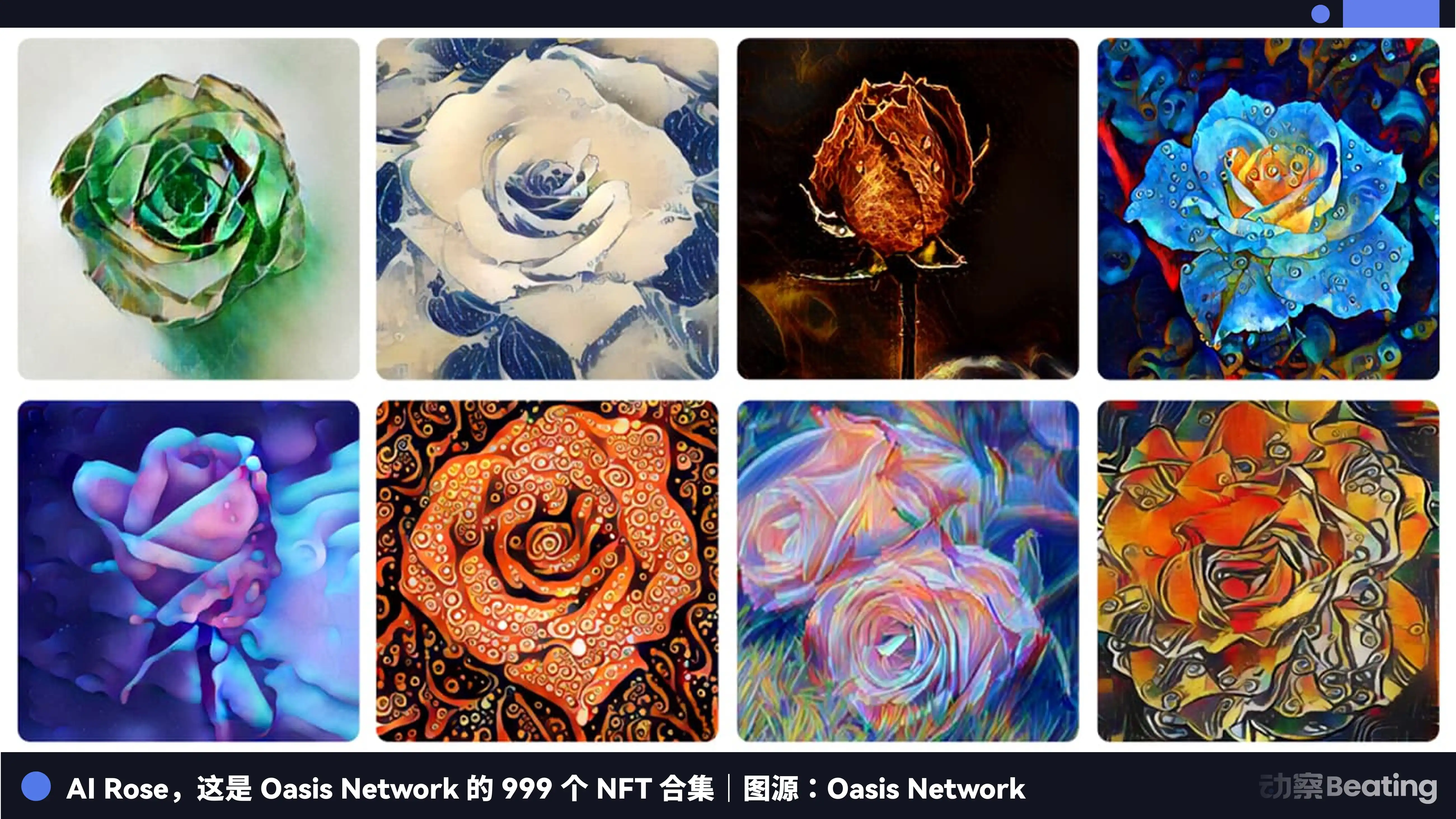
Over the next few years, the project's self-introduction changed one after another. It was first called a blockchain-based cloud computing platform. In 2020, the main network was launched, and the ROSE token was added to Binance. After that, let's talk about the data economy, DeFi when DeFi is popular, and a set of AI-generated rose NFTs was distributed at the end of 2021, when NFTs became popular. It launched a new framework in 2025, and the statement was changed to “trust AWS in the AI era.” In January of this year, the “privacy AI” narrative increased ROSE by 105% a month.
After the increase, a ROSE token was worth less than two cents. Its all-time high was $0.596, and last week's price was $0.0059, down 99%. Today's market value of the entire project is $44 million, which is less than the money it raised on the day it was founded in 2018.
In fact, it's not just other industries; the AI industry hasn't lost its scab on itself. In the 2023 100 Model Battle, 305 major models were released domestically in one year. At its peak, 300 companies were on the same stage. By 2025, companies with a media statistics model layer had completed only 22 financings throughout the year. The share of big model financing in total AI investment dropped from 51% the previous year to 14%, and more than 90% of people were no longer on the table.
There aren't many words left in the dictionary that are bigger than the world; general artificial intelligence counts as one.
Blow bubbles with your eyes open
Having written this, it is reasonable to say that it is time to curse the project side of the concept. They were scolded unfairly, and our good friend Burial AI just posted an article last Friday.
I want to talk about another thing in this post.
The current situation is that, as the founder, you don't write the four words “world model” in your BP. The number of investors you can make an appointment with is not a magnitude, nor is the valuation you talk about. If you don't write it, you can't even date anyone. If you write it, the valuation can double, and the team will probably live two more years. If that were you, how would you choose?
The same goes for investors. For example, the few Xiaodeng investors mentioned at the beginning all know that there are bubbles here. There are quite a few, quite large bubbles. They knew even earlier than the entrepreneurs. However, the problem is that investing is not an answer to the college entrance examination; the comparison is not who is right; the comparison is who can invest in the bubble before it blows up and who can run away before the bubble bursts. When a new story was born, they weren't concerned about whether it was actually reliable, but whether more people would believe it in the next few years.
Keynes explained this situation almost 100 years ago. For a person who manages money for others, failure according to the rules is more likely to preserve one's reputation than success out of the ordinary. It's safe to follow everyone and make mistakes.
The rest is logical. The fund also needs to tell LPs a story. The estimated value of the projects put forward will rise, and the increase will require someone to take over in the next round, and those who take over need to believe the same story. Narrative is the unit of account for a primary market.
Therefore, in my opinion, many times the project party did not invent a narrative to defraud money; it was the capital that first chose a narrative that seemed imaginative enough. Whoever the entrepreneurs changed their voice to ask their dad to ask for tea can get a red envelope, just like at a wedding.
If you follow this chain one step further, you can see why there is no uniform definition of this term until now. Because there is no uniform definition; the definition is exclusive. Once you have clearly written what the world model means, you also clearly write who is not a world model, and then more than half or more companies will have to clean up their stuff and leave. Obscurity is the infrastructure of this industry, which is secretly maintained by all those present.
Narrative is king
Some people call this a cycle. The term cycle is so mild that it suggests that everything will go back to square one. There are things you can't go back to.
After several rounds of running the same method over and over again, what changed was the definition of the art of entrepreneurship itself.

The company's first customer went from being a user to an investor. The company's first goal went from a product to a story. The oldest part of the business is to make things, sell them to users, receive money, and change from mandatory questions to additional questions. After listening to a lot of road shows during this time, I had a rough experience. When talking about narratives, everyone had light in their eyes; when talking about retention and gross profit, the stage was quiet for a few seconds, like someone mentioned something that wasn't decent.
This kind of environment will screen people. People who can run a business have a harder time getting money than people who can tell stories; if they don't make money, they won't be able to live the day they prove themselves. Those that were screened out were not necessarily bad companies; many were honest companies. The people who stayed behind were more and more alike. They were all good at speaking, and all were ambitious. They all talked about the next decade, and no one talked about the next quarter. In the days when narratives were king, the ability to depreciate first was the ability to do business well.
The people who wrote that paper in 2018 started talking about people who let intelligence understand the real world ten years ago. They finally waited for the rise, and at the same time lost the term “world model.” People who are actually modelling the world now have to find a new word to remove themselves from that group of people.
Most of that new term has now been written in a paper. It's clean, accurate, and not many people have quoted it yet. One word spent most of his life like this. He was born in a paper, became popular at a press conference, and died in a financing PPT.
Twitter:https://twitter.com/BitpushNewsCN
Compare the TG exchange group:https://t.me/BitPushCommunity
Compare TG subscriptions:https://t.me/bitpush
