


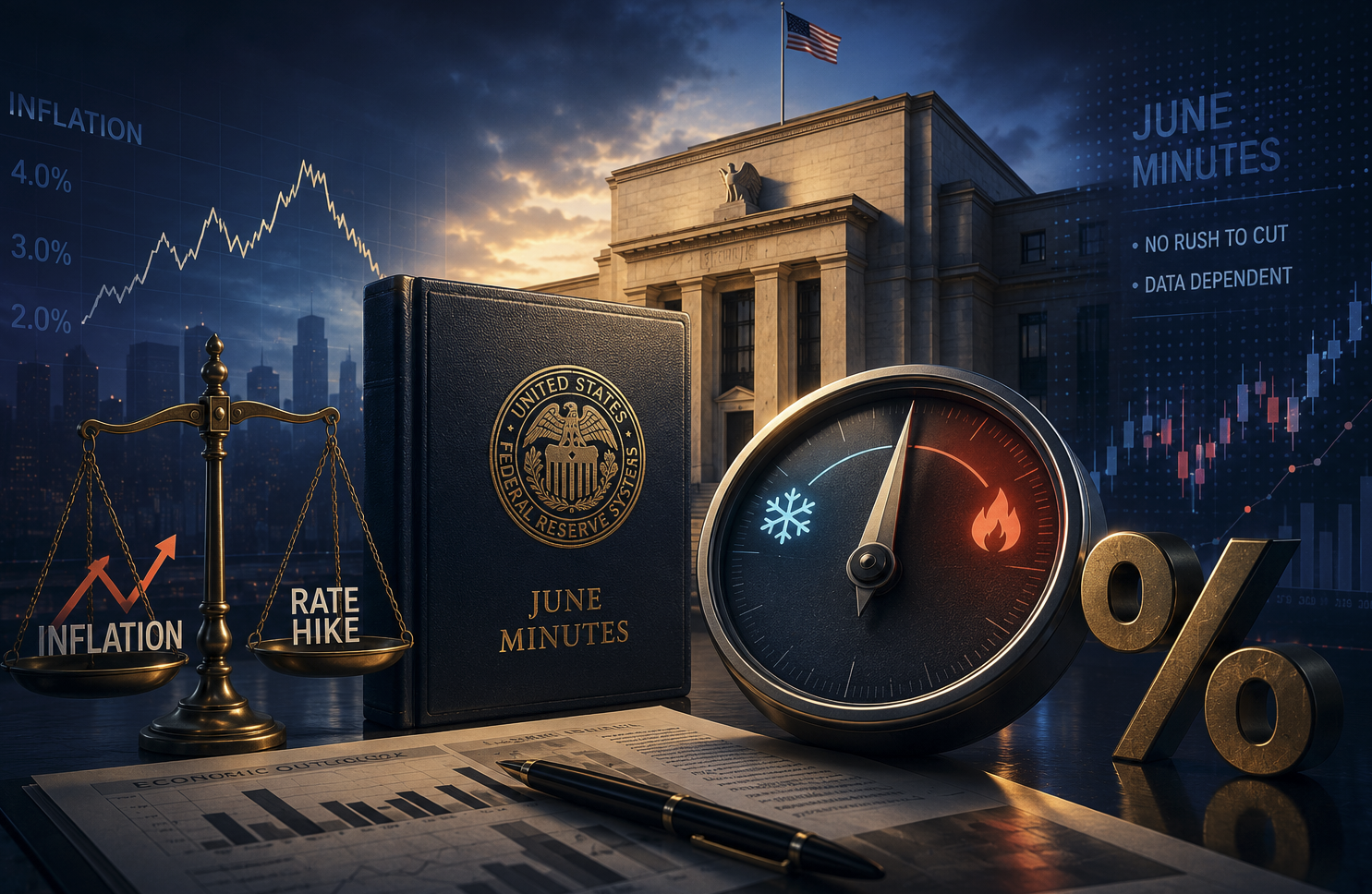
The Federal Reserve's June minutes sent a cooling signal: inflation will not recede, interest rate hikes will not fall
Source: Wall Street News
Author: Long Yue
Original title: Wall Street Review Federal Reserve June Meeting Minutes: Focus on inflation, there is no urgency to raise interest rates in the short term
The minutes of the meeting showed that all participants supported keeping interest rates unchanged. Only a “few” believed that there was a reason to raise interest rates but ultimately did not act on it. Wall Street institutions believe that the trend of inflation is a core variable in the policy path — if inflation quickly subsides, interest rates will be maintained or lowered; if they continue to be high, they will face a certain degree of tightening. However, the market is too aggressive in pricing recent interest rate hikes; the benchmark scenario is to keep interest rates unchanged throughout 2026.
The minutes of the Federal Reserve's June meeting came to fruition, and the three major Wall Street institutions unanimously read the same signal — inflation is the real switch that determines whether or not to raise interest rates.
The minutes of the Federal Reserve's June FOMC meeting were released on July 8. The minutes showed that “all” participants supported keeping the federal funds rate unchanged in the 3.5%-3.75% range. The market initially worried that the records were hawkish, but after reading them, they generally interpreted them as marginal pigeons — the reason is simple: there is no urgency to see any recent interest rate hikes in the minutes.
According to the Chase Trading Desk, the three institutions Goldman Sachs, Morgan Stanley, and Citibank quickly released review reports after the minutes were released. The core judgment was highly consistent: the Fed's current response function is still data-driven, and the policy direction depends entirely on the performance of inflation data over the next few months.
Goldman Sachs economist Jan Hatzius's team directly pointed out the core logic: the key watershed in the minutes is whether inflation can begin to fall “soon”. If so, “almost all” officials discussing the scenario support “maintaining or eventually lowering” interest rates; if not, similarly, “almost all” officials discussing the high inflation scenario think “some degree of policy tightening” is likely.
Two paths, one key: inflation data.
“Few” see reasons for interest rate hikes, but no one really wants to
One of the words that received the most attention in the minutes was that a “minority” of participants believed “there is a reason to raise interest rates” at the June meeting.
But Michael Gapen, the chief US economist at Morgan Stanley, clearly stated that this is the opposite of “inclination to raise interest rates.” “These 'few' participants said they are currently satisfied with maintaining policy interest rates at current levels,” he wrote.
Citibank economist Andrew Hollenhorst shared the same opinion. Citing the original transcript in the report, he stated that these participants “expressed support for maintaining the current target range at this meeting”. In other words, even if some people think the rate hike makes sense, no one actually wants to press that button at this point.
Notably, nine officials in the previous SEP bitmap expected interest rate hikes in 2026, and many of them expected to raise interest rates 2-3 times. However, judging from the wording of the minutes, this hawkish trend has yet to be translated into a will to act.
Inflation: Don't just look higher, but also look at the direction
The core logic of the minutes can be summed up in one sentence: wherever inflation goes, interest rates go.
The Goldman Sachs team pointed out that the “majority” of participants in the minutes discussed two scenarios:
Scenario 1: Inflationary pressure subsides, and inflation “soon” begins to return to the 2% target - “almost all” participants discussing this scenario believe that the federal funds rate should be “maintained or eventually lowered” at that time.
Scenario 2: Inflation continues to be high due to AI-related demand, the Middle East conflict, or tariff factors — “almost all” participants discussing this scenario think “some degree of policy tightening may be necessary”.
The team sorted out specific statements from officials: Participants generally noticed that both core inflation and overall inflation have risen further, “far above” the 2% target, mainly due to the impact of tariffs, supply chain disruptions caused by the blockade of the Strait of Hormuz, and strong demand driven by AI-related investments.” A number of “officials” indicated that price pressures had broadened, covering transportation, air tickets, petrochemicals and agricultural inputs; inflation in services other than housing “remains high.”
However, there are two key reasons why the officials are not in a hurry to act:
First, inflation expectations are still in line with the path back to target. Second, “many” officials believe that the labor market “is currently not a source of inflationary pressure”. Citibank's Hollenhorst added that the June non-farm payrolls data fell short of expectations and the previous month's data were revised downgraded, further weakening concerns about renewed inflation in the labor market. This means that in the eyes of officials, the current high level of inflation is more a result of supply-side shocks than uncontrolled demand.
Morgan Stanley's Gapen gave a specific interpretation of the expression “a certain degree of policy tightening”: it meant a “recalibration of policy positions”, that is, raising interest rates by 50-75 basis points, rather than starting a complete cycle of interest rate hikes.
Gapen used a “soon” (soon) to position the Federal Reserve's patience boundary — they think this probably means “the next few months,” specifically maybe the next 3 to 4 inflation data. If you can see that inflation has dissipated and supply-side pressure is temporary, holding back is the correct answer.
It's not an “institutional shift,” it's still data-driven
Some market participants worry that the new Federal Reserve Chairman Warsh (Warsh) may push for a fundamental shift in the monetary policy framework — that is, no longer “looking at data,” but instead actively tightening to reduce inflation more quickly.
Morgan Stanley's Gapen directly responded: “The minutes do not point to an 'institutional change' in the Federal Reserve's reaction function.” He believes that the section on monetary policy prospects in the minutes is still entirely within the framework of “data dependency” in the past.
The logic is: if inflation subsides, the Fed remains on hold and opens the door for future easing; if inflation does not recede, the Fed may reverse some or all of the interest rate cuts implemented last year for risk management purposes.” This shows that the data is still important, and the Commission is still uncertain about the path of inflation.” Gapen wrote.
At the level of communication strategy, the format of the minutes is basically the same as previous meetings, and still preserves forward-looking statements, scenario analysis, and descriptive terms such as “few”, “part” and “majority.” Morgan Stanley pointed out that previously, the market feared that Chairman Walsh might drastically reduce the amount of information in the minutes, but “the new minutes look very similar to the old ones.”
The predictions of the three institutions: there will be no interest rate hikes this year, and interest rate cuts will have to wait until 2027
The three agencies have slight differences in their predictions, but they are in the same direction:
Morgan Stanley expects that if inflation subsides as predicted, the Federal Reserve will keep interest rates unchanged this year and cut interest rates twice in 2027 or later, by 25 basis points each time. Gapen believes that there is insufficient data support for the July rate hike, but if inflation exceeds expectations, it is “theoretically possible” to raise interest rates in September.
Goldman Sachs expects core PCE to fall to 3.0% year on year by the end of 2026 (currently 3.4%), core CPI to drop to 2.6% (currently 2.9%), and the month-on-month reading will remain moderate over the next few months. The benchmark scenario is to keep interest rates unchanged throughout 2026, but it is acknowledged that there is a risk of interest rate hikes.
Citi's judgment is most dovish. Hollenhorst believes that the market's pricing for the July rate hike is “too hawkish compared to the Federal Reserve's response function”. He expects that as the unemployment rate rises in the next few months, the balance within the committee will shift from interest rate hikes to interest rate cuts. The benchmark scenario is to cut interest rates by 25 basis points each in October and December of this year, and another 25 basis points in January 2027.
Twitter:https://twitter.com/BitpushNewsCN
Compare the TG exchange group:https://t.me/BitPushCommunity
Compare TG subscriptions:https://t.me/bitpush
