


Crypto VC Collective “Out of the Circle”: Behind the $1.2 billion new fund, can pure crypto projects still get money?

By Claude, Deep Wave TechFlow
Original title: Turning Crypto Old Money: Paradigm Raises $1.2 Billion, Half Betting on AI and Robots
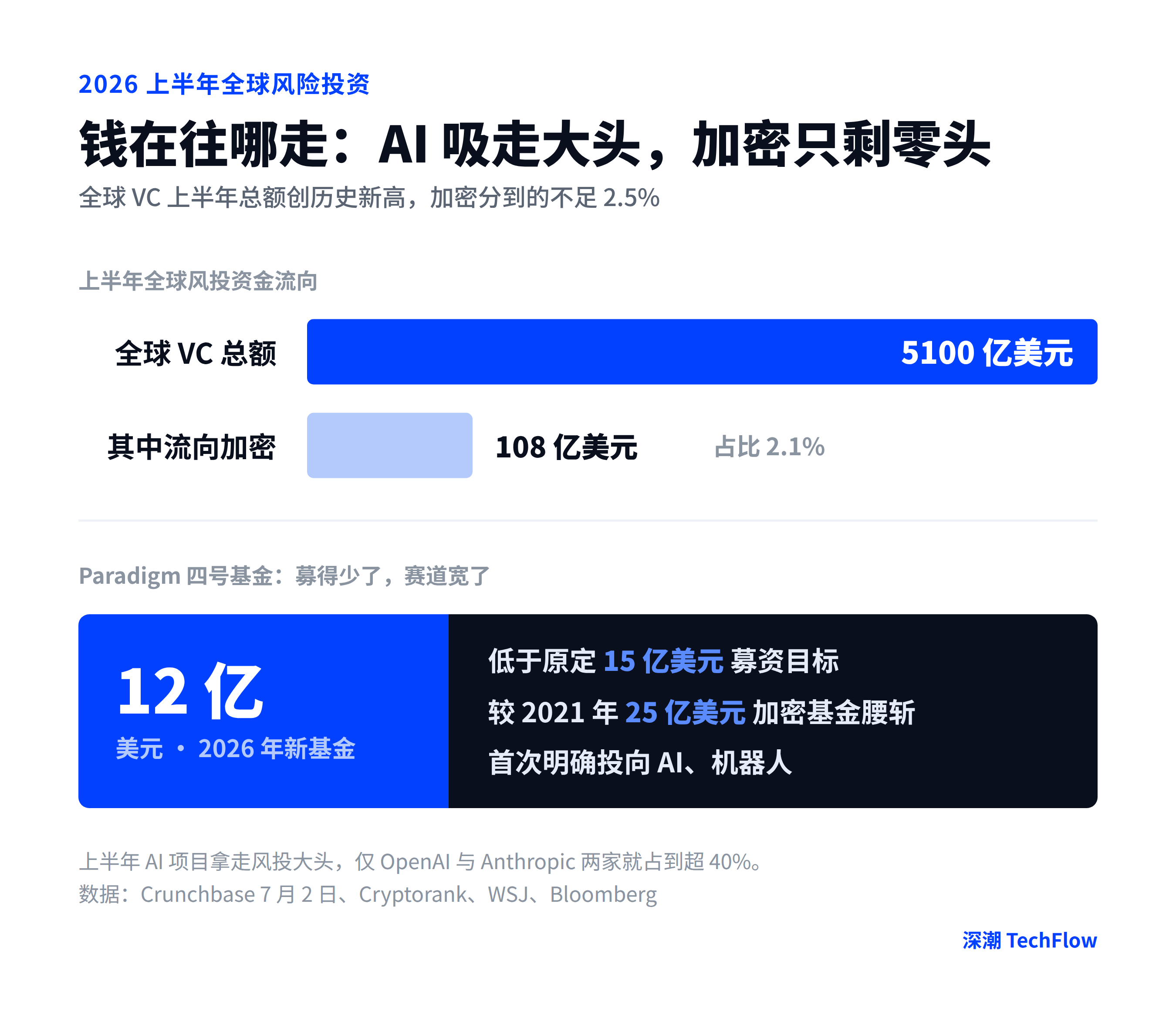
Deep Dive Guide: If you still think of crypto VC as just buying coins, Paradigm's new $1.2 billion foundation will let you recalculate your accounts. The fourth phase of the fund, which manages nearly $12 billion and is one of the best institutions in the crypto industry, clearly invested money in the three lines of AI, robotics, and encryption. The background is that out of the 510 billion US dollars in global venture capital in the first half of the year, crypto was only allocated 10.8 billion dollars. Old money is voting with its feet; the problem is that it still doesn't look like a pure crypto project.
On July 8, crypto venture capital giant Paradigm announced the completion of the fourth phase of the fund raising, worth $1.2 billion, to expand from crypto to AI, robotics, and other cutting-edge technologies. This is the fourth fund and the third venture capital fund since the company was founded.
Managing partner Alana Palmedo wrote on the X platform that this $1.2 billion will be invested in “steep exponential growth.” Their supporters believed in the frontier of crypto eight years ago, and now they want to double their bets on the “colliding frontiers” of AI, crypto, space, deep technology, and energy. Co-founder Matt Huang was quoted in an interview with Bloomberg as saying that crypto was their first frontier, and it's still exciting, but there are still too many things to ignore right now.
For the crypto industry, this isn't a tactical adjustment for a small organization. Founded in 2018 by Huang (former Sequoia partner) and Coinbase co-founder Fred Ehrsam, Paradigm is one of the biggest venture capitalists in the crypto sector, managing close to $12 billion in assets by the end of 2025. The fact that such an agency with “cryptographic native” written on its signboard publicly diverts half of its ammunition to AI and robots is a signal in itself.
$1.2 billion fell short of expectations and shrunk by half from the previous crypto fund
The figure of $1.2 billion is only interesting when viewed in Paradigm's own financing history.
The company raised a $2.5 billion crypto fund in 2021 and raised another $850 million early blockchain fund in 2024. The current $1.2 billion is more than half that of 2021. What's more worth considering is that, according to the Wall Street Journal's February report, Paradigm originally planned to raise up to 1.5 billion US dollars for this new fund, but the 1.2 billion that eventually fell short of the target of about 300 million dollars.
The fund-raising fell short of expectations, but the direction was broader. There is less money, and there are more racetracks. The trade-off in between points to the same thing: encrypting a single track can no longer hold the money that leading organizations want to invest.
For those who hold crypto assets or are concerned about the primary market, the meaning of the operation here is that the total amount of crypto bullets for leading VCs is shrinking, and early pure crypto projects may face more demanding and scattered capital pools in the future.
Venture capital of 510 billion dollars in the first half of the year, and crypto was only distributed to 10.8 billion
The real reason for Paradigm's transformation lies in the flow of capital throughout the industry.
According to Crunchbase's July 2 data, total global venture capital reached $510 billion in the first half of 2026, a record high of investment in the second half of the year, surpassing $44 billion for the full year of last year. Most of this money was taken away by AI, and OpenAI and Anthropic alone accounted for more than 40% of the financing amount in the first half of the year. (Disclosure: Anthropic is the developer of Claude, a deep-wave content tool; this data is from public reports, not provided by Anthropic.)
The crypto landscape was in stark contrast over the same period. According to Cryptorank data, venture capital inflows into crypto in the first half of the year were only $10.8 billion, less than 2.5% of the global total. The explosion of AI financing on the one hand and the cooling of crypto investments on the other is the immediate background behind Paradigm's decision to expand the racetrack.
Bloomberg's statement is more straightforward. Palmedo is not describing the trade-off of “choosing one of two,” but rather the abundance of “too many things to invest in.” The subtext is that Paradigm believes it has sufficient capital and research capabilities to invest in both, without sacrificing one side to the other.
Crypto hasn't been abandoned, but it's been downgraded to “one of the frontiers”
Both Palmedo and Huang have repeatedly emphasized that they have not given up on encryption; this statement needs to be taken apart.
Among the new fund investments listed by Paradigm, crypto still plays an important role: decentralized derivatives exchange Hyperliquid, Tempo, a stablecoin public chain co-incubated with Stripe, and Kalshi, a prediction market platform. In terms of open source tools, we continue to invest in the Ethereum development tools Foundry and Reth. These are the most active topics in crypto right now, decentralized transactions, stablecoin infrastructure, and regulated event markets.
But the list of non-cryptographic investments is just as long: autonomous drone delivery company Zipline, rapid manufacturing platform SendCutSend, space defense startup True Anomaly, and Nous Research (developer of Hermes Agent), an open source AI. According to CoinDesk, among the projects the new fund has invested in, Zipline was valued at $7.6 billion in January this year, and True Anomaly was valued at $2.2 billion in April.
Huang's position is that crypto and AI are not zero-sum competition; there is a lot of overlap between the two. Paradigm also specifically ordered a cross-project EVMbench, a blockchain security benchmark developed in collaboration with OpenAI. (Disclosure: OpenAI is a competitor to Anthropic.)
For crypto practitioners, the signal here is that even in the eyes of the most determined crypto VCs, encryption has gone from being the “only racetrack” to “one of the frontiers.” It is a fact that money and attention are being diluted. Determining whether this is good or bad for a specific project depends on whether it is stepping on the intersection of encryption and AI.
More than Paradigm, the collective expansion of crypto money
Paradigm is not an exception; crypto VCs have collectively moved beyond crypto in recent months.
Crypto venture capital Haun Ventures raised $1 billion in May to expand into AI for the first time while supporting crypto startups, according to Bloomberg. In June, Framework Ventures raised $400 million for the fourth phase of the fund to invest in crypto, AI, robotics, and energy. Coupled with Paradigm this time, the three leading crypto VCs invariably incorporated AI into their investment scope within two months.
There is both defense and offense behind this wave of table expansion. On the defensive side, the crypto market has become more institutionalized, more regulated, and more concentrated on a few large platforms, and early projects that can absorb large venture capital checks are declining. On the offensive side, AI and robots are creating a new round of company creation cycles. The scale and urgency are exactly what venture capital wants.
For those who want to enter the primary crypto market, this trend means that it may become more and more difficult to follow leading VCs in the future and only bet on crypto. These agencies are treating cryptography as part of a “cutting-edge technology stack,” not all of it. The next big company to be incubated by them is probably not in the crypto category at all.
Twitter:https://twitter.com/BitpushNewsCN
Compare the TG exchange group:https://t.me/BitPushCommunity
Compare TG subscriptions:https://t.me/bitpush
