


Wikipedia has less than 7% coverage, how can crypto projects be “hidden” in the AI era?

Author: Shenzhao TechFlow
Original title: Only 67 of the top 1000 crypto projects by market capitalization have Wikipedia pages. ChatGPT's “understanding” of the crypto industry is being distorted
Deep Tide Guide:Crypto evangelist Chainstory audited the Wikipedia coverage of CoinGecko's top 10,000 tokens by market capitalization and found that only 67 of the top 1000 had entries. Wikipedia is the single most cited source for ChatGPT (accounting for about 7.8% of total citations), which means that AI tools have systemic gaps in their perception of the vast majority of cryptographic projects. Neither the $15 billion Hyperliquid nor the $5 billion Sui have Wikipedia pages.
The crypto industry is almost non-existent on Wikipedia.
According to CoinDesk's July 14 report, a research report published by crypto communication agency Chainstory shows that according to CoinGecko's market capitalization ranking, only 67 of the top 1000 crypto projects have Wikipedia entries, with less than 7% coverage. At a time when AI tools are increasingly becoming the main channel for users to obtain information, this gap is systematically affecting the understanding and presentation of the crypto industry by models such as ChatGPT.
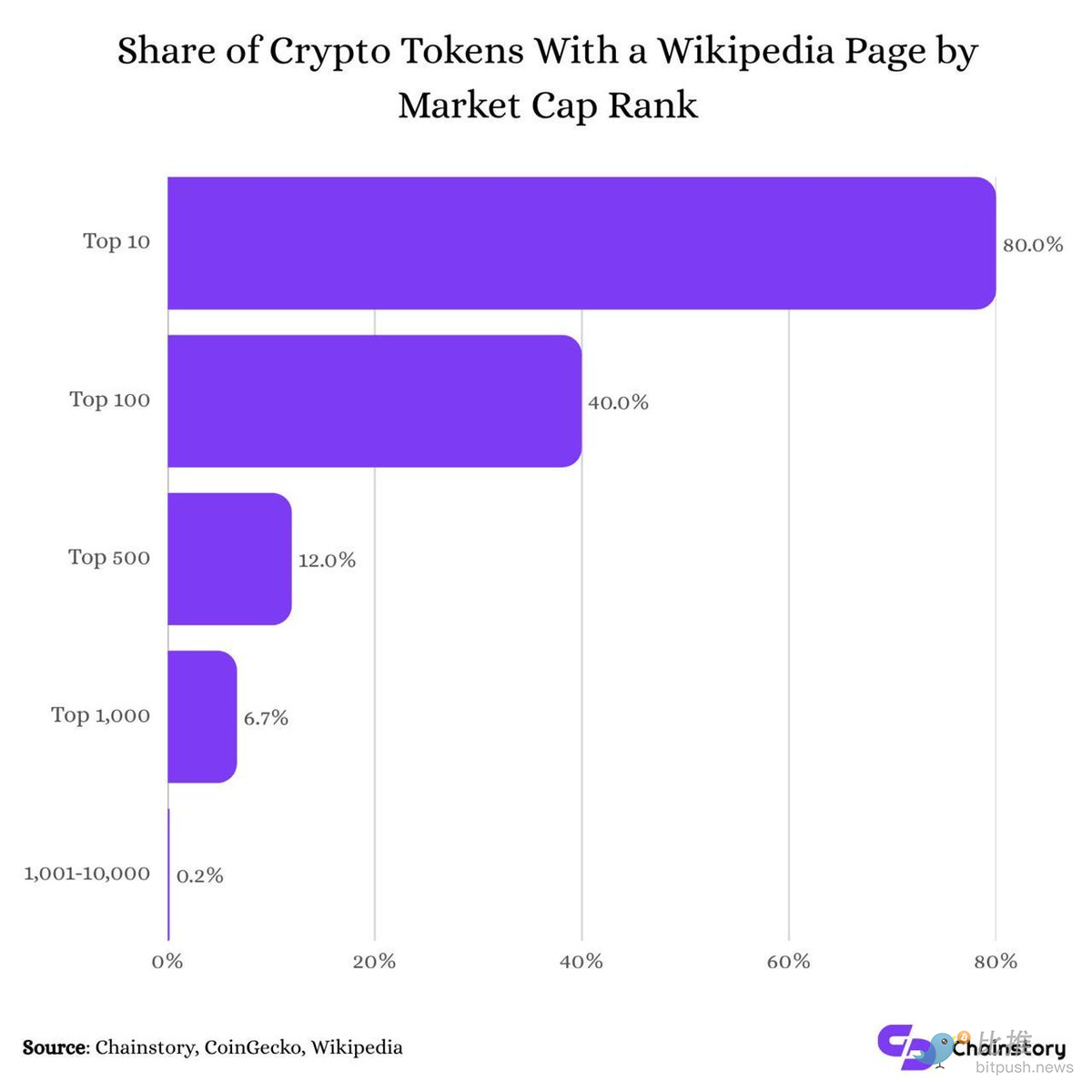
Coverage fell cliff-style with market capitalization rankings, and the $15 billion project had no entries
Chainstory conducted an audit of the top 10,000 CoinGecko tokens by market capitalization from June 1 to 4, 2026, to verify the existence of entries one by one through the Wikipedia API. The results showed an extreme long-tail distribution:
The top 10 tokens by market capitalization had 80% coverage, the top 100 dropped to 40%, the top 500 only 12%, the top 1000 dropped to 6.7%, and the 1001-10,000 ranked 1001 to 10,000 tokens had coverage of only 0.2%. Out of the entire top 10,000, only 84 tokens have Wikipedia entries.
There is no shortage of huge projects on the absentee list. Hyperliquid, a perpetual contract platform with a market capitalization of about $15 billion, has no Wikipedia page; Sui, a Layer-1 network with a market capitalization of about $5 billion, is also absent; Monad Labs (valued at $3 billion) led by Paradigm, Berachain (valued at $1.5 billion) co-led by Brevan Howard Digital, and eigenLayer with a $100 million investment by a16z, None of them have been recorded on Wikipedia.
The smallest project with a market capitalization of $15 million and ranked 959th is Firo.
As a comparison, Wikipedia includes about 640 fintech companies and more than 7,000 software companies, but only about 80 companies in the crypto and bitcoin categories.
Wikipedia is ChatGPT's most cited single source, accounting for nearly 8%
The reason this coverage gap is important is because Wikipedia's position in the AI information chain far exceeds common perception.
Chainstory cites audit data from AI tracking platform Investigations in the report: Of all ChatGPT citation links, about 7.8% point to Wikipedia, and Reddit (1.8%) and Forbes (1.1%), which rank second and third, are far behind. Of the top 10 most referenced domains by ChatGPT, Wikipedia accounts for about 47.9%.
Another research agency, Trakkr's analysis of 3.29 million citation links showed that as of May 2026, Wikipedia had 36.1% of the top 10 ChatGPT citation sources and 25.3% of the top 100 cited sources.
Muck Rack's May 2026 study further confirmed that Wikipedia is not only ChatGPT's number one citation source, but Claude's second most cited source (after PubMed Central), and the fourth most cited source for Gemini.
According to the report, Wikipedia mainly provides conceptual information to AI models, but when users ask questions about specific projects, Wikipedia entries are the core basis for model reasoning. Projects with entries are clearly defined and described in AI answers; for projects without entries, AI can only piece together information from scattered second-hand mentions, and is prone to basic factual errors such as the founder, time of establishment, and headquarters location.
The root cause of Wikipedia's low coverage of crypto projects lies in Wikipedia's special review threshold for the crypto industry.
Wikipedia has developed specific crypto-related attention guidelines, requiring that the project's attention must come from “mainstream” news sources, clearly stating that the media that mainly reports on the crypto industry “are insufficient to prove attention.” The guide even names CoinDesk and Bitcoin Magazine as “generally unreliable” crypto media. The same logic also applies to cryptographic native media such as Cointelegraph, Decrypt, and The Block.
Reliable sources recognized by Wikipedia include mainstream business media such as Reuters, Bloomberg, CNBC, and the Financial Times. However, these media paid little attention to crypto segments such as liquid collateral and perpetual contract DEXs.
Chainstory pointed out this contradiction in its report: media that actually report on crypto industry developments have no source value in Wikipedia's eyes, and mainstream media approved by Wikipedia do not cover most cryptographic projects.
The process of creating new terms itself is also an obstacle. New articles need to be reviewed by volunteers to check standards such as attention, verifiability, and reliable sources. Even if it passes review, the administrator can still delete it unilaterally, or decide to stay through a 7-day community vote, and the subject of the entry has no right to participate and cannot appeal.
Twitter:https://twitter.com/BitpushNewsCN
Compare the TG exchange group:https://t.me/BitPushCommunity
Compare TG subscriptions:https://t.me/bitpush
