


$365 million is betting on tokenization, Cantor wants to end the IPO roadshow

Author: Prathik Desai
Compiled and organized by: bitPushNews
preface
Just in the same week that Cantor and Securitize joined forces to promote stock tokenization, Canton chain developer Digital Asset raised an additional 10 million US dollars, bringing the total of this round to 365 million US dollars, with a valuation of 2 billion US dollars.The money came from an unidentified institutional investor. The $365 million not only placed Digital Asset among the largest blockchain infrastructure companies to finance in 2026, but also sent a clear signal that the boundaries between traditional finance and the crypto world are dissolving faster than expected.
Why now? Why Cantor? The answer points in the same direction: equity financing is undergoing a paradigm shift comparable to a revolution in the bond market.
A company that wants to borrow $200 million can use either a commercial paper project or a portion of the medium-term note (MTN) issuance amount. The former satisfies immediate cash needs through a continuous and revolving debt issuance mechanism. The latter allows companies to sell bonds in batches when market conditions are favorable using a one-time “shelf registration” filed with the supervisory authority. But if the same company wanted to raise $200 million by selling its shares, it would have to hire bankers, spend weeks visiting fund managers, and pay up to 7% of the capital raised to cover the cost of the entire process.
This is one of the oldest questions in corporate finance. Issuing bonds is a routine operation, but issuing shares requires a “ceremony.”
This asymmetry is due to more than just paperwork or regulatory requirements. The bigger problem is on the demand side. A company's shares are traded in only one trading pool on an exchange during trading hours. When the number of shares it wants to sell exceeds the trading pool's absorption capacity, the bank or fund manager must go through a roadshow to find new buyers.
Blockchain can solve this asymmetry by expanding the scope of the geographical market for which new shares are issued.
This article will explore how the tokenization trajectory makes equities behave like bonds, and who captures value in the process.
Peel away the sense of ceremony
Although IPOs involve roadshows and processing costs in the form of bank commissions that account for 5-7% of the amount raised, it has become relatively easy to issue additional shares over the past few decades. In 1982, the US Securities and Exchange Commission (SEC) passed Rule 415, creating a “shelf registration” system that allows eligible companies to register securities they plan to issue over the next two years and then sell them in batches.
The “Issuance at Market Price” (ATM) program goes a step further. Under this model, the company issues new shares to designated broker-dealers in the primary market. Brokers then trickle these stocks into the open market in small amounts to avoid a sudden oversupply. Usually, the market doesn't notice this action until the company releases its quarterly report.
ATM projects may only bring issuers 1-3% of commission costs, which is only half of the IPO fee.
However, there is still a problem with these ATM projects. If a company's broker-dealers invest too much stock into a weak order book, they will artificially cause prices to fall. That's why this route is only suitable for companies looking to raise modest capital. For larger financings, companies still tend to opt for roadshows. This is what the IPO fee buys from partner banks — the ability to find buyers for their new shares.
Blockchain can solve this problem.
Widen the pipeline
Last week, Cantor Fitzgerald partnered with Securitize to allow the company to issue shares directly on the blockchain. This is unlike other tokenized stock versions that have appeared on the blockchain. Vaidik and I have written about how ownership works in these different versions. Some of these tokenized versions are simply packages that provide price exposure, and do not come with voting rights or ownership.
But Securitize isn't packaging stocks. Cantor — the bank that topped the US IPO underwriting list in 2025 (its business covers equity, SPAC, and ATM placements) — knows that there is also value to be tapped in expanding demand coverage for US listed companies.
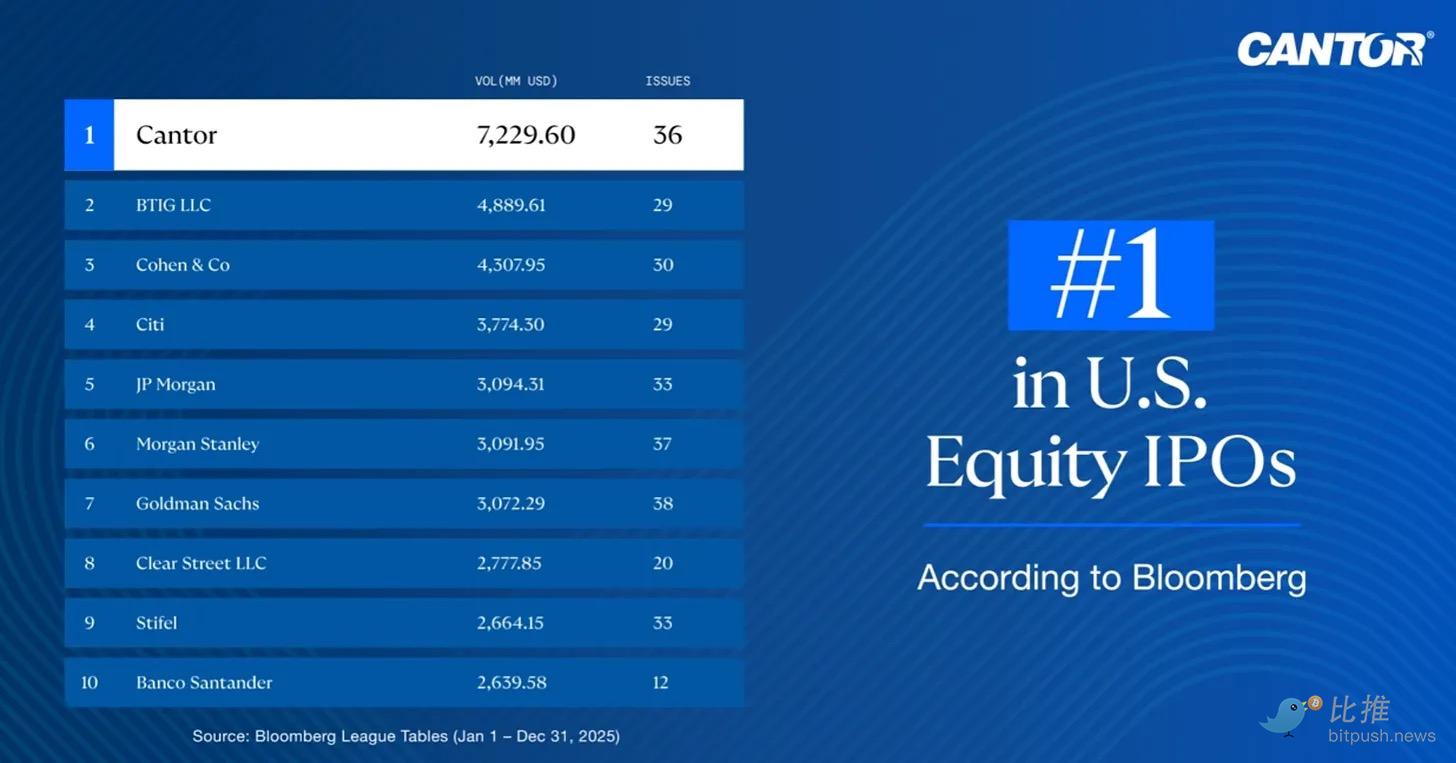
@Cantor
On July 2, Securitize became the first US company to complete listing and listing on the same day. Its approximately $270 million common stock (SECZ) began trading simultaneously on the Solana and Avalanche blockchains on the morning of the same day it was listed on the NYSE.
Two weeks later, Securitize teamed up with Cantor to market this proof of concept as a product and sell it to other companies. Cantor will contribute to its equity capital markets team and transactional relationship resources. Securitize provides tokenized infrastructure around issuance, distribution, and settlement through its SEC-registered brokerage dealer Securitize Markets. The two will jointly provide IPOs and additional issuance services for companies, and some of these stocks will be “born” on the chain.
In principle, on-chain issuance allows global investors to access and own US securities just like investors in the US. Tokens issued through Securitize enjoy the same voting rights and dividend claims as the underlying shares recorded on the official shareholders' register.
But whether this equal status can cover non-US investors depends on the regulatory environment. The issuing company must simultaneously issue a parallel Reg S batch in addition to a registered offering to the US. Although shares issued under this batch enjoy similar voting rights and dividend claims, Securitize's own SECZ tokens are currently limited to eligible US investors.
If this parity can be ensured, then a company issuing on a chain will no longer be limited by the depth of its own listing order book. The “trickle in” of IPOs will be supported by broader demand.
The tokenization of the stock issuance layer also occurred at the same time as the tokenization of the settlement layer.
DTCC — an institution that clears almost all US stock exchanges — has completed the first batch of real-time tokenized transactions for SPY, QQQ, and treasury bonds with more than 50 institutions, and is scheduled to fully launch in October this year.
Rationalize requirements
Simply building infrastructure is not enough to gain widespread adoption. Only native crypto investors can immediately understand and value the convenience and value of tokenized stocks. Tokenization and blockchain are unfamiliar concepts to most non-crypto-native investors.
At this point, companies are setting up markets in the language most understood by traditional retail investors. Robinhood has made tokenized stocks one of its 28 million funding accounts a key product over the past year. It recently launched a stock token on its native Robinhood chain for retail users who want to hold tools on the chain but don't need to know or care what its underlying chain is.
Although Robinhood's packages don't raise capital for anyone, they help issuers by addressing an urgent need on the distribution side. Retail platforms like Robinhood have nurtured large numbers of users to hold tokenized shares through familiar apps without touching mnemonics. Such investors are more likely to be future buyers of tokenized shares directly issued in the pipeline that Cantor and Securitize are building.
This pipeline removes the complexity of increasing distribution, making it as simple as financial operations. It is easier for companies to issue bonds because it allows the company to continue financing, provides a deep pool of buyers including money market funds, insurance companies, and bond trading departments, and has a relatively small impact on the company's stock price. Although the “shelf registration” rule introduced in 1982 allows companies to continue to issue shares, it is less effective because issuing additional new shares in a weak order book may cause large price fluctuations. The issuance of tokenized shares made up for these shortcomings, making the shares behave like bonds.
What is at stake?
According to SEC data, US companies raised about US$207 billion in new equity through IPOs and additional offerings in 2024, compared to US$219 billion in 2025. When SPAC and other blank check instruments are included, this figure amounts to $216 billion and $246 billion, respectively. Issuing just one additional item brings in about 175 billion dollars a year, spread over about 1,000 transactions per year.
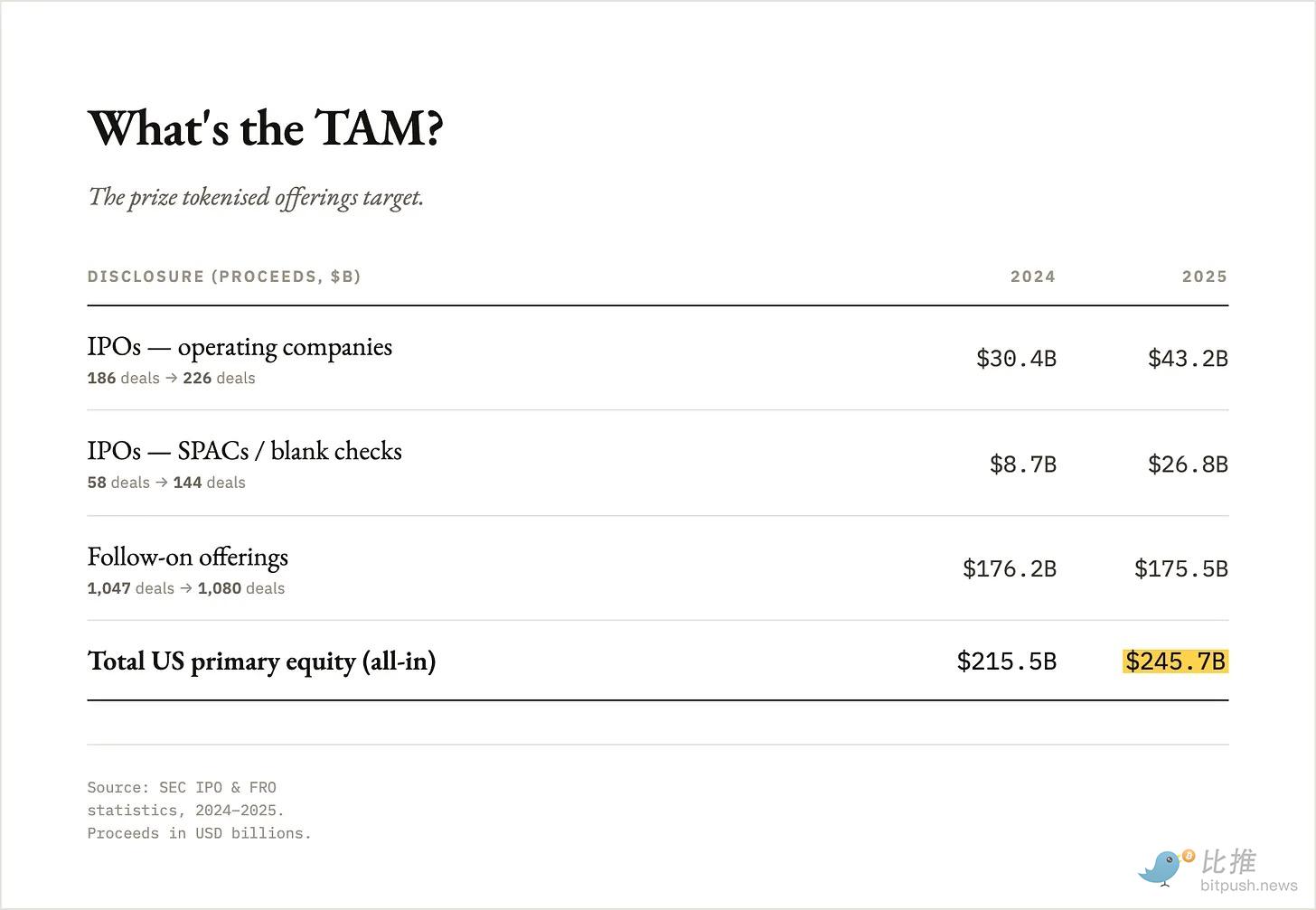
This trend continued in 2026. In the first half of the year alone, the company raised about $115 billion through its IPO, mainly thanks to SpaceX's $75 billion debut in the second quarter. According to SEC data, the increase in issuance has maintained an operating rate of about $175 to 180 billion dollars per year.
Cantor's own equity division expects issuers to test tokenization with 5-10% of an offering. Even starting with a conservative starting range of 1% to 2%, revenue could reach $220 million depending on rate percentages.
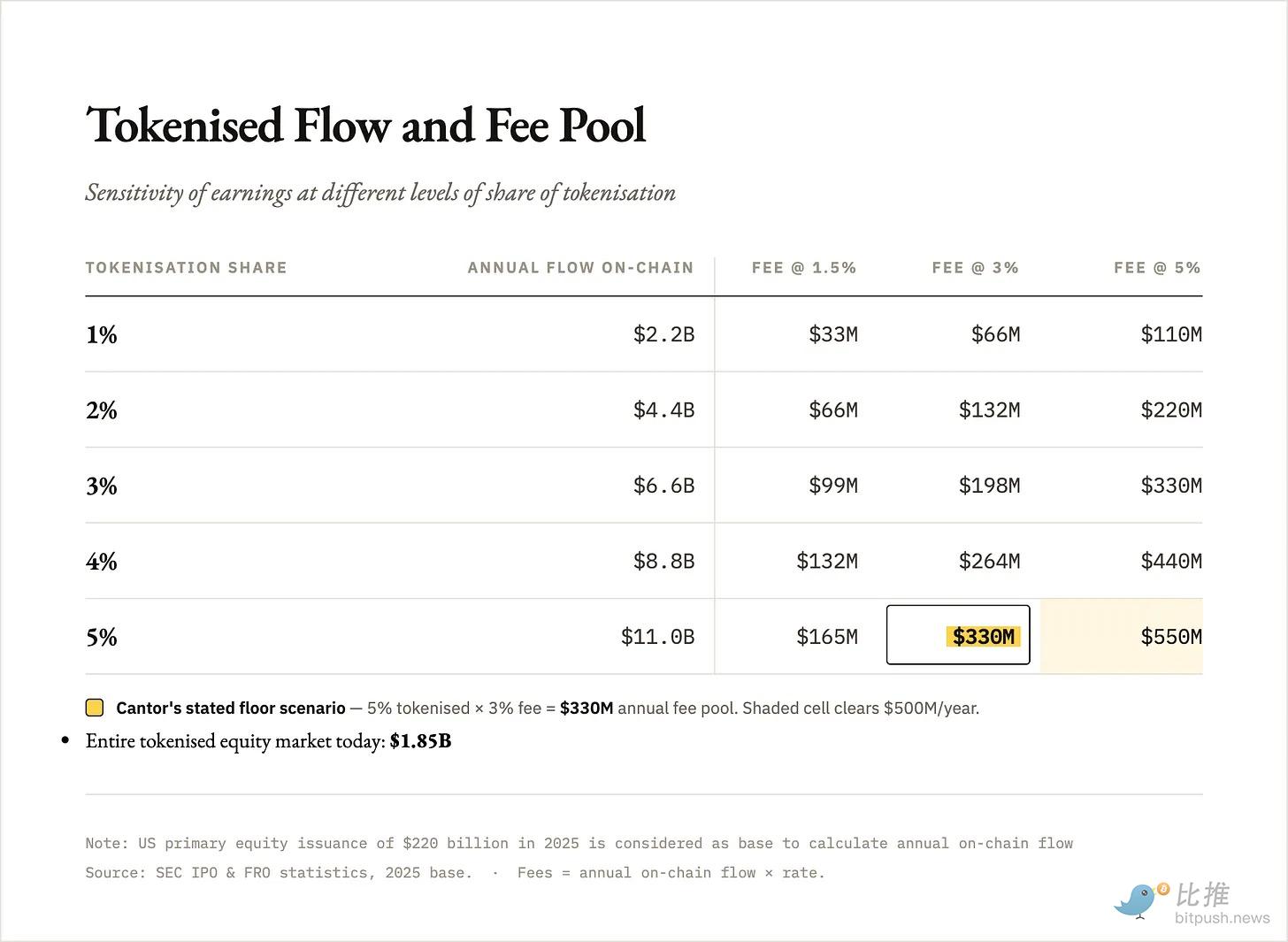
At a 1% adoption rate, about 2.2 billion US dollars circulate through the on-chain track every year, exceeding the total current stock of tokenized shares. At a 5% adoption rate, the fee pool is close to US$330 million per year, equivalent to one-fifth of J.P. Morgan Chase's 2025 equity underwriting revenue.
The tokenization layer is a market opportunity for anyone with these tracks. As IPO underwriting fees are compressed due to the “unbundling” of IPOs, tokenized stock issuance acts like a hedge for underwriters like Cantor trying to capture value in this new tier.
Bet on incremental demand
Today, the tokenized version of the main stock is trading less than 1% of the trading volume of its principal listed shares. In its current form, the adoption appears to be mainly a transfer of funds from existing crypto users. However, tokenized stock issuance can reach an incremental pool of funds. A retail investor in Bengaluru or Lagos who has stablecoins but is unable to open a US brokerage account can still own a share like a US resident. The size of this pool has yet to be counted. But the growth of tokenized stocks (which have tripled in the past 12 months) bodes well for what is possible in the future.
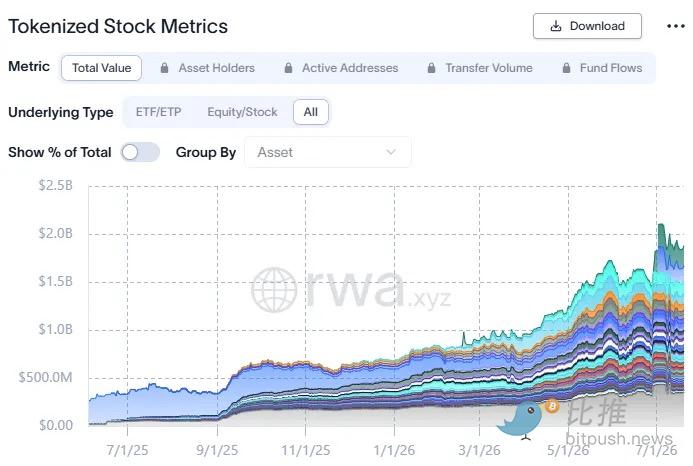
@RWA .xyz
The art of capturing value
Cantor is in a position to capture the most value out of it. Its number one IPO underwriting position is largely based on SPAC underwriting business. Many other banks collect 5-7% of the IPO capital raised to visit institutional investors and find demand that exceeds the company's supply. It is this business that will be eroded by on-chain publishing. Cantor's business doesn't rely heavily on road shows. In fact, it was Cantor's SPAC that brought Securitize to the NYSE at a valuation of $1.25 billion. If tokenized offerings expand in scale, Cantor will profit from its holdings, regardless of who is responsible for these offerings.
You can see Cantor's value capture strategy in other deals. Cantor hosts Tether's treasury bond holdings. It also co-founded Twenty One Capital, a Bitcoin money management tool with Tether and SoftBank. The pattern is,Hold shares in the crypto counterparties of its services in order to have a place in any future value-added layer.
When a feature is commercialized in this industry, the costs are transferred to neighboring layers that are not yet crowded out by competitors.
In the corporate world, we first saw the commercialization of pricing through blockchain-based trading tools such as perpetual contracts, prediction markets, and tokenized stock wrappers. The market is now hinting at a company's IPO price level before bankers opened the books. Settlement is being commercialized as DTCC competes for tokenization. The Cantor-Securitize deal is an attempt to commercialize demand generation, and aims to make bankers redundant in every round of new stock issuance.
Although I think it's too early to bet on incremental demand, it's in the right direction. Today's on-chain buyer pool isn't enough to support an increase in the issuance of a mid-cap stock. But over time, with the help of centralized platforms like Robinhood that take in millions of retail users and provide them with these tokenized stocks, these demand pools will be built. They don't need to know that blockchain is behind it all. The more this happens, the more likely it is that the company will choose a tokenized distribution route.
Roadshows and ceremonies may still not die out. They may fall back to areas where manufacturing demand is still needed. For companies and industries like SpaceX and OpenAI that don't have that deep liquidity on the blockchain, roadshows and ceremonies will remain important. However, in terms of cost efficiency and ease of financing, most companies would prefer equity financing over borrowing.
Twitter:https://twitter.com/BitpushNewsCN
Compare the TG exchange group:https://t.me/BitPushCommunity
Compare TG subscriptions:https://t.me/bitpush
