


Insiders broke the news: April ban, May layoffs, BitMart shutdown long predicted
A “wave of bankruptcies” of cryptocurrency exchanges is spreading at an accelerated pace.
继AscendEX(formerly BitMax),BitMEXFollowing the announcement of the shutdown, on July 26, BitMart made an official announcement announcing the decision to stop operations in an orderly manner after comprehensively evaluating the company's operating status, market environment and future strategic direction.
There was an uproar in the crypto community, but in fact, the downfall of BitMart was by no means a “sudden decision”; some signs have already appeared.
Withdrawals were abnormal in April, and layoffs began in May
At the end of April this year, anomalies began to occur within BitMart.
According to information circulating in Lark's internal group at the time, the platform clearly indicated that user orders were not in line and directly gambled with users — as long as the user wins money, the funds will be locked. The customer service response was that withdrawals are prohibited for at least three months, and will not be lifted when they expire.
At the beginning of May, several BDs reported the issue of user funds being banned in an internal group. As a result, contract leader Gavin directly requested Roham, the head of the mainland region, to close the group. The BDs moved to another group and continued to report, and were also kicked out.
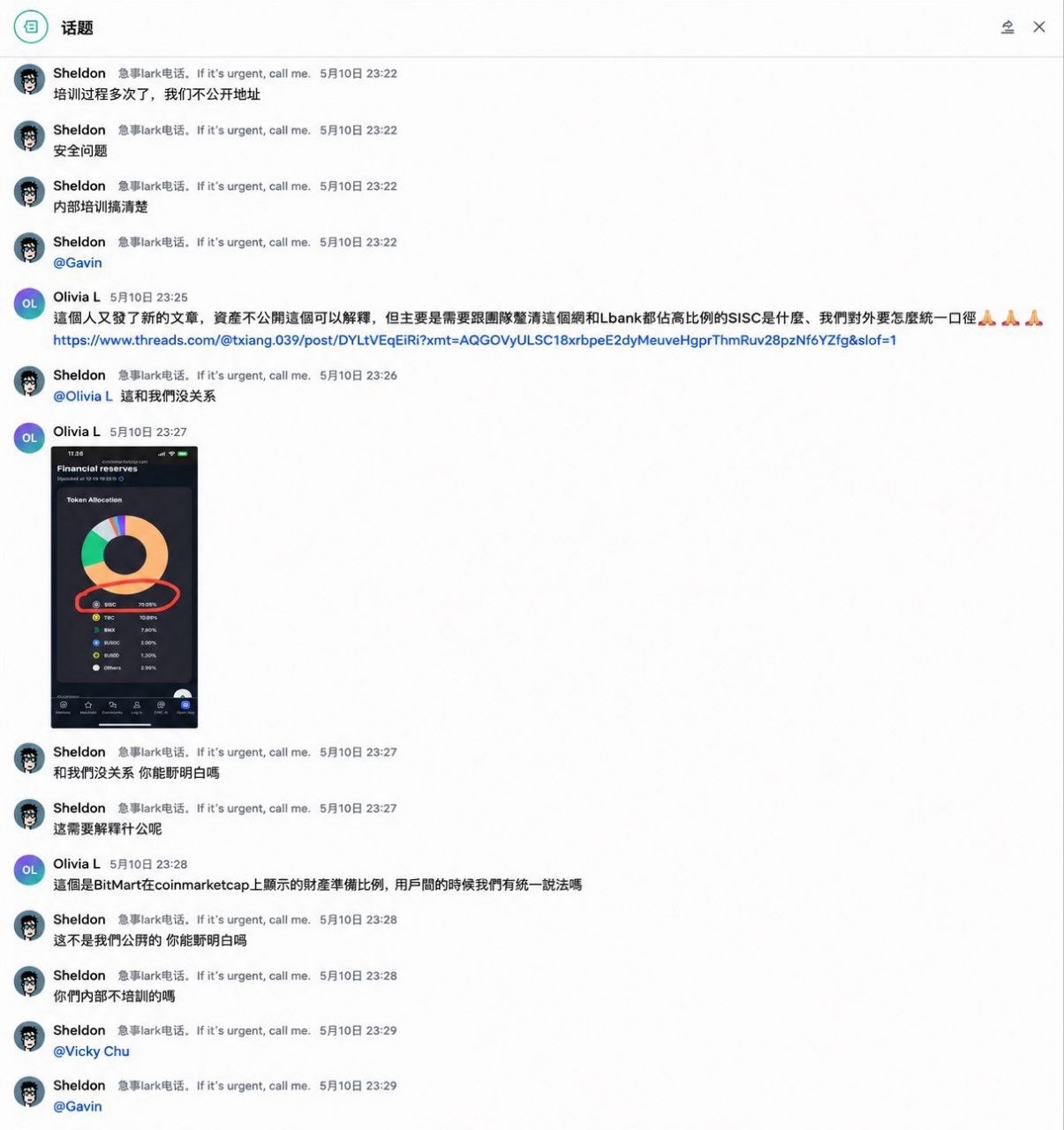

In the same period, some employees inquired about the company's asset reserves in the group, and was harshly criticized by founder Sheldon Xia. Sheldon clearly stated that BitMart was unwilling to disclose asset reserve certificates.
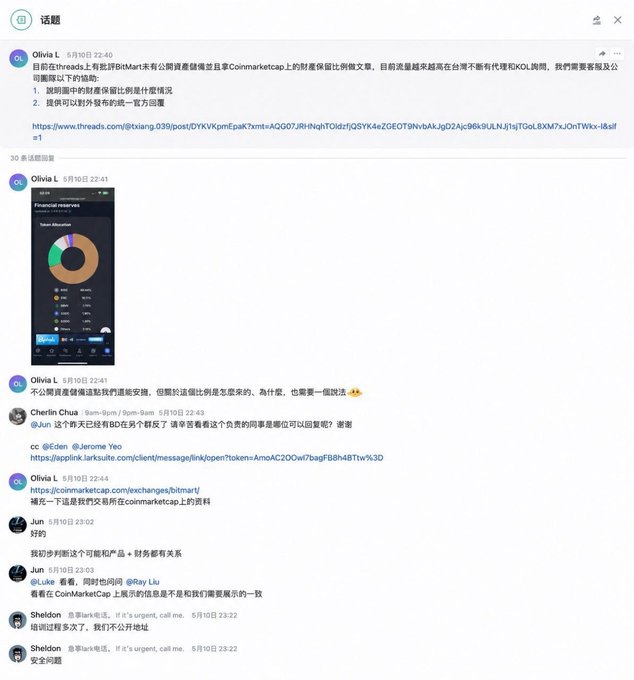
An anonymous Bitmart employee told Bitpush that the entire department's layoffs began in May.

Interviewees said that in May of this year, the company had already begun to “silently” abolish some business divisions — no formal announcements, no separation compensation negotiations, and the entire department was notified “not to be used tomorrow.”
These abolished departments mainly focus on business lines where growth is weak or compliance costs are too high, including some overseas operations teams and marketing departments.
With this complete shutdown, many people only learned through the official social media that they have lost their job, without the slightest preparation.

DI (@Start16Start), a whistleblower who claims to be a “former BitMart employee and current WEEX employee,” wrote on the X platform that BitMart “went from using the unattainable KPIs of CIS employees to reduce our salaries to the chaos within the entire company.” He alleges that the company has long been delinquent on employees' wages and bonuses and refuses to deliver on promises to employees, traders, and KOLs.
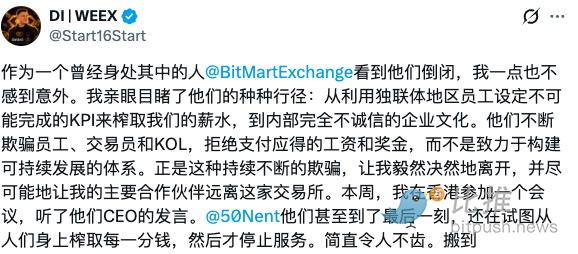
“This endless act of deception is the reason I chose to leave and keep my key partner as far away from that conflict as possible.” DI wrote.
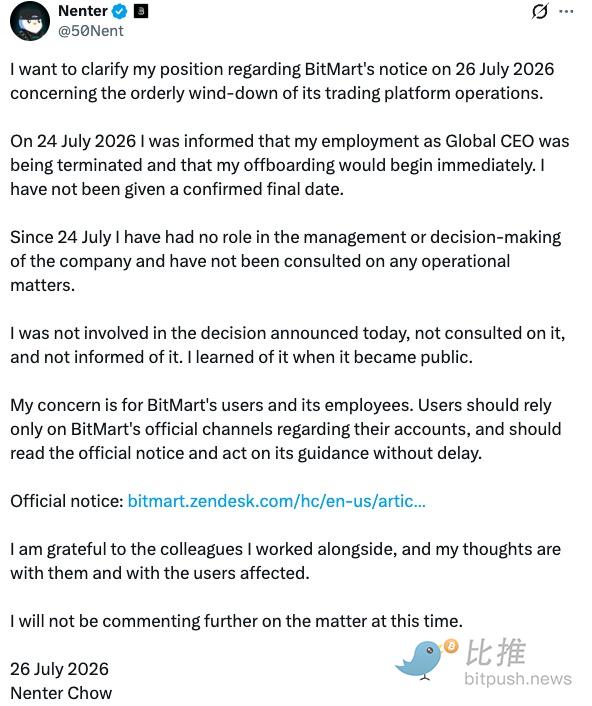
The most absurd thing about this shutdown is that BitMart Global CEO Nenter (Nathan) Chow posted a clarifying statement on X:
“On July 24, 2026, I was told that my role as Global CEO would be terminated and the separation process would begin immediately. I have yet to receive confirmation of my final separation date. Since July 24, I have not participated in any management or decision-making of the company, nor have I been consulted on any operational matters. I was not involved in the decision announced today, was not consulted, and was not informed in advance. I only learned about it when I saw the public announcement.”
Chow said he is most concerned about BitMart users and employees, advises that users only handle account matters through official channels and “will not comment further on this matter”。
Chow joined Bitmart as a partner at Animoca Ventures in April 2025 as Global CEO, where he createdFounder Sheldon Xia was re-elected as Group President. In just over a year, the CEO witnessed the end of the company by being “fired”.
Just a month ago, BitMart also claimed its asset management business in a reportAUM grew by about 256% month-on-month, and Chow also said “BitMart is eight years old and we plan to work for another eight years”.
Bitmart also previously claimed to have obtained an Australian AFSL license, serving more than 13 million users. It was only one month from “working for another eight years” to “announcing the shutdown”.
创The founder, Sheldon Xia, has not made any direct comments on the shutdown as of press time.
KOL: Customer service and BD garbage exchanges will go out of business
Crypto KOL @tradermige posted an article on the X platform saying, “The employees at BitMart and BitMEX are all in a shambles. No wonder they went out of business. I had a hunch for a long time.”
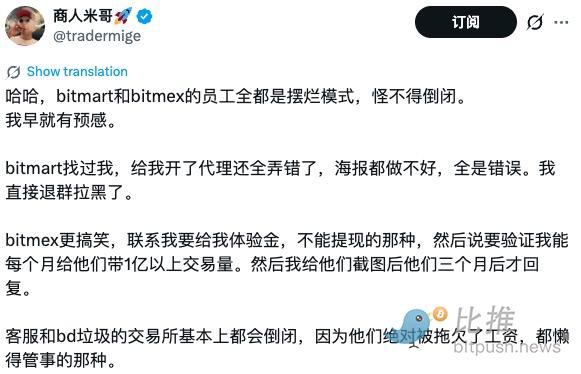
He recounted his experience working with BitMart: BitMart set up a rebate agency for them, but “they made all mistakes, the posters weren't good, they were all wrong”, and in the end, he simply left the group and blackmailed. For BitMEX, the other party contacted him to give away the trial fee but was unable to withdraw it. They also needed to verify that he brought more than 100 million transactions to the exchange every month. “I only responded three months after I gave them a screenshot.”
The KOL said, “Customer service and BD garbage exchanges will almost always go out of business because they are definitely in arrears of wages, and they are all too lazy to manage.”
Phyrex, on the other hand, gave a different perspective. He believes that BitMart and BitMEX “did not go out of business due to thunderstorms; they are very different from FTX's sacrifice; these two companies are mainly business issues.”
Withdrawal crisis: only 60+ wallets were successfully withdrawn within 24 hours
In addition to chaotic internal management, what worries users the most is the asset safety issue.
According to Lookonchain monitoring, 24 hours after BitMart announced its closure, only 63 withdrawal applications were approved, totaling about 800,000 US dollars, and the withdrawal fee was as high as 10.97 US dollars.
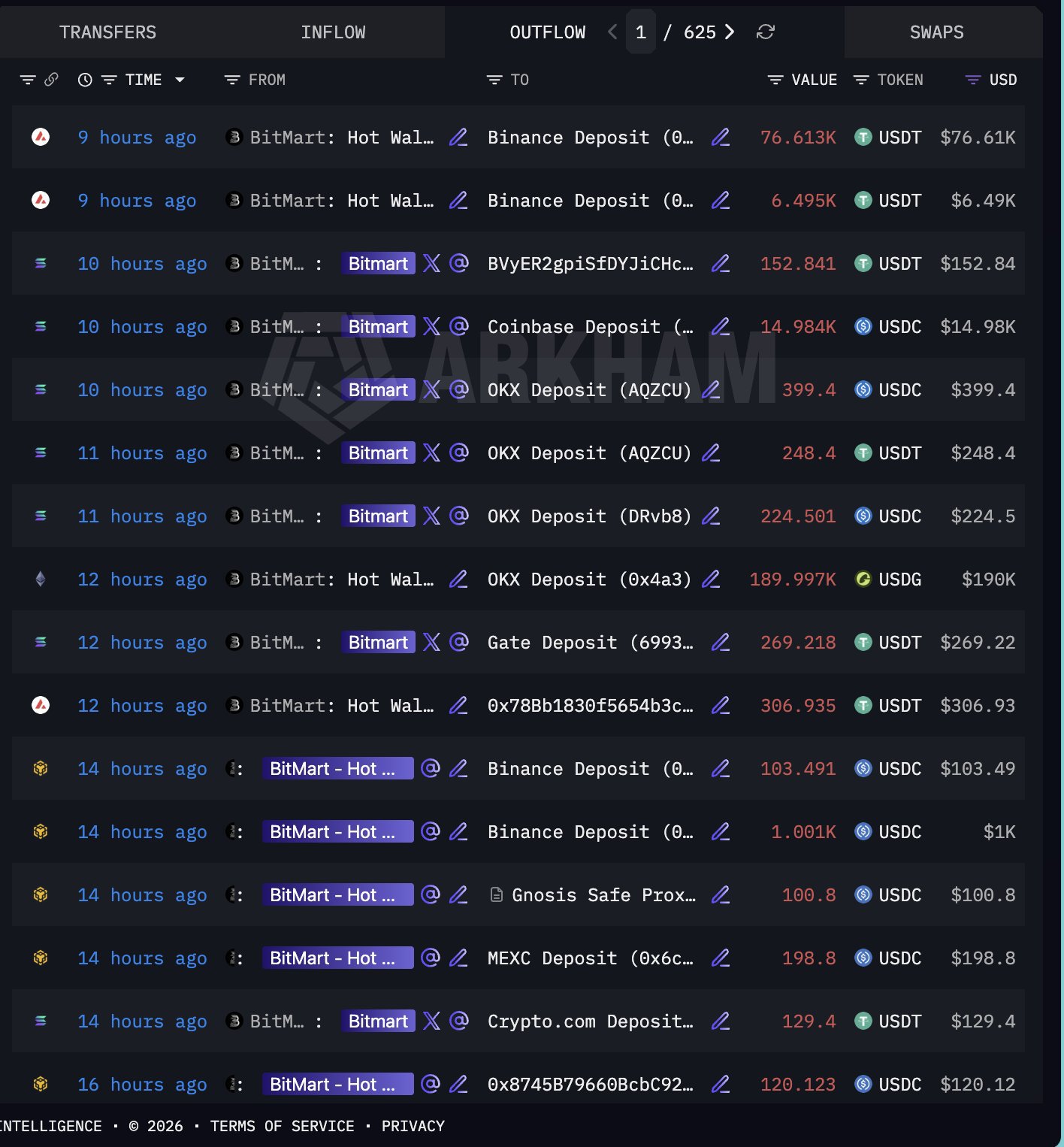
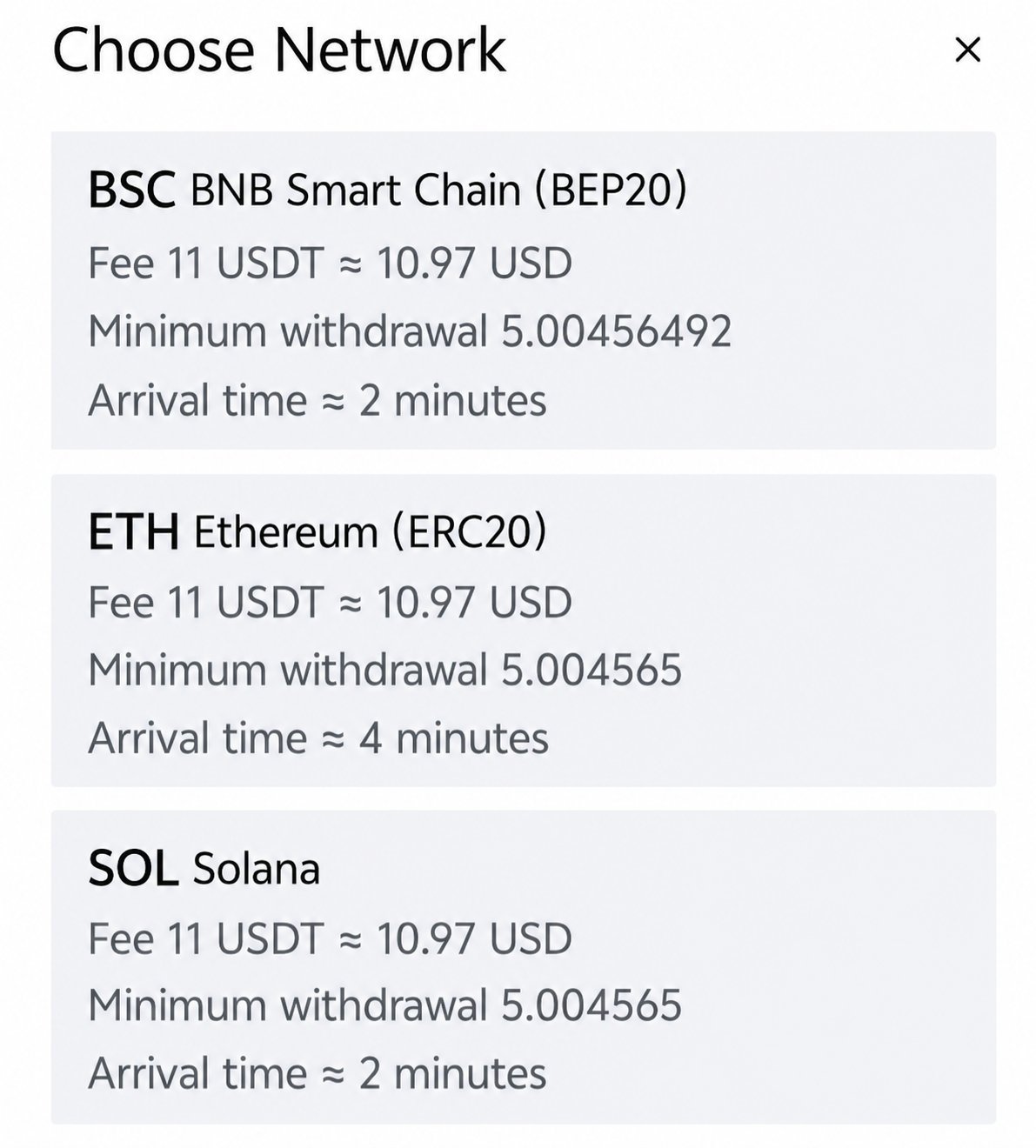
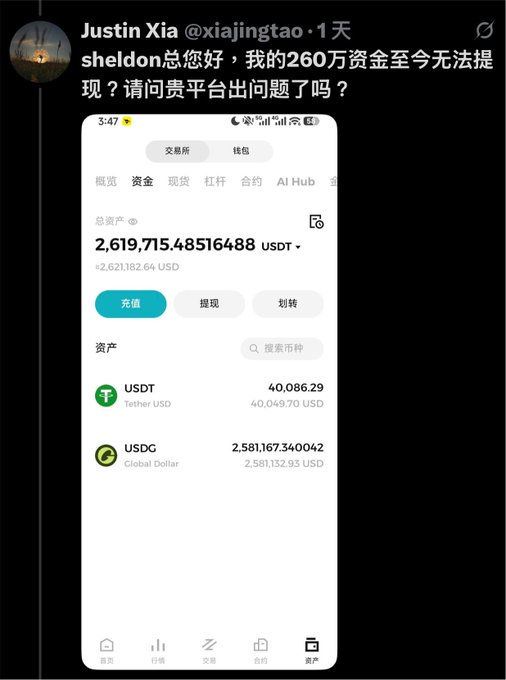
Funds worth up to 2.6 million US dollars from large BitMart customers were withdrawn from the card, and no customer service handled it:
On-chain data also showed that BitMart's public reserves fell sharply from about 12 million dollars to about 2 million dollars, and large withdrawals almost stagnated. The BMX platform coin plummeted by nearly 60% within 24 hours after the announcement.
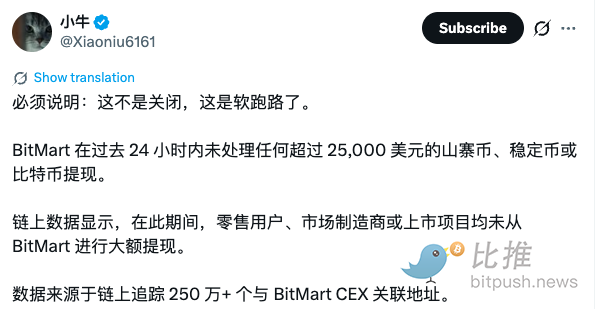
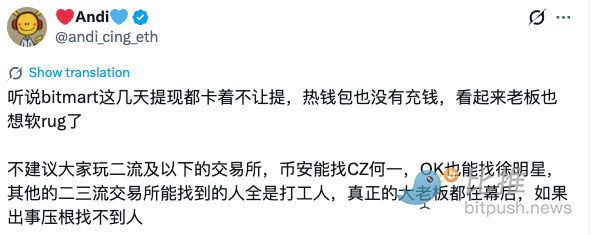
Despite official promises that the withdrawal service will continue to be open until January 2027, some users' withdrawal requests have already entered the “manual review” process, and the processing time is uncertain. Officially, users are advised to complete identity verification and close all positions before August 26, and submit withdrawal requests as soon as possible.
Crypto companies are falling one after another: is this bottoming out or an abyss?
BitMart isn't the first, and probably won't be the last.
According to Rootdata statistics, as of July 26, 2026, blockchain and encryption projects announced cessation of operation, bankruptcy, or long-term inability to use the website properlyReached 101. This ever-changing death list spans the whole year, from DeFi protocols and crypto wallets at the beginning of the year to today's established exchanges, and the pace is picking up.
With the European MiCA Act officially ending the transition period and forcibly removing unlicensed institutions, combined with US regulations and comprehensive penetration of global anti-money laundering “travel rules,” non-leading platforms that once relied on “gray leverage, high transaction fees, and compliant arbitrage” have completely lost profit margin. This is by no means the collapse of the “decentralized ideal,” but rather a brutal commercial knockout.
The future exchange landscape will be extremely polarized: offshore small and medium-sized platforms will return to zero at an accelerated pace, and liquidity will be completely concentrated on the few who eat Wall Street ETF dividends and hold global compliance licenses.
But the other side of elimination is reconstruction. The traditional CEX offshore spot model is losing its appeal, and tokenized assets (RWA) and on-chain derivatives (Perp DEX) are becoming new channels for capital flows. From tokenizing US stocks and treasury bonds to bringing Wall Street interest-bearing assets to the chain, to on-chain perpetual contracts that allow users to trade global assets with extremely low cost and high leverage, blockchain is being transformed into a global financial clearing platform that operates 7 x 24 hours a day.
The collapse of established exchanges will certainly trigger panic and pressure and drain liquidity in the short term — this is the most intense and painful “deleveraging” process during the bottom-finding phase. However, looking at the larger cycle, this is exactly the only way for the market to get rid of rotting skin and concentrate capital back on safe assets. When the stock bubble is completely dried up and compliance pipelines are laid, the crypto market can truly complete this “bottom-building reconstruction” that spans traditional finance and Web3.
Author: Seed.eth
Twitter:https://twitter.com/BitpushNewsCN
Compare the TG exchange group:https://t.me/BitPushCommunity
Compare TG subscriptions:https://t.me/bitpush
