


Violent trend in the AI sector: rebound or reversal?

A month ago, one of the most popular judgments in the market was “the end of the AI story.”
The reason sounds good enough: chip stocks are too expensive, the capital expenses of tech giants are becoming more and more like a bottomless hole, revenue hasn't fully caught up, and cash flow has already been eaten up by data centers, GPUs, and power facilities first. After the drastic adjustment of AI assets in July, many people even began to compare this round of the market to the internet bubble.
But the market soon gave another answer.
On August 4, local time, the Dow rose 1.7% to 54,085 points, and the S&P 500 rose 1.8% to 7,736 points, both breaking closing records. The NASDAQ surged 2.6%, and the Philadelphia Semiconductor Index rose more than 6%. The cumulative rebound of the NASDAQ in four trading days was close to 9%. Palantir led the AI sector, surging 29.5% in a single day — CEO Alex Karp called it an “beyond imagination” quarter, with revenue surging 93%. Money is pouring back into chip, storage, and AI infrastructure. Even traditional industrial giant Caterpillar has benefited from a surge in data center turbine orders. For the first time, revenue in a single quarter exceeded 20 billion US dollars, and its stock price surged 5.6%.
The decline in oil prices and US bond yields certainly helped — Brent crude oil plummeted 5.4% to $79.25 per barrel in a single day, and the 10-year US Treasury yield fell from 4.70% to 4.63% — but what really ignited technology stocks was the same signal sent by several financial reports: AI investment is expensive, but not without return.
Why is the market suddenly willing to trust AI again?
The point is not that capital expenditure has decreased. On the contrary, it continues to accelerate.
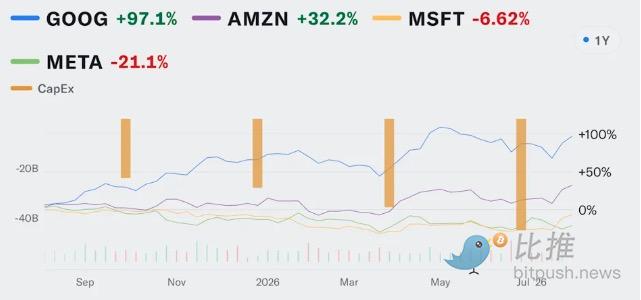
Bank of America predicts that hyperscale cloud vendors may spend more than $860 billion in 2026 and close to $1.2 trillion in 2027. What the market was most worried about in the past: was this money blindly expanding production?
The answer given in this earnings season is that at least part of the investment has begun to be converted into orders, revenue, and profits.
Amazon is a prime example.
In the second quarter, AWS revenue increased 37% year over year, reaching 42.2 billion US dollars, the fastest growth rate in 18 quarters; AWS operating profit increased 64% to reach 16.6 billion US dollars. Amazon also revealed that the annualized revenue from its AI business and self-developed chip business has exceeded 25 billion US dollars.
In other words, instead of building a computer room and then slowly waiting for customers, it is expanding production while being pushed forward by real demand.
Microsoft is also strengthening this logic.
Azure revenue increased 43% year over year, far exceeding the 39%-40% guidance range. Annual annualized revenue surpassed $100 billion for the first time. The Smart Cloud segment recorded quarterly revenue of $39.3 billion, up 32% year over year. Commercial remaining performance obligations (RPO) reached $678 billion, an increase of 84% year over year.
This is equivalent to telling the market that the customer is not only testing AI, but has already signed a number of future contracts.
Google Cloud, on the other hand, provided the most amazing growth rate.
Google Cloud's revenue in the second quarter was 24.768 billion US dollars, surging 82% year over year, far exceeding market expectations of 22.46 billion US dollars. Operating profit was $8.8 billion, up 212% year over year. Cloud backlog orders reached $514 billion. Global cloud market share climbed to 15%, a record high.
For the past two years, Wall Street has been asking the same question: When will tech giants make money after spending hundreds of billions of dollars?
Amazon and Microsoft didn't fully answer this question, but at least handed over the part 1 answer: AI is driving revenue from cloud computing, chips, and enterprise software, not just the big story at the press conference.
Goldman Sachs estimates that AI infrastructure companies contributed about one-third of the S&P 500's second-quarter earnings growth, and this share may be more than half for the rest of 2026 and 2027. The profit of S&P 500 constituent companies increased by about 26% year over year (after excluding one-time investment income), and when these earnings were included, it was as high as 45%, the fastest growth rate since 2021.
In this round of growth, storage stocks such as SK Hynix, Micron, and SanDisk performed better than many traditional AI leaders.
On August 4, SanDisk surged 8% to $1,393, Micron rose 6% to $880, and SK Hynix rose 4% to $148. The Philadelphia Semiconductor Index rose more than 6%, with storage stocks leading the market.
The direct catalyst is the joint release of the first High Bandwidth Flash (HBF) industry standard by SanDisk and SK Hynix — introducing high-speed NAND flash memory into the AI storage tier through open standards is expected to significantly expand the addressable market for flash memory vendors. Meanwhile, SanDisk data center revenue surged 645% year over year, and Micron data center revenue increased 346% year over year.
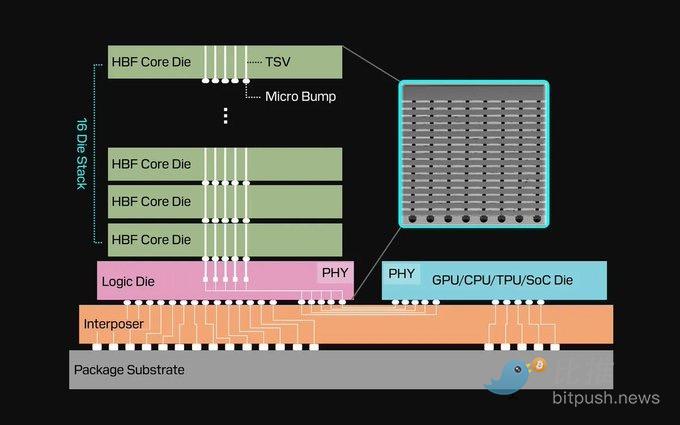
This shows that capital is trading the next bottleneck in AI infrastructure.
Training and running large models requires more than just GPU. Servers also require HBM, DRAM, enterprise flash, high-speed networking, and lots of power. In the past, the market mainly focused on Nvidia, but now they are beginning to realize that the entire data center supply chain could benefit.
Wall Street is intensively raising the target price of storage stocks. RBC Capital gave SK Hynix an “outperforming market” rating, with a target price of $200. The upward memory cycle is expected to continue until 2027. Stifel gave a target price of $240, saying DRAM is “critical” to AI hardware. William Blair pointed out that tight supply has increased the price of AI memory by about three times.
As cloud vendors continue to raise capital expenses, the scope of “selling shovels” is also expanding: from GPUs to storage, networks, heat dissipation, electricity, and engineering equipment.
This is also the difference between this round of growth and an ordinary overrun rebound. The capital is not just to make up for one or two leaders, but to buy back the entire AI infrastructure industry chain.
But the problem of “burning money” has not been solved
In addition to optimism, the pressure on the books is still real.
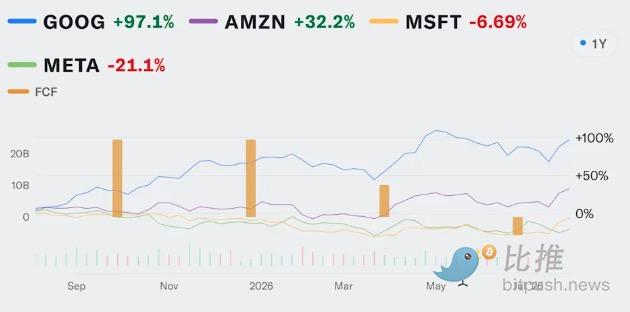
According to Bank of America forecasts, the overall free cash flow of hyperscale data center operators is expected to be negative this year.
Amazon's free cash flow over the past 12 months has turned negative 7.6 billion US dollars; Meta invested about 31.1 billion US dollars in capital expenses in the second quarter, leaving only 784 million US dollars in free cash flow.
J.P. Morgan Asset Management estimates that AI capital expenditure as a share of the operating cash flow of hyperscale cloud vendors has risen from 33% in 2023 to about 93% in 2026.
This means that the asset-light model of “high growth, high profit, and high cash flow” of tech giants in the past is changing.
They are becoming more and more like infrastructure companies: they need to constantly build data centers, buy chips, sign energy contracts, and bear the costs of depreciation, financing, and equipment upgrades.
As soon as the growth rate of cloud revenue slows slightly or interest rates rise again, the market will once again ask: How long will it take for these data centers to pay back?
A rebound or a reversal?
There are clear differences on Wall Street about the nature of this upturn.
The bullish side believes that profits are verifying the sustainability of the AI narrative. Ben Snider, chief strategist at Goldman Sachs, said corporate profits are still extremely strong. “Unless profits begin to deteriorate, the overall bull market will still be based on corporate profit growth, not just speculation.”
Bank of America is bolder — although admitting that free cash flow will deteriorate drastically, it believes that “surging demand exceeds production capacity under construction,” and it is expected that after the AI infrastructure is fully put into operation, annual free cash flow will far exceed the historical average. UBS strategist Keith Parker sees the July adjustment as a “healthy rebalance in a bull market,” and funding is spreading from highly concentrated AI transactions to a wider range of sectors.
The bearish side warns of valuation and FOMO risks. Aswath Damodaran, a professor at New York University, said bluntly that the current rise was “mainly FOMO driven, not fundamentals,” warning that “the AI peak may have been reached a few months ago”. The danger lies not in Mag 7, but in smaller AI companies — they lack financial buffers to withstand the downside.
Bank of America's own survey also revealed the conflicting mentality of the market: 82% of investors surveyed regard semiconductors as the most crowded transaction in the market — congestion itself is not a problem, but once expectations are reversed, the risk of stepping on cannot be ignored.
To determine whether this round of the market can move from a rebound to a reversal, we can observe three signals.
First, can the cloud business maintain high growth for several consecutive quarters; second, can the huge backlog of orders be successfully converted into revenue; third, and most importantly, can free cash flow stop falling.
Now, the first two signals have appeared, and the third one hasn't.
So, the AI story isn't over; it's just a more strict set of test questions.
In the past, the market was willing to pay for “the future may be huge”; now the market requires companies to prove that “they are already making money today,” and the real reversal is yet to come. It requires revenue, profit, and cash flow to prove one thing at the same time: the commercial returns on these sky-high investments are keeping up with the pace of its construction.
Author: Little Bear Cookies
Twitter:https://twitter.com/BitpushNewsCN
Compare the TG exchange group:https://t.me/BitPushCommunity
Compare TG subscriptions:https://t.me/bitpush
