


AI accounts for 30% of revenue but eats up 86% of capital expenses: SpaceX's ledger is splitting

Author: Groove BlockBeats
Original title: SpaceX's AI ledger: revenue still depends on Starlink, capital expenditure already depends on AI
According to the company's second-quarter quarterly report, SpaceX completed its initial public offering (IPO) in June 2026. The first post-listing report for the second quarter, which was handed over later, included Space, Link, and AI side by side in the public financial report. In the past, people used to talk about this company in terms of rocket launches and Starlink (Starlink) satellites. Now, there are also figures that can be checked for investment trade-offs that were originally hidden within the company.
The easiest thing to catch your eye is the growth rate of AI. However, according to the company's second-quarter results annex, the AI segment contributed 32.8% of consolidated revenue but accounted for 86.2% of the quarter's capital expenditure. Revenue and capital expenditure are not skewed in the same direction; this is where this financial report is most worth breaking up.
How does SpaceX make money now
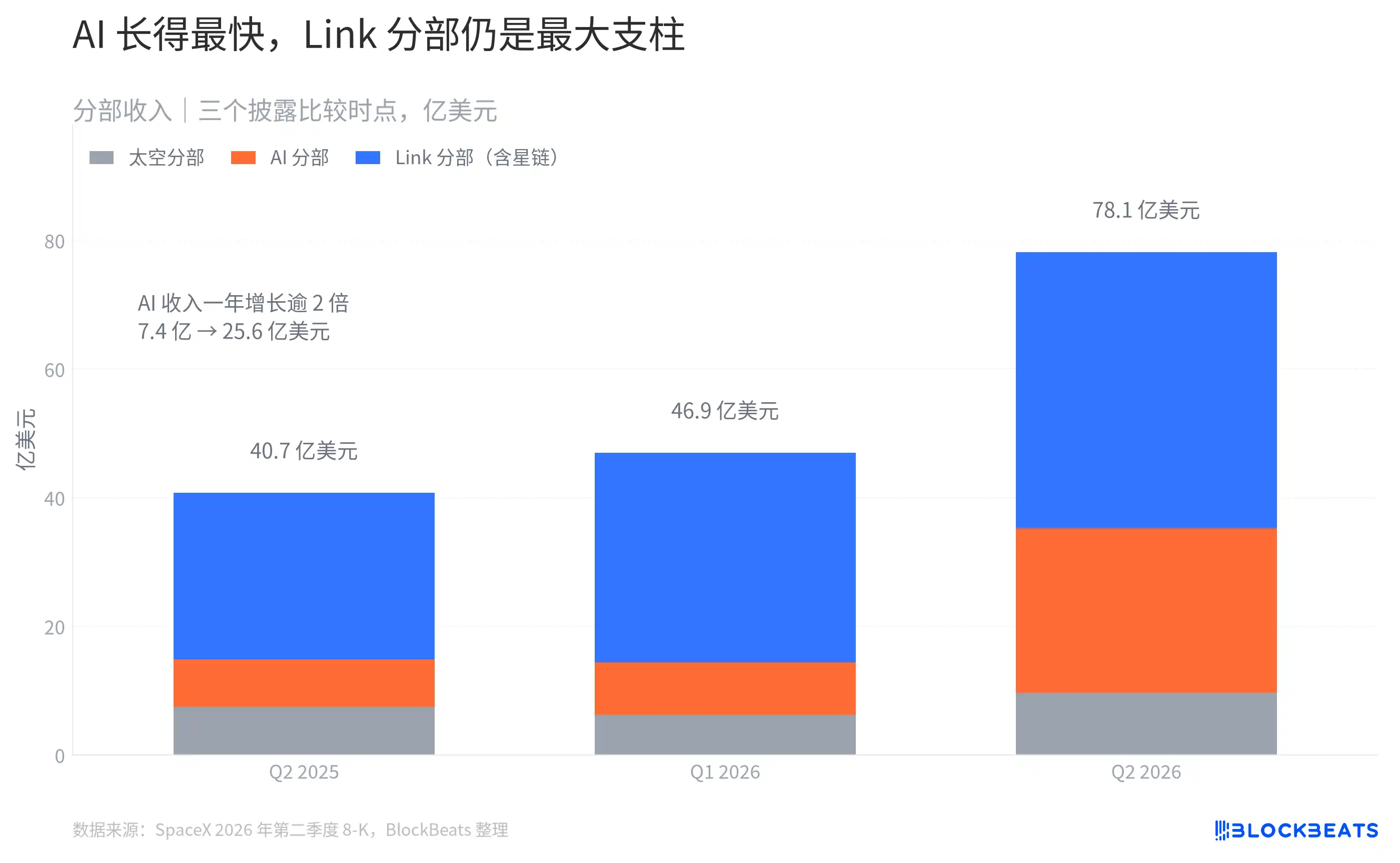
Let's take a look at the income statement first. The conclusion is not mysterious. The Link segment continued to be the biggest revenue source for the quarter. According to the company's second-quarter results annex, it brought in revenue of $4.291 billion, while the AI segment was $2,561 million. This segment includes Starlink's business for consumers, businesses, and the government, and still supports the highest level of revenue in the current period.
Figure 1 selected three disclosure comparison points, which is not a continuous quarterly sequence. Even so, the AI changes are still intuitive. By the latest quarter, the orange section had significantly thickened, and the Link segment still occupied the largest blue area. The same company is writing two businesses at different paces. One is the current larger Link service revenue, and the other is the AI business, which is rapidly expanding.
Here, we also need to draw a boundary for the “AI Division.” According to the company's second-quarter results annex, the Grok, X platform, AI solutions for consumers and enterprises, and AI computing infrastructure are all placed in the same segment. Therefore, AI revenue on the chart cannot be directly equivalent to pure cloud service revenue, which also includes advertising revenue.
This will change the reading. If you only look at the year-on-year growth rate of AI, it's easy to think of it as an independent and mature cloud service business. The financial report shows more like a business basket that is merging and expanding. It has models, platforms, and AI infrastructure that is still being built.
Where did the money go again
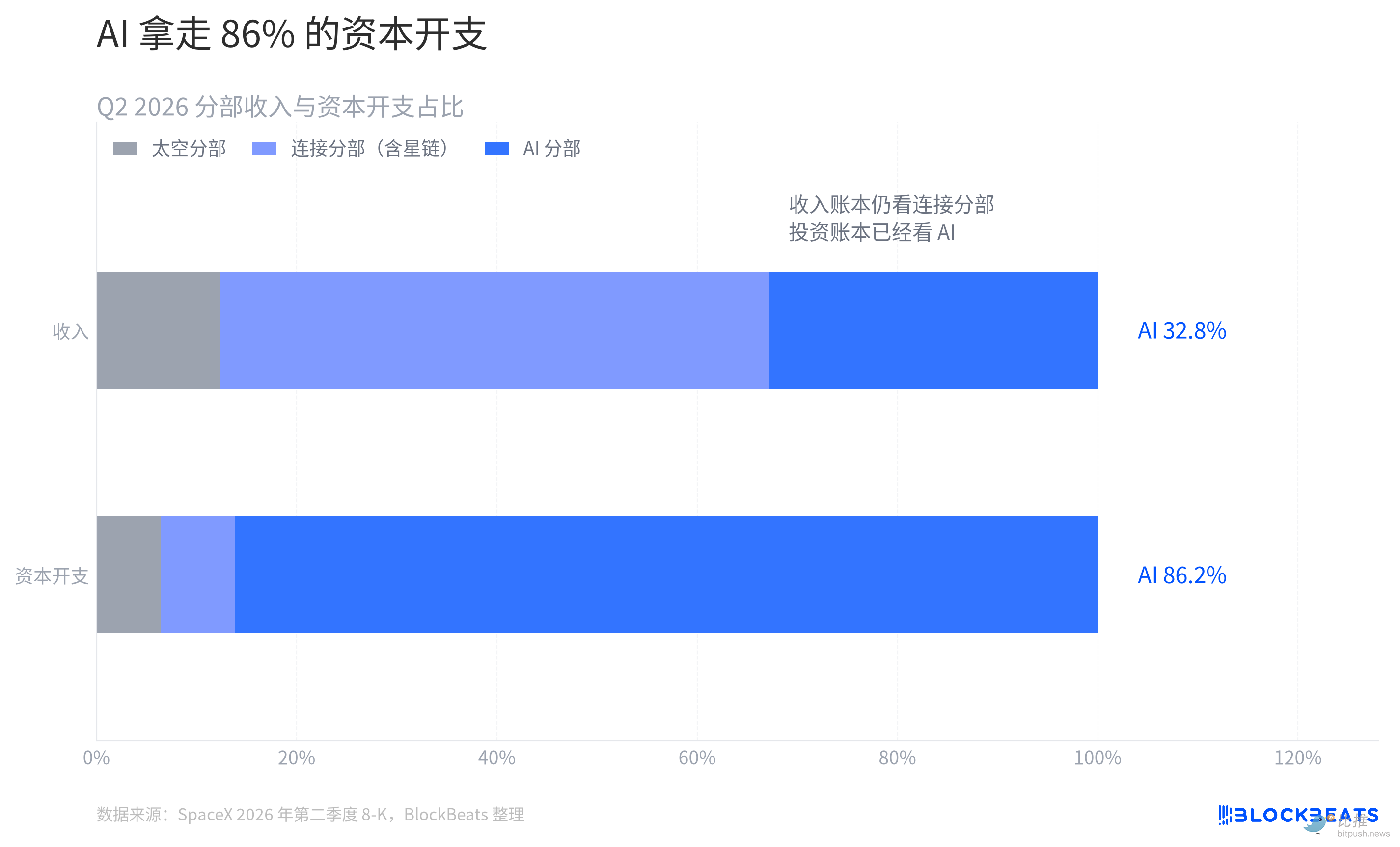
The income statement records services that have already been sold, and capital expenses show where the company has deployed its infrastructure. In Figure 2, AI's revenue share has not caught up with the Link segment, yet its share of capital expenditure has far exceeded it. According to the company's second-quarter results annex, AI accounted for 32.8% of revenue and 86.2% of capital expenditure.
If you exchange this contrast for an amount, it will be even more tactile. According to the company's second-quarter results annex, the AI division's capital expenditure for the quarter was US$15.828 billion, and revenue for the quarter was US$2,561 billion. This is like comparing the construction cost of a factory building with the current rent on the same sheet of paper. You can see the difference in scale, but you can't handle it one by one. The comparison here is segmented capital expenditure and current revenue, not segmental cash flow.
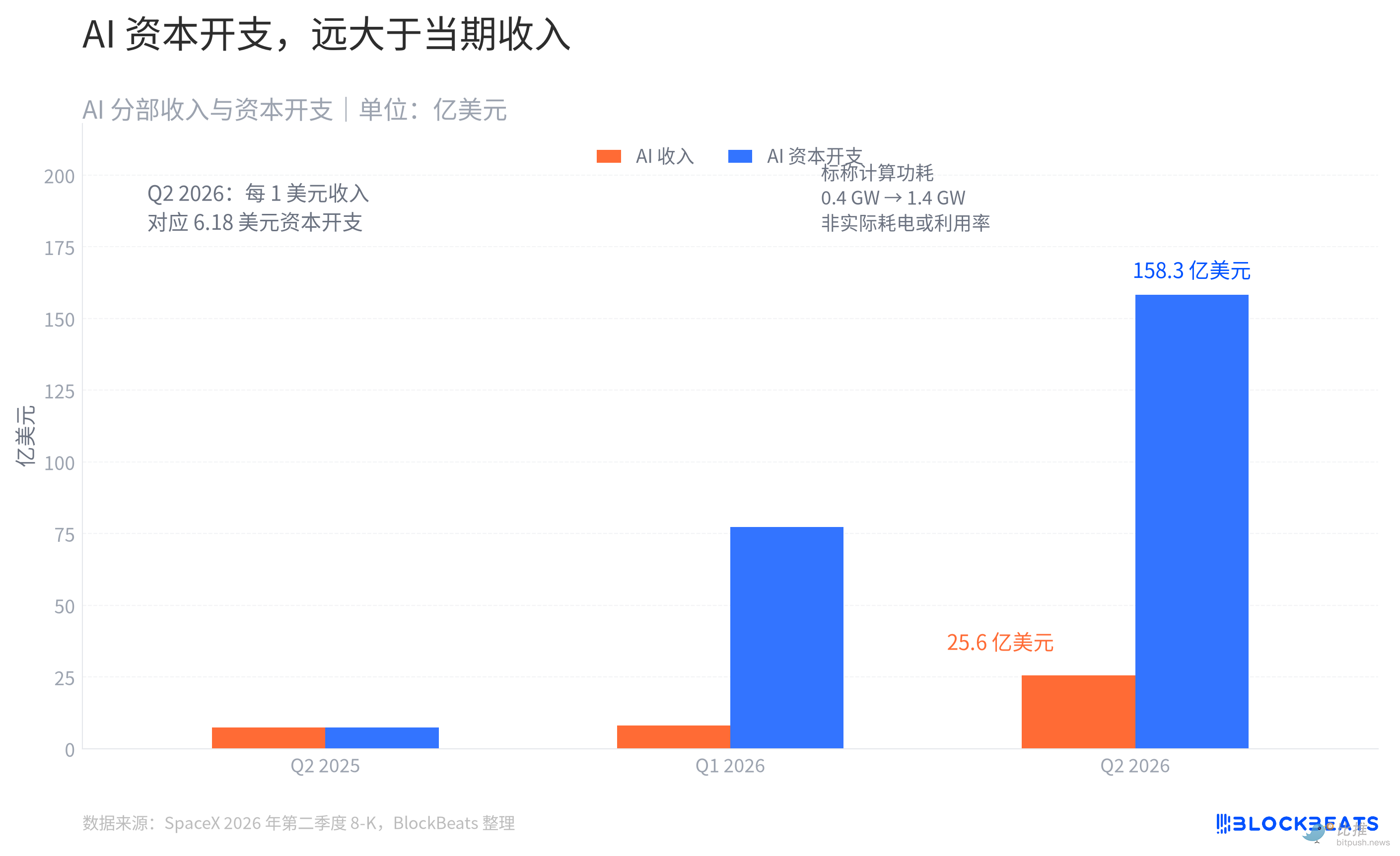
Figure 3 puts these two pillars back to when the three disclosures were compared. In the latest quarter, every $1 in AI revenue corresponds to $6.18 in capital expenses, according to the company's second-quarter results annex. This is not a confirmation rate, and future profits cannot be estimated from this. It only shows that current revenue and equipment, data centers, and related infrastructure configured for AI are not on the same level for the time being.
The nominal computing power consumption disclosed by the company also increased from 0.4 GW in the same period a year ago to 1.4 GW. According to the definition in the performance annex, it is calculated based on the installed GPU and full aperture power consumption, and does not represent actual power consumption or utilization. This set of changes is like adding lanes to a new highway. What can be confirmed now is that the road is getting wider, and the financial report does not disclose how many cars have already run in each lane.
Another column in the same division table gives this expanded, more simple footnote. According to the company's second-quarter results annex, the AI division still recorded an operating loss of US$1.257 billion for the quarter. Adjusted EBITDA can help observe the operating structure, but it is not a substitute for cash flow. The capital expenditure, adjusted EBITDA, and operating loss in the chart are of a different caliber and cannot be replaced with each other.
Contract sales of $141 billion, how much incremental revenue did the second quarter bring
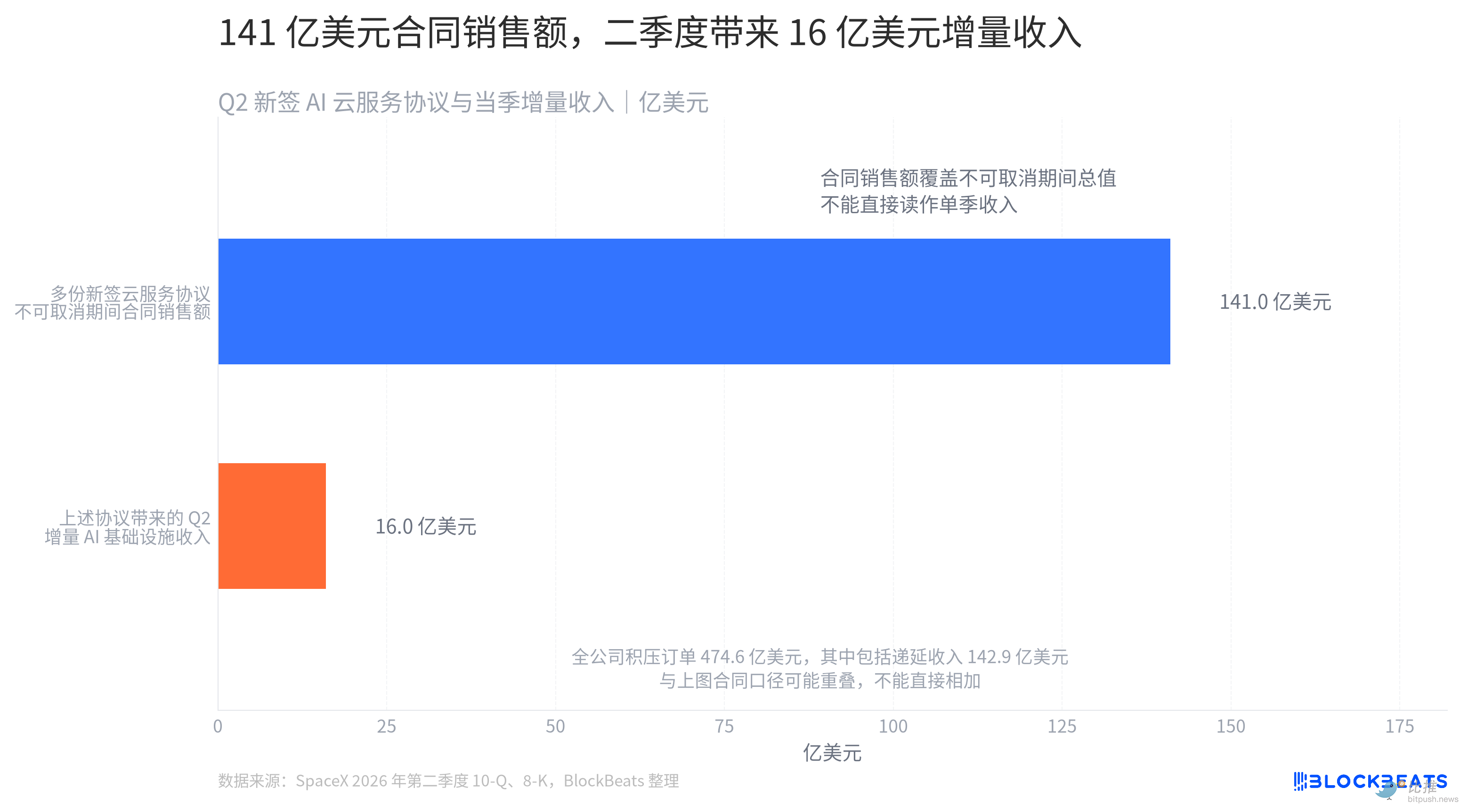
The easiest thing to be amplified in financial reports is the contract sales of multiple cloud service agreements totaling $141 billion. According to the company's second-quarter results annex, these agreements brought in $1.6 billion in incremental AI infrastructure revenue during the quarter. The former is the caliber of the total contract value, while the latter only shows the increase in AI infrastructure revenue this quarter due to the signing of the new agreement.
The performance annex did not separately disclose the total confirmed revenue of these newly signed agreements for the quarter. Therefore, these two numbers cannot be used to calculate the recognition rate, nor can the difference be treated as unrecognized income.
According to the company's second-quarter results annex, SpaceX's definition of “contract sales” is very specific. It covers the total value of the contract during the non-cancellable period, including confirmed revenue for the current period and related deferred revenue, excluding future amounts that the customer can cancel. Treating the total contract amount directly as a quarter's income is like treating a full year's rent contract as the rent that the landlord has collected into the account today.
Another company-wide contract form also needs to be viewed separately. According to the company's second-quarter quarterly report, the backlog of orders at the end of the period was US$47.461 billion, and deferred revenue of US$14.286 billion was only part of that. The two may overlap with the contract sales range of cloud service agreements, and several items cannot be added as separate contract pools.
The company expects 56% of backlog orders to be confirmed within a year. According to the company's second-quarter quarterly report, this provides a time dimension for revenue and also preserves the distance between delivery and confirmation. Orders are piled up at the door, which doesn't mean every one will go through the revenue confirmation counter in the same quarter.
SpaceX's new ledger has been split into two pages. One page writes about the current revenue that the Link division is still bringing back, and the other page is about AI's capital expenditure allocation. Reading the two pages separately, contract sales are more like the total price of an entire non-cancellable contract period rather than a quarterly revenue answer.
Twitter:https://twitter.com/BitpushNewsCN
Compare the TG exchange group:https://t.me/BitPushCommunity
Compare TG subscriptions:https://t.me/bitpush
