


Is Bitcoin still salvageable? Let the data do the talking
Author: Will Clemente (@WClemente)
Compiled and organized by: bitPushNews
Author profile:
Will Clemente worked as the chief analyst at Blockware Solutions in his early years, focusing on Bitcoin on-chain data (exchange fund flow, holder behavior, etc.). In 2021-2022, he co-founded Reflexivity Research with Anthony Pompliano to provide institutional-level on-chain and macroeconomic research, which was later acquired by the listed company DeFi Technologies. He then became a consultant and participated in STIX related work. X has nearly 800,000 fans. The analytical style is data-driven and easy to understand. It is one of the influential voices in the field of Bitcoin cycle judgment.
The following is the text:
Happy summer! I haven't written a long analytical article on Bitcoin in a while. In this post, I'm going to do a thought review and share my thoughts on this asset class and some of my personal thoughts on how to deal with future trends.
Last year, I generally focused my personal market attention on commodities, because it was clear at the time that there was an oversupply problem in the cryptocurrency sector, which made the market seem very heavy. At the same time, with the exception of Hyperliquid, lack of substantial innovation led to a lack of market interest — at least compared to the market activity we saw in other markets — making it difficult for demand to absorb all supply.
I thought that late last year, when small-cap stocks soared and gold had just set off a sharp rise, Bitcoin had a window of good performance, but I was very disappointed when Bitcoin basically experienced a failed breakthrough (a few days before October 10). In January of this year, I further reduced my Bitcoin positions that I personally still hold because the market trend at the time was similar to the previous bear market we experienced in 2022.
Frankly speaking, this hasn't been a fun year for those focused on Bitcoin and the cryptocurrency space.
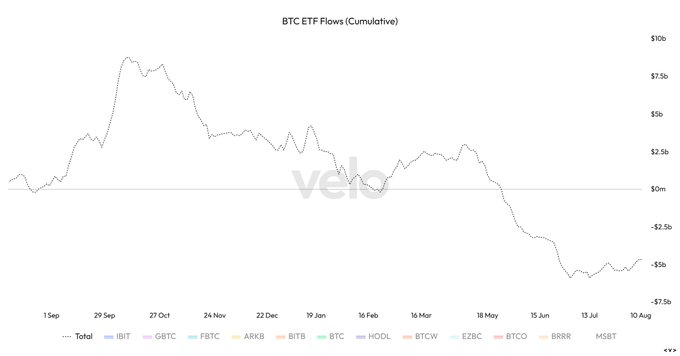
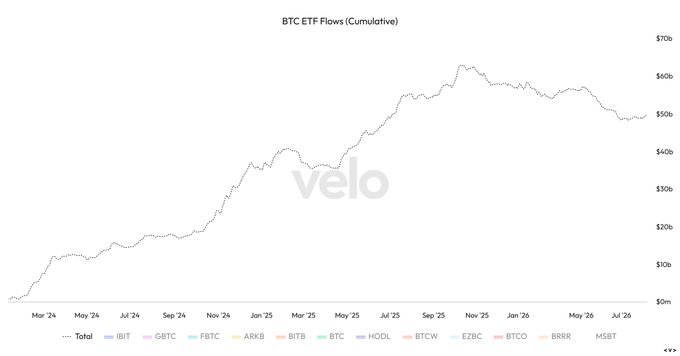
Although judging from the percentage decline, Bitcoin's retracement is much milder than in 2022, in many ways one can argue that this bear market is even tougher than 2022. At least in 2022, you can clearly indicate the reason for the decline (rising interest rates, removal of leverage and fraud, FTX thunderstorm) and determine that “if these things are likely to change, and at the end of 2022, things are asymmetrically biased towards the impossibility of getting worse, then Bitcoin is probably a good long-term buying point here” — yet today, we don't see any similar situation, other than DaTS and quantum computing (which I'll talk about later), and what I think are some positive signs of recovery that I think are finally beginning to appear. Bitcoin ETFs hold 50 billion US dollars in assets and set a record for initial capital inflows, but they were surpassed by storage ETFs earlier this year. Major institutions have begun to introduce loan products. Gold performed extremely well last year, driven by central bank reserve demand. Fueled by the de-dollarization narrative, this should have been a time for Bitcoin to shine. Almost any individual or entity that wants to gain exposure to Bitcoin can do it, which makes it even more disappointing to see a net Bitcoin ETF outflow of $5 billion over the past year, while DRAM attracted $10 billion in capital inflows within a month.
Internet health
When we talk about Bitcoin's fundamentals, we're clearly not talking about metrics in the traditional sense; we're focusing on the underlying state of the network itself. I'm not going to go through each data point one by one to list the data, but I think there are two main points that are really important. In an increasingly centralized world, in the context of a country-led economy and a country-influenced market, and the most centralized technological power brought by large technology companies, I do believe that decentralization is of great value.
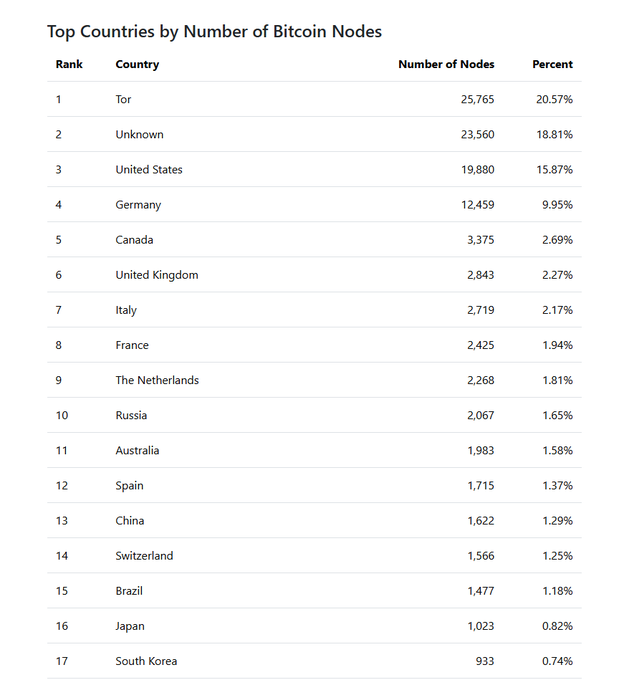
For those who don't know much about the details of Bitcoin, in addition to the miners we all know, there are also nodes. Nodes can be run by anyone and are responsible for enforcing rules and verifying the network, while miners provide security through extensive energy-backed computation. There are nodes all over the world, and there are probably many more that you can't easily track. The following list alone covers nearly 200 countries.
Source:https://bitref.com/nodes/
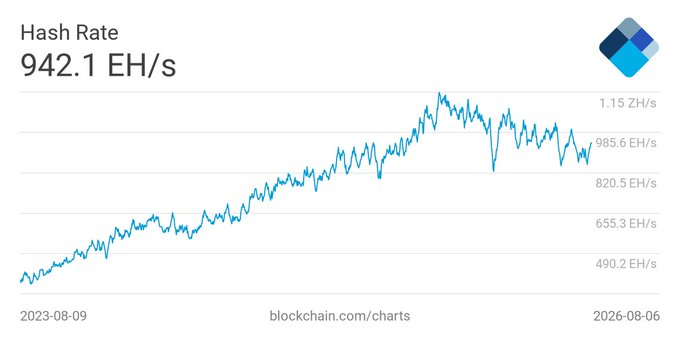
While it's possible to view mining pools (they don't have control over individual miners), it's hard to track individual miners like tracking nodes. However, we can use computing power to observe the overall energy scale that supports the network. No matter how you analyze it, computing power is on a downward trend. This happened in a context where miner margins were being squeezed after 2022 due to increased competition and rising energy prices, but more importantly, many miners turned to the AI/HPC sector, and judging by publicly listed companies, these measures have so far proven to be prudent commercial decisions. This dynamic was further strengthened as Bitcoin's underperformance as AI-related assets and the rate of change in computing demand increased.
So there are good and bad things here. On the one hand, from the energy perspective of the security network, the Bitcoin network has become less technically secure, and the value investment (production cost) that supports each unit as a digital commodity has declined. (It is worth noting that due to the difficulty adjustment mechanism, there is no problem with the network itself, since it automatically adjusts mining rewards every two weeks based on computing power to motivate new miners to join the guarantee network when competition declines.)
On the other hand, I think the positive side is that although almost all listed miners we know are switching to AI/HPC, overall computing power has only fallen back to the level of mid-last year. This indicates that more entities with cheap energy are participating in Bitcoin mining, which may have exceeded the expectations of some people. Coupled with node distribution data, it shows that the Bitcoin network is still distributed and healthy.
All in all, I think the network itself is still as distributed and healthy as ever.
Valuation Methodology and Current Readings
While Bitcoin clearly has no cash flow, there are several unique ways to measure its valuation level relative to historical market behavior.
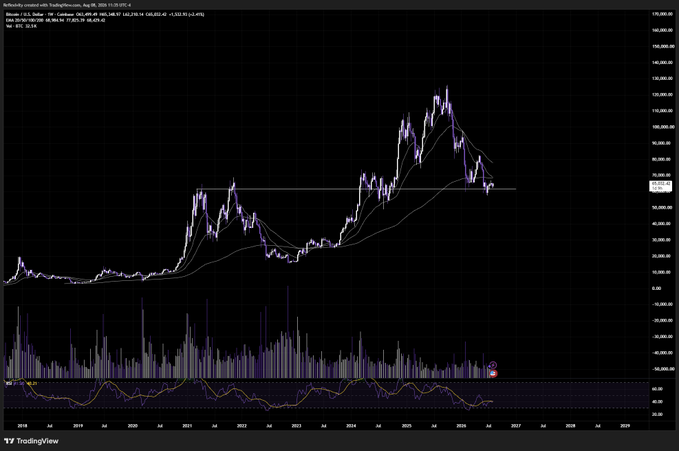
From a technical perspective, Bitcoin is currently consolidating near its 2021 all-time high, slightly below the 200-week EMA (EMA), and the weekly RSI is showing the first bullish divergence in the oversold region since the depth of the last bear market. Historically, the 200-week EMA has been a good basic threshold to start considering gradually accumulating spot BTC positions.
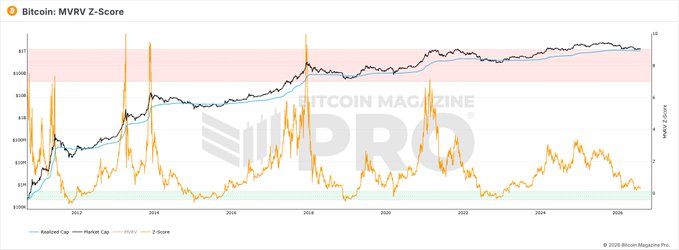
One of the best valuation methods based on blockchain data is the market value to realized value ratio (MVRV). This ratio compares Bitcoin's current marginal transaction price to the network's average cost basis based on the last time the coin moved to a new wallet cluster. When this ratio rises, it means that the current marginal transaction price is much higher than the average cost base of the network, which means that the large amount of unrealized profits in the market has a strong profit margin. When this ratio falls below 0, it indicates that the market is generally in the red, which historically marks a prudent time for accumulation. You'll notice that between 2024 and 2025, this reading never actually reached the fanatical top reading of the past, which reflects the asset class's maturity in recent years and the resulting compression of volatility.
Given that the high point in each bull market cycle decreases in sequence, and the lowest reading in each bear cycle shows a slightly higher low, we can reasonably infer that the market may not need to enter a negative zone to reach the bottom. Accurate bottom reading is very difficult. The core conclusion here is that Bitcoin is in the lower range of historical valuation readings.
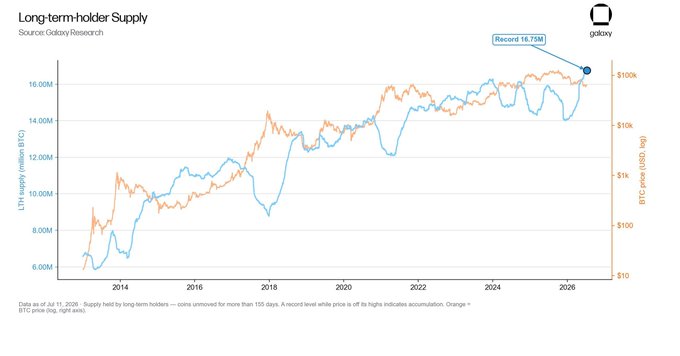
Long-term holders also appear to be actively re-accumulating after some distribution in mid to late 2025, which indicates they think they see value at these price levels.
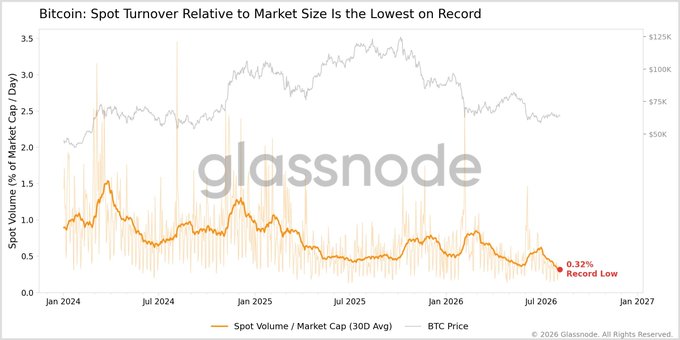
Trading volume has completely dried up, @n3ocortex的图表做的非常好, showing that the ratio of the spot turnover ratio to Bitcoin's market capitalization has fallen to an all-time low. The trading volume of ETFs and DATs also showed a similar situation.
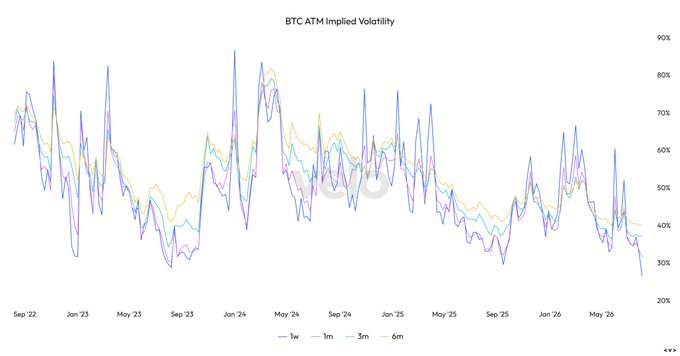
The implied front-end volatility of the options market is at its lowest level in many years, which means that the market believes that Bitcoin has become “dead money.”
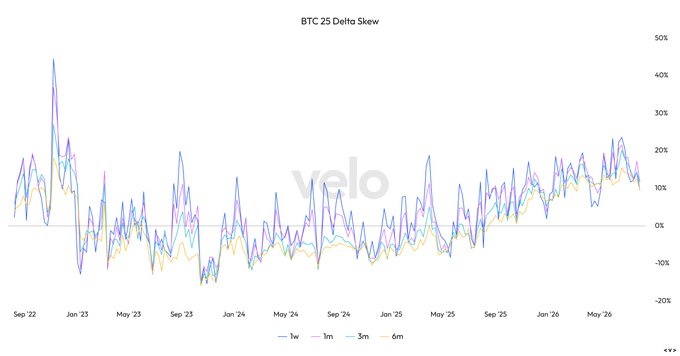
Meanwhile, options skew shows that over the past year, the market was only interested in buying more downside protection.
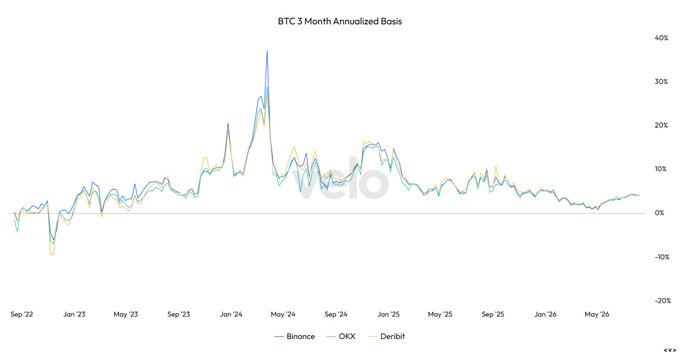
Finally, in terms of derivatives, Bitcoin's futures base (the difference between forward contract price and Bitcoin spot price) has been declining for many years, and it is difficult to even reach a level comparable to treasury bond yields. This means that A) more funds are carrying out arbitrage transactions based on Bitcoin futures, but it also means that B) the market does not give much premium to forward contracts compared to the spot price.
When we put all of this together, the objective picture is that the market is completely dead, traders have shown no bullish views in the futures and options markets, and Bitcoin's volatility will continue to flatten even when pricing. At the same time that all of this is happening, the asset is entering a deep value zone in terms of multiple indicators, and we see that the background of long-term holders' accumulation seems to be in stark contrast to the views of traders and the net outflow of $5 billion from Bitcoin ETFs over the past 52 weeks.
DaTS and quantum computing—unresolved concerns
The biggest market suppressor during the 2023-2025 bull market has been digital asset treasury companies (DATs). These tools are, at least in theory, designed to dilute common shareholders' equity to increase Bitcoin's accumulation and drive shareholder value. However, as competition for returns intensified after the success of Strategy and Japan's Metaplanet, capital inflows into these instruments were widely diluted and led to a premium compression relative to NAV (net asset value).
In recent months, we've seen news of several treasury companies slowing down Bitcoin accumulation, directly selling Bitcoin, and even completely changing their strategies in some cases. I think these are all positive signs that the market is healing itself. Recently, we've even seen that after Strategy announced the sale of Bitcoin, Bitcoin instead rose because Strategy is integrating its capital structure and prioritizing STRC (based on its latest earnings call), which is in stark contrast to the decline in Bitcoin due to past purchase announcements. Looking ahead, I don't think DATS will put the same pressure on the market as it did 6 to 9 months ago, especially when prices have dropped more than 50% from their high point.
I think quantum computing is indeed a concern worth paying attention to, especially in terms of time over 5 years.
While I was employed by STIX to assist in investment analysis, I learned quite a bit about quantum computing by studying several early maturing startups and communicating with people in the industry, even though I'm by no means an expert. My opinion is that this threat should be taken seriously; however, with the price of Bitcoin at $60,000 — down 50% from its high point and underperforming other assets — I think this risk has probably been discounted quite a bit from the current price. From now on, despite the possibility of an apocalyptic scenario, these issues (which have now been discussed very publicly) are likely to be tilted in the direction of “only getting less bad”. The worse Bitcoin's performance is due to perceived quantum risk, the more motivated large holders or institutions that profit from Bitcoin trading/custodian/borrowing are to motivate a group of developers to find and propose solutions. Similar to the ETF approved in the previous cycle, the market will trade the probability that this issue will be resolved in advance, so once the concerns are completely dispelled, you will no longer be able to buy at an extremely low price.
Potential bull market logic
Even if you think Bitcoin might be at a good long-term level, as a short to medium term allocator, there is a huge perceived opportunity cost consideration for allocating BTC compared to the real innovation that exists in a hot economic environment that can be speculated and invested. The main question that has continued for several months is: given that Bitcoin has failed to rise at the same time as gold, and the high-beta sector in the stock market has performed well this year, what needs to happen to Bitcoin to perform well again?
As mentioned earlier, as can be seen from the chart, according to blockchain data readings, we are seeing quite strong long-term holders' buying, along with DAT's capital-up sell-off and quite significant net selling pressure from ETFs. The previous Bitcoin bear market ended with the exhaustion of sellers without necessarily requiring aggressive new demand catalysts. At this point, if you've ever worried about DatS, quantum computing, or poor performance, who else is going to sell on a larger scale over the next 6 to 9 months? Obviously, there is a risk of a sharp drop in correlation due to macro/geopolitical turmoil, but here's a month-long time frame.
I understand very well that there are currently no clear catalysts (Clarity might count as one, but I don't think this will have much effect on Bitcoin itself), but this is often the bottom characteristic.
You're weighing the probability that the situation will get worse with the current market's predetermined expectations, similar to the reverse process of evaluating the probability of a better than expected situation in a bull market. I accept the possibility of a final decline sometime this year, but so far, I think the market has priced a lot of risk over the past year.
One catalyst for Bitcoin may simply be mandatory stable purchases from large institutions.
Although the initial AUM (Asset Management Scale) growth was impressive, we have now far surpassed the initial excitement phase of ETFs, and total AUM has been declining steadily since October last year. One catalyst may be the decision of large asset managers to add a tiny single-digit percentage allocation to their portfolios, which will bring in capital inflows that are not price sensitive to assets. Although this sounds like a bit of self-comfort, Bitcoin's lack of correlation with various assets over the past year may be enough to make it reasonable for large asset managers to allocate it as a small portion, as they often seek to diversify asset correlation and risk exposure.
Conclusions/Thoughts on configuration methods
TLDR. I thinkBitcoin is currently “cheap,” although we might see a lower wave of decline sometime this year.
The internet is generally fundamentally healthy. Most of the risks are currently priced, and anyone who would sell because of these risks may have already sold. You're extremely unlikely to copy the exact bottom. From now on, in my opinion, there are several configuration methods to choose from. (Certainly not financial advice!) I think it's reasonable to do spot dollar cost averaging (DCA) over the next few months; this would be the easiest strategy.
You can also choose to wait to either drop one last time or wait until the market starts showing signs of vitality and momentum before entering the market. Another strategy is to directly allocate and then use the options market to hedge against any eventual decline that might knock you out of your position because the implied volatility is very cheap. I personally haven't started the layout yet, but I'll probably be starting to act one way or another soon. Hope this post provides some insightful thoughts and sparks a discussion about how others view the current situation. Maybe the four-year cycle confirmed that we're living in a simulated world, but the next few months are getting interesting for BTC.

Twitter:https://twitter.com/BitpushNewsCN
Compare the TG exchange group:https://t.me/BitPushCommunity
Compare TG subscriptions:https://t.me/bitpush
