


Does the forecast market with monthly turnover of 44.8 billion US dollars need a main broker?
Source: Fintech Blueprint
Compiled and organized by: bitPushNews
Betterment recently released its 2026 retail investor survey.
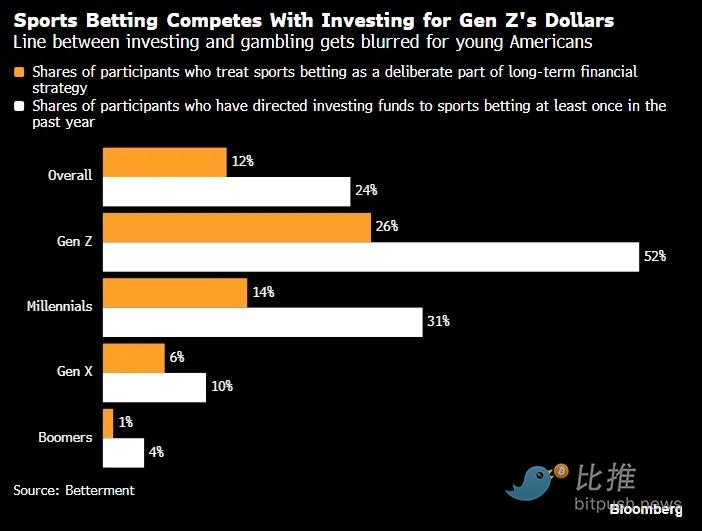
The main conclusion is that 26% of Gen Z investors see sports betting as part of their long-term financial strategy, and 52% have invested the money they originally intended to invest into it last year.
The survey of 1000 US retail investors in early April showed that proportion rapidly declined as people grew older — 31% and 14% for millennials, 10% and 6% for Gen X, and 4% and 1% for Baby Boomers.
Betterment ChiefExecutive Sarah Levy's statement was blunt: The problem comes when a prediction market or sports betting platform starts to feel like a retirement strategy.
The combined monthly trading volume of Kalshi and Polymarket reached in June$44.8 billion, which is more than three times the average monthly transaction volume of about $14 billion for all US legal sports betting in 2025.
Source: Bloomberg/Betterment
Let's explore whether this transaction volume is large enough to support the dedicated agency hierarchy below it.
Earlier this month, River Markets raised $8.5 million in seed funding to build what it calls “the first institutional-grade execution and prime broker platform for the prediction market.” Led by Haun Ventures, Y Combinator, Coinbase Ventures, Qube Research & Technologies, and Cherry Ventures participated, in addition to angel investors from Citadel, HRT, J.P. Morgan, Nvidia, and Google.
The company has been online with trading clients since May 1 and has publicly listed five client names: Chimera Capital Management, Game Point Capital, Cleat Street, Skywalk, and 646 Equity. It claims to own three of the top ten traders on Kalshi and Polymarket, as well as several quantitative funds running on its API. The problems they are solving are real and unremarkable. The liquidity of the prediction market is distributed across multiple trading sites, which may have different quotes on the results of the same event, involving separate accounts, separate balances, independent APIs, and no uniform view of risk. A trader who trades the same event on Kalshi and Polymarket actually manually manipulates the two books and then reconcile the accounts.
River integrates these sites into a single terminal and an API, uses a unified code system, adds execution algorithms (iceberg orders, linked orders, stop-loss orders, take-profit orders) not native to the exchange, and routes eligible orders to the best prices in the online ledger. It's live on Kalshi, Polymarket, and Polymarket US, and is integrating Novig and Crypto.com.
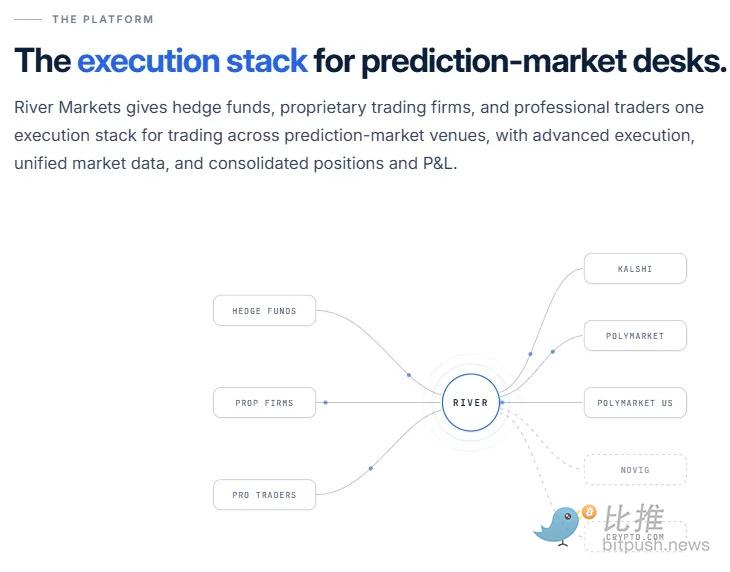
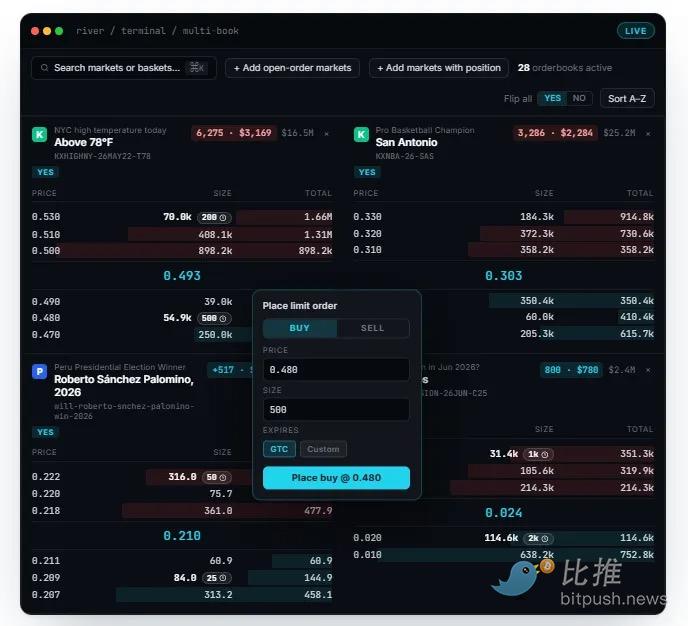
Today, it's more like an order and execution management system than a Prime Broker (PB) — a boundary drawn by River itself.
Its FAQ states that the real-time platform covers execution, routing, data, and profit and loss, that customer funds are kept in venue accounts rather than centrally pooled, and that companies are invited to contact them about financing, collateral, and cross-market requirements.
Source: Allium
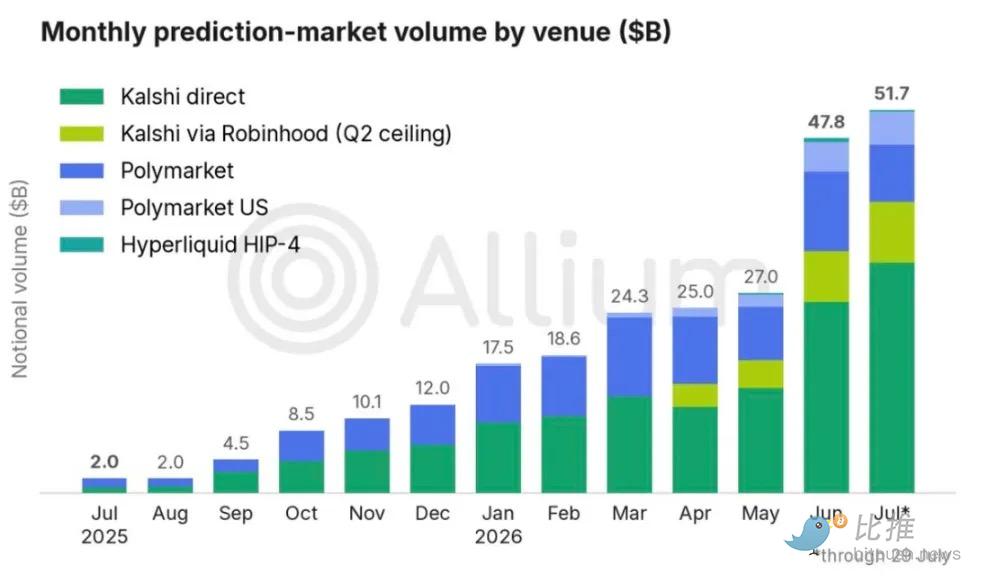
The cumulative historical trading volume of the market is predicted to exceed 150 billion US dollars in May. Kalshi alone reached 31.5 billion US dollars in June, while Polymarket was 10.8 billion US dollars. Kalshi is currently in final negotiations to finance at least $750 million, with a valuation of $40 billion; Polymarket is financing at a valuation of $15 billion, after ICE had already committed $2 billion in two instalments. Kalshi's annualized revenue surpassed $4 billion in July, roughly double the $2 billion annualized pace two months ago. On the peak day of the World Cup, daily expense revenue was over $13 million.
In an August case study on a 50,000 contract US Federal Reserve decision transaction, River charged a fee of $53, compared to $38,500 in nominal principal — about fourteen basis points. At this rate, River's target of hundreds of millions of annualized transactions at the end of the year would generate approximately $700,000 in revenue, and to reach a business scale of $10 million, it would need to match more than $7 billion in annual transactions.
This is less than 2% of a single site's traffic compared to Kalshi's annual operating rate of approximately $378 billion. The volume threshold is not an issue. Nor is its value proposition insignificant. In the same case snapshot, passively routing orders between locations was $945 cheaper than opening a position directly at a single optimal location—an overall savings of 238 basis points after deducting River fees.
The real limit lies in the customer base.
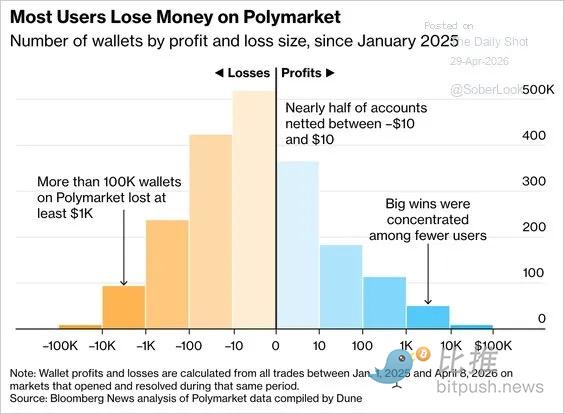
The Wall Street Journal's analysis of 1.6 million Polymarket accounts found that 67% of profits went to 0.1% of accounts. Fewer than 2,000 traders netted nearly $500 million while over 70% of users lost money. Another on-chain analysis covering around 2.5 million wallets showed that the number of wallets that achieved historical profits of over $100,000 was 840.
Kalshi's own data is that every 1 profitable user corresponds to 2.9 loss-making users.
Source: The Daily Shot, Dune, Bloomberg
This concentration is often cited as evidence that retail users are being “harvested.”
But compared to comparable markets, this is not unusual. Academic research on retail intraday trading found that 84.3% of intraday traders lost money, had a median return rate of -8.7%, and unprofitable traders generated 72% to 80% of trading volume. Research on Brazilian index futures found that 97% of continuous day traders are losing capital. Kalshi's own comparison shows that around 74% of its traders are at a loss, compared to around 81% in the stock market and 96% in sports betting.
This is exactly the range of markets that can be served. Customers who need to integrate a cross-site view of risk are the ones who make money. There are probably a few hundred of them, and probably only about 50 of them are real institutions — a small group of professionals that derive most of the profits and losses from a large retail customer base.
So, let's go back to the Prime Broker (PB) business.
The core of this business is financing: margin loans for clients' books, securities loans for their positions, cross-market margin write-offs (so that hedging positions take up less capital than the sum of two separate positions), and interest spreads earned on clients' idle funds. Goldman Sachs and Morgan Stanley established the primary brokerage business not to route orders, but to lend money.
However, none of these were present in the event contract. Predicting market positions is structurally fully collateralized. If you buy a contract for 40 cents, you'll pay 40 cents because the maximum loss is known and limited to the price you paid. There are no extendable security deposits, no remortgable positions, and no basis to lend. Full collateral is a regulated “transaction” that allows CFTC (US Commodity Futures Trading Commission) designated contract markets to provide binary options results to retail customers.
That's why River's real-time products currently stop at the execution level. This is what the current market structure allows.
However, funding pools are being created — just not in the field of event contracts, nor by a third party. Kalshi launched its CFTC Registered Futures Commission (FCM), Kalshi Prime, in June, and appointed Jeff Bandman, the former head of CFTC's Liquidation and Risk Division, and legal adviser who secured Kalshi's 2020 designation as CEO on August 12. Its stated goal is to provide margin backed perpetual futures. Bandman is already publicly discussing expanding the scope of eligible collateral to corporate bonds, money market funds, and stablecoins. Kalshi's crypto perpetual contract was launched in June and achieved $5.5 billion in trading volume with zero fees in the first two weeks.
Perpetual futures are margin trading rather than prepaid, which is why leverage first appeared there. This order favors the trading floor: Kalshi lists leveraged products, Kalshi's own FCM provides financing for them, and Kalshi decides what can be counted as collateral. However, FCM can only provide margin for positions held on its own exchange. As a result, Kalshi Prime captures the economics of financing without solving the meaning of River's existence—an institution that deals in the same event at three different locations still can't make net payments across sites, and there is no single location that can provide this kind of service.
The same pattern can be seen elsewhere.
Take Ondo, for example. For over a year, Ondo has been building the Ondo Chain—a dedicated Layer 1 designed for tokenizing physical assets—a classic version of the tokenization topic, introducing spot assets into the ledger. Just recently, it shelved this plan and instead launched Ondo Network: an off-chain matching engine running within a trusted execution environment, verified by a set of decentralized certifying agents, and transferring assets to a public blockchain.
The first and only app on the network is Ondo Perps, which launched on July 7, and offers perpetual futures on stocks, indices, and commodities with up to 20 times leverage, and accepts tokenized stocks and ETFs as collateral.
Its trading volume in the first month was around $8 billion. Issuing tokenized treasury bonds and stocks is a type of escrow and issuance business with very low fees. Perpetual futures, on the other hand, are a fee-paying business with a high turnover rate. Ondo has found where today's revenue really lies.

Another example is Alpaca, an API-first brokerage and crypto service provider that just registered as a futures commissioner with the CFTC. This is the first company to enter the derivatives sector (whether cryptocurrencies or stocks and bonds).
RWA Report 2026 | CoinGecko
One core case is Hyperliquid.
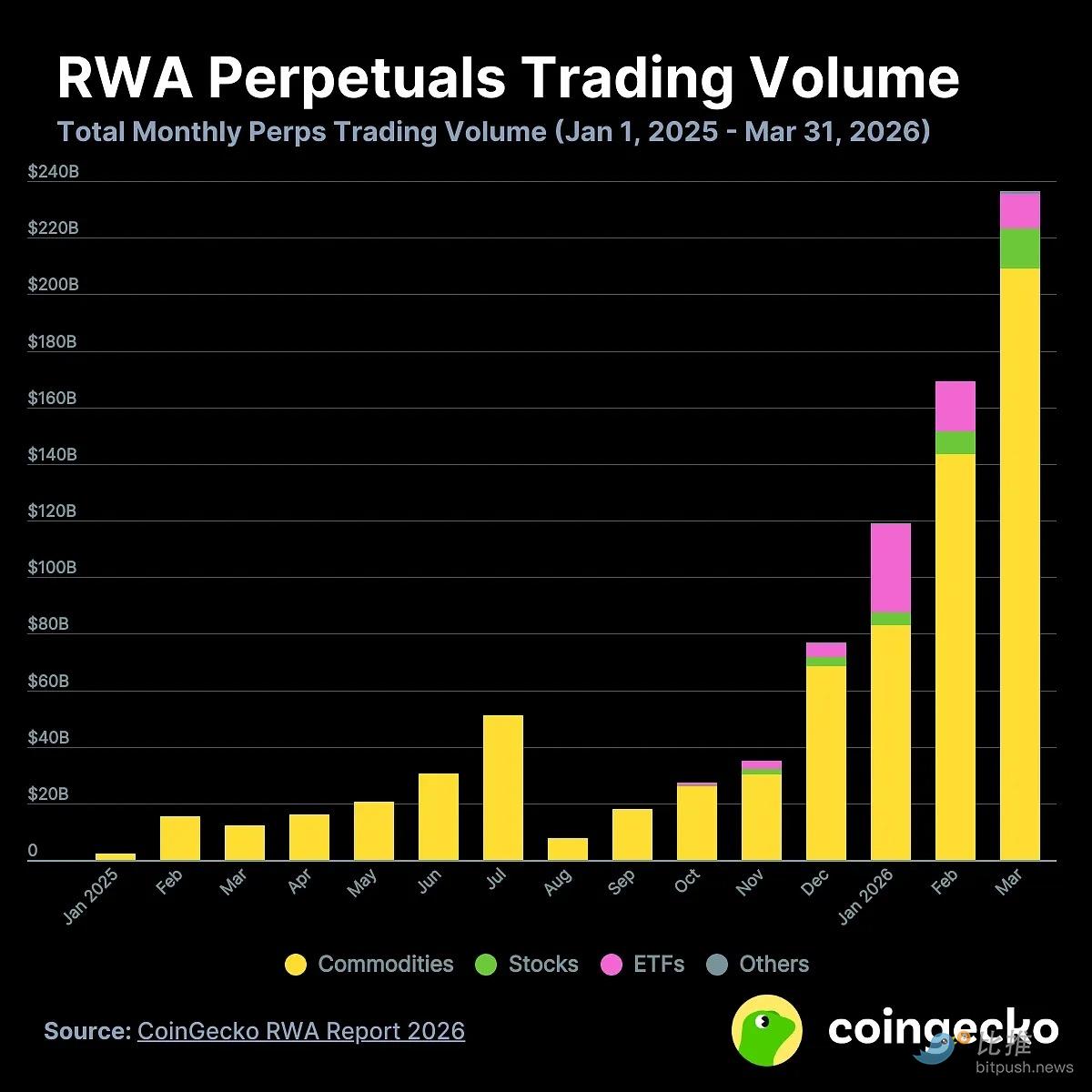
In the week of July 13, the trading volume of physical asset perpetual futures reached $25 billion on the platform — accounting for 52% of its total trading volume of $48 billion, and this is the first time that the RWA (physical asset) market surpassed the total trading volume of all cryptocurrency categories on the platform. Single share contracts drive 61% of that trading volume.
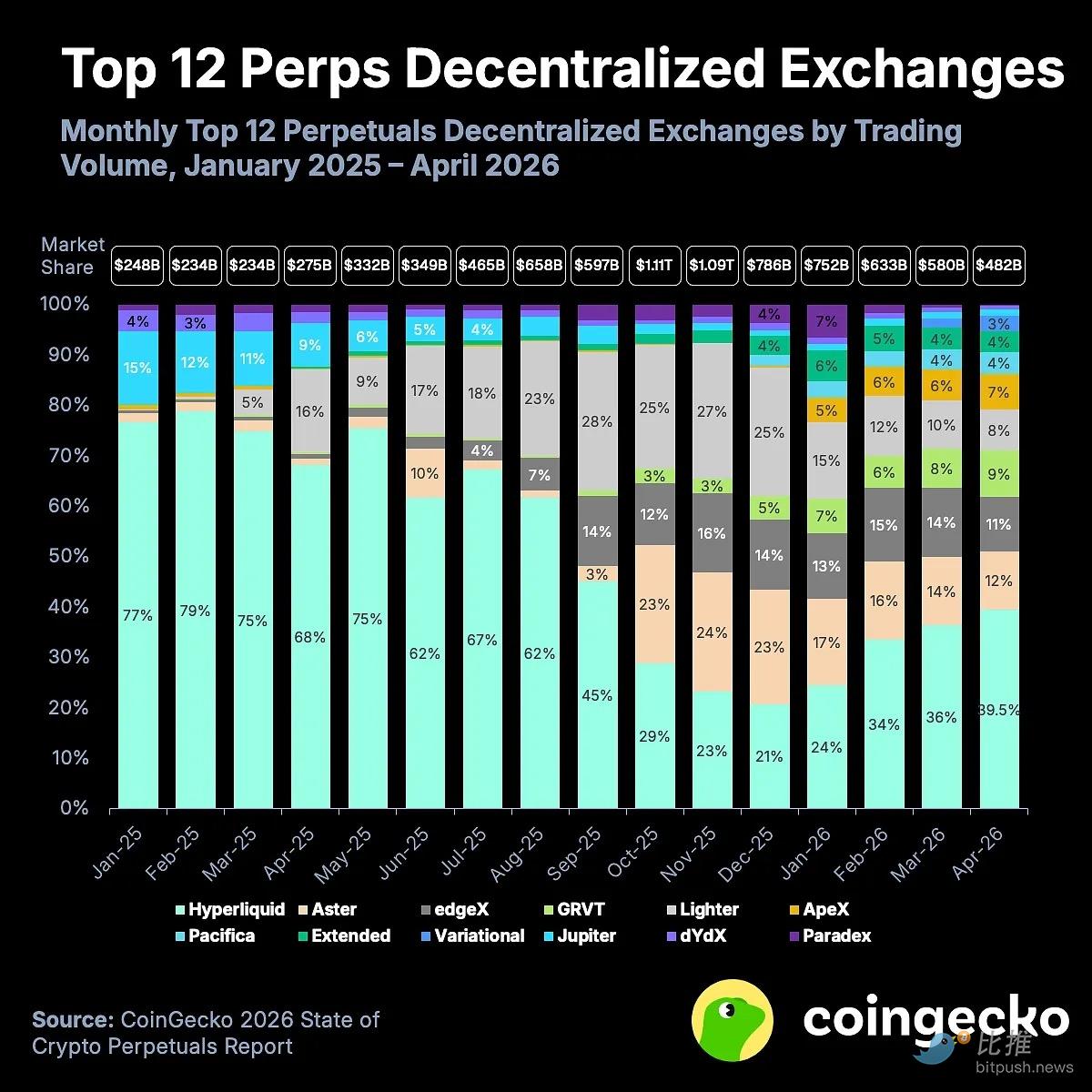
24/7 equity perpetual contracts: a sign of rising RWA trading volume
This conclusion is unsettling for the tokenization debate.
Tokenized assets did not arrive as spot instruments to gradually accumulate liquidity. They arrived as collateral against their own derivatives. Demand is about gaining exposure to risk, not the asset itself — this is what the Betterment survey showed about the people generating the demand, and what Kalshi Prime revealed about where the infrastructure was built to serve that demand.
Massive growth is a strong argument for building infrastructure in this market—this is the financialization of the attention economy. Within nine months, the monthly transaction volume grew from less than $5 billion to $44.8 billion, while the average monthly transaction volume for all legal sports betting in the US was around $14 billion in 2025.
A generation has decided that synthetic leveraged positions are more important than holding underlying assets, and that makers of financial products are only creating things people are willing to buy. Ondo abandoned a blockchain because of this, Hyperliquid's RWA (physical asset) book now has more trading volume than its encrypted ledger, and Kalshi is building its own FCM (futures commission dealer).
Trading venues are taking the lead in leading brokers' business, and they are likely to keep the financing business firmly within their walls.
Twitter:https://twitter.com/BitpushNewsCN
Compare the TG exchange group:https://t.me/BitPushCommunity
Compare TG subscriptions:https://t.me/bitpush
