


How did liquidity mining, which set off the DeFi wave, eventually die?

Liquidity mining was the starting point of this DeFi wave. Currently, Chinese players are beginning to copy it. As long as you have basic financial knowledge, you can predict that it will eventually die like this.
The rise of liquidity mining
Let's talk about two concepts first: “liquidity” and “mining”
Liquidity:
Any market needs to be able to be traded at any time, that is, it requires buying and selling. The combination of buying and selling is called market liquidity.
Short-term transactions in the financial market do not trade the securities themselves; they are essentially trading risk. The market only provides a place for risk to circulate, and traders reap benefits from taking risks. Market participants also price current risk, and voting on risk is a buy/sell price.
Anyone who has speculated on coins or stocks should know that in the financial market, they are not afraid of not making money, nor are they afraid of getting caught; what they are most afraid of is running out of liquidity.
If you think about these waves of sharp rises and falls this year, do they represent a sudden increase in the value of Bitcoin? It's not! Instead, the market lacks rivals. When liquidity is exhausted in the market, prices will show a sharp one-sided trend, which may even endanger the survival of the entire market. This is the importance of liquidity to the market.
Mining:
The “mining” of the blockchain world startedBitcoinNow, for a complete financial system, the additional issuance of system currency needs to be considered “to whom?” , “How many posts?” , “What are the criteria for judging?” These problems allow the system to enter a self-operating distributed system through incentives for ecosystem participants and maintainers.
On the other hand, the token initially had no value. Through mining, the value was finally anchored and captured, making the token scarce and “costly to acquire.” For example, under the POW mechanism, miners invest in computing power and operation and maintenance in exchange for block rewards and participate in transactions in the secondary market, so they have the concept of “shutdown price.”
Liquidity mining:
Having understood “liquidity” and “mining” clearly, let's combine them and define “liquidity mining”: it refers to the process of obtaining profits by depositing or lending specified token assets as required through DeFi products with a mining mechanism to provide liquidity to the product's capital pool, thereby increasing the activity and usage of the product.
Take the Compound project as an example. As an Ethereum-based DeFi protocol, Compound's main business is collateral lending. According to DeFiPulse, Compound's hedged amount was approximately $650 million on July 7. Users can secure their assets to obtain annualized income, or pay corresponding interest to lend assets. At the same time as borrowing and loans, they can obtain a certain amount of COMP, the governance token distributed by the system.
What is the underlying logic of high yield in liquidity mining?
Let's talk about the conclusion first: In liquidity mining projects, the price of project tokens often rises as participation capital increases. Under such circumstances, the increase in the number of participants and capital locked in the platform will drive the price of the project token to rise, while the increase in the price of the project token will in turn continue to stimulate more capital to participate in the platform's liquidity mining. The participation of high-liquidity capital will further increase the token price. This forms a cycle, and even spawns a kind of “false prosperity”, a “pseudo-Ponzi spiral.”
Source: Alberquilla
Source: not small
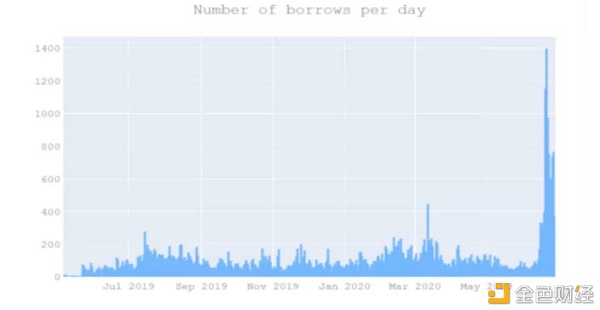
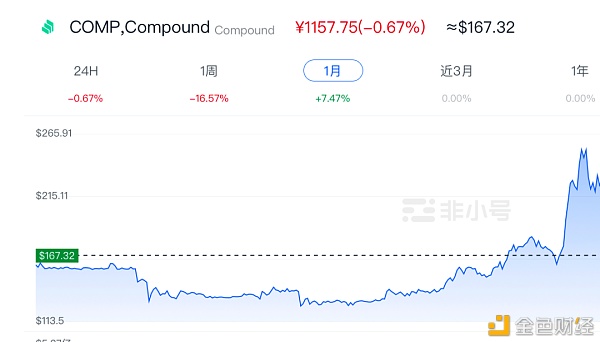
Taking the Compound platform as an example, as long as borrowers borrow on the Compound platform, they can receive 50% of the platform's daily COMP token distribution, and as long as the COMP value obtained can cover the repayment interest rate, they can arbitrage without loss. This is also the main reason why the number of loans has risen rapidly as the COMP price rises.
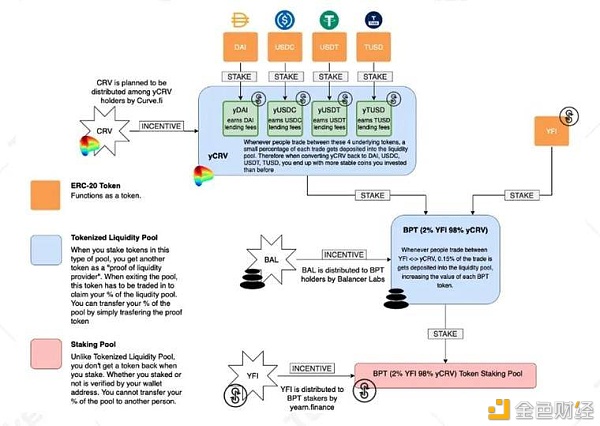
Also, take the popular YFI project as an example. Users can complete different liquidity mining strategies through yearn.finance, which is a liquidity mining aggregation platform. On July 17, 2020, yearn's hedged position (TVL) on Curve was approximately $8 million. Three days later, as of Monday July 20, 2020, that number had risen to $147 million. The rise in TVL drove the price of its governance token YFI, which surged from an initial valuation of $30 to $13616.
Can the high returns of liquidity mining continue?
Liquidity mining is fresh for Westerners, and they have also called it “Yield Farming,” but after this wave of analysis, we found that the model seems very familiar. Isn't this just the FCoin model back then?
Back then, FCoin launched a liquidity incentive policy using its platform currency FT to reward users who trade on the platform. The platform's trading volume exploded rapidly within a month, and the rapidly growing trading volume was not a real transaction demand; rather, investors with many trading robots speculated in it. Eventually, the FCoin platform was shut down in February of this year and failed to pay users between $67 million and $125 million.
Let's go back to the example in the previous section. As long as borrowers borrow on the Compound platform, they can get 50% of the platform's COMP token distribution every day, and as long as the COMP value obtained can cover the repayment interest rate, they can arbitrage without loss. This is also the main reason why the number of loans has risen rapidly as the COMP price rises.
We soon discovered the root of this model. Whose money did the speculators make? By circulating reward tokens to the secondary market, speculators transfer risk to those who buy reward tokens. As a speculator, they have no real borrowing or transaction requirements; they simply sell the reward tokens for profit in the trading market.
Obviously, this model incentive itself does not stimulate real demand for loans or transactions, nor does it actually resolve the mismatch between supply and demand. Most traders also come to stimulate themselves, not to trade demand.
The risk point of this stimulus model is that due to the rapid influx of speculators in the positive growth cycle, the proportion of speculators in the system is much higher than the share of actual transaction demand. Once for speculators at some point, the cost (commission or borrowing cost) exceeds the distribution of profits, the speculators will withdraw from trading, leaving only a small number of real traders.
As a result, no matter how the scenery circulates in a positive cycle, the end will end in a death spiral. Once the situation is reversed, the system has not yet had time to establish negative feedback support (or due to the explosive increase in releases, no effective negative feedback management can be carried out at all), accelerating the price drop and speeding up the exit of speculators, causing the system to collapse.
Back then, in a negative cycle, the FCOIN team tried to carry out artificial negative feedback. For example, the secondary market bought some assets and ended up paying nothing, and still couldn't resist the torrent of negative feedback.
In addition to this, liquidity mining is now exposed to security risks and systemic risks. The flash loan attack against bZx is typical. Without stealing tokens, the attackers arbitraged more than one million US dollars in ten seconds according to the rules. Defi products with the spirit of cross-chain agreements are getting closer and closer to traditional financial leverage games. The popularity of liquidity mining aggregation platforms has intensified the mutual influence between mainstream projects, which may cause certain systemic risks.
China's overall market has yet to fully recover from the big bubble in 2017. As a practitioner, I also cherish the current gradual development of the ecology, and I don't want to see a major systemic crisis occur. For the project side, liquidity mining attracts users and players, but whether it can capture value and achieve real value supply should be a key question for us to think about, and we are pessimistic about the outcome of this model.
Contributing Author: Zhang Bu-nui Editor: Wu talks about blockchain
Source: Wu Says Blockchain Real
