大公司 · 1158
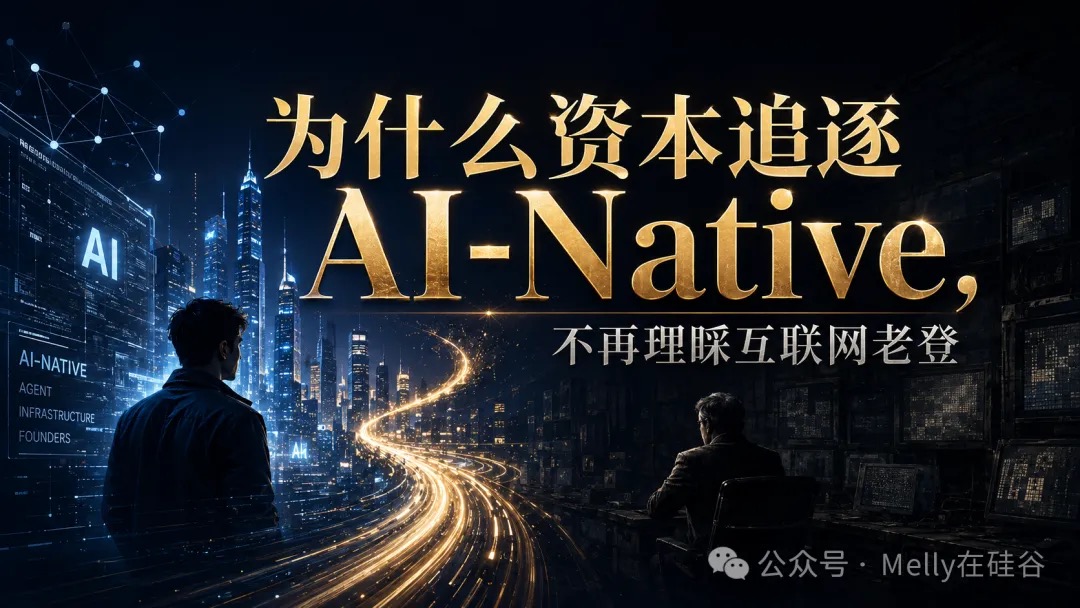
Why is capital chasing AI Native and ignoring the old Internet

Why is capital chasing AI Native and ignoring the old Internet

Capital doesn't reward being old-fashioned, not because old-fashioned people are at fault. The old part is clearly priced. There is no bad information, so there is no excess profit. Global venture capital was $510 billion in the first half of 2026, surpassing $44 billion for the full year of 2025 in one and a half months. More than 70% have entered AI; OpenAI and Anthropic took 217 billion dollars, accounting for 43%. With that much money, you'd think everyone could share a little bit. The truth is that distribution is more extreme than total volume, and the first sieve doesn't screen the industry, it screens people. The category that has been screened out now has an unkind name: the internet is old. Let's just say one thing: the “old man” in this article has nothing to do with age. It refers to a set of methodologies that have been formed in the mobile internet cycle, have been tested over and over, and have brought huge returns to holders. The person holding it may be 45 years old or 32 years old. It was this methodology that was being repriced, not the year of birth. Confusing these two things is Lao Deng's most common mistake and one of the most comfortable mistakes — because if the problem is someone else's age discrimination, you don't need to change a single word. 01 What is AI Native The term has been misused. They can use ChatGPT not called AI native, nor AI in the company name, let alone in their twenties. There are three things that really separate people. First, the starting point is a model, not a requirement. The order in which Lao Deng makes a product is: look at what the user wants, write down the requirements, and find technology to implement it. The order of AI natives is reversed: first figure out what level the model is capable of today and what step it is likely to reach tomorrow, and then move from this capability boundary to the external product. The former uses the model as a tool, and the latter uses the model as the foundation. There was no difference between these two kinds of things made by humans in the first edition; by the third edition, there was a difference of one species. Article 2. The default unit of an organization is not a person. The division of labor in the Internet age is the division of one thing into ten people. AI Native's division of labor is to take ten things from one person and add a bunch of agents. The CEO of a domestic application company said that the team consists of less than ten people, but a large number of AI work at night, and the first thing employees do every morning is check the work the AI handed in the night before. Cursor's side is even more extreme. Public reports mention that the company doesn't have a product manager; engineers write their own code, talk to users themselves, and participate in recruiting people themselves. Article 3. Information is first-hand. AI Native's input sources are papers, model cards, GitHub issues, original discussions on X, and self-run evals. Lao Deng's input sources are industry summits, closed-door meetings, brokerage reports, interpretation of public accounts, and finding someone to drink coffee with. This one is the least obscure and most lethal; I'll talk about that separately later. I'm satisfied with all three. The 25-year-old is an AI native, and so is the 45-year-old. I'm not satisfied with the three rules; I'm still an old man at the age of 25. AI natives are a state, not an age group. The trouble is that tickets in this state are works, not resumes. 02 The two lists spread the results of this round on the table. These are two lists. The first one is an all-AI native company. Their valuations are not rising; they are exchanging orders of magnitude. List 1 · Upstream OpenAI raised $122 billion in a single round of financing in Q1 2026, followed by $852 billion, the largest private equity financing in history. Anthropic Q2 had a single round of $65 billion, after investing $965 billion, accounting for about half of the total global venture capital for the quarter; the revenue operating rate in May reached about $47 billion. DeepSeek raised about 70 billion yuan in its first round of financing in May 2026. In April of the same year, Liang Wenfeng raised his direct shareholding from 1% to 34%, and controlled a total of about 84.29% of the shares through related entities. The Dark Side of the Moon (Kimi) was estimated at $4.3 billion in December 2025; it went for three consecutive rounds from January to February 2026 to reach 18 billion; the D round in May was about $2 billion, breaking 20 billion dollars after the investment; the July round surpassed $3.5 billion, after investing 35 billion dollars; the pre-IPO target was 50 billion dollars. ARR broke 100 million in March, 200 million in May, and held steady at 300 million US dollars in June, with APIs accounting for more than 70%. Smart Spectrum · MiniMax successively landed in Hong Kong stocks in early 2026, with a market capitalization exceeding 100 billion yuan. It was one of the first major model companies listed in China. The second one...

4d agoWendy#AI #DeepSeek
Meta can't keep the Chinese University of Science and Technology hegemony: the big model in Silicon Valley, the Chinese are starting to form their own games

Meta can't keep the Chinese University of Science and Technology hegemony: the big model in Silicon Valley, the Chinese are starting to form their own games

He dropped a $100 million, four-year “contract” in exchange for leaving after 14 months — the talent Zuckerberg had taken from OpenAI and left Meta. In the summer of 2025, Zuckerberg personally knocked out Jiahui Yu (Jiahui Yu), the head of multimodal research, from OpenAI using a salary plan with a total value of up to 100 million US dollars and covering four years. Silicon Valley is on the sidelines, and the industry calls it “stealing people at sky-high prices.” However, just 14 months later — on August 14, 2026, the star researcher, whom Meta had high hopes for, announced his departure and started his own business. A year ago, the blockbuster in the industry ended up being held for a shorter period of time than an NBA season. Just eight days before leaving his job, Muse Spark, the multi-modal model he led, had just been updated to version 1.2. From forming the team to continuously launching the four product lines Muse Spark, Voice Mode, Muse Image, and Muse Video, Yu Jiahui's year at Meta covered almost the entire process of this new team from construction to intensive delivery. Muse Image finished second in the Arena Wensheng Trials Test, beating Google Nano Banana, behind OpenAI GPT Image 2; Muse Video ranked third in the Wensheng video rankings. For Meta, this is certainly an impressive report card. But for Yu Jiahui, this is just an interlude. In his departure statement, he said he was “increasingly drawn to an issue that is critical to the future of humanity but has yet to be fully explored.” Details of the new company have not been disclosed, but he has decided to leave. From the junior class to the history of Yu Jiahui, the top in Silicon Valley, he is at the “top” level for any major AI company. Born in 1995 in Cixi, Zhejiang. In 2012, while still in his sophomore year of high school, he was admitted early to the Junior Class College of the Chinese University of Science and Technology. During his undergraduate studies, he won several contests, including the National Parallel Application Challenge Championship. After graduating in 2016, he went to the University of Illinois at Urbana-Champaign (UIUC) to study for his PhD in computer vision. This scholar trained many famous figures in the field of AI, such as Zhou Xi, founder of Yuncong Technology, and Han Xu, founder of Wenyuan Zhixing. After graduating from her PhD, Yu Jiahui's career progressed step by step. He has worked as a senior research scientist and manager at Google Brain and Google DeepMind, and has participated in the development of visual modules for the Gemini multi-modal project. Joined OpenAI in October 2023 as the head of the Perception (Perception) team, leading the development of GPT-4O and O-series inference models. In June 2025, Zuckerberg personally stepped down, and Yu Jiahui joined former OpenAI researchers such as Zhao Shengjia, Bi Shuchao, and Ren Hongyu into Meta's newly formed super intelligent team. According to foreign media Wired, Meta's compensation package was as high as $100 million — although Meta CTO Andrew Bosworth later clarified that this was not a one-time signing bonus, but a four-year total compensation plan that included stocks, bonuses, and performance conditions. But even so, this is one of the few sky-high contracts in the AI field. (Photo source: One mu of three-quarters of land) After conversion, even though Yu Jiahui only worked for 14 months, Meta paid an estimated cost of more than 25 million dollars for this short period of cooperation — but the actual cost of sunk was even higher. After all, the investment in team building and project start-up cannot be proportionately calculated. The fanaticism of the capital market is driving Silicon Valley's talent exodus, and Yu Jiahui's departure is by no means an exception. In fact, Silicon Valley in 2026 is experiencing an unprecedented “exodus” of AI talents. According to data from the research platform AlphaXiv, Meta alone has lost more than 200 well-known researchers, and another 929 researchers have “worked at Meta but have left their jobs.” In October of last year, Meta drastically cut more than 600 researchers in the AI business. In June of this year, with Llama 4's poor market performance and the company's implementation of more stringent performance reviews, it is expected that 15% to 20% of employees will be rated as “below expectations”, and many senior researchers have switched to competitors. Tech author Gergely Orosz pointed out that Meta's internal organizational restructuring and efficiency adjustments have caused engineers to feel uneasy, and many senior experts have begun to remain open to external opportunities. Google's situation is no less than happy...

4d agoBitpushNews#AI #Yu Jiahui #original #Silicon Valley
Jeff Dean's Last Conversation Before Leaving His Job: I Underestimated AI and Seen the Entrepreneur's Only Way to Live

Jeff Dean's Last Conversation Before Leaving His Job: I Underestimated AI and Seen the Entrepreneur's Only Way to Live

Source | InfoQ Compilation | Curated by Yu Qi | Tina A year ago, Google Chief Scientist Jeff Dean predicted at the AI Ascent 2025 Summit: By 2026, there may be AI systems that can work around the clock and are as capable as junior software engineers. A year later, six days ago, he admitted in an interview with YC that he had underestimated how fast AI is progressing. The model's ability to handle complex tasks grew much faster than he had anticipated at the time. So, according to Jeff Dean, how fast will AI move forward in the future? How can startups survive in an era where generic models continue to expand the boundaries of capabilities? Early this morning, this interview had a different weight. Jeff Dean announced that tomorrow will be his last day at Google. After working at Google for 27 years, this legendary engineer, known as the “programmer among programmers” in Silicon Valley and deeply involved in the construction of Google's system architecture and AI technology, co-founded Discovery Loop with long-term partners Sanjay Ghemawat, Oriol Vinyals, and Quoc Le, a public welfare company focusing on cutting-edge research in machine learning, science, and engineering. Google will continue to work with them as a founding investor and cloud computing partner. According to WIRED, this startup idea actually only surfaced a few weeks ago. In order to retain this core team, Alphabet CEO Sundar Pichai also tried to persuade them to “not lose the job card” during many meetings. But in the end, a few people decided to leave the big company system in exchange for the fun, speed, and freedom that only a startup can have. Screenshot from: https://x.com/JeffDean/status/2085035498222002595/photo/1Jeff Dean wrote in his farewell letter that he saw Google grow from a company of just 25 people to a tech giant with more than 190,000 employees. Today, Google has 13 products with over 1 billion users. From search, email, translation, and video to large-scale computing, autonomous driving, and AI systems, the technology he participated in building has spanned almost the entire evolution of Google. And one of the main reasons that prompted them to leave was precisely inertia, which is difficult for large companies to get rid of. As Oriol Vinyals said, within large organizations, driving any radical change requires overcoming layers of resistance; they want to do something different. What's interesting is that until now, the new company hasn't even had time to recruit people or rent an office. As for who will be the CEO, after a short pause within the team, everyone has their eyes on Jeff Dean — “I think it's me.” he said. As a result, this interview, published on the eve of Jeff Dean's departure, is like a focused judgment on the next stage of AI as he stands at a turning point in his career. On the program, he and YC partner Diana Hu discussed the paradigm shift in AI from “model centered” to “context engineering,” the huge opportunities that inference hardware is emerging, and how entrepreneurs can find a real living space worth sticking to in an age where generic models are becoming stronger and more applications may be directly incorporated by models. This article is based on a video compilation of this interview, edited by InfoQ. Too long without reading the Q edition: Last year you said 2026 would have AI with capabilities close to those of junior engineers. A year has passed, does this prediction punch you in the face? A: That's pretty accurate, but I've underestimated one thing: the model's ability to handle increasingly complex tasks is growing much faster than I expected. Moreover, this ability is spilling over into fields other than coding, and Agent-based systems are starting to really take off. Q: What are the bold predictions for 2027? A: The deep learning system will implement a fully automated problem decomposition and automated experiment cycle: split the problem into sub-problems, run experiments automatically, integrate the results, and obtain an improved system. And this doesn't just apply to machine learning; it can be used in any field of science and engineering with measurable goals. Q: In 2001, Google loaded the search index into memory,...

9d agoburnking#AI #Jeff Dean #Google

Bill Ackman's Pershing Square is preparing a new venture fund to bet on a pre-IPO high-growth AI company

Comparatively, with the emergence of a large number of high-growth startups in fields such as artificial intelligence and biotechnology, and the rapid increase in private equity and pre-IPO investment tools for ordinary investors, Pershing Square, an investment institution under billionaire investor Bill Ackman (Bill Ackman), is preparing to launch a new fund to provide investors with an opportunity to participate in unlisted high-growth companies. Currently, Pershing Square has begun the process of establishing “Pershing Square Ventures.” The fund will use a “permanent capital” model, which can hold investment targets for a long time and continue to hold shares after the investee company is listed. Ryan Israel, chief investment officer of Ackman and Pershing Square, said in a letter to shareholders that the new fund aims to seize investment opportunities for pre-IPO companies and expand the scope of the company's investments outside the open market. Currently, Pershing Square has not disclosed the fund's target size, investment strategy details, and specific fundraising schedule.

9d ago
Office Agent's Summer: Big manufacturers are raising their knives and slashing their former self

Office Agent's Summer: Big manufacturers are raising their knives and slashing their former self

Author: Motion Detecting Original title: Twenty Years of the Internet in China, and Office Agent's This summer, there are two office buildings across the street in Hangzhou. On the roof of a building before the 2026 Spring Festival, a red and gold statue of Sun Wukong was erected next to the dowel's lightning symbol. The roof of the other building is the symbol of Feishu. On the day Sun Wukong stood up, photos were quickly uploaded on social media. Many people laughed that this was the most simple commercial battle. The meaning of DingTalk was probably one step higher than Feishu. The two have been playing for ten years. From whose messages you've read, to documents, forms, and customer lists, all the way to the roof. However, the monkey on the roof had empty hands and didn't wave. It's going to take out something, at the press conference a little over a month later. March 17, Xixi, Hangzhou. The founder of DingTalk was uninvited to stand at the press conference. He created DingTalk in 2015, left in 2021, and was invited back in 2025. On this day, he wants to release a new set of AI assistants. The name is Goku, and the logo uses the monkey on the roof of the building. Ali CEO Wu Yongming sat offstage. Needless to say, we need to break the nail and refine it again with AI. In the past, humans used DingTalk; in the future, AI used DingTalk. When talking about the logo, he removed the gold hoop from the monkey's head, saying it was already a battle over the Buddha. Offstage applause. The monkey that made a big fuss at Tiangong didn't go to Lingshan. He was crushed by Wuxing Mountain for 500 years. When he came out, he had an extra hoop on his head. He rolled all the way under the spell, and his temper was cleaned up little by little. The one who actually walked to Lingshan was already another monkey; he no longer wanted to be king. Fighting over the Buddha is the new name Qi Tian Daisheng got after walking that path. If you want to get there, you have to get rid of the original monkey first. This story is about Goku, but it's also about Ding Ning. What was ostensibly unveiled at this press conference was an AI product, but the one that really wanted to move was DingTalk itself. DingTalk has rewritten more than a thousand low-level abilities into instructions that AI can directly call. In the past, employees had to open approval, schedule, and business systems layer by layer on the screen. Goku could bypass this level, directly read data, adjust tools, and then move things on. Not only is there no way to hand it over, it's not just an entrance; it's also the company's internal organs that have been growing for ten years. However, after just 86 days, he left DingTalk on June 11. This incident is a bit dramatic, but returning to the Chinese Internet for the past 20 years is nothing new. Companies that have actually lived through cycle after cycle have almost all done the same thing, that is, hand over the next knife to their own people when the old business is still making money and the old products are still at their best. In the past 20 years of the Chinese Internet, no one has relied on protecting their former self until today. If you want to survive, you must first kill your former self. Big internet companies have been practicing this art for a long time to kill themselves at the pinnacle. October 2010, Shenzhen. Zhang Xiaolong wrote a letter to Ma Huateng, saying that QQ is a computer, and Tencent needs a communication tool born on a mobile phone. Tencent did not directly hand this matter to the QQ team. The three internal teams started construction at the same time. QQ, QQ address book, and QQ email each made one. Whoever did it first counts as who did it. That year, QQ was at its highest point. January 21, 2011, Guangzhou. The team that works for QQ email launched WeChat 1.0. Tencent took the lead. Two years later, something similar happened in Hangzhou. In 2013, Ma Yun said that the responsibility of the Alibaba Wireless team was to destroy Taobao. That year, Taobao was in the center of the stage. Two years later, mobile Taobao became the main battleground for Double 11. The words Taobao have been preserved, but the screen where people buy things has been replaced, and few people sit in front of a computer and open the Taobao web version. After another five years, it's Beijing's turn. August 2018, Zhichun Road. The China Airlines Building removed the four words “Today's Headlines” and replaced them with “ByteDance.” Today's headlines are still open, and are still being updated, as well as users and ads. That year, today's headlines are still national apps. It's just that TikTok has surpassed it. Three months later, Chen Lin became the CEO of Today's Headlines, and Zhang Yiming's official title was changed from “Today's Headline Founder and CEO” to “ByteDance Founder and CEO.” It's the same three times. Things that need to be used are making money and are getting a lot of attention. It seems like the last place the whole company should touch. But when it grows old on its own, the company will grow old with it. So you have to use it while it's still tough, hand over the next knife to your own person, let the new one grow from the inside, and then eat the old one little by little. The Division of the Losers, but it's bound to be...

10d agoburnking#agent
Silicon Valley's new gang takes shape: AI giants are mass-manufacturing founders

Silicon Valley's new gang takes shape: AI giants are mass-manufacturing founders

By David, Deep Wave TechFlow Original title: Silicon Valley's New Gangster: OpenAI and Anthropic Are Mass Manufacturing Founders Silicon Valley hasn't used the term “Mafia” (Mafia) collectively for a long time. The last time was over 20 years ago. In 2002, eBay spent $1.5 billion to buy PayPal, and a group of young people who had experienced the company's 0 to 1 overnight wealth freedom and then scattered. Everyone knows the story later. Musk did Tesla and SpaceX, Peter Thiel did Palantir, Hoffman did LinkedIn, Chen Shijun and Karim did YouTube... they called the PayPal gang in Silicon Valley. Gangster isn't derogatory; it's a certification that certifies that you came from that winner and that you have the ability to create another winner. This word has been dormant for a long time. The conditions it requires are too stringent. A company that can win enough, a centralized distribution of wealth, and a group of people who have seen the world and haven't been smoothed out yet. Google didn't spawn gangsters, nor did Meta. Until recently, it began to be used frequently by another group of people. People who left OpenAI and Anthropic. Half of 2026 has just passed, and there are people who have left these two leading AI companies and turned over to start new companies, so many can make a long list: Jerry Tworek, the former vice president of OpenAI research, founded Core Automation, former Anthropic researcher Behnam Neyshabur and others formed Mirendil. Among the researchers who just left, some did verifiable mathematics, some did AI that really belonged to them, and others wanted to start an AI that really belongs to them Reinventing PCs at the hardware level... this path has already been crossed once before. Anthropic itself was founded by people who left OpenAI five years ago, and is now valued at 380 billion US dollars, making it the biggest rival of the old owner. The list is still getting longer. These runaways are all using their expertise to prune the leaves of the big tree of AI. When the gang starts looking at a question outside of the big model first. Why are almost none of the people who left OpenAI and Anthropic in 2026 making big models? The answer is realistic, because there is no place on the backbone anymore. Training a cutting-edge model can easily cost several billion dollars. OpenAI, Anthropic, and Google themselves are fighting hand in hand, and entering the startup head-on is tantamount to death. But the stronger the model, the larger the open space around it. Today's models are smart enough, so smart that the bottleneck in the industry is no longer “will it or not”. This group of runaways, when you get together, you'll find that they are actually writing articles about “work” and using their expertise to expand where the model's reach has not yet been extended. For example, can AI actually fall to the job level? The work is done, and believing it or not has become a problem again. I can trust it, it doesn't matter if it's a problem. Big companies can't take care of these layers of trouble, and some of them aren't suitable for them to answer on their own. Almost all of the companies on this 2026 list grew on these few open spaces. One of the most radical open spaces is for AI to research AI on its own. Jerry Tworek, the former vice president of research at OpenAI, and several colleagues founded Core Automation to be an automated research lab where models can read papers, make hypotheses, and run experiments themselves. The judgment behind it is quite ruthless. The bottleneck in AI progress is no longer an algorithm; it is manpower for research. Mirendil, founded by former Anthropic researcher Behnam Neyshabur and others, has just taken $200 million to create another extension of the same logic, a self-accelerating system that allows the model to participate in improving the model itself. The role of humans has been reduced from being the subject of research to being a supervisor. The work was done, and a new problem followed, which was how to confirm that it was done right. As a result, another open space focused on AI trustworthiness. In most fields, verifying an answer given by an AI is far more expensive than generating an answer. Math Inc focuses on this most expensive part. Jesse Han, a former OpenAI researcher, left to found it. The goal is to turn mathematical proofs into a form that machines can verify line by line. Math is one of the few right and wrong things that can be thoroughly checked...

12d agoburnking#AI #Anthropic #OpenAI
After cutting positions for three years in a row, Buffett suddenly took action! What did nearly $20 billion buy?

After cutting positions for three years in a row, Buffett suddenly took action! What did nearly $20 billion buy?

Source | Odaily Planet Daily Author | Azuma Original Title | After three years of continuous stock cuts, Buffett finally dared to laugh a few months ago, “The old man is not as good as me,” but only now does he know “Your grandpa is still your grandpa.” Core view: In the second quarter of 2026, Berkshire Hathaway ended 14 consecutive quarters of net stock sales, switched to net purchases of nearly US$19.8 billion, and invested in Google's parent company Alphabet with 10 billion private equity, marking a shift from long-term wait-and-see to active layout under the leadership of new CEO Abell. After the US stock market on August 9, Beijing time, Berkshire Hathaway announced financial results for the second quarter of 2026. According to financial data, Berkshire's total revenue for the second quarter of 2026 reached US$101.888 billion, an increase of about 10% over the previous year. Net profit attributable to shareholders was US$25.667 billion, doubling from the same period last year (up about 107%), and both operating profit and net profit greatly exceeded market expectations. However, the more signalling point in the financial report is that Berkshire Hathaway has finally ended net stock sales that continued for more than three years (14 quarters) and switched to net purchases. With $400 billion in cash, Berkshire finally got his hands on earnings data. In the second quarter, Berkshire Hathaway bought about US$23.47 billion in shares, sold only US$3.69 billion, and net purchases were close to US$19.8 billion, ending the long-term net sales situation since 2023. What is more worthy of investors' attention is where the funds are going. According to financial reports, Berkshire Hathaway's biggest move last quarter was an additional investment of about $10 billion in Alphabet (Google's parent company) through private placement. It also officially placed Google among the top five largest stocks in Berkshire Hathaway by market capitalization — along with American Express, Apple, Bank of America, and Coca Cola. As of the end of June, these five major holdings together accounted for 66% of the stock portfolio, and position concentration is still extremely high. Although Buffett himself has been cautious about technology stocks for a long time, Buffett previously revealed when he first opened a position at Google that his investment in Google was a joint decision he made after discussions with Greg Abell (current CEO of Berkshire Hathaway, who officially took over as Buffett on January 1 of this year). Buffett also confessed that missing out on Google in the early years was a “historic mistake.” This ticket replacement is based on value investment logic, and what it values is the barriers to its search monopoly and stable cash flow. The current 10 billion dollar increase in holdings is an investment decision made under the new CEO, Commander Abel. This may indicate that Berkshire Hathaway's tolerance and participation in the cutting edge of technology is increasing under the new pattern where Buffett retreats from behind the scenes and Abell comes to power. In addition to restarting net purchases in the market, Berkshire Hathaway also carried out its first share repurchase in two years in the second quarter. According to financial reports, Berkshire Hathaway spent a total of about US$4.527 billion on repurchases in the last quarter, a record high in a single quarter since 2021; in July, an additional more than US$3.3 billion was added to the repurchase. In March of this year, Berkshire Hathaway officially announced the restart of the stock repurchase plan. Abell said at the time that the buyback was because management believed that the “intrinsic value” of his stock was higher than its market price. As the pace of investment and repurchases changed, Berkshire Hathaway's long-term cash reserves also began to change. Over the past few years, one of the company's biggest labels has been “cash machine.” Due to a lack of large-scale opportunities that meet Buffett's investment standards, the size of the company's cash and short-term US debt continued to rise, reaching a record high of close to 400 billion US dollars at the end of the first quarter of this year. However, as stock increases, share buybacks, and industrial mergers and acquisitions (mainly to acquire petrochemical company OxyChem and housing developer Taylor Morrison) unfolded one after another, Berkshire Hathaway's cash reserves began to decline. As of June 30, Berkshire held about US$35.1 billion in cash and cash equivalents, and the size of short-term US Treasury bonds was about US$324.9 billion, totaling about US$364.7 billion, a significant decrease from US$397.38 billion at the end of the first quarter. It was once ridiculed for “not being able to keep up with the times,” but in fact, they are quietly watching the “shores of the turbulent times” and go back in time from 2023 to the beginning of 2026. Over the past few years, the technological wave of AI has completely detonated the global capital market, with chips and semiconductors represented by Nvidia, SK Hynix, Samsung, and Micron...

12d ago22#Berkshire Hathaway #Buffett #invests
Hinton, Li Feifei, and Wu Enda are on the same stage for the first time: targeting AI companies together

Hinton, Li Feifei, and Wu Enda are on the same stage for the first time: targeting AI companies together

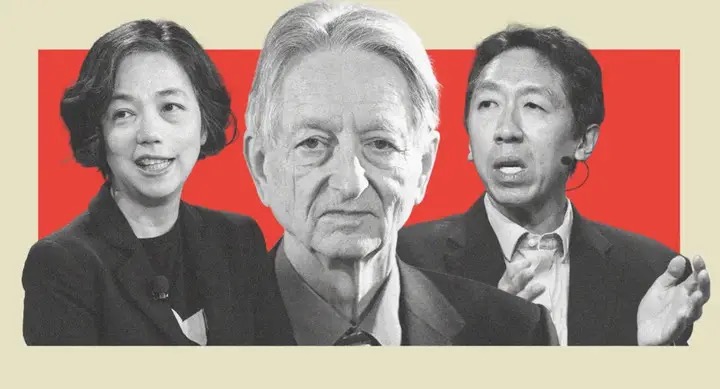
Source: First Electric Network Author: First Electric Editorial Office On the morning of August 6, Beijing time (morning of August 5, local time in Las Vegas), Jeffrey Sinton, Li Feifei, and Wu Enda were on the same stage for the first time. The round table called “Smart Architects: A Historic Gathering” was the most watched event at this year's Ai4 conference. Since Hinton and Wu Enda are almost completely opposed to each other on “will AI destroy humanity”, everyone is looking forward to a live confrontation before the meeting. In fact, all three have their own opinions on regulation, unemployment, and China's open weight model. On stage, Hinton directly said, “We don't always agree,” and Li Feifei immediately added “But we are still friends.” But these three people, whose positions are far apart, are pointing the finger in the same direction: big AI companies. A person seen as a representative of apocalyptic theory, a standard-bearer of individualistic AI, and an open source faction that has long opposed existential risk narratives. They all agree on this matter. As of press release, the organizers have not released the video or full transcript of this round table. First Electric compiled the core views of the three people based on the participants' immediate records, post-conference summaries, and live media reports. ▍ Li Feifei: Increased productivity does not equal prosperity. Li Feifei is the current CEO of the space intelligence company World Labs. The ImageNet data set she led and its 2012 competition are widely regarded as the starting point of this wave of deep learning. She is also the co-founder of Stanford's Human-Centered AI Research Institute. At the round table, she criticized current “irrational and unscientific” remarks surrounding AI. Among the three sources she listed, in addition to critics and many journalists, there are also big AI companies that have financial motives to keep competitors out of their doors. “Let's bring science, not sci-fi, back to the AI debate.” At the same time, she criticized that the utopian statement is also unhelpful; “if used improperly, it can also cause harm.” One of Li Feifei's most quoted words at this roundtable was that increased productivity does not automatically translate into shared prosperity. Improving efficiency is one thing; who the benefits go to is another. On the employment issue, she believes that AI will improve the efficiency of certain work processes rather than the disappearance or retention of an entire job. After all, “no job is a single task.” But for the jobs that are actually being replaced, she thinks a “soft landing” is needed. Many participants also described Li Feifei as the most cautious of the three about the rapid acceleration of AI and its impact on society, and was applauded by the audience. Li Feifei also said that describing AI development as a dispute between open source and closed source routes is a false debate. She used two analogies. The first is nuclear physics. Basic research is carried out publicly, but the most sensitive downstream applications, such as uranium enrichment, are always strictly controlled, and AI is likely to fall on a similar spectrum rather than converge into a single model. The second is the human genome project in the 90s of the last century: at the time, a private company and a consortium of publicly funded universities were the first to complete sequencing. If the private sector completely wins and applies for a patent, this technology may have been blocked from the wider scientific research and pharmaceutical industry. However, in reality, the results of the two parties were jointly announced by the Clinton administration, and the resulting public data integrated the foundation for many years of drug development. With this, she emphasized the importance of the government supporting AI research and making basic breakthroughs widely applied. “This debate, especially on the general level of “we can only tolerate one kind,” is a false debate.” Li Feifei named the reporter's responsibility to break out of this framework and discuss when, where, and how to use varying degrees of openness or closure. Asked what kind of AI headlines the world might wake up to in the next five or six years, her answer was: Using AI as a tool, the world announced the elimination of illiteracy. ▍ Hinton: Regulation is needed, but not this kind of regulation. Hinton won the 2024 Nobel Prize in Physics for his neural network research. After leaving Google in 2023, he continued to speak out about AI risks. He has publicly estimated that the probability of human extinction due to AI development is between 10% and 20%. Although tech leaders generally believe regulation will stifle innovation, Hinton believes regulation is essential to guide the safe development of AI. “You can't hand over the control of artificial intelligence to people like Elon Musk and Mark Zuckerberg” received the most enthusiastic applause that morning. What he wants is not fewer rules, but rules not to be written by people with the most motive to miswrite them. When it comes to employment, Hinton's judgment is pessimistic. He pointed out that AI has surpassed humans in some ways, and predicted that jobs such as call center operators and paralegals will increasingly face the risk of unemployment. “Once artificial intelligence is capable of routine mental work, anything involving routine mental work...

15d agoWendy#AI #Wu Enda #big model #Li Feifei #Hinton
The N-shaped market has two waves and four points. How can technology stocks set the pace of trading?

The N-shaped market has two waves and four points. How can technology stocks set the pace of trading?

Author: Trend Research Original title: Technology Stock Investment Methodology: N-shaped, Two Waves of Markets Four Points Recently, the SDIC Securities Strategy Team recently published a long report called “Technology Industry Investment Methodology” to try to answer a question that all technology investors ask: how to buy and sell technology stocks. How much money will a company like Changjiang Electric Power make every year for the next ten years. Analysts can calculate that if future cash flow is discounted back, that is the stock price. Tech stocks can't figure this out. Because technology evolves by leaps and bounds, one catalytic event can reverse the logic of an entire industry. In 2019, the market thought that general artificial intelligence would take 80 years; 2022 was reduced to 8 years; in 2023, ChatGPT came out, and the schedule was changed again. The A-share data is more direct: technology stocks that doubled their increase in the previous year fell by an average of 40% the next year. Only 5% of technology stocks can maintain a growth rate of 30% or more for five consecutive years. The bottom line is that technology stocks are making a steady stream of money, and they can't get it. N-shape: Two waves of the market. The four-point core framework of technology stock investment methodology can be compressed into one chart: N-shaped. To draw a round of technology market with an N word, there are four key positions: A, B, C, D. A → B is the first wave, from 0 to 1. What this wave earns is narrative money. The company has no performance, and even a product hasn't come out yet, but the story is sexy enough. The valuation method is crude: the output value space of the entire industry is captured, the market capitalization ceiling is distributed according to the link, and the market capitalization/output value ratio is capped at about 3 to 3.5 times. We are now in the direction of A→B: embodied intelligence, low-altitude economy, commercial aerospace, AI applications. B→C is the callback period. The first wave of speculation was over, the story was over, and the stock price dropped. Most tech stocks died here, and there was no second wave. C→D is the second wave, from 1 to 100. What is being earned in this wave is profitable money. The company began to show results, the penetration rate climbed rapidly, and the stock price went up again, but the price-earnings ratio declined because the profit growth rate was faster than the stock price. I have gone through C→D examples: optical modules, PCBs, AI computing power chips, data centers. Point C is the most important C point, which is the real winner or loser for institutional investors. Characteristics of point C: The stock price has dropped from point B for a while. The market sentiment is very poor, the ceiling cannot be clearly seen, and most people have very light positions. But it was in this position that performance began to appear, orders began to land, and the fundamentals of the industry actually exploded. How do you tell when point C has arrived? Of the three elements, it is impossible to do without one: giant capital expenses. Are there any big companies throwing money in this direction. The significance of capital expenditure to the industry is equivalent to the significance of credit to the economy. Without a source of capital, the industry cannot start up. The pace of the AI industry follows this line: from 2023 to 2024, overseas cloud vendors spent capital expenses to buy overseas chains (Zhongji Xuchuang launched); in the second half of 2024, bytes spent capital to buy domestic computing power (Cambrian era launch). Hot product. Is there a product that rips the penetration rate apart. iPhone 4, AirPods, Model 3, ChatGPT, and DeepSeek, every hit marks the beginning of a C→D round. The industrial chain has been launched. Has any company received the order? After the giant's capital expenditure and explosions formed a closed loop, companies in the industrial chain began to generate revenue, and a positive cycle began. The report uses a sentence to summarize: as long as the three elements are in place, we should quickly intervene. This is the most critical action to carry out a round of super markets. How to determine point D (when to sell)? This section of the report introduces the “M top” framework. M is the two peaks. The first top is the trading peak (sentiment peak), and the second top is the fundamental top. At the top of the fundamentals, there are three observational signs: whether there is a recession at the macro level, whether there is a price war on the supply side, and whether capital expenditure on the demand side has begun to decline. If two or more of the three appear, this round of the industry market is basically over. If the leader falls due to macro or external factors, the direction of an industry trend is the best place to buy. For example, when the NASDAQ fell in 2010, Apple was the point of purchase; when the epidemic fell in 2020, Tesla was the point of purchase; the trade war also provided a buying point for AI technology. Nvidia's selling point mainly depends on two conditions: one is whether the US economy has a hard landing, and if it does, it sells; because the cash flow of the five major cloud vendors is highly tied to consumption, the entire logic fails; the second is whether the competitive landscape deteriorates, and if the pattern deteriorates, it should also sell. In terms of mapping US stocks, it has historically been an important investment methodology. 90's to 2...

17d agoburnking#GPT
The AI sector is bloody. Why is Gavin Baker, a well-known investor, bucking the trend and bullish on AI?

The AI sector is bloody. Why is Gavin Baker, a well-known investor, bucking the trend and bullish on AI?

Abstract: Gavin Baker said that AI stocks fell by 40%-60% in July, which seriously deviated from actual fundamentals — after field research in Silicon Valley, he did not find any negative quantifiable indicators, and GPU rental prices rose 50%-60%. He believes that the only real risk is the tightening of the credit market, but if the operating cash flow of hyperscale cloud vendors accelerates as scheduled, the demand for debt financing will be drastically reduced. Regulation, on the other hand, is listed as the biggest tail risk. Markets are panicking, but Silicon Valley data tells a different story. Recently, well-known technology investor Gavin Baker revisited the sharp sell-off in the AI and semiconductor sector in July 2026 on the podcast program “Invest Like the Best”. Baker described this period as “compressing 2022 into one month,” and said that after weeks of field research in Silicon Valley, he couldn't find any negative quantifiable indicators. The trigger for the sell-off: a series of narratives, not fundamentals, Baker sorted out the trigger chain for the July market decline. First, Meta announced that it would rent out part of its computing power. The market interpreted this as a sign of “excess computing power and cutting capital expenses,” and the stock price immediately fell. But Baker thinks this is a misinterpretation — “Meta's capital expenditure plan hasn't changed at all; if anything, they've become more aggressive. “Meta then released the strong Llama model, further proving that it wasn't on the brakes. Immediately after that, open source models such as Kimi K3 were released, and structural changes occurred when superimposed on the Silicon Data Token Index. The market feared that the open source model would seize share and reduce AI infrastructure demand. Baker clearly refutes this: “Generating a token, whether open source or closed source, consumes exactly the same computing power — the same floating-point operations, the same memory, and the same power consumption. Open source grabbed share, but only transferred profits from the cutting-edge model layer to the AI infrastructure layer, and there was no negative impact on computing power demand. “Then there was the DUV lithography machine rumor, which caused the semiconductor equipment sector to plummet. Baker believes the market is overreacting, but it shouldn't be completely ignored either. The only real risk: Of all the triggers in the credit market, Baker only takes changes in the credit market seriously. “Real interest rates have risen and credit spreads have widened; these are undeniable facts. “He pointed out that the pricing of bonds issued by Meta last week was far lower than expected, and CDS spreads across the board for major tech companies. The core of the question is: How much debt financing is needed for large-scale AI infrastructure construction? Baker's judgment is that if the operating cash flow of hyperscale cloud vendors accelerates as planned, the need for debt financing will be drastically reduced. Citing data, he said that operating cash flow (non-free cash flow) of Microsoft, Meta, and Amazon has accelerated from 28% in the previous quarter to 32%. After excluding one-time items such as EU fines, the actual growth rate reached 35%. “This is a substantial acceleration at this volume. “He further estimated that if the computing power of hyperscale cloud vendors were to be monetized at the current Blackwell price rather than the lower previous generation price, operating cash flow could jump from the current consensus estimate of $1.3 trillion to $140 billion to about $2 trillion, thus removing about $700 billion in credit requirements from the market. “If repriced at current prices, construction over the next few years could be entirely self-funded from operating cash flow. “GPU prices: 50%-60% increase, which is completely contrary to expectations. Baker shared an example that he believes best explains the problem. A well-known startup leased a number of Blackwell clusters for around $2 per GPU per hour 7 months ago and expects to pay close to $4 when renewing the contract — an increase of about 50%-60%. “You would have expected a moderate drop in prices to be beneficial; the result was a vertical rise. “He also mentioned that an inference cloud company publicly stated on the podcast that it plans to pay 100% more for Blackwell after the contract expires. “This means that all hyperscale cloud vendors are underestimating their profitability. “Baker said the goal of his research in Silicon Valley was to “try as hard as possible to find negative data points,” but apart from the increase in Anthropic...

17d ago22#AI #Nvidia