拉里·埃里森 · 22
New York Times Long Article | 81-year-old Allison All In AI bet on Oracle and kidnapped the entire United States

New York Times Long Article | 81-year-old Allison All In AI bet on Oracle and kidnapped the entire United States

Source: The New York Times Authors: Jonathan Mahler, Jim Rutenberg, Kirsten Grind Original title: Larry Ellison Bet It All on the A.I. Boom. Will He Be the Face of the A.I. Bubble? Editor and collation: BitPushNewsBitPush Note: Through long-term in-depth research, the New York Times reporter interviewed dozens of people familiar with Larry Ellison (Larry Ellison) and Oracle (Oracle) in Silicon Valley, San Francisco, Hawaii, and New York, and reviewed numerous financial documents, analytical reports, and court records. The article focuses on Larry Ellison's bets on the aggressive transformation of artificial intelligence, revealing how Oracle (Oracle) relies on huge debt to expand AI infrastructure, and the profound risks this gamble may bring to companies, capital markets, and even the US economy. Here's the text: January 21, 2025 — the first full working day since Trump's second administration took office — Larry Ellison woke up in his 33-bedroom, 34-bathroom beachfront mansion in Florida, boarded his private jet, and flew to Washington. Ellison, who was 80 years old at the time, had a net worth of about 200 billion US dollars and wanted to go to the White House for an appointment. He was too lazy to even bring his driver's license — got to the door and call a staff member close to the president to guarantee his identity — but at 2 p.m., he was already standing next to Donald Trump in Roosevelt Hall. The president announced the launch of “the largest artificial intelligence infrastructure project in history to date,” and told the world that his friend Larry Ellison was the right person to complete this task. “He's kind of like the CEO of everything,” Trump said. “He's an amazing person and an amazing businessman.” Ellison first thanked Trump. “Of course we wouldn't be able to do this without you,” he said. “It just wouldn't be possible.” He then drew up this ambitious plan. Ellison's database software and cloud computing company Oracle, and its partners — most notably OpenAI — will invest up to $500 billion over the next four years to build a number of giant data centers. Each data center covers an area of 500,000 square feet and will generate a total of 10 gigawatts of computing power, consuming enough electricity to power up to 10 million homes. The name of the project “Stargate” is taken from the 1994 sci-fi movie of the same name: in the film, Kurt Russell walks through a wormhole and finds himself inside a pyramid on an alien planet. In reality, this “Stargate” will be the entrance to lead humans from the post-industrial era to the era of artificial intelligence. Ellison sided with Trump long before many other tech leaders turned to support him. After the 2020 election, he attended a strategic conference call with Trump's cronies to discuss how to reverse the election results; in 2024, he also donated tens of millions of dollars to support Trump's campaign. However, OpenAI CEO Sam Altman, who was also present at the White House on the same day, was a Democratic Party donor and Trump critic. To facilitate this event, Ellison helped arrange a call between the two. As far as Ellison is concerned, this White House appearance is a work of him running frantically for two years trying to transform Oracle into an AI giant to the top. The effort began in late 2022: ChatGPT came out of nowhere, shocking the world and starting a battle of contention — everyone wanted to master and control the most disruptive new technology since the birth of the internet. As one of the founders of Silicon Valley and the last person still on the table in that generation, Ellison desperately didn't want to be left behind. He acted quickly and harshly — some would even say almost reckless — to try to turn Oracle into a “hyperscale cloud service provider,” one of the few companies that can provide critical infrastructure and power the AI boom. These efforts have at times brought Ellison into conflict with the Biden administration. The latter has taken a more cautious approach to artificial intelligence and introduced a series of regulatory measures, hoping that the government can take some control over its development process. The Biden team believes that if the US wants to stay ahead in the AI competition, the best way is to control the ability of US companies to provide computing power to foreign countries such as China and the Persian Gulf authoritarian regime. Picture: On January 21, 2025, after announcing the “Stargate” project, President Trump met SoftBank CEO Masayoshi Son, Larry...

21d agoWendy#AI #Larry Ellison #datacenter #lather #depths #Oracle #viewpoints
Trillions worth, shares are not given to children... why do so many people hate Musk?

Trillions worth, shares are not given to children... why do so many people hate Musk?

What is it like to get a “trillion dollar” pregnancy experience voucher as soon as you were born? According to common sense, this should be a “lie back and win” life at the top of human society. But if you're Elon Musk's kid, sorry, this script might be difficult. With SpaceX successfully completing the “largest IPO in human history,” Musk officially became the world's first “trillionaire.” He is worth more than the sum of the wealth of the four richest people behind him — Larry Page, Sergei Brin, Jeff Bezos, and Larry Ellison — and is even close to surpassing Bitcoin's total market capitalization. Along with his wealth, there is also his huge family map — up to now, Musk has revealed that the number of children Musk has publicly reached 14. 14 kids, worth a trillion dollars. While the entire internet was trying to figure out how his kids would split this account, Musk himself publicly spilled a pot of cold water. In an interview with the “Wall Street Journal” CEO Council summit on the eve of the IPO, he said that he did not support the practice of children automatically inheriting control or shares of the company: “I would never take the initiative to give children shares in the company. If they have no interest or ability to manage, it is a “huge mistake” to pass on the company to them.” This kind of operation, which pursues extreme efficiency in business and also puts performance first in private, is very “Musk.” A workplace “tyrant”? Here are a few numbers: On the eve of SpaceX's IPO, the Wall Street Journal estimated how fast Musk was making money. In the 31 years since starting his business in 1995, he has earned an average of $992 per second — converted to $3.6 million an hour, or $85.7 million a day. An American family with a median income of $8,3,730 in 2024 would need to work for more than 11 million years without eating or drinking to save the same amount of wealth. His personal net worth already exceeds the annual GDP of 125 countries around the world, including Norway, Thailand, Argentina, and South Africa, accounting for about 3% of the US GDP. If Musk keeps working 70 hours a week at high intensity and never takes a vacation until he is 75, his actual perceived hourly wage during his career is about $4.2 million. In reality, his pace is even crazier — after buying Twitter, his working hours soared from around 80 hours to over 120 hours a week. Musk follows a work culture he called “Extremely Hardcore” (Extremely Hardcore). After buying Twitter for $44 billion in 2022, he cut the total number of employees from 7,500 to 1,500 within six months — laying off about 80% of the workforce. The remaining employees received an email from all employees with the subject “A Fork in the Road”: either accept “intense long hours of work” or leave with three months' severance pay. He is extremely repulsive of the bureaucratic hierarchy and is used to going beyond his supervisor to give orders directly to engineers. During Tesla's most difficult period, he used the factory as his main residence for three consecutive years. “For a while, he slept under his desk, and it was an open desk, placed right in the middle of the workshop.” His reason is straightforward — let employees see for themselves that leadership is under pressure just like them. However, Musk's management style has created both an avid following and serious career burnout. The turnover rate of his company's executives is extremely high, “violent dismissals” occur from time to time, and employees need to survive in an extremely unstable pace. According to the Wall Street Journal, a former SpaceX employee once described it this way: Most of the people left behind had a strong sense of identity with Musk's mission and were willing to bear extreme pressure, while those who left were often engulfed by the unpredictable intense pace and intense consumption. In an interview with the Financial Times, a former Tesla engineer recalled that he had received a text message from Musk at 3 a.m. on Sunday and was asked to respond within 15 minutes. Another former executive put it bluntly: “He's very ruthless and extremely involved in every decision you make — he has little fear of failure.” When an idealist is “Sheda” Musk is really worried about big things: Mars, AI, and the survival of civilization. However, the blind spot of this idealism is that it often only aims to save the macroeconomic “future of humanity,” yet it is extremely lacking in feeling about specific individuals. The collapse created by others was an acknowledged turning point — Thailand's “Sleeping Beauty Cave” junior soccer team rescue incident in 2018. At the time, Musk rushed to the scene with a high-profile “mini submarine” built by SpaceX, but was supported by experienced British professional rescue team member Vernon Uns (Vernon Uns)...

67d agoWendy#SpaceX #public #Musk

Forbes: SpaceX IPO Will Create 9 Billionaires Including Twitter Co-Founder

Comparatively, as SpaceX launches its IPO at a valuation of $1.8 trillion, it will create 9 billionaires, including a CFO who managed his 14-year accounts, a female executive who became president from employee number 11, a Twitter co-founder, and a Saudi prince who bet early on, have also reaped huge wealth in this space capital feast. They are: 1. Prince Alwaleed bin Talal Al-Saud: An estimated holding ratio of 0.28%, with a corresponding share value of US$5.1 billion; 2. Luke ·Northack: estimated shareholding ratio 0.19%, corresponding share value of 3.4 billion US dollars; 3. Larry Ellison: estimated shareholding ratio 0.15%, corresponding share value of 2.7 billion US dollars; 4. Jack Dorsey: estimated shareholding ratio 0.14%, corresponding share value of 2.6 billion US dollars; 5. Gwen Shortwell: estimated shareholding ratio 0.10% (including options), corresponding share value of 1.7 billion US dollars; 6. Brett Johnson: estimated shareholding ratio 0.07% (including options), corresponding share value of 1.2 billion US dollars; 7. Tom Mueller: Estimated shareholding ratio 0.06%, corresponding share value of US$1.1 billion; 8. Kimball Musk: Estimated shareholding ratio of 0.04%, corresponding share value of US$760 million; 9. Steven Witkoff: Estimated shareholding ratio of 0.01%, corresponding share value of US$270 million. (Forbes)

71d ago

Trump appoints former Attorney General Bondi to the White House Artificial Intelligence Committee

Comparing news, US President Trump has appointed former Attorney General Pam Bundy to join the White House Artificial Intelligence Committee. Bondi was removed from the position of Attorney General by Trump last month, and she will join the President's Science and Technology Advisory Council. The committee is co-chaired by former White House AI advisor David Sachs and White House scientific advisor Michael Krazios, and also includes more than a dozen tech executives, such as Nvidia co-founder Wong In-hoon, Meta CEO Mark Zuckerberg, and Oracle co-founder Larry Ellison. According to reports, Bondi will be responsible for promoting coordination between the government and the tech giants in the Commission. (AXIOS)

87d ago
When Web4 Begins Knocking: A Self-Help Handbook for Ordinary Migrant Workers

When Web4 Begins Knocking: A Self-Help Handbook for Ordinary Migrant Workers

Author: TT3LABS, Web3/AI/SaaS remote recruitment platform Original title: On the eve of Web4, anti-elimination guidelines for ordinary migrant workers On February 26, 2026, fintech giant Block announced the layoffs of more than 4,000 employees, and the team size was directly reduced from more than 10,000 to less than 6,000. CEO Jack Dorsey mentioned in a letter to shareholders: “Smart tools have changed what it means to create and run a company... a significantly smaller team can do more and do better with the tools we're building. “Dorsey also gave his extremely cold prediction: “I think most companies are late. Within the next year, most companies will draw the same conclusions and make similar structural adjustments. “Block's share price skyrocketed 20% + after the day. This is the capital market's response with real money: paying for the company's AI leverage and efficiency. An ordinary person who doesn't understand programming at all can already independently run a fully functional app overnight with the help of a large model. Then the capital market is bound to ask a sharp question: how much is the value of a tech giant that hires tens of thousands of programmers to maintain the daily operation of a super app with its huge human costs? The trend of replacing manpower with AI will surely be followed by more large companies. Anxiety is inevitable, but anxiety alone is useless. We must start with changes in the general environment and step by step back to individual survival strategies. AI is more than just a tool; it is becoming a means of production market where some people are beginning to use “Web4” to define the current stage. To clarify the context, let's first take a look at the different stages of the evolution of the Internet: the core of Web2 is the interaction between software and people. Different platforms use algorithms to get users' attention, which is essentially a traffic grab battle. Web3 is trying to solve the problem of digital asset entitlement and value allocation. Many people simply equate it with cryptocurrency, but in essence, it is still a game of wealth distribution rules and does not touch on the “manufacturing” relationship of digital products. On the eve of Web4, AI first touched on changing the production relationship itself. It is no longer just a tool for improving efficiency; it is becoming a new type of production tool. Whoever uses it more can push the output limit by an order of magnitude. Traditional teamwork has many hidden costs: good leaders' judgment and industry intuition are difficult to replicate to subordinates, and misunderstanding and rework losses are unavoidable in multi-person execution. These are “dark taxes” on how organizations operate, and there was no clear solution before. AI has drastically reduced this dark tax. It has no learning curve, can execute with high quality when given clear reminders, and can process multiple task lines in parallel at the same time. When one person's strategic judgment is superimposed on AI's execution levers, the output of an entire team in the past can be leveraged. Of course, AI still occasionally “makes serious nonsense”, which determines that human review and judgment are still essential. However, the reliability of the model is improving on a monthly basis, and the buffer window left for pure executives is much shorter than most people think. Efficiency equality and deep crisis: When the entry threshold is lifted, in the short term, ordinary people can get efficiency dividends by accessing AI tools. However, in retrospect, when AI erases the basic inefficiency and greatly lowers the entry threshold for professionals, companies will find that after a significant increase in individual output efficiency, if the overall business scale does not expand in the same proportion, maintaining the original employee base is a negative asset. If you look at the current wage differentiation, you'll see. According to TT3LABS job monitoring data, starting in 2025, salary packages in units of “10 million US dollars or more” have repeatedly appeared in the AI job market, and these candidates are all young AI engineers and do not have very rich “team management skills”. When Meta was looking for OpenAI core researchers, the contract bonus alone exceeded 100 million US dollars. The average equity compensation of OpenAI employees reached 1.5 million US dollars, and the basic annual salary of Anthropic senior research engineers reached up to 690,000 US dollars (excluding equity). Capital spent this money on a scarce ability: making AI itself stronger. The value of people who can drive the evolution of the underlying model can be measured at a geometric level throughout the commercial network...

170d agoLuxurytracy

US stocks opened, the Dow rose 0.1%, and technology stocks generally rose

Comparative news, according to the Golden Ten report, the Dow Jones Industrial Average rose 0.1%, the S&P 500 rose 0.4%, and the Nasdaq Composite Index rose 0.6% when the US stock market opened. Technology stocks performed strongly, with Nvidia up 1.5%, Micron up 4%, and Oracle 2.3%. Warner Bros. Exploration rose 3.5%, and Paramount bought Warner Bros. with a $404 billion guarantee from Larry Ellison. The Nasdaq China Golden Dragon Index rose 0.2%, Alibaba 0.3%, and Baidu 0.1%.

243d ago
[Comparing Daily News Picks] Forbes: Elon Musk became the first millionaire in history to surpass 500 billion US dollars; Strategy bought 42,706 bitcoins in Q3 this year, worth over 5 billion US dollars; Sui Group Holdings plans to launch two stablecoins in partnership with Ethena

[Comparing Daily News Picks] Forbes: Elon Musk became the first millionaire in history to surpass 500 billion US dollars; Strategy bought 42,706 bitcoins in Q3 this year, worth over 5 billion US dollars; Sui Group Holdings plans to launch two stablecoins in partnership with Ethena

Web3 news selected for you every day by Bituo Editor: [Forbes: Elon Musk becomes the first person in history to surpass 500 billion US dollars] Betweet news, according to Forbes, Tesla CEO Elon Musk became the first person in history to surpass 500 billion US dollars. According to data from the “Forbes” real-time billionaire tracking system, as of October 1 at 3:30 p.m. EST, the richest man in the world was worth 500 billion US dollars. Musk became the first billionaire to surpass 400 billion US dollars in December last year. Currently, he is worth 150 billion US dollars more than second-place Larry Ellison, and is only one step away from becoming the world's first trillionaire. [Strategy bought 42,706 bitcoins in Q3 this year, worth over $5 billion] Comparing news, Strategy bought 42,706 bitcoins in the third quarter of 2025, worth more than $5 billion. [Sui Group Holdings plans to launch two stablecoins in partnership with Ethena] According to The Information on Wednesday, Sui Group Holdings, a digital asset library based on the NASDAQ, plans to launch two stablecoins on the Layer 1 blockchain. The report said, “The company will launch two types of stablecoins: SuiUSde, which will provide revenue to holders; USDi, which will not pay proceeds to holders.” “The company is partnering with stablecoin startup Ethena to issue these two tokens and will go live by the end of this year.” According to a statement, Sui Group Holdings said last month that it held SUI tokens worth over $300 million after the company increased its SUI token holdings by around 20 million. [Bullish obtains New York Department of Financial Services (NYDFS) license to launch in-stock crypto trading] In comparison, crypto platform Bullish (BLSH) obtained a BitLicense and remittance license issued by the New York State Department of Financial Services (NYDFS) last month, and officially launched spot trading in the US. The deal is now live in 20 US states and regions, including California, New York, and Washington, D.C. Bullish Exchange said that although it is still new to US users, it has been operating internationally since the end of 2021, with a cumulative trading volume of over $1.5 trillion. The cryptocurrency platform owns CoinDesk and was listed on the New York Stock Exchange (NYSE) in August. Currently, the stock is trading at $63.36 per share, which is 70% higher than the IPO price. The exchange is aimed specifically at institutional clients and uses a hybrid model combining a central price limit order book and automated market making to stabilize liquidity and improve trade execution even in volatile environments. [Matrixport: If the price of Bitcoin remains above $108,000, the “increase in October” will continue] In comparison, Matrixport released today's chart saying, “We were resolutely bullish in October 2022, late September 2023, and early October 2024. The first two judgments deviated from mainstream market opinions at the time, but in the end they were all confirmed by subsequent trends. Today, Bitcoin is once again entering its strongest performance ever in October. Over the past ten years, the average increase in October was 21.6%, and negative returns were recorded in just one year. This rule shows that the current market environment still favors bulls. If the price of Bitcoin remains above $108,000, the market's seasonal advantage is likely to continue.” [Bitcoin lending platform Lava completes $17.5 million financing and launches US dollar yield products, with former Visa and Block executives participating] According to The Block reports, Lava, a platform focusing on Bitcoin mortgage lending, announced that it has completed the $17.5 million Series A expansion financing and launched a new dollar yield product at the same time. The funding round was supported by a number of angel investors, including Peter Jurdjevic of the Qatar Investment Authority and former executives of Visa and Block (formerly Square). Twitter: https://twitter.com/BitpushNewsCN...

324d agoWendy#Compare Daily Picks

Forbes: Elon Musk becomes the first person in history to surpass $500 billion

Comparative news, according to Forbes: Tesla CEO Elon Musk became the first person in history to surpass 500 billion US dollars in net worth. According to data from the “Forbes” real-time billionaire tracking system, as of October 1 at 3:30 p.m. EST, the richest man in the world was worth 500 billion US dollars. Musk became the first billionaire to surpass 400 billion US dollars in December last year. Currently, he is worth 150 billion US dollars more than second-place Larry Ellison, and is only one step away from becoming the world's first trillionaire.

325d agoWendy
New game for US stocks: 100 billion AI turntable, who will be the final taker?

New game for US stocks: 100 billion AI turntable, who will be the final taker?

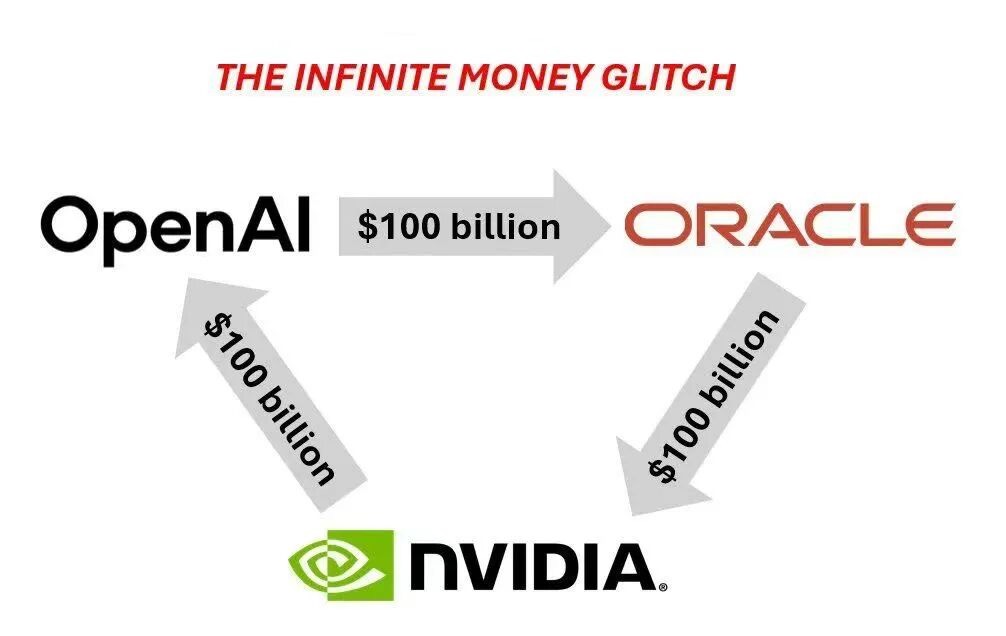
Article | Original title of May Day | US stocks are playing a new type of AI turntable game. Recently, a section has been circulating in the US stock market: “OpenAI invests 100 billion US dollars in Oracle to buy cloud computing services; Oracle invests 100 billion US dollars in Nvidia to buy video cards; Nvidia invests another 100 billion dollars in OpenAI to lay out AI systems. The question is, who actually paid for this 100 billion dollars?” Of course, the above is just a joke. There is a big discrepancy between the amount and the facts, and it's not that the three companies are putting the same amount of money around, but this does reflect a closed loop in a new type of capital narrative. In this closed loop, every step is a real contract or investment, and every action will be amplified by the capital market, which in turn will increase the market value by trillions of dollars. On September 11, Oracle shares surged 36%, the biggest one-day increase since 1992. Overnight, the company's market capitalization soared to $933 billion, and founder Larry Ellison even briefly surpassed Musk to become the richest man in the world. On September 22, Nvidia and OpenAI announced that they have reached a strategic cooperation. Nvidia plans to invest up to 100 billion US dollars in OpenAI. Nvidia closed up nearly 4%, the market capitalization exceeded 4.46 trillion US dollars, and set off the overall technology stock market. The three major US stock indexes all reached new highs. $100 billion may seem like a lot, but overnight it drove US stocks up trillions of dollars, and properly spend a small amount of money to do big things. US stocks are playing a new kind of AI turntable game. Triangular cycle: How does money turn around? In the real-life version of the investment maze, three names form a perfect closed loop of capital: OpenAI, Oracle, and Nvidia. Part 1: The core protagonist of the OpenAI Computing Power Hunger story is OpenAI. As the creator of ChatGPT, OpenAI processes requests from 700 million users every day. AI computation on this scale requires massive computational power. This year, OpenAI and Oracle signed the largest technology contract in history, a 5-year $300 billion cloud computing agreement. Under this contract, OpenAI will pay Oracle approximately $60 billion a year, equivalent to six times the company's current annual revenue. What did this money buy? 4.5 gigawatts of data center capacity, equivalent to the electricity consumption of 4 million American households. Oracle wants to build data center campuses spread across five states, including Wyoming, Pennsylvania, and Texas for OpenAI. For OpenAI, this guarantees a model with location and computing power; for Oracle, this is revenue certainty for the next five years. Second step: After Oracle needed a chip and received a huge order from OpenAI, Oracle faced a problem: how to build these data centers? The answer is chips, lots of chips. Oracle plans to spend tens of billions of dollars on the Stargate project to buy Nvidia GPUs. According to industry estimates, 4.5 gigawatts of computing power would require more than 2 million high-end GPUs. Oracle CEO Safra Katz put it bluntly: “The vast majority of our capital expenditure investments are used to buy revenue-generating equipment that will go into data centers.” These “revenue-generating devices” are mainly Nvidia's H100, H200, and the latest Blackwell chips. Oracle became one of Nvidia's biggest customers. Third step: Nvidia backfeeds Just as Oracle is frantically purchasing chips, Nvidia announced an amazing decision: invest $100 billion to support OpenAI's construction of a 10-gigawatt AI data center. The investment will be phased in, and every time OpenAI deploys 1 gigawatt of computing power, Nvidia will invest the corresponding amount of money. The first phase is scheduled to launch in the second half of 2026, using Nvidia's Vera Rubin platform. Nvidia CEO Hwang In-hoon said in an interview, “10 gigawatts of data center capacity is equivalent to 4 million to 5 million GPUs, which is approximately our total shipment volume this year.” At this point, a perfect capital cycle was formed: OpenAI paid Oracle to buy computing power, Oracle paid Nvidia to buy chips, and Nvidia...

333d ago深潮TechFlow#AI #OpenAI #Oracle #US stocks
[Weekly Web3 News Picks] Nasdaq submits a proposal to the US SEC to allow the trading of tokenized securities; the US Supreme Court hears Trump's tariff case, and the debate is scheduled for early November; Tether will launch USAT, a compliant stablecoin in the US and appoint Bo Hines as CEO

[Weekly Web3 News Picks] Nasdaq submits a proposal to the US SEC to allow the trading of tokenized securities; the US Supreme Court hears Trump's tariff case, and the debate is scheduled for early November; Tether will launch USAT, a compliant stablecoin in the US and appoint Bo Hines as CEO

Weekly Web3 News Picks: [NASDAQ Submits Proposal to US SEC to Allow Tokenized Securities Trading] Comparative News. According to Reuters, NASDAQ (NASDAQ) has submitted a proposal to the US Securities and Exchange Commission (SEC) to amend the rules to allow trading of securities listed in traditional digital or tokenized forms on the NASDAQ Exchange. [Trump's personal net worth has increased by $3 billion in the past year] According to Fortune magazine, Donald Trump has just had the most profitable year of his life. Today, the president's net worth is a record $7.3 billion, a significant increase from $4.3 billion when he ran for election in 2024. The $3 billion increase jumped him 118 places on the Forbes 400 Rich List, ranking 201st this year. There has never been a president in US history who has used his position of power to obtain such huge wealth as Trump. His main tool to get rich is cryptocurrency — an asset class full of hype and highly affected by regulatory risk. [Grayscale has submitted BCH, LTC, and HBAR registration statements to the US SEC] In comparison, US SEC documents show that Grayscale has submitted Grayscale Bitcoin Cash Trust (BCH) and Grayscale Litecoin Trust (LTC) S-3 registration statements to the US Securities and Exchange Commission. In addition, Grayscale also submitted a Grayscale Hedera Trust ETF S-1 registration statement to publicly issue securities in the US. [REX/Osprey Dogecoin ETF will begin trading this Thursday, Bitwise's proposal was delayed by SEC] According to Bloomberg, the US Securities and Exchange Commission (SEC) delayed its decision on Bitwise's Dogecoin (Dogecoin) ETF on Tuesday, saying it would take “longer” to analyze and approve the rule changes for this product. Meanwhile, the Dogecoin ETF, launched in collaboration with REX Shares and Osprey Funds, is scheduled to officially start trading this Thursday (September 12), under the stock code DOJE. The ETF leverages the Investment Companies Act 1940 compliance path to provide investors with Dogecoin exposure by investing in a subsidiary registered in the Cayman Islands. Bloomberg analyst Eric Balchunas notes that this may be the first ETF in the US to hold “deliberately useless” assets. The context of this incident is that new SEC Chairman Paul Atkins promised a friendlier attitude towards digital assets, and there are currently nearly 100 spot crypto ETF applications awaiting approval. [US Supreme Court to hear Trump's tariff case; debate scheduled for early November] According to news, the US Supreme Court agreed on Tuesday to rule on the legality of Trump's full imposition of global tariffs. Earlier, lower courts ruled that most of the tariffs imposed by Trump were in excess of authority, that is, the tariffs were not valid. After the Trump administration asked the Supreme Court to review the case last week, the latter acted quickly. The Supreme Court will expedite the case and schedule oral arguments for the first week of November. The judges also agreed to hear another challenge to Trump's tariffs from family toy company Learning Resources. [Musk regains the title of the richest man in the world, Oracle founder Elon Musk is only a few hours away] According to CNN reports, Elon Musk (Elon Musk) regained this throne on September 10, local time, after briefly losing the title of “World's Richest Man” for a few hours. Larry Ellison (Larry Ellison), the co-founder of Oracle (Oracle)), once surpassed Musk with a net worth of 383.2 billion US dollars due to the company's stock price skyrocketing in a single day, but by the close of the US stock market, Musk had overtaken it with a net worth of 384.2 billion US dollars and returned to the top of the list with a margin of 1 billion US dollars. The dispute over the richest man was due to strong earnings reports issued by Oracle. Due to a surge in demand related to artificial intelligence, the company's stock price rose to a high of 43% in the session on Wednesday and closed up about 36%, the biggest one-day increase since 1992. As Oracle's largest individual shareholder, Ellison's wealth increased by up to 101 billion US dollars in a single day, with a net increase of 89 billion US dollars in the end, making Bloomberg's billionaire fortune...

342d agoburnking#Weekly review of the comparison