泡沫 · 2540

Review of this week's macro hot topics: the US debt crisis, AI infrastructure, and geopolitical conflicts are the main lines of the market this week

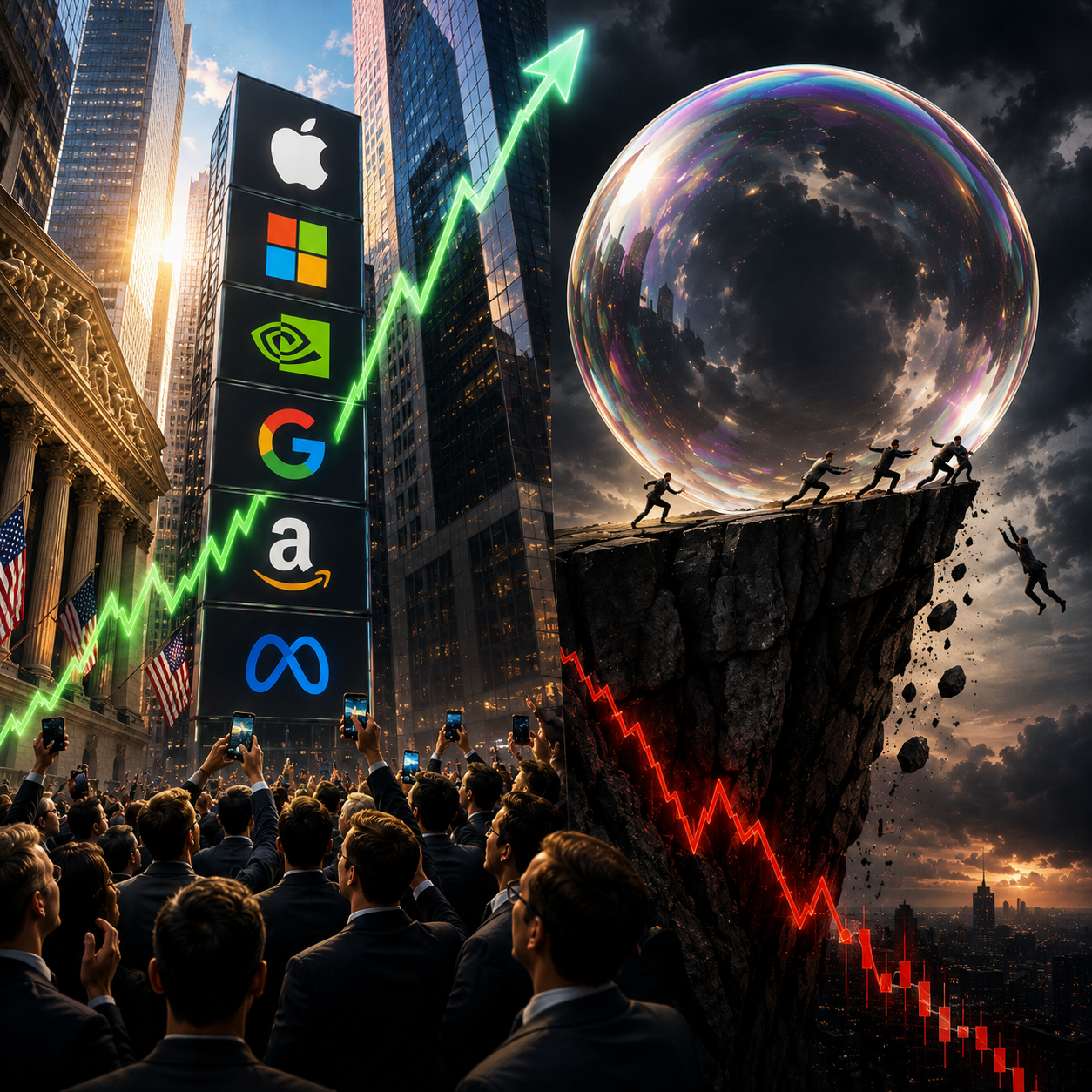
Comparing news, the global market this week focused on US debt pressure, AI capital expansion, and the US-Iran economic game. After the US Treasury expanded the scale of long-term treasury bond repurchases, US bond yields declined briefly, but the market feared that fiscal deficits and debt growth pressure would be difficult to ease through liquidity tools. The US federal government debt surpassed 40 trillion US dollars for the first time. The yield on 30-year US bonds once rose to a high level since 2007, and the global long-term bond market was under pressure simultaneously. The minutes of the Federal Reserve's July meeting show that internal hawkish forces are growing, and there are more than three voting members supporting interest rate hikes. Some officials are concerned that tariffs, energy prices, and AI infrastructure investments could drive up inflation. Meanwhile, Federal Reserve Chairman Walsh suggested that in the future, consideration could be given to reducing the number of annual meetings from 8 to 6. Driven by the weakening dollar and risk aversion, gold broke through the 4,600 US dollars/ounce mark this week and rose for the third week in a row; crude oil was higher, supported by the risk of the Strait of Hormuz and expectations of US sanctions against Iran. Geographically, the US-Iran relationship is shifting to putting pressure on the economy. The US plans to weaken Iran's economy by expanding sanctions and economic isolation, while Iran is studying countermeasures against energy transportation nodes, and the safety of the Strait of Hormuz has become the focus of market attention. In the field of technology, AI infrastructure competition continues to escalate. Nvidia guarantees up to $105 billion for the OpenAI data center project, and Broadcom is also planning an AI financing plan of up to $100 billion. Meanwhile, Anthropic's revenue surpassed OpenAI for the first time, and plans to advance IPOs, further intensifying AI companies' commercialization competition. On the capital market side, Yushu Technology skyrocketed on the first day it landed on the Science and Technology Innovation Board. At one point, its market capitalization exceeded 44 billion yuan, and founder Wang Xingxing's net worth increased dramatically. South Korean semiconductor giant SK Hynix announced a repurchase plan of approximately 40 trillion won, and Samsung is also planning to increase shareholder returns. Furthermore, trade negotiations between the US and Canada ushered in a critical window. The US suspended the imposition of up to 50% tariffs on Canadian goods for three days, and the two sides continued to seek trade agreements. The core logic of the market this week still revolves around three themes: whether US fiscal pressure worsens further, whether AI capital investment is forming a new round of asset bubbles, and whether global geopolitical risks are driving safe-haven assets to continue to rise.
16h ago

J.P. Morgan warns of the risk of a fall pullback in US stocks, the AI boom may repeat the 2000 tech bubble

Comparing news, JPMorgan (JPMorgan) warned that although the world's major stock indexes are still on an upward trend, the market may face the risk of a pullback in late summer to early fall. The bank said that recently the internal structure of the US stock market is deteriorating, capital has begun to shift to defensive assets, and investors' confidence in artificial intelligence (AI) related stocks has also weakened. Jason Hunter, a strategist at J.P. Morgan Chase, pointed out that the current AI trading boom is similar to the 1999-2000 tech stock bubble. The market's excessive concentration of positions in the technology sector may increase the risk of adjustment. Furthermore, the continued rise in US Treasury yields, geopolitical tension in the Middle East, and slowing consumer spending have also been identified by J.P. Morgan as potential sources of market pressure. J.P. Morgan believes that the current AI investment cycle still has potential for long-term growth, but market valuations, capital congestion, and investor expectations in the short term may put technology stocks at greater risk of volatility.

1d ago
US Stock Value Investing Is Heading Into Another Trap

US Stock Value Investing Is Heading Into Another Trap

Source: Shenchao TechFlow Original title: (Opinion: Value investing in US stocks is not equal to fundamental investment) When “fundamentals are dead” becomes a consensus, investors who blindly organize giants will eventually experience astonishing capital destruction. Guide: When the market shouted “fundamentals are dead” and the capital frenzy formed a group of tech giants, the author used an astronomy discovery to unravel the logical loopholes behind this narrative. Starting from the composition of valuation multiples, this article reminds investors to distinguish between the true quality of an enterprise and the premium that the market is willing to pay. It is particularly cautionary about long-term allocation in the crypto and technology sector. I promise this introduction won't be as long as the last one on the weather. But please give me 90 seconds. More than 100 years ago, a woman named Henrietta Levitt was doing the tedious job of measuring the brightness of thousands of stars on photographic negatives (the way they were imaged before film appeared). She noticed one characteristic of a class of pulsating stars: the slower they pulsate, the brighter they themselves are. ¹ This might just seem a little interesting today, like “OK, that's pretty cool.” But at the time, astronomers couldn't tell the difference between a dark star very close to Earth and a very bright star far away. For them, the two left the same stain on the photographic film. Visual brightness is a messy mix of these two variables: how bright the thing itself is, and how far away it is from us. Henrietta's work decouples these two things: if you can observe the rate of pulsation, you can know its true luminosity; if you know its true luminosity, you can reverse the distance based on how dark it looks. Astronomers call it “standard candlelight.” A few years later, a man named Edwin Hubble discovered one of these pulsating stars, applied Levitt's math, and discovered what he had always thought was a cloud of gas within our galaxy; in fact, it was an entire independent galaxy, one million light years away. So in simple terms, the observable universe has grown about a trillion times larger, just because one person has figured out how to tell the difference between what things look like and what they actually look like. That in itself is obviously pretty cool. But another interesting thing is that around the same time period, two other astronomers each independently drew a scatterplot. One axis was actual luminosity, and the other axis was temperature. They discovered that stars are not randomly distributed in this space, but rather clustered into different families. The meaning behind this is: stars with the exact same visual brightness may and do belong to a completely different family, have a completely different past, and most importantly, have a completely different future... So what is written in the star? Over the past few years, there has been much discussion about markets, narratives, capital, company building, and financial nihilism. This feeling seems to have reached a feverish climax as the tech and financial world begins to face a very different future than a few decades ago. What is particularly clear is that separating progress from asset prices has become more noisy and in many ways more repulsive. But as an investor who makes a living by buying assets that (hopefully) outperform, a simple framework is: forward returns are roughly equal to growth in fundamentals multiplied by changes in valuation multiples (and multiplied by the dividends you've collected along the way). In this case, the valuation multiplier can very cleanly correspond to the smudges on the photographic film. It's an observable data point, but it entangles two things that the market can't directly see: how good the company actually is, and how far (or how long) its future cash flow is now. I think most of the money that can be made comes from investors who are most capable of unraveling these two variables earlier than others (or “perception of differences”), and we will continue to see astonishing capital ruin for investors who treat their stains as stars. Value investing is not equal to fundamental investing. I think there is a misunderstood view: fundamental investing has historically dominated the creation of excess returns. Most of these legends come from the Graham, Buffett, and Tiger Foundation lineage, as well as numerous narratives built around this group of people. It is believed that by some point in the 2000s, this approach was no longer effective, and anyone who invested in this way was overwhelmed by momentum, trends, and “direct buying tech giants.” The conclusion was (and still is?) It's “fundamentals are dead.” ² The modern version of “fundamentals don't matter” itself isn't stupid. It's rooted in a lot of ideas that many of us on the Compound team have written before. The biggest companies get the most mechanical purchases, and the software industry has a winner-take-all economic law. AI means that giants can transform scale into moats faster than challengers, and there are also reasons why the market's microstructure embeds momentum more deeply into our market infrastructure. These are all real...

1d ago深潮TechFlow#US stocks
Whoever sings down Anthropic may be disappointed

Whoever sings down Anthropic may be disappointed

Author: Alan Walker, Silicon Valley Original title: Is Anthropic's Growth Slowing Down? Source of controversy. Claude Code ARR tracking chart produced by TickerTrends. The latest data is $15.12 billion for the week of August 10, 2026, accounting for 21.9% of Anthropic's total ARR. Please note: This is an estimate from a third party agency and is not an official disclosure of Anthropic. The first section below explains how important this difference is. Alan Walker from Silicon Valley made an appointment for dinner in Hong Kong. After some hard work, he discovered that this picture had been retweeted more than 30 times, and the matching statement was similar — “Anthropic's growth has leveled off; 2 trillion dollars is a bubble.” Alan saved the image, zoomed it in, and looked at it again. The problem isn't in this picture. This picture is very well done, and the data is probably done seriously. The problem is that almost everyone who retweeted it was using it to answer a question it couldn't answer at all. 01 Let's first figure out who made this picture, there is a Claude icon in the upper left corner. The color scheme is Claude's familiar orange. At first glance, it looks like an official product. It's not. The author of this picture is TickerTrends and has his name written in the upper right corner. It is a third-party data tracking agency that uses various external signals (application data, payment panels, recruitment, channel caliber, etc.) to estimate the revenue of an unlisted company. The line in the picture is written very honestly: “tracked allocation” -- the percentage of allocations that have been tracked. Let's be clear: Anthropic has never publicly disclosed Claude Code's individual ARR numbers, not once. Every point on this curve has been estimated by an outsider. For example, this is like someone using “long queues at the entrance of a restaurant every day” to estimate its turnover and then draw a beautiful weekly curve. The length of the team does correlate with turnover, but in the middle there is turnover rate, customer unit price, takeout ratio, private room business — you see that the team is three short weeks, and the kitchen is probably being renovated in those three weeks. What is more important is the caliber itself. ARR's algorithm is “revenue for the most recent period times 12.” Enterprise software contracts are not executed evenly every day; they are signed batch by batch. Big orders signed at the end of a quarter will jump a week's curve by a large margin; if the next quarter's big orders aren't signed, the curve will go sideways. Weekly ARR tracking is extremely insensitive to this kind of blocky landing—it will paint the “pace of signing” as a “change in demand.” In a nutshell, what you have in your hand is an unofficial weekly map estimated by an outsider, with a very blunt caliber. Judging by the weight of the “bubble” under it is tantamount to using body temperature to measure blood pressure. 02 I hit myself in the face on this picture. I haven't seen anyone mention it, but it's the most interesting part of the whole thing. The picture shows two numbers: Claude Code is $15.12 billion, or 21.9% of Anthropic's total ARR. By dividing: calculate 15.12 billion ÷ 21.9% = about $69 billion. This is Anthropic's total ARR for the week ending August 10, implied by this image. The official caliber figures reported by Bloomberg, Reuters, and CNBC on August 17 were — $65 billion at the end of July. Clear: This chart, which is being used to prove “slowing growth,” its own implied total number of companies is 4 billion US dollars higher than the official figure ten days ago. Further 10 days until today, if the trend continues, more than 70 billion is a reasonable estimate (this sentence is an inference, not data). In one sentence, people who retweeted only read the number 151.2 and the height of the column, skipping the 21.9% next to it. And that 21.9% said: This company went a step further when everyone shouted “it's slowing down.” I only believe in the two numbers on the same picture that is beneficial to my opinion; this is not called analysis. 03 You are looking at the picture below. The money in the picture above has the upper and lower two pieces. Above is the absolute amount (how many billion dollars), and below is the percentage change (how much more than a percent increase from four weeks ago). The vast majority of people's reasoning is: below...

2d agoWendy#Anthropic #ARR #IPOs #MiniMax

The wave of AI debt financing in the US heats up and may attract market attention in September

Comparatively, the US Treasury recently relieved the pressure on the US bond market by expanding the long-term treasury bond repurchase program, but a wave of corporate bond financing driven by artificial intelligence infrastructure construction is heating up. As investment in data centers, high-end chips, and AI services continues to expand, tech giants such as Microsoft, Google, Amazon, Meta, and Oracle are increasing their bond financing efforts. The market anticipates that the issuance of US investment-grade corporate bonds will peak after Labor Day in September, and the scale may reach 200 billion US dollars. According to the data, US investment-grade corporate bond issuance has increased 38% year over year since 2026, and the annual issuance scale is expected to reach a record 2.1 trillion US dollars. The large amount of new supply is related to AI capital expenditure. In the past few years, tech giants have mainly relied on cash flow to support AI layout, but with the escalation of industry competition and the rapid expansion of long-term capital demand for data centers, electricity, computing power equipment, etc., companies have begun to rely more on bond market financing. The market's focus is also shifting from whether AI can generate profits to whether huge infrastructure investments can generate sufficient returns. Some investors are concerned that the expansion of AI debt is changing the allocation of capital in the fixed income market, and that new capital competition between technology corporate bonds and US Treasury bonds may form. Andrzej Skiba, head of fixed income at RBC Global Asset Management, said the current AI-related bond supply is close to the limit of not disrupting the market. Analysts pointed out that if future AI revenue growth cannot cover huge investments such as data centers and chip purchases, some capital expenses may face the risk of insufficient returns. The market is also beginning to compare the current AI financing boom with the internet bubble around 2000, wary that capital is being invested faster than the business model is being realized. Although the US Treasury Department's repurchase program helps improve the liquidity of the treasury bond market, it cannot change the trend of simultaneous growth in government debt and corporate financing needs. The large-scale issuance of corporate bonds in September may become a new stress test for the US bond market.

2d ago#financing

The US stock market may welcome the second-best decade in history. The S&P 500 has risen 141% since the end of 2019

Comparing the news, The Kobeissi Letter posted on the X platform that the US stock market is experiencing one of the best decades in history. The S&P 500 has risen 141% since the end of 2019. If this pace continues, the index will end the decade with a cumulative increase of about 277%, making it the second-best decade on record, second only to the 316% increase during the 1989-1999 internet bubble, and surpassing the 257% increase during the post-war boom of 1949 to 1959. For comparison, between 2010 and 2020, the S&P 500 returned 190% after the 2008 financial crisis. The 2020s are turning into one of the greatest decades in the history of the US stock market.

2d ago

Legendary investor Cooperman is betting on the US recession next year: rising inflation may hit US stock valuations hard

In comparison, billionaire investor and Omega Advisors CEO Leon Cooperman warned this week that the US economy could fall into recession within the next year and drag down the stock market. He pointed out that the current market is similar to the collapse of the Pretty 50 in the 70s of the last century, and expressed concern about cooling AI optimism. In an interview with CNBC, Cooperman said: I think we will experience a recession sometime next year, which may cause the market to fall. At the same time, he believes that the market's expectations for S&P 500 earnings growth are biased (FactSet data shows that this quarter's year-on-year increase is expected to exceed 50%). Currently, he clearly deviates from mainstream Wall Street bullish views. In particular, he avoids technology stocks, and has a negative view of the overall market. He reminded investors not to underestimate the risk of inflation rebounding. Brent crude oil remained high after the Iran war (about $90 per barrel, more than 20% higher than before the war), and retail sales fell 0.6% month-on-month in July (far lower than the 0.1% increase expected). Higher inflation or a blow to stock valuations is similar to the sharp decline in growth stocks after the rise in oil prices in the 70s. One of the most dangerous words in the field of investment is: “This time is different.” Cooperman said that the current market is almost generally bullish, and once a negative catalyst appears, investors may sell off quickly. At the same time, fluctuations in the bond market have intensified the pressure. The US 30-year Treasury yield hit 5.33% on Tuesday, the highest since June 2007, and broke through a three-year trading range. Analysts warned that if yields rise rapidly to 6%, the stock market may face further pressure on valuations. Historically, after a similar trend in 1999, the S&P 500 then adjusted and the Internet bubble burst.

3d ago

Arthur Hayes: AI bubble focused on data center debt and unprofitable AI companies, still optimistic about the agentic economy

Comparing the news, Arthur Hayes posted an article on the X platform saying that some people asked why he launched an AI/encryption project when they thought AI was a bubble that would burst. He said the bubble is in debt to build data centers, as well as unprofitable hyperscale cloud service providers and cutting-edge lab stocks. The price is what you pay, the value is what you get. He believes 100% in the Agentic Economy, and the excess computing power caused by the construction of loan funds supports his judgment on Flop Labs. Earlier, Arthur Hayes announced that he would end his retirement and lead Flop Labs. Flop Labs is “food” for AI agents. The project has no pre-sale, no venture capital agency participation, and uses a 100% fair distribution model.

3d ago

Bank of America survey: Global investors' risk appetite is heating up rapidly, and AI capital spending has yet to deter bulls

Comparing news, Bank of America's latest global fund manager survey shows that global investors' risk appetite is rapidly heating up. As US stocks approach record highs again, fund managers' allocation of the stock market rose to a five-year high, and the cash ratio fell to 3.5%, indicating that the market has clearly recovered from previous concerns about slowing growth and the AI bubble. Bank of America strategist Michael Hartnett pointed out that a record 56% of fund managers surveyed do not expect a significant landing-style slowdown in the global economy. In other words, mainstream market positions are betting that the economy will remain resilient, corporate profits will continue to expand, and risk assets will still receive liquidity support. Notably, the survey showed that AI capital expenditure has not yet become a core concern for investors. Although tech giants continue to raise budgets for data centers, GPUs, servers, and power infrastructure, and the market is increasingly discussing overheated AI spending, the Bank of America survey shows that fund managers are currently not too concerned about growth, interest rate hikes, AI capital spending, or US political risks.

3d ago
Why is capital chasing AI Native and ignoring the old Internet

Why is capital chasing AI Native and ignoring the old Internet

Capital doesn't reward being old-fashioned, not because old-fashioned people are at fault. The old part is clearly priced. There is no bad information, so there is no excess profit. Global venture capital was $510 billion in the first half of 2026, surpassing $44 billion for the full year of 2025 in one and a half months. More than 70% have entered AI; OpenAI and Anthropic took 217 billion dollars, accounting for 43%. With that much money, you'd think everyone could share a little bit. The truth is that distribution is more extreme than total volume, and the first sieve doesn't screen the industry, it screens people. The category that has been screened out now has an unkind name: the internet is old. Let's just say one thing: the “old man” in this article has nothing to do with age. It refers to a set of methodologies that have been formed in the mobile internet cycle, have been tested over and over, and have brought huge returns to holders. The person holding it may be 45 years old or 32 years old. It was this methodology that was being repriced, not the year of birth. Confusing these two things is Lao Deng's most common mistake and one of the most comfortable mistakes — because if the problem is someone else's age discrimination, you don't need to change a single word. 01 What is AI Native The term has been misused. They can use ChatGPT not called AI native, nor AI in the company name, let alone in their twenties. There are three things that really separate people. First, the starting point is a model, not a requirement. The order in which Lao Deng makes a product is: look at what the user wants, write down the requirements, and find technology to implement it. The order of AI natives is reversed: first figure out what level the model is capable of today and what step it is likely to reach tomorrow, and then move from this capability boundary to the external product. The former uses the model as a tool, and the latter uses the model as the foundation. There was no difference between these two kinds of things made by humans in the first edition; by the third edition, there was a difference of one species. Article 2. The default unit of an organization is not a person. The division of labor in the Internet age is the division of one thing into ten people. AI Native's division of labor is to take ten things from one person and add a bunch of agents. The CEO of a domestic application company said that the team consists of less than ten people, but a large number of AI work at night, and the first thing employees do every morning is check the work the AI handed in the night before. Cursor's side is even more extreme. Public reports mention that the company doesn't have a product manager; engineers write their own code, talk to users themselves, and participate in recruiting people themselves. Article 3. Information is first-hand. AI Native's input sources are papers, model cards, GitHub issues, original discussions on X, and self-run evals. Lao Deng's input sources are industry summits, closed-door meetings, brokerage reports, interpretation of public accounts, and finding someone to drink coffee with. This one is the least obscure and most lethal; I'll talk about that separately later. I'm satisfied with all three. The 25-year-old is an AI native, and so is the 45-year-old. I'm not satisfied with the three rules; I'm still an old man at the age of 25. AI natives are a state, not an age group. The trouble is that tickets in this state are works, not resumes. 02 The two lists spread the results of this round on the table. These are two lists. The first one is an all-AI native company. Their valuations are not rising; they are exchanging orders of magnitude. List 1 · Upstream OpenAI raised $122 billion in a single round of financing in Q1 2026, followed by $852 billion, the largest private equity financing in history. Anthropic Q2 had a single round of $65 billion, after investing $965 billion, accounting for about half of the total global venture capital for the quarter; the revenue operating rate in May reached about $47 billion. DeepSeek raised about 70 billion yuan in its first round of financing in May 2026. In April of the same year, Liang Wenfeng raised his direct shareholding from 1% to 34%, and controlled a total of about 84.29% of the shares through related entities. The Dark Side of the Moon (Kimi) was estimated at $4.3 billion in December 2025; it went for three consecutive rounds from January to February 2026 to reach 18 billion; the D round in May was about $2 billion, breaking 20 billion dollars after the investment; the July round surpassed $3.5 billion, after investing 35 billion dollars; the pre-IPO target was 50 billion dollars. ARR broke 100 million in March, 200 million in May, and held steady at 300 million US dollars in June, with APIs accounting for more than 70%. Smart Spectrum · MiniMax successively landed in Hong Kong stocks in early 2026, with a market capitalization exceeding 100 billion yuan. It was one of the first major model companies listed in China. The second one...

4d agoWendy#AI #DeepSeek