注意力经济 · 110
Does the forecast market with monthly turnover of 44.8 billion US dollars need a main broker?

Does the forecast market with monthly turnover of 44.8 billion US dollars need a main broker?

Source: Fintech Blueprint Compiled and edited by BitPushNewsBetterment recently published its 2026 retail investor survey. The main conclusion is that 26% of Gen Z investors see sports betting as part of their long-term financial strategy, and 52% have invested the money they originally intended to invest into it last year. The survey of 1000 US retail investors in early April showed that proportion rapidly declined as people grew older — 31% and 14% for millennials, 10% and 6% for Gen X, and 4% and 1% for Baby Boomers. Betterment CEO Sarah Levy put it bluntly: The problem comes when a prediction market or sports betting platform starts to feel like a retirement strategy. The combined monthly trading volume of Kalshi and Polymarket reached $44.8 billion in June, which is more than three times the average monthly transaction volume of approximately $14 billion for all US legal sports betting in 2025. Source: Bloomberg/Betterment Let's explore whether this transaction volume is huge enough to support the dedicated agency hierarchy below. Earlier this month, River Markets raised $8.5 million in seed funding to build what it calls “the first institutional-grade execution and prime broker platform for the prediction market.” Led by Haun Ventures, Y Combinator, Coinbase Ventures, Qube Research & Technologies, and Cherry Ventures participated, in addition to angel investors from Citadel, HRT, J.P. Morgan, Nvidia, and Google. The company has been online with trading clients since May 1 and has publicly listed five client names: Chimera Capital Management, Game Point Capital, Cleat Street, Skywalk, and 646 Equity. It claims to own three of the top ten traders on Kalshi and Polymarket, as well as several quantitative funds running on its API. The problems they are solving are real and unremarkable. The liquidity of the prediction market is distributed across multiple trading sites, which may have different quotes on the results of the same event, involving separate accounts, separate balances, independent APIs, and no uniform view of risk. A trader who trades the same event on Kalshi and Polymarket actually manually manipulates the two books and then reconcile the accounts. River integrates these sites into a single terminal and an API, uses a unified code system, adds execution algorithms (iceberg orders, linked orders, stop-loss orders, take-profit orders) not native to the exchange, and routes eligible orders to the best prices in the online ledger. It's live on Kalshi, Polymarket, and Polymarket US, and is integrating Novig and Crypto.com. Today, it's more like an order and execution management system than a Prime Broker (PB) — a boundary drawn by River itself. Its FAQ states that the real-time platform covers execution, routing, data, and profit and loss, that customer funds are kept in venue accounts rather than centrally pooled, and that companies are invited to contact them about financing, collateral, and cross-market requirements. Source: Allium predicts that the cumulative historical trading volume of the market exceeded 150 billion US dollars in May. Kalshi alone reached 31.5 billion US dollars in June, while Polymarket was 10.8 billion US dollars. Kalshi is currently in final negotiations to finance at least $750 million, with a valuation of $40 billion; Polymarket is financing at a valuation of $15 billion, after ICE had already committed $2 billion in two instalments. Kalshi's annualized revenue surpassed $4 billion in July, roughly double the $2 billion annualized pace two months ago. At the peak of the World Cup,...
4d agoBitpushNews#HYPERLIQUID #Kalshi #Ondo
“Cow Lai” went from being a “bad movie” to a top meme, and the token of the same name soared 3,000 times in 3 days

“Cow Lai” went from being a “bad movie” to a top meme, and the token of the same name soared 3,000 times in 3 days

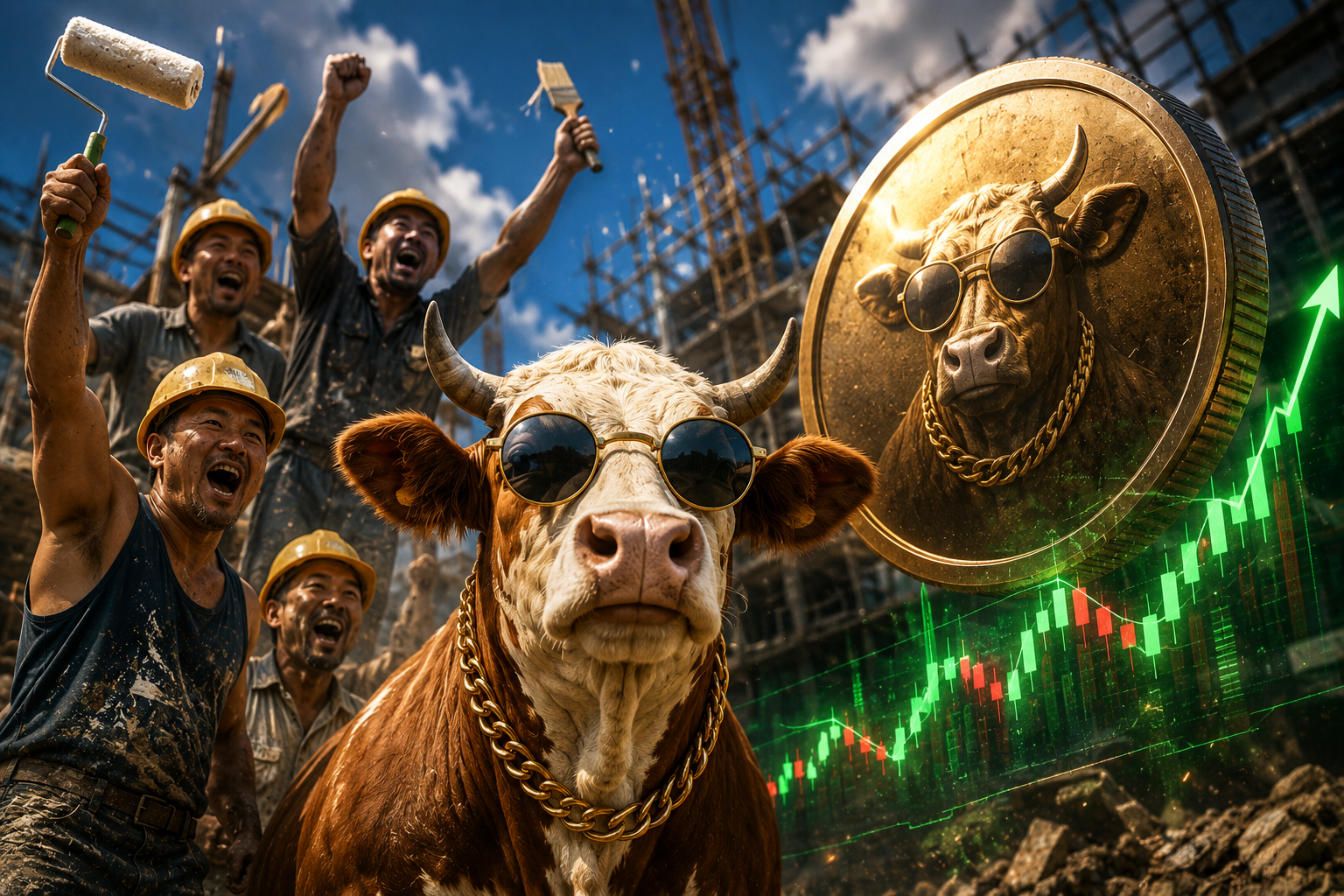
Source: OdailyPlanet Daily Author: Wenser Original title: The decoration team's hand-rubbed abstract masterpiece “Cow Lai” went viral. The meme coin of the same name rose 3,000 times in three days. The animated film “Cow Lai” became popular due to its rough painting style and abstract plot. The box office was poor at the beginning of its release. Later, due to the popularity of the Internet, the box office hit back to over 2 million yuan. The film was produced by a team from a former decoration company over 5 years. The official response was that Dragon Biao only reviewed the content for compliance, not quality. The film sparked a lot of innovation, became a cultural meme, and caused the meme coin of the same name to skyrocket. At one point, the market capitalization was close to 30 million US dollars, and a “3,000x miracle” was staged. Behind the phenomenon is an expression of the attention economy and the power of memes, and it also carries the public's good expectations for a bull market. Overnight, “Cow Lai” became a hot topic of discussion within and outside the community. At one point, the market value of the meme coin of the same name was close to 30 million US dollars. The animated film, which went live on August 5, attracted widespread attention and discussion due to its rough graphics, abstract plot, bizarre Dragon Ball review, and “impressive results” that only grossed more than 7,000 yuan in 9 days. The crypto community is concerned about its abstract style, meme attributes, and meme coins, which have skyrocketed in market value; outside the industry, there has been a “boom in watching movies and checking in”. Netizens at home and abroad have said they want to see how abstract this animated film, created by a team of only two people from a former decoration company, is. Today, when beautiful AI videos are popular, “Cow Lai” not only shows us the roughness of “ancient hand rubbing,” but also expresses to some extent the public's earnest expectations for “Cow Lai.” I can only say that today, when the attention economy is king, the power of memes far exceeds the imagination of ordinary people. The movie “Cow Lai” tells some bitter past stories: when the decoration company was evicted by ducks to make an animated film, we need to discuss the “Cow Lai” meme. Let's start with the movie “Cow Lai”. The “work of sincerity” of the decoration company: the producer of the film “The Cow Lai”, which was distributed online or the curve of saving the country in order to seek repayment for the project, called Dalian Jingyuan Culture, Film and Television Media Co., Ltd., was founded in March 2016. The legal representative is Xin Yu Meng, one of the film producers. The company changed its name in July 2021 to “Dalian Jingyuan Decoration Engineering Co., Ltd.” As a result, netizens joked that this was a decoration company turning it into an animated film, and accidentally created a new god in the abstract world. According to online news, the picture source shows that the box office reversal for the watermark “Cow Lai” movie: from more than 7,000 yuan in 10 days to breaking 2 million dollars a day, “Cow Lai” officially went live on August 5. Although it was considered a concurrent student with popular summer programs such as “Odyssey” and “Welcome to Dragon Restaurant,” it had no resources, and the number of movies released on the first day was only a poor 342 yuan. On August 14, 9 days after its release, “Cow Lai” still grossed at over 7,000 yuan. Many people haven't even heard of this movie. But who came up with it, the rough modeling, the stiff animation, the film's thunder dubbing the cow shouting “Mom,” and the ink wash-style poster produced by the movie's official production, all kinds of abstract power were spread wildly online, and the film sparked a lot of curiosity and sparked a stir. According to information, the film is based on a vast prairie, and tells the healing story of the young calf “Cow Lai” getting to know a lark and bringing it into a dream. In my dream, Skylark saw that under the nourishment of love, persistence, bravery, and dedication, the cow grew all the way to become a little warrior who dared to take responsibility and face life and death. The movie is officially defined as “parent-child animation,” but the style of painting is really unbearably charming. The origin of “Niu Lai” According to Maogan Pro Edition data, as of 10:00 on August 16, 2026, the cumulative box office for “Niu Lai” had reached 25.31 million yuan, and the total box office was estimated to be about 18.376 million yuan. Behind the scenes of “Niu Lai”: Dragon Biao's review is not that strict. Just look at the hard restrictions on how to complete the “Dragon Biao (Film Release License) review”, which is hotly discussed on the internet. The film official also publicly responded: “(Dragon Biao Review) only reviews content compliance; it doesn't review whether the film is good or not, the graphics are not exquisite, and the quality of the story is high or low. Al Animation is of mediocre quality and low cost. As long as the content is compliant, it can successfully obtain a screening license.” The official statement says, “This is also the key for all of us ordinary people to make our anime dreams come true!” Not to mention, it sounds really inspiring that “little people can make big dreams come true.” Cultural communication, memes are king: the 3 behind “Cows Come”...

5d agoOdaily星球日报#MEME #Cow Lai topic
Circle CEO 10,000 words long article: The agent economy is reconstructing everything, and the corporate era will come to an end

Circle CEO 10,000 words long article: The agent economy is reconstructing everything, and the corporate era will come to an end

Author: Jeremy Allaire, Co-founder and CEO of Circle Compiled by Jia Huan, ChainCatcher Original title: Circle CEO 10,000 characters long article: The Agent economy is disrupting value creation and circulation 1. Technology integration and the dissolution of companies Every platform-level transformation in the Internet era does not rely on a single invention, but several mature technologies collide at some point. The birth of the Web required a graphical interface, a commercial open Internet, a sufficiently fast modem, and an open software layer of web pages, links, and servers. Digital media, mobile internet, cloud computing, and social platforms all follow the same path. There is a recurring pattern behind this: when multiple capabilities are integrated, the marginal cost of an otherwise expensive activity will collapse to close to zero; once the cost collapses, the speed of this activity will explode. The Web has detonated the speed of information publication, mobile and social networking have detonated the speed of interpersonal communication, and cloud computing has detonated the speed of software production and delivery. Now, two new “operating systems” are being integrated, applying the same mechanisms to two things that the Internet has never natively digitized: intelligence and economic activity itself. The first is an intelligent operating system, that is, artificial intelligence in the form of a basic model and an agent system built on it. The second set is an economic operating system, or blockchain network, where values, contracts, and collaboration can be expressed and executed with software. The former reduces the cost of cognition and work to zero; the latter reduces the cost of transactions, settlements, and collaboration to zero. The two reinforce each other. Intelligence enables economic activity to run at machine speed, and the economic foundation allows machine intelligence to trade, exchange value, collaborate, and execute contracts. The core assertion is that the smart economy and the on-chain economy are not neighbors, but the same economy. The two are converging into a force to reshape the global economic system. Let's look at smart operating systems first. It is comprised of cutting-edge foundational model capabilities, as well as inference and agent infrastructure that enables models to execute at scale. Today, representatives include platforms such as Claude and Claude Code, OpenAI, and Codex. This is a new type of computer: instead of programming in traditional ways, it uses natural language to give instructions to produce results and complete work. The atomic unit of this type of work is an intelligent body, that is, a reasoning process that is sent to perform a certain task. Why is this important? First, let's look at what the company actually is. Without brands and buildings, a company is an information system organized around a set of familiar functions: product and engineering, marketing, sales, talent, finance, legal compliance, operations, and customer service. The vast majority of the cost of maintaining this system comes from manpower. Looking at the economy as a whole, manpower is the largest single operating expense. It usually accounts for one-quarter to one-third of revenue, and the service sector accounts for a higher proportion. Among intellectual and technology companies, this is almost absolute: almost all non-capital expenses are wages. In other words, such a company is essentially an “organized perception with a logo attached to it.” There is also a second huge market outside the company's walls: professional services such as consulting, lawyers, accounting, and agency agencies. In the end, it is also organized manpower rented from outside. These two huge cost pools are the target targets of intelligent operating systems. This is why the smart economy is disrupting classic business theories. Economists have long used transaction costs to explain why companies exist: the costs of coordinating, signing contracts, and trusting external labor are too high, so companies internalize “do it yourself cheaper.” Company boundaries are essentially delineated by coordination costs. When every non-physical work unit can be completed by an intelligent entity that can be discovered, contracted, and settled instantly, coordination costs begin to collapse, and the company's traditional boundaries become meaningless. The most intuitive result is a one-person company: one person directs a group of intelligence agents to do work that previously required multiple departments. Small, highly leveraged teams will also appear within large companies to execute the business on a scale far exceeding their own preparation. Economic accounts continue to be compounded because the three exponential curves are moving simultaneously: cognitive work continues to be transferred to smart devices, and the share of manpower in operating costs is declining; the cost of operating intelligent devices continues to drop, and the price of the same machine intelligence drops by about an order of magnitude every year; at the same time, the ability of intelligence continues to improve on almost all benchmarks. The combination of cheaper, more powerful, and more costly will unlock huge production potential. This disintegration will not happen evenly. It first appeared in software engineering because today's models are extremely good at understanding and writing code. Meanwhile, it...

39d agoWendy#Circle

Brave Releases BAT Roadmap 4.0, Launches New Unified Wallet and Stablecoin Payment Protocol

Comparatively, according to the official blog, Brave officially released Basic Attention Token (BAT) Roadmap 4.0 on July 9. The update aims to address the new challenges posed by artificial intelligence and the cashless economy, bringing BAT, Brave Rewards, and Brave Creators to the transactional attention economy. The roadmap's core initiatives include launching a new unified version of Brave Wallet that integrates traditional payment methods with self-hosted crypto assets, and building a stablecoin-based private payment protocol layer BravePay to provide basic support for autonomous proxy payment functions such as x402 and Machine Payment Protocol (MPP) within the browser. In addition, the roadmap also plans a number of new products to expand ecological boundaries. Brave plans to launch Brave Rewards virtual and physical payment cards that support everyday purchases and return BAT rewards, while developing a new creator contribution agreement to ensure that creators can receive micro-royalty compensation when content is invoked by AI products. In terms of tokenomics, part of the net revenue generated from Brave Wallet's revenue-generating features, payment cards, and BravePay agreements will be directly used to repurchase BAT to support user rewards and ecological growth. As these new features advance, Brave will phase out the traditional ad notification unit by the end of 2026, and completely shift the user's reward system to a personalized discount wall and a new loyalty program.

43d ago
Crypto KOL Survival Guide

Crypto KOL Survival Guide

Source: @Eli5defi编译及整理: BitPushNews If you woke up today to find your timeline unusually quiet (or chaotic, depending on that mysterious algorithm), it's not your illusion. The “InfoFi” ban is officially in effect. X (originally Twitter) has revoked API access to the “post-to-earn” (post-to-earn) apps we know (and some people love and hate), including Kaito, Cookie, Wallchain, Xet, etc. Well, the “easy mode” is over. The harvest period is over. We need to talk about Goodhart's Law: when an indicator becomes a goal, it's no longer a good indicator. We turned “response” into a goal, and by doing so, we turned our timeline into a Turing test where everyone was left out. But what now? Why did the bubble burst? Let's be honest: the “attention economy” is suffering from hyperinflation. Apps like Kaito, Cookie, and Wallchain are trying to financialize attention. In theory, it motivates activity. In practice, it creates a distorted incentive structure where “engagement” is decoupled from “value.” We're not building a community; we're carrying out a distributed, human-driven DDoS attack on the notification bar. X eventually realized that if they let a third-party app consume X users' dopamine, they would lose control of their ad inventory, and more importantly, lose real interactions and content on X. This is a battle for platform sovereignty. Advantages (and why this is a good thing for real creators) A cleaner timeline and a better user experience: No more endless AI spam, “gm” farms, or bot responses that clog up every post's response area. Real conversations can be breathed out again. Focus on quality over quantity: Projects and creators that rely on paid spam must now focus on real value. This creates a level playing field for real sound (less noise = more visibility for thoughtful content). Forcing Web3 marketing to maturity: the “publish and earn” model is a short-term hack that makes quick money but burns communities and hurts long-term trust. This is driving us towards a more sustainable model. Community relief: Many OGs and veteran users are celebrating (ZachXBT called it a “fact-based decision,” and even some creators saw it as a reset of Crypto Twitter). The downside (painful reality) An immediate economic blow: Tokens such as $KAITO, $COOKIE, and related NFTs plummeted by more than 15-20% overnight. Many creators (particularly in emerging markets) lost a real source of revenue because leaderboard rewards or campaigns came to an abrupt end with no possible compensation. Disrupting growth strategies: Web3 projects love to use InfoFi for cheap viral distribution. Now without automated farming, it's harder to sell. The reach rate of cryptocurrency topics is likely to decline further. Platform risk exposure: X can change the rules overnight (happen again). It reminds us that we are building a house on rented land. One policy update and your entire strategy falls apart. Short-term chaos: The project side is shutting down features, activities are being suspended, and some creators are mourning the “gold rush” era that allowed them to earn rent through everyday posts. What do we need to do now X The InfoFi ban has stirred up the situation, but it's opening a more structured and professional path for Web3 content creation. I see this as a driving force towards a true project/agency collaboration and a close-knit community of creators. Many creators have begun to move in this direction, agencies are preparing to fill this gap, set up select networks, and the creator community is becoming a new hub for transactions and collaboration. Here's the full updated walkthrough, with detailed steps for each point: 1. Double down on high-quality, high-signal content to focus on deep analysis, threads, visual content, and real insights (which is what brought me to where I am today). If the content is human-created and valuable, X will still reward high-quality interactions. Detailed steps: Audit your posts over the past 30 days: keep only posts with > 5% engagement or meaningful responses; delete or archive the rest. Plan 3-5 highlights each week: (e.g....

66d agoWendy#InfoFi #KOL #X
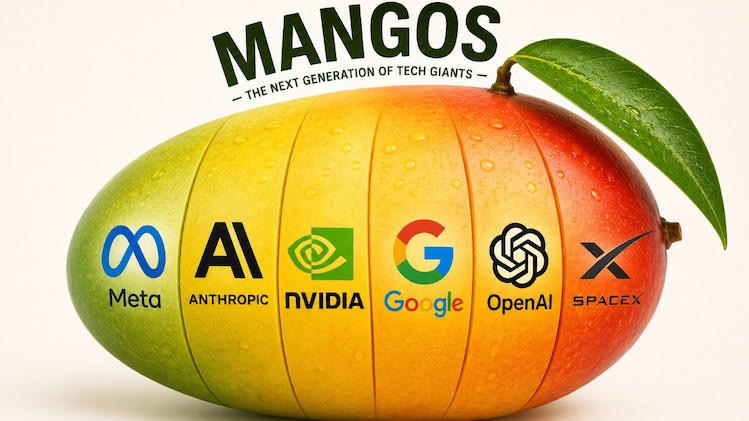
Goodbye FAANG, hello MANGOS

Goodbye FAANG, hello MANGOS

If you're still using the term “FAANG” to talk about tech giants, congratulations, you're out of date. In 2013, CNBC's Jim Cramer invented the abbreviation “FANG” — Facebook, Amazon, Netflix, Google. Apple joined in 2017 and became FAANG. This combination ruled Wall Street for a full decade and is synonymous with the golden age of mobile internet. But now, times have changed. Recently, engineer @krishdotdev posted a post on X: “It's not FAANG arguing. The post “It's MANGO.” quickly received 4.1 million views, triggering discussions about the “hegemony” of the new era. So the question is: who exactly is MANGO? Interestingly, MANGO had two versions, but they pointed to the same trend. Version 1 (popular in 2025): Microsoft (Microsoft), Anthropic, Nvidia (Nvidia), Google (Google), OpenAI. This version was widely distributed by Axios after it was reported in October 2025. Version 2 (hot in 2026): Meta, Anthropic, Nvidia, Google, OpenAI — plus an S to represent SpaceX and become MANGOS. Whether it's MANGO or MANGOS, the core lineup is highly consistent: Nvidia, Google, and OpenAI are members of Iron Force. The only difference was the fine-tuning between Microsoft/Apple and Meta/Anthropic, and SpaceX later added to turn the singular into the plural. But what's really worth watching is who got kicked out. Apple? Out. Amazon? Out. Netflix? It's long been out of the scope of discussion. Even Microsoft was removed from the MANGOS version. A new era has begun. Attention Economy to Smart Economy Why these companies? Answer: AI. What is the business model in the FAANG era? attentiveness. Facebook sells ads, Amazon sells products, Netflix sells memberships, Google sells search traffic — essentially turning people's attention into revenue. The core assets of the MANGO/MANGOS era are intelligence, computing power, and infrastructure. Nvidia's GPU runs the most complex AI model in the world; OpenAI's ChatGPT ignited a generative AI revolution; Google DeepMind and Anthropic are desperately catching up with the basic model; Meta open-sourced the Llama series of big models. SpaceX is using rockets and satellites to build the “space AI infrastructure” of the future. The former is changing how we consume, and the latter is changing how we create. As venture capitalist Kristina Shen said on CNBC: “Power has been transferred from FAANG and MAG 7 to AI leaders. Judging by the products they have launched, the consumer love they have won, and the types of acquisitions they have made, they are dominating the market sentiment.” More than a Wall Street game, this change is more than just a stock code replacement. For job seekers, the job search ceiling for recent North American graduates is entering FAANG; now, MANGO/MANGOS is the new holy grail. SignalFire's 2025 tech talent report shows that the proportion of new graduates recruited by major tech companies has dropped to 7%. The number of new graduates recruited is 25% lower than in 2023, and by more than 50% compared to before the 2019 pandemic. Package differentiation has also become more exaggerated. According to Levels.fyi's public salary data, Google's total contract for an entry-level L3 software engineer is around $210,000, including basic salary, shares, and bonuses; the Meta E3 software engineer package is also over $180,000. OpenAI's total contract range for software engineers starts at around $249,000, with a median of around $590,000. Anthropic's public sample is more senior, but the total software engineer package range has been shown to be between $560,000 and over $780,000. This shows a harsh reality: the AI era is not about not giving money to young people, but rather that money is increasingly concentrated on a small number of people who “can generate leverage right away.” In the past, big manufacturers were willing to train new hires; now, AI companies prefer...

67d agoWendy#AI topics #Anthropic #Facebook #Google #MANGOS #Meta #Netflix #Nvidia #OpenAI #SpaceX #Amazons #original
When users become agents, will the crypto industry's profits go to protocols or applications?

When users become agents, will the crypto industry's profits go to protocols or applications?

Author: Jonah Burian Compiled by: Peggy Original title: How can the crypto industry make money when users become agents? Editor's note: If Agents actually become the next billion users of the blockchain, the more important question is probably not “how much transaction volume will they bring in”, but rather, if the world does come, who can make money? In the past, whether it was the “fat protocol” or the “fat app” theory, it was the default that on-chain users were human. Humans care about whether the interface is easy to use, whether the brand is trustworthy, and whether the path is convenient, so the application layer can capture value by grasping user entrances and transaction flows. But Agent is different. They call the API directly, have no brand loyalty, and can switch between different protocols, aggregators, and trading venues at low cost. This means that agents may rewrite Web3's value allocation logic. The application layer can move to “headless”, opening up wallets, aggregators, and deposit/withdrawal capabilities into Agent-facing APIs; the protocol layer may also reclaim opportunities because the Agent skips the middle tier; but more aggressively, the Agent will push the entire on-chain stack into price competition, so that the profit margins of applications, aggregators, and infrastructure are reduced to close to marginal costs. What is really noteworthy is that Agent not only makes existing on-chain transactions more frequent, but may also create new activities that were not established in the past: continuous portfolio rebalancing, machine-to-machine payments, and new types of markets that only make sense in automated high-speed execution. Therefore, the core issue of the Agent era is not to simply determine whether value will flow to the protocol or application, but to see who can make the Agent choose to return here when they have unlimited alternatives. The answer may no longer be UX and brand, but rather liquidity, delays, settlement certainty, or some new business model that hasn't been named today. Here's the original text: Many people imagine that Agents will become the next billion users of the blockchain. But few people ask the second question: if this world really comes to life, who will make money? All past theories about value capture in the crypto industry have default users to be humans. According to the “fat protocol” theory, the protocol layer is best at monetizing users. However, the “fat app” theory proposed by my colleagues and I in “How to Capture Value” (How to Capture Value) and “The Great Repricing” (The Great Repricing) suggests that the application layer has done a better job. But the Agent changed who the “user” was. As a result, established value capture theories are no longer reliable. “Fat Protocol” theory In 2016, @jmonegro wrote the “Fat Protocols” (Fat Protocols). Since then, for nearly a decade, this article has almost become the most mainstream value capture theory in the crypto industry. Its core idea is that in the Internet age, value mainly flows to application layers, such as @Google and @facebook, while the underlying protocols, such as TCP/IP and HTTP, hardly capture value. But the crypto industry will do the opposite. Blockchain data is open and shared, so applications will be commercialized; and the use of protocol tokens required for the network will capture corresponding speculative value as usage grows. Every successful application will drive demand for tokens to grow. Ultimately, the protocol layer will compound interest faster than any application above it. For a long time, that judgment seemed right. Bitcoin and Ethereum have a higher market capitalization than any company built on them. This model was founded because the protocol layer was scarce, expensive, and difficult to replace at the time. Bitcoin and Ethereum were indeed scarce in 2017, when no more than a dozen general-purpose L1s were competing for the same workloads. Blockchain space is scarce enough that holding the underlying assets is like holding a share of all the applications that require the network. But now, every layer of the infrastructure stack has trusted alternatives: multiple high-throughput L1s, dozens of L2s, and modular billing and data availability layers that compete with each other in price. Blockchain space went from scarce to abundant. As cross-chain bridges and aggregators make the underlying chain almost invisible to users, switching costs also drop rapidly. Infrastructure becomes fungible, and in the end, alternatives can only compete on price. As a result, the pricing power at the protocol layer also disappeared as scarcity disappeared. The “fat app” theory By 2026, entities that capture large amounts of economic value will no longer be protocols, but applications, such as @phantom, @coi...

86d agoburnking#agent #AI
If you don't read financial reports, how can you speculate on new stocks? Supply chain sniper logic for US stock investment in the AI era

If you don't read financial reports, how can you speculate on new stocks? Supply chain sniper logic for US stock investment in the AI era

Author: Jaleel Plus 6 Original title: This year's US stock speculators are no longer looking at financial reports. In the 2026 AI wave of US stocks, the most profitable ones are not holding familiar stocks such as Nvidia, Microsoft, Amazon, and Google. Of course, these trillion-dollar giants are also rising, but it's hard for elephants to dance. A group of newcomers focusing on “supply chain snipers” are popping up in batches from Reddit, X, and Substack, leaving the benefits of Buffett's value investment veterans far behind. What they hold is a bunch of micro-cap stocks with a market capitalization of hundreds of millions to billions of dollars, which Wall Street analysts disdain, and ordinary investors can't even read the names well. And the person who turned these micro-cap stocks into a trading consensus and trend is Leopold Aschenbrenner, a 22-year-old German who used a starting capital of 200 million US dollars to trade stocks to earn 14 billion US dollars, becoming synonymous with “new stock god.” After Leopold, Buffett's fascination accelerated. A group of newcomers focusing on “supply chain sniper” are popping up in batches on Reddit, X, and Substack. Basically, they don't read financial reports; they look at micro-cap stocks that are “stuck in the neck” upstream of the supply chain. Following this logic, Groove Xiaobian has found some new stock giants for everyone to analyze. Are the “New Stock Gods” all from Reddit? Among this group of newcomers, the most popular one recently is Serenity, from the WallStreetBets channel on Reddit. Many readers who speculate on US stocks should be familiar with Serenity's own story. Simply put, he used to be an AI research scientist, participated in the RISC-V Foundation, published a Nature paper, and even mocked himself for rejecting the Nvidia AI team's offer when Nvidia's stock price was 6 dollars. Serenity's true “New Stock Gods” narrative was not these self-described resumes, but because he called out a stock called AXTI on WSB. His core argument is straightforward: the construction of the entire AI industry depends on this $700 million monopoly, and all players, including Google, Nvidia, and Microsoft, have to rely on its indium phosphide substrates and materials. He believes the entire AI industry is shifting from Google TPU to photonics and using optical interconnect technology. Without indium phosphide substrates, the entire AI “growth” story would come to an end in 2026. He directly called out the target price of $15 to $150 in the AXTI hot post, and the title was very straightforward. Related reading: “Rejecting Nvidia's 6 yuan share offer, he says he can make more money by trading stocks”. The stock price gave Serenity the best endorsement. When Serenity discussed AXTI at the time, the stock price was around $12. After that, AXTI went all the way up, first to $70. Serenity itself claimed that this was a single ticket with a floating profit of 1000 percent at one point. At the time of writing, the public market website shows that AXTI has settled at $140.83, which is only a step away from his original target price of $150. This makes Serenity's image more complex and three-dimensional. He is not just a lucky gambler in WSB, but an in-depth researcher in the new technology AI industry chain. Why would someone like this pop up on WallStreetBets Reddit in the first place? Let's take a moment to talk about the history of WallStreetBets. WallStreetBets, WSB for short, is the most famous US retail community on Reddit. It's great, not because everyone here is rational, or because you can always find the right answers here. On the contrary, WSB first became famous because it put the two most extreme aspects of US retail investors on the face: on the one hand, zeroing out short-term options, Stud's bankruptcy, and laughing at each other; on the other, it occasionally pops up a post that changes the market's narrative. The 2021 “retail battle against Wall Street” came from WSB. A large number of retail investors clashed head-on with GameStop and shorting agencies. A game retail stock that was originally treated by the market as a wreck of the old days was bought by global financial news. After that, WSB was no longer just a forum. It became a form of communication...

87d agoburnking#invests #Financial reports. US stock topics
114 projects, 5579 wallets: a community experiment in a meme contest

114 projects, 5579 wallets: a community experiment in a meme contest

If I were to use one word to describe this year's Meme circuit, “attention economy” isn't enough. This year's competition is: Who's distributing the attention. When Bitcoin fluctuated widely at $75,000 and mainstream coins entered the stock game cycle, the Meme Coin circuit did not stop; on the contrary, it showed amazing financial sensitivity and turnover frequency. The data also confirms this. After experiencing a dark time when the total market value fell 75% at the end of 2025 (once shrinking to 34 billion to 47 billion US dollars), the Meme sector quickly recovered in the first quarter of 2026. The overall market value rebounded by more than 8 billion US dollars, and the daily spot trading volume once approached 9 billion US dollars. However, behind the data boom, lies an extremely bitter fact — this is still a “high-risk Brave Game” where the vast majority of people are losing money. According to on-chain data, about 60% of retail investors in the entire market still lose money in meme transactions, and most of the profits continue to flow to “insiders” and robot wallets with more accurate tools and earlier car qualifications. This “high-heat, high-risk” fragmented ecosystem is forcing on-chain capital in 2026 to find a new asset paradigm. From simply relying on the mindless charge of “buying a dog, buying a cat” in the past, to putting more emphasis on community consensus, cultural long-term effects, and equal tool rights. The market is beginning to call for an infrastructure that can break the “open and smash the market” curse and truly receive public attention. Game breaker: An on-chain experiment with the native Web3 meme launch platform GENG As traditional automated launch platforms gradually became pure “high-frequency high-risk casinos,” the native Web3 meme launch platform GENG (@geng_one) is quietly changing the rules of the game on the racetrack through a decentralized cultural experiment. Recently, GENG's first Meme Meme Idea Contest was officially announced to have officially come to an end. In this campaign, which lasted nearly a month, a solid set of on-chain data intuitively reflected the community's desire for creative capitalization: 114 participating meme projects covering internet satirical art and instant hits were born on the platform; 5,579 real independent wallets on the chain participated deeply in community voting and consensus building; and the 2,100 USDT total prize pool (including Top 6 generous rewards, random participation awards, and voting rewards) was distributed in full. Why does GENG's model deserve the industry's focus in the next battle for attention? Faced with the pain point of the vast majority of retail investors being ruthlessly sniped by “scientists” due to poor information, GENG did not follow the old path of “only sending, not living” on traditional platforms, but instead tried to break down barriers through product mechanism innovation: the “1 USDT miracle” of extreme equality: on GENG, any ordinary user can turn a sudden inspiration into a real on-chain asset without any code costs or market making capital, and only requires a very low 1 USDT platform token launch fee within a few seconds. From vicious PVP to “long-tail community co-creation”: many meme coins tend to zero within days or even hours. And through long-tail incentive mechanisms such as creative contests, community voting, and the Sunshine Incentive Award, GENG brought Meme back to its essence: cultural expression, emotional consumption, and community resonance. In the GENG ecosystem, a project may initially be just a sarcastic humor on the homepage, but with the incubation of the platform mechanism and secondary creation of the community, it can quickly complete a cold start and evolve into a cultural symbol with real cohesion. What meme narratives are worth watching for the second half of 2026? As the second half of the year approaches, simply replicating past narratives is no longer enough to whet the appetite for smart money. Combining recent hot topics with the rotation of the global macro cycle, the next Meme Circuit may focus on the following directions: 1. AI Agents (AI Agents): The rise of silicon-based autonomous consensus In the past three months, the fusion of AI and cryptographic culture has completed the transformation from concept to absolute main line, and the meme market is being taken over by a new species known as a “silicon-based life form.” Robots deployed on autonomous chains, represented by Clanker, and new narratives like SKYAI, which have risen more than 700% in the past 30 days, are becoming a new direction for capital chasing. Now the way players play has changed—instead of buying an “AI concept coin” and waiting for a wheel, they directly interact with an AI-driven deployment agreement. In the second half of the year, gameplay such as “AI automatically filters and trades K-line charts” and “Absurdist machine language” is likely to become a center for emotional outbursts. 2. Sports memes (Sports...

91d agoWendy#Geng #MEME #Meme coin #neighborhoods
A screenshot of the eBay blockade. How can the $56 billion takeover farce be leveraged?

A screenshot of the eBay blockade. How can the $56 billion takeover farce be leveraged?

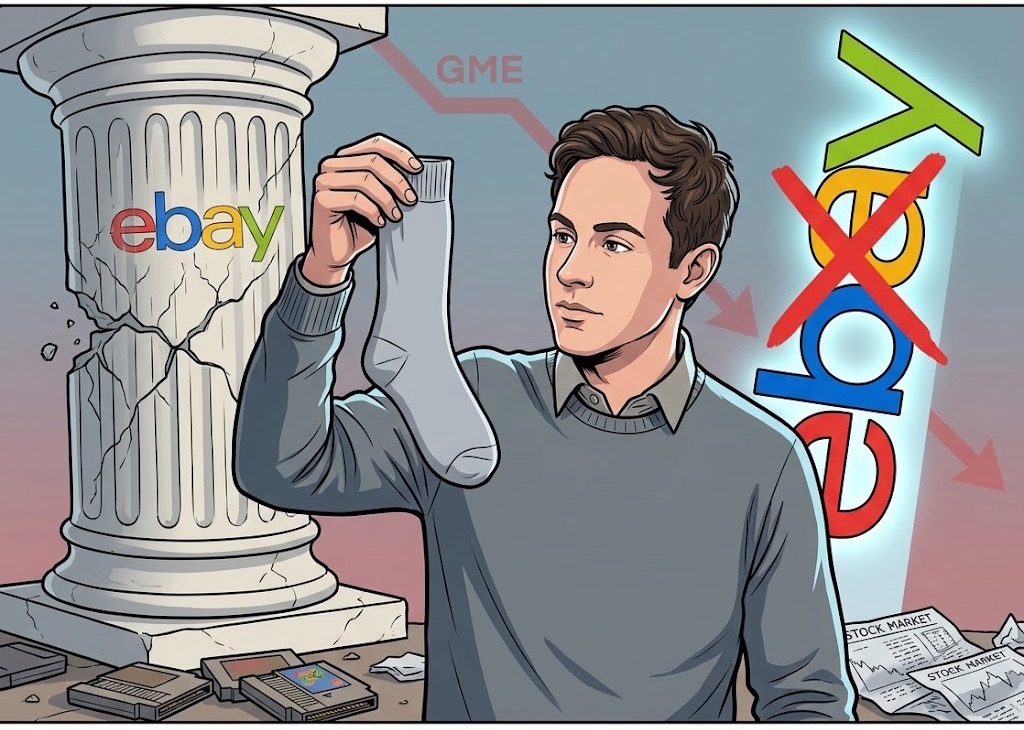
Author: Ada, Shenchao TechFlow Original title: GameStop CEO Selling Socks: Buying eBay for $56 billion, crashing with a pair of socks GameStop CEO's new script: Using a screenshot of “selling socks” blocked by eBay, leveraging the $560 billion purchase of flatbread. In the early morning of May 7th, GameStop CEO Ryan Cohen posted a screenshot on X. eBay notified him that his account had been permanently suspended on the grounds that “we believe this activity is putting the eBay community at risk.” 24 hours ago, he also posted a pair of socks on his personal eBay account with the caption: sell things on eBay and make money to buy eBay. It sounds like a joke, but he's serious. Because just three days ago, he just threw a $56 billion takeover offer to eBay's board of directors. An Unstoppable Offer On May 4, GameStop announced a non-binding takeover offer for eBay at $125 per share. GameStop said in a statement that the offer will be paid in cash and half of GameStop's common stock, a 20% premium over eBay's closing price of $104.07 on Friday, and a 46 percent premium over the closing price of February 4 (when the game retail giant began increasing its shares). On Monday, eBay's stock price rose about 5% to around $109, far below GameStop's $125 purchase offer. Meanwhile, GameStop's stock price fell by about 10%, indicating that investors are skeptical about whether the deal can be completed. GameStop's current market capitalization is around $112 billion, a fraction of the $56 billion deal. Although the company has received a $20 billion letter of intent to finance from TD Bank, the funding gap is still huge. What about the rest? Cohen answered in front of CNBC's camera: “We are offering a plan of half cash and half stock, and we have the ability to issue additional shares to complete this deal.” In other words, Indian stocks. Use the shares of a company with a market capitalization of 11.2 billion dollars in exchange for shares in a company valued at 55.5 billion US dollars. And for eBay shareholders to accept GameStop shares in exchange, I'm afraid the premise is that GameStop's stock price first rises 5 times. So what does the market think? Kalshi's traders think the probability of GameStop closing the acquisition in 2026 is only 26%, although the total volume of the new contract is low, just over $2000. On the Polymarket platform, traders are more pessimistic. Traders on the platform believe that the probability of GameStop closing the acquisition is only 15%. Citing reports from people familiar with the matter, Semafor said that eBay's board of directors met this week to review the offer, but the deal “appears to have died” and Cohen was unable to persuade any important shareholder to publicly support him. On May 6, 48 hours after the invitation was handed out, Cohen began posting items, socks, miscellaneous goods, and personal items on his eBay personal account. The total auction price reached tens of thousands of dollars. He also intensively attacked eBay's board of directors on Twitter, accusing the other party of mismanagement. On the same day, he first received an eBay notification that he had reached the maximum amount of pending monthly orders. The account was then blocked. The phrase “poses a risk to the eBay community” in the ban notice, combined with a person trying to buy eBay, is an absurd picture. But that's just Cohen's performance. Since the bid didn't scare the board of directors, use noise to activate GME's basic retail account. Let the stock price fly up first, and only then can the stock be considered when it flies. Why is Cohen initiating an acquisition? Here's a background. At the beginning of 2026, the GameStop board adjusted Cohen's compensation plan. If the company's market capitalization reaches $100 billion, he can receive up to $35 billion in stock incentives. Currently, GameStop's market capitalization is only about 11.2 billion dollars. If you want to sell game CDs to 100 billion dollars, then only increase the market value through acquisitions. And Cohen's complete script for “Selling Socks to Buy eBay” was never written to the board of directors; it was written to retail investors in the WSB section on Reddit. From Bitcoin to...

107d agoburnking#CEO #GameStop