通证 · 1951

A fund under “AI Stock God” sells shares of Taiyo Yuden to Citadel and other institutions

Comparative news. According to a report by Jin Shi, Situational Awareness, a fund owned by “AI stock god” Leopold Aschenbrenner, stated in the filing that the fund reduced part of its holdings this month and sold shares of Japan's Taiyo Yuden to Citadel and other investors. According to filing documents submitted to Japan's Ministry of Finance, on August 3, the fund sold approximately 4.62 million shares of Taiyo Yuden shares to the Citadel Multi-Strategy Stock Master Fund at a price of 9,397 yen per share through OTC trading, corresponding to a shareholding ratio of 3.42%. The documents also revealed that the fund almost went out of business last month and sold shares to Jane Street Finance, J.P. Morgan Securities, and Barclays Bank at a price of 10,225 yen per share on the same day.
4d ago
Gold tokenization: How does regulation force gold to move onto the chain?

Gold tokenization: How does regulation force gold to move onto the chain?

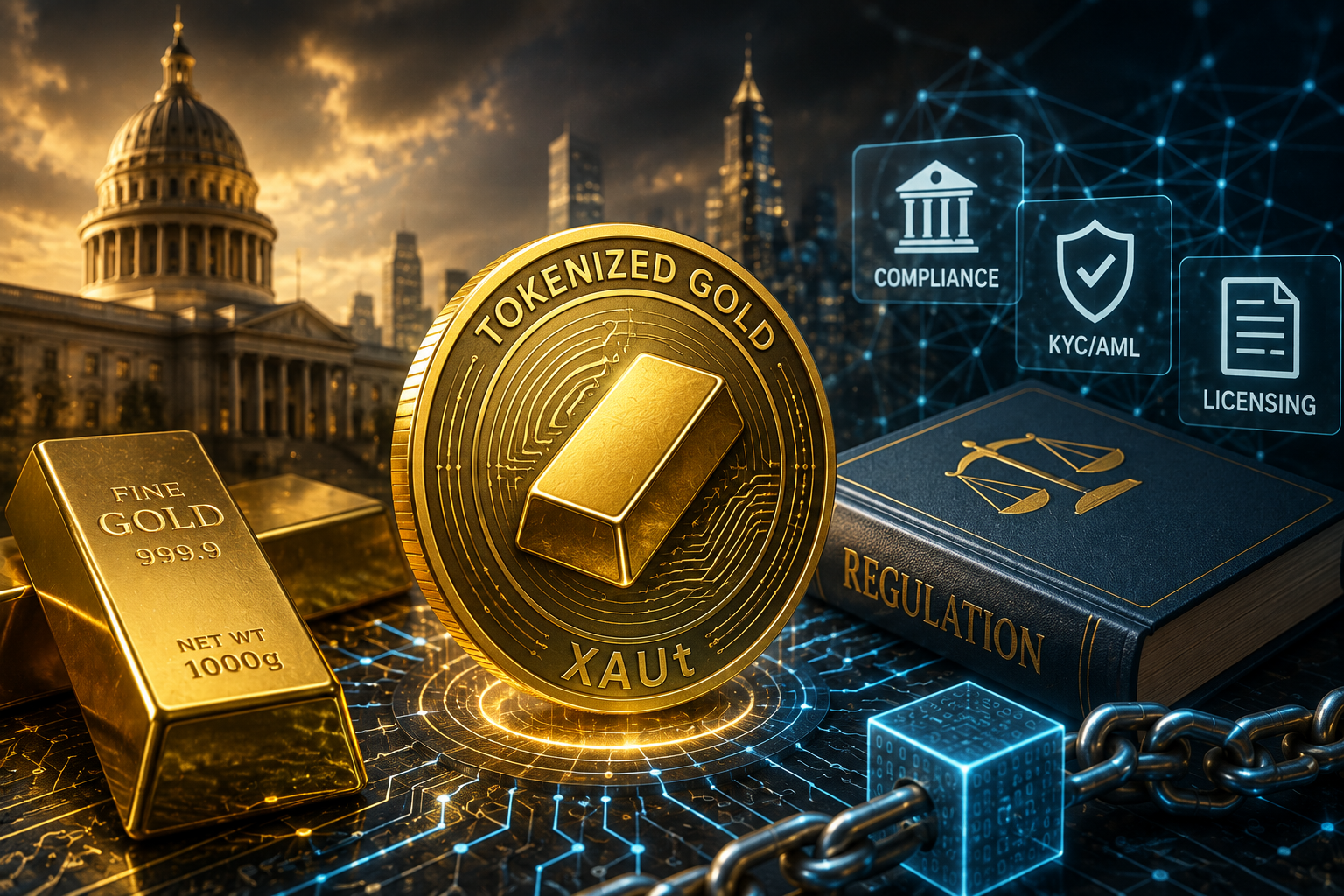
Source: Token Dispatch Author: Thejaswini M A Compiled by: Foresight News Original title: Gold tokenization, a financial revolution forced by regulations New York crowds, slow delivery, and Basel's “tight spell” — a dark battle for the London Treasury's ledger. In February 2025, the market anticipated that the US would soon introduce a tariff policy, and traders took gold from the Bank of England treasury and shipped it to New York. The waiting time for gold bar withdrawals has been extended from a few days to 4 to 8 weeks, and all withdrawal reservations are about full. Bank of England Deputy Governor for Market Affairs Dave Ramsden told reporters that the process of entering the building that morning was extremely cumbersome because a cargo truck was parked in the treasury area. Gold ownership certificates are traded on a daily basis at the London Gold Market, while physical gold is stored securely in vaults. However, during that period of uncertainty, the extractability of gold directly changed the price: the price of gold under the Bank of England dropped due to weeks of queues; the price of gold in commercial vaults rose, and buyers were willing to pay a premium so that physical gold could be immediately withdrawn and transported. On an ordinary trading day in May, the banks responsible for the gold clearing business in London reached $73.7 billion on the market, and there was no need to move physical gold throughout the process. As of the end of July, there were 9534 tons of gold in various gold stocks in London, worth 1.2 trillion US dollars, or about 762,000 gold bars. The clearing agency said that this mechanism already works — moving physical gold is expensive, and comes with security risks. This article will explore why the UK Financial Conduct Authority (FCA) has begun to develop regulatory rules for tokenized gold, and why the relevant regulations focus entirely on the ledger system. London is a global gold trading hub. The London Bullion Market Association (LBMA) is an industry trade organization and is responsible for setting industry standards. The final settlement of the parties' debts and liabilities was completed by four clearing banks: HSBC, ICBC Standard Bank, J.P. Morgan Chase, and UBS Group. The electronic reconciliation clearing agency operated by the above banks is London Precious Metals Clearing Limited (LPMCL, also known as AURUM). The UK Financial Conduct Authority (FCA) has been communicating with major banks to discuss how to regulate tokenized gold and whether such assets can be used as collateral in the wholesale market. Prior to that, the UK Financial Conduct Authority, the Bank of England, and the Prudential Supervisory Authority had jointly issued a report on May 18, 2026, suggesting that tokenized gold can be used as collateral for non-liquidated OTC derivatives. There are already precedents to follow in related fields. The UK Financial Conduct Authority issued a policy statement in April stating that all types of money market funds (including tokenized funds) are eligible to be collateral for non-liquidated transactions in accordance with the British version of the European Market Infrastructure Regulation (UK EMIR). Currently, a total of 16 institutions in the UK are carrying out tokenization-related pilot projects within the regulatory sandbox. The UK government estimates that tokenization technology could add £33 billion to the UK economy every year by 2035. The first tokenized government bond is expected to launch in early 2027, coinciding with the Bank of England upgrading its collateral system; by 2028, various types of digital ledgers are expected to be interconnected with the digital pound. There is a common opinion that London's promotion of gold tokenization is due to concerns about losing business to the Asian market. But the truth is that this technology was independently developed by the Local Clearing Bank of London. At the end of 2023, HSBC will split the standard 400-ounce gold bars in the London Treasury to generate small digital shares to facilitate transactions for institutional investors. The bank then launched a version for retail customers in Hong Kong, with a cumulative transaction volume of US$2.2 billion, but this innovation originated in London. The London gold market has four core functions: the first two are physical storage (treasury and security) and quality inspection. Quality verification also confirms that the purity of the gold is compliant; buyers do not need to re-check the molten gold. The token clearly can't do these two jobs; it can only do business based on physical infrastructure. Third function: Register ownership of gold. There is a consensus that the token performs very well in this regard and is inexpensive. The fourth function is credit business, which is also the key to the conflict. Tokenizing gold will make banks' existing credit systems irrelevant. With tokens, ownership of physical gold can be transferred instantly. Investors do not need to deposit gold with banks in exchange for convenient transaction channels. The vast majority of gold in the London market is held and traded on an unallocated account model. Customers do not own a specific number of gold bars; they only enjoy the corresponding number...

5d agoForesight News#Financial regulation #gold token

Quantum of Light “Unicorn” Turing Smart Computing Filing Sprint A Shares “First Quantum Computing Stock”

Comparing news, the official website of the Securities Regulatory Commission revealed a major news story today: Shanghai Turing Intelligent Computing Quantum Technology Co., Ltd. has submitted guidance and filing to the Shanghai Securities Regulatory Bureau, signed an agreement with Cathay Pacific Haitong Securities, and officially took the first step in A-share listing. With Turing Quantum entering the market, the 2026 “quantum computing launch year” race is heating up, and leading companies in the superconducting and photonic quantum circuit are intensively starting the IPO (initial public offering) process.

16d ago
25 times increase in half a year: Smart Spectrum AI's trillion-dollar market capitalization is betting on scarcity rather than profit statements

25 times increase in half a year: Smart Spectrum AI's trillion-dollar market capitalization is betting on scarcity rather than profit statements

Author: Robonaisance Compiled by: Shenchao TechFlow Original title: Intelligent Spectrum AI in the Eyes of a Foreigner: Models are free, huge losses, why did market capitalization surpass Meituan at one point? Guide to Shenzhen Chao: Zhi Spectrum AI's Hong Kong stock market rose 25 times in half a year, and its market capitalization once surpassed Meituan, but it had revenue of 724 million yuan in 2025 and a loss of 4.72 billion yuan. The strongest model, GLM-5.2, or the MIT open source agreement, is free to download. It's not that the market is crazy; it's pricing scarcity, sovereignty, and circulation markets that are small enough to be promoted. Tsinghua ancestry, state-owned endorsements, and 73.7% of revenue comes from privatization deployments of state-owned enterprises — this is what Zhipu is actually selling. On July 2, 2026, the stock price of the world's first publicly listed AI lab plummeted by nearly 17% in a single day. Six days later, in early trading on July 8, the lockdown period expired, and the HK$46 billion frozen stock ban was lifted. Instead, the stock price rose 13%. Within 24 hours, the company took advantage of the rally to issue $4 billion in new shares. Smart Spectrum AI, called “Knowledge Map Technology” in Hong Kong stocks, was rated by Bloomberg as the most volatile stock in Asia. But fluctuation is not a side effect; fluctuation itself is a mechanism. The underlying business is more magical than a K-line chart. In 2025, Zhi Spectrum's revenue was 724 million yuan, or about 105 million US dollars. The loss was RMB 4.72 billion, or approximately US$650 million. The R&D investment was RMB 3.18 billion, which is 4.4 times the annual revenue. The flagship model, GLM-5.2, uses the MIT open source protocol. Anyone can download weights, run their own reasoning, fine-tune, and make commercial products without paying a penny for Smart Spectrum. At the end of June, the market valued the company at HK$1 trillion, or about US$128 billion. More expensive than Meituan — Meituan delivers takeout to hundreds of millions of people and really makes money. The simple explanation is that the market is crazy. A more useful interpretation is that the market is pricing something real, and that thing isn't on the profit sheet. It's pricing scarcity, sovereignty, and a circulation market small enough to be pushed around. This is a story about these three, and when the world finally set an open price for a cutting-edge AI lab, it was discovered that this price hardly reflected the lab itself. Tsinghua Genealogy didn't start as a startup; it started with a university research team. This difference explained most of the company's later forms. The Tsinghua University Knowledge Engineering Group, known internationally as THUDM, has been studying knowledge maps and language models for many years when they were not popular. In 2019, two professors Tang Jie and Li Juanzi split these jobs and set up a company. The architecture they brought out is called GLM, the Common Language Model, which is both the technical identity of the company and the origin of its name. This origin brought two things, but only the same one is often written. The first is technology. In March 2023, when most Chinese AI companies had not released anything that developers could use, Smart Spectrum released ChatGLM-6b, an open source conversation model small enough to run reasoning on a single consumer-grade video card. It became one of the most downloaded models that year, and the first widely available Chinese command fine-tuning large language model. Enthusiasts fine-tune it on a notebook, university laboratories use it as a course, and companies disassemble it to study the principles. The habit of posting models for free has been around since the beginning, and the reason isn't romantic at all: free posting is how academic spin-out gets noticed. The second thing is trust, which later became the business itself. Zhipu became one of the “Six Little Dragons,” or the group of big Chinese model startups that emerged from the generative AI wave. Before going public, it formed an unusually broad list of investors: Ali, Tencent, Ant, Meituan, Xiaomi, Gao Wei, Qiming Ventures, China Local Government Fund, and Saudi Aramco's Prosperity7 Ventures, totaling about $1.5 billion. A Tsinghua spin-out company with state-owned assets on the shareholder list, China's state-owned banks can buy with confidence, and no one in the procurement chain needs to defend this decision. This admission is not a soft advantage. As can be seen from the revenue structure, it is the entire business engine. There are less than 900 intellectuals, and about three-quarters are researchers. The CEO is Zhang Peng, Tang Jie is the core scientist, and the chairman is Liu Debing. For a company whose market valuation once surpassed Meituan, this is a very small building, all of which are academics. What is the real sale of Smart Spectrum in 2025, Smart Spectrum 724 million...

37d agoburnking#AI

Securitize plans to use more than $400 million to expand institutional tokenization business through acquisitions

Comparatively, according to CoinDesk, the New York Stock Exchange listed company Securitize (SECZ) plans to use more than 400 million US dollars to expand its institutional tokenization platform by acquiring complementary businesses, rather than acquiring rivals in the same industry. Securitize previously merged with Cantor's SPAC, retaining about 70% of trust funds and raising more than $400 million in total. Since its establishment in 2017, the company has issued approximately $4.4 billion in tokenized assets, including BlackRock (BlackRock)'s $2.2 billion US Treasury monetary fund BUIDL and nearly $300 million in Securitize's own tokenized shares. It is currently one of the largest tokenized asset issuers. CEO Carlos Domingo said that he is optimistic about the opportunities for stocks and ETFs to go online, and even if only 2% of the global $140 trillion equity market is on the chain, it can form a tokenized market of about $3 trillion.

47d ago
Bitcoin is losing ground, how can the crypto industry achieve structural transformation?

Bitcoin is losing ground, how can the crypto industry achieve structural transformation?

Author: Nikshep Compiled by: Luffy, Foresight News Original title: Bitcoin is losing ground. It was Crypto's transformation AI that stole Bitcoin's risky speculative attributes, and the US dollar stablecoin replaced Bitcoin as a common currency in circulation in the crypto market; once silently maintaining the anchor of the fragmented crypto world, it is no longer Bitcoin. This is the best structural change in the crypto industry in years, yet very few people understand the logic behind it. Bitcoin fell below $70,000 this week, plummeting about 45% from its high in October last year, and the market is crying. Spot ETFs have experienced historic outflows of large sums of money, creating the longest redemption cycle since the product was launched; the Bitcoin market, known as “digital gold,” is weak; on the other hand, physical gold has made great strides. However, the market's regret is that it is looking in the wrong direction. At a time when Bitcoin continues to plummet, an on-chain exchange that most people have not heard of has surpassed Coinbase in trading volume last year; a forecasting market platform surged to $20 billion, with annualized fee revenue of up to $365 million; privacy coins, which were once underrated by the market, surged 70% in a single week and emerged from an independent market during Bitcoin's sideways fluctuation; and an underlying network that has been underestimated for a long time to enable private transfers across the entire chain. Users can complete asset transfers without even buying their native tokens. The crypto industry didn't sink along with Bitcoin, and crypto no longer needs Bitcoin. At first glance, this statement is negative; in fact, it is quite the opposite. Cryptography is maturing. Farewell to the wild stage in the past where all currencies were tied to Bitcoin's rise and fall, and relied on market game speculation, and evolved into a real economy ecosystem denominated in US dollars. Each project relies on its own fundamentals to survive the fittest. A new set of underlying interconnection infrastructure is replacing Bitcoin and connecting the entire crypto world. Bitcoin lost two core functions this year, and two new types of new things have been replaced, and the original ecological vacancy is nurturing new opportunities. AI has taken away Bitcoin's risky speculative capital Bitcoin itself does not generate cash flow, has no profit, dividends, or interest. The price rise and fall is almost entirely determined by the amount of speculative capital. It is a typical capital reservoir: when liquidity is relaxed, prices skyrocket, and when capital is tight, there is a deep correction. In 2026, the AI circuit rose strongly and continued to divert the speculative hot money that originally poured into Bitcoin. This year, the global AI infrastructure investment is expected to be in the range of 700 billion to 830 billion US dollars, about half of the total investment grade bond size of the US market, which is expected to impact 7 trillion US dollars in 2030; the AI industry contributes about 5% of the US GDP, and the increase in the US economy has already surpassed consumer consumption. Nvidia alone accounts for 8% of the S&P 500's market capitalization. AI has long ceased to be an ordinary racetrack; instead, it has formed a strong financial gravitational field, reshaping the capital pricing logic of the entire market. AI continues to draw Bitcoin's blood from three dimensions: 1) AI captures the core of the narrative. Bitcoin's core selling point in the past was “betting on asymmetric opportunities in the future,” but AI has real revenue, continued to explode market demand, and policy support from various countries, and investors can deploy through index funds. Today, institutions classify Bitcoin and subject-matter junk stocks with no performance support as the same type of risky asset. In the same risk pool, while profits are realized while relying solely on expectations, funds naturally continue to be withdrawn from Bitcoin. This is the root cause of ETF redemptions one after another. 2) AI requires funding. AI expansion relies heavily on debt financing. Cloud giants have surpassed the size of last year's debt, and private credit to the AI industry has surpassed 200 billion US dollars. Massive issuance of high-quality bonds absorbs top-level capital, and funds that can flow to high-risk assets such as Bitcoin are intercepted at various levels. 3) AI is forcing a high interest rate environment. The AI industry is driving up production costs for hydropower, memory chips, etc., and price increases for related categories are generally in the 5% to double-digit range, driving US inflation to anchor around 3.8%. The Federal Reserve was forced to maintain a high benchmark interest rate of 3.50% — 3.75%, and the market hardly expected to cut interest rates throughout the year. AI not only competes with Bitcoin for capital, but also locks in loose liquidity in the macro environment. In addition to this, the computing power side has also ushered in disruption. Bitcoin mining and AI computing power essentially use electricity to convert computing power to compete for the same power resources, and the economic benefits of Nvidia servers per unit of electricity are far higher than those of mining machines. Last quarter, leading listed mining companies discovered that the total cost of a Bitcoin was about 80,000 US dollars, but the market price of Bitcoin was only 70,000 US dollars, and a single coin lost 1.9 million US dollars. A large number of mining companies are transforming AI computing power: the industry has signed more than 70 billion US dollars...

79d agoburnking#AI #Bitcoin #Market topics

Zhi Spectrum AI plans to raise 15 billion dollars in an IPO on the Science and Technology Innovation Board and will join forces with MiniMax to establish an A+H dual listing platform with A-shares

Comparative news, according to monitoring, Beijing Zhipu Huazhang Technology Co., Ltd. (abbreviated as Zhipu Shares, Hong Kong stock code: 2513.HK, formerly Knowledge Atlas Technology), the first major domestic model company listed on the Hong Kong Stock Exchange, issued an announcement. The board of directors has considered and passed a bill recommending the allocation and issuance of A shares and applying for listing on the Shanghai Stock Exchange Science and Technology Innovation Board. This means that following the listing on the Hong Kong Stock Exchange on January 8 this year, Zhipu Co., Ltd. officially kicked off the return to domestic A shares and the establishment of an A+H dual listing platform. At the same time, the company plans to change its English name to Z.AI Co., Ltd. (the Chinese name remains unchanged) to demonstrate its global strategic position centered on general artificial intelligence. According to the announcement, the number of new A shares to be issued by Zhipu Co., Ltd. accounts for 2% to 8% of the total share capital after issuance (that is, approximately 9.9088 million shares to 387.69 million shares). After introducing the over-allotment option (green shoe mechanism), the maximum issuance scale can reach approximately 10.4637 million shares to 44.5843 million shares. The Science and Technology Innovation Board IPO plans to raise no more than 15 billion yuan in total capital, of which 12 billion yuan will be used for the R&D and construction of the AI Universal Foundation Big Model Project, 2 billion yuan for the Big Model MaaS one-stop service platform project, and the remaining 1 billion yuan to supplement working capital. This move will fully support the construction of computing power infrastructure and core technology iteration for its general-purpose large model GLM series. Zhipu Shares' move to return to A shares has long been paved. In February of this year, Zhipu Co., Ltd. re-submitted the listing consultation filing to the Beijing Securities Regulatory Bureau. The counseling agency was changed to Cathay Pacific Haitong Securities and CICC, officially targeting the guidance direction of the Science and Technology Innovation Board's IPO. Another major domestic model company, MiniMax (Hong Kong stock abbreviation: MINIMAX-W, code: 00100.HK), also signed a listing counseling agreement with CITIC Securities on May 29, 2026 to officially launch the Science and Technology Innovation Board IPO process. Following the two companies successively landing on Hong Kong stocks in January of this year, Zhipu and MiniMax are expected to meet again on the A-share Science and Technology Innovation Board to open up a new competitive pattern for big domestic model giants under the A+H dual equity capital channel.

81d ago

RWA outdoor ecosystem platform XZ Navigator officially launched BNB Chain

Comparing news, XZ Navigator, an RWA ecosystem platform that combines outdoor experiences and digital assets, announced the official launch of BNB Chain. According to reports, XZ Navigator targets outdoor walkers and high-net-worth groups around the world, and is committed to tokenizing real-world resources such as offline travel IP, event benefits, and outdoor camps through digital means. Its core ecosystem mainly covers the three major sectors of global outdoor IP, elite social circles, and RWA digital asset empowerment. Officials say the platform's long-term goal is to build a global network covering 100 countries, 100 selected routes, and 1 million users. In addition, XZ Token will be the core digital rights carrier within the ecosystem, supporting application scenarios such as identity authentication, activity participation, equity circulation, community incentives, and ecological governance.

84d ago

J.P. Morgan Chase executives say tokenization will change ETFs and the entire fund industry, but it will be a few years until good use cases appear

Comparatively, according to The Block, Ciarán Fitzpatrick, global head of ETF products at J.P. Morgan Securities Services, said, “We believe tokenization will definitely drive changes in the market, not only for ETFs, but for the fund industry as a whole.” Ciarán Fitzpatrick pointed out that experiments with ETF tokenization are still ongoing, given the many benefits that tokenization may bring, such as more convenient subscription and redemption, “near-instant settlement,” and uninterrupted access. He added, “I think tokenization will be part of the ETF ecosystem, but it's still a few years until some good use cases actually emerge.”

118d ago