Adyen · 20
Stripe is struggling to change, and the time for agents in the payment industry is yet to arrive

Stripe is struggling to change, and the time for agents in the payment industry is yet to arrive

Author: Grandpa Zao's Crooked Mountain Original title: Eternal Fragments of Money: Three Party Payments, four generations without a primary payment business, want the rain to fill the air. Stripe is also trying to buy PayPal, and Feng Shui is taking turns. The last time was 30 years ago, Peter Thiel's PayPal merged with Musk's original X.com. I don't understand why everyone is talking about PayPal's sluggish growth, as if this FinTech circuit is full of trouble and bad for us. Twenty years ago, Peter Thiel embarked on a payment journey and started his first business, and the PayPal gang came all together. Wherever Musk went, the public welcomed him wholeheartedly. It really can be described as when the sky was full of life, the state where everything flourished was still right in front of us. After just 20 years, did Payment change and become our burial place? The growth is a miracle. Stablecoins aren't listed due to the Stripe pandemic; now it's a failure. Stripe's various efforts are aimed at an unattainable dream of going public. In the context of the pandemic, Stripe touched a $100B valuation for the first time. However, it did not follow the listing of Coinbase and the like, causing its valuation to fall over and over again, mistakenly treating the opportunities of the times as a personal effort, so in the midst of pain, Stripe embarked on the path of mergers and acquisitions. Stripe started with a Dev-friendly model, with one-click API access, which is very tempting for developers. It's also the most unique way to play in the payment industry. It doesn't worry about rates and scenarios, but rather reaches out to the people actually working behind them. Stripe hopes to reinvent the entire payment industry by reusing its experience, moving from the B-side to the billing system, from the C-side to stablecoins, and even laying out ACP/MPP agreements on the Agent side. Photo Caption: Stripe's bumpy path to listing Image source: @zuoyeweb3支付行业始终存在两个特点 also hampers Stripe's continued progress: the highly fragmented pattern of the payments industry has not changed. If one country, one industry, or even a few companies are defined, they can continue to survive and cannot be directly eradicated by external forces; payments are an accessory to the banking industry. Developers and B/C-side companies are ultimately externalized banking processes, and stablecoins are eventually included in the bank's trajectory. In particular, the series of stablecoin acquisitions, from the issuance of Bridge, to Privy's wallet portal, and even Tempo and OpenUSD, can hardly repeat Stripe's past glory. The proposed takeover of PayPal is actually a phased result of Stripe's attempt to open up the C-side failure with stablecoins, trying to make up for itself with PayPal's C-side business. PayPal's problem isn't that it can't keep up with the times; nothing from Venmo to PYUSD has saved PayPal's downtrend. In other words, PayPal is really old. The entire enterprise is structurally disabled, and it's no longer possible to start a new business to recover. Stripe, which launched a little later, also wanted to add more narrative possibilities to itself before its IPO. If the Stripe package backend dominates the developer market, then the stablecoin market package front-end - distribution network story is probably over. Tempo and OpenUSD will impact Circle's stock price, but they won't be able to touch Tether in the slightest. If Stripe's upper limit is Coinbase or Circle, then the listing is bound to break the fate. Compared with Adyen's market capitalization and the valuation of Sky Cloud Exchange, Stripe's stablecoin narrative X Agent's narrative is useful. Stablecoins are not a part of the current payment system; they are a visible trend; agents still need to find an entry point for themselves to enter the current system. On the front side of the news, Agent is already buying computing power and tokens with stablecoins, but apart from removing quantitative suspicions, Agent still hasn't entered the Web3 business, let alone more conservative companies or banking systems. Photo Caption: Currently, Agent is mainly used to scan volume Image source: @BarkerMoneyXA side (future), B-side, C-side, and D-side (startup), but Stripe's valuation can hardly escape the reasonable value of the FinTech limit of 50 billion dollars. 100 billion contains too much active imagination. If it's not possible to reach the future for a short time, then scale up and...
32d agoburnking#agent #Agentic #CoinW
Buy PayPal for $530 billion? Stripe's wishful thinking abacus doesn't work

Buy PayPal for $530 billion? Stripe's wishful thinking abacus doesn't work

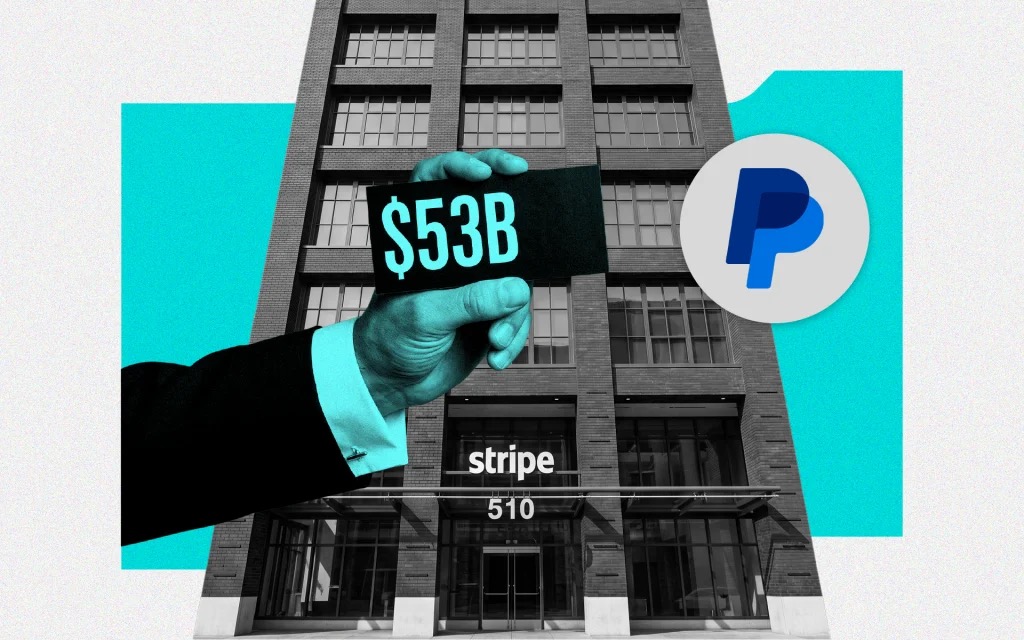
Source: Fintech Blueprint Compiled and organized by BitPushNews payments giant Stripe and private equity firm Advent International, as well as other potential players such as Block, are planning to privatize PayPal. PayPal is currently a $50 billion publicly traded company, which is far from its peak of $360 billion. As a comparison, card giants Mastercard (Mastercard) and Visa both have market capitalization of around $500 billion. Stripe's competitor Adyen's market capitalization fluctuates around $35 billion. Going public can be a tough job. Stripe can enjoy its $160 billion private equity valuation and much less demanding venture capitalists. The idea is that a consortium formed by Stripe and Advent will package a leveraged buyout plan for PayPal's entire open market capitalization, with a small premium — including approximately $17 billion in equity, $36 billion in debt, and other capital, for a total of $53 billion. It's unclear why Stripe isn't directly buying the company in its entirety, but this merger may have monopoly concerns. The entity will operate independently, but will obviously be jointly owned by all parties. This is similar to Tempo's gameplay, which targets retail consumers as an independent but controlled subsidiary of Stripe and takes out one of its smaller competitors (Venmo/Braintree legacy assets). The following numbers... do they mean something? Stripe is second only in size to Visa and Mastercard. If you look at the stock's performance over the past 5 years, you'll also notice that only the card organization has retained value, while the rest of the payment processing stack is in a state of loss. You might be asking why? Because they're in a very different position in the value chain. These networks have full market penetration in a duopoly, so they are used whenever and wherever there is anything new happening in the payments sector. The only exception is cryptocurrencies. So whether it's PayPal, Stripe, or Adyen, it doesn't matter to Visa or Mastercard. They will grow no matter what, so they are immune to competition for market share among their upstream service providers. So downstream, you have Stripe, PayPal, and Adyen, which all have transaction volumes between $1.5 trillion and $2 trillion, but the three have very different rates of change and growth. PayPal is managed by professional managers, and its talented startup gang — Elon Musk (Elon Musk) and Peter Thiel (Peter Thiel) — have apparently left long ago to run the world and launch space rockets. Stripe, on the other hand, still runs on the founder's aura (mana) and outperforms professional managers at all times. Let's take a look at these companies from a high level of fundamentals. From a revenue perspective, PayPal is the larger company—with total revenue of $33 billion, of which net revenue was $150 million. But its transactions are valued at only 1.2 times the total revenue multiple, as it has been struggling to grow and has instead been eaten by various competitors, from Stripe to the impenetrable Google Pay and Apple Pay. Once hyperscale businesses have devoured a feature, good luck in retaining your independent market share. Moreover, all payment processing startups targeting the checkout process are actually stealing PayPal's job. Stripe, on the other hand, continued to grow, and with its $6 billion revenue, its transaction valuation reached a revenue multiple of 27 times, almost 3 times that of its listed counterpart Adyen. This whole thing is a game of price-earnings ratio/valuation multiples, and multiples are a derivative of the cost of capital, which in turn depends on growth expectations. It's unclear if PayPal can do better, but this isn't a particularly good result. Maybe Tether and Circle can create a consortium, buy it for $100 billion, then stuff it with stablecoins and DeFi...

36d agoWendy#DeFi #Paypal #stripe #public #mergers and acquisitions #Stablecoin d
Whose stablecoin will stand on the platform? What does OUSD's “fake collaboration” storm explain?

Whose stablecoin will stand on the platform? What does OUSD's “fake collaboration” storm explain?

Author: Chloe, ChainCatcher Original title: OUSD Fake Cooperation Storm? A credit game endorsed by stablecoins and giants Last week, Open Standard launched the US dollar stablecoin OpenUSD (OUSD) and revealed a strong lineup with more than 140 companies standing at the same time, from Visa, Mastercard, Stripe, and American Express, to BlackRock, BNY, Standard Chartered, to Google, Shopify, Samsung, Coinbase, Solana, and Ripple. As soon as the news came out, Circle's stock price fell on the same day, but in just a few days, this gorgeous list began to crack. A number of Korean companies came forward to cut OUSD, led by Bridge co-founder Zach Abrams (Bridge was acquired by Stripe in 2024), focusing on three things that are different from existing stablecoins: zero processing fees for minting and redemption, no maximum transaction volume, and returning most of the proceeds from reserve assets to partners driving adoption, rather than being taken by the issuer alone. In terms of governance, it does not have a single controller; instead, partners form a board of directors to make collective decisions. The structure is more like payment networks such as Visa and Mastercard, and plans to launch on the four chains of Solana, Polygon, Aptos, and Stellar first. However, according to a report by the Korean media “North Korea Biz” on July 3, many of the 13 Korean companies on the list came forward to cut. Samsung Electronics said that there have been no formal negotiations between the two sides, and the company doesn't even know what role it wants to play in the alliance. Shinhan Financial Group, Upbit's parent company Dunamu, and K Bank are almost the same: Open Standard only asked “if they are willing to participate,” and their responses were simply “I will evaluate and see,” but the names appeared directly on the official member list. What is even more embarrassing is that some companies said that they only discovered that they were listed through local news. Their initial response was only “I will consider it if everything goes well,” and they are amazed that it was written into the alliance. This question is not limited to South Korea either. Gabor Gurbacs, founder of US OpenAssets, said that several of his clients on the list told him that they had never signed or agreed to anything, and could only speculate that “either the media is seriously distorted, or that this list of participants is misleading.” Objectively speaking, this list is not entirely fictional. Companies such as Mastercard, Stripe, Visa, Coinbase, BlackRock, BNY, and Adyen do indeed have executive endorsements, and Stripe has even stated that it wants OUSD to become the default stablecoin for its platform merchants. The real controversy is that OUSD's model is to share reserve profits, and being listed as a partner is tantamount to enjoying financial benefits. This makes whether or not to participate officially no longer just a matter of PR copywriting, but a real business and reputation issue. Reputation is built up into marketing inertia. In the past, “All-Star League” also fell from heaven and used the fame of giants to stack their momentum. This is a marketing inertia that has been around for a long time in the crypto industry. Chainstory analyzed nearly 3,000 crypto press releases in the second half of 2025. Projects rated as high risk accounted for 35.6% of all published projects, and 26.9% of projects flagged as scams. Together, these questionable categories account for more than 62% of the total number of press releases. Meanwhile, low-risk projects only account for about 27% of the total number of press releases. If you want to talk about how the “All-Star League” fell from heaven, the most classic and apt counterpoint is Facebook's Libra. In the summer of 2019, Facebook made a high-profile announcement with a white paper to launch the stablecoin Libra. The lineup was unprecedented: payment terminals include Visa, Mastercard, PayPal, and Stripe; e-commerce companies include eBay, Shopify, Coinbase in the crypto sector, and even top venture capital such as a16z. Almost half of Silicon Valley is shouting for it. Later, a congressional hearing changed fate. Governments feared that the status of sovereign currencies and the US dollar would be impacted. France was the first to oppose it, while the US Congress fought hard against Facebook's past privacy and data scandals, questioning “why this government...

47d agoburnking#OUSD #stablecoins

Mastercard launches AI payment protocol “Agent Pay for AI”, where AI agents can directly pay each other

According to Twitter, Mastercard (Mastercard) announced the launch of a new payment agreement called Agent Pay for AI, which aims to make it easier for AI agents (AI agents) to make small payments to each other, such as paying as needed when accessing website data. Mastercard's chief product officer Jorn Lambert said the project will not be a major source of revenue in the short term, but it is expected to become a new expandable market over the next five years. He also predicted that AI chatbots will eventually play an important role in e-commerce transactions and may spawn a payment ecosystem between bots. According to reports, the agreement records that humans grant operation permissions to AI agents through blockchain to ensure that agents execute according to instructions. Initially, Mastercard chose to store this permission information on the Ethereum-based Polygon network. Other companies involved in developing the agreement include fintech company Adyen, crypto exchange Coinbase, and web hosting giant Cloudflare.

73d ago
What makes Stripe up and PayPal down?

What makes Stripe up and PayPal down?

Author: Odailey Planet Daily Original title: Stripe Up, PayPal Down: On February 24, 2026, the global payments industry ushered in two landmark “turnaround events”: First, Stripe announced the completion of a new round of tender acquisitions at a valuation of $159 billion, with joint funding from Thrive Capital, Coatue, a16z, etc., which surged 74% from the $91.5 billion valuation a year ago. On the same day, two of Stripe's co-founders, Patrick and John Collison, released an open letter for 2025, reviewing the $1.9 trillion annual transaction volume on the Stripe platform — an increase of 34% year over year, accounting for about 1.6% of global GDP. Second, there is the latest news from PayPal, the “old payment hegemon”: According to Bloomberg, PayPal is approaching a potential buyer, and at least one major competitor is evaluating this acquisition. As soon as the news came out, PayPal's stock price soared 9.7% intraday, and closed up about 5.76%, making it the biggest increase in the S&P 500 stock of the day (Daily Planet Daily note: even though the three major indices fell across the board). It's worth checking out that, according to subsequent Bloomberg news, Stripe is considering buying all or part of PayPal's business. Isn't it fun? The advantage of the former is that valuations have skyrocketed; the advantage of the latter is that “finally, big money owners are willing to buy me.” This is not just a story episode between the two major payment giants, but more like a dividing line about “who sees the next era.” Stripe's Infinite Game: The “Internet of Money” Operating System If you're still thinking of Stripe as “a company that makes a payment API,” it's at least three years behind. Looking back at Stripe's business revenue in 2025, its results are obvious to all: 90% of companies in the Dow and 80% of companies in the Nasdaq 100 Index use Stripe; almost all leading AI companies — OpenAI (ChatGPT), Anthropic (Claude), Cursor, Midjourney — all have Stripe's receipt infrastructure; 25% of Delaware's newly registered companies known as the “Heart of American Innovation” have passed Stripe Atlas (Daily: 2B's company registration service platform) was founded. In 2025, 20% of Atlas startups completed their first fee within 30 days of establishment, compared to only 8% in 5 years. An important driving force behind these achievements is undoubtedly Stripe's deep layout in the business line of crypto payments and on-chain finance. In their long open letter, the Collison brothers wrote a phrase that made the entire payment industry and even the crypto market have to ponder: “We may have entered the crypto winter now, but it is definitely the summer of stablecoins.” The data confirms this judgment — in 2025, the price of Bitcoin fell by about 50% from its high point, but stablecoin trading volume reached an unprecedented $34 trillion; payments doubled to about $400 billion, of which about 60% came from the B2B payment scenario. The reality is that in 2025, data growth in stablecoin adoption was officially decoupled from price fluctuations in crypto assets. Stripe was already heavily focused before this inflection point: in October 2024, it bought stablecoin infrastructure company Bridge for about $1.1 billion, the largest single acquisition in the company's history, and Bridge's transaction volume increased more than 4 times; in July 2025, it bought crypto wallet infrastructure company Privy, which supports more than 110 million programmable wallets; and in September 2025, its joint Paradigm incubation was created specifically for payments Tempo, a layer 1 blockchain, was officially launched on the main network in March 2026. It supports more than 100,000 TPS and sub-second settlement. Visa, Shopify, Mastercard, Anthropic, OpenAI, Revolut, etc. have all been connected. Just like that, Stripe built its own set of stablecoins...

143d agoburnking#Paypal #stripe
People who “beat” PayPal and want to buy it

People who “beat” PayPal and want to buy it

A deal that could change the landscape of the global payments industry is quietly brewing. On February 24, Bloomberg broke the news: Stripe, a private payments giant headed by the Collison Brothers, is considering buying all or part of the business of established payment pioneer PayPal. On the day the news broke, PayPal's stock price surged nearly 7% in response. One is a private unicorn valued at $159 billion, and the other is the former king with a market capitalization of only 43 billion US dollars but a huge user network. Behind this deal, there is not only a decline in market share, but also a deep game about future payment patterns — especially crypto/stablecoin payments. PayPal's plight and undercard To understand why this potential transaction caused such a big shock, let's first take a look at two sets of numbers. Over the past 12 months, PayPal's stock price has dropped by nearly 46%, and the market value hovered around 40 billion US dollars. Yet Stripe, which is yet to go public, pushed itself to a valuation of $159 billion in a recent employee share buyback — less than one-third of the latter. What is behind this inversion is that the PayPal business is being squeezed in multiple dimensions. The competitive landscape has already been turned upside down. Apple Pay and Google Pay have relied on mobile phone systems to lock down C-side entrances, while new forces such as Adyen and Stripe continue to encroach on B-side technical flexibility. PayPal, which once started as a “third party guarantee,” is gradually losing the scarcity of connectors in today's increasingly diversified payment portals. User habits are also quietly evolving. After the explosion of social payments and embedded finance, people preferred to complete transactions as soon as they made a purchase rather than redirecting to heavy third-party pages. Whether it's Stripe's one-click payment or Apple Pay's biometrics, it seems to work better than the blue icon interface that requires remembering passwords. Although PayPal has Venmo as a social trump card, it has been faltering in the process of turning it into a business engine. The most fundamental pain point is the loss of market confidence in its growth. In the old world of fiat payments, PayPal's imagination is close to the ceiling; in terms of testing the waters of cryptography, although it launched the stablecoin PYUSD, it has been criticized for “being compliant but has no endogenous transaction requirements”. It has neither penetrated the DeFi ecosystem nor formed special value in its B2B cross-border scene. However, PayPal, whose fundamentals have been questioned, still holds several “chips” coveted by tech giants. One is Braintree, which processes about $700 billion in annual payments, and Bernstein's valuation is $10 billion to $15 billion. If successful, Stripe's total payment volume will jump to $2.1 trillion, freeing itself from competition with Adyen and others. The second is Venmo, a P2P application with over 100 million monthly active users, with a valuation of about 5 billion dollars. For Stripe, which has been “behind the scenes” for a long time, this is a valuable consumer touchpoint: a kind of “last mile visibility.” The third is a global network that has been established for nearly 30 years: clearing infrastructure spanning more than 200 countries, deeply embedded in cross-border trade, and 438 million active accounts with real credit history. Although it looks old, it is the most stable bridge to the edge of global commerce. PayPal recently launched the PayPal World Program. Through cooperation with Tenpay, UPI, etc., it can potentially reach more than 2 billion users. This “interoperability” connecting Eastern and Western payment systems is a strategic entry ticket that is difficult for any opponent to replicate. Nearly 30 years of accumulation have not been in vain. Unfortunately, the person who knows how to use this voucher the most is probably not PayPal itself anymore. Stablecoins became a hidden mainline, yet a term repeatedly mentioned by Wall Street analysts revealed the deal's deeper ambition: stablecoins. “Stripe and PayPal may become an important player in the stablecoin sector after merging, as stablecoins are increasingly becoming a more critical part of global commerce,” Mizuho analyst Dan Dolev said bluntly. Looking back at the two companies' actions over the past two years, it's easy to see that cryptocurrencies — especially stablecoins — have become the future they are betting on together. However, the strategic paths of the two are quite different. PayPal chose the “currency control network” path. Its underlying logic undertakes and continues the centralized thinking of the SWIFT era. It aims to extend the advantages of its payment network to the on-chain world, thus building a closed loop ecosystem with PYUSD as the core. In April of this year, it even launched the “PYUSD Holding Rewards Program” to give back 3.7% of annualized earnings to users,...

178d agoWendy#John Collison #Paypal #stripe #pays #stablecoins
In-depth research report: Fintech relies on a draw to win, while DeFi's turnover is trillions but only makes a fraction

In-depth research report: Fintech relies on a draw to win, while DeFi's turnover is trillions but only makes a fraction

Source: Artemis & Fintech Architects Original title: Report: Is Fintech or DeFi a better financial system? Compiled and compiled: BitPushNews Foreword: Fintech Architects and digital finance think tank Artemis jointly released the first comparative analysis report on key performance indicators (KPIs) between fintech (Fintech) and decentralized finance (DeFi). If you've ever struggled with Robinhood or Uniswap who is a better asset to invest in, then you've come to the right place. For the first time, this report compares fintech stocks and crypto tokens in the same dimension. Covering fields such as payments, digital banking, transactions, lending and forecasting markets, the report compares revenue, number of users, take rates (take rates), industry KPIs, and valuation metrics. The results are shocking: Hyperliquid's transaction volume has reached more than 50% of Robinhood's; the total amount of outstanding loans from DeFi protocol Aave has surpassed that of Buy-To-Pay giant Klarna; stablecoin settlement networks are growing far faster than traditional payment providers; and wallets such as Phantom and MetaMask have enough users to rival digital banking giants such as Nubank and Revolut. We found that valuations fully reflect this game: crypto assets are either at a very high premium or at a deep discount, depending on their expected ability to cash out. Ultimately, we think the core question of merging the two is: will the crypto industry learn to establish a “toll booth”, or will the fintech industry switch to the crypto industry's “open track”? The game between the two financial systems For many years, we have always viewed cryptocurrency and fintech as parallel universes. One is a system that is regulated, audited, and traded on NASDAQ; the other is a system for trading on decentralized and centralized exchanges without permission. They share a common language: revenue, volume, payments, borrowing, trading, but with different “accents.” This situation is changing. As Stripe bought Bridge, Robinhood launched a prediction marketplace, and PayPal minted its own stablecoin, the lines began to blur. The question is, when these two worlds collide, what is the power comparison? Comparison chart description: In our chart, purple represents cryptocurrencies (Crypto) and green represents equity companies (Equities). Currently, Robinhood has the highest trading volume, but Hyperliquid is in second place... We decided to conduct this experiment: select well-known fintech companies in the fields of payments, digital banking, buy and pay later (BNPL), and retail brokers, and stack them against crypto-native benchmarking protocols. We used the same metrics (P/S market rate, ARPU per capita revenue, total TPV payments, number of users, etc.). The green bar chart represents US stocks, and the purple bar chart represents the token agreement. A panoramic picture of these two financial systems has emerged: on-chain financial agreements often match or surpass fintech rivals in terms of transaction volume and asset size, yet they capture only a fraction of the economic benefits of each other. In contrast, the valuation of crypto assets is either extremely high or extremely low, and there is little middle ground. Moreover, the two are not growing at the same rate at all. Payment sector: The capital flow channel begins with the largest category of fintech - capital transfer. Green camp (lots of giants): PayPal's annual transaction volume is $1.76 trillion. Adyen's processing volume amounts to $1.5 trillion. Fiserv (that almost forgotten infrastructure layer) processed $320 billion. Block (formerly Square) has driven $255 billion through Cash App and merchant networks. Purple Camp (Artemis estimated annualized B2B payments): Tron moved $68 billion in stablecoins. Ethereum reached $41.2 billion. BNB was $18.6 billion. Solana is around $6.5 billion. Judging from the absolute numbers, the two are not on the same scale. The amount of stablecoin transfers across all major public chains is only about traditional...

204d agoWendy#Adyen #Bridge #DeFi #Fintech #Fiserv #Robinhood #depths #Predicting the market
CoinbaseQ3 earnings report shows new trend: non-transactional revenue is becoming a pillar of growth

CoinbaseQ3 earnings report shows new trend: non-transactional revenue is becoming a pillar of growth

Authors: Lin Wanwan, Kaori Original title: Q3 Financial Report: The price of the currency is cold, but Coinbase's money-making machine is heating up. On October 31, 2025, Coinbase released its Q3 earnings report. This report card came at the right time to inject a dose of strength into the underliquid crypto industry. Total revenue was US$1.87 billion, up 55% year over year and 25% month on month. Net profit of $433 million was only $75.5 million in the same period last year. Earnings of $1.50 per share beat analysts' expectations by 45%. Wall Street analysts applauded. J.P. Morgan adjusted the rating to an increase last week, with a target price of $404. Just when many people expected the liquidity of the coin industry to be poor and trading volume to fall short of expectations in the third quarter, Coinbase gave a perfect answer. Consumer transactions jumped to $59 billion, an increase of 37% over the previous quarter. Retail transaction revenue reached $844 million. Other than that, Coinbase has been increasing Bitcoin. Bitcoin holdings have increased by a cumulative total of $299 million this quarter through weekly fixed investments. Up to now, its total Bitcoin holdings have reached 14,548. CEO Brain Armstrong said during the company's earnings call: “Everything can be traded” is central to the next phase of our construction. In addition to that, Coinbase is integrating prediction markets, tokenized stocks, and other products into its platform. Behind the fact that everything can be traded, Coinbase is no longer a cryptocurrency night watchman; it is becoming a “encrypted Apple ecosystem” connecting humans and capital. What ambitions did Coinbase lay out behind this 14,548 BTC holdings increase? Wall Street's “comeback”: Base×USDC From side business to cash cow, looking back to 2023, the stock price of the first crypto stock Coinbase has been like a roller coaster, climbing from a trough of $30 to above $300 today, not by luck, but by walking on two legs: Base and USDC. These two were originally “side jobs,” but now they have become cash bullies, and Wall Street reviews are coming quickly and directly. COIN Price Chart | Source: Tradingview first said that J.P. Morgan's rating had risen to “gain.” On October 24, analyst Kenneth Worthington stated bluntly in the report that “the valuation of Coinbase is undervalued, and the potential opportunity value of the Base token is $120-34 billion.” Base is an Ethereum layer 2 network incubated by Coinbase. It was only a “low fee experimental field” when it launched in 2023, but now it has become a star. How did this money come about? As an optimistic rollup, each transaction requires a scale effect superimposed on a single sequencer (sequencer). Although the fee is low (average $0.01 per transaction), the scale effect is terrifying — the number of daily transactions has exceeded 5 million, which is double that of the main network. The sequencer model makes expense revenue a strong source of cash flow. Base Sequencer Revenue | Source: DunecoinBase transferred all of these fees to its own escrow account on the grounds of “security and audit,” but the community once complained that this was “centralized blood-sucking.” Management responded at the earnings conference to explore ecological profit sharing in the future, such as returning part of the fee to developers or users, forming a positive feedback cycle. More to look forward to is a potential native Base token. J.P. Morgan predicts that if Base issues native tokens, the market capitalization could reach tens of billions of dollars. What can tokens do? Stimulate flexibility in use, and holders can participate in governance, pledge to earn a share of fees, and even use it to discount gas fees. There are millions of daily active users, and the flexibility of fee revenue is huge. If the token is landed, Base will soon change from a “cost center” to a “profit engine.” Also look at USDC, this stablecoin is a combination of Coinbase and Circle. The Q3 earnings report showed that USDC's market capitalization reached a record high of $74 billion, and the average balance of USDC within the Coinbase platform was $15 billion, up 9% from the previous month. Average balance of USDC off-platform 53...

295d agoburnking#Coinbase
“Trillion-dollar” stablecoin finance companies are on their way, and the countdown to the end of traditional payment systems begins?

“Trillion-dollar” stablecoin finance companies are on their way, and the countdown to the end of traditional payment systems begins?

Author: Rob Hadick, Dragonfly Partner Reprint: Daisy, Mars Finance Original title: Traditional payment models are about to collapse, trillion-dollar stablecoin finance companies are about to be born? Stablecoins are not meant to improve existing payment networks, but to completely disrupt traditional payment networks. Stablecoins enable businesses to completely bypass traditional payment channels; in other words, these traditional payment channels are likely to be completely replaced one day in the future. When payment networks are based on stablecoins, all transactions are just digital changes in the ledger. Currently, many emerging companies have begun to promote the restructuring of capital flow methods. Recently, many people are discussing how stablecoins can become bank-as-a-service (BaaS) online platforms, connecting existing payment channels, from the issuing bank to merchant acceptance, and everything in between. Although I agree with these views, when I think about how companies and agreements will create and accumulate value in the future under a new paradigm, seeing stablecoins simply as a platform to connect to existing payment channels is actually underestimating their true potential. Stablecoin payments are a gradual improvement that represents the possibility of reimagining payment channels from the bottom up. To understand where the future is going, we need to look back at history, because history reveals an obvious path of evolution. Evolution of modern payment channels The origins of modern payment systems date back to the early 1950's. Diners Club, founded by Frank McNamara, introduced the first multi-purpose bookkeeping card. This type of debit card introduces a closed-loop credit model, and Diners Club acts as a payment intermediary between merchants and cardholders. Prior to Diners Club, almost all payments were made directly between merchants and customers via cash or proprietary bilateral credit agreements. Following the huge success of Diners Club, Bank of America (BofA) saw a huge opportunity to expand its credit business and reach a wider customer base, and launched the first consumer credit card for the mass market. Bank of America has mailed middle-class consumers more than 2 million unsolicited, pre-approved credit cards that can be used at more than 20,000 merchants in California. Due to regulatory restrictions at the time, BofA began licensing its technology to other banks in the US and even expanded to international markets, resulting in the first credit card payment network. But with that came huge operational challenges and raised serious credit risks, and the overdue rate soared to more than 20%. At the same time, along with rampant fraud, the entire project almost collapsed. People are beginning to realize that the challenges and chaos in the banking network can only be solved by forming a true cooperative organization that will set the rules for managing the system and provide the infrastructure. Organization members can compete on product pricing, but they need to follow uniform standards. This organization later became the Visa we know today. Another organization founded by the Bank of California to compete with Bank of America later became Mastercard. It was the birth of our modern global payment model and has become the dominant structure of the global payments industry. From the 1960s to the early 21st century, almost all innovation in the field of payments revolved around enhancing, complementing, and digitizing current global payment models. After the internet boomed in the 1990s, many innovations moved to software development. E-commerce was born in the early 1990s, and buying a Sting CD on NetMarket was the first online payment. PizzaNet then became the first national retailer to accept online payments. Well-known e-commerce companies such as Amazon, eBay, Lotte, and Alibaba were established one after another within the next few years. The boom in e-commerce companies has in turn spawned many early independent payment gateway and processor companies. The most famous ones are Confinity and X.com, which were founded in late 1998 and early 1999, respectively, and merged to become today's PayPal. Digital payments have spawned many well-known companies with a market capitalization of hundreds of billions of dollars. These companies connect offline merchants to online retail, including payment service providers (PSPs) and payment aggregators (PayFACs) such as Stripe, Adyen, Checkout.com, Square, etc. They solve problems on the merchant side by bundling gateways, processing, reconciliation, fraud compliance tools, merchant accounts, and other value-added software and services. But apparently they...

429d agoAlvin Liu#ecommerce #stablecoins #Cross-border payments
Stablecoins restructure payment systems: traditional financial models ushered in fundamental changes

Stablecoins restructure payment systems: traditional financial models ushered in fundamental changes

Author: Rob Hadick, Dragonfly Partner Compiled by: AidiDiaoJP, Foresight News Original title: Traditional payment models are about to collapse, and trillion-dollar stablecoin finance companies are about to be born? Stablecoins are not meant to improve existing payment networks, but to completely disrupt traditional payment networks. Stablecoins enable businesses to completely bypass traditional payment channels; in other words, these traditional payment channels are likely to be completely replaced one day in the future. When payment networks are based on stablecoins, all transactions are just digital changes in the ledger. Currently, many emerging companies have begun to promote the restructuring of capital flow methods. Recently, many people are discussing how stablecoins can become bank-as-a-service (BaaS) online platforms, connecting existing payment channels, from the issuing bank to merchant acceptance, and everything in between. Although I agree with these views, when I think about how companies and agreements will create and accumulate value in the future under a new paradigm, seeing stablecoins simply as a platform to connect to existing payment channels is actually underestimating their true potential. Stablecoin payments are a gradual improvement that represents the possibility of reimagining payment channels from the bottom up. To understand where the future is going, we need to look back at history, because history reveals an obvious path of evolution. Evolution of modern payment channels The origins of modern payment systems date back to the early 1950's. Diners Club, founded by Frank McNamara, introduced the first multi-purpose bookkeeping card. This type of debit card introduces a closed-loop credit model, and Diners Club acts as a payment intermediary between merchants and cardholders. Prior to Diners Club, almost all payments were made directly between merchants and customers via cash or proprietary bilateral credit agreements. Following the huge success of Diners Club, Bank of America (BofA) saw a huge opportunity to expand its credit business and reach a wider customer base, and launched the first consumer credit card for the mass market. Bank of America has mailed middle-class consumers more than 2 million unsolicited, pre-approved credit cards that can be used at more than 20,000 merchants in California. Due to regulatory restrictions at the time, BofA began licensing its technology to other banks in the US and even expanded to international markets, resulting in the first credit card payment network. But with that came huge operational challenges and raised serious credit risks, and the overdue rate soared to more than 20%. At the same time, along with rampant fraud, the entire project almost collapsed. People are beginning to realize that the challenges and chaos in the banking network can only be solved by forming a true cooperative organization that will set the rules for managing the system and provide the infrastructure. Organization members can compete on product pricing, but they need to follow uniform standards. This organization later became the Visa we know today. Another organization founded by the Bank of California to compete with Bank of America later became Mastercard. It was the birth of our modern global payment model and has become the dominant structure of the global payments industry. From the 1960s to the early 21st century, almost all innovation in the field of payments revolved around enhancing, complementing, and digitizing current global payment models. After the internet boomed in the 1990s, many innovations moved to software development. E-commerce was born in the early 1990s, and buying a Sting CD on NetMarket was the first online payment. PizzaNet then became the first national retailer to accept online payments. Well-known e-commerce companies such as Amazon, eBay, Lotte, and Alibaba were established one after another within the next few years. The boom in e-commerce companies has in turn spawned many early independent payment gateway and processor companies. The most famous ones are Confinity and X.com, which were founded in late 1998 and early 1999, respectively, and merged to become today's PayPal. Digital payments have spawned many well-known companies with a market capitalization of hundreds of billions of dollars. These companies connect offline merchants to online retail, including payment service providers (PSPs) and payment aggregators (PayFACs) such as Stripe, Adyen, Checkout.com, Square, etc. They bundle gateways, processing, reconciliation, fraud compliance tools, merchant accounts, and other value-added software and services to...

430d agoburnking#Crypto payments #stablecoins #Stablecoin regulation topics #Financial model