PoP · 25

Binance Alpha's new P airdrop earnings are around $62

Comparative news, according to market data, Binance Alpha has launched PoP Planet (P), the price is temporarily estimated at $0.124, and the current market value is $17.32 million. Each eligible user can receive an airdrop of 500 P tokens. The single number revenue from this airdrop campaign is approximately $62 at the current price.

323d ago

Gavin Wood reveals 5 new future directions he and Parity are exploring!

Gavin Wood reveals 5 new future directions he and Parity are exploring!

Source: PolkaWorld Original link: https://mp.weixin.qq.com/s/23hgx9ucfsBCjbOMbQVITA今天给大家分享 Gavin Wood's final speech at the Web3 Summit! Gavin Wood suggests several directions of exploration that could reshape the future of Web3. This is not only an extension of technical details; it is more like a blockchain research outline for the next ten years. He said bluntly: Today's Web3 still lacks critical foundational capabilities, and without solving these problems, we can't really enter the era of large-scale applications. To this end, he proposed several strategic breakthroughs: Rebuilding financial privacy: creating legal and secure privacy protection tools within the FATF compliance framework. Proof of individuality (PoP): An uncompromising anti-witch mechanism, which he called “Web3's silver bullet.” Web3 Oracle: Replacing centralized services operated by foundations and individuals with decentralized oracles. Web3 Outpost: Bringing on-chain rules into reality and building autonomous communities and economies. Polkadot native stablecoin: It is necessary not only to have a protocol-grade stablecoin overcollateralized with DOT, but also to explore a new “stable-ish” system. These directions point not at a single point of innovation, but rather at upgrading the underlying narrative of Web3: from simple on-chain experiments to real-world institutions and economies. As Gavin said, these puzzles, if completed, would be a critical turning point in Web3's development path. Rebuilding financial privacy in Web3 In the second half of my talk, I'd like to focus on some of the new directions we're exploring in the Parity and Web3 world, the most important of which is privacy protection. The right to privacy is a right that most people should enjoy, and many countries' constitutions even clearly enshrine this. In reality, however, these rights are often overlooked, particularly in traditional institutions such as banks. Technicians' job is not to force people to make choices, but to provide them with the tools to freely and safely exercise their right to privacy. However, there is currently a lack of effective technical means in this area, and this is an area where improvements are urgently needed. Therefore, we are trying to develop specialized tools to help people protect personal privacy while ensuring that these tools are legal and safe for both providers and users. In fact, this type of technology has already been partially used in our “Proof of Personhood (Proof of Personhood)” system to hide the user's identity when issuing rewards. Internationally, the Financial Action Task Force (FATF) has issued relatively clear guidance. Although it is not a government agency, it is often viewed as having more influence than most governments. Many countries will follow its standards. As recommended by the FATF: • A single transaction under $1,000 should enjoy privacy, and KYC is required for more than that. • Individuals should also enjoy privacy with a daily transaction limit of less than $10,000, and KYC is also required if it exceeds it. These standards are actually very much in line with the everyday banking experience: you can usually take around $1,000 at an ATM, and you need to go to the counter; when it's over $10,000, you have to fill out the relevant forms. Therefore, we hope to establish the underlying primitives (primitives) of financial privacy, so that users can easily and safely enjoy privacy protection within these widely recognized limits. The portion exceeding these limits may require further careful treatment. Next, PoP, a new weapon against witches, we'll talk about individuality (individuality) and anti-witch attack (Sybil resistance). This is one of the toughest questions in the Web3 world. I've been researching in this direction for a long time. Simply put, I believe if Proof of Personhood (PoP) succeeds and becomes popular, it may be a “silver bullet” — a solution to a problem we haven't been able to overcome for over a decade. It has to fit the Web3 philosophy though, or else...

338d agoPolkaWorld#PolkaWorld
Boca Weekly | W3F and Gavin will participate more actively in voting on treasury proposals! Hydration TVL is over $400 million!

Boca Weekly | W3F and Gavin will participate more actively in voting on treasury proposals! Hydration TVL is over $400 million!

Source: PolkaWorld Original Article Link: https://mp.weixin.qq.com/s/_C6Rc2g0h2aAKB2HacYSug本周最重要更新,Gavin Live Highlights: Distribution route: Gavin clearly stated that it supports “hard pressure” (up to 2.1 billion DOT), decreasing every two years on Pi Day (13.14% based on remaining supply). First cut: 2026-03-14; if approved, the plan is incorporated into the v1.8.1 policy goals: The emphasis is on managing “interest rates” rather than nominal inflation; unify pool redistribution (verification/nomination/treasury/others) by decoupling issuance → interest rates → security through the “Revenue Pot”. Validator payments: It is proposed to use DOT-based stablecoins to pay validator returns; solutions such as Hollar can be used in the short term to promote “native, overcollateralized DOT stablecoins” in the long term (and explore stable-ish designs). Nominee mechanism: It is proposed to eliminate slashing and unbundling periods, introduce “zero risk interest rates” (interest rates are low but stable), and maintain the nomination mechanism to bring interest rates closer to real economic regulation. Validator governance: Introduce the Proof of Personhood idea to improve the transparency of identity and node declarations, require a certain degree of self-pledge, and reduce the risk of centralization and tandem connections. Treasury and Governance: After Gavin returns to CEO of Parity, W3F/Parity will vote more actively to establish spending committees and open standards, and move towards more conservative and strategic fiscal discipline. Product and path: Build not only machines, but also applications — Hub+ Coretime two-wheel drive; Parity will build the Hub into a “dual VM (Revm/PolkAVM) contract platform”, and will launch its own products to drive adoption. For more details, see the full Chinese version of “Polkadot Changes: Gavin Supports Hard Pressure and a Complete Reshaping of the Fiscal Expenditure Mechanism!” compiled by PolkaWorld In addition, in this live broadcast, Gavin Wood revealed for the first time his mission and direction after returning to CEO of Parity! He said he will return to the original intention from all aspects — Polkadot should truly reach the public and become a useful product platform. Parity is positioned as a product company that not only makes “machines” (Hub, PoP, JAM...), but also personally applies them. Future direction: Invest strategic capital and concentrate resources → Build a hub smart contract platform, incubate new scenarios such as Proof of Personhood, games, etc. Use the platform yourself + promote Gavin on both lines for users Teaser: New products will be released in the next few months! Learn more in PolkaWorld's latest article “Important! Gavin Wood shares his mission and direction after returning to CEO of Parity! This Friday marks Parity's 10th anniversary! Parity mainly served Ethereum for the first five years and Polkadot for the next five years! Now, on the 10th anniversary of Parity, it has finally opened the doors of Polkadot for Ethereum developers through REVM! Ten years ago, Gavin Wood and core developers brought EVM to the crypto world at ETHCore (now called Parity)! Ten years later, Parity finally allows every Ethereum developer to start over on Polkadot. Polkadot has been behind EVM's source code from the very beginning! If you're a Solidity developer and have had concerns about Boca — now, the launch of REVM has paved the way for you. You no longer need to adapt to a new language, understand Runtime, or restructure your account system. You can continue to use the tools, languages, and ways of thinking you are familiar with to build applications belonging to the next generation multi-chain ecosystem. Welcome to the Polkadot Hub! REVM is waiting for you to deploy the first line of code! “Parity 10th Anniversary: REVM Opens Polkadot Doors for Ethereum Developers!” This week's major developments: 500ms block generation is coming soon! Parity engineers said the feature has been developed and merged as soon as the end of the year, first...

348d agoPolkaWorld#PolkaWorld
When Polkadot's $500 million security cost becomes a burden, Gavin Wood offers three ways out!

When Polkadot's $500 million security cost becomes a burden, Gavin Wood offers three ways out!

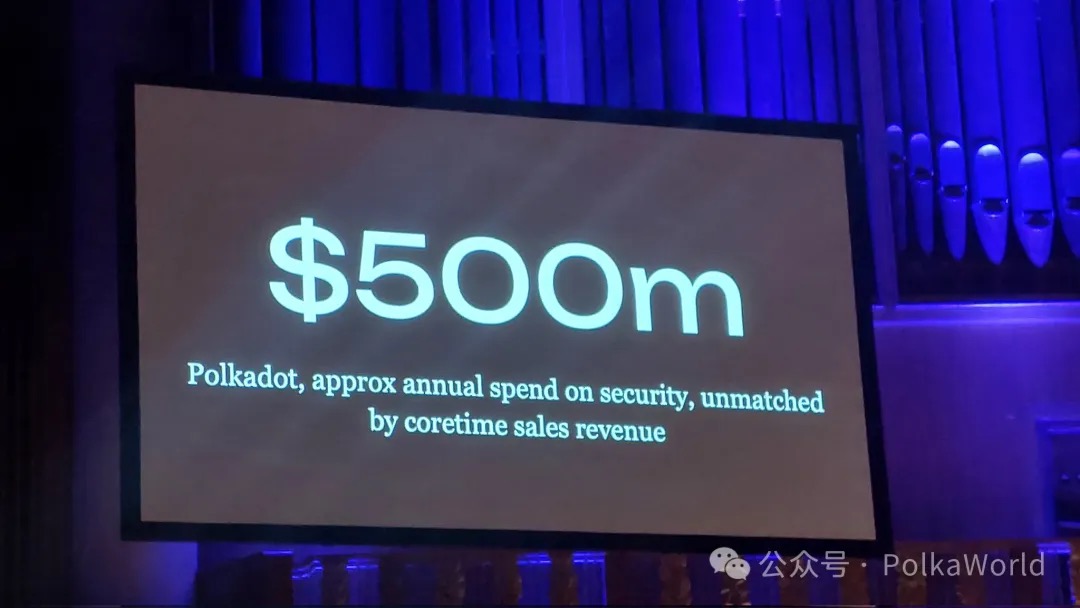
Source: PolkaWorld Original link: https://mp.weixin.qq.com/s/xLlnTgs9jUOkiHVI6g2euQ本文为 Chinese version of Gavin Wood's speech at the July Web3 Summit (Part 2). Due to the huge content of the speech, we will divide it into four articles and publish them one by one to make it easier for everyone to gradually understand and digest. Although the big information about Gavin at the Web3 Summit has been widely disseminated by the community, more details in the original article are still worth knowing! The first “Gavin Wood's speech: JAM delivery and medium- to long-term strategies for introducing ZK into JAM!” In the second installment, Gavin focuses on the economic woes of Polkadot staking: 1. The huge gap between $500 million in annual security expenses and meager revenue; 2. Staking rewards were sold off on a large scale due to tax issues, and staking costs continued to spill over; 3. To address this long-term structural deficit, he proposed three paths: increasing the value of Coretime — making the “products” sold by Polkadot more useful and attractive; reducing costs and reshaping the distribution curve — reducing annual costs from 500 million to less than 100 million; and exploring native stablecoins and proof of individuality (PoP) — optimizing payment methods and reshaping cybersecurity mechanisms while reducing security costs. At the core of all this is Fiscal Discipline (Fiscal Discipline), which is the key to Polkadot's long-term sustainability. Next, keep reading to learn about the second part of Gavin's talk. The economic difficulties faced by Polkadot staking Let's first bring the topic back to the cost of staking, which can be called fiscal discipline (fiscal discipline). One of the most intuitive numbers is: $500 million. That's roughly what Polkadot is currently spending on cybersecurity each year. In other words, Polkadot invests such a huge amount of money each year to keep itself safe. However, this expenditure did not match the revenue. The revenue stream is almost negligible, mainly coretime's sales revenue. And if this money continues to circulate within the DOT system, it won't necessarily be a problem. The problem is that we know that quite a bit of money is going outside of the system. The reason is simple — many stakers are in high tax jurisdictions. Take a live example: How many people have participated in the pledge? ——Almost everyone. So, how many people have paid taxes on pledge rewards? ——Almost everyone. Paying more than 10% in tax? ——Almost everyone. More than 20%? ——There are quite a few more. Over 35%? ——Probably one or two. So overall, pledgers are generally in the 20% to 30% tax range. By contrast, the mining situation is completely different. The mining industry is highly concentrated and highly institutionalized, making it easier to optimize taxes. Common methods include putting the mining machine under the name of an offshore company or using grey methods to unblock relationships. In other words, mining rewards are more likely to evade taxes through institutional channels; while pledge rewards are distributed to ordinary people distributed across various normal jurisdictions. The government finances in these places are tight, so of course they will not let go of any opportunity to collect taxes. Especially now, the financial situation in various countries is becoming increasingly tight, and taxing staking, which “looks like profits are being taken in vain,” has become a logical choice. As a result, staking rewards have almost become an obvious tax target. I'd like to ask everyone to think about a question: if you're paying taxes on staking rewards, how many people would be willing to specifically move to a lower tax jurisdiction to avoid this tax? The answer: there was only one person present. This shows that most people don't have a strong desire to relocate to avoid taxes. In other words, everyone's investment in keeping pledged assets within the system for a long time is actually not very deep. This is the problem, and it is also an economic dilemma facing staking. Of course, I can't assert that all staking rewards will be immediately cashed out. But we already know that a significant portion of rewards is quickly sold off due to tax pressure. Frankly speaking, I...

353d agoPolkaWorld#PolkaWorld
The crisis of multi-chain architectures: Thinking from Cosmos to Polkadot!

The crisis of multi-chain architectures: Thinking from Cosmos to Polkadot!

Source: PolkaWorld Original link: https://mp.weixin.qq.com/s/i-21DJ_EZg0rGjet2WN1VQ“多链架构”这个词在过去很长一段时间,一度被视为 The golden story of Web3: Every chain can expand flexibly according to its own needs, collaborate with each other, share security, and connect values to build a truly open and interconnected cyberuniverse. This is the story of Ethereum L2, Cosmos, and Polkadot. However, the ideal has yet to be realized, and the dilemma has quietly arrived. As we look back at the current state of development of mainstream L1 and L2 networks, a common problem surfaced: there are more and more chains, but users are not keeping up; technology is constantly breaking through, but the product experience is still far away; and the rapid influx of capital makes it difficult to accumulate sustainable value. Public chains with a multi-chain architecture have always been caught in a dangerous “incentive cycle” in the past: issuing coins, airdrops, pulling, shipping, and crashing. Short-term heat can be easily created, but long-term trust is increasingly scarce. The Cosmos crisis is not an exception; it is a microcosm. Once upon a time, this ecosystem was considered one of the best practitioners of multi-chain architectures. Through the path of staking ATOM → obtaining airdrops → supporting sub-chain projects, Cosmos once established the earliest and most active batch of “ecological flywheels” in the Web3 world: projects such as Osmosis, JUNO, Evmos, Celestia, etc. are all “incubated” under this mechanism; users actively participate in ATOM's staking (staking), obtain airdrops of sub-chain tokens, and further participate in the governance or trading of these new projects; project parties quickly attract traffic and attention through airdrops. Complete the cold start tasks in the early stages of startup. This “stake-to-earn+ airdrop” mechanism has activated the vitality of the Cosmos community in a short period of time, and has also enabled many projects to gain initial users and markets. The problem, however, is that the mechanism itself is not sustainable. As more and more projects “take off with airdrop,” airdrop gradually no longer represents long-term construction, but only a one-time benefit: users participate in staking only for arbitrage; project parties crash the market when the airdrop is completed, and there is no long-term incentive mechanism; ATOM's staking is diluted by high inflation, which damages the interests of long-term holders; the value of the sub-chain cannot feed back ATOM itself, leading to a “bustling ecology and sluggish main chain”. Eventually, when the market heat faded and the bubble of the airdrop economy burst, the ecology quickly moved from peak to collapse. From Evmos and Stride to Celestia and Osmosis, this “Airdrop Takeoff → Hot Sale → Crash to Zero” script was performed over and over again. This is exactly what we're saying: incentive cycle ≠ business model. The airdrop brings one-time attention rather than product retention; staking does not protect the value of the token, nor can it support the long-term survival of the project. Today's Cosmos is paying a heavy price for what seemed like a “value binding” growth path in the past: the core asset $ATOM fell by more than 90% from its historical high; on-chain projects such as Osmosis, JUNO, and INJ dropped by 70% to 99%; the crisis of multi-chain architecture, we cannot blame “speculators” for all problems. There is nothing wrong with the incentive mechanism itself; what is wrong is the project side's misuse of incentives and evasion of business logic. The problems faced by Cosmos also exist in more multi-chain ecosystems: sub-chain values are fragmented, making it difficult to form a unified return mechanism; native tokens lack usage scenarios and long-term inflation dilutes trust; the governance system is fragmented and the community lacks stable consensus; the airdrop economy destroys the long-term culture and harms builders; there is no revenue model to support user growth, making it impossible to form a closed loop of products. This isn't just a Cosmos problem, it's not just an L1 or L2 problem; it's a deep challenge that Web3 projects generally face: most projects only get through the incentive system, not the business logic. In any industry, healthy growth follows the same path: projects solve real problems for users; users are willing to pay for services; projects receive revenue and continuously optimize products; and form a sustainable positive cycle. This set of logic has been tried and tested over and over again in Web2, but it has become invaluable in Web3. Most projects have not yet taken the first step and are in a hurry to pursue the “market capitalization” of the second step. P...

376d agoPolkaWorld#PolkaWorld
Boca Weekly Report | Reducing DOT inflation is imminent, Kusama may launch a lightweight version of JAM

Boca Weekly Report | Reducing DOT inflation is imminent, Kusama may launch a lightweight version of JAM

Community discussions on DOT inflation continued to deepen this week. In a live broadcast organized by Alice und Bob, all parties in the ecosystem expressed their views on DOT inflation! Some people think we should set a fixed upper limit and set a step-down inflation. They think this can push Polkadot into a “either generate revenue or die” state! Jonas of the Web3 Foundation also cautioned against sacrificing security in pursuit of Cap, and that DOT's “demand-side” fundamentals should also be considered. Check out the full discussion in PolkaWorld's latest article, “Face Up Big! DOT Tokenomics won't change, will you finish playing Polkadot?” PolkaWorld opinion: Should inflation be cut directly to 2%? We believe that everyone's discussions are reasonable. Generally speaking, we should open up resources and save money, expand on the demand side, and optimize on the supply side. Demand side: How else can DOT be used? Staking (staking) accounts for up to 50%, but high inflation has diluted DOT holders with safe costs. It should have been cut off. DeFi is seen as the most promising new scenario, and DOT released by falling staking rates may flow into DeFi protocols. Fees: The Polkadot architecture allows parachains to choose their own gas, causing high-volume projects such as Mythos and peaq to not directly feed back DOT. And we can force Polkadot Hub to use DOT as a processing fee! Coretime: Too many high hopes are placed on it. The goal is to cover network costs, but the short-term pressure may be high, and a “low price attraction → later charge” strategy may be needed. How effective the DOT ETF will be right now is yet to be determined! Supply side: Inflation and cap The current community plan suggests setting a fixed upper limit of 3.14 billion + stepped inflation falling, but the 20-year timeline is too long, and there is no sense of actual change in the short term, which can easily cause the community to lose confidence. PolkaWorld believes that if we want to achieve the “reset the game, or die” effect, we should just reduce inflation to 2%! The annual inflation rate is about 32 million DOT, which is 320 million US dollars in terms of $10/DOT, which is enough for cybersecurity. Or the upper limit should be fixed at 2.1 billion and step-down inflation to 0 in 5 years instead of 20 years. Give the community a real signal of change through “strong stimulation.” What's your opinion? Should Polkadot “cut directly to 2%” to break the pattern of interests? Therefore, we reviewed the development history of the public chain. We found that the rise and fall in token prices is only an indication, and the real transfer of power behind it often comes from the change of “bookmakers.” From the geeks and idealists of the Ethereum 1C0 era, to miners, DeFi capital, to Wall Street financial power after entering the ETF — every round of “changes” has changed the network's power structure and narrative. So, where is Polkadot's “Journey to Change the House”? Will it experience a similar transformation? Who will be the “bookmaker” of the next generation of DOT? Learn more in PolkaWorld's latest article “Should Polkadot reduce inflation to 2% and break the established stakeholder pattern?” Gavin proposed a discussion in the JAM Dev Group -- maybe we can launch a Kusama “lightweight JAM” first? Gavin said that if Kusama and Polkadot don't share the same JAM chain in the end, then Kusama can first run a smaller, faster JAM to become a “testing ground” for JAM technology. The lightweight JAM can be started with 32 cores (cores), which is much smaller than the JAM size of Polkadot's future versions (1023 cores). Potential benefits Lower operating costs (depending on Toaster test results): Assuming the PoP+ lottery mechanism selects validators, the network bottom cost is only about $6 million/year, and delays can also be significantly reduced by offsetting Coretime rental revenue: Although throughput will drop, faster block times will allow What do you think of the JAM app on Kusama being more “instant”? https://x...

382d agoPolkaWorld#PolkaWorld
Should Polkadot reduce inflation to 2%, breaking the established stakeholder pattern?

Should Polkadot reduce inflation to 2%, breaking the established stakeholder pattern?

Source: PolkaWorld Original Link: https://mp.weixin.qq.com/s/iauOarpTRZY8u1YM4VKdaA今天正好看到星球日报发布了一篇回顾以太坊的文章《以太坊十周年:重温ETH换庄之旅,筹码中心化回潮》,很好的总结了以太坊的“换庄之旅”,今天我们也想就这个话题,跟社区一起探讨下 Polkadot's “Zhuang Change Question”! Note that the “bookmakers” discussed in this article are not traders as we understand them, but rather characters that influence decisions, control liquidity, and determine ecological trends. I think that in the history of the development of public chains, the rise and fall in token prices is only an indication, and the real transfer of power behind it often comes from the change of “bookmakers.” From the geeks and idealists of the Ethereum 1C0 era, to miners, DeFi capital, to Wall Street financial power after entering the ETF — every round of “changes” has changed the network's power structure and narrative. So, where is Polkadot's “Journey to Change the House”? Will it experience a similar transformation? Who will be the “bookmaker” of the next generation of DOT? Looking at the inevitable evolution of the capital structure from the perspective of Ethereum — any public chain will eventually “replace” the first batch of “bookmakers”: 1C0 participants and early contributors (2014-2016) Ethereum started with geeks and idealists. The early bookmakers of ETH were IC0 participants, founding teams, and developers, who entered with the vision of a “decentralized world computer.” From $0.3 in 1C0 to 60 million ETH distributed to participants and 12 million shares to core contributors, the story of Ethereum's first-generation wealth is now in full swing. At the time, ETH was extremely centralized, and 100 addresses took 40% of the allotment, which also sowed the seeds of controversy for many years. The second batch of “bookmakers”: miners and crypto capital (2015-2022) is computing power capital and native institutions in the medium term. After The DAO fork, Ethereum regained its new life. Miners have become the maintainers of cyber security and a new group of “bookmakers.” In 2017-2020, the DeFi wave hit, ETH was locked into smart contracts, institutions such as Hashkey and Dragonfly also took over positions, and ETH distribution gradually became decentralized. 2022 Merge (The Merge), PoW → PoS, miners exited, major stakers took over. From a technical dream to an economic machine, ETH drove ecological expansion and diluted early centralized holdings. Third batch of “bookmakers”: Wall Street Capital (2024-) Wall Street and ETF funds are now entering Ethereum. Native capital such as Galaxy and Paradigm gradually “abdicated,” Ethereum spot ETFs were approved, giants such as BlackRock and Fidelity appeared, and listed companies' reserve treasury became a new story. Ethereum's “bookmaker” has gone from being a chain to a “financial player” in the financial market. Seemingly, any public chain that wants to become a global asset will go through a “bookmaker” replacement process of “ideal → native capital → institutional capital”. In fact, changing houses means changes in power and game methods. The “bookmakers” here are not traders as we understand them, but rather characters that influence decisions, control liquidity, and determine the ecological direction. A change of property is not only a change of wealth, but also a change of governance power and narrative dominance. Where is DOT's changelift trip going? As I mentioned earlier, every public chain will upgrade technology and advance over time, leading to a “transformation” journey. Of course, Polkadot will also go through this process, but the story is far from being “linear” with Ethereum. Let's throw in the ball and do a brief analysis. I hope everyone will participate in the discussion. Please note that the data and analysis mentioned below are not necessarily accurate and are merely intended to suggest a direction of thought. Similarly, in the description below, “bookmakers” are not traders as we understand them, but rather characters that influence decisions, control liquidity, and determine ecological trends. First batch of bookmakers: Web3 Foundation and its early supporters (2017-2020) The Web3 Foundation sold 50% of its tokens in 2017, raised about $145 million, and about $98 million was frozen due to the Parity wallet bug, forcing the Web3 Foundation to spend 20...

382d agoPolkaWorld#PolkaWorld
Polkadot Treasury Spending Drops 46.9%, Multiple Ecological Defi Projects Launch Liquidity Incentives | Polkadot

Polkadot Treasury Spending Drops 46.9%, Multiple Ecological Defi Projects Launch Liquidity Incentives | Polkadot

Gavin Wood has another big idea: JAM might need a “three-coin model”? This week, Gavin and JAM developers discussed JAM's token economy design in depth. The topic was not only “what currency does JAM use”, but also redefining Web3's resource pricing method — from security and computing power to storage. Quick overview: PoS logic is collapsing — the old 2019 narrative of “staking tokens = buying safety”, the model of relying on inflation subsidies for staking rewards is failing. Functions must be split — JAM envisions matching staking (security) /core (computing power) /storage (storage) to different tokens to avoid price distortions and resource inefficiency caused by “one coin arranges everything”. Three-tier economic model — Staking Economy (staking), Core Allocation (core leasing), and Storage Deposits (storage deposit). In particular, storage must be priced using a fixed supply of independent tokens. Security costs plummeted after the introduction of PoP — if the authenticator's identity can be proven + second-tier cheaper nodes, security costs can be reduced from $500 million/year to almost zero, no longer dependent on inflation to support security. Multi-chain shared security — JAM allows services such as Polkadot and Kusama to use DOT/KSM to buy cores, and even share the same JAM in the future, like multiple countries sharing a “Web3 cloud computer.” But pay attention to fairness — Gavin warns: DOT holders will not join the “clearly biased KSM” JAM, must ensure that no chain gets “special treatment,” and that everyone “merges better.” It's not simply a question of “what currency is used for JAM” — it's a “reloaded system” of Web3 tokenomics. http://x.com/polkaworld_pro/status/1948724766128701536Polkadot Treasury spent $46.2 million in the first half of 2025, down 46.9% from $87 million in the first half of 2024! Key trends at a glance: 1. Stablecoin settlement has become the new normal: 74% of assets are still DOT, but reports show that stablecoin purchases have been institutionalized (automatic swap), and the “kidnapping effect” of DOT fluctuations on the treasury has been weakened. If Polkadot's native stablecoin is introduced in the future, spending will be more stable. 2. Economic incentives replaced development/operation and maintenance as the biggest expense: Liquidity activities such as Q2 GigaHydration and DeFi Singularity spent a total of $9.1 million. The signal was clear: Polkadot is exchanging capital for market share, and DeFi is the core of the strategy. 3. Decentralized financial system: 25% of capital flows out through bounties & collectives, and the treasury is evolving from “one big wallet” to a financial network of multiple specialized departments. 4. The treasury is clearly positioned: the Public Goods Foundation! The report shows that 2/3 of the capital is invested in infrastructure, research, education, operation and maintenance; 1/3 is used for market expansion, liquidity incentives, and BD! It's not “venture capital” chasing short-term ROI, but blood that supports the Web3 public good for the long term. For more details, see PolkaWorld's full explanation of “Polkadot 2025 Q2 Treasury Report: $27.6 million spent, $106 million left!” Polkadot Cloud officially opens the closed beta phase (soft launch)! Polkadot Cloud is building a cloud platform tailored for the decentralized world. It has: high throughput performance, rock-solid security, native cross-chain interoperability, elastic support for any service and application Learn more: https://x.com/polkaworld_pro/status/1948350387049877798Web3 The Foundation officially announced that registration for the fifth issue of Decentralized Voices (DV) is open! Three new DV upgrade highlights have been added this time: Added DV-Ligh...

390d agoPolkaWorld#PolkaWorld
With the release of 345 million DOT staked, can Polkadot break into the top ten DeFi?

With the release of 345 million DOT staked, can Polkadot break into the top ten DeFi?

Source: PolkaWorld Original link: https://mp.weixin.qq.com/s/Ij5GgGOvCZGYnCdoXFYrPwPolkadot What changes will be triggered by reducing security spending? I'm sure you've seen the PolkaWorld article published yesterday — a key direction proposed by Gavin Wood at the Web3 Summit in Berlin on July 16 — that he believes that the current security costs of the Polkadot network are too high, and he hopes to cut security spending from around $500 million to $90 million a year, or as much as 82%. What is cybersecurity overhead? In other words, under Polkadot's NPoS mechanism, 85% of DOT generated from annual inflation is rewarded to validators and nominees! Gavin thinks this part of the reward is currently too high and needs to be lowered! I've heard that this proposal may be proposed at the end of this month. If this proposal is actually implemented, what major changes will this bring to Polkadot's pledge mechanism, DeFi ecosystem, and treasury mechanism? Today, let's do a brief analysis! Staking side: Polkadot easily enters the top 10 global DeFi TVL? Polkadot's current high staking rate is to support an expensive security model. Namely, the Nominate Proof-of-Stake (NPoS) mechanism relies on large amounts of money locked in staking to resist attacks and maintain network security. Gavin proposed at the Web3 Summit to reduce cybersecurity spending from 500 million to $90 million. From some of the measures he mentioned, we saw that future security mechanisms may no longer rely solely on high staking. The essence of these measures is to remove the assumption that “the more pledges, the safer” is no longer valid. For example: fixing the revenue for each validator rather than allocating it according to staking weights; performing KYC or interviews on validators; using a more refined slashing mechanism combined with PoP (Proof of Personhood) identity constraints; changing the incentive structure, setting up an intermediate pool to regulate rewards to reduce inflation, using an issuance mechanism with a fixed total amount of 3.14 billion DOT to set a fixed fiat return for pledgers (for example, receiving 3% annual revenue when staking $1 million), etc. That is, staking revenue is reduced, so it will no longer attract a large amount of DOT into StakingDOT. The staking rate for other uses such as DeFi, governance, and liquidity staking may drop from the current 52% to a more reasonable ratio, but the network can still remain secure (through higher verification thresholds and PoP identity mechanisms), so once the security spending model changes from “locking up large amounts of capital in exchange for security” → “ensuring safety more smartly,” then of course there is no need to use 52.25% DOT The total amount is staked (security protection). OK, so now let's do a simple calculation. Currently, Polkadot's staking rate is 52.25%, and a total of about 809 million DOTs are locked in stakes. Assuming that the staking rate drops from 52% to 30%, this is close to Ethereum's current staking ratio (about 29.5%). This will unlock up to 3.45 billion DOT of on-chain liquidity. https://staking.polkadot.cloud/#/overview如果这些 What will happen if DOT flows into Polkadot defi? If DOT is calculated at $10, then Polkadot's defi TVL can easily reach over $3 billion! This will directly push Polkadot into the top ten of the global DeFi TVL and launch a new growth flywheel. https://defillama.com/chains如果 Polkadot enters the top ten global DeFi TVL rankings by releasing staked capital and activating DeFi liquidity, which will have an impact in at least five areas: 1...

397d agoPolkaWorld#PolkaWorld
Polkadot is expected to complete the migration in mid-September, and the elastic expansion is coming to an end

Polkadot is expected to complete the migration in mid-September, and the elastic expansion is coming to an end

The June Polkadot Technology Fellowship Call still has a huge amount of information. PolkaWorld has compiled highlights from this monthly Polkadot Technology Fellowship live broadcast hosted by Alice und Bob, covering the JAM agreement, Kusama and Polkadot system feature migration, next steps in elastic expansion, internal differences in Fellowship, and the upcoming on-chain identity system PoP (Proof of Personhood). Here are some important developments you can't miss! JAM progress: v0.7 is about to be released, and the econometric mechanism has entered the experimental stage. Gavin said that he has recently been working almost full time to rewrite the JAM Grey Book (v0.7 will be released), focusing on making the economic metering mechanism (economic metering) closer to actual hardware time. The new mechanism will draw on some of Polkadot's current practices and make JAM more realistic and adaptable in terms of resource management and costing. This part of development is expected to continue for at least a month. Migration plan progress: Westend AssetHub has been completed, and Kusama/Polkadot time determined that Westend's AssetHub has successfully migrated staking and governance features. This marks Polkadot's formal transition from a complex relay chain to a lightweight relay chain architecture. As of publication, the Subscan block explorer has taken the lead in completing migration and adaptation! https://assethub-westend.subscan.io/validator后续排期如下: • Kusama: Staking, governance, and balances will be migrated to AssetHub on August 15 • Polkadot mainnet: Expected to migrate in mid-September • DOT's reserve position will be moved from the relay chain to AssetHub, but the asset ID will remain the same, Parachains need to update the XCM configuration path as soon as possible What is a “reserve location” migration? The assets in Polkadot use a multi-asset model, where every asset (including DOT) has a “reserve chain”, where this asset is actually stored and measured. Currently, DOT's reserve chain is the relay chain Relay Chain. After this migration, DOT's reserve chain will change to AssetHub, but the asset ID will not change. This means: DOT essentially hasn't changed, or is DOT just its storage address. Why did it migrate from a “main chain” to a “system parallel chain”? What's the meaning behind this? This is actually a key step in Polkadot's overall architecture transformation. The goal is to: minimize the role of the relay chain: Relay Chain will focus on consensus and verification, and no longer carry functions such as execution and governance; improve flexibility and upgradability: AssetHub will be easier to adapt to new features, such as localized governance, upgrade logic, and asset expansion; unified asset processing logic: in the future, all assets will be managed uniformly in AssetHub to improve operational consistency between chains. What is the impact on DOT holders? Although migration itself won't change your DOT, its impact cannot be ignored, particularly in the following aspects: 1. Wallets/apps may have “unable to read balance” issues. If some wallets (such as Ledger, some light wallets) do not update the XCM configuration path, users may not be able to see their balance or fail when transferring money across chains. 2. The XCM cross-chain path will change. All parachain projects (Acala, Moonbeam, Hydration, Astar, etc.) must adjust the DOT path definition in a timely manner, otherwise DOT may not be properly received or transferred out. 3. User awareness threshold increases. Users are used to “DOT in the Relay Chain”. After migration, they may mistakenly believe that assets are “lost” and require guidance and education from wallets and apps. 4. Potential trading and liquidity risks If DEXs or liquidity pools use the old path configuration, they may cause temporary capital locking or transaction interruptions, and developers need to adapt as soon as possible. What should developers do? Polk...

428d agoPolkaWorld#PolkaWorld