web3.0 · 1427
Why is connecting the middle layer between banks and blockchain more valuable than the two ends?

Why is connecting the middle layer between banks and blockchain more valuable than the two ends?

Author: Bryan Daugherty Article Compilation: Block Unicorn Original Title: Who Gets Value in Web 2.5? For most of financial history, it was the transfer of funds that was the difficult point. The challenge is how to pay the funds from point A to point B, which requires going through a series of banks, each of which draws commissions. Sometimes, this even involves transferring funds across borders. Over the past decade, cryptocurrencies and stablecoins have promised to minimize these frictions through crypto apps and wallets. But if these funds can't be used in the broader economic system, then these quick, low-cost transfers are meaningless. The dollar value stuck in a crypto wallet is less than its actual value. Because of this, cryptocurrencies are now playing the role of a more complete infrastructure for transferring existing traditional assets. The integration of old and new financial systems has given birth to a new middle layer, and it is in this layer that value is accumulated. In today's post, I'll explore who is seizing value in this new layer. The need for Web 2.5 For over a decade, the cryptocurrency industry has been trying to convince people to download wallets, set up assets between different blockchains, and store funds in new applications. But people don't abandon systems they've been familiar with and used for decades just to try something new. No vendor wants to accept payments via blockchain and then watch the money lie in their wallets, waiting for them to find a way to exchange it back into a bank account they can use for everyday expenses. Transferring funds from your wallet to your bank account is subject to processing fees and, in most cases, compliance checks. The problem has never been the ability of cryptocurrencies to transfer funds in seconds, but rather its architecture requires people to abandon the systems they already use, such as bank accounts, credit cards, and payroll systems, and use a completely new system. Access points, exit points, and bridging solutions are all friction points that need to be hidden, not features to show off. People are always embracing new technology that makes it faster and cheaper to transfer the funds they already have into their existing accounts. The ideal infrastructure is cryptocurrency as an efficient, invisible enabler and the underlying carrier of traditional finance. We call this optimal state “Web 2.5.” While this term may sound obscene, the idea behind it is to balance the best of both. We've preserved the essence of traditional finance, such as regulation, licensing, verification, and the user interface and user experience that people already trust and use. We then combined that with the low-cost, programmable, and always-on payment methods brought about by cryptocurrency. The two don't need to replace each other. Banks are still banks, and cryptocurrencies are injecting new life into infrastructure that used to be slow-moving and obsolete. But if cryptocurrency becomes an invisible underlayer, and traditional finance is still a familiar surface, where does value accumulate in the new world of Web 2.5? The layer that connects the two major financial systems has historically been worth more than most institutions to which it is connected. Visa's operating profit last year (fiscal year ending September 2025) was as high as $24 billion, while its network's processing fee for each transaction was less than 1%. Even so, its operating margin is still as high as 60%. Depository Trust and Settlement Corporation (DTCC), which is currently building its own on-chain settlement system, processed securities transactions worth $4.7 trillion in 2025 and made a profit of $2.9 billion. Both middle tier institutions are now building a conversion layer that enables banks to convert ISO 20022 instructions to on-chain settlement while retaining their infrastructure. On June 23, Chainlink and a consortium of more than 50 European and South Korean banks (with total assets of around $10 trillion) announced the launch of the Pangea project to test real-time settlement of foreign exchange transactions. The goal is to transition the foreign exchange settlement infrastructure from a traditional T+2 cycle to a real-time T+0 model. Chainlink's Runtime Environment (CRE) acts as an orchestration layer to connect blockchains and other external payment systems without manual routing or bridging. It converts every regular instruction into an on-chain atomic exchange and returns the results to the banking system for reading. Chainlink is a relatively new technology. However, DTCC, which has a 50-year history and is located in the center of the US market (which handled approximately $4.7 trillion in securities transactions last year) chose the same Chainlink runtime for...
32d agoburnking#finance
Tianya is back, but this time with the Web3 label

Tianya is back, but this time with the Web3 label

Article: KarenZ, Foresight News Original title: Tianya Resurrection: Feelings are real, and the Web3 package is also a real Tianya Resurrection. On June 1, 2026, visits to Tianya Community, which had been suspended for three years, officially resumed. For many old netizens, this isn't an ordinary website reboot; it's like an old era suddenly shone. Once again, the place that once housed countless divine posts, gossip, long texts, arguments, and late-night stories appeared on the screen. In the first phase, Tianya Community will prioritize the resumption of browsing of some highlights. Interactive functions such as login, posting, and private messaging will gradually resume as data migration and compliance progresses. However, unlike the “Grandpa Qinghui” that many people imagine, Tianya's return was first pushed to the front of the stage, not only old posts and memories, but also the 1999 yuan “Xintianya Founding Member Gift Pack,” which was already on sale. A Chinese forum born in 1999 that uses a 1999 yuan digital collection-style membership package to tell the story of the reboot. This incident itself is both dire and current. Digital badges have become tickets, and imagination of governance, distribution, and equity have all been stuffed into it. There is also a key entity here: Chengdu Tianyake Network Technology Co., Ltd. According to Tianya Community's February 9 open letter, “Chengdu Tianyake Network Technology Co., Ltd.”, a new Tianya investor founded specifically in 2024, is the core force behind the relaunch of the Tianya community platform and the construction of Xintianya. The Xintianya Program includes the Tianyake Online Platform (a global social platform for travel and fashion consumption) that integrates online and offline, Tianya Community, and overseas Tianya (decentralized community governance, IP copyright digital asset trading) based on the Web3.0 platform. According to the Tianyake member store page, the package is limited to 9999 copies. The benefits include the Tianya Rebooter digital badge, the Tianya Ke Premium Premium Membership Gift Box, 10-year free reading access to the official Tianya Diary Pay Zone, Tianya Yuan Space, a 10-year membership discount, and 1999 Tianya Golden Beans. According to Tianya Ke's May 31 announcement, the “Tianya Rebooter Digital Badge” has been minted on Ant Chain. It is a digital badge with identity authentication, honor recognition, and commemorative characteristics. Badges support compliant circulation. The transfer is limited to 3 times per year. The transfer must be completed through a national compliance cultural property trading agency or an officially designated compliance platform. What's more noteworthy is that the announcement binds this badge to a full set of “Xintianya Core Benefits.” The first is the right to govern. Genesis members who hold badges are defined as the “foundation nodes” of Xintianya. They can participate in the formulation and revision of Xintianya's domestic and international community rules, submit suggestions for platform function optimization, ecological construction and future development, and receive Xintianya Interactive Credit rewards through participation in governance and contributions. As it sounds, this is close to common governance narratives in the Web3 community: identity credentials, rule voting, contribution incentives, and point rewards, all placed within the same entitlement framework. The second is the right to offline space. According to the announcement, Genesis members can prioritize becoming social space managers or partners of the Tianyake chain in cities around the world. In other words, Tianya wants to translate user relationships in the forum era into cultural tourism, social spaces, and local consumer networks. The third is e-commerce distribution rights. Tianyake's membership-based e-commerce focuses on cultural tourism products. Founding members with badges can be prioritized as “good goods recommendation officers” and “good goods marketing officers” for member stores, recommend global goodies and cultural tourism routes on the supply chain side, and can also earn Tianya Golden Beans through good product promotion and distribution. This level is already very close to the logic of social e-commerce: the identity of old users is further encouraged by recommendations, marketing, distribution, and points. The fourth is an equity-related channel. The announcement also stated that Founding members who have already held a specified number of badges and qualified investors who have passed the qualification review can voluntarily apply to participate in a special limited partnership registered and managed by the licensed private equity manager Hainan Shiyuan Tongda Private Equity Fund Management Co., Ltd., and give priority to indirect investment in Xintianya shares. You must clearly read the restrictions here: it requires a “specified number of badges”, it also requires the status of an “qualified investor”, and it also needs to pass the corresponding review. It is not an ordinary user who buys a 1999 yuan gift package to directly obtain shares. This list of benefits tells a great story. Governance authority is responsible for creating a “sense of ownership”, managers and partners are responsible for undertaking offline entrepreneurial imagination, good product recommendation officers and marketing officers are responsible for introducing e-commerce distribution, and equity channels are responsible for raising future expectations. Putting these words together, it's hard not to let people take a closer look: digital badges, limited edition, Genesis members, numbers, metaspace, divine rights, consumption scenarios, governance, and equity channels. It packaged a digital collection into a social...

82d agoLuxurytracy
Agent Economic Platform: A Panoramic Teardown of the Web 4.0 Infrastructure Circuit

Agent Economic Platform: A Panoramic Teardown of the Web 4.0 Infrastructure Circuit

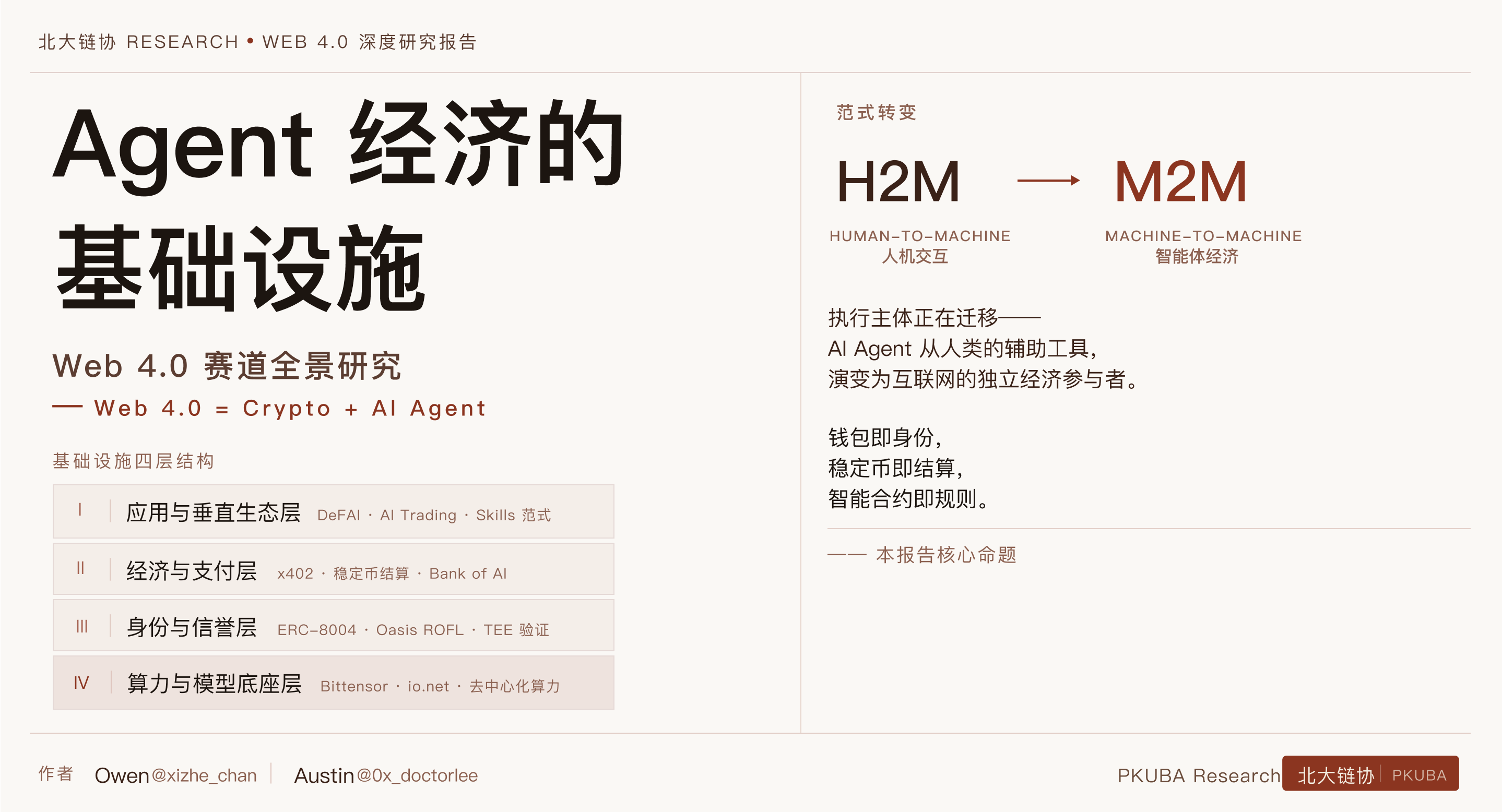
Abstract The core proposition of Web 4.0 is the migration of execution agents — AI agents are gradually evolving from human auxiliary tools to independent economic participants on the Internet. The underlying driving force behind this transformation is that the existing financial system is structurally excluded from AI agents. Whether it is account opening, contract signing, or micropayment settlement, traditional financial infrastructure is not compatible with machine-native behavioral logic. The permissionless blockchain network just provides agents with an alternative path to circumvent these restrictions — wallets are identities, stablecoins are settlements, and smart contracts are rules. This report systematically sorts out the context of the evolution of Web 4.0 from narrative to infrastructure. At the protocol layer, gaps in the three layers of the x402 payment standard, ERC-8004 identity standard, and MCP tool calling protocol are being filled centrally to form the minimum operational protocol stack required for an Agent as an independent economic entity. At the track level, the report scanned representative projects at four levels from the bottom up: ●Bittensor and IO.net provide decentralized computing power supply●Oasis ROFL pioneered TEE integration in the ERC-8004 verification layer ●Bank of AI (based on TRON ecosystem) packages x402, 8004 protocols, MCP, Skills, and OpenClaw extensions into a one-stop Agent financial operating system for developers ● Midaz At the application level, the “Built for Agents, Visualized for Humans” Skills product model was demonstrated. From an investment perspective, the Web4.0 circuit is currently in a window period of centralized infrastructure construction: the dispute over standards has yet to be settled, the actual commercial traffic on the chain is still in the early stages of verification, and the overall narrative is ahead of implementation. The first-mover card window for the underlying infrastructure is narrowing, and being able to transform protocol capabilities into a closed commercial vertical application layer will be the most noteworthy opportunity in the next phase. Keywords: Web 4.0, AI Agent, Smart Economy, Decentralized Infrastructure 1. Introduction: Why is Web 4.0 suddenly everywhere In the past year, the frequency of Web4.0 appearing in cryptographic research reports and AI industry gatherings has increased dramatically. Along with the “lobster fever” triggered by OpenClaw, the wave of AI agents has taken the world by storm, and more and more people are beginning to realize that the underlying logic of this wave of technology is very different from previous AI crazes. There is currently no strict definition of Web 4.0, but the core proposition has gradually become clear - Web 4.0 = Web 3.0 + Agent, that is, combining blockchain infrastructure with AI agents to gradually become new active actors on the Internet, fundamentally changing the network's participant structure. The capital side's response to this judgment has arrived. Dragonfly completed a $650 million new fund raising in February 2026, and partner Haseeb publicly stated: “Crypto was not designed for humans, but for AI agents. “At the same time, the critical puzzle of the infrastructure layer was also in place during the same period: in May 2025, Coinbase launched the x402 payment protocol, which first provided a standardized channel for machine-native settlement between agents; in August 2025, the Ethereum Foundation and others took the lead in proposing the ERC-8004 identity standard, which provided a verifiable foundation of trust for cross-organizational agent collaboration. Narrative, capital, and infrastructure, the three forces resonate within the same time window — this is a sign that Web 4.0 is moving from concept to racetrack. This report will systematically sort out the core logic, infrastructure gaps and racetrack pattern of Web 4.0, focus on analyzing representative projects at the four levels of computing power, identity, payment, and application, and use Bank of AI as an implementation case to discuss the complete closed-loop path of the Agent economy from agreement to product, and provide a reference framework for investigating investment opportunities on this racetrack. 2. What is Web 4.0: The core is the smart economy 2.1 From Web1.0 to Web3.0: The executor is always a human looking back at the three stages of development of the Internet, every transition...

123d agoLuxurytracy

Shanghai, China: Accelerating the piloting and commercialization of technology applications such as brain-computer interface, 6G, and quantum computing

Comparatively, the General Office of the Shanghai Municipal People's Government of China issued a notice on the “National Digital Economy Innovation and Development Pilot Zone (Shanghai) Implementation Plan”, which mentions exploring cutting-edge technology. Accelerate the piloting and commercialization of technology applications such as brain-computer interface, sixth-generation mobile communication (6G), quantum computing, etc., and build a common technology R&D service platform. Conduct research on third-generation Internet (Web 3.0) innovation testing ground mechanisms, explore building a trusted technology foundation based on smart contracts, and carry out technical verification in an orderly manner.

123d ago
Take advantage from all over the world, and the whole agenda is revealed for the first time! 2026 Hong Kong Web3 Carnival, all stars shine in the Hong Kong River

Take advantage from all over the world, and the whole agenda is revealed for the first time! 2026 Hong Kong Web3 Carnival, all stars shine in the Hong Kong River

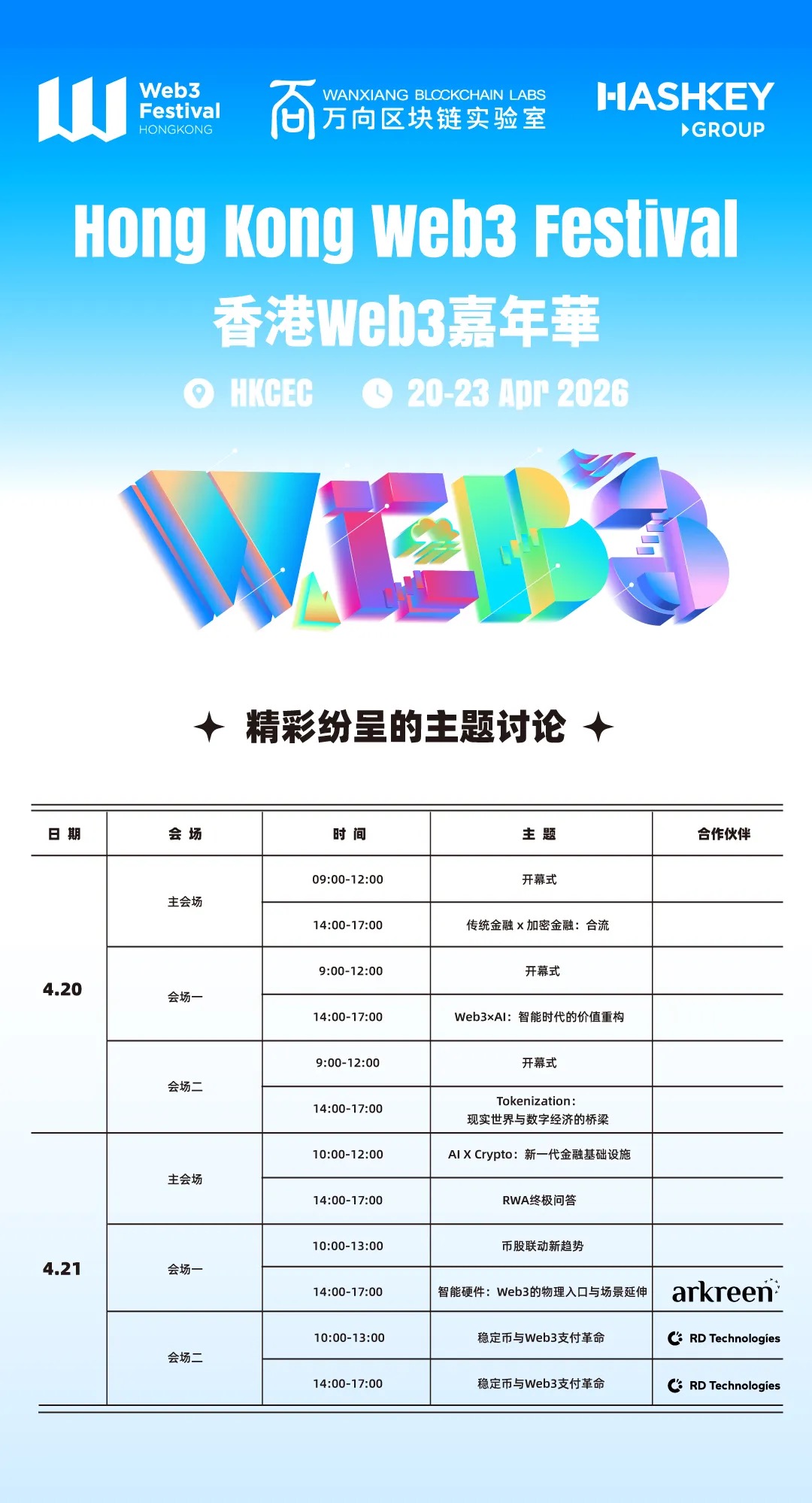
From April 20 to 23, the 2026 Hong Kong Web3 Carnival will kick off at the Hong Kong Convention and Exhibition Center. This year's carnival will be held in Hong Kong for the fourth year in a row since the first Web3 Carnival in 2023. Using “Mountain, Wind, Cloud, and Sea” as the context, the conference set up four major themed stages over a four-day period to conduct in-depth discussions and sharing, and jointly write the chapter “Wind the Xiangjiang River and Connect to All Seas”. Hong Kong Financial Secretary Chen Maobo, Ethereum Co-Founder Vitalik Buterin, University of Maryland Finance Professor Michael Faulkender, Binance Co-CEO He Yi, Quantum Solutions CEO Francis B. Zhou, Sharplink CEO Joseph Chalom, and hundreds of other major guests from the fields of regulators, crypto ecology, traditional finance and technology frontiers will attend the event and share their insights, from tradition The confluence of the financial and cryptographic worlds, to the collision of AI and Web3, to the actual dismantling of RWA from concept to scale, the three core topics run through the four-day agenda and jointly define the direction of the next generation of digital world evolution. Main venue on April 20 · Mountain At 9 a.m. on April 20, the opening ceremony of the 2026 Hong Kong Web3 Carnival will be held at the main venue · Mountain. Representative to the National People's Congress, Vice Chairman of the All-China Federation of Industry and Commerce, Chairman and CEO of Wanxiang Group; Chen Maobo, Hong Kong Financial Secretary; Chen Haolian, Deputy Secretary for Financial Affairs and the Treasury; Ye Zhiheng, Executive Director of the Hong Kong Securities Regulatory Commission's Intermediaries Department; Michael Faulkender, former Vice Minister of the US Treasury and Professor of Finance at the University of Maryland; Li Guoquan, Director of the Global Financial Technology Institute; Chen Siyuan, Chief Public Mission Officer of Hong Kong Cyberport Management Co., Ltd. (JVCEA) & Yuki Masashi, Executive Director of the Japan Crypto Asset Business Association, Fan Wenzhong, Executive Director of the China Finance Association and former Chairman of the Beijing Financial Holdings Group, Chen Long, Secretary General of Luo Han Tang and Director of the Shanghai Smart Chain Finance Research Institute (Planning), and other guests (speakers were introduced in order of appearance) will all attend to share their opinions on hot topics in their respective fields and jointly kick off the 2026 Hong Kong Web3 Carnival. On the afternoon of April 20, there will be one of the most popular topics of this year's carnival, “Traditional Finance x Crypto Finance: Confluence”. Du Yu, Head of Wanxiang Blockchain Lab; He Yi, Co-CEO of the HashKey Group Exchange Business Group; Ru Haiyang; OKX Global Chief Commercial Officer Lennix Lai; Rita Liu, CEO of RD Technologies; Bugra Celik, Director of Digital Assets at HSBC; Deng Chao, CEO of HashKey Capital; Francis, CEO of Quantum Solutions B. Zhou, Sharplink CEO Joseph Chalom, KGA Managing Partner Kevin M. Goldstein, Binance Co-CEO Richard Teng, Stable CEO Brian Mehler, J.P. Morgan Asia Pacific (Payment Business) Fintech Industry Leader Akhil Devmurari, Bitstamp by Robinhood President Leonard Hoh, and many other industry leaders ( (Speakers will be introduced in order of appearance) will gather to discuss topics such as Hong Kong's stablecoin development, cross-border payments, and asset digitization. ▍ Session 1 · Are Wind AI's autonomous decisions and Web3's decentralized trust natural allies or genetic clash? When AI agents begin to manage assets and invoke contracts, who will endorse AI's actions? On the afternoon of April 20, a forum on the theme of “Web3xAI: Value Reconstruction in the Intelligent Era” will be held at the venue. Byteplus HK Technical Director Sophia Jin, Silicon Valley AI blogger Lang Hanwei (online), Ant Math CTO Yan Ying, Gen Labs Limited CEO He Xiaoyang, Google Cloud Strategy Advisor Michael Yung, Slow Mist Technology Partner and Product Leader Keywolf, TON Foundation Asia Pacific Head John and Qtum joined forces...

131d agoLuxurytracy
Hong Kong Web3 Carnival kicks off in April: Top topics revealed for the first time, big guests gathered in Hong Kong

Hong Kong Web3 Carnival kicks off in April: Top topics revealed for the first time, big guests gathered in Hong Kong

On April 20-23, the 2026 Hong Kong Web3 Carnival will be grandly opened at the Hong Kong Convention and Exhibition Center! As one of the world's most influential and large-scale top industry events jointly created by Wanxiang Blockchain Lab and HashKey Group, this year's Hong Kong Web3 Carnival not only inherits the grand vision of previous editions, but also completed strategic upgrades in depth. AGENDA's three core topics define future topic 1: Confluence of traditional finance and crypto finance In the past few years, the relationship between traditional finance and the crypto world has experienced qualitative changes from wait-and-see, testing the waters to deep integration. The conference brought together the world's top financial institutions to talk with the native power of cryptography to jointly outline a new pattern in the digital asset era. From the evolution and iteration of traditional payment infrastructure to the development of Web3's innovative power, discussions around the “disruption and symbiosis” of stablecoins and new global payment systems will unfold here. Here, you will gain insight into the strategic positioning of the world's largest asset management institutions on digital assets, understand how listed companies incorporate digital assets into treasury management, and grasp the historic transformation of digital assets from “niche exploration” to “mainstream allocation.” Meanwhile, the “sandbox experience” of Hong Kong's stablecoin regulation and the launch of the “first batch of licenses” will undoubtedly be the focus of the conference. Topic 2: Reconstructing the value of AI and Web3 The collaborative evolution of artificial intelligence and blockchain is spawning a new generation of financial infrastructure. As AI evolves from a “dialogue assistant” to an on-chain entity capable of autonomously executing economic actions, such as OpenClaw, when AI agents begin to reshape the fundamental paradigm of human-computer interaction, and when the x402 micropayment protocol and ERC-8004 identity standards pave the way for the AI agent economy, the boundaries of technology integration are constantly being pushed to the forefront. Focusing on these rapidly occurring changes, many AI native projects, Web3 pioneers, and the world's top investment institutions will gather at the Web3 Carnival to discuss the future of AI and Web3 integration. In this feast of ideas, you can not only learn more about how AI agents become on-chain native economic agents, but also understand the core logic of the collaborative evolution of AI and Web3, and perceive a paradigm shift from “human-led” to “human-robot collaboration.” Topic 3: RWA's “Ultimate Q&A” RWA is becoming a key bridge between traditional finance and the digital economy, as well as an important vehicle for activating real assets and promoting financial innovation. This year's Hong Kong Web3 Carnival specially invited authoritative experts such as Zhao Yao, a special senior researcher at the National Finance and Development Laboratory, to thoroughly interpret mainland regulatory policies; at the same time, they brought together world-renowned institutions such as CICC, Ondo, and Galaxy Digital to work with top law firms to discuss the actual path and compliance landscape of RWA from domestic filing to global distribution. A high-level dialogue on how to open up the “last mile” of cross-border compliance is about to begin, helping Hong Kong accelerate its construction into a global RWA innovation highland. Whether you're looking for a strategy to digitalize physical assets or want to gain insight into RWA's global trends, you can complete a “one-stop cognitive construction” from policy to practice, from idea to implementation, and seize strategic opportunities in the new blue ocean of digital assets at this carnival. Top global guests from around the world appeared in Hong Kong at this year's Hong Kong Web3 Carnival, bringing together industry leaders such as senior Hong Kong Special Administrative Region government officials, traditional financial giant decision makers, leading technology company representatives, top blockchain project founders, investment agency partners, and well-known experts and scholars. Currently, the Financial Secretary of the Hong Kong Special Administrative Region, Chen Maobo, Executive Director of the Intermediaries Department of the Hong Kong Securities Regulatory Commission; Xiao Feng, Chairman of Wanxiang Blockchain, Chairman and CEO of HashKey Group; Qiu Dagen, member of the Hong Kong Special Administrative Region Legislative Council (science and technology innovation community); Zhao Yia, Distinguished Senior Researcher at the National Finance and Development Laboratory; Lennix Lennix Lai, CO-Founder and Chief Product Officer of Mysten Labs; Adeniyi Abiodun, CEO of Solana Foundation Lily Liu, Sharplink Co-CEO Joseph Chalom, Quantum Solutions CEO Francis B. Zhou, BlackRock Managing Director Abdelhamid Bizid, ZR Financial Group CEO Phil Kang, Animoca Brands...

154d agoWendy#Universal blockchain #Hong Kong Web3 Carnival
When AI starts using USDC for payments, Circle's victory and fund custody challenges

When AI starts using USDC for payments, Circle's victory and fund custody challenges

Author: RWA Research Institute Original title: 99% of AI payments use USDC, and Circle's silence became the biggest winner, but where should AI agents put their money? In March 2026, Peter Schroeder, head of global marketing at Circle, released a set of data on the X platform: Over the past nine months, 140 million payments have been made between AI agents, with a cumulative transaction volume of 43 million US dollars. Of these, 98.6% were settled in USDC, with an average of only $0.31 per transaction. More importantly, the number of AI agents with purchasing power has exceeded 400,000. This set of data explains the problem more than any financial report: AI agents are moving from concept to real economic activity. 400,000 AI agents, 140 million transactions, 43 million dollars — this is an autonomous exchange of value between machines. No human intervention, no bank approval, no credit card verification. Code to code, agreement to agreement, completed the process that required human signature, reconciliation, and settlement in the past. Circle's stock price has risen 75% from $60 to $105 over the past few trading days. The market interpreted this rise as a positive reaction to financial reports — Circle achieved revenue of US$770 million in the fourth quarter of 2025, an increase of 77% over the previous year, and net profit of US$133 million. But what is really worth paying attention to is not the numbers themselves, but the structural changes behind the numbers: when AI agents become new economic agents, the logic of the entire financial infrastructure needs to be rewritten. And in the process of this rewrite, a deeper question is emerging: when AI agents start to have disposable funds, and when they can earn USDC by completing tasks, how will they handle these funds? Payment is the first step, and asset management is the second step. It is this second step that the RWA (Real World Asset) track needs to answer. 1. To understand what kind of financial services AI agents need, from ability to pay to asset holding, we must first understand their economic activity model. Deloitte pointed out in the “2026 Technology, Media and Telecom Industry Forecast” report that if enterprises and service providers can achieve efficient intelligent collaborative scheduling, the global proxy AI market is expected to reach 45 billion US dollars by 2030. The basic characteristic of this multi-agent collaboration model is that a complex task is broken down into multiple steps, completed collaboratively by different professional agents, and each call is accompanied by a micropayment. Take API calls as an example. An AI application may need to call multiple large language models, access multiple databases, and use multiple computing resources at the same time. Each call is the sum of $0.01, $0.05, and $0.1. These payments are extremely small, yet extremely frequent. According to Circle's data, 140 million transactions in the past nine months averaged just $0.31 each — a typical characteristic of the micropayment market. But the problem is that when AI agents continue to generate revenue — whether by providing services to users or by participating in distributed computing networks — money will be deposited in their accounts. These funds can't stay liquid forever. Any rational economic entity will consider: How to deal with idle funds? This is the logical starting point for AI agents to transform from “payers” to “asset holders.” In the traditional financial system, individuals and enterprises will deposit short-term idle funds into banks and buy monetary funds or short-term treasury bonds to obtain profits. AI agents also need this ability — not to speculate, but to optimize their own economic models. It is necessary to always keep a USDC amount in the account for payment, but if the part that exceeds the threshold simply lies down, it means a loss in opportunity cost. If excess funds can be automatically purchased for a tokenized fund backed by short-term US Treasury bonds and then automatically redeemed when payment is required, then its “operational efficiency” will be improved. Further, if AI agents need to reserve value for long-term operation or hedge against cost uncertainty caused by fluctuations in gas fees, it may generate the need to allocate assets with different risk levels. At this point, it's no longer just a “payer,” but an “investor” — even though this investor is a piece of code. Circle solves the problem of making AI agents “payers.” And to make them “investors,” another infrastructure is needed. 2. RWA and AI agents: What the ongoing “two-way” circle has done in the past few years can be summed up as building three layers of capabilities. The first layer is a stablecoin issuance and liquidity network. According to Circle's official disclosure, as of 2025...

163d agoLuxurytracy
Embarrassing! The two AI giants refused to shake hands on the same stage... What have crypto KOLs been talking about for the past 24 hours?

Embarrassing! The two AI giants refused to shake hands on the same stage... What have crypto KOLs been talking about for the past 24 hours?

The fourth year is auspicious! Welcome to Vesta and good luck, I wish all readers a prosperous account, a stable mentality, keep up with the hot topics you should follow, and don't step on any of the pitfalls you should avoid. What are the KOLs in the crypto industry talking about in the past 24 hours? Note: The following content is compiled from the X platform. They are all personal opinions. They do not represent the platform's position, let alone constitute investment advice. Awkward moment at the AI summit: OpenAI and Anthropic leaders refuse to shake hands! There was an embarrassing scene at the AI Impact Summit being held in India. When Indian Prime Minister Narendra Modi took a group photo with the guests attending the conference, the crowd held hands and raised their heads. However, OpenAI CEO Ultraman and Anthropic CEO Amoudai — a former colleague and today's rival — each clenched their fists and refused to hold hands. The two worked together at OpenAI. Amoudai left his job in 2021 to set up a separate path and publicly criticized each other's business model many times. Netizens ridiculed their refusal to shake hands on the same stage: “This sense of embarrassment spilled over the screen.” Popular replies: If we arrange for Lao Ma and Ultraman to be on the same stage, will the two fight; the organizers aren't doing it right; I'm probably pessimistic. I only see that in front of the national machine, even the most powerful AI company is just a dragon supporting actor. This has been the case since ancient times; it seems that India can look forward to the future. Stanford University leads the way in the distribution of OpenAI employee graduate schools (230), followed by Berkeley (151), MIT (100), and Carnegie Mellon (90). Chinese universities Tsinghua (39) and Peking University (31) are on the list, but the gap is clear. Popular response: 230 in Stanford, only 37 in Tsinghua... This gap is not a school gap; it is an age gap, ah, an undergraduate college comparison, or the origin comparison would be better able to find problems; the University of Waterloo is excellent, CS and some engineering are strong, but not in the QS top 100. Based on this distribution, Georgia Tech is the most cost-effective school OpenAI is finalizing a new round of financing. After completion, the valuation company will reach 830 billion US dollars. SoftBank is expected to lead an investment of 30 billion US dollars, which will be completed in three installments within a year. Amazon may invest 50 billion US dollars, Nvidia may invest 30 billion US dollars, and long-term partner Microsoft plans to invest billions of dollars. If achieved, this round of financing will set a new financing record in the AI field. Negotiations are still ongoing. Popular response: Saudi Arabia's sovereign fund came in and was not satisfied; DS completed the 100 billion dollar investment, but Huang Renxun denied the previous investment of 100 billion dollars, and the bubble was about to explode; the valuation must not be directly worth trillion US dollars at the time of listing; this feels like the US National Transportation Administration has to continue to hold up no matter how big the plate is, otherwise it's all stupid. I haven't fully understood Web 3.0, is Web 4.0 out? Silicon Valley startup star @0xSigil has built an AI that can earn its own money, improve itself, and replicate itself. It claims to launch “Web 4.0: The Birth of Super Intelligent Life”. The application of AI agents (agents) in the field of encryption is being viewed as the starting point of “Web 4.0.” However, some KOLs said bluntly that this could evolve into a new Ponzi game. Popular response: What's the difference between $Conway and a shopping app that downloads a cash account, buying a high-priced item on it and then waiting for the platform to give you a rebate? But foreigners are just willing to pay for the story; the Ponzi structure is correct, but there is a difference from traditional Ponzi: when the agent dies, no one takes over. The problem is that currently the only source of revenue for agents is token speculation. The closed loop hasn't gone through until one day, when some agents live for a month by selling services; have you participated in those celebrity meme coins in the past? Buying meme coins is like scratching a lottery ticket. Retweet: Twitter: https://twitter.com/BitpushNewsCN比推 TG Exchange Group: https://t.me/BitPushCommunity比推 TG Subscription:... https://t.me/bitpush

183d agoWendy

Hong Kong Chief Policy Group Digital Finance Symposium: Moving from Financial Innovation to Serving the Real Economy and Promoting High-Quality Financial Development

Comparative news, according to Sing Tao Headline, the Hong Kong Chief Executive's Policy Group held a digital finance symposium on February 8, 2026. Participants include experts such as the research team of the Financial Research Institute of the People's Bank of China, Chairman of the Board of Directors of Yuancoin Technology, a member of the Web3.0 Development Task Force, and former CEO of the Monetary Authority Chen Delin. The conference discussed how Hong Kong can help the country build a financial power through high-quality development of digital finance. The focus is on three major aspects: application scenarios of digital finance, balancing supervision and innovative development, connecting with mainland digital finance infrastructure and achieving collaborative development. Chief Executive Policy Team leader Huang Yuanshan said that Hong Kong should seize the digital wave and help the goal of becoming a financial power by promoting high-quality financial development. Hong Kong has the advantages of technological infrastructure, active market and policy environment. Digital finance applications should shift from financial innovation to serving the real economy, such as promoting the tokenization of assets and expanding to real-world assets such as precious metals and renewable energy to solve problems such as poor liquidity and complicated transactions of traditional assets.

194d ago

Advertising Time Trace has launched an “IEO” campaign where you can redeem ETH with 10% off using ATT

Comparatively, according to ATT Global.io's official news, ATT can be redeemed for ETH with a 10% discount and will become one of the ongoing activity sections of the “IEO” series. The aim is that the ATT Foundation can better give back to the vast number of ecological contributors and participants, and at the same time provide more applications and usage scenarios for ATT. Advertising Time Trace (ATT) is a forward-looking Web 3.0 application incorporating DePin technology. Through its unique DA-AIOT-P decentralized assets-artificial intelligence-IoT-payment) mechanism, a new digital advertising ecosystem integrating physical advertising assets, advertising e-commerce merchants, user resources and digital technology has been built. At present, a commercial advertising system centered on large LED screens in Lan Kwai Fong, Hong Kong has been formed to gradually improve LED large-screen advertising coverage in core commercial areas such as Southeast Asia, Japan, South Korea, and Europe. Currently, the core participants in the ecosystem have reached tens of thousands, reaching hundreds of thousands of commercial ecosystem users, aiming to become a new entry point for traffic and assets in the Web3 field.

205d ago