


TI Rating Report - UENC

1. Project introduction
UENC is a scalable basic public chain with cross-chain technology. The main techniques and characteristics used are:
· The dPoW (Targeted Workload Proof) consensus algorithm, independently developed by the team and using C language, avoids centralized mining problems to a certain extent; node block generation uses a random extraction mode mining method, and miners confirm their probability of being drawn through gas settings, which ensures the randomness of block miners being extracted;
· Hybrid network structure: Using two types of nodes, public network and internal network, to form a network, theoretically supports any CPU for mining, lowers the threshold for user participation to a certain extent, randomly sharding through transaction networks formed with verification nodes, and completes network-wide consensus through local consensus;
· The storage method has been improved to: cross-type parallel storage (CPS) transaction data to form a virtual main chain, combined with distributed hash tables, to solve the high cost problem of traditional methods of storing data through serial main chains;
· Hierarchical networks cross-chain: Connect to the network layer, consensus layer, incentive layer, etc. of other blockchains (such as the Bitcoin network) to complete the actual cross-chain of assets, but this has not yet been realized;
· Using CPU mining, the mining threshold has been lowered. Each miner node needs to pledge 500 UENC to start mining, and excessive staking is not possible.
It aims to solve three problems: improving on-chain transaction efficiency (expanding the consensus layer main chain through a standard interface); a public bookkeeping chain that is both WASM compatible and can use the UTXO model; and aims to link public chain assets with high-energy consensus algorithms across the chain to the UENC chain to achieve low-cost and fast on-chain token circulation.
Construction of the project began in 2018, and a token was issued. Although it is an early project, it has not accumulated sufficient market popularity and participation. According to the project disclosure, there was no financing in the early stages. It was mainly for the team to independently fund research and development. It is expected that capital will be added in the primary market in the future through the mining sector. Ecological construction is still in its infancy.
1.1 Hybrid network structure
Due to the restrictions of the three major operators in China, UENC did not use the Kademlia overlay network transmission protocol, but instead adopted a hybrid mesh network structure. Kademlia is a distributed network protocol commonly used in P2P networks. KAD for short, the transmission communication protocol UDP is used between nodes. The main function of UDP is to send IP packets, and the entire node also uses distributed hash tables (DHT). Each client is responsible for a small range of routes, and at the same time stores a small portion of data, which is connected and combined into a complete data network. UENC, on the other hand, divides network nodes into two parts: public network nodes and private network nodes. Public network nodes are a core node group, and the threshold is high: they must meet the requirements of an independent external network IP, and their hardware requirements for the CPU are also relatively high. They must be equipped with at least an 8-core processor and 8 GB of memory. Compared to intranet nodes, the threshold is low, and theoretically any CPU after networking can participate.
After an intranet node enters the network, according to the description in its white paper, it must first go through an adaptation period of time (depending on the size of the network). During this period, the intranet node and the public network node request to shake hands, and since the public network nodes have clear IP addresses, their respective locations can be clarified. Specific verification node information such as block height, IP address, etc. will be kept in the K bucket (Kad's routing table).
Each public network node is linked to some verification nodes (intranet nodes), so only these public network nodes are connected through the network layer and the consensus layer, and each intranet node will randomly perform trusted communication with the public network node and perform communication updates from time to time to ensure the availability of internal and external network communication through a heartbeat monitoring mechanism. This network structure can effectively integrate with the fact that IP addresses are constantly changing, and is also compatible with the different network settings of the three operators, thereby satisfying home users to connect to the UENC blockchain network through their own home network. Since internal network verification nodes randomly make communication requests from public network nodes and implement updates and replacements at irregular times, the arrangement of nodes in the network changes at any time, just like a Rubik's Cube, UENC guarantees its decentralized characteristics.

UENC's hybrid network structure, Source: TokenInsight
The K-bucket marks each verification node's unique ID to ensure the authenticity of the verification node in the network. Through verification of K-bucket data, verification nodes that meet the conditions (such as pledge information, height information, etc.) are concentrated in the verification pool, and random selection of block verification nodes is performed using discrete random functions to ensure smoothness and fairness during node selection, and to a certain extent, to avoid unfair problems caused by the continuity function due to network speed, etc.The core purpose of this isEnsure the randomness of verification and block generation by the verification node, and then confirm the tolerance range for a rogue node (such as 41%),Any node that participates in verifying the legitimacy of a block can get a reward.
Each transaction requires at least 6 verification nodes to verify and confirm before the block can be issued. These nodes include both public network nodes and private network nodes, all random. Unlike projects such as Boca,UENC's public network nodes can both generate blocks and verify.Essentially, an intranet node can also perform both verification and block generation functions, but due to limited network conditions, block generation is not its main job, and the chance of initiating a transaction is much lower than that of a public network node.
In terms of the number of nodes, public network nodes and intranet nodes are all formed spontaneously by user participation, and there is no fixed upper or lower limit. However, it is important to note that the ratio of the two types of nodes must be balanced, and the number of intranet nodes connected to each public network node must not be too large; otherwise, bandwidth pressure will cause the network to be paralyzed. Therefore, its mechanism design will perform functions based on the computing power of a single node on the public network.If excessive pressure causes a bottleneck in public network node performance, this local network will be temporarily unavailable.Currently, the maximum connection limit for 8-core 8G and 20M bandwidth public network nodes is about 1,000+ verification nodes. If you need more connections, you need to improve the performance of the hardware.
Overall, the greater the number of public network nodes, the more stable and smooth the main network.
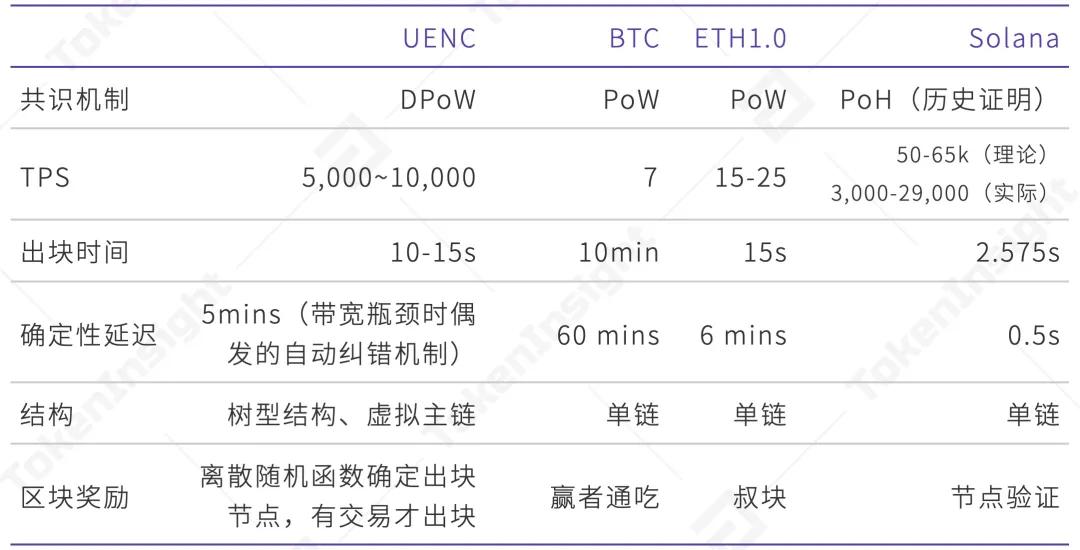
Performance comparison of various public chains, source: UENC, Solana.com, TokenInsight
1.2 dPoW Targeted Workload Proof
UENC uses the dPoW (Directional Proof of Work) model in the consensus layer, written in C language, and the execution efficiency is high. Compared to traditional PoW (Proof of Work), UENC introduced targeted signal locking technology to save resources and ensure the fairness of the blockchain network.
Targeted signal locking technology (mentioned above): Each node has its own unique node ID in the network, and each node is located in the main network and verified through a random number selection process. Dpow uses nodes randomly selected from the verification pool to verify linearly broadcast data, quickly verify transaction legality through zero-knowledge proof, use UTXO to avoid double flowers, and determine the legality of the block through finally satisfied signature verification.
By introducing “targeted signature locking technology”, dPoW distributes bookkeeping rights in an orderly manner, avoids the centralization of computing power and “winner-take-all” problems caused by free competition for bookkeeping rights in traditional PoW, and has achieved a balance between fairness and competitiveness to a certain extent.In the UENC network, higher load capacity will be achieved as the number of verification nodes and public network nodes continues to increase. Due to the low energy consumption of the nodes and the satisfaction of increasing availability of verification nodes in the future, transaction costs will theoretically be controlled, but only if the actual number of nodes is large enough in practice.
dPoW is calculated and executed through the CPU. Compared to models such as GPU and ASIC, a quad-core CPU can meet the minimum requirements.To become a node, pre-staking is required. Currently, the pledge amount is 500 UENC, and there is no excessive staking mechanism.
dPoW operates in a separate layer and interacts with the network layer through standard interfaces, which means that the consensus layer can be expanded and upgraded, and the network is relatively flexible.

Schematic diagram of UENC hybrid node and tree block structure, source: TokenInsight
1.3 Developments
The project started early, but it did not reach much ground and did not gain popularity. The public chain began to be built in 2018. It was first listed on the Fcoin exchange in August 2018, and then listed on four other exchanges in January 2019. Currently, the market value remains around 58.4 million US dollars. The project is scheduled to land on second-tier exchanges in the second half of 2021.

Information on UENC's transaction, source: TokenInsight, 2021.05.17

UENC roadmap, source: UENC official website, TokenInsight
2. Teams and partners
2.1 Core team
According to the project source, UENC currently has a team size of about 40 people, including about 20 people from the Beijing Main Network Laboratory, all of whom are technicians; Jiangsu also has about 20 members responsible for testing, application development, and operation, accounting for about 75% of the total number of technicians. As can be seen from the distribution ratio, the team takes the lead in technology and products. The management team all have a certain computer background; the development members have more than 5 years of software development experience, involving blockchain, big data, and cloud computing, and have rich overall work experience; the CTO and architects have more than 10 years of experience in developing products in the front-end and multi-technology fields. The background of the core team members is as follows:

Team composition, Source: TokenInsight

2.2 Advisors
The team sought support from senior consultants in the field in the three areas of technology, operations, and token design. Among them, Jiang Zhiyu, the chief technical consultant, has senior subject research experience, industry experience and consulting experience; in terms of operation, Lihui Blockchain Business School collaborates with the UENC community on “online course projects”, which are all disclosed in the UENC Weekly Report; the chief token design consultant is the author of “Token Design” and a special expert from the SoftBank Finance Research Institute, and has in-depth research on blockchain project token design.
2.3 Strategic investment institutions and partners
There were no major investors in the early stages of the project. There are currently no financing arrangements. According to the project party's disclosure, the public chain was incubated by the founder's original capital. The main way to attract capital in the future is to invite investors to enter the ecosystem through mining.
Partners include Golden Finance, TokenInsight, 499Block, Non-Small, Certik, Vimi Technology, WBF, ZG.com, HBTC, Beijing Chainan, JORK Fund, Hyperspeed Node, BiXiaobai.com, Anypay, and Ruihe Capital.
3. Ecological analysis
3.1 Project Cooperation Ecology
The project party reached cooperation with HBTC, WBF, and ZG.com in January 2020 to launch the UENC/USDT trading pair before and after; UENC also reached cooperation with bixiaobai.com in the field of external brand operations and blockchain information. bixiaobai.com is positioned as a blockchain data information platform to integrate and provide users with information on project progress and airdrop status. According to the project disclosure, in 2021, the project signed an annual frame service with Golden Finance and an intensive brand promotion service with 499Block.

UENC ecosystem partner, Source: UENC, TokenInsight, 2021.05.17
3.2 Token economy
UENC was released as an ecological native token in March 2018, with a total volume of 200 million, of which 80 million (40%) need to be mined and minted under the dPoW consensus mechanism; 60 million (30%) have already been distributed through ICO. According to the project party, UENC's public offering price was 0.077 US dollars. Fcoin was first launched in August 2018, and the price broke to 0.027 US dollars, rising to an all-time high of 6.01 US dollars; UENC is currently publicly traded in the form of ERC-20, and the early community had more than 70,000 addresses. The main network was launched in November 2020. The number of addresses is about 30,000, and the actual circulation volume in the market is about 50 million units. The distribution of its tokens is as follows:

UENC token distribution, source: UENC; TokenInsight

As of May 17, 2021, three exchanges, ZG.com, BHEX, and WBF, are currently listed, and the overall market value remains around $58.4 million.

UENC listed on exchanges, source: TokenInsight
The main functions of UENC include: consuming or staking UENC to obtain permission to issue tokens and develop DAPPs on the UENC public chain; obtaining the right to use ecological applications such as Energy Club; receiving fee discounts on purchasing goods and services; and pledging to become a mining node (each node requires a deposit of 500 UENC). UENC holders can participate in ecological governance and obtain voting rights; participate in UENC ecological revenue distribution. The token economy model is as follows:

UENC Token Economy Model, Source: TokenInsight
3.3 Mining rewards
The mining rewards of UENC miner nodes mainly include transfer fees and transaction rewards (i.e. block rewards). After each transfer transaction is completed, the UENC network will reward all participating mining machine nodes. The reward is distributed jointly by the nodes participating in the transaction confirmation. UENC block rewards are periodically halved as the total amount of rewards is halved. UENC's total block rewards are 80 million, and when the total number of rewards reaches 40 million (half of 80 million), all block rewards are halved. This is reduced until all 80 million block rewards have been distributed. In the UENC network, a block contains a single transaction (a one-to-many transaction is considered a single transaction). Therefore, block rewards are related to the number of transactions on the chain, that is, the number of blocks. The specific rules are:
· Use 5 minutes (min) as the minimum unit of time;
· Get the same reward for every block within 5 minutes;
· The block reward for every 5 minutes is determined by the number of blocks in the first 5 minutes.
For example, the number of blocks within n+1 5 minutes is 15, the number of blocks within the nth 5 minutes (that is, the first 5 minutes) is 10, and the block reward corresponding to the block number 10 in the block reward algorithm is “5UENC/block”. Then each block within the N+1 5min will receive a 5uENC block reward, and the total block reward within this 5min is 15*5 = 75uenc.
3.4 Joint curve design
When setting up the block reward algorithm, UENC refers to the design logic of the joint curve and uses a log mixing function to establish a functional relationship between the number of blocks and the number of rewards to achieve a block reward mechanism with high rewards in the early stages, constant rewards in the future, and continuous and smooth changes.
The exact equation for the Log mixing function is as follows:

The meaning of this function is that for every c times x increases, y increases a%.
We applied this function to the block reward design of the UENC network, and defined it as every time the number of blocks x is increased by c times, the network reward y is reduced by -a%. Then, if m and b take a certain constant, we can obtain a functional relationship between the number of blocks and block rewards in the UENC network.
According to the above function, it is defined that every time the number of blocks in the UENC network increases by 2 times (take c as 2), the network reward is reduced by 50% (taking a% as -50%). At the same time, taking m=70 and b=0.025, when x approaches positive infinity, the block reward curve is shown in the following figure:

UENC mining node block reward chart, source: UENC, TokenInsight
3.5 Public opinion analysis
Operation work began in 2020. According to the project party's disclosure, in terms of operation, the former CMO of Achain is responsible for the overseas incubation of the project, and the team consists of about 10 people. The UENC project team has successively achieved stable updates on social media such as Twitter and Medium platforms to disclose project progress and cooperation. As of May 17, 2021, the UENC Project Medium has posted a total of 25 articles, with a total of 17k followers, and has maintained weekly updates since February 2021, mainly including technical progress, secondary market transactions, community events, ecological applications and social media; the UENC official Twitter account has 23k followers and 144 tweets; the official Telegram community has a total of 10k members; the Discord community has a total of 13,924 members; Reddit The community has 15k members, and the update content is basically the same as Medium. The project has been set up for a long time, the number of followers on each platform is fair, and there is still room for improvement in overall community activity.

Number of followers on UENC social platforms, source: TokenInsight, 2021.05.17
4. Future challenges and prospects
UENC is positioned as a basic technology public chain with a cross-chain orientation. Its main advantage is its low cost of participation. You can participate using a 4-core CPU, and since the physical device has low energy consumption, gas costs are relatively low. In the long run, there is a good entry threshold for retail participants, and user education costs are also relatively low. This grounding also supports its potential for decentralization. Especially for public chains, the number of participating nodes is huge, which is the cornerstone of ensuring decentralization.
The dPoW consensus mechanism essentially combines the common advantages of PoW and PoS. The CPU mining model reduces energy consumption, and the 500-token pledge threshold plus a random block generation model allows miners to confirm their probability of being drawn through gas settings, which also avoids centralized mining problems to a certain extent.
Although the project itself supports the WASM virtual machine and can build dApp applications similar to smart contracts on Ethereum, it is still in its early stages, and there is no significant ecosystem market. Ecological construction will be a key point for evaluating the performance of its public chain and market recognition in the future.
Team founder Jason Shen was an early Bitcoin beneficiary, and CTO John Soko is familiar with advanced Unix (BSD, Linux) kernel and application development. The high proportion of technical developers is another advantage of the project. Currently, the operating side is at a disadvantage, but the community is quite popular. Future marketing and operation will also be another key indicator for evaluating the strength of the project.
Overall, TokenInsight gave the UENC project a B rating, with a positive outlook.
