


What do leading institutions think of the 2024 bull market outlook?

Written by Fire
2024 is a promising year for the crypto market, and everyone's eyes are on those new tracks worth watching in the crypto space, as are leading institutions.Various institutions published their own research reports at the beginning of the year, looking forward to 2024 from a professional and meticulous perspective, which is very valuable for reference.
Vernacular Blockchain reviewed research reports from 23 leading organizations (includingMessari、a16z、Coinbase, MT Capital, etc.), in an attempt to summarize and find an “institutional consensus” to improve certainty, the summary is as follows:
The top ten tracks that are generally optimistic
1) Bitcoin Ecological Revival
December 2022OrdinalsAfter its launch (a Bitcoin-based digital content coding method), it promoted inscriptions andBitcoinEcological boom. In 2023, the Bitcoin ecosystem developed strongly, and Bitcoin's dominance (Bitcoin's share of cryptocurrency market capitalization) rose from 38% in January to around 50% in December, making it one of the most noteworthy ecosystems in 2024.
Agencies' predictions are also generally optimistic about the development of the Bitcoin ecosystem this year:
Major US crypto index fund management companyBitwiseIt is predicted that the Bitcoin transaction price will surpass $80,000 in 2024;
CoinbaseIt is believed that at least in the first half of 2024, the main focus of institutional investment will continue to be on Bitcoin, as the adoption of ETFs will make traditional investors have a strong demand to enter this market.
Other agencies' forecasts are also optimistic. The main reasons are:
US Securities and Exchange Commission (SEC) A spot Bitcoin ETF has been approved, and the next major event, the Bitcoin halving event in April, is coming soon, and supply and demand are expected to change significantly;
The Bitcoin ecosystem will see infrastructure upgrades, increased programmable features, including basic protocols (such as Ordinals), and the development of various protocols such as Layer 2 and other extensible layers (such as Stacks and Rootstock).
2) The development of Ethereum L2
In addition to the Bitcoin ecosystem,EthereumAs the pioneer of smart contracts, the development of Ethereum Layer 2 is also the highlight of the 2024 predictions. In particular, as Vitalik released the Ethereum 2024 roadmap and the Cancun upgrade is approaching, Ethereum Layer 2 project tokens such as ARB and OP have all recently skyrocketed.
The competition in the public chain ecosystem has always been quite fierce. In 2023,SolanaPublic chain ecosystems such as avalanches are developing rapidly, and the momentum has even overtaken Ethereum. However, as a leader, Ethereum is also starting to gain strength,Agencies mostly predict that with the completion of the Cancun upgrade, gas fees will drop even more drastically, which can drive the explosion of the Ethereum Layer 2 ecosystem in 2024. For example, Bitwise believes that a major upgrade to the Ethereum blockchain will make the average transaction cost less than $0.01, laying the foundation for more mainstream uses.
If the upgrade is successful, some of the leading Ethereum Layer 2 projects (such asoptimism、Arbitrum、BASEetc.) In terms of performance, it can completely compete with other Layer 1 public chains.
Furthermore, according to Vitalik's vision, in the long run, zero-knowledge proof is the future of Ethereum Layer 2, and the two Layer 2 projects, zkSync and StarkWare, are also favored by everyone.
3) Development of the Solana ecosystem
In the past 2023, the Solana public chain ecosystem has performed well. Whether it is technology accumulation or community, etc., it has laid a solid foundation for the long-term development of the Solana ecosystem, and the explosion of the Solana ecosystem has also attracted a large number of users and capital.
Agencies predict that in 2024, more projects will choose or migrate to the Solana public chain, and the Solana ecosystem will continue to explode. Because, whether it's TPS, gas fees, or community users, Solana is quite resistant.
Market agencies' expectations for Solana in 2024 focus on the following aspects:
Solana's technical upgrades, such as developing a light client through Tinydancer, allow validators to complete verification work at a lower cost and achieve a higher degree of decentralization;
Solana's performance improvements, including increased throughput and performance, improved user experience, and deployment of new Token standards, have enhanced its robustness;
The launch of new products, increased on-chain liquidity, and the expansion of developer tools have contributed to the prosperity of the Solana DePin ecosystem.
4. DePin (Decentralized Public Internet Network)
DePin, or Decentralized Physical Infrastructure Network, is a new way to build and maintain infrastructure in the real world. Its goal is to build decentralized networks in industries such as telecommunications, energy, mobile communications, and storage.In 2023, there were over 650 DePins, with a market capitalization of over $20 billion and annual revenue of over $150 million.
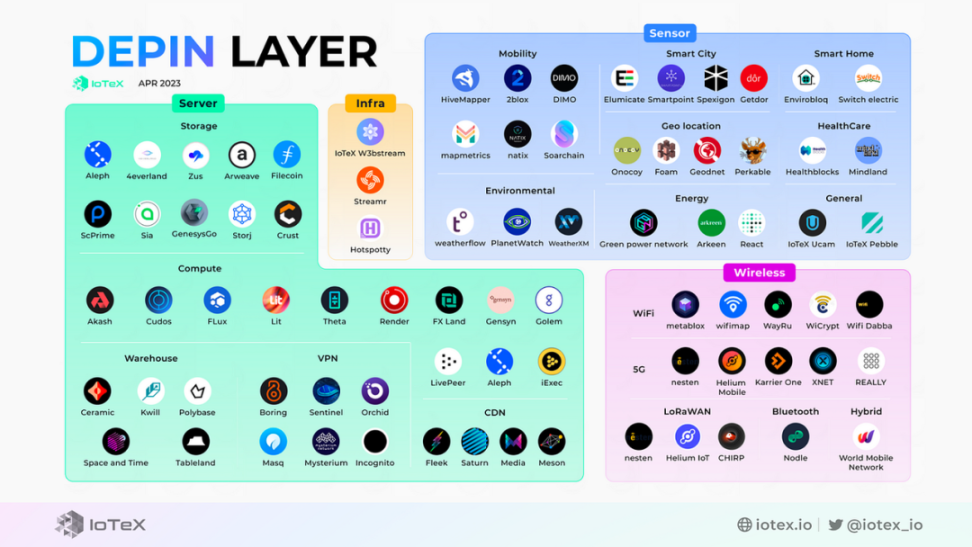
DePIN development in 2023 at a glance
2024, cryptocurrency data platformCoinMarketCapDePin has been listed as an independent category, reflecting the crypto market's strong interest in this area.
DePin covers a wide range of fields, including server networks, wireless networks, sensing networks, and energy networks. Currently, various companies predict that DePin tracks have huge potential for growth. For example, according to crypto research firm Messari, the overall size of the DePin industry is currently around $2.2 trillion, and is expected to grow to $3.5 trillion by 2028.Messari is also paying particular attention to the following segments of the DePin sub-race: the cloud storage market, decentralized databases, decentralized wireless networks, and the combination with AI。
However, while predicting, various agencies also believe that the maturity of DePin will require long-term investment and operation development from the market, institutions, and developers before it can gradually penetrate into people's lives and applications, from complementing to parallel to replacing existing infrastructure.
5) The combination of AI and blockchain
The rapid development of artificial intelligence (AI) in 2023 has also boosted the development of AI+ web3 services. At the beginning of January 2024, the market value of AI-related tokens reached $7.04 billion. Given the increasing popularity of artificial intelligence, predictions are mostly optimistic about using AI as a core feature to enhance the appeal of blockchain-based cryptographic platforms.
Currently, the tracks that various organizations are optimistic about are:
Direct application of AI in the field of cryptography:A combination of trading robots, automated payments, and arbitrage robots with blockchain. Combined scenarios include AI agents using cryptographic infrastructure to make payments, smart contract security scheduling AI models, token rewards personal fine-tuning models, and collecting valuable data.Messari believes that advances in AI will increase the demand for cryptocurrency solutions.
Innovative applications of AI and cryptography:Here, AI is being used to improve the user experience and efficiency of Web3, and more blockchain technology is being used as a fence and transparency layer for AI. For example, we've seen research and new use cases on zero-knowledge and machine learning (ZKML), games that allow users to train AI agents with ERC 6551, etc.
Bankless analyst Jack Inabinet thinksCrypto+AI could be an explosive combination. Although early activities were mainly aimed at exploiting hype to spread worthless projects, the prospects are still huge.
Crypto company DWFI believe that in guiding social perception and its limitations in centralized AI, decentralized AI has great potential for development in 2024 and can lead the future of AI through Web3.
6) The explosion of GameFi, the development of chain games
Chain games in 2021 and 2022 were in full bloom. They evolved from “Play to Earn” to “X to Earn”, and came out with popular projects such as Axie and Stepn. Compared to that, chain games in 2023 were quite bleak.However, with the improvement of infrastructure, various agencies are still optimistic about the future development of chain games.
After all, judging from the traditional Web2 market, gaming is a very promising market that has almost become a part of many people's lives. Moreover, most traditional game users don't know much about the GameFi (Gaming) field. From a TVL perspective, at the time of writing this article (2024.2.1), the GameFi section in the image below also had a TVL of only 19.6 billion US dollars.
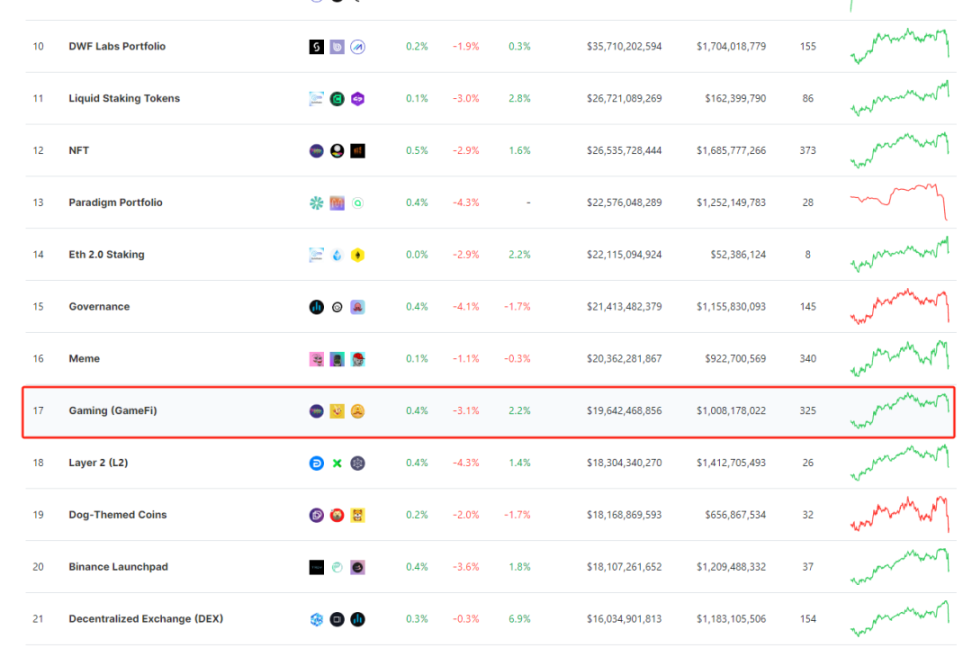
TVL overview by track, source: coingecko.com
Judging from GameFi's development space, the most mentioned one is that it is expected that in 2024-2025, GameFi will have a larger narrative and receive more attention.
For exampleAzuki Researcher Wale SwooshThink gaming will be one of the big trends that will define 2024. Gaming has been and will always be the great Trojan horse when it comes to cryptocurrency applications, and is convinced that the Web3 gaming trend seen at the end of 2023 will not only continue next year, but will also become more apparent.
Kelvin Koh, Co-Founder and Chief Information Officer at Spartan CapitalThink a batch of AAA Web3 games will launch in 2024, and believe these games will bring in millions of new Web3 users.
Overall, agencies are currently optimistic about GameFi on two main points:
First, in 2024, the number of blockchains focused on games will continue to increase. In addition to some traditional established public chains, new public chains such as Oasys and Sui have also joined them;
Second, the addition of major traditional game companies. For example, Oasys has attracted many well-known publishers to join its ecosystem, such as the well-known Ubisoft Entertainment (Ubisoft Game Software), Square Enix (a Japanese game software production and development company and publisher), Activision Blizzard (Activision Blizzard), Games Epic, etc.
7) Development of modular and zero-knowledge proof (Snark) technology
In 2023, modular blockchains and zero-knowledge proofs (ZKP) have been fully developed, such as Celestia, zkEVM, etc. Furthermore, an obvious phenomenon is that these two narratives are beginning to show a trend of integrated development, and projects in the ZK field are beginning to “modularize” development by combining specific vertical fields (such as coprocessors, privacy layers, proof markets, and zkDevOps).
Spartan Managing Director Leeor GroenIt is believed that privacy and security will be a key driver in Web3. As technology evolves, we will see users begin to realize the value of zero-knowledge proofs and modular blockchains, and users don't even know that they rely on these zero-knowledge proofs and modular blockchains for various applications from digital identity to gaming.
A16zIt is believed that the rise of modular technology stacks has brought the greatest advantages of open source, modular technology stacks. As tools inspired by formal methods are widely adopted by developers and security experts, the next wave of smart contract agreements is expected to be more robust and less susceptible to expensive hacking attacks. Mainstreaming SNARKs technology will become a trend.
As for the 2024 outlook, various institutions and researchers also expect this trend to continue.Zero-knowledge proofs will be an interface between the different components of a modular blockchain stack. This provides developers with more flexibility to build dapps while lowering the threshold for blockchain stacks; for consumers, zkp may be seen as a way to protect identity and privacy, for example in the form of zk-based decentralized identity.
Also highlighted is that SNARKs will be a priority project in 2024 because they can provide corresponding proof proofs for calculations that generate specific outputs, so verifying proof is far faster than the speed of executing corresponding calculations.
8) Mobile and decentralization trends may become mainstream channels, improving user experience.
Regardless of the type of crypto ecosystem, if it wants to grow in the long term, its ultimate goal is to attract new users and encourage existing users to become more active participants. As the market recovers, infrastructure improves, and the layout of various institutions, it is widely believed that there will be a significant influx of crypto users in 2024.
like Eddy Lazzarin, chief technology officer of a16zIt is believed that although the user experience in the cryptographic field has always been criticized, developers are actively testing and deploying new tools to reset the encrypted front-end user experience, such as multi-party computing, simplified password transmission to login applications and websites, and embedded wallets. These innovations will enable users to experience a better and more secure environment when using cryptographic apps.
Overall, however, the reasons why the various agencies are optimistic are mainly the following two points:
On the one hand, a major theme that has emerged during the recent bear market cycle is a focus on how to make cryptography more user-friendly and easy to use. The additional responsibility of managing cryptocurrencies and all associated content (wallets, private keys, gas fees, etc.) doesn't suit everyone, making it difficult for the industry to mature unless it can overcome some of the key challenges associated with the user experience. For example, development around account abstraction, etc., to promote the development of wallet recovery mechanisms and better create fault protection for simple human errors (such as losing private keys).
On the other hand, the Ethereum Cancun upgrade may reduce rollup transaction fees by 2-10 times, and it is thought that more Dapps may pursue the “no gas transaction” path, effectively allowing users to focus only on advanced interactions.
9) Regulatory Policies
Over the past year, the entire crypto industry has faced increased regulation. As the development of the crypto industry expands, regulatory compliance is an unavoidable issue。
Many agencies predict that in the new year, as leaders of various countries are elected for new terms, other regulatory policies will continue to be introduced.
digital assetsJi Kim, General Counsel and Head of Global Policy at the Crypto Innovation Council (CCI)Think one of the bigger stories in 2024 will be the continued battle of various jurisdictions for top positions to become critical hubs for digital assets and the financial system of the future.
Gemini EU Head Gillian LynchAlthough opinions on cryptocurrency and blockchain technology are still divided, the vast majority will agree that the crypto industry needs a regulatory framework centered on customer protection while balancing the creation of a clear and consistent rulebook, which will ultimately help promote innovation.
Stuart Alderoty, Ripple's Chief Legal OfficerThe SEC lawsuit against Ripple Coin is expected to end in 2024, but its regulatory strategy is likely to continue targeting other prominent figures. The US Congress will work to reach an overall agreement on cryptocurrency regulation, but it still needs to determine the best approach.
Low-noise racetrack
The more contentious tracks are RWA and NFTs. Some predictions are bullish, some are bearish, and there are relatively few mentions.
1) NFTs
Compared to popular inscriptions, NFTs have been in a slump in 2023. With the exception of individual projects, the leading blue-chip projects have all fallen into the dilemma of rebound rather than reversal.Taking BAYC as an example, the average price reached 71 ETH at the beginning of the year, but the floor price dropped to less than 30 ETH by the end of the year.
The landscape of the NFT market has also changed dramatically. Blur competed fiercely with Opensea in early 2023 to almost monopolizing market share at the end of the year, while Opensea, which once dominated the market, accounted for only 20% of the weekly trading volume in December 2023. Despite Opensea's product and community feedback in an attempt to withstand Blur's impact, there was little effect. With the rise of Blur, the zero-royalty debate faded away, and discussions about “whether creators should get royalties” have gradually drifted away.
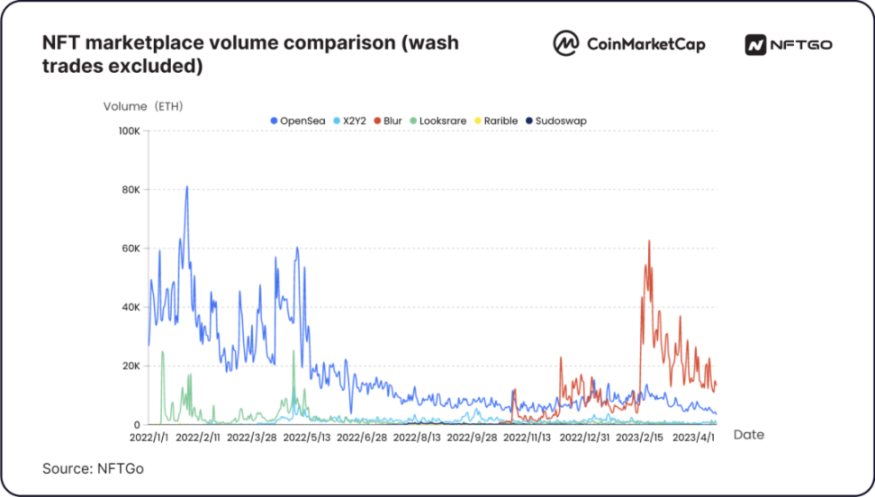
2023 Market Share Comparison of NFT Trading Platforms
Some organizations believe that consumer brands will use NFTs to spawn users to participate in a new model, and that NFTs can continue to promote increased liquidity in the collectibles and art markets. Especially if GameFi develops, NFTs can follow suit as an important basic accessory.For example, A16z indicates that more and more well-known brands have begun to launch digital assets in the form of NFTs to mainstream consumers. Entering 2024, the conditions are in place for NFTs to become ubiquitous digital brand assets.
There are also institutions that believe that it is difficult to replicate the boom in NFT trading volume in 2021, because most NFT projects are hyped up more and lack real cumulative value, and NFT creators need to adjust their strategies to improve competitiveness.
2) RWA
Compared to NFTs, there are a few more organizations that are optimistic about RWA:
Researcher at The BlockThe bridge between DeFi and TradFi continues to grow as Bitcoin spot ETFs trigger a surge in institutional interest. In turn, as more types of traditional financial elements enter the on-chain environment, tokenized real-world assets are gaining more adoption, so RWA is bullish.
BitwiseIt is believed that RWA will set off a new trend. At the request of Wall Street, J.P. Morgan will tokenize the fund and put it on the chain.
Delphi DigitalRWA is considered to be one of the most successful areas of cryptocurrency in 2023, and will continue to grow in 2024.
In summary, their reasons are as follows:
It helps build a bridge of communication between traditional institutions and the crypto world.RWA tokenizes off-chain assets and transforms them into blockchain digital assets, which are easy to understand. Stablecoins are common RWA applications because they are tokenized expressions based on fiat money.
A number of large institutions have increased their investment in the RWA field, and crypto projects such as Chainlink are also cooperating with the world's largest traditional financial institutions to introduce large amounts of RWA into the crypto industry and tokenize them.
RWA is building a financial ecosystem,Among them, digital tokens represent tangible assets, which are easier to obtain and expandable to public users, not just privileged investors or institutional investors. RWA has a broad scope, and can also be divided into various categories such as private credit, treasury bonds, real estate, commodities, stablecoins, insurance, etc., and has great application potential.
However, less optimistic institutions think:
As interest rates peaked, on-chain treasury yields emerged. Cryptocurrency is pursuing the same or more benefits that traditional financial investors seek, but everyone's needs need to be further explored, and this will require a long development process, but it will be difficult to achieve major development in 2024.
3) SocialFi
SocialFi is a fusion of social media and DeFi. From a macro perspective, Web2 is moving from social to finance, while Web3 is trending from finance to social networking.
Looking back at social media in Web2,Twitter reached 100 million users in 5 years, Facebook reached 1 billion in 8 years.SocialFi is a relatively new concept in comparison.
The SocialFi circuit attracted investors' attention in the second half of 2021. Various projects such as Whale, Chiliz, Rally, BBS Network, Showme, and Mirror.xyz became popular, and some platforms even had a big event where it was difficult to find a one-code registration invitation code. However, as the market as a whole turns bearish,SocialFi is also quiet.
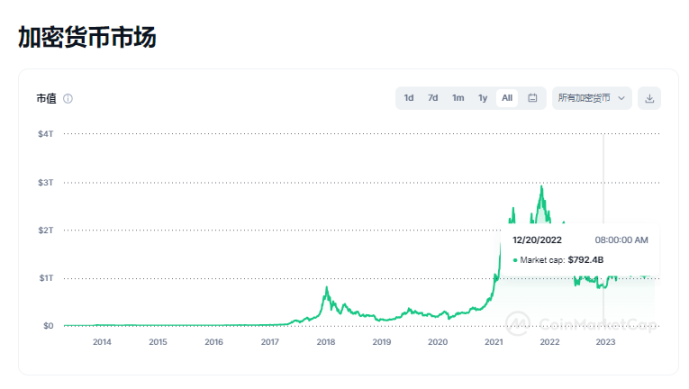
It became popular again because in August 2023, friend.tech pioneered a new form of social experience on Base Layer 2, where users can buy and sell other people's “shares” on X (Twitter). It peaked at 30,000 ETH TVL in October and inspired several copycat projects. Friend.tech has pioneered a new tokenomics model for the SocialFi sector by financializing Twitter profiles.
However, in these agencies' predictions, SocialFi's outlook for 2024 is rarely mentioned. Occasionally, it is also mentioned because more decentralized social media networks and tools will be launched as the decentralized concept continues to spread, but we can look forward to seeing if they actually make it out of the ring.
summed
Overall, the entire crypto industry went through the trough and hopelessness of the bear market in 2023 and began to set off a minor bull market. The development of the public chain ecosystem, led by Bitcoin, has entered a new stage, with new narratives and new tracks taking turns, laying the foundation for the next big bull market.
