


Tear down the crypto world's “Berlin Wall”

Author: Arjun Chand
Interoperability: Crypto's Invisible Switchboard
Compiled and organized by: bitPushNews
The crypto world has always been like tribes, built around the “supreme faith” of the chain. You choose a chain, learn its tools and applications, integrate into its community, follow its conference trajectory, and rarely step outside of this bubble.
Your initial choices often depend on what initially attracted you to the crypto world. Since early decentralized finance (DeFi) developed mostly on Ethereum, many early adopters stayed there. Later, the NFT boom and meme coin cycle brought new users into another ecosystem —Solana. The result is a “chain first” pattern of getting started: once you're on a chain, you usually stay there.
For most users, the crypto world is like a separate world, and you only interact with one of them at a time. This mental model is being disrupted.
Today, the crypto world is increasingly being experienced as a single market rather than a collection of multiple chains. Activities are simultaneously distributed across multiple thriving ecosystems. Capital flows to places with the highest returns, and assets are purchased in places with the deepest liquidity. Users no longer choose chains; they choose actions and focus on results. They want to exchange, earn, send, or pay, and are concerned about the results of these actions: the transfer of profits, profits, or money.
As a result, the dominant user model has changed. The crypto world is no longer “chain first,” but “asset first.” Wherever the asset is, users now expect to be able to reach it.
The reason why this new “assets-first” economic system works depends entirely onInteroperability (often abbreviated as interop)Enable value to flow freely across chains.
What is interoperability?
Interoperability connects the entire crypto ecosystem, making it usable as a whole. Without it, every blockchain would be its own closed garden.
As defined in the 2026 State of Interoperability Report:
“Interoperability is the ability for value, state, and intent to flow seamlessly between independent blockchains. It enables composability to operate on a large scale in the crypto world, enabling coordination between originally separate ecosystems. For users, interoperability compresses the multi-chain ecosystem into a single, interconnected model of cryptographic usage mentality.”
An analogy that helps to understand is to think of each chain as its independent financial backend. They don't naturally interact with each other. Assets, liquidity, and applications exist in different environments, each with different rules, costs, and trade-offs.
Interoperability is the level at which these backends are connected.
If this sounds abstract, traditional finance provides a familiar analogy. Nor are banks inherently interconnected. The global financial system was made usable not because there was a giant bank, but because shared channels like Visa, SWIFT, and ACH were located on it and transferred funds between them. When you send money, you don't consider which bank's system is involved; you just expect it to be completed.
The crypto world is undergoing the same transformation. Interoperability makes each chain feel less like an isolated network and more like a single financial system. It enables users to swap assets, chase earnings, or transfer capital across chains without having to start from scratch every time.
For a long time, this was mostly theoretical. The tool exists, but the user isn't ready. Today, things have changed.
Users already live in a multi-chain world
Today, active crypto users usually hold assets across multiple chains. While many still have a “main chain” (usually Ethereum, and high net worth users in particular), their on-chain behavior shows that they are inherently multi-chain users. Capital flows based on risk, cost, and opportunity rather than loyalty to a single chain.
Highly active cross-chain user data from the cross-chain exchange and bridging platform Jumper reveals this transformation. Most users spread their funds across multiple chains. They tend to keep most of their money on one or two major networks and then move smaller amounts elsewhere when market opportunities arise.
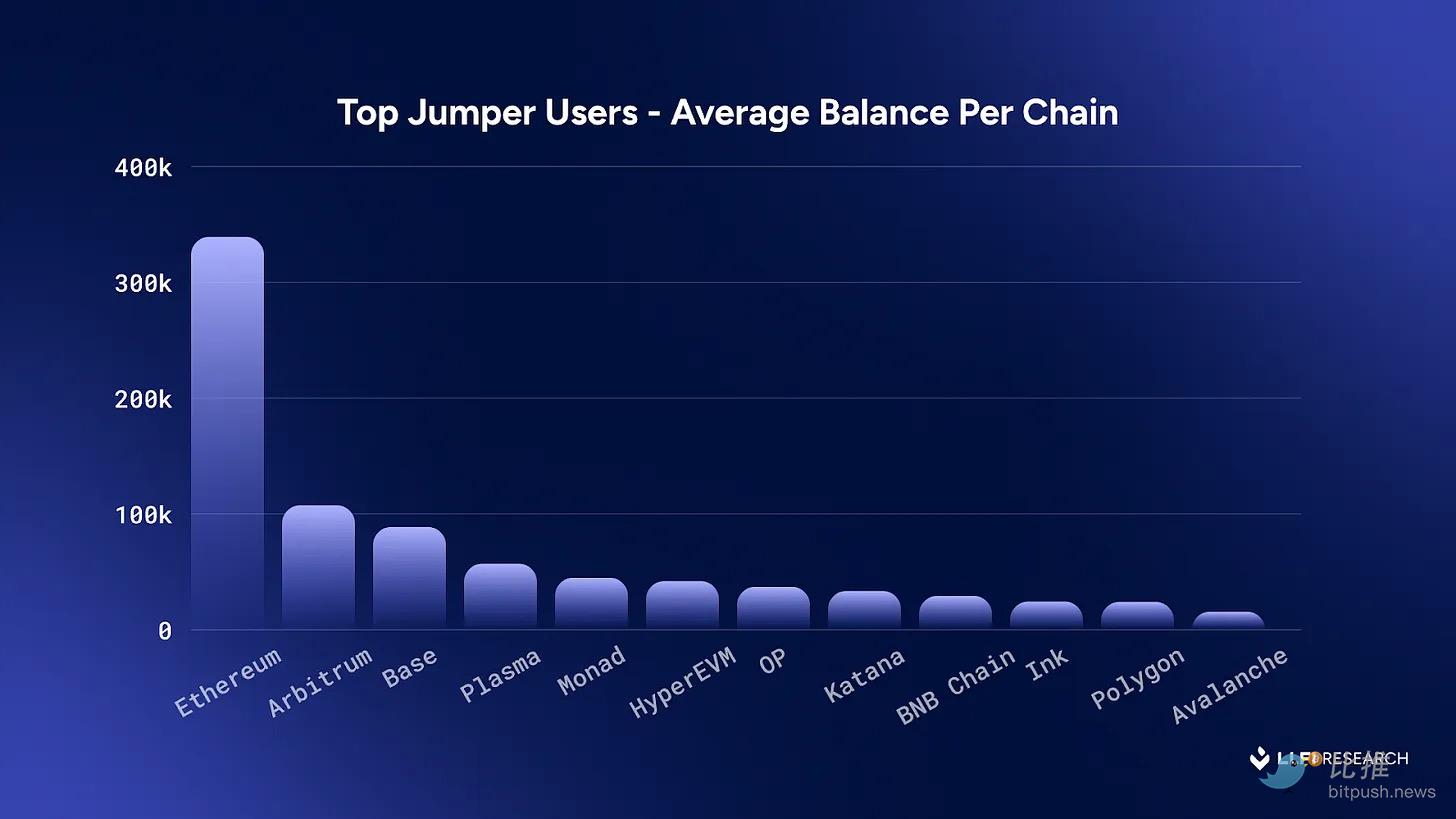
This is a reflection of how the crypto world is actually being used.
Users leave their funds where they feel most comfortable. When new opportunities arise, such as higher yields, new applications, or new opportunities for narrative speculation, they use interoperability channels such as bridging to move capital to where that activity takes place.
As a result, “bridging” capital (that is, transferring capital from one chain to another) has become a routine operation to participate in the crypto world, and cross-chain transactions have increased 100 times since 2022. During periods of high speculation and attention, bridging activities often peak, and users transfer funds to the latest popular chains.
Three things happened simultaneously, amplifying the importance of interoperability:
First of all,Users are embracing the multi-chain reality of the crypto world. Liquidity will never be limited to one corner of the global market. It will go where the returns are highest, and the average user no longer expects everything to happen on one chain.
Second,The chain is being launched at an unprecedented speed. 2025 saw one of the broadest wave of chain launches in the industry's history. This includes crypto-native ecosystems and chains run by fintech companies like Stripe. The surface area of the crypto world has greatly expanded.
Finally,Asset tokenization is accelerating. Everything from stocks and treasury bonds to private credit and real-world assets is on the chain. Meanwhile, regulatory clarity (particularly through the GENIUS Act) has unleashed a wave of stablecoin issuance.
This is the reality of today's crypto world, and interoperability is at the heart of these three transformations.
对usersAs such, interoperability is how the crypto world is being used. Bridging is the main way for users to transfer, trade, and express intentions across chains.
对链Interoperability, for example, is economic infrastructure. Without bridging connections, the chain cannot attract external capital or attract users on a large scale. A chain without interoperability is like a country without trade routes — isolated, limited, and irrelevant in a globalized market.
对Asset issuerInteroperability, for example, is a distribution requirement. Issuers no longer want to issue assets only on a single chain; they want assets everywhere. This means that assets need to be available across markets, chains, and liquidity locations. This can only be achieved efficiently and at scale through interoperability channels.
Taken together, this shows that interoperability is now a level of expansion in the crypto world. As users, chains, and assets multiply, interoperability becomes a mechanism for maintaining market liquidity. Interoperability is the crypto world. Interoperability is unstoppable.
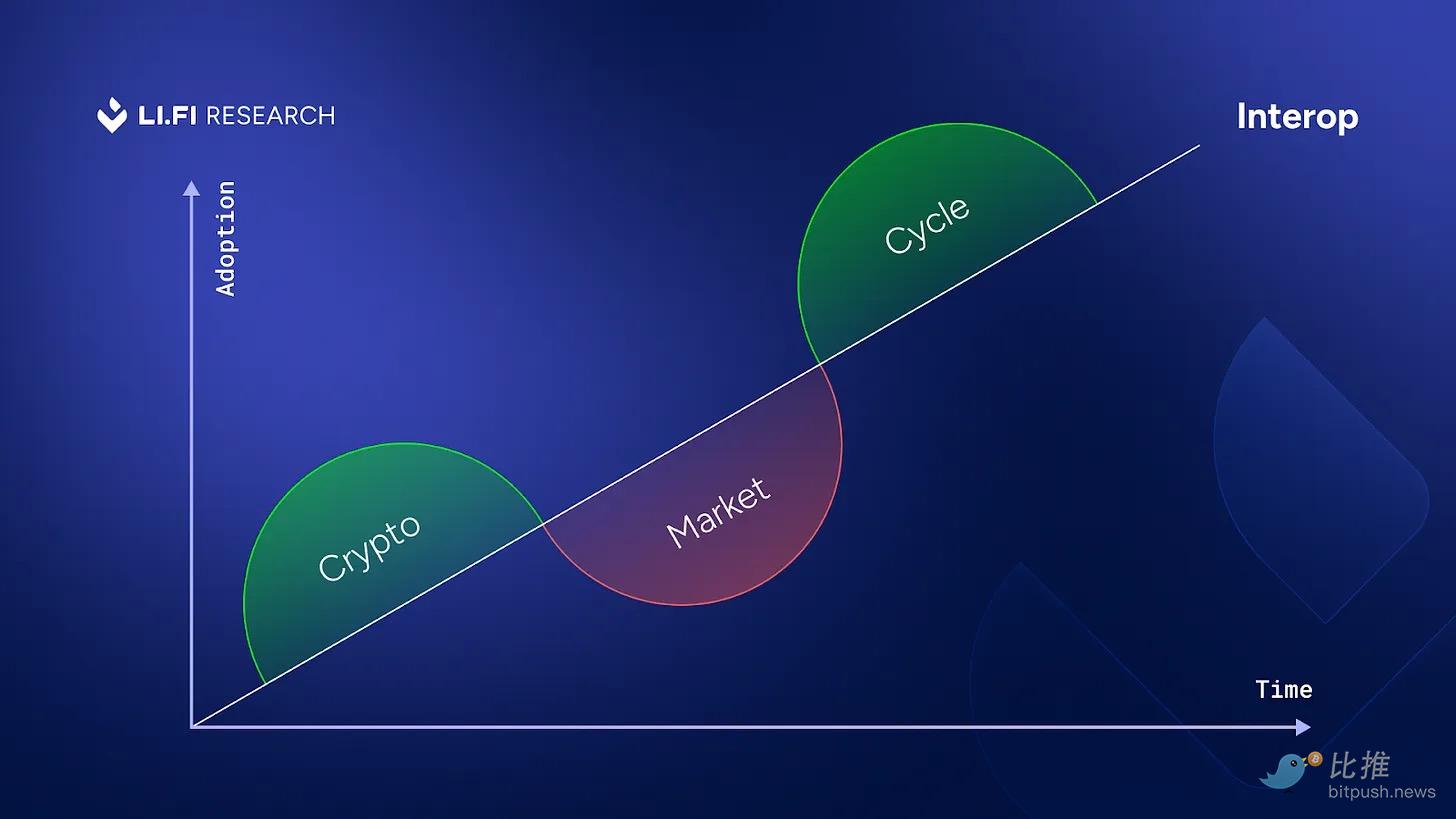
State of interoperability 2026
Now that we've determined the importance of interoperability, what does the interoperability market actually look like?
It's entering a phase that every infrastructure category will eventually go through: Consolidation.
You can see this pattern in every corner of finance and technology. In the early days of the category, the distribution of values was sparse. Many participants coexist. Differentiation is weak. Growth comes more from early entry than from becoming the best.
Think back to the early days of fintech. instripeBefore it became the default payment layer, there were dozens of payment gateways. inPlaidPreviously, every bank integration was custom made. Before Bloomberg integrates financial data, traders need to piece together information from multiple terminals and information sources.
Interoperability followed the same trajectory. As blockchain proliferates, few interoperability protocols have received attention. That phase is now over.
As the category matures, value no longer accumulates in the middle tier, but is concentrated at both ends. You either excel at specific tasks or operate at scale to make you indispensable. Everything in the middle was squeezed.
In effect, this means two things:
1. Users tend to look for the best solutions for specific jobs.
2. By default, developers choose proven, reliable, and widely adopted infrastructure.
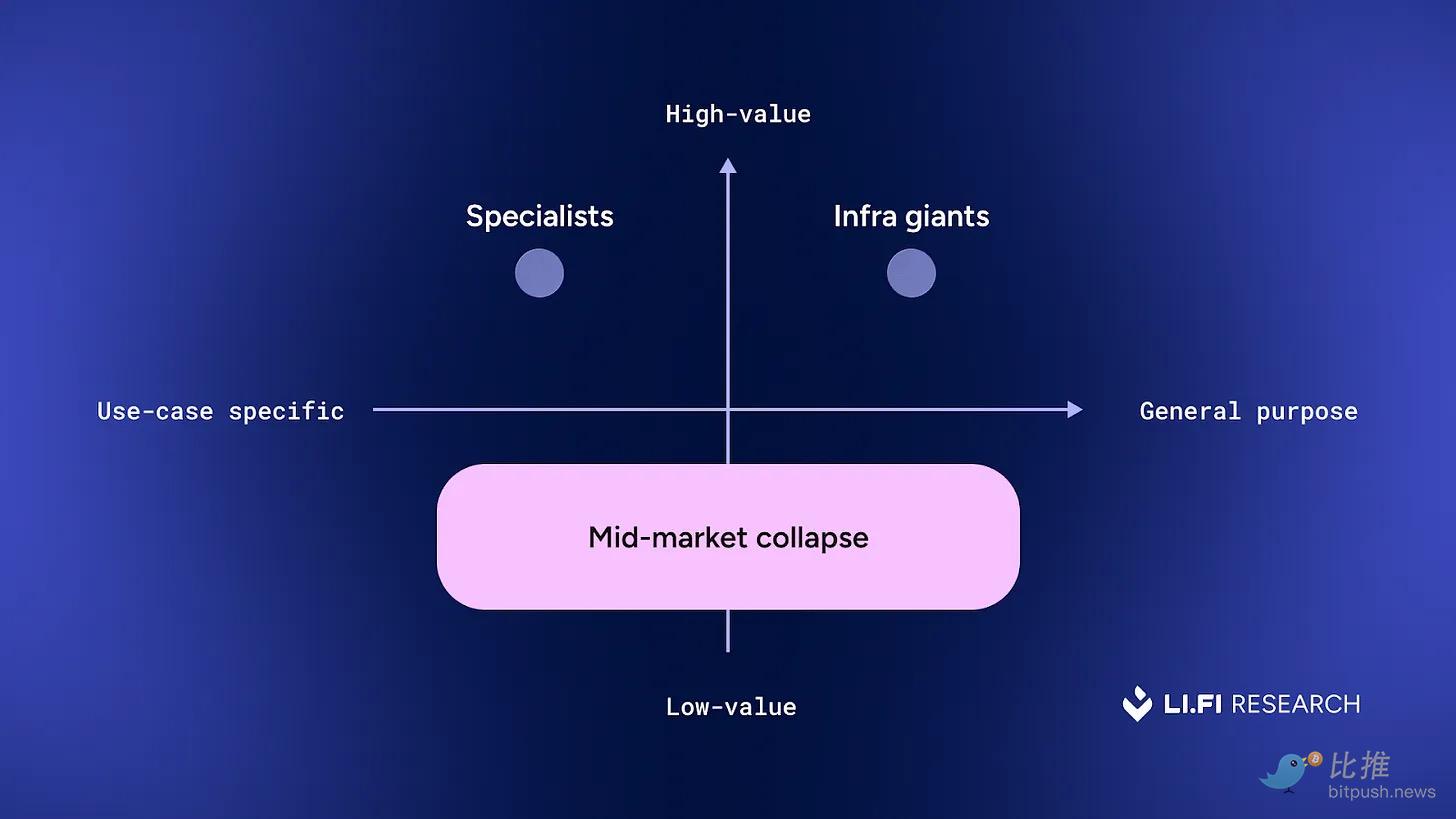 Today's interoperability is a prime example of this dynamic.
At one end are expert players. These teams are obsessed with a single result and optimize everything around it. They're not trying to be a platform, they're aiming to win a job.
Think Stripe, which started as a payment API; Wise focuses on cross-border foreign exchange; and Robinhood makes transactions simple and cheap. In the field of interoperability, intent-based bridging falls into this category. Teams like Relay and GAS.zip realise that most users just want fast, cheap cross-chain exchanges, so they're built for speed and low cost, and nothing else.
At the other end are infrastructure giants. These are universal platforms with real distribution channels, deep integration, and network effects.
Think SWIFT in banking, Visa in payments, or AWS in cloud computing. In the field of interoperability, large platforms that support many applications, wallets, and chains fall into this category. This includes LI.FI, LayerZero, and WormHole.
Once a team has proven that it can reliably operate at scale, the market will allow it to expand to neighboring products. This is happening in the interoperability space, and the team is expanding into new product areas such as exchange and revenue aggregation.
What is struggling is the middle class.
Projects that are neither focused enough nor widely adopted will end up in dangerous, borderless land. They are too generic to dominate a niche market, and too small to become basic infrastructure. They move slower than expert players, and lack the platform's reach.
This is where consolidation happens. Some teams were transformed, some closed, and others were acquired due to talent or technology, such as Circle's acquisition of Interop Labs' team and intellectual property.
2026'sInteroperability isn't just “good enough” anymore. As in every mature market, specialization and scale are the values.
Future trends
If you take a step back, this shift is obvious.
The crypto world is now asking you what you want to achieve, no matter where you are.
Users don't need to be aware of which chain they are in. They just need to act: exchange, earn revenue, send money, and gain exposure to assets no matter what chain they're on.
Moreover, these actions are increasingly occurring automatically, even when multiple chains are involved at the bottom.
This is the new reality of the crypto world. The chain still exists, but mostly as infrastructure. For users, the crypto world is beginning to feel like a single, global market and currency system.
However, this still requires users to know which interoperability tools to use and how to use them.
The next step is coming: everything will soon be embedded in the app button, and things will be done automatically.
Today, interoperability helps you move across chains. Soon, it'll help you move across chains — automated, atomized, and done in a seamless process. Exchange, borrow, rebalance, pay, issue assets, and coordinate agents with just one click, even when ten different chains are involved.
It's an assets-first, action-first crypto experience.
For readers, this means that on-chain capabilities are rapidly increasing. Things that once required planning, bridging, and manual coordination are collapsing into a single decision and click.
All in all:
The era of chain priority is over, and the era of priority action is coming.
Twitter:https://twitter.com/BitpushNewsCN
Compare the TG exchange group:https://t.me/BitPushCommunity
Compare TG subscriptions:https://t.me/bitpush
