


In conversation with Bloomberg experts: This is the truth about crypto ETF capital flows
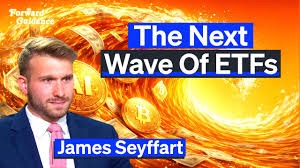
Podcast: Forward Guidance
Broadcast time: February 25, 2026
Guest: James Seyffart
Edited by BitPushNews
Guest profile
James SeyffartHe is a senior research analyst at Bloomberg (Bloomberg). He has been tracking the global ETF market and crypto asset ETFs for a long time, and is regarded by the industry as one of the analysts most familiar with ETF capital flows and product structures. He continues to study how institutional capital enters the crypto market, how ETF products evolve, and the trend of integration between traditional finance and blockchain.
Market Sentiment Divided: Retail vs. Institutions
Moderator:
Let's first talk about market sentiment. Recently, there has been a strange phenomenon where people who have been in the crypto field for a long time feel “it's all over, it's too bad.” But when you talk to established traditional financial institutions (TradFi) that are preparing to enter the market, they say “no, there are still plenty of opportunities here,” and they are very optimistic. This has created a strange kind of differentiation. On the one hand, prices are collapsing, and on the other hand, those institutions that we have been calling for entry seem to have finally begun to actually invest in this field. What do you think about this?
James:
You put this question very well. First, if you look at the current market discussion climate and the sentiments of those long-term holders, what I heard when communicating with ETF issuers and institutional investors are completely two worlds. Stablecoins, tokenization (tokenization), their views on all of these underlying assets are still very optimistic. This strange split has been going on for over a year. Prices are falling, but the traditional institutions we've always said needed them are finally starting to seriously invest and deploy resources in this area. The problem is, we don't know which agreements will ultimately benefit, or how much they will benefit from it.
Moderator:
This emotional contrast is very interesting. However, we have also seen that while institutions are optimistic, their actual actions, such as participating in Basis Trade (basis difference trading), are Delta-neutral, or like banks issuing their own stablecoins to earn fees. These actions do not directly add value to the issued tokens. What do you think of this “difference in words and actions” comparison?
James:
I agree completely with you; this comparison is really hard to understand. But there's actually a lot more going on underneath the surface. There are a number of agencies that are getting involved in a very deep way. Take a lookRobinhood、Fidelity、BlackRock(BlackRock), they are actually building on these public chains and tokenizing assets.
A lot of so-called “fake tokenization” is happening, but there are also many that are real weapons. Small teams within these agencies have been focusing on this area, testing, and are now expanding these teams. Frank Chaparro, for example, often mentioned on Twitter that the new jobs he saw from the companies I just mentioned were all about doing vaults (vaults) and all kinds of different things.
So I think we're still in a very early stage. It's hard to know exactly how all of this will eventually come together. Some networks, and many institutions, still tend to use private blockchains, and I don't even want to call them blockchains because the core of blockchain should be open and decentralized.
I'm still optimistic that some of these things will eventually succeed. I thinkHumans always tend to overestimate what will happen in the next 12 to 18 months and underestimate what will happen in the next 5 to 10 years. This is the situation right now. This takes time, and especially for these heavily regulated financial institutions, they can't do it overnight.
Schwab, for example, will soon launch cryptocurrency trading directly on its platform. All of these things are happening. There are also advisor networks (Advisor Networks), that is, who actually holds these ETFs, and they are still online one after another. I discussed it with you two years ago that eventually these network of advisors and brokerage platforms will allow their clients to invest in these ETFs. Until now, I've been able to hear that some platforms have just allowed these products to be launched. There are also many platforms where you still can't buy some ETFs with one click. So we are still a long way from true popularity.
ETF products are exploding, but there will be a wave of elimination
Moderator:
The number of ETFs issued seems to be skyrocketing.
James:
Yes, and there are so many that I can't keep up with them. Currently, there are approximately 160-170 related ETF applications or products, covering:
Leveraged ETF
Yield ETF (covered call)
Derivatives structure
Individual ETFs for various tokens
I wrote in my annual outlook for December last year:
Hundreds of crypto ETFs will be launched in the next year.
But I also think:
Many products are liquidated within 12-18 months
It is difficult for assets ranked lower in market capitalization to support multiple ETFs
Publishers are using a “casting net strategy” to test the market
This model is actually the “spaghetti cannon” in the industry — throw the product to the market and see which one sticks.
Moderator:
Is this “go first, then eliminate” model common in the ETF industry?
James:
It has become more common over the past few years. Changes in regulatory rules have made ETF issuance cheaper, faster, and easier, which means that issuers can launch products first and then wait for market demand. If an asset suddenly explodes, and you happen to be the only issuer with an ETF, then even if no one paid attention for the previous 12 months, you could suddenly attract hundreds of millions of dollars and make a profit.
Of course, the strategies of different institutions vary greatly. For example:
BlackRock: Using only BTC and ETH, extreme restraint
Other publishers: Want to post almost anything
Therefore, in the future, we will see both the launch of a large number of products and the disappearance of a large number of products.
Is AI stealing money?
Moderator:
Over the past decade, cryptocurrencies have basically been the “bastards” of speculative capital. But now a narrative has emerged: AI has completely taken over this position and is far ahead in attracting speculative capital. Can you see that in the data? Whether at the retail level, or institutions are rushing to invest in AI leaders like CoreWeave and withdraw from products like IBIT?
James:
To be honest, I didn't see a particularly clear correlation in the data. But I totally agree with your judgment that AI is now the focus of speculative capital. You don't even need to look at price data to see what the media is discussing, and it's clear what is being talked about on social media. What you said is the truth.
But what I want to say is that even though these Crypto ETFs have outflows of 9 billion dollars, their asset management scale peaked at 170 billion dollars and is still around 100 billion dollars. 9It is true that the outflow of 100 million dollars is quite significant, but judging from the overall situation, it does not account for a large share.Also, people who buy ETFs such as Ethereum, Solana, and XRP, from our point of view, know very well what they are buying; these are more like long-term asset allocations. Of course, there are also many people who trade leveraged ETFs.
I think most people entering the market know in their hearts that the assets they buy may experience a 70% retracement every four years. So like I said at the beginning, if you told me that with the price falling so much, only this amount of money has flowed out, then I'd say that's pretty good. Compared to the entire cryptocurrency market, the performance of these ETFs has been unusually strong. Of course, the current trend doesn't look good because we see money trickling out almost every day. But that's the other side of the coin.
There is no doubt that AI-related targets are attracting all attention and funding. The 2X leveraged single-share ETFs I mentioned earlier, as long as they are associated with AI, are booming, capital is pouring in, and the trading volume is huge. Interestingly, with the purest AI leaders, such as SpaceX, Anthropic, and OpenAI, it's hard for you to gain exposure through traditional methods. But ETF issuers are trying their best. I saw issuers applying for single-share ETFs from companies that haven't yet IPOed. There were applications yesterday to issue bullish option ETFs for SpaceX, OpenAI, and Anthropic. None of these three companies are listed yet! Although they are likely to be IPOs this year, this shows that the publishers are already thinking ahead of schedule. They saw the market's desire for AI, and their idea was: “We have to prepare application documents first, so that once these companies go public, we can bring products to market as quickly as possible.”
Changes in institutional positions: Who is selling?
Moderator:
What does the latest 13F data show?
James:
First, according to the latest data (up to the fourth quarter of last year), investment advisors generally net sold nearly 22,000 bitcoins in the fourth quarter. This is related to the possibility that spread trading, which I mentioned earlier, will collapse, and we are seeing an outflow of funds. Hedge funds are the biggest sellers, and they are also the first and second largest holder category in the 13F report.
As of the third quarter of 2025, approximately 26-27% of holders were institutions that submitted 13F reports to the SEC. But by the end of last year, that percentage had dropped to 24%. This means that we are seeing a real decline in the overall allocation ratio of these institutions.
But that doesn't mean everyone is selling it. There are also many institutions that are buying for the first time, and there are also many institutions that have increased their configurations. However, it is important to keep in mind that the 13F report only shows long positions. For example, we saw Jane Street holding a Bitcoin ETF worth several billion dollars, but I'm almost certain that they never had an “epiphany” like Michael Saylor and then simply made a few billion dollars more. They are likely hedging, overall positions or evenNet shortfall.
So, when you see people on social media exclaiming, “Look who bought the Bitcoin ETF!” Sometimes, you need to understand that this is just one part of their whole deal. So, what surprised me the most about the 13F data: this is net sales from 13F reporting institutions, mainly driven by hedge funds, ETFs, and brokerage firms. And that doesn't even include the larger capital outflows we saw in January and February. Based on current prices and capital outflows, I doubt that institutional holdings may drop again when the next quarter's data comes out.
Of course, new buyers are also entering the market. For example, the Hong Kong entity Lioner Limited, as reported by the media, bought IBIT (BlackRock's Bitcoin ETF) of about $437 million. So, there are always new stories on the market.
Tokenization and the future of ETFs
Moderator:
What do you think about ETF tokenization?
James:
There are many theoretical advantages:
7×24 trading
Atomic settlement
Globally accessible
But the reality is that progress will be slow. ETFs have not completely replaced mutual funds since their inception in 1993, and tokenization will be a similar long-term process.
I think the first to land would be:
Tokenized treasury bonds
Tokenized dollars
A truly comprehensive tokenization of assets requires addressing a number of regulatory issues.
ETF money flow signals
Moderator:
Over the past many years, people have been passively buying technology stocks like QQQ (Nasdaq Index ETF). But now, we're seeing a significant outflow of capital from the tech sector to other sectors. What have you observed in terms of ETF capital flows and transactions?
James:
That's true. Let me talk about the software section first. I've noticed that ETFs in the software sector (such as IGV) have been trading a lot recently, and everyone is using it to trade this subject. What is interesting, however, is that although software stocks are falling, the ETF itself continues to attract capital inflows, so it can be said that everyone is “breaking the bottom.” This is in stark contrast to the situation with cryptocurrency ETFs, which in general are still experiencing outflows.
As for the sector rotation you mentioned, we have seen a large influx of capital into other industry sectors other than technology. In the first quarter of 2026, the top three ETFs in the industry with the most capital inflows were:The first place is the energy sector; the second place is the materials sector; the third place is the industrial sector. The fourth place is a themed ETF,The largest of these topics is in the natural resources category. This clearly shows that capital is flowing to large-cap stocks with cash flow and hard assets.
In my opinion, this is not necessarily an “outflow” of all capital from the technology sector; more likely, incremental capital is no longer pouring into the “Big Seven Tech”, but is beginning to diversify investments. We are also seeing similar trends in international equities and emerging markets. This is consistent with Trump's view that the dollar may weaken and benefit the international market.
When a sector is very small, the impact of capital inflows will be significant. The inflow of several billion dollars into technology stocks may not be surprising, but inflows into the industrial or consumer sector are enough to drive the index up, which is reflected in an increase in valuation multiples. This is indeed a positive “broadening” of the market and a very healthy sign. For active fund managers, this situation of irrationally buying or selling the entire sector is the stock selection environment they dream of, because they can unearth individual stocks that have been mistakenly killed.
chairpersons:
Indeed, this is so exciting. As a market watcher, the market over the past year and a half has been full of topics worth studying. From uranium mines to industrial stocks, it's no longer just a single technology stock deal.
James:
Totally agree. That's why I love my job. ETFs cover almost any industry and topic you can think of, which allows us to get a glimpse of the full picture and trends of the market from the perspective of capital flow, product issuance, etc. I can be a generalist “a mile wide and an inch deep” and then dig deep into a specific field like cryptocurrency when needed.
chairpersons:
Finally, we'd like to talk about another area that is experiencing turbulence — private credit. Some people think it's similar to the problems faced by the software sector. What do you think?
James:
Yes, this is a big topic. The question of private credit does relate to software companies. In the past, software companies seemed to have very steady cash flow due to stable profit margins and low capital expenditure, making them ideal loan targets for private credit. However, if the business models of these software companies are disrupted by AI and other technologies in the next few years, then their stable cash flow will be threatened, which will undoubtedly impact the private credit market.
Another huge trend related to this is that people are trying to put illiquid assets such as private equity and private credit into the “shell” of ETFs. For example, there is an ETF called XOVR, which holds shares in SpaceX through special purpose vehicles (SPVs). Although initially SpaceX's share was probably only around 10%, its share was diluted due to the influx of capital to buy this ETF to gain exposure to SpaceX. The problem is that investors are eager to gain exposure to these illiquid assets through ETFs, but there is a fundamental mismatch in the structure itself.
According to regulations, investments in illiquid assets in ETFs are usually capped (say 15%). Also, I personally think that assets such as private credit and private equity are better placed in closed-end funds or fixed-term open-ended funds, because investing in such assets itself should have a lock-up period. But investors don't like these structures because they are more expensive and can't be redeemed anytime.
My boss and I often argue about this. He feels that these things should be allowed to be put into ETFs. Even if ETFs are heavily discounted, at least investors can sell them in the secondary market when they want to. And I think if you buy this kind of thing, you shouldn't be able to get rid of it easily at 2 p.m. on a Tuesday because of a whim.
But ETFs do have a unique advantage in price discovery. For example, in the Egyptian market during the “Arab Spring,” or during the Greek debt crisis, ETFs tracking these markets were traded every day, and the underlying market was closed. The ETF was probably trading at a huge discount compared to net worth (NAV) at the time, and it looked like it was “broken.” However, in reality, when the market reopened, the opening price of the stock was in line with the trading price of the previous ETF. This shows that ETFs have effectively discovered prices ahead of time. Another example is the high-yield municipal bond market during the COVID-19 pandemic in 2020. The discount for some ETFs is as high as 30%. That is because the entire market maker market is in a “no offer” state, so ETF transaction prices actually reflect market fears and liquidity depletion, and net worth (NAV) cannot reflect this due to lack of transactions.
Therefore, how to turn these illiquid assets, which are only valued quarterly, into liquid products that can be traded every day is a major problem we need to solve in the future. Because more and more excellent companies are choosing to stay private for a longer period of time, such as Anthropic, everyone wants to invest in it, so much so that some people are even buying Zoom shares holding a small amount of Anthropic shares. This is already a little crazy.
Moderator:
Yes, people want exposure too much. James, I had a great time talking with you today, and thank you for your insight.
James:
Thanks for the invitation, I'm so excited to be here.
Twitter:https://twitter.com/BitpushNewsCN
Compare the TG exchange group:https://t.me/BitPushCommunity
Compare TG subscriptions:https://t.me/bitpush
