


After dismantling 203 million deals, we discovered the truth about Kalshi's profiteering
Author: Sam Schneider
Original title: What's Kalshi's Revenue?
Compiled and organized by: bitPushNews
Let's say it's 2005 and you founded a company called “Meth Labs, Inc.” The company. You began to solicit clients and get venture capital. Before you know it, the company was listed on the NYSE with the stock code $METH. People can buy and sell your shares, and even build Iron Hawk options strategies. The NYSE provides a centralized market where buyers and sellers trade, and prices are adjusted in real time as information is disclosed.
I mentioned the NYSE just now, but there are also many stock exchanges in the world (such as NASDAQ, London Stock Exchange, Shanghai Stock Exchange, etc.), all of which facilitate the trading of securities. In fact, the market is so important to society that even if you're not an avid day trader, you're constantly interacting with them... Uber connects drunkards and drivers, Facebook connects people to used furniture, and your dad is trying to get you a job...
Let's say you want to retire, sell your $METH shares, and get involved in other charitable causes. Who would buy these stocks? And at what price should they be sold?
The market defines the price at which people are willing to buy and sell things (price discovery).
The market provides a platform for people to trade assets because probably no one in your domain wants to buy your $METH (liquidity).
But what if these markets don't show the price per share, but the probability of a discrete event occurring? These are known as prediction markets (Prediction Markets).
Whether it's through small handwriting or through centralized, large-scale, and well-funded companies like Kalshi and Polymarket, predicting the market is different from stock trading:
They are binary. Things either happen or they don't.
They settle as soon as specific events occur, results are reached, or time expires.
You can't buy $METH shares by predicting the market, but you can bet that $METH will trade between $122 and $124 on January 6th.
In this article, we'll take a frame-by-frame look at the billions of dollars flowing through these markets, see how FTX's “legacy” continues, how much of it is sports betting, and find out how much money Kalshi actually makes.
History/Getting Started
Kalshi and Polymarket were launched in 2018 and 2020, respectively. Although these two companies form the current duopoly, the origins of the forecasting market date back much longer. One of the veterans is the Iowa Electronics Marketplace (IEM), which has been hosting prediction markets since 1988.
Betting on one person's “beliefs” can get you into trouble, but group intelligence is still a valuable predictive power. See Wolfer and Zitzewitz atA paper published in 2004:
“The average absolute error in these market predictions for Democratic and Republican candidates was about 1.5 percentage points... while the final Gallup poll produced a forecast error of 2.1 percentage points.”
However... for so many years, something has been missing... that has prevented us from gathering predictions, building markets, reaching millions of people, and using them for personal gain. The missing part is a well-funded crypto web app that provides you with free supplies and the ability to bet on whether the next pope is transgender. Just as Hayek isWhen writing “The Use of Knowledge in Society” (The Use of Knowledge in Society)Just as expected.
We'll be exploring Kalshi in detail, but there are other projects/agreements in this area.
How does it all work?
The prediction market has expanded the surface area of human gambling. Personally, I'd bet $10 that I can finish 10 bottles of beer before midnight, and my wife probably won't believe it. On this side, I said “Yes, I can finish ten bottles,” and TA said “No, you can't finish drinking”. Replace “me” with LeBron James, “beer” for points, and “before midnight” for the end of the game, and you have a real market where you can trade on Kalshi.
In Kalshi, a market (Market) refers to a single binary market with a “yes” or “no” settlement. An Event is a collection of such markets, while a Series (Series) groups similar but separate events. For example:
The highest temperatures in Miami are a series.
Every day in the series is an event.
Each event includes a market about temperature: [68° to 69°] or [69° to 70°].
Each market contains a “yes” and a “no”, and is accompanied by an associated order book.
What is an order book, you ask? Let's get some terminology straight first...
Every transaction on Kalshi is a match between a pending order maker (maker) and a taker (taker). Just like in our “fictional” scenario that definitely never happened, the person who placed the order/eater traded with another person, not with the platform itself. You're not buying a stock; it's a contract: if you're right, it's settled at $1; if you're wrong, it's settled at $0.
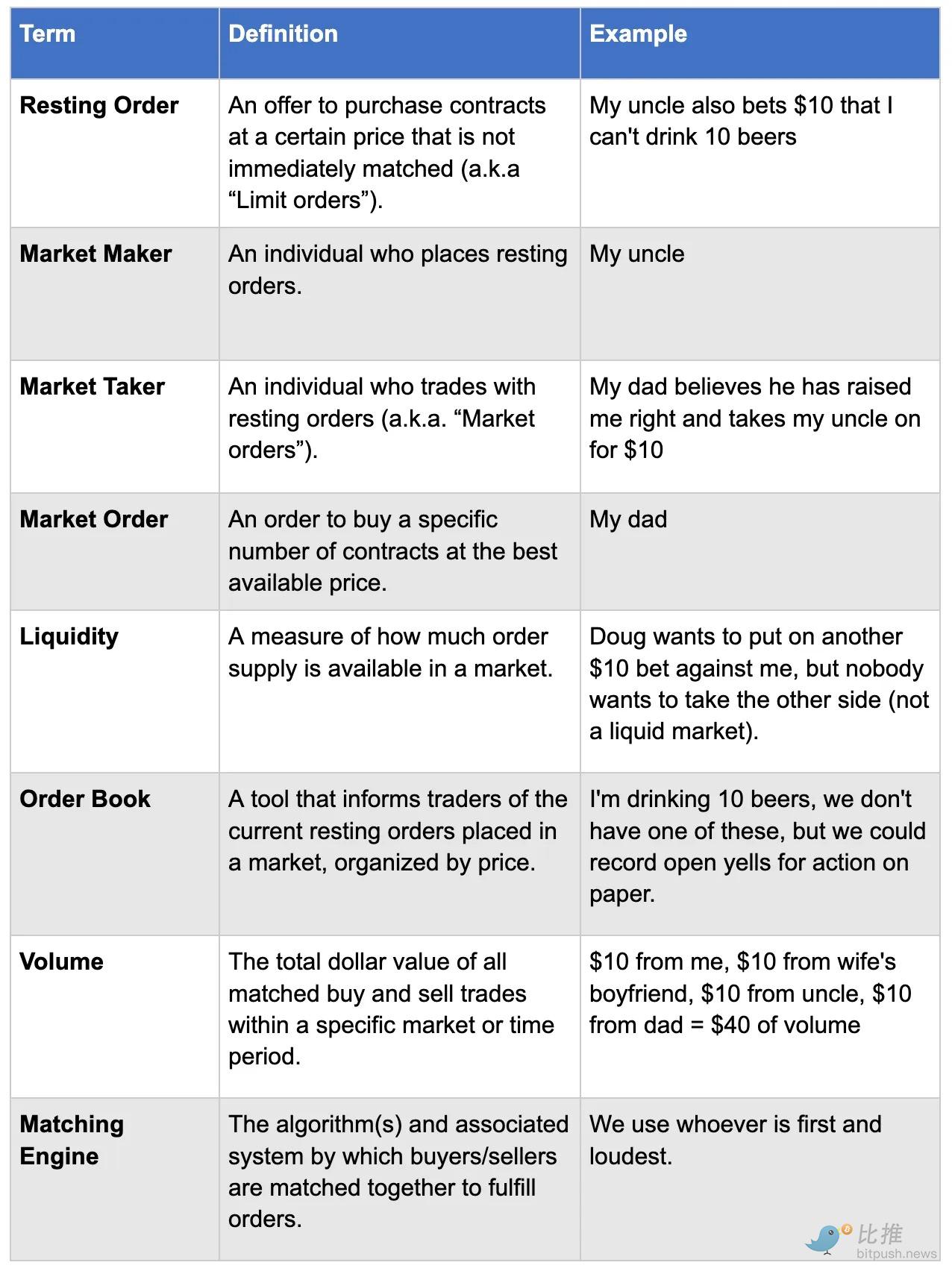
As a price-sensitive and rational actor, I'm willing to pay $10 to win $20, and so is my wife. Since these bets are in place, the implied probability of this event is 50% (10/20). In the term “event contract”:
We split it into 20 contracts with a face value of $1.
Each contract is an agreement, and we both lock in $0.50.
The winner can keep the other party's $0.50 at the time of settlement.
As deals heat up, it's helpful to use an Order Book (Order Book) to track activity.
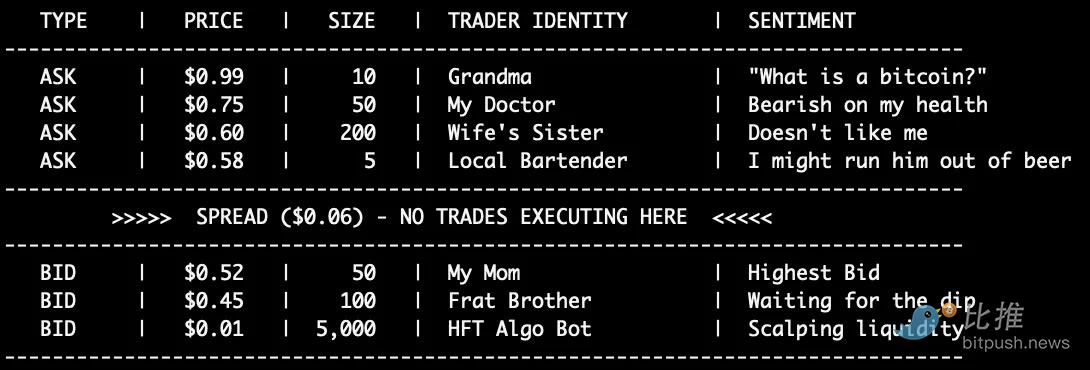
There are many ways to display an order book. They usually show pending orders (pending orders), whether they are buying or selling, the number of transactions, and the time the order was placed.
The buying price (Bids) includes all those seeking to buy, and the selling price (Asks) includes all those seeking to sell. In the example above, the purchase price and sale price have been ordered from best to worst. The gap between Best Bid (Best Bid) and Best Ask (Best Ask) is called Spread (Spread).
In a highly liquid market, such as the Super Bowl, the spread may be minimal (maybe only 1 cent). In an inactive market, the spread can be huge because no one cares about being willing to play against the market. That's why Kalshi provides incentives for liquidity and market making.
Looking back at our order book, when an eater decided $0.52 was a good deal and bought it, he signed 50 contracts with my mom (you can see her on the buyer side). The price of the asset just “moved” to $0.52, and that purchase order disappeared from the ledger. This is price discovery, or rather, the market is allocating probabilities. Speculators updated my chances of liver failure to 52%.
If you take a look at Kalshi's actual order book, things will be different:
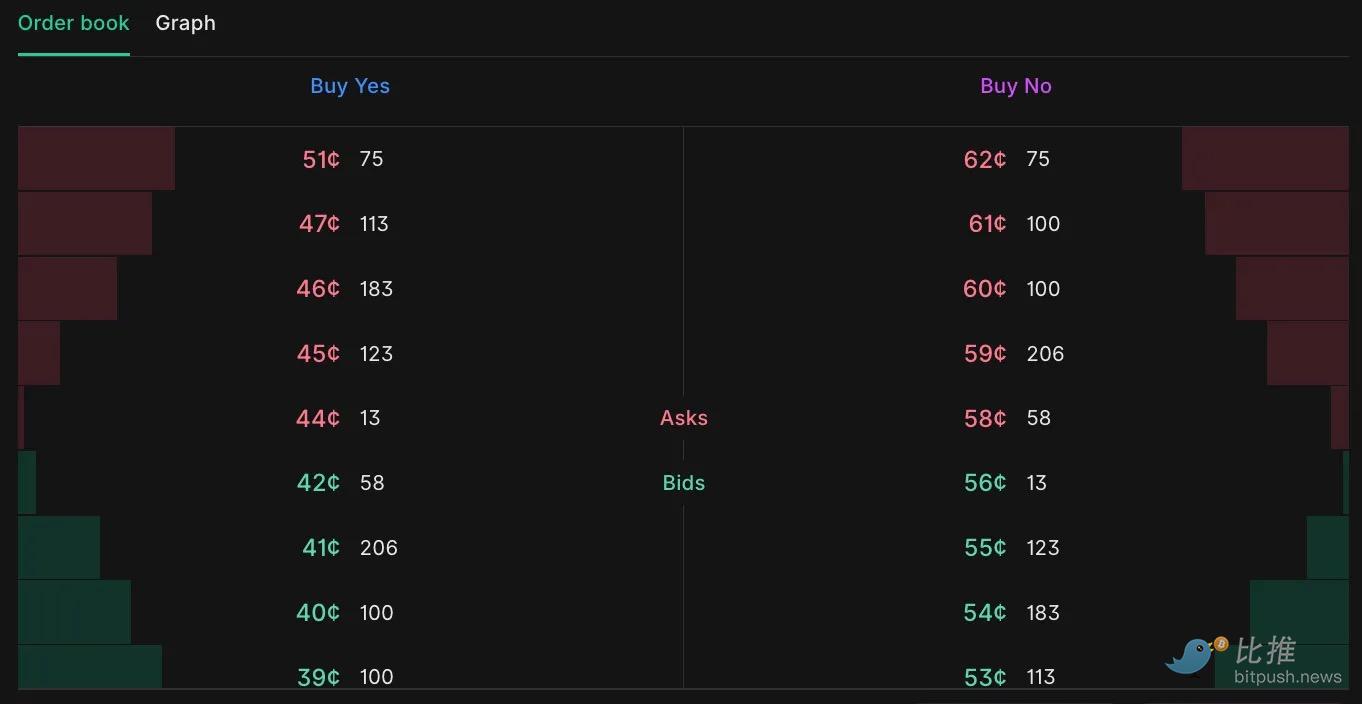
You'll notice that this order book has both “Yes (Yes)” and “No (No)” sides. Contracts on Kalshi can be settled as “yes” or “no”, and traders have a need to buy and sell both.
On the “yes” side, there are 13 contracts that sell for as low as $0.44, and 58 can be bought for $0.42, with a spread of $0.02.
On the “no” side, there are 58 contracts that sell for as low as $0.58, and 13 can be bought for $0.56, with a spread of $0.02.
Wait... this seems pretty funny. Why is everything complementary? Why does the “yes” buy price and the “no” sell price have the same number of contracts, and the sum of the price of $0.42 and $0.58 equals exactly $1? Because buying “yes” is equivalent to selling “no”.
Now that we know the concept of pending orders, how does matching work?
Kalshi uses a price and time-first algorithm to match orders on its central limit order book. On the face of it, it sounds simple: orders are ordered by price and then by submission time; however, building an exchange and processing these orders on a large scale is no easy feat. On Kalshi's exchange, orders must be fully collateralized, so margin (margin) trading does not currently exist.
For a while, miaxDX (via miax) was the clearing house (central place for trading) of Kalshi Exchange trading contracts. MiaXDX used to be known asLedgerX, but miax bought and renamed it through... (there should be a drum beat here)... FTX's bankruptcy process!
After a while, Kalshi felt “we wanted our own clearing house,” so they registered with the US Commodity Futures Trading Commission (CFTC) and established Kalshi Klear in August 2024. To close the loop, Robinhood recently bought another one from Miax... Yes, that's rightLedgerX!
datum
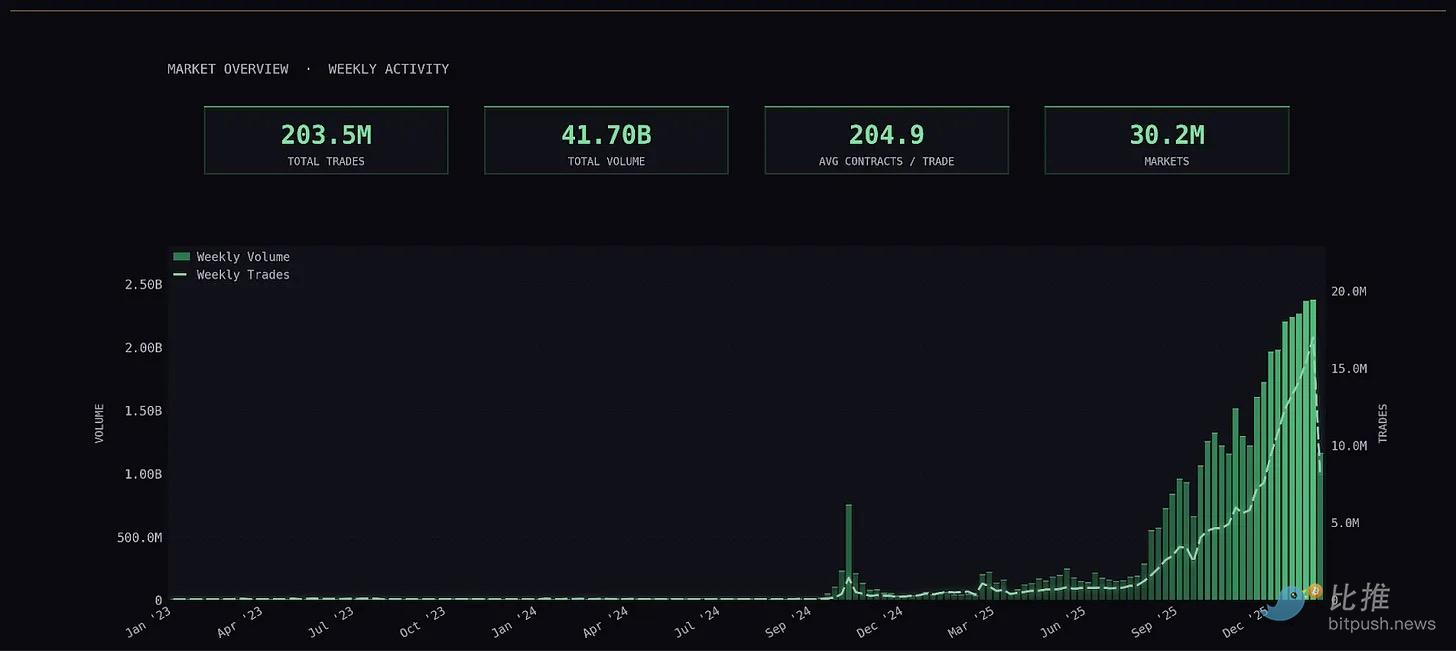
I used Kalshi's market interface and trading interface to obtain historical data on approximately 30 million markets, 203 million transactions, and a total turnover of over $41.7 billion.
Where did this turnover come from? Kalshi's website and app directly generate significant traffic. It has also partnered with a number of futures commission dealers (FCMs), which facilitate futures trading by accepting contracts on behalf of clients. You might recognize them:
For example, where you transfer your IRA to... Robinhood;
A place for teenagers to trade... WeBull;
And where you keep your junk coins... Coinbase.
The top two events in terms of turnover were the 2024 presidential election (over $535 million) and the 2026 Super Bowl winner (approximately $244 million).
Wait... the Super Bowl... isn't this just... sports betting?
Isn't this just sports betting?
Kalshi is regulated by the CFTC, which oversees the US derivatives market. When I say “regulated,” I really mean “not regulated.” The Commodities Exchange Act (CEA) establishes the statutory framework for the operation of the CFTC. This gave the CFTC the power to ban onion futures trading, but also allowed 18-year-olds to trade contracts on Kalshi. Kalshi even boasted in its FAQ page that the “minimum age to sign up and participate” was 18+, and directly compared it to... Sportsbooks on that page.
Bookmakers are at the mercy of state governments; some states ban sports betting altogether, while others require bettors to be 18 or over 21 (usually 21+).
Cool, but... Kalshi is different. You're trading a contract with a peer, and the contract can be anything. It's not just sports, right? I'm not gambling with the dealer, am I?
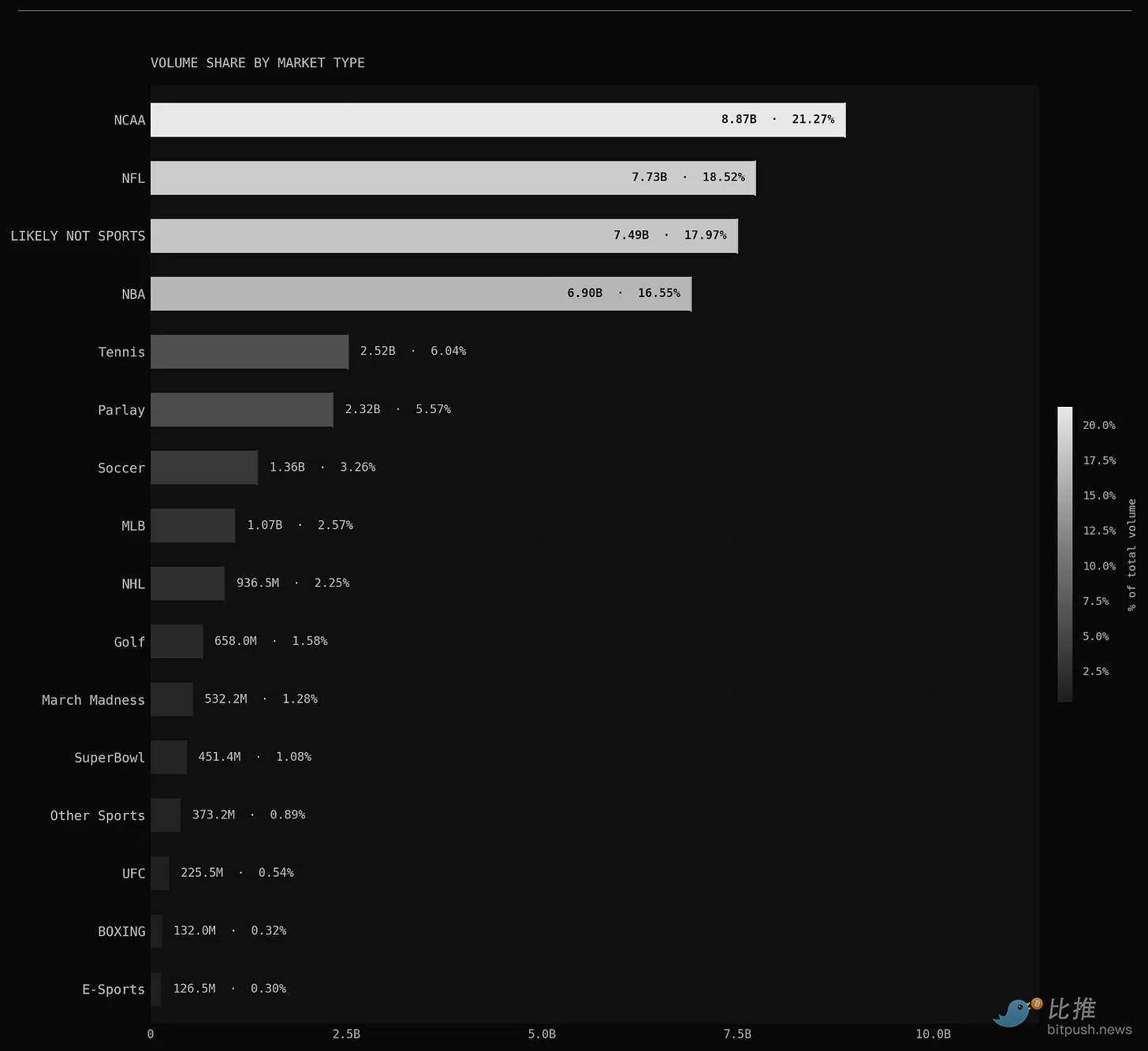
Over 82% of contracts are about... sports. Kalshi is a growing business. The more contracts you trade, the more fees you charge. As the first betting platform for 18-year-olds, this couldn't be better. Incidentally, they also offer playthrough bets (parlays), which account for more than 5% of the total turnover!
Another thing about not betting with the bookmaker... from Kalshi's article“Who am I trading with”:
“Another important player on the exchange is Kalshi Trading. Kalshi Trading is an entity separate from the Kalshi Exchange... they are participants in the exchange like everyone else.”
If it looks like a bookmaker and trades like a bookmaker, then it's probably...
Back to the data!
The turnover in these markets shows a power law distribution. This is a good example of this by bucking the total transaction amount (USD) in an order of magnitude.
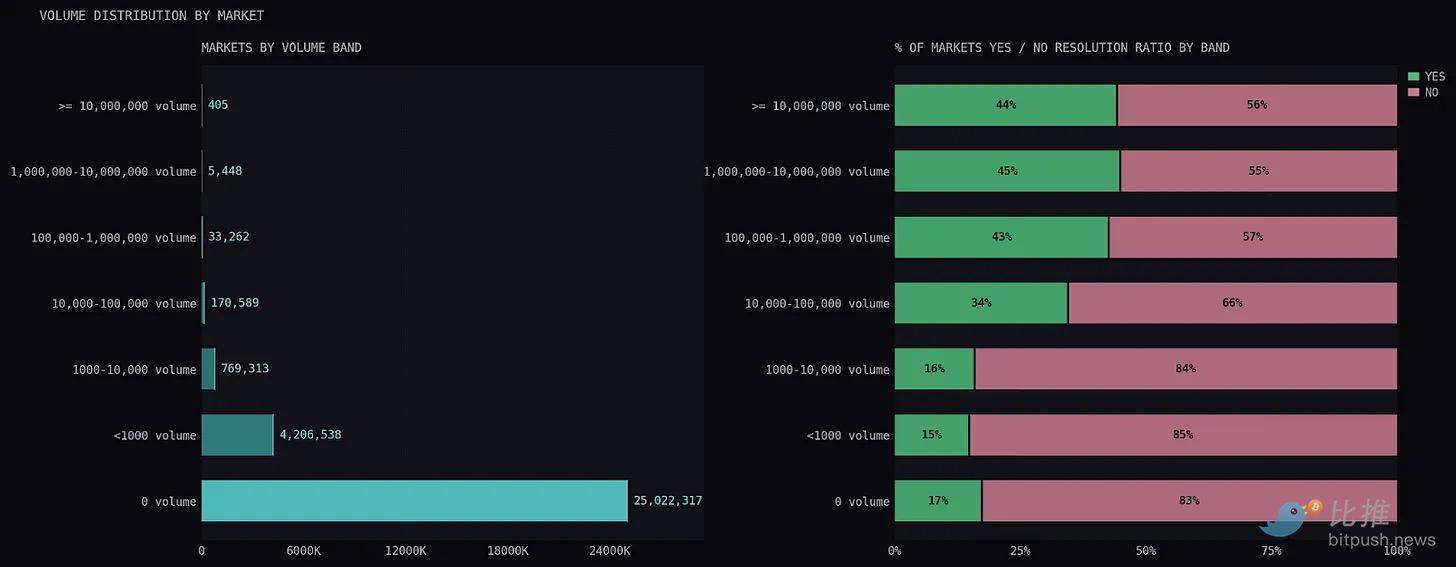
80% of markets with zero turnover are combinations (i.e. multivariate events, also known as playthrough bets). Each is a unique market generated through Kalshi's RFQ (Request for Quotation) system, and many of these markets have not found a match.
Using the same transaction amount in buckets and splitting them according to the settlement results, we saw that as the turnover increased, the proportion of markets that settled “yes” also increased.
This indicates that your benchmark expectations for any particular market should tend to settle as “no.” The relationship between this and turnover is reasonable: an event involving a large number of markets will cause the turnover to be diluted, and in the end, only one or two markets will settle as “yes.”
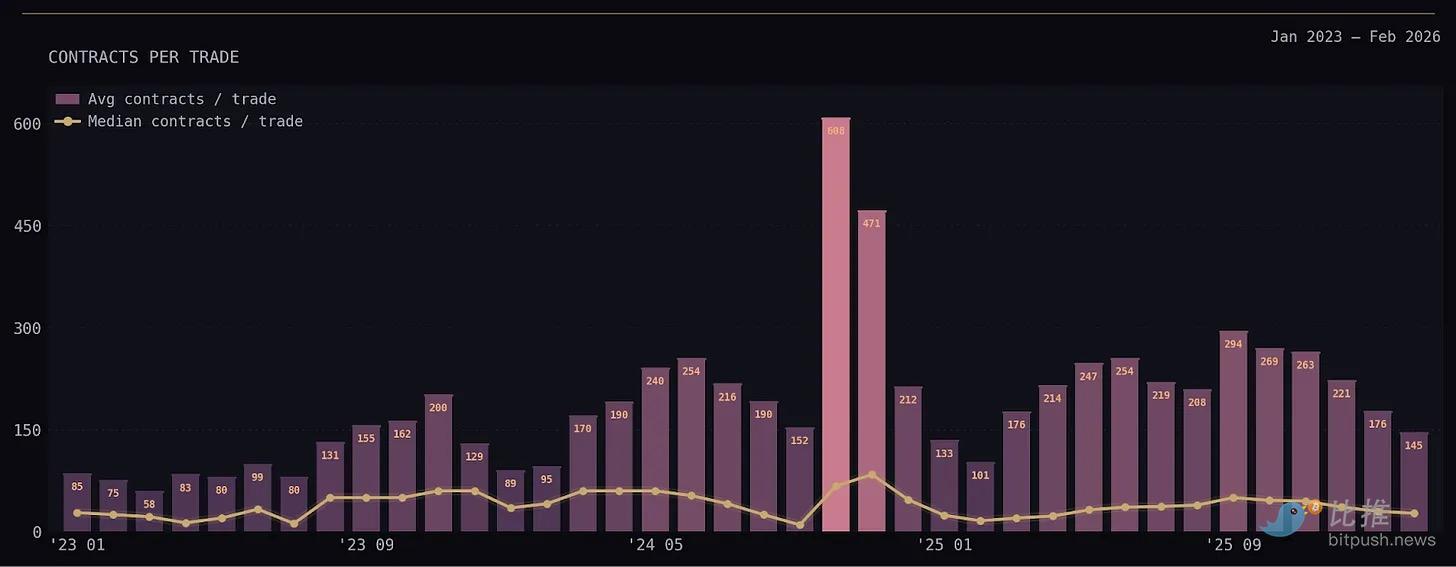
In these markets, the average number of contracts per trade hovers between 150-250. Except for the huge spike in 2024 due to the US election, which saw large orders of some 1 million contracts. The median is far below that, and most months are usually below 50 copies.
Fees: bookmaker vs Kalshi
If sports betting companies are like roulette and win money through the odds offered, then Kalshi is like poker, where the bookmaker makes money by raking (rakes), and it has nothing to do with who loses and who wins.
At bookmakers, you'll find “even odds (even odds),” a market where each side has a 50% chance, such as the Super Bowl coin toss. They won't give you equal odds; instead, they'll give you a 52.4% chance in person and a 52.4% word probability, which is higher than reality.
In a fair market, if you bet $10 on a coin toss, you can expect to win $10 if you pick the right one... but with better-odds bookmakers, you can only win $9.09.
In sports betting, if two people bet $10 each on a coin toss duel, then in the end, one person can get back $19.09, and the other person lost their money, and the bookmaker made a steady profit of $0.91, or 4.5% of the total bet. This 4.5% is what people often call “pumping” — you could call it“Water money”, “commission” or “bookmaker advantage”。
For example, the Islanders vs Devils market is conveniently set at 52.4%/52.4% at bookmakers. On Kalshi, the contract traded at $0.51 (51%). Then you should trade on Kalshi because you get better odds (51% vs 52.4%), right?
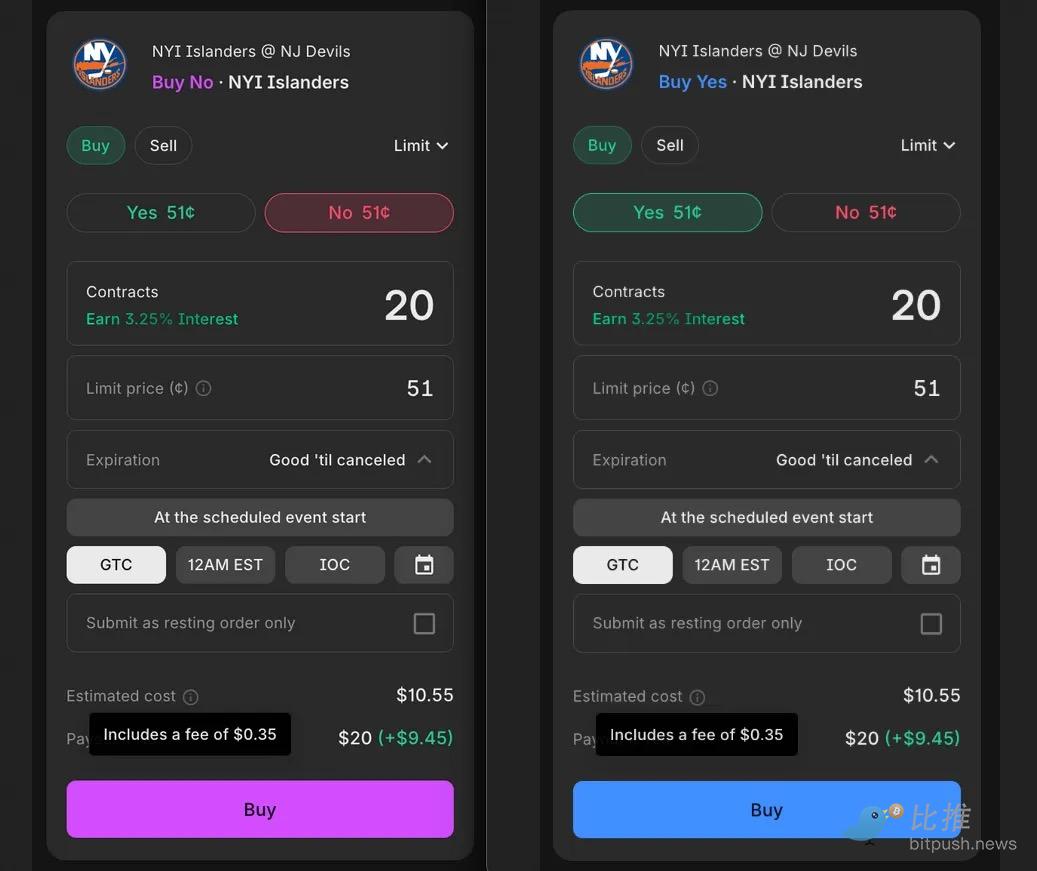
no! Although the bookmaker offers worse odds, Kalshi's food order fee ($0.35) offsets this:
Kalshi: Bet $10.55 (buy 20 contracts for a total price of $10.20 + $0.35 processing fee) to win $20.
Bookmaker: Bet $10.55 and win $20.14 ($0.14 more than Kalshi for the same bet).
This isn't the whole story for all markets, as Kalshi provides liquidity incentives and volume incentives. Furthermore, the fee structure isn't the same in every market, and Kalshi does pay daily accrued profits from the positions you hold.
overheads
How much did Kalshi earn from this much turnover? First, let's take a look at the fees charged to “order eaters.” The formula is:
Cost = round up (0.07 × C × P × (1-P))
Where C is the number of contracts and P is the price (ranging from $0.01 to $0.99).
We can chart how costs vary with P and C. The fee increases linearly as the number of contracts increases; this is controlled by P (1-P). As you can see in the chart on the right, it shows how the fee is reduced when the implied probability is far from 50%, which makes the most likely and unlikely contract fees the least likely to occur.
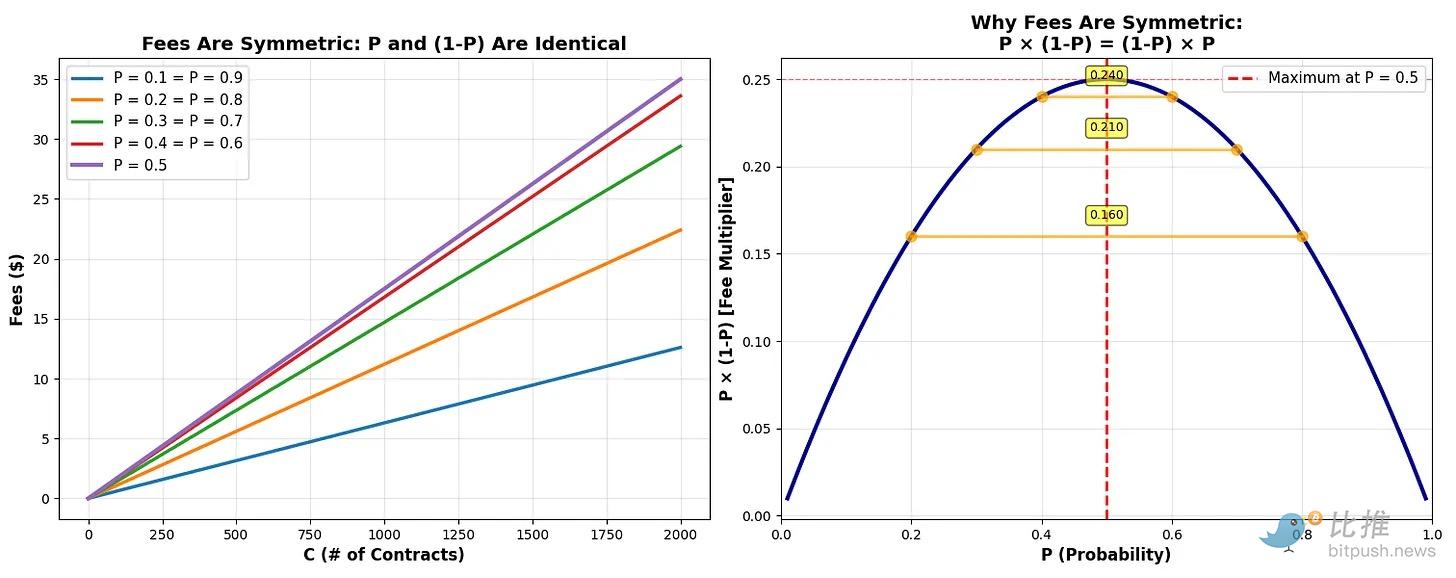
We found this to be the Bernoulli distribution. The Bernoulli distribution models the outcome of a single “yes” or “no” question (in our case a market). The variance of this distribution can be modeled as P (1-P), where P is the probability of “yes”; that is, the Y axis in the figure on the right.
The variance is between 0 and 0.25.
Entropy (uncertainty or randomness in a probability distribution) reaches its maximum value at P = 0.5.
Why doesn't Kalshi implement a fixed rate so we don't have to draw a picture? Most likely due to trading concerns:
If the price of a contract is98 cents, the maximum profit you can get is2 cents. If Kalshi charges a fixed fee of 2 cents, your profit is 0... no one will trade it.
The slope of the pending order fee is the same, only it is scaled down due to the 0.0175 multiplier (one-quarter of the order fee):
Cost = round up (0.0175 × C × P × (1-P))
Downloaded all of KalshiSection 203 million historical transactionsAfterwards, I know the exact transaction price for each contract. I can substitute P and C into these equations to get the total revenue Kalshi generated from all of these contracts...$545.6 billion.
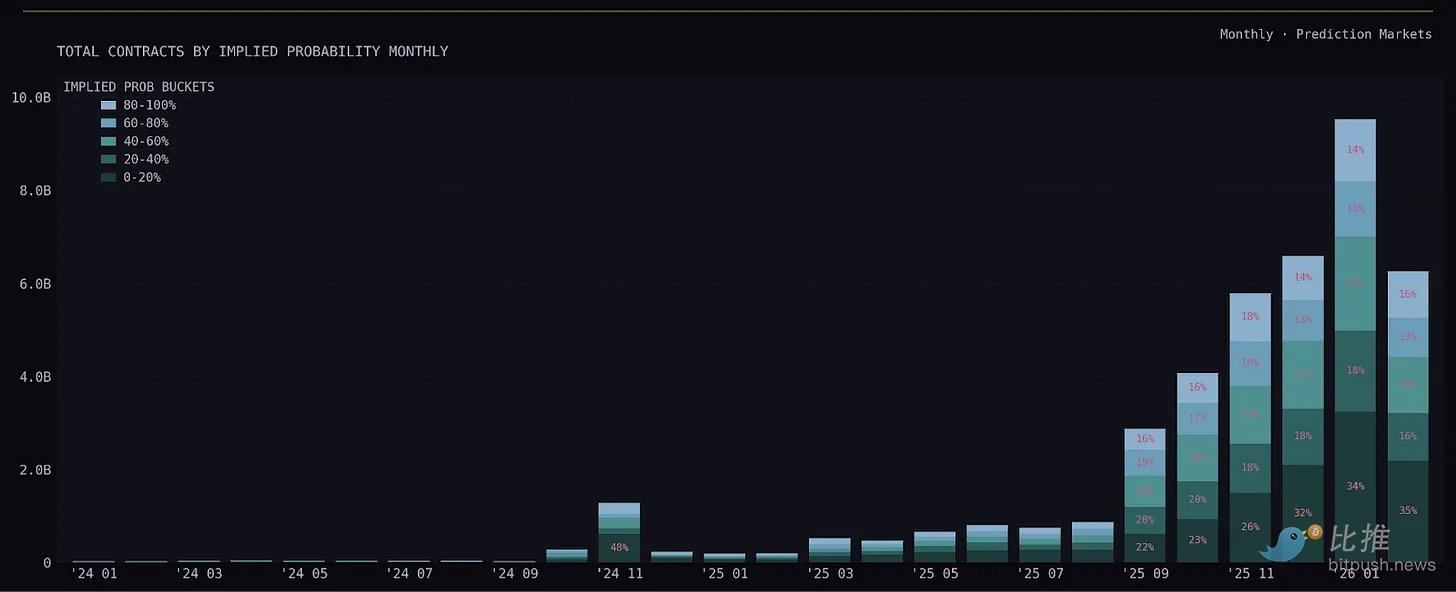
Here is Kalshi's monthly transaction amount by implied probability:
The following is Kalshi's monthly fee revenue:
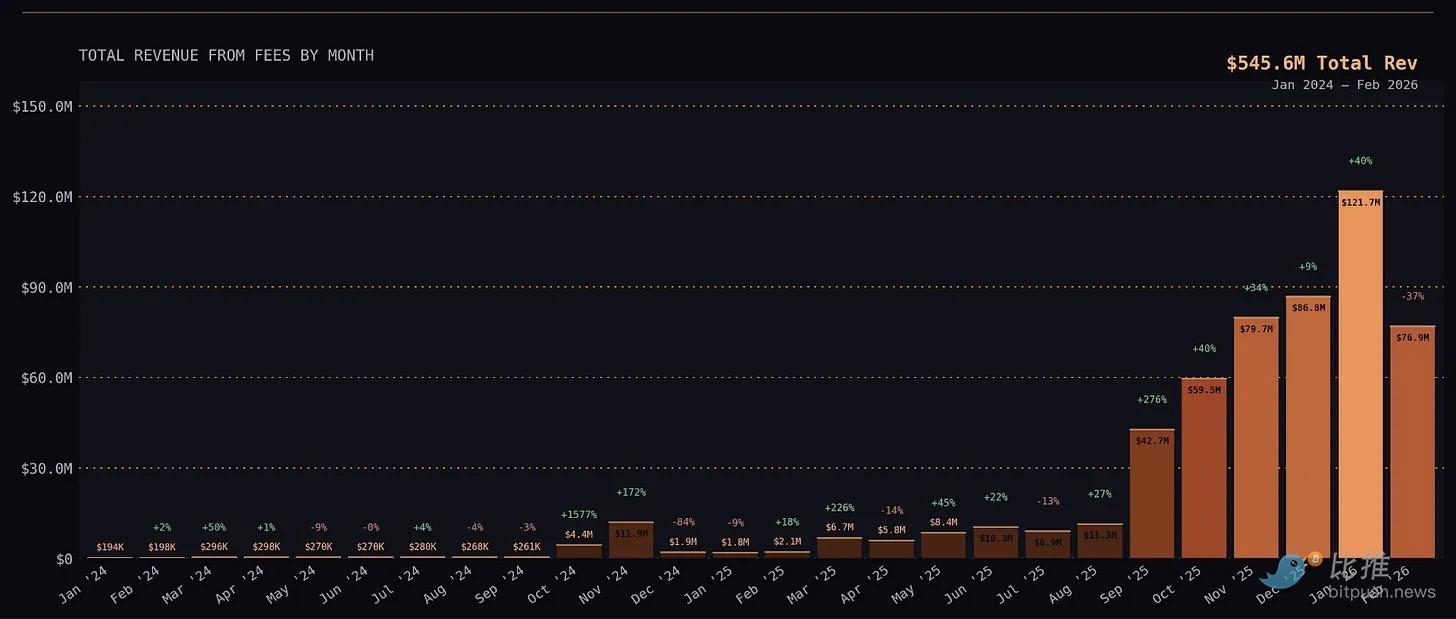
Obviously, these markets are exploding, and DraftKings, FanDuel, and Fanatics are scrambling to rush into this carnival — a “we do basically the same business, but now it's a pseudo-regulatory model, and 18-year-olds can play” carnival.
settlement
An interesting settlement example is when Dallas and Green Bay tied in an NFL game. This market settles 50/50, not yes or no, 100 or 0... There is no concept of refunds (refunds) or voiding (voiding) in the prediction market. When things became unclear, Kalshi stepped in. In the data, Kalshi labeled these results as “scalars (scalars),” and over 170,000 markets were labeled as scalars.
Market settlements on Kalshi seem to rely quite a bit on humans. They have a dedicated marketing team to thoroughly review the results. Every market has an authoritative reference point. For example, the Super Bowl lists several sources and includes rules specific to that event. Despite this, they are still unsure if Cardi B performed the show and settled the market at the final transaction price.
Polymarket, on the other hand, said “Yes, she performed”, which highlights how they used UMA's Optimistic Oracle (Optimistic Oracle) for different settlements... but we'll leave that for next time.
conclusions
Speaking of which, I still have 9 bottles of beer to drink, and the number of words in this article has seriously exceeded the standard.
Quick cut into oneLaw extras: There is also a company calledPredictITThe prediction market specializes in political prediction markets. PredictIt is operated by a company called Aristotle, which provides data mining services for political campaigns. It was launched in 2014 as a non-profit education program at Victoria University of Wellington, New Zealand. To be able to operate, like IEM, they obtained a letter of no objection from the US Commodity Futures Trading Commission (CFTC) agreeing to comply with certain protective measures and serve academic purposes. Then, in 2022, PredictIT was heavily cleaned up by the CFTC because it did not operate in accordance with the agreement. By 2025, they gave the CFTC a beautiful Jedi counterattack in federal court, so this “Predictive Cadillac in the Market” is back!
Anyway, basically, all of these companies involved in the “event contract” game are constantly askingCFTC submits letter after letter, requesting that no action be taken against them because they failed to meet commonly required reporting standards. So far, the CFTC also seems to agree, citing”Traditional swap reporting rules have limited applicability to exchange-traded event contracts”.
Of course, there are other issues here, such as Kalshi and Robinhood's classification issues, but arguably, there will be a lot of discussion about how to regulate, tax, and manage these “new” entities in the future.
Twitter:https://twitter.com/BitpushNewsCN
Compare the TG exchange group:https://t.me/BitPushCommunity
Compare TG subscriptions:https://t.me/bitpush
