


Why did S fall more than 97% after AC withdrew from Sonic while FT's valuation reached 1 billion?
By Curry, Deep Wave TechFlow
Original title: AC withdraws from Sonic's board, DeFi godfather comes out of his shell once again
My experience with crypto this year is probably watching US stocks reach new highs every day, then open one's position in silence for three seconds and then close it off.
BTC has fallen by almost 20% since the beginning of the year, and ETH is even worse, so don't mention copycats. Under this kind of market, a 90% drop in any public chain's token is not news. What's even colder than the price is that people walk away to cool off.
On June 19, AC, the godfather of DeFi, left the Sonic Labs board along with two other founding directors. The S token was reported at 0.028 at the time, leaving only a fraction of 1.03 at the beginning of the year. The on-chain TVL dropped from a peak of 1.14 billion in May last year to 20 million. According to DeFilLama's data, 98% has evaporated.
There wasn't much reaction from the community when AC left. After all, he left the ring once in 2022 and then came back. The withdrawal statement is also very standard, saying that he is “still optimistic about Sonic,” but that he is no longer involved in business decisions.

But what bothers me is the next part.
He said the main focus has been on Flying Tulip for the past 18 months. This project raised 200 million dollars in private placement in August last year, with a valuation of 1 billion dollars. In February of this year, another public offering was launched on CoinList. The investors are Brevan Howard, DWF Labs, Susquehanna.
In other words, during the period when S dropped from 1.03 to 0.028, AC was busy setting the stage for a new billion dollar project.
Even more impressive is the Flying Tulip token design.
Investors with a Tier 1 subscription get an NFT called FTPut, which is essentially a perpetual put option. If they lose money, they can destroy the token at any time and redeem the principal amount at the original price. CoinList's public offering page clearly states that FT (splitable tokens, normal coins) bought on the open market do not have this right; only first-level participants have it.
In contrast, the holders of S took over the market and fell to 0.028, which is 0.028. No floors, no redemptions, no one wrote you a way out...
It has nothing to do with me
AC's withdrawal statement was posted on X and was very short, but every sentence seemed overrated.
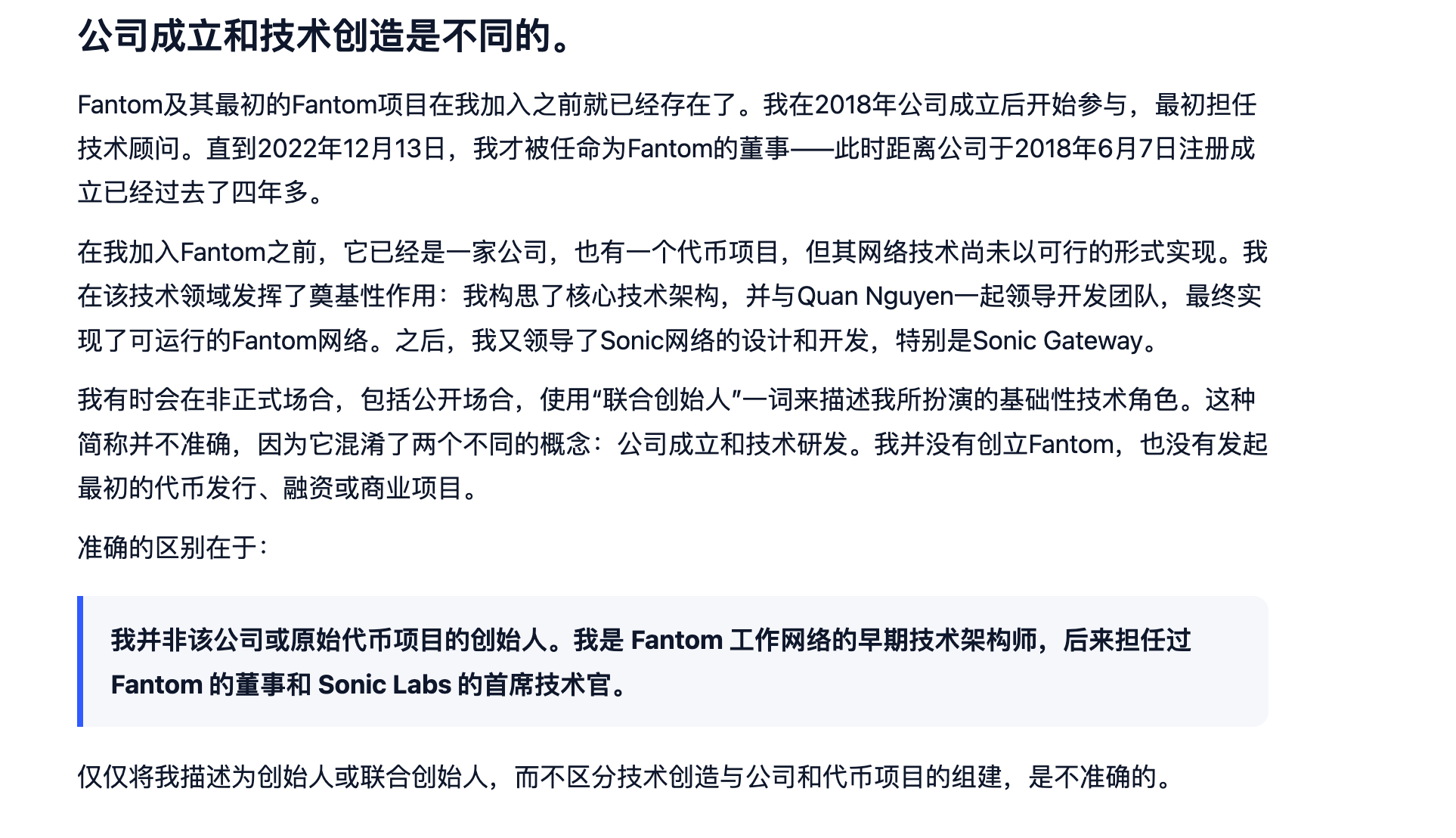
He said he was a technical advisor when he joined Fantom in 2018 and only officially became a director in December 2022. He wasn't the founder of Fantom; he never was; he was just the earliest technical architect. He was responsible for the underlying technology, including later Sonic's core system and cross-chain gateway.
Then there's the key paragraph, which was to the effect:
“I am responsible for the technical decisions I lead, but I am not the sponsor or patcher of the decisions of migration, airdrops, tokenomics, and the disposal of old networks.”
One sentence removed myself from the fact that the S token dropped 97%. The technology was done by me, and the technology was fine. As to why the coin you bought dropped from one dollar to three percent, that was someone else's decision.
The author does not evaluate whether this statement holds true, but admits that the cut is so clean that it is admirable.
When most project founders run away, they either pretend not to talk, or send a vague statement full of “us” and “the team,” turning responsibility into a pot of porridge. AC is different; he drew his boundaries of responsibility so accurately that it's hard for you to refute, because he really doesn't care about the token economy.
Moreover, he didn't temporarily think of doing this.
In March 2022, AC announced its exit from the crypto industry citing regulatory pressure and burnout. At the time, Fantom's TVL evaporated almost one-third within a week, and the community was full of criticism. He quietly came back a few months later, and all he did was reinvent Sonic's technology.
He said he was tired when he left, was silent when he came back, and when he left, he said, “I've actually been busy with other things for the past 18 months.”
On Sonic's side, the six months before he left, executives changed one after another. CEO Mitchell Demeter, who was just invited in September of last year, resigned in February of this year, and the business leader also joined him. After the CEO left, the board of directors took charge of the board itself for a few months, and now the board of directors has resigned and replaced it with Matt Visser, a new CEO who has never managed the front line of the public chain.
In five months, the entire management team changed everything from top to bottom. Sonic's official statement was also unwhitewashed; it simply wrote “The coin has declined, and so has community sentiment; we won't pretend this is not the case.”
This kind of “lying flat and honest” is rare in the crypto industry. But the problem is, to be honest, it's the new team, and the one who left was the one whose name was worth it.
Screenplay of The Golden Cicada
Looking back at AC's trajectory over the past few years, you'll notice a rhythm.
Written in 2020, Yearn Finance, the iconic product of DeFi Summer, once reached several billion dollars in TVL. He gave up without much care. Later, Yearn ran on his own and was fine, but he didn't have much to do with him anymore.
Next, we went to Fantom's technical architecture, and Fantom went up a wave. He announced his withdrawal in March 2022, and Fantom then went into a long slump, then changed its name to Sonic and repackaged online, and he returned to take the title of CTO. At the beginning of Sonic's launch, TVL surpassed 1 billion, then went all the way down to where it is now.
Every time, when the heat is at its peak or when it's just starting to cool down, he pulls out to make the next thing. Each time, the holder of the old project withstood most of the decline after he left.
Flying Tulip is his fourth project right now. The author feels that this time, he may have actually absorbed all the lessons learned from the previous few times and then incorporated them into the token design.
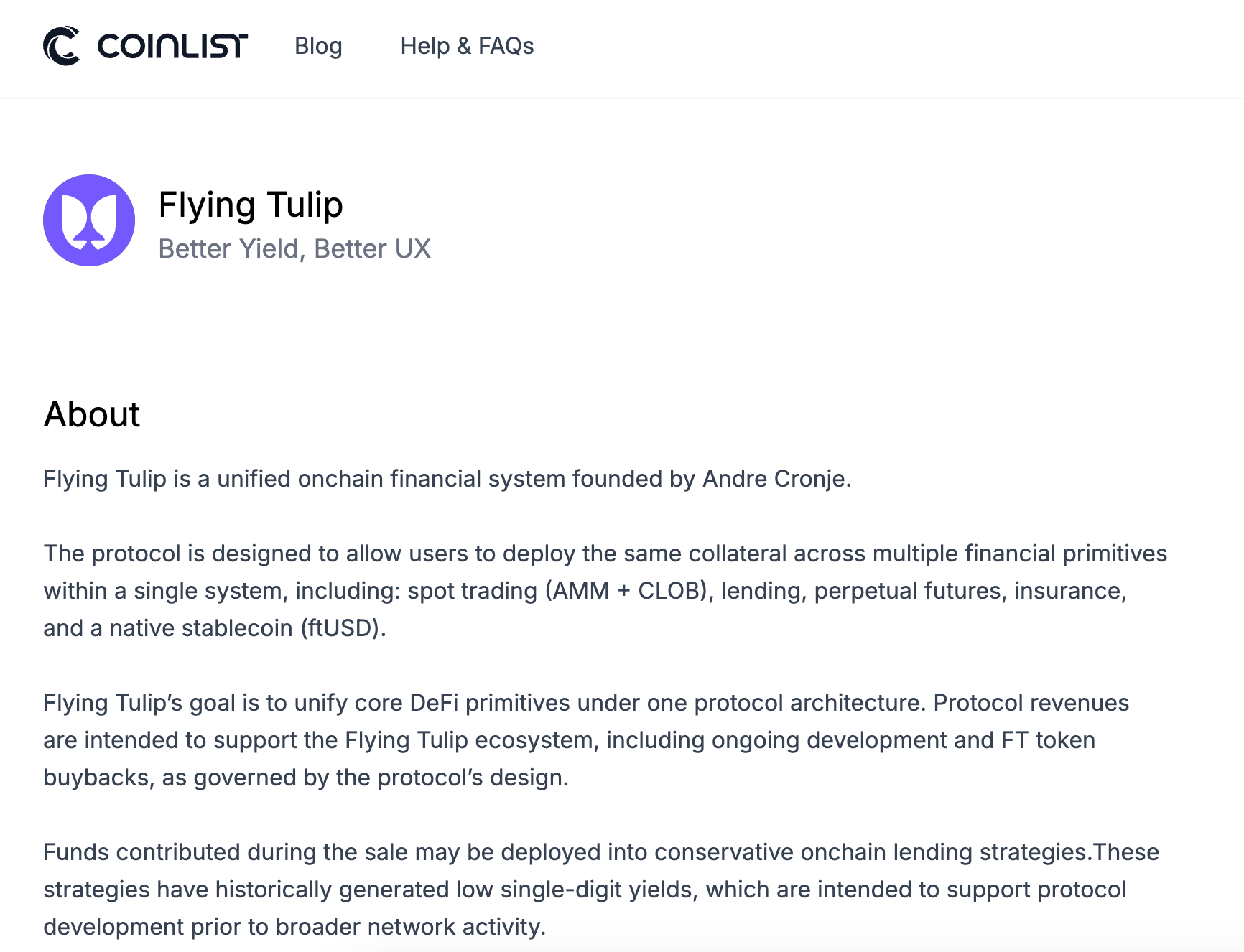
You participate in Flying Tulip's public offering on CoinList and spend $0.10 to buy an FT. You get not the token itself, but an NFT called FTPut, which is locked inside this NFT. This NFT is that perpetual put option. You have three paths to choose from.
Article 1. If it doesn't move, the token remains in the NFT and cannot be traded, but the right of redemption is always there. When you want to leave, destroy the tokens and get your USDC or ETH back at the original price. No matter how much FT falls in the external secondary market, you have a bottom line.
Article 2. Withdraw tokens from NFTs and trade them freely. However, the moment it is proposed, the right of redemption is permanently voided. No matter how much you offer, that portion of the principal amount will be released as an agreement for repurchase and destruction.
Article 3. Partial mention, partial retention. Remaining in the NFTs continues to be protected, and the proposal is to run naked.
In an interview with The Block, AC himself said something very interesting, to the effect that because of the existence of perpetual PUT, none of this money raised can actually be spent.
The actual amount raised was zero. So where do the operating expenses come from?
All funds raised are thrown into loan agreements such as Aave and Ethena for a conservative strategy, with a target annualization of about 4%. Based on a full funding of 1 billion US dollars, the annual output is about 40 million US dollars in interest, and this money is used to support the team, develop, and buy back. The team did not have any initial token allocations, and all FTs were bought back from the open market with protocol revenue.
I have to admit that this set of designs is quite sophisticated in DeFi. It solved the worst problem in the crypto industry in the past few years. The project party took the money and ran away, or spent the money indiscriminately, and the investors lost their money. AC's plan is tying up one's hands. The money can't be moved, the team doesn't pre-allocate tokens, and investors can return it at any time.
But subtlety is subtlety; this protection only exists in the primary market. After FT went on the exchange, tokens bought on the secondary market did not come with FTPut. This sentence was bolded on the CoinList page.
Open market buyers see the same token and are treated in a completely different way.
The epitome of the industry
It's no secret that money in the crypto market is running out this year.
BTC has fallen by nearly 20% from the beginning of the year to now, and the median decline of altcoins far exceeds this figure. There is no need for me to describe the feeling that people in the circle opened the US stock market to a new high and then switched back to their positions.
The actual operation of many people this year is to slowly move their positions away from US stocks and stablecoin financial management, and the activity on the chain is shrinking visibly with the naked eye.
In this environment, AC's exit from Sonic is just the tip of the iceberg. The entire L1 circuit is experiencing the same story, with TVL shrinking, losing users, and the founding team changing blood or simply disappearing. Sonic was only taken as a sample because of its fame and extreme decline.
But the AC case has something that other projects don't have.
Flying Tulip is currently valued at around a billion dollars. Sonic's current market capitalization is around 100 million. The same person, over the same period of time, one billion, one billion and one hundred million, the difference is ten times. What's the difference? The difference is where the AC name hangs on.
This is a fact that few people in the DeFi industry want to break down.
The valuation of many projects is not based on revenue, users, or technical barriers; it is based on someone's name. The name is there, the money is there. The name went away, and the money went with it.
The bear market tore this cover away. All L1s are rising in the bull market, and you can't tell whether the fundamentals support it or the name. When the tide recedes, it's clear what's left behind.
There is one more detail, which I think is most interesting.
Flying Tulip's initial deployment chain is Sonic. AC has left Sonic's board of directors and is no longer involved in any business decisions, but his first stop on his new project is on Sonic. He's gone, his business is still up.
The captain disembarked, but opened a new store on the pier, selling more expensive items than those on board.
Twitter:https://twitter.com/BitpushNewsCN
Compare the TG exchange group:https://t.me/BitPushCommunity
Compare TG subscriptions:https://t.me/bitpush
