


After the metaverse burns 90 billion dollars, Meta turned its bets on predicting the market: can the traffic advantage fill the trust gap?

By Gino Matos
Compiled by Luffy, Foresight News
Original title: If Meta follows the trend and enters the prediction market, can it avoid the old path of metaverse failure?
TL; DR
According to the New York Times, Meta formed a small team to develop an internal point-based prediction application codenamed Arena. Users can bet on political, sports, and global current affairs results.
The forecast market has shown real demand. With 3.56 billion daily users, Meta is expected to push the niche racetrack to the mass market.
But Meta's crisis of trust, combined with elections and disinformation censorship, could make Arena a regulatory target even before it grows in size.
The New York Times reported on June 23 that Mark Zuckerberg took the lead in forming a special team to develop the market prediction application Arena. Users can bet on the results of political elections, sporting events, and international events through platform credits.
This company, which once lost nearly $90 billion due to the metaverse's name change and its Reality Labs subsidiary, has now turned its head to the forecasting market. This track is actually in high demand and a formed user base, but the regulatory rules are intricate. This transformation is probably Meta's smartest strategic adjustment, or it may be a repetition of past huge costly failures.
The huge bills left by the metaverse
Facebook officially changed its name to Meta in October 2021. Zuckerberg wrote that the company's core goal was to “build a metaverse,” and predicted that the metaverse would reach 1 billion users within 10 years.
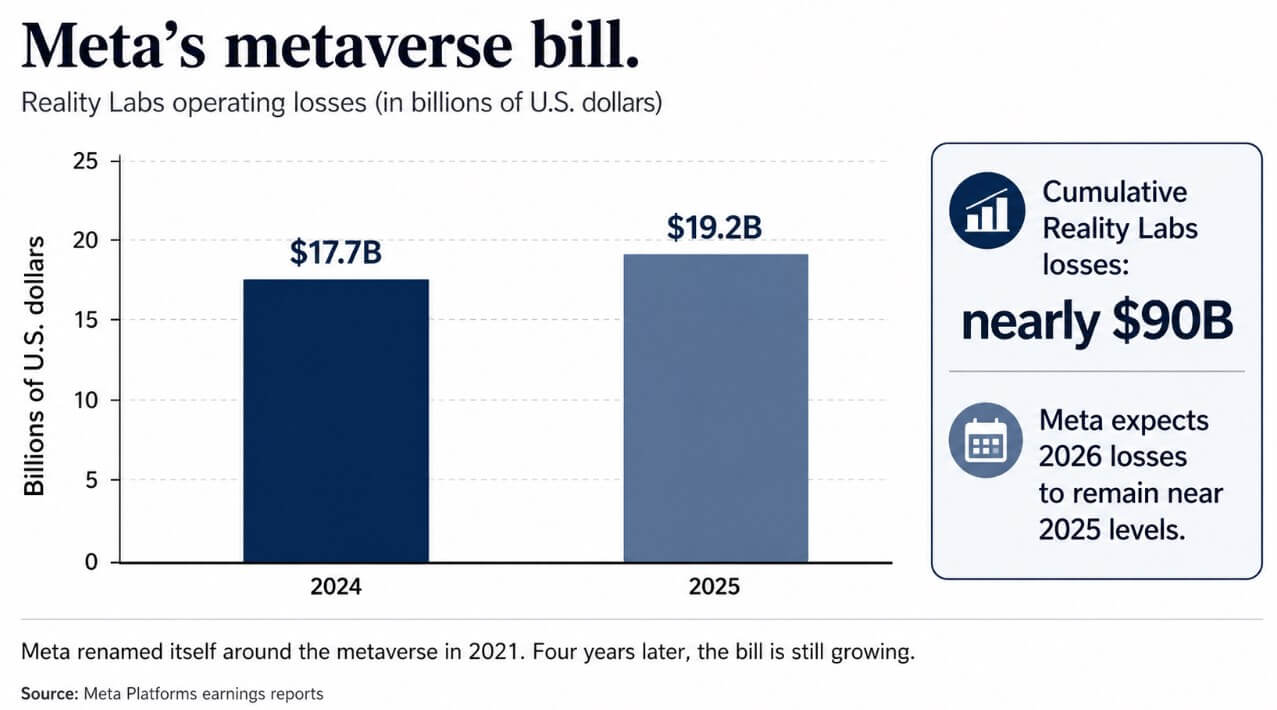
Reality Labs, the division that carries this vision, continues to grow in losses: operating losses of $17.7 billion in 2024 and $19.2 billion in 2025, with cumulative losses approaching $90 billion. Meta revealed to investors that the scale of losses in the sector in 2026 may be the same as in 2025.
Horizon Worlds, its flagship social VR platform, fell below 200,000 monthly active users in 2022, far below the initial target of 500,000. Meta then lowered its expectations again and plans to gradually shut down the VR version in 2026.
Predicting why the market is a completely different track
In 2026, Kalshi and Polymarket's two leading platforms will have a combined monthly transaction volume of about US$24 billion, and industry institutions predict that the market transaction volume will exceed US$130 billion for the whole year.
Robinhood launched the Forecast Market Zone in 2025. Yingtou Securities also integrated event contracts into the trading platform, and the Golden Globe Awards ceremony even introduced an interactive prediction market session. Bernstein's April research report estimates that the track's annual transaction scale is expected to impact $1 trillion in 2030.
Meta has always been good at replicating popular products and using huge traffic to overtake curves: after Snapchat launched limited-time updates, Instagram Stories were launched; Twitter occupied the social graphics circuit for ten years and Meta Threads was launched; after TikTok became popular for short videos, Meta launched Reels. As of April, the daily activity of all Meta products reached 3.56 billion, and the volume of traffic overwhelmed all existing forecasting market platforms.
Arena uses a credit design to continue Meta's consistent strategy: capture users' existing behavioral needs, embed its own traffic ecosystem, and rely on mass distribution to make up for the lack of product originality.
Building a prediction market requires only software, information flow, account systems, content review, and compliance systems. Some scenarios can be connected to licensed partners; however, the metaverse requires customized hardware, immersive content, virtual images, and an exclusive operating environment, and it will take years to cultivate user usage habits. Reality Labs' huge losses prove that creating a new track model out of thin air is extremely expensive.
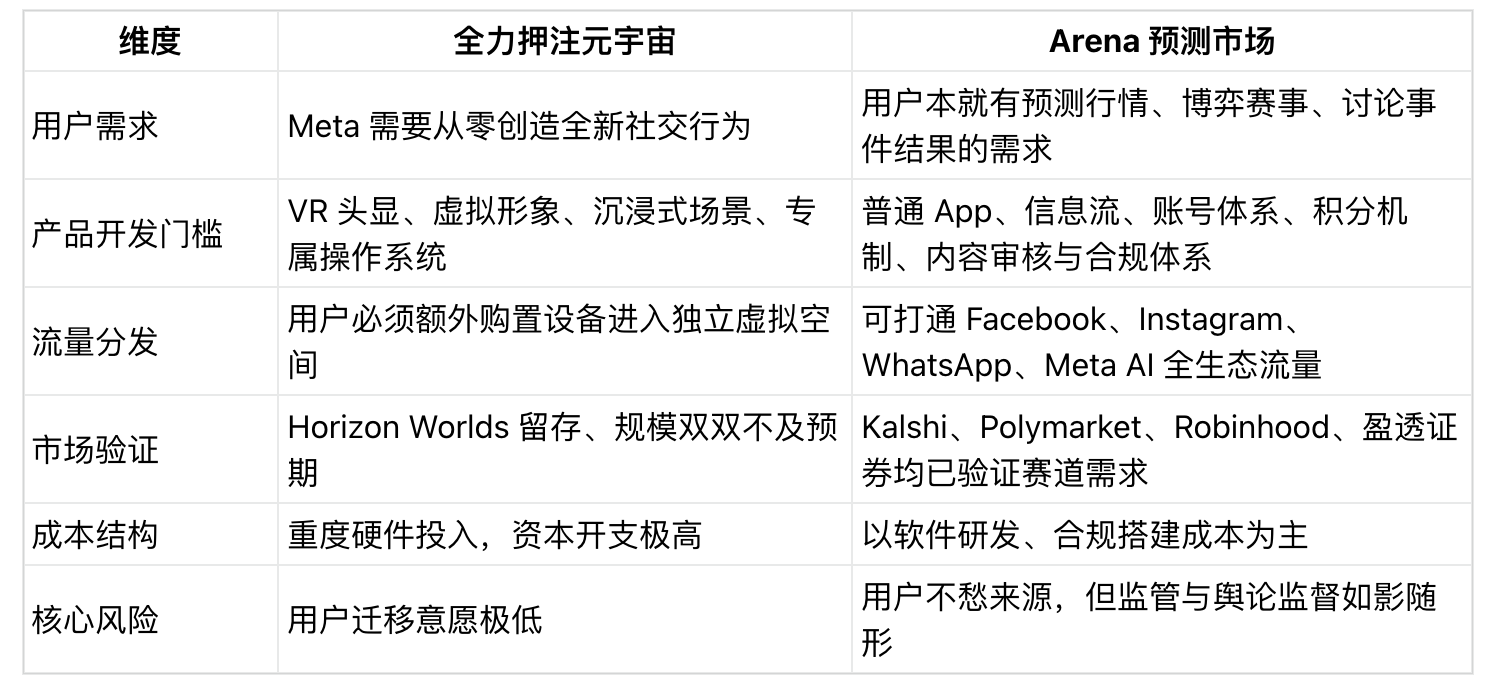
Comparison of the core dimensions of the metaverse and prediction market Arena
Arena is not Meta's first time testing the waters and predicting the market; the last product has already been shut down
As early as the beginning of the 2020 pandemic, Meta launched Forecast, a point-based mass forecasting application, which focused on predicting current events, but shut down in 2022. At the time, Polymarket had yet to explode in the 2024 US presidential election, Kalshi did not win the Federal Commodity Futures Trading Commission (CFTC) election contract lawsuit, and the industry's annual trading volume had not exceeded 50 billion US dollars.
There are plenty of cases of regulatory penalties for Meta's upcoming race track:
In 2022, the CFTC determined that Polymarket conducted OTC derivatives transactions without registration and fined them $1.4 million;
Kalshi spent several years competing for election contract eligibility. The district court handed down a favorable ruling in September 2024, the CFTC abandoned the appeal in May 2025, and the space for contract compliance in general election events was liberalized, but disputes over political transactions and market impartiality have not subsided;
In April 2026, the CFTC launched the first predictive market insider trading lawsuit in history, accusing an active US military officer of using confidential intelligence from Venezuelan operations to profit from Polymarket transactions.
Meta's financial product layout in the past has already made regulators highly wary of its financial ambitions. Diem (formerly Libra), a digital stablecoin project led by Facebook, was sold to Silvergate Bank at a low price in 2022 because regulators determined that Meta's control of the multi-billion user payment network would cause excessive concentration of financial and social power. During the Libra hearing back then, Meta's combination of social identity, political content, financial incentives, and market data was fiercely opposed by regulation.
Meta chose this as the starting point system for Arena because it predicted that the game would circumvent strict financial regulations in the early days.
What advantages can massive traffic bring
The most viable form of Arena's original product is to build a public prediction function based on a social scale: Instagram creators post award prediction markets, Facebook groups discuss sports odds, WhatsApp communities share collective prediction opinions, and Meta AI summarizes mainstream expectations across the network.
Currently, this version does not involve cash incident contracts that have led to regulatory penalties; it only operates on the 3.56 billion Nikko Social Map.
However, the core logic of predicting the market is to rely on real capital games to constrain predictive behavior and form fair prices; once replaced with interactive incentives with points, the product will prioritize dissemination and user time rather than the accuracy of predicted results.
Meta's poor record of dealing with political content and cracking down on disinformation in the past makes it natural for regulators and media to look at every dispute caused by Arena with a critical eye.
Meta's traffic advantage is enough to support the size of the racetrack. Stories and Reels have the same success logic, capture users' existing preferences, and amplify dissemination through billion-level user platforms. If Arena builds a lightweight social forecasting function, controls financial thresholds, and allows ordinary Facebook users to easily access the prediction market, while platforms such as Kalshi maintain professional trading positions, Meta may expand the industry cake and benefit existing leading platforms.
Crypto-native and financial-savvy users have supported the 100-billion-level prediction market circuit, and Meta's 3.56 billion daily activity is a large group of ordinary users that the industry has never reached. This is also the biggest opportunity to enter the market.
However, just two months before news of Meta's entry into the market came to light, the CFTC had just launched the first insider trading lawsuit in predicting market history, and industry regulatory scrutiny continued to tighten. Meta's platform covers forecasting markets related to general elections, sporting events, and public figures, and can easily trigger regulatory intervention; compounding the company's negative records of handling sensitive political content, Meta had its own shortcomings in credibility when it entered the market. Instead, huge traffic amplified all kinds of negative disputes.
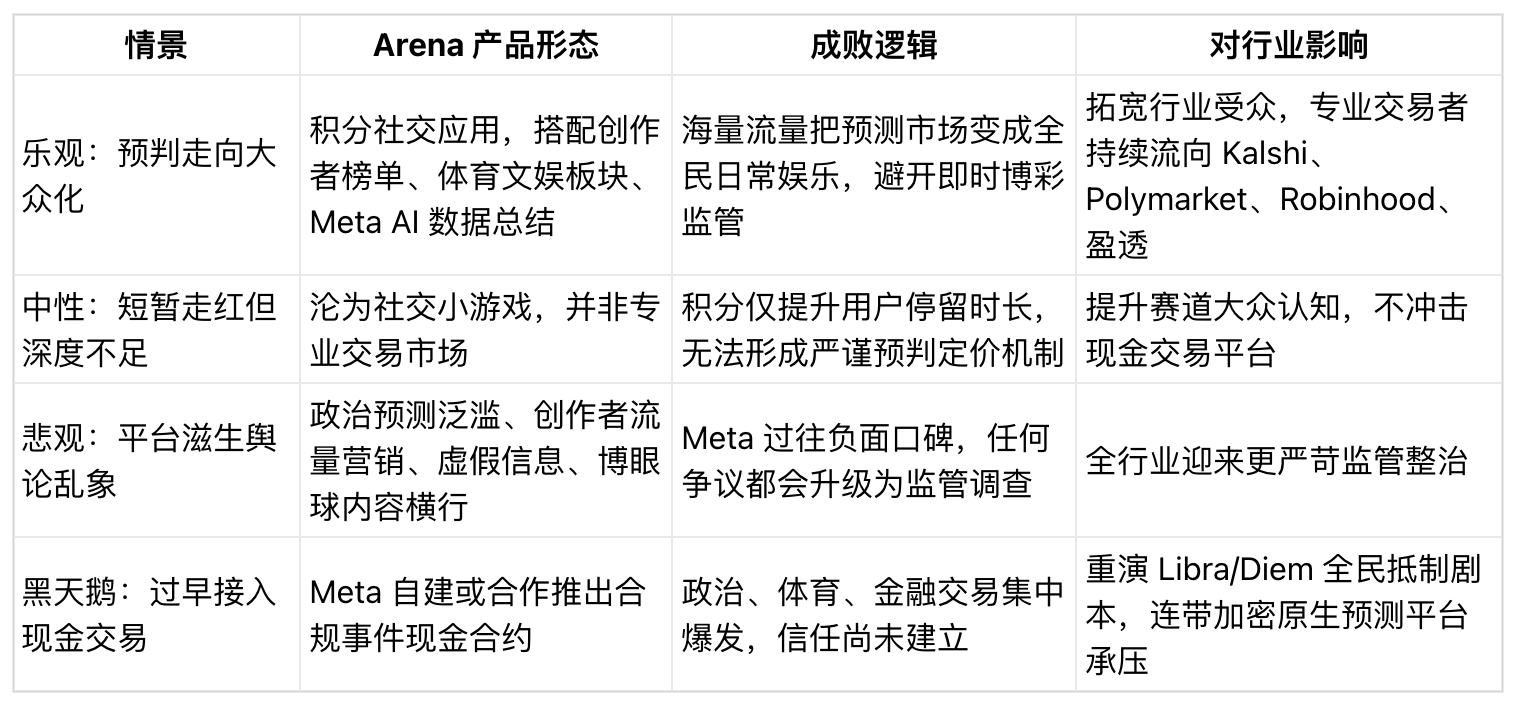
Introduction to the four development prospects of Arena
Many of Meta's previous financial products completely failed due to regulatory findings that trust issues could not be resolved.
Arena has an innate advantage, predicting that the market circuit has taken shape and that there are real existing users. However, Meta, which operates the platform, bears the same negative reputation as when Libra fell through. Once it comes to elections and financial transactions, trust is a core asset that Meta must trade for long-term operations, and the sheer volume of traffic cannot make up for the lack of credibility.
Twitter:https://twitter.com/BitpushNewsCN
Compare the TG exchange group:https://t.me/BitPushCommunity
Compare TG subscriptions:https://t.me/bitpush
