


Sacrificing three exchanges in a month, can the Crypto bull market still come?

The midwaist exchange business seems to have come to an end.
On July 1, AscendEX ceased operations.
On July 23, BitMEX, which once defined a cryptographic perpetual contract and brought 100x leverage to the mainstream market, announced that it would close after two months.
Three days later, BitMart, which has been in operation for nearly nine years, initiated a shutdown procedure: it stopped accepting new users and deposits, ended spot and contract trading on August 26, and officially terminated platform operations on January 31, 2027.
In less than a month, three centralized exchanges (CEXs) that have gone through at least one round of bull and bear cycles have left the market one after another.
In a market that is used to treating bad news as an inverse indicator, this can easily raise the question: exchanges can't survive. Has the crypto market bottomed out?
Not Another FTX Moment
AscendEX, formerly known as BitMax, was founded by a Chinese team with a background in quantitative trading on Wall Street. Founder George Cao and others are closely linked to the New York financial community.
BitMart was founded by Sheldon Xia. In the early days, he participated in events organized by the Yangtze River Business School and the Chinese and US blockchain community in New York, and also set up a team in New York; however, its global business has been operated through offshore entities for a long time, and public commercial data shows that it is headquartered in the Cayman Islands.
Both have clear Chinese entrepreneurial backgrounds and experience in the US market, and are typical examples of the “Wall Street team plus offshore trading platform” entrepreneurial model in the early years.
This model used to work very well.
Between 2017 and 2021, an exchange is not required to obtain a full license in every market or have a bank-level compliance and escrow system. As long as the coin is listed fast enough, the contract leverage is high enough, and there are enough rebates, and with the Chinese-speaking community, Telegram, and KOL subscription channels, it is possible to quickly accumulate users in a round of bull markets.
By 2026, these conditions are far from enough.
Judging from current public information, the three exchanges can be boiled down to three “dead” methods: AscendEX faced liquidity and compliance pressure, BitMart chose to exit in an orderly manner, and BitMEX was left behind by users and trading volume. What they all have in common is that they can no longer afford the high costs of a global crypto exchange.
On the face of it, exchanges have been shut down one after another, which seems easily reminiscent of the FTX-style crisis in 2022.
However, the transmission mechanism is not the same this time.
The bear market in 2018 was the disappearance of demand. The ICO bubble burst, a large number of tokens lost liquidity, retail investors withdrew, and listing fees, transaction fees, and Taiwan dollar valuations fell together.
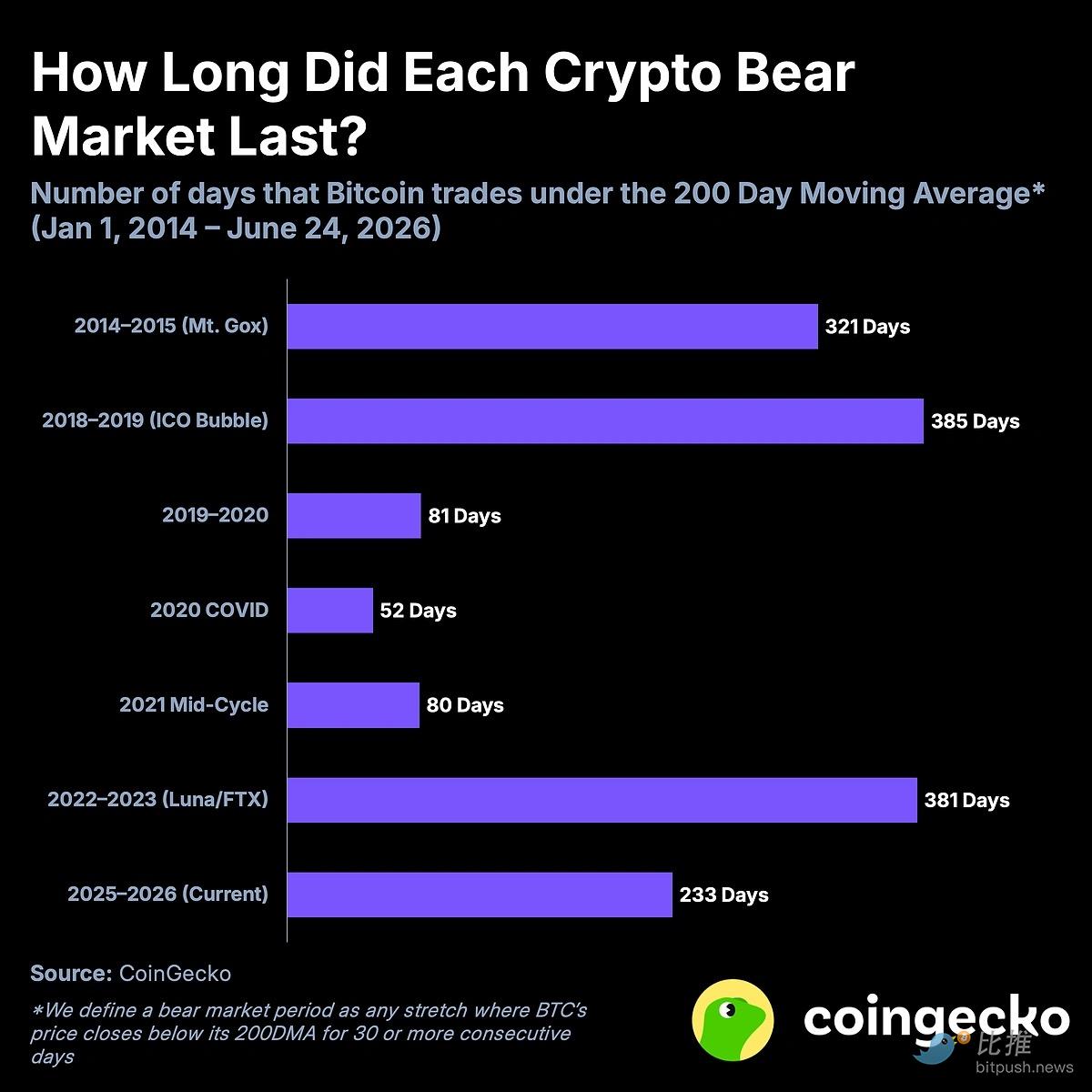
According to CoinGecko's statistical method — which defines Bitcoin running below the 200-day EMA for 30 consecutive days as a bear market — the bear market from 2018 to 2019 continued for 385 days, with Bitcoin's biggest retracement of 83.6%.
The problem in 2022 is a broken credit chain.
After Terra's collapse, the complex borrowing and asset liability relationships between Three Arrows Capital, Celsius, Voyager, Genesis, and FTX turned the failure of a single project into a credit contagion for the entire industry.Bank for International Settlements StatisticsAfter the Terra incident, the market value of more than 450 billion US dollars of crypto assets evaporated; after FTX went bankrupt, the market lost about 200 billion US dollars.
In the 2026 shutdown wave, there was no serial rush of the same scale. It's more like a slow but complete structural elimination:The total market volume has declined, the regulatory threshold has been raised, and liquidity is concentrated at the top, and on-chain transactions have taken away users from the other side.
Regulation has gone from a potential risk to a cost of doing business.
EU MiCA will be fully applicable from December 30, 2024. According to ESMA's explanation, the original crypto service provider can continue to operate for a period of time according to member state regulations, but the transition period must not exceed July 1, 2026 at the latest. Platforms that are not authorized by MiCA cannot continue to rely on the original system to carry out related business after the transition period is over.
AscendEX ceased operations on July 1st. It also acknowledged in the announcement that the platform was not authorized by MiCA. But compliance is only one reason: AscendEX also mentioned failed financing transactions, market pressure, and financial condition assessments.
Regulation didn't kill this exchange alone. It just makes an already weak balance sheet more difficult to maintain.
The old exchange model is dead, and the “incremental sharing dividend” is over
In the second quarter of 2026, the total market capitalization of the crypto market fell 12.6%, from $2.4 trillion to $2.1 trillion, about 52% below the October 2025 high.
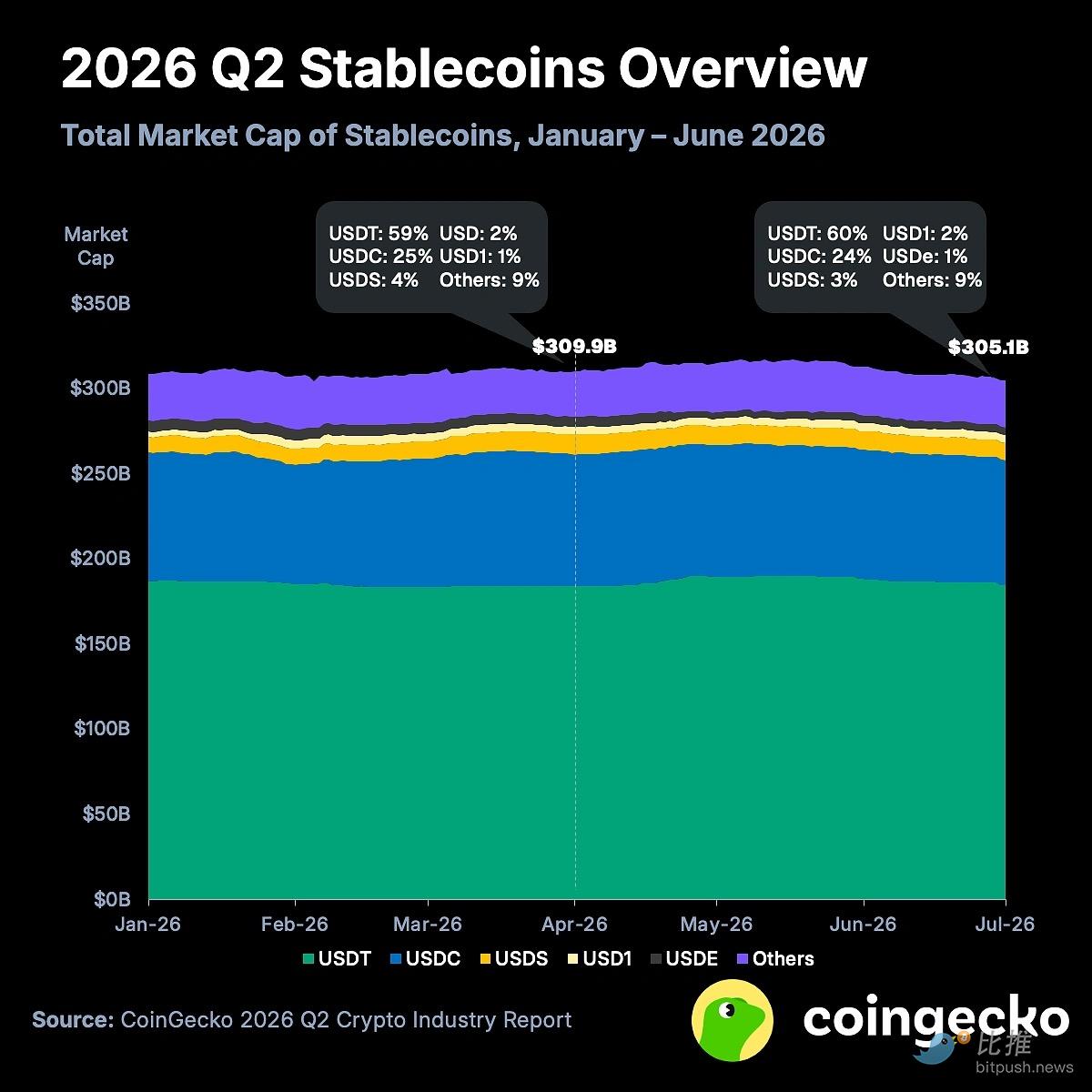
More importantly, “cash” in the industry is also dwindling. The total market value of stablecoins fell 1.6% quarterly to $305.1 billion, the first quarterly contraction since the third quarter of 2023, a clear sign that capital is exiting the crypto market.
The exchange first felt this contraction.
In the second quarter, the spot turnover of the top ten centralized exchanges fell 27.9% month-on-month to US$1.95 trillion; perpetual contract turnover fell 10% to US$12.7 trillion. Binance's spot market share expanded to 38.7%, and Bybit is another platform with a double-digit share.
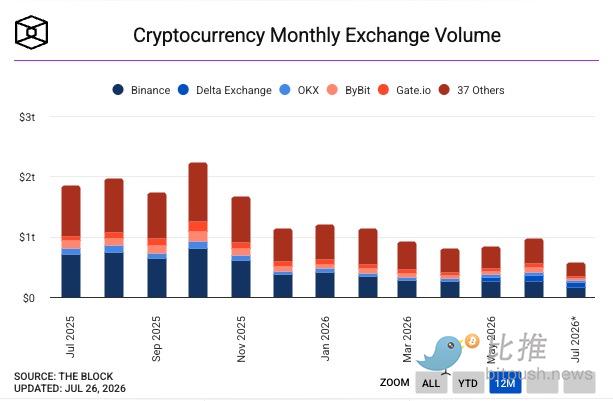
The total trading volume declined, and the share of leading platforms increased.
Small to medium exchanges face a typical squeezing process: the cake is getting smaller, and the biggest companies are taking more.
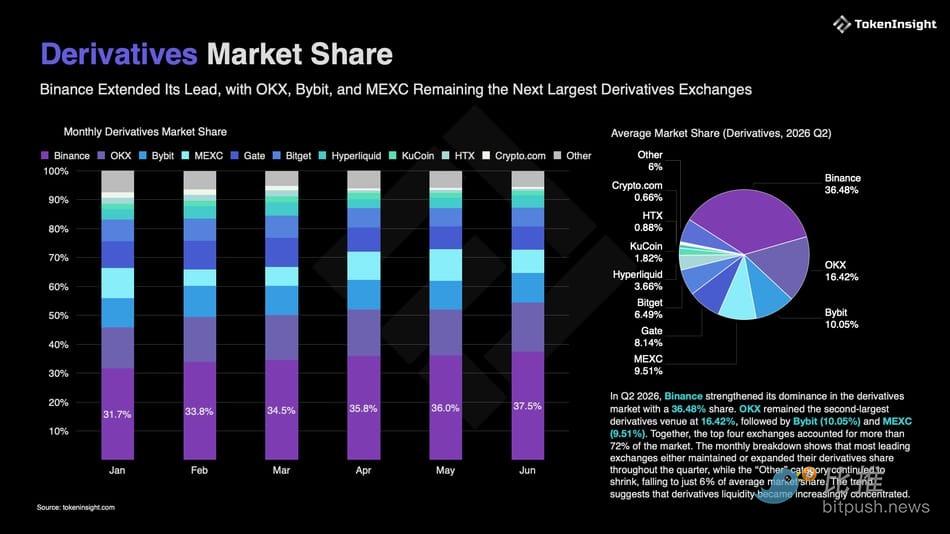
The derivatives market is more concentrated.TokenInsight statistics displayIn the second quarter of 2026, Binance, OKX, Bybit, and MEXC together accounted for more than 72% of derivatives trading volume; classified as “other” exchanges, the average market share was only 6%. In the same period, the size of outstanding futures positions dropped from a high of about 170 billion US dollars in the third quarter of 2025 to about 80 billion US dollars. At the end of June, it was only about 60 billion US dollars.
Liquidity reinforces itself. Platforms with larger trading volume have lower slippage, and market makers are more willing to provide offers; the deeper the liquidity, the easier it is to attract new users and institutions. Conversely, once the volume of small to medium exchanges begins to decline, market makers withdraw, trading price spreads widen, and loss of users often occur at the same time.
But top exchanges aren't the only winners.
The spot share of decentralized exchanges increased from 6.9% in January 2024 to 13.6% in January 2026; on-chain perpetual contract turnover increased about eight times in two years, and the market share increased from 2% to 10.2%. Hyperliquid and Uniswap have already entered the top ten in some spot or derivatives trading volume rankings.
Mid-waist exchanges are in a very embarrassing situation as a result.
They don't have the liquidity of Binance, OKX, and Bybit; they don't have the banking access and regulatory status of local compliant trading platforms; and they don't have the openness and asset coverage capabilities of DEX on-chain agreements.
Over the past two years, many second- and third-tier platforms have tried to find a way out by purchasing licenses and connecting to traditional financial services, such as US stock mapping, compliant derivatives, etc. However, the core problem is that users in the coin industry use cryptocurrencies to trade US stocks, essentially not for long-term holding, but rather view US stocks as another highly leveraged short-term game tool. Although the subject of the transaction has changed, the trading habits have not changed.
This demand itself is rather weak. With the exception of leading platforms such as Binance, OKX, and Coinbase, which can still maintain a certain volume of transactions with traffic advantages, the TradFi business of mid-tier platforms is generally bleak. Spending on a license, connecting to brokerage APIs, and completing compliance audits is ultimately difficult to recoup — it's more like an expensive trial and error investment.
Looking back, the competitive barriers that midwest exchanges depended on in the past are breaking down one by one.
Fast coin transfer? Today, any token can create a liquidity pool directly on the chain, which is faster and has a lower threshold. High leverage? On-chain perpetual contracts also provide high leverage, and come with transparent clearing mechanisms and self-custody of assets. Low offshore operating costs? This advantage has now been transformed into a disadvantage — increased regulatory risks, weak banking relationships, and rising global compliance costs.
Therefore, this wave of shutdowns is not simply a cyclical end of the bear market, but a systematic end to the old exchange business model.
The market has bottomed out, but buying is yet to come back
At the time of writing this article, Bitcoin was fluctuating around $63,000 to $64,000, rebounding from the beginning of the month, but it is still close to falling short from its all-time high of around $126,000 in October 2025.
Glassnode's latest market report shows that up to now, hedging positions have almost been eliminated, bears have been cleared, and capital rates have returned to a stable range. Even the ETF channel, which had been a source of pressure until now, has turned around to net buying support. However, the core of the problem is that the accumulation of supply above has not been digested, and the chip structure has not been substantially improved.
$69,000 is the average cost of holding a position for short-term holders, and it is also the most immediate short and short watershed in the short term. Looking further up, there is a vacuum belt with relatively sparse chip distribution, while $84,000 above is a medium term pressure. Looking downwards, there is a clear demand support around $63,000, but the support structure further below is still in the middle of a run-in, and it cannot be said that it is stable.
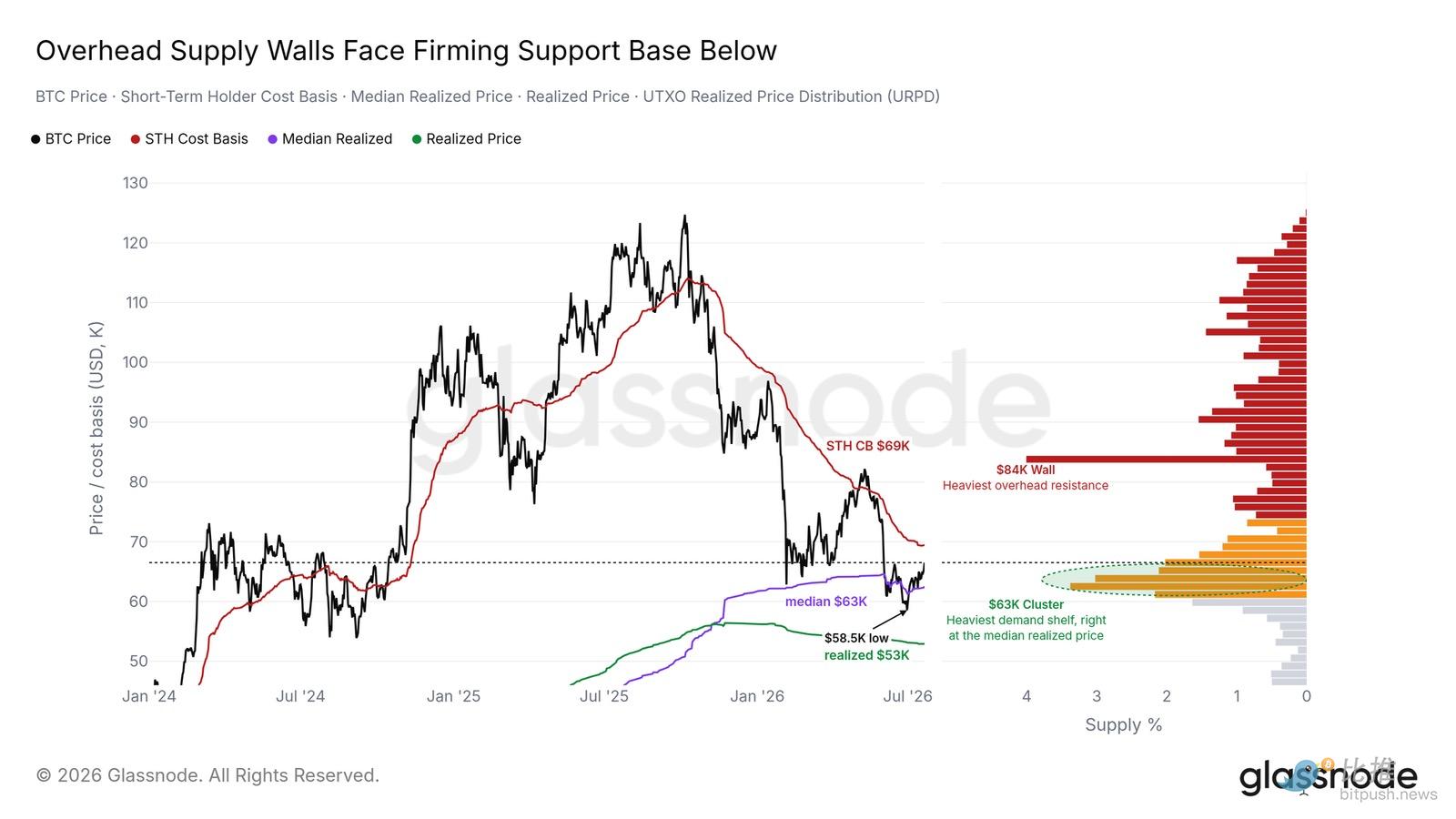
In other words, sellers are drying up, and buyers haven't come back.
This is usually a characteristic of the latter half of a bear market: bad news can hardly cause continuous slumps, but good news can't attract enough new capital.
Citi represents the cautious faction. At the beginning of July,CitiBitcoin's 12-month target price was lowered from $112,000 to $82,000, and the net ETF inflow assumption for the next 12 months was reduced from $10 billion to zero. Its pessimistic scenario target is $53,000. Citi believes that the continued outflow of ETF funds, the slow progress of US crypto legislation, and the shift of market capital to AI-related assets are weakening demand for Bitcoin.
Standard Chartered is more optimistic. Geoffrey Kendrick, its head of digital asset research, still maintains the forecast that Bitcoin will reach $100,000 by the end of 2026, and believes that a major sell-off may have already occurred. But at the same time, he warned that if Bitcoin effectively falls below $60,000, new selling pressure may be triggered.
These views focus on different variables.
Citi looks at ETFs and external incremental capital; Glassnode looks at on-chain costs, holder behavior, and capital flows; Standard Chartered sees whether the sell-off has been fully released. They actually only agree on one thing: whether the market can reverse depends on when new capital re-enters.
Could the next bull run be in 2027?
The start of a bull market never happens in one day—the price bottoms out, the trend reverses, and most coins generally rise. These are three completely different stages.
The first stage is the bottom of the price. At the beginning of June, around 60,000 US dollars was likely to have formed a phased low. This position has been tested repeatedly, and leverage and the size of open positions have been reduced. Note, however, that this can only be confirmed in hindsight — it can only really stand firm until it doesn't break down in the future.
The second stage is trend reversal.
The real market average for short-term holders given by Glassnode in early July was about $76,600; the 200-day EMA calculated by CoinGecko for the same period was about $76,500. This means that Bitcoin needs to return to at least the 75,000 to 80,000 US dollar area in order to break out of the current “deep value zone” and re-establish a medium-term upward structure.
In addition to prices, several conditions are needed simultaneously: net inflows of ETFs for several weeks, total stablecoin market capitalization growing again, spot trading volume rebounding, and simultaneous improvement in on-chain activity and new capital.
Prior to these signals, any rise was more like a rebound than a new cycle.
Based on the current market structure, a more reasonable benchmark scenario would be:The second half of 2026 is still dominated by bottoming out and range-bound shocks. A clear trend reversal window may occur from the fourth quarter of 2026 to the first half of 2027; an overall bull market that actually covers a large number of altcoins and financing markets is more likely to occur in 2027.
This is a scenario deduction based on the current price cost line, ETF funding, stablecoin supply, and historical bear market recovery times.
Under an optimistic scenario, ETF inflows back in, macro-liquidity relaxed, Bitcoin stabilized at 80,000 US dollars within 2026, and the market entered a structural bull market ahead of schedule.
Under the pessimistic scenario, $60,000 was broken down, ETFs continued to flow out, and more corporate treasury companies or mining companies were selling coins. Bitcoin could retest the $53,000 area in Citi's pessimistic scenario, and the new cycle was delayed until the second half of 2027 or even later.
What is certain is that the next round of the bull market will not simply replicate 2017 or 2021. Trading volume will be further concentrated on leading platforms. Exchanges that still rely on currency fees, rebates, leveraged games, and exploiting regulatory gaps to survive are likely not to survive this round of reshuffle.
Author: bootly
Twitter:https://twitter.com/BitpushNewsCN
Compare the TG exchange group:https://t.me/BitPushCommunity
Compare TG subscriptions:https://t.me/bitpush
