


Predicting “no action” and betting on “interest rate hikes” exist at the same time. What are the concerns of the market on the eve of the FOMC?
Author: Fire
Original title: Whether to raise interest rates tonight: Economists say it or not, the market gives a 30% probability
TL; DR
· According to a Reuters survey, economists agree that interest rates will not be raised in July, but the futures market once gave a probability of about 30% of interest rate hikes.
· The disagreement centered on whether the oil price shock would force Warsh to use more hawkish communication to maintain inflationary credibility.
· Related targets: US dollar index, USDJPY, WTI/Brent crude oil, gold, US stocks, Bitcoin and crypto assets.
Federal funds futures were re-priced ahead of the July FOMC resolution, and traders began paying higher prices for the Federal Reserve to unexpectedly raise interest rates or release more hawkish signals.
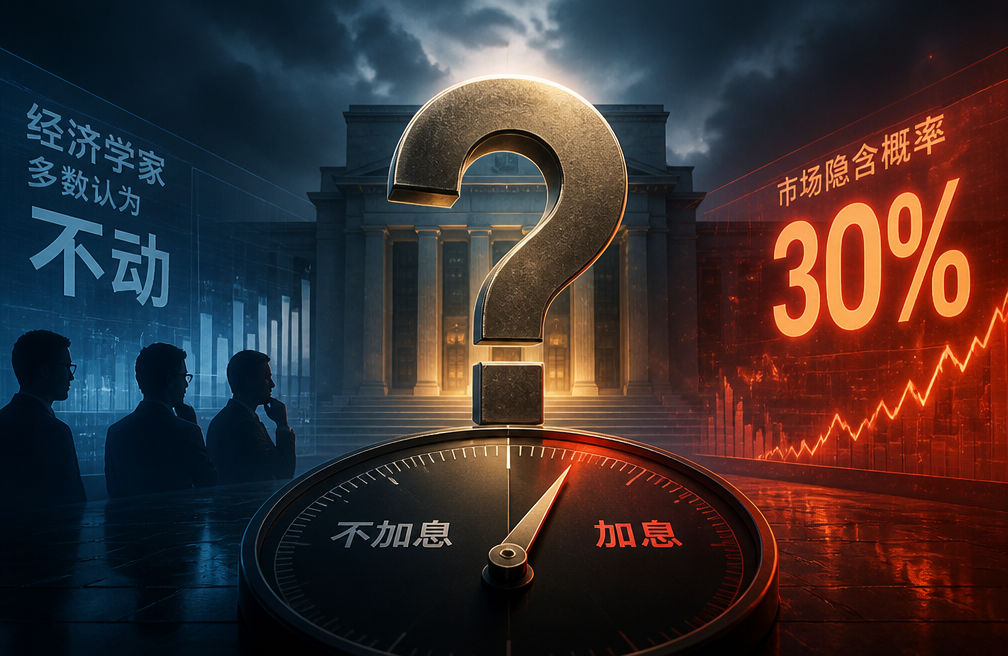
The anomaly is that economists' judgments are almost on the other side. According to a Reuters survey on July 21, all 104 economists expect the target range of 3.50% to 3.75% for the July meeting, and 78 of them expect it to remain the same until the end of the year. However, the futures market once gave a probability of about 30% of the 25 basis point interest rate hike.
For investors, this isn't guessing the outcome of a meeting. The bigger question is whether the market is re-understanding how the Federal Reserve reacts to the impact of oil prices after Kevin Warsh took office as Chairman of the Federal Reserve on May 22.
If Warsh sees the situation in the Middle East driving up oil prices as a temporary supply disturbance, the Federal Reserve is more likely to keep interest rates unchanged and wait for more data. If he is more concerned that oil prices will lead to secondary inflation, even if interest rates are not raised tonight, the September interest rate hike window may be reopened.
Futures markets buy hawkish tail risks
Federal funds futures can be understood as contracts betting on the path of the Federal Reserve's interest rate. The more open contracts, the more money is being bet or hedged around the outcome of the resolution.
According to CME and media data leads, the federal funds futures open position contract rose to a high level before the resolution. This signal does not mean that the majority of the market believes that interest rates will be raised, but it indicates that the uncertainty before the resolution has already been traded into a crowded position.
The “25 basis point rate hike probability” is the same logic. The probability of CME FedWatch comes from the 30-day federal funds futures price and is not the result of an economists' vote. The meaning of a probability of about 30% is that the tail risk suddenly becomes expensive.
Markets don't necessarily think the Federal Reserve will act tonight. It's more like buying insurance for two types of unexpected events. One category is a direct rate hike, and the other type is no rate hike, but statements and press conferences suggest that the September rate hike has entered a serious discussion range.
This is straightforward about asset pricing. The US dollar will be supported by interest rate expectations. If the yen continues to be pressured at a high level, the risk of intervention will be re-discussed. Overvalued stocks and crypto assets face higher discount rates and weaker risk appetite.
BofA and Citi are fighting over the weight of oil prices
The difference between hawkish institutions and dovish institutions is not whether oil prices have risen, but rather how the Federal Reserve should handle this rise.
According to a Reuters report on July 27, institutions such as BofA and Deutsche Bank still use the July standstill as the benchmark scenario, but believe that oil prices and the situation in the Middle East made this meeting close to a dilemma. BofA's concern is that if the Fed completely downplays pressure on oil prices, it could challenge its inflationary credibility.
This set of logic emphasizes the new chairman's first stress test. Warsh has just taken office, and the market doesn't have enough samples to judge the bottom line of his policies. If he seems too relaxed in the face of geopolitical shocks and inflationary pressures, investors may wonder whether the Federal Reserve is still willing to prioritize inflation.
The judgment of agencies such as Citi is more biased towards a different set of explanations. The rise in oil prices is first a supply shock. Price pressure comes from concerns about energy supply; it is not that US demand is overheating. Interest rate hikes will not produce more crude oil; an overreaction may dampen growth.
The core concept is secondary inflation. The rise in oil prices itself can be a short-term disturbance, but if it is transmitted to transportation, commodities, wages, and inflation expectations, it will become more enduring price pressure. Hawks are worried about the latter; doves believe that interest rates have not yet been raised to the point where it is necessary to raise interest rates.
Therefore, what the market is arguing about is not the price of oil itself, but the weight of the oil price in the response function of the Federal Reserve. Will Warsh treat it as temporary noise or as a reputational risk that needs to be suppressed in advance.
New Chairman Expands Path Pricing
The peculiarity of Warsh since taking office is that the market has yet to form stable expectations about his communication style. In the Powell era, investors were used to looking for path hints in wording, bitmaps, and press conferences. In the new presidency phase, the weight of every sentence will be amplified.
If the Federal Reserve reduces forward-looking guidance and repeatedly emphasizes reliance on data, the market ostensibly gains flexibility; in reality, it assumes a wider distribution of interest rates. Traders are not convinced that the policy path is stable before the next meeting, so they can only hedge ahead of time.
This also explains why economists can unanimously predict no movement tonight, and the market is still willing to price interest rate hikes. The economist answered that the most likely outcome was that the trading market would have to pay for the unfavorable scenario. The two measurements are not the same problem.
As far as the US dollar is concerned, as long as Warsh does not clearly lower the possibility of raising interest rates, there is still support for a strong US dollar. As far as the yen is concerned, once the spread between the US and Japan is expected to continue to widen, the high level of USDJPY will test the Japanese authorities' tolerance.
For risky assets, the most uncomfortable combination is not tonight's interest rate hike itself, but rather the combination of rising oil prices, a strong dollar, and the Federal Reserve's reluctance to rule out interest rate hikes early. This will reduce valuations, liquidity expectations, and risk appetite.
Even if the Federal Reserve maintains the target range of 3.50% — 3.75%, assets may still trade according to hawkish results as long as it states that the risk of inflation is ranked higher, or Warsh refuses to downplay the possibility of a September rate hike at a press conference.
The September window determines how far this pricing can go
The benchmark scenario remains on hold. Current market changes only indicate that traders are significantly reevaluating policy paths and communication risks; they do not mean that the Federal Reserve has decided to restart the interest rate hike cycle.
What the press conference wants to verify is how Warsh defines an impact on oil prices. If he emphasizes that the rise in energy prices still needs to be observed and long-term inflation expectations remain fixed, the market's hawkish pricing for July and September may fall, and the dollar's rise will cool down.
If he repeatedly emphasizes that oil prices may be transmitted to a wider range of prices and puts inflation back to 2% as a policy priority, the market will understand this as opening the September window. At that time, that is, the convenience rate will not change tonight, and the focus of the transaction will also shift to whether the next meeting needs to be repriced.
The yen would be the most sensitive external pressure gauge. If USDJPY continues to rise, the risk of Japanese intervention will become a border that dollar bulls must face. For US stocks and crypto assets, the pressure is not a single meeting, but whether the market is beginning to accept a higher and longer interest rate path.
Twitter:https://twitter.com/BitpushNewsCN
Compare the TG exchange group:https://t.me/BitPushCommunity
Compare TG subscriptions:https://t.me/bitpush
