


Gold returns to 4,350 US dollars, and a new round of precious metals market begins?
Source: Groove BlockBeats
Original title: Gold returns to $4,350, is the precious metals pullback over?
The central bank's gold purchases have resumed, and silver is in continuous deficit. The rebound also depends on the US dollar and actual interest rates
Key points:
· Sprott believes that the 2026 annuity decline is more like a cyclical correction in a long-term bull market. Gold rose above $4,350 per ounce on August 7.
· Global central banks' net purchases in the second quarter were 289 tons, about five times the 57 tons after the first quarter correction, but the amount of money purchased in the first half of the year was still the lowest since 2022.
· Silver is expected to be in short supply for the sixth year in a row, but industrial demand is slowing, and the dollar, real interest rates, and liquidity will still amplify short-term fluctuations.
Sprott Asset Management recently released a precious metals report, characterizing the retracement of gold and silver since 2026 as a cyclical correction in a long-term bull market.
It's not the end of the market since 2025.
As of August 7, gold had once risen above $4,350 per ounce, a seven-week high.
Previously, the price of gold stabilized in the 4,000—4100 US dollar area, indicating that safe-haven demand and financial sentiment have begun to recover.
The question this report is trying to answer is straightforward: after gold rose 64.58% and silver rose 147.95% in 2025,
Does the apparent pullback in the first seven months of 2026 mean a trend reversal, or a rebalance after leverage and financial sentiment have cleared up?
As of July 31, gold closed at $4046.15 per ounce, falling 6.33% during the year;
Silver closed at $57.60 per ounce, down 19.63% during the year. Although both varieties are down from the beginning of the year, prices are still significantly higher than a year ago.
For investors, what they really need to observe is not whether there is a correction in gold and silver, but whether the long-term demand that supported the previous round of growth has changed.
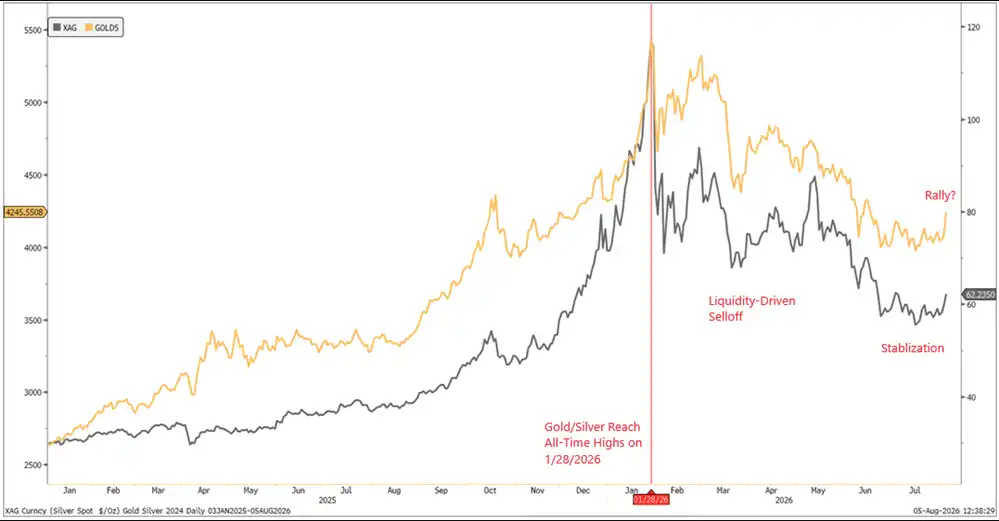
Gold and silver rose sharply in 2025 and retreated markedly after hitting a high in early 2026, but by the end of July they were still higher than a year ago
The price of gold stabilized around $4000, and futures funds began to flow back
Sprott's judgment is not that precious metals will not continue to fall, but rather that this round of retracement has not destroyed long-term support factors.
Annuity banks rose too much in 2025, and continued to reach record highs in early 2026, and the market has accumulated more leverage and profit margins.
Sprott believes that the March geopolitical conflict unexpectedly tightened global liquidity, and some leveraged investors were forced to sell gold to raise cash;
After entering the second quarter, the situation between the US and Iran eased, oil prices fell, and the US dollar strengthened.
As well as expectations that US interest rates may remain high for a longer period of time, precious metals prices have been further suppressed.
By early summer, some selling pressure was gradually released.
Gold regained physical demand and central bank buying support around $4,000, then rose above $4350 on August 7.
Silver fluctuated more sharply, but it also stabilized in the $55-60 area, and once rose again above $60.
Futures positions are also showing signs of a return.
According to Saxo Bank's compilation of CFTC data, as of the week ending August 4, hedge funds had increased their exposure to precious metals before gold completed technical breakthroughs.
Net speculative long positions in silver futures increased 32% month-on-month, and net long gold positions also continued to rise, reaching their highest level since January.
Meanwhile, speculators cut back about $13 billion in a week, the biggest weekly decline in six years.
However, the overall dollar position is still clearly too large, and it is not yet possible to judge that the dollar trend has reversed based on this.
COT data is more suitable for observing short-term financial sentiment. It shows that precious metals are attracting speculative capital again.
However, it cannot be proven alone that a new round of bull market has begun.
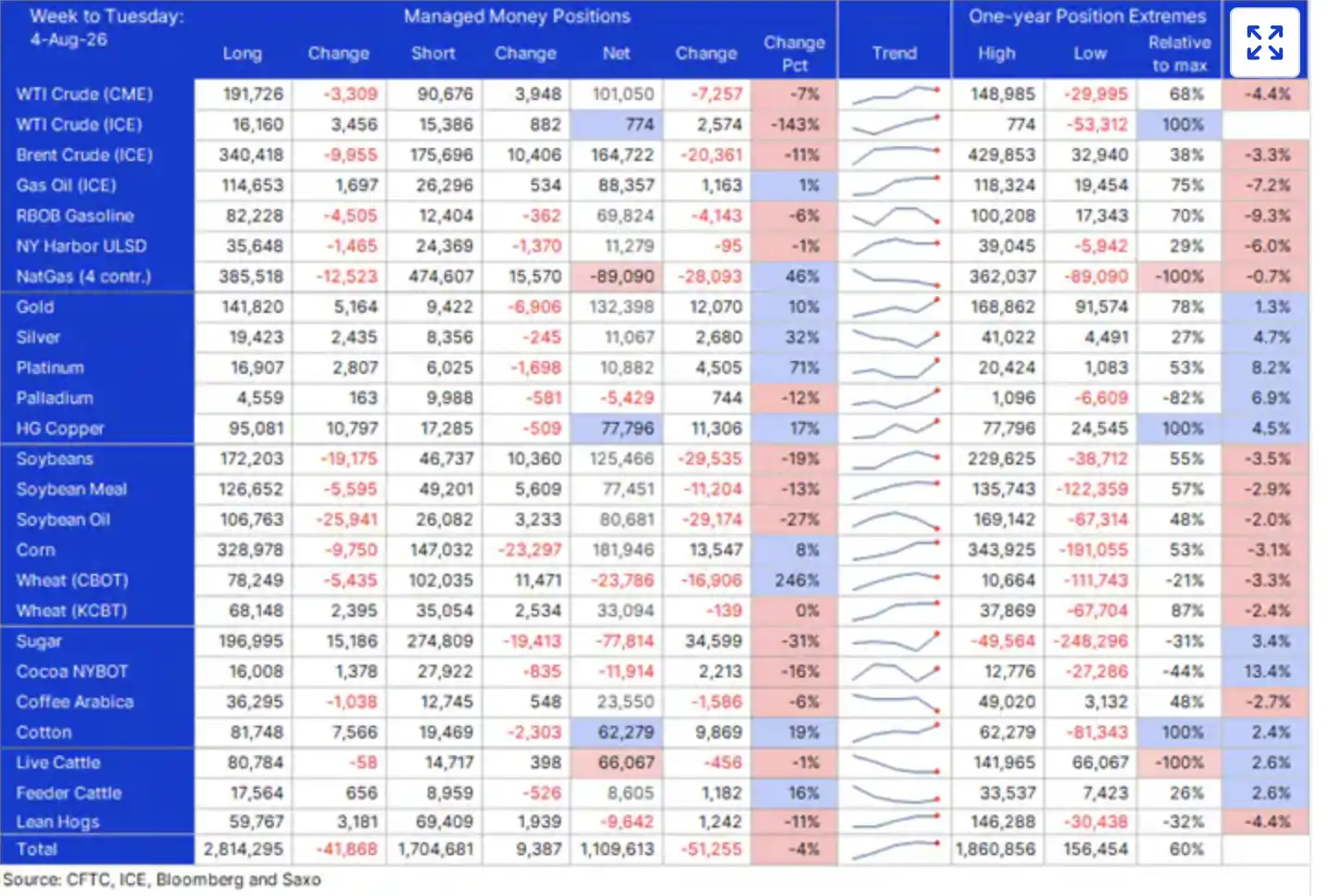
Net longings for silver increased 32% month-on-month to about 11,000 lots, but overall positions remained relatively low.
The central bank's net purchase capital was 289 tons in the second quarter, but demand did not fully recover in the first half of the year
Long-term support for gold is still inseparable from central banks and sovereign funds.
According to data from the World Gold Council, the net purchase amount of global central banks reached 289 tons in the second quarter of 2026, which is about five times the revised 57 tons in the first quarter.
The year-on-year increase was 62%, and the highest level for the second quarter since statistics were available.
However, there is another side to this set of data.
Due to the drastic reduction in the volume of funds purchased in the first quarter, the central bank's total net purchase amount for the first half of 2026 was 345 tons, the lowest level since the first half of 2022.
This means that central bank demand clearly recovered in the second quarter, but whether it has re-entered the phase of continuous acceleration is yet to be confirmed by subsequent data.
Judging from the disclosed data, Poland and China were significant buyers in the second quarter, increasing their holdings by about 51 tons and 33 tons, respectively.
The official sector continues to allocate gold, and long-term factors such as expanding sovereign debt, fiscal deficits, geographical differentiation, and diversification of reserves are still behind it.
Gold is not tied to a single sovereign credit, so it is still regarded by some central banks as a strategic asset other than traditional foreign exchange reserves.
This type of buying may not continue to drive up short-term prices, but it may support spot demand when ETF outflows, leverage is closed, or investor sentiment weakens.
Whether central bank purchases can maintain their strength will also be one of the important variables in judging whether support around $4,000 is stable.
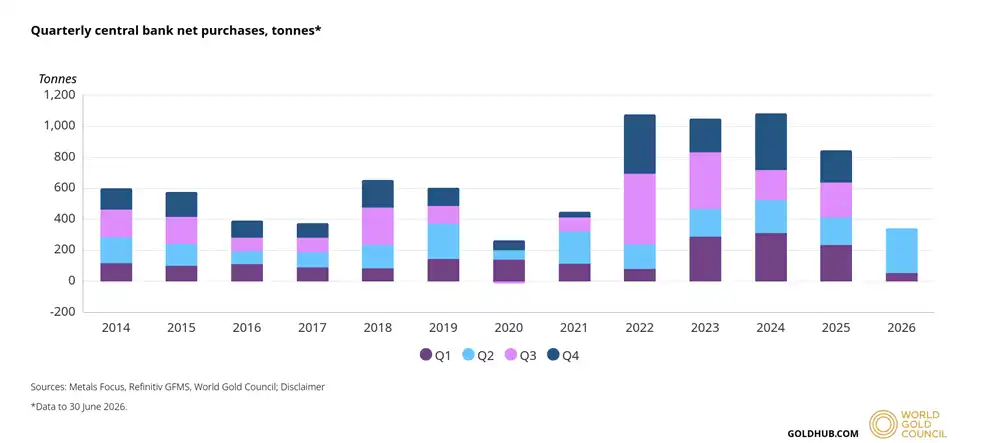
The net purchase of global central banks in the second quarter of 2026 was 289 tons, about five times the revised 57 tons in the first quarter, and the highest level in the second quarter since statistics were available;
However, the net purchase amount for the first half of the year was still the lowest since 2022
Demand in the silver industry is slowing, but the supply gap is still widening
The pricing logic for silver is more complicated than gold. It has both monetary and investment attributes, and is also affected by changes in industrial demand, mine supply, and inventories.
According to the “World Silver Survey 2026” released by Silver Institute and Metals Focus in April,
The global silver market gap was 40.3 million ounces in 2025 and is expected to expand to 46.3 million ounces in 2026, which will be the sixth year in a row that supply will be in short supply.
Continuous deficits mean that the market still needs to consume ground inventory to make up for the gap between supply and demand. However, 2026 was not an all-inclusive increase in industrial demand.
The report predicts that industrial demand for silver will drop to 639.6 million ounces in 2026, a year-on-year decrease of about 3%;
Among them, demand for photovoltaic silver is expected to drop by 19%.
This mainly reflects that high silver prices are driving photovoltaic companies to reduce the amount of silver used per unit of product, rather than all industrial applications expanding at the same time.
Grid investment, electrification, AI infrastructure, and advanced manufacturing are still sources of long-term demand for silver.
However, it cannot simply be understood that all industrial segments will grow in 2026.
The silver gap continues to widen, and is not only determined by industrial demand, but is also related to changes in mine supply, recycling supply, and investment demand.
This is why silver usually fluctuates more than gold. When rising, the market size is smaller, inventories are tight, and speculative capital inflows will amplify price elasticity;
In times of decline, concerns about industrial demand, tight liquidity, and liquidation of leveraged positions will also make the decline even deeper.
Silver fell nearly 20% in the first seven months of 2026, which is significantly weaker than gold.
As prices stabilize in the $55-60 region, the market is re-evaluating the driving effects of continuous deficits, rising investment demand, and a rebound in gold on silver.
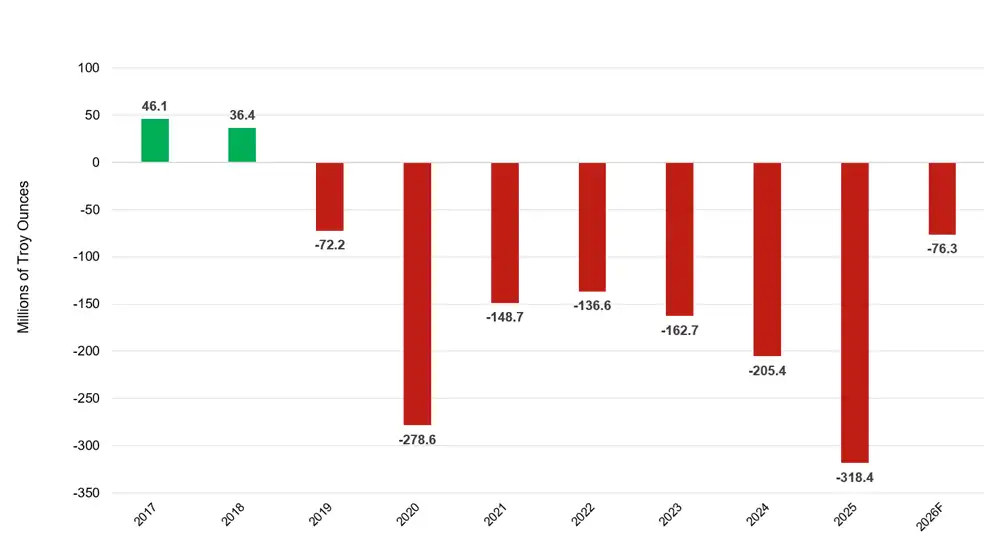
The global silver market experienced a 40.3 million oz supply gap in 2025 and is expected to expand to 46.3 million ounces in 2026. It will be the sixth year in a row that supply will be in short supply
Long-term logic has not been broken, and short-term reversals are yet to be confirmed
Sprott's long-term bullish position is very clear, but “a pullback is not the end of a bull market” cannot be directly equated with “a new round of gains has been confirmed.”
The biggest turmoil facing precious metals still comes from the macro environment. If the US dollar strengthens again and real interest rates continue to rise,
Or global liquidity tightens again, and the rebound in gold and silver may be interrupted.
Due to its industrial nature, smaller market size, and higher participation in leveraged trading, silver is likely to continue to fluctuate more than gold in the short term.
The central bank's gold purchase and silver deficits are medium- to long-term support, and this does not mean that prices will not retreat sharply.
Although central bank purchases clearly recovered in the second quarter, the scale in the first half of the year was still lower than in recent years;
Although there is a continuous supply gap for silver, industrial demand is slowing down; although COT shows a return of capital,
Futures positions may also reverse rapidly as the dollar and US bond yields change.
Therefore,The meaning of 4350 US dollars is not just a price point, but after gold stabilizes around 4,000 US dollars,
The market is beginning to re-examine whether the long-term bullish market for precious metals still holds true.
Next,Whether the rebound in gold and silver can continue depends mainly on four variables: whether the central bank's gold purchases can maintain their intensity,
Whether the silver deficit continues to consume inventory, whether the dollar and real interest rates are rising again, and whether the return of futures capital can continue.
Existing data supports “the long-term bullish logic has not been broken,” but it is not enough to prove that a new round of one-sided upward movement has begun.
(This article is not an investment basis)
Twitter:https://twitter.com/BitpushNewsCN
Compare the TG exchange group:https://t.me/BitPushCommunity
Compare TG subscriptions:https://t.me/bitpush
