


How do you view the US macroeconomy and the trend of US stocks in the second half of the year?
2020 should be a year that will go down in history. Since the outbreak of COVID-19 at the beginning of the year, the global economic situation has completely changed. Based on the extensive data I have come into contact with experts and scholars in the medical community, it can be initially determined that the coronavirus will coexist with human society for a long time. Eliminating the pandemic is almost impossible. One conclusion that can be clearly concluded is that the future direction of human development will be completely out of use with the past few decades. It is likely that the 20s of the 21st century will be the beginning of a major transformation. The author hopes to use this article to make an outlook on the US macro and global economy. At the same time, we are also doing some analysis on the next trend of the core S&P 500 index of US stocks.
Like other economies, the US macroeconomy consists of four major components: consumption, investment, government revenue and expenditure, and trade. The current situation has led me to judge that consumption will be the highlight of the US economy. The government's fiscal policy to stimulate the economy will also continue to increase in the second half of the year. However, investment and trade will be the weak link in the US macroeconomy in the second half of the year.
1. US consumer spending is expected to rise sharply
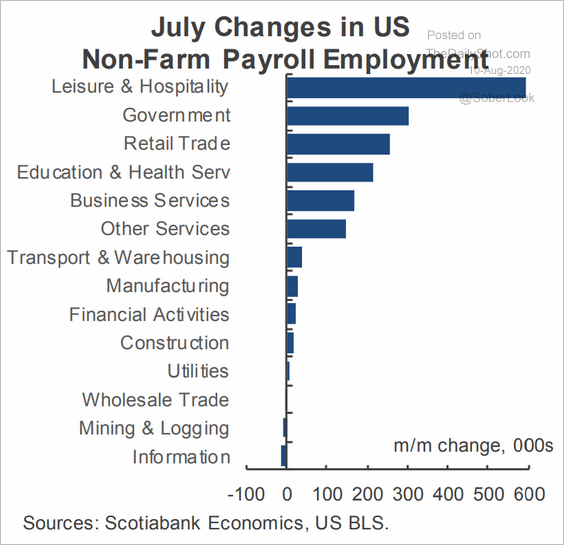
Although there was a second wave of COVID-19 in the US in mid-July, which led the governments of Florida, Texas, California and other places to introduce new social distancing regulations, which affected the consumer confidence index, there is no doubt that the overall consumption situation in the US has improved dramatically. It can be said that April and May were the bottom of the US economic recession caused by the coronavirus. As the economies of New York and other northeastern US states gradually resume work, various data have shown a sharp recovery in consumption. This can be seen from the July employment changes in the figure below: The sector with the most new jobs was the leisure and hospitality industry.

(US Department of Labor added employment breakdown data for July)
Of course, after the COVID-19 outbreak, the government's large-scale fiscal stimulus policies, including issuing cash checks to residents, also stimulated consumption very strongly. Looking at specific consumption categories, the number of trucks and motorhomes purchased by US residents is rising rapidly, probably due to the new trend of summer car travel. Also, including furniture, home improvement spending is at the top of the rise. Everyone works from home, and after studying and attending classes at home, it triggers the need to update and upgrade the home environment. The epidemic has caused a large number of residents to shop online, see a doctor online, etc., which has had a huge impact on the development of the technology industry. Spending related to cloud computing, chips, remote video, etc. is expected to continue to grow rapidly.
2. The scale of fiscal and monetary policy stimulus will remain high
Over the past 30 years, tax cuts have been at the core of fiscal policies in countries around the world. The large-scale tax cuts that began after US President Reagan came to power have been emulated by various governments. Personal income tax for America's highest income earners has been declining since it peaked at nearly 90% in the 70s. Reagan, Clinton, and George W. Bush all drastically cut personal income taxes. There has been a slight increase since Trump came to power; currently, it is around 40%. A more serious issue is corporate income tax. Over the past 30 years, countries have competed to cut taxes on enterprises. Ireland in the European Union became the country with the lowest tax rate among developed countries. It plummeted from 50% in 1982 to 12.5%, attracting a large number of global multinational companies to establish their tax headquarters in Ireland. The US tax reform at the end of 2017 also directly reduced corporate tax from 38% to 21%. Countries around the world also have a large number of special economic zones, which maintain extremely low tax rates. The research report I saw mentioned that the actual tax rate for many multinational companies around the world is close to zero. For example, Amazon in the US is extremely successful, with a market capitalization of over 1 trillion US dollars, but the income tax paid is basically close to zero.
After the outbreak of COVID-19, America's fiscal stimulus was at the top of the list among countries in the world, both in absolute value and as a share of GDP. These include direct cash benefits to individuals, unemployment benefits, and substantial loan and grant subsidies for small and medium-sized enterprises. The current second wave of fiscal stimulus policies will include the suspension of payroll tax collection, a second round of cash subsidies, etc. It can be said that America's fiscal stimulus will continue at a high level. The driving effect of finance on macroeconomic growth will be very obvious in the second half of this year and next year.
In line with this, the Federal Reserve's monetary policy is also unprecedentedly relaxed. This includes rapidly cutting interest rates to zero after the outbreak of the pandemic, and then expanding the balance sheet by more than $3 trillion. A large amount of liquidity injection has had a significant effect on the rise in the stock market and the corresponding wealth.
3. Weak investment expectations
After the outbreak of COVID-19, the negative impact on the real economy was enormous. In particular, demand for machinery manufacturing, transportation, etc. is sluggish, and factory capacity utilization is very low. Looking at it now, it is likely that the global overcapacity situation will continue until 2021. As a result, corporate investment under capital projects is expected to weaken. In the energy industry in particular, after oil prices plummeted this year, all major energy companies have drastically cut their investment scale. Corresponding investments in oilfield services, machinery manufacturing and other industries have had a negative impact. It can be said that looking ahead to the second half of the year and 2021, overall investment expectations in the US macroeconomy will be relatively weak. This can also be confirmed from the outlook for large US manufacturing companies such as Boeing and Caterpillar. The latest quarterly reports of these companies all mention that it will not be possible to see a return to growth in investment demand until the second half of next year.
4. There has been a serious contraction in trade
The theory of “internal economic circulation” proposed domestically this year is actually very forward-looking. After the outbreak of COVID-19, the impact on global trade was enormous. The author believes that it is likely that the highly effective, low redundancy industrial chain structure between countries in the past will probably be gone. Since Clinton was elected President of the United States in 1992, the world has experienced a major development of free trade for nearly 30 years. Some of the more iconic events include the establishment of the North American Free Trade Area (NAFTA) by the US, Canada, and Mexico in 1994. The establishment of the North American Free Trade Area has had many positive effects. For example, American agricultural products have entered the Mexican market in large numbers, while the Mexican manufacturing industry has received large amounts of past employment and investment transfers from the US and Canada. This has had a positive effect on the macroeconomy of all three countries, but it has also caused a large number of Mexican farmers and industrial workers in the US and Canada to lose their jobs. In the ten years of the North American Free Trade Area, which began in 1994, the share of US foreign trade in the US macroeconomy jumped from 19% to 30%. And China's entry into the WTO in 2001 was also an extremely important event. Beginning in 2001, a large amount of global manufacturing capacity began to be transferred to China, and China became the world's factory. China's total economy has grown rapidly since 2001. From the speed of urbanization to reducing the number of people living in poverty, it has created a miracle in human economic history.
However, after the outbreak of COVID-19, transportation between countries around the world was basically paralyzed due to various reasons such as quarantine and control of the spread of the virus. Global international air traffic declined by 97%. Even this year, half a year after the outbreak of the epidemic, the vast majority of countries have not achieved normal passenger and freight traffic. Total global trade fell by more than 30% in the second quarter of this year, and there is no sign of rapid improvement in the second half of this year. Whether it's trade in goods or services, face-to-face communication is very important. Without effective communication for a long time, it is difficult to recover global trade.
The bigger problem facing global trade now is a lack of trust. The premise of an efficient industrial chain, zero inventory, and specialized division of labor is a high level of trust. After the outbreak of COVID-19, there were many cases of restrictions on the import and export of key raw materials, intermediate products, and finished products between countries, which seriously affected the mutual trust relationship in the trading system. What is more serious is the healthcare industry. Many countries are now proposing to localize the production of important pharmaceuticals, medical equipment, etc., to ensure that shortages do not occur again. Other industries such as food, electronic equipment, and auto parts have also experienced cases where the industrial chain was interrupted. In fact, the common problem currently shared by major industries around the world is overcapacity. The core problem solved by international trade in the past was the global division of labor to achieve efficient production based on the comparative advantages of each country. Global trade is facing a long-term structural decline as major economies are promoting localized production. WTO Director-General and former Brazilian diplomat Roberto Azevedo (Roberto Azevedo) resigned in May of this year. The unprecedented resignation of the head of a major international organization in the middle of his term represents his pessimism and disappointment about the prospects for international trade.
5. Prospects for the US stock market
The US election will be held in November this year. The author believes that in the face of serious differences between the two parties in American society, it is not ruled out that some extreme remarks and incidents will occur before the US election. The current valuation level of the US stock market is high, and the main driving force for profit comes from technology stocks. Therefore, if a risk event occurs, which affects investor sentiment, there is a high possibility that US stocks will fluctuate drastically. Of course, due to the Federal Reserve's large-scale quantitative easing policy, the current market is extremely liquid. Therefore, when there is a sharp decline in US stocks, it will also be a good opportunity to break the bottom. From now until the US election on November 3, US stocks are likely to fluctuate within a large range.
Judging from seasonal factors, US stocks generally fluctuate a lot from June to September, and the expected risk is higher than the return period. Some of the major risk events in the past, including financial crises, and geopolitical risks also occurred frequently during this period. However, after the election results were revealed in early November, the uncertainty about who the future owner of the US White House will disappear, which will be beneficial to risky assets.

In summary, the author believes that after the outbreak of COVID-19, the global economy, including the US, will face very serious challenges. In the past, we only talked about efficiency. The global industrial chain structure with a high division of labor, zero inventory, and zero redundancy will inevitably be reset. While pursuing economic security, governments will largely sacrifice the efficiency of some global multinational industrial chains. Under a combination of fiscal policy and monetary policy to stimulate the economy, America's macroeconomy will be largely consumption-driven. Therefore, consumption-related sectors can be paid attention to.
The overall performance of global technology companies has been excellent since the outbreak of COVID-19. For example, the recent public speech by the chairman of Microsoft mentioned that after the COVID-19 outbreak, Microsoft customers' demand for technology applications grew faster than the two-year increase under normal circumstances. The author believes that from cloud computing, to artificial intelligence, to work-from-home, remote learning, and telemedicine applications, the COVID-19 pandemic has sparked a technological revolution and triggered rapid growth. In addition to software, demand for hardware after the outbreak of the epidemic also drove rapid global growth in the chip industry. This trend will continue in the next few years, so the technology sector can also be the focus of the configuration.

(The number of IPOs of US biotech companies reached a record high this year. Data source: WSJ)
Finally, the severity of the epidemic has also triggered large-scale investment in medical industries such as pharmaceuticals and vaccines. It can be said that after experiencing a period of decline in the past five years, the global pharmaceutical industry will also see another round of explosive growth in innovation and R&D. The immunization needs of hundreds of millions of people, and the treatment needs of tens of millions of people will greatly stimulate the healthcare and biotechnology industries. Therefore, the medical and pharmaceutical sectors are also industries we recommend investors pay attention to and be highly qualified for.
Source: Kevin Chen Kaifeng Chen
