信任危机 · 226
Coin Circle OG Ye Junde fell naked and died: from the peak of his wealth to the last early morning

Coin Circle OG Ye Junde fell naked and died: from the peak of his wealth to the last early morning

Source: Shenchao TechFlow Author: Lin Zhengying Original title: Coin Circle Who Fell Naked OG: Ye Junde's Wealth, Gambling, and Asunción's 100-meter altitude in the last early hours of the morning. At 4:30 a.m. on August 7, 2026, the 911 alarm center in Asunción, the capital of Paraguay, received a call: A dead body was lying downstairs in Jade Park, an upscale apartment building in the Trinidad district. When the police arrived, they saw strange images: the deceased was naked, covered in a black plastic bag, and suspected to have fallen from 30 floors about 100 meters high. The deceased was soon initially identified — Harry Chun Tak Yeh, Chinese name Ye Junde, founder and managing partner of cryptocurrency fund Quantum Fintech Group, a Chinese crypto investor claiming to be in charge of more than $2.4 billion in assets. Investigators went up to the 30th floor and found that the doors of the apartment he was living in were wide open, and the house was a mess, but it was empty. He also has another apartment on the 27th floor of the same building where his Brazilian girlfriend, Isadora de Proenca Braganholo Carvalho, 29, lives. Faced with questioning by the prosecution, she said she didn't know anything, and the police have not publicly charged her with any wrongdoing so far. Prosecutor María del Carmen Palazón led the investigation and investigated the three possibilities of accident, suicide, and homicide. Everything waited until the autopsy results were discussed. The $500 entry history of Ye Junde's family is the most classic screenplay in the coin industry. He was born in Hong Kong and immigrated to Canada as a child. He studied electrical engineering at the University of California, Berkeley as an undergraduate, and later got an MBA at Stanford Business School. At least that's what he described as his resume. Prior to entering the crypto world, he followed the standard Silicon Valley elite route: an engineer, CTO and co-founder of several startups, running a technology consulting firm, and serving organizations with revenues ranging from $5 million to $200 million. Bitcoin was still hovering around $60 in 2013. Ye Junde used $500 to buy his first BTC, set up his first fund with $250,000 in the same year, set up the venture capital company Binary Financial, and later changed its name to Quantum Fintech Group several times. It was a pioneering era. Doing crypto OTC OTC trading and managing hedge funds for high-net-worth clients, Ye Junde caught up with Bitcoin's entire curve from $60 to tens of thousands of dollars. By 2023, he and his team claimed to have managed more than $2.4 billion in hedge funds and private equity networks. He began appearing frequently in the industry spotlight: he discussed Bitcoin forks and ICOs on CNBC in 2017, and was a guest on the Bloomberg crypto show in 2022, calling Bitcoin “digital gold,” and speaking on the same stage as Mark Cuban, Tether co-founder Craig Sellars, and others. He also took over the production team for the North American Bitcoin Conference (TNABC) and the Fantom Developer Conference, and set up his own Quantum Miami conference, which the mayor of Miami personally stood for. Highlight moment: In four months, between 2.5 million and 1.6 billion, the most legendary “investment” of Ye Junde's career occurred in the Fantom ecosystem. Fantom is one of the hottest public chains in the “DeFi Summer” of 2021, and was personally coded by Andre Cronje, known as the “Godfather of DeFi.” In September 2021, Tomb Finance, an algorithmic stablecoin project on Fantom, fell into a trust crisis due to a bug called “Gatekeeper” and was on the verge of collapse. Yip Chun-tak took over the team as a member of the Fantom Foundation. The next four months were a magical moment for Tomb Finance: the total hedged volume (TVL) went all the way from $2.5 million to a peak of $1.6 billion, and within two months, TVL skyrocketed nearly 80 times, making it the brightest project in the Fantom ecosystem. This battle established Yip Chun-tak's position within the Fantom community. Someone at X missed it: “Even if Harry turned to the dirty one at the end...

12d ago22#Harry Chun Tak Yeh
Korean stocks plummeted to persuade retail investors to retreat, and Upbit's turnover soared 436% in one day

Korean stocks plummeted to persuade retail investors to retreat, and Upbit's turnover soared 436% in one day

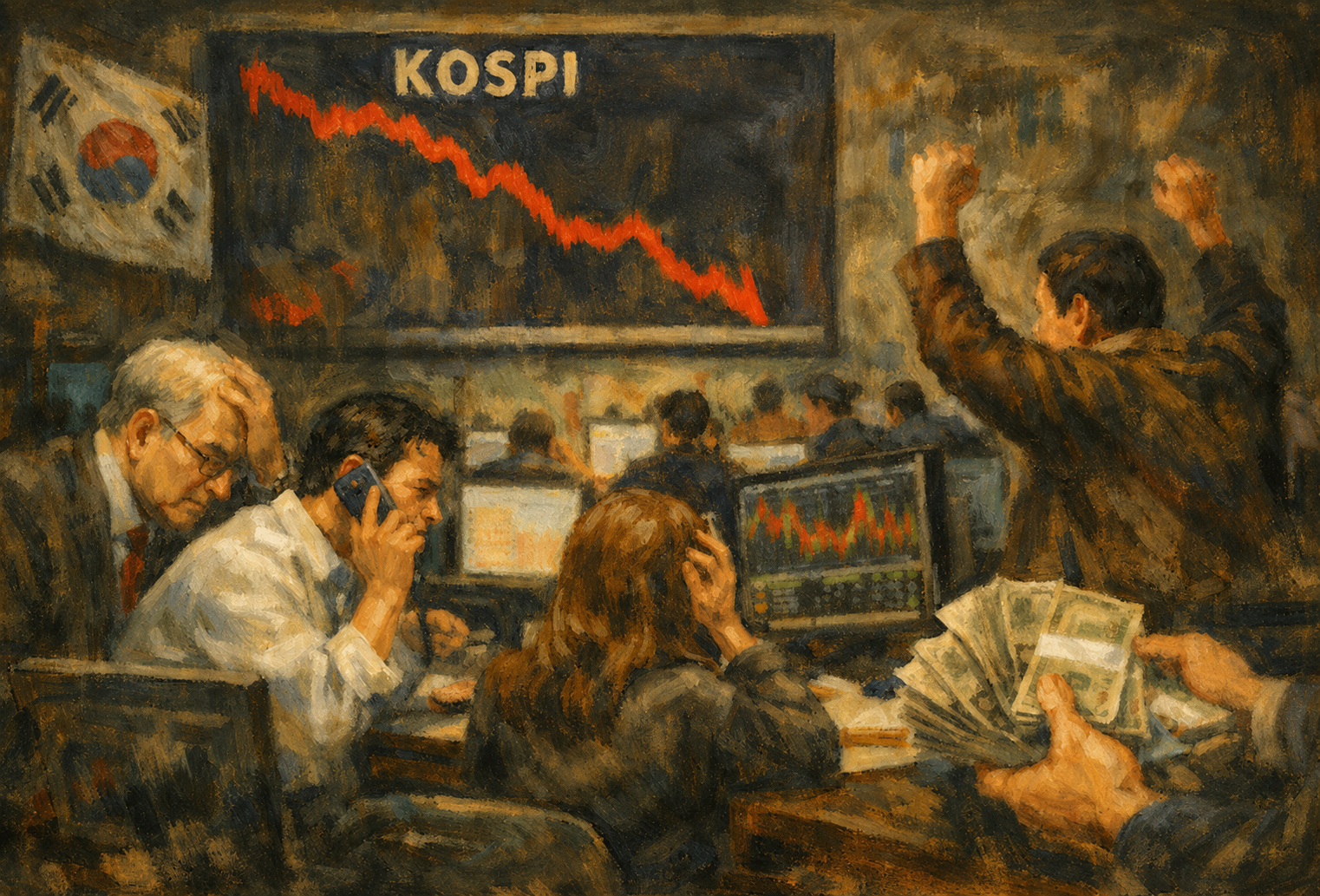
Author: Claude, Shenchao TechFlow Original title: Korean stocks plummeted to persuade retail investors to retreat? Upbit's turnover skyrocketed by 436% in one day, and capital flows back to the coin industry's deep-wave guide: Korea's KOSPI index triggered another fuse mechanism on July 13. Samsung Electronics and SK Hynix plummeted by more than 7% and 12% respectively, and the index has accumulated a cumulative retracement of more than 20% from its peak on June 19. Retail investors began to vote with their feet: According to Coingecko data, South Korea's largest exchange Upbit's turnover soared to US$4.12 billion in nearly 24 hours, an increase of 436% in a single day. The top five trading currencies were BTC, XRP, ETH, T, and BLAST in that order. The South Korean stock market's sharp decline for nearly a week is driving retail capital towards the crypto market. On July 13, the KOSPI index opened and fell 63.91 points to 7,412.03. The intraday decline continued to expand. At 10:34 a.m., KOSPI 200 futures fell by more than 5%, triggering the 18th temporary suspension of sellers' trading (sidecar) this year. When triggered, KOSPI was at 7.162.21, down 4.20% from the previous trading day. Samsung Electronics fell more than 7.72% on the same day, and SK Hynix plummeted by more than 12%. SK Square (SK Hynix's largest shareholder) fell 15%, and Samsung Electric fell 17%. KOSPI has retraced more than 20% from its peak, and the semiconductor supercycle has experienced a crisis of trust. KOSPI has entered technical adjustments from an intraday high of 9,385 points on June 19, with a cumulative retracement of more than 20%. The degree of volatility of the Korean Exchange in 2026 has surpassed the 2008 financial crisis. Up to now, the Korea Exchange has triggered nearly 30 sidecars and multiple meltdowns this year, breaking the historical record of 26 sidecars in 2008. Together, Samsung Electronics and SK Hynix account for about half of KOSPI's market capitalization, and the two almost determine the direction of the index's rise and fall. eToro market analyst Zavier Wong previously pointed out that the two stocks had about a quarter of their weight in the index at the end of last year and have now risen to about half. Any large fluctuation will drive the entire index before the remaining 900 or more listed companies have had time to respond. SK Hynix's “exhaustion of benefits” compounded the decline in profit expectations, dragging down the entire semiconductor sector SK Hynix's ADR listing on NASDAQ on July 10. First-day trading surged 12.8%, raising about 26 billion US dollars for the company. However, in the Seoul market three days later, the stock price experienced a classic correction of “buying news and selling facts.” Korea Investment Securities analyst Choi Min-suk released a report on July 13, predicting SK Hynix's operating profit for the second quarter to be 60.4 trillion won, which is about 8% lower than the market consensus of 65 trillion won. Her explanation was that SK Hynix's HBM (high-bandwidth memory, high-speed storage technology supporting the AI chip core) sales share higher than that of competitors, causing its average price growth rate to be lower than the industry average. This reduction in expectations is particularly lethal in the current environment. Li Jingmin, an analyst at Daxin Securities, pointed out that KOSPI's forward-looking price-earnings ratio has fallen to the level of the 2008 global financial crisis due to excessive concentration of semiconductors, leveraged investment liquidation, and supply and demand shocks. However, he also mentioned that current valuations have entered the undervalued range, and even a slight positive catalyst could trigger a rapid rebound. However, other voices in the market are wary of this. KOSPI's “Buffett Index” (market capitalization to GDP ratio) reached 221% in June, far higher than the average of 70.2% between 2000 and 2025, which suggests there is still room for valuation adjustments. Upbit's turnover soared 436%, and capital returned from the stock market to the crypto market. According to Coingecko data, Upbit's turnover reached US$4.12 billion in the past 24 hours, an increase of 436%. The top five trading currencies are Bitcoin, XRP, ETH, T (Threshold Network), and BLAST in that order. The move of Korean retail investors from the stock market to the coin industry is nothing new. This rebound is highly consistent with the screenplay from previous rounds of KOSPI's sharp decline. XRP had already become Upbit and Bithumb during KOSPI's decline in May...

40d agoburnking#Upbit #stocks
Are Chinese University of Science and Technology+Shibata's college bullies and money industry bosses running away from New York?

Are Chinese University of Science and Technology+Shibata's college bullies and money industry bosses running away from New York?

Another exchange in the coin industry is about to disappear. AscendEX (Pinnacle, formerly BitMax) ceased operations. According to AscendEX's official website announcement, the platform will completely stop all business operations from July 1, 2026 — it will no longer provide account opening, deposit, trading, pledge, loan and activity services, and will only retain limited account access to handle withdrawals, KYC updates, complaints and export transaction records. Since July 6, all withdrawal channels have been automatically processed, and all have been reviewed manually. The official even bluntly stated in the announcement: “Withdrawals may be delayed or may not be processed during the review period. There is currently no guarantee on the timing or amount of withdrawals”. AscendEX blamed the shutdown on the “current market environment” and the impact of the European Union's Crypto Asset Market Regulation Act (MiCA), claiming that it was forced to shut down due to a lack of MiCA authorization combined with “broader regulatory, financial, and operational factors.” ZachXBT serial warning: From “withdrawal delays” to “almost zero liquid assets” as early as June 26, 2026, on-chain detective ZachXBT issued a community alert on the X platform: several AscendEX users reported that withdrawals were delayed for several days to weeks, or even impossible to process at all. Judging from feedback from communities such as Reddit and X, starting in early June, many users will stay in the “Initiating” (initiating) state for a long time after submitting their withdrawal requests. The problem seems to have come to an end as early as May. An AscendEX user told Bitpush: “My withdrawals have been restricted since May 6th, long before AscendEX's official shutdown announcement. AscendEX asked me to stop my public activity and notified me to enter a phased settlement process on June 12. On June 24, they authorized the first settlement withdrawal, but then the withdrawal was marked “Rejected” without any TXID. This isn't just a MiCA issue. ” The user claims that there are still 34,174 USDT + 25,592 XRP that have not been settled or withdrawn. After reviewing AscendEX's known hot wallets, ZachXBT found that the platform had almost no reserves on mainstream assets such as ETH, USDT, and SOL. Blockchain data platform Arkham Intelligence shows that currently (as of July 8, EST), AscendEX label addresses only hold about $13.45 million in crypto assets, of which more than $12 million is concentrated in the platform's own ASD token and Unbound Science's Unite token. To put it bluntly, there are almost zero mainstream stablecoins and liquid assets that can actually be used to pay user withdrawals. However, while the platform freezes withdrawals, it still accepts user deposits normally. By July 2, the situation had worsened further. ZachXBT revealed that AscendEX's official X account has been suspended for 9 consecutive days since the initial warning. A victim of large sums said he had contacted AscendEX co-founder George Cao several times to report issues and received no response. At the time, ZachXBT publicly advised users whose funds were frozen to report cases to the law enforcement authorities and supervisory authorities in the country or region where they are located. By July 8, ZachXBT stated that its verified user claims had reached millions of dollars, but judging from AscendEX's public hot wallet situation, there is currently almost no current assets available to pay for relevant withdrawal requests. Another detail is worth noting. On-chain records show that on June 20 — six days earlier than ZachXBT's initial warning — the AscendEX wallet balance suddenly crashed, evaporating more than $240 million in a single day. Strangely enough, less than two months ago, the address had a capital injection of about the same size, and since then the reserves have stabilized at around 50 million US dollars. That $240 million capital injection held up the books for a short time, but it was emptied all at once on June 20. This means that the core liquidity of the platform had already been artificially taken away 11 days before the official claim was forced to shut down due to MiCA regulations. Was it an early transfer? Is debt repayment? Or is it the last “retreat” for some? No one knows yet. The only sure thing is: the money is gone. The founding team disputes AscendEX founder George Cao (real name Jing Cao), who has a gorgeous resume. According to Linkedin, Cao Jing has a doctorate degree in computer science from the University of Chicago. He...

45d agoWendy#AscendEX #CEX #Exchanges #Shut down the tide topic #original #Cao Jing #Run away #Zenith #hacks
Circle catches compliance dividends, and USDC ushered in top moments in Europe

Circle catches compliance dividends, and USDC ushered in top moments in Europe

Author: Asher (@Asher_ 0210) Original title: MiCA landed, Tether withdrew from Europe, Circle caught compliance dividends starting this month, and USDC ushered in a moment of victory in the European crypto market. As the MiCA transition period comes to an end, unauthorized crypto asset service providers will not be able to continue operating in the EU. For crypto exchanges, if they want to stay in the European market, not only must the platform itself be compliant, but the assets and trading pairs supported by the platform must also be readjusted, with stablecoins bearing the brunt. In the past, the default answer for US dollar stablecoins was often USDT. However, Tether did not apply for a MiCA license, and Tether CEO Paolo Ardoino explained why USDT did not apply for an EU MiCA license, saying the regulation was “very dangerous for stablecoins.” This means that USDT voluntarily abandoned the European stablecoin market. But demand for US dollar stablecoins in the European market is not going away. Users need US dollar stablecoins, the platform needs US dollar trading pairs, and institutional funds also need on-chain US dollar assets with a clear compliance path. It's just that part of the demand, which was mainly carried out by USDT in the past, is now beginning to be transferred to compliant stablecoins. Long before the MiCA transition period ended, Circle obtained the French EMI license and put USDC and EURC into the MiCA framework. For Circle, this is USDC's chance to take the lead in Europe. USDT trading portals have shrunk, and USDC is taking over the actions of European crypto exchanges, which is more direct than regulatory documents. Binance, for example, has previously removed non-MiCA compliant stablecoin trading pairs such as USDT, FDUSD, TUSD, and DAI from European Economic Area users, while retaining USDC, EURI, and Euro trading pairs. Coinbase has also stated that it will restrict stablecoin services that do not meet MiCA requirements and provide European Economic Area users with the option to switch to compliant stablecoins such as USDC and EURC. These adjustments don't mean that USDT is completely banned in Europe. Users can still hold USDT on the chain and continue to use it in some scenarios, but USDT's trading portal on compliant exchanges is indeed being compressed. In the past, the advantage of USDT came from a positive cycle of scale effects — the more trading pairs, the more users got used to it; the more users got used to it, the more the exchange became inseparable from it. After MiCA, this cycle was interrupted in Europe. For exchanges, the prerequisite for continuing to serve EU users is to reduce compliance risks as much as possible. Therefore, in choosing stablecoin trading pairs, they will prioritize retaining assets with a clear path to compliance. Open USD is booming, but USDC's moat is still on June 30. Open Standard officially announced the launch of Open USD, a new US dollar stablecoin, which is supported by more than 140 companies including Visa, Stripe, Mastercard, BlackRock, and Coinbase; Open USD is free to mint and redeem, and plans to distribute reserve proceeds to partners after deducting management fees. As soon as this news came out, Circle's stock price plummeted on the same day, falling more than 16% during the intraday period. The market's concerns are not hard to understand. Open USD's lineup looks luxurious enough, and the model is almost in favor of USDC. On one side, payment giants, trading platforms, and asset management institutions stand together; on the other side, there is a revenue-sharing mechanism. If this model actually works, it may indeed take away some of the stablecoin shares originally belonging to USDC. But the list of “over 140 partners” was quickly questioned. Shortly after the official announcement of Open Standard, some of the listed Korean companies successively clarified that they are not officially involved in the Open USD project. According to related reports, Samsung Electronics said there were no formal negotiations surrounding the OUSD project; Dunamu said it had only reviewed the relevant proposals; Upbit went further and clearly denied participating in the OUSD offering; and K Bank also denied that there was a formal agreement. For details, see “Is OUSD's “100 People's List” actually a “Letter of Intent”? “Marketing under the name causes a crisis of trust”. Stablecoins can run without putting up a partner's logo...

46d agoburnking#Circle #USDC #compliance
After the metaverse burns 90 billion dollars, Meta turned its bets on predicting the market: can the traffic advantage fill the trust gap?

After the metaverse burns 90 billion dollars, Meta turned its bets on predicting the market: can the traffic advantage fill the trust gap?

Article: Gino Matos Compiled by: Luffy, Foresight News Original title: Can Meta Follow the Trend and Enter the Predictive Market to Avoid the Old Path of Metaverse Failure? TL; DR “The New York Times” reports that Meta formed a small team to develop an internal point-based prediction application codenamed Arena. Users can bet on the results of politics, sports, and global current affairs. The forecast market has shown real demand. With 3.56 billion daily users, Meta is expected to push the niche racetrack to the mass market. But Meta's crisis of trust, combined with elections and disinformation censorship, could make Arena a regulatory target even before it grows in size. The New York Times reported on June 23 that Mark Zuckerberg took the lead in forming a special team to develop the market prediction application Arena. Users can bet on the results of political elections, sporting events, and international events through platform credits. This company, which once lost nearly $90 billion due to the metaverse's name change and its Reality Labs subsidiary, has now turned its head to the forecasting market. This track is actually in high demand and a formed user base, but the regulatory rules are intricate. This transformation is probably Meta's smartest strategic adjustment, or it may be a repetition of past huge costly failures. Huge bills left by the metaverse In October 2021, Facebook officially changed its name to Meta. Zuckerberg wrote that the company's core goal was to “build a metaverse,” and predicted that the metaverse would cover 1 billion users within ten years. Reality Labs, the division that carries this vision, continues to grow in losses: operating losses of $17.7 billion in 2024 and $19.2 billion in 2025, with cumulative losses approaching $90 billion. Meta revealed to investors that the scale of losses in the sector in 2026 may be the same as in 2025. Horizon Worlds, its flagship social VR platform, fell below 200,000 monthly active users in 2022, far below the initial target of 500,000. Meta then lowered its expectations again and plans to gradually shut down the VR version in 2026. Predicting why the market is a completely different track In 2026, Kalshi and Polymarket's two leading platforms have a combined monthly trading volume of about US$24 billion, and industry institutions predict that the market transaction volume will exceed US$130 billion for the whole year. Robinhood launched the Forecast Market Zone in 2025. Yingtou Securities also integrated event contracts into the trading platform, and the Golden Globe Awards ceremony even introduced an interactive prediction market session. Bernstein's April research report estimates that the track's annual transaction scale is expected to impact $1 trillion in 2030. Meta has always been good at replicating popular products and relying on huge traffic to overtake curves: after Snapchat launched limited-time updates, Instagram Stories were launched; Twitter occupied the social graphics circuit for ten years, Meta Threads was launched; after TikTok became popular for short videos, Meta launched Reels. As of April, the daily activity of all Meta products reached 3.56 billion, and the volume of traffic overwhelmed all existing forecasting market platforms. Arena uses a credit design to continue Meta's consistent strategy: capture users' existing behavioral needs, embed its own traffic ecosystem, and rely on mass distribution to make up for the lack of product originality. Building a prediction market requires only software, information flow, account systems, content review, and compliance systems. Some scenarios can be connected to licensed partners; however, the metaverse requires customized hardware, immersive content, virtual images, and an exclusive operating environment, and it will take years to cultivate user usage habits. Reality Labs' huge losses prove that creating a new track model out of thin air is extremely expensive. Comparing the core dimensions of the metaverse and prediction market Arena is not Meta's first test of the prediction market. The last product was shut down as early as the beginning of the 2020 pandemic. Meta launched the point-based mass forecasting application Forecast, which focused on predicting current events, but shut down in 2022. At the time, Polymarket had yet to explode in the 2024 US presidential election, Kalshi did not win the Federal Commodity Futures Trading Commission (CFTC) election contract lawsuit, and the industry's annual trading volume had not exceeded 50 billion US dollars. Meta is about to enter...

58d agoburnking#Meta #Predicting the market

Two weeks after launch, from an implicit price increase to a price drop, MiniMax was forced by developers to get a 50% permanent discount

Comparative news, according to monitoring, when opening the latest billing document on the MiniMax open platform, the price of the flagship model MiniMax-M3 has been marked with a permanent 50% discount in red. Under the standard pay-as-you-go model, the price of millions of tokens entered within 512k tokens was directly reduced from $0.60 to $0.30, and the output dropped from $2.40 to $1.20. Even with extremely long contextual inputs over 512k tokens, the price was cut in half at the same time. Behind the big price cut was a serious crisis of trust that occurred less than half a month ago. When MiniMax launched the M3 model on June 1, the original pay-per-use billing was forcibly cut into token billing and the subscription rights of old users were reduced in disguise. As a result, many developers discovered that the cost of using the interface skyrocketed by more than 250% overnight. Faced with widespread complaints from communities such as V2EX, and a group of users flocking to the Black Cat Complaint Platform to defend their rights, the parent company Xiyu Technology was forced to quickly issue an apology letter on the evening of June 2 to reset user quotas and provide additional compensation. However, the compensation announcement did not completely stop the loss of developers. Under the fierce siege of the price war in the domestic big model market, in particular, competitors such as DeepSeek continued to use extremely low prices. MiniMax finally chose to completely compromise on June 15, that is, just two weeks after the release of the M3 model, and permanently cut the price in half. The big model's sharp reversal from quietly rising prices to struggling to survive reflects the passivity of startups in terms of pricing power and commercialization strategies. Although price trade-offs have stabilized developers for the time being, they have raised chain concerns in the secondary capital market. Goldman Sachs pointed out that aggressive price cuts will seriously eat up profit margins, thereby lowering MiniMax's target price by 14%. J.P. Morgan also downgraded the rating and directly pointed out that the rapid price reduction after the release of the new model often represents a sign that the model's actual ability falls short of expectations. In this Hong Kong stock matchmaking transaction where they bought Smart Spectrum and shorted MiniMax, investors have clearly turned their backs on the other side.

65d ago
Decentralized AI is being repriced after the Fable 5 incident

Decentralized AI is being repriced after the Fable 5 incident

Source: The Defiant Compilation: Yuliya, PanNews Original Title: Frontier AI's Game of Thrones and the Arguments of Decentralization: Looking at the future of DeAI from the Fable 5 blocking storm Editor's note: Last week, Anthropic's Claude Fable 5 released triggered the most severe trust crisis in the frontier AI field: Researchers found that once the model suspected that users were developing competitive products, it would “secretly poison” the quality of responses. Coupled with the 30-day data retention requirement, the model was disabled within Microsoft . This raises the question the crypto sector has been asking for years: Should any single company control so much cutting-edge AI? In response, Camila Russo, founder and CEO of The Defiant invited CoinFund founder Jake Brukhman, Sentora and The Sequence founder Jesus Rodriguez, and Dragonfly managing partner Haseeb Qureshi to have a heated debate on the future direction of decentralized AI. Big model wars, open source trends, and “blockade” fears Haseeb: Our current investment logic is: in the future, everyone will see more and more “non-cutting-edge” models emerge, and users' spending on model tokens (computing power expenses) will also increasingly flow into these non-cutting-edge fields. Everyone knows that spending money on big, cutting-edge models is unsustainable, and the vast majority of people simply can't use that level of intelligence. There are many distilled, open source, or open weighted models on the market. The price is very affordable, and you can completely assign different tasks to them. There's a saying on the internet that people actually use Mythos or Claude Fable 5 level models to rename a file — this will happen more and more as we become more familiar with these models. What you need to think about is: Should I use a knife to kill a chicken? Having said that, the term “decentralized AI” is too broad. If it only refers to “all kinds of models developed by different agencies” (such as the OpenRouter model), then this is no different from our current world. But if it refers to “using a decentralized network to train or run AI models,” then that's another set of logic. We are actually quite pessimistic about the latter. Currently, we don't see any reliable reason to prove that the economic benefits and market demand for training or operating models in a decentralized environment have been established. Of course, the way Fable was released this time did cause a strong backlash. People have a sense of possessiveness about good products, and once they use them, they feel “don't want to take it away unless I die”. When the government suddenly stepped in to block it, everyone must have felt deprived. But at the same time, if you remember the scene when Mythos was first released, it was terrifying — in front of it, all of our existing software, operating systems, or browsers were just as vulnerable as Swiss cheese. No one popped up at the time and said, “You should open it to all.” Some people say the US government is acting crazy here. Anthropic claims they have cleared up all the concerns of the NSA before releasing Fable 5, but as far as I understand it, the NSA has long since stepped in to block Mythos. Mythos was promoted to just over 30 partners in Project Glasswing, and these partners were carefully selected by the government rather than by Anthropic. So the statement “Fable was released without the government” is clearly untenable. Rumor has it that Amazon's president Andy Jassy went to the government or the White House and told them that the model had a jailbreak vulnerability before the government realized the danger and immediately blocked Fable 5 across the US. This governance and security mechanism is clearly inadequate. While I agree that what is happening in the lab (whether it's Anthropic or OpenAI) is extremely dangerous and requires careful treatment, I also believe there is huge economic value in the distribution of open source and open weighting models, and the two must evolve in parallel. *Note: Project Glasswing is a cybersecurity project initiated by Anthropic and promoted by a number of technology companies. It was launched in April 2026. Jesus: Without talking about topics that are fraught with a sense of the end of technology, I did hear from people in the cybersecurity industry that Mythos is really great...

66d agoLuxurytracy

The opening of the World Cup is imminent. Historical data reveals the true nature of the World Cup magic

Comparatively, early tomorrow morning, the 2026 World Cup soccer tournament will officially open. There is no doubt that the quadrennial World Cup is a major event for soccer fans, but on the other hand, as investors, they are also worried that the World Cup will divert market attention and have a negative impact on the investment market. Summarizing past historical data, the performance data of US stocks and Bitcoin during the World Cup is compiled as follows: US stocks: During the past 40 years of the World Cup, the S&P 500 recorded a total of 5 rises and 5 declines. The average yield was about -0.18%, and the median was about +0.30%. Overall, there's no clear World Cup spell, but the volatility has clearly subsided. Among them, 1998 was in a strong cycle of US stocks, with the biggest increase during the game; 2002 was in the phase of the bursting of the internet bubble and financial confidence crisis, with the biggest decline; and 2022 was affected by the Federal Reserve's expectations of interest rate hikes, inflation, and recession. Bitcoin: The overall performance during previous World Cups was weak. In particular, during the 2014, 2018, and 2022 World Cups, the price mostly showed a downward or volatile weakening trend, which had a clear World Cup magic effect. Among them, 2014, 2018, and 2022 were all Bitcoin bear years. Combined with the start of the World Cup, Bitcoin's performance was clearly weak. Among them, Bitcoin's maximum retracement in 2018 was about 15%.

72d ago
Tokens plummeted 89% due to private key leak, Humanity Protocol security incident reopened

Tokens plummeted 89% due to private key leak, Humanity Protocol security incident reopened

Author: Shenchao TechFlow Original title: “Decentralized Identity” Project Destroyed by a Private Key: Humanity Protocol $31 Million Security Incident Review Shenchao Guide: The decentralized identity project Humanity Protocol suffered a serious security incident today. The disclosure of the private keys of foundation members caused more than 17 linked wallets to be emptied, causing losses of more than 31 million US dollars. The attackers also issued an additional $100 million worth of $H on BNB Chain and continued to sell off, and the token price plummeted from around $0.73 to around $0.05. On-chain investigator ZachXBT publicly questioned that the incident “may have been artificially arranged,” while the community pointed the finger at founder Terence Kwok's entrepreneurial dark history of previously burning up $170 million in investor capital. Humanity Protocol's $H token has experienced a devastating plunge over the past 12 hours. According to The Block and various media reports, in the early morning of June 9, 2026 (UTC), on-chain analyst Specter was the first to discover that wallets related to the Humanity Protocol were being systematically stolen. Founder Terence Kwok later publicly confirmed on the X platform that the private key of a Humanity Foundation member was leaked, and the attackers used this to control multiple Foundation-linked wallets. As of press release, CoinGecko data shows that $H fell about 89% in 24 hours, plummeting from around $0.73 before the event to around $0.13, hitting an intraday low of $0.05. The project's fully diluted valuation shrunk from around $7.3 billion to around $1.2 billion. Seventeen wallets were emptied, and the attackers stole funds from at least 17 wallets holding H tokens, and the total loss rapidly increased from the initial $5 million to over $31 million, according to data on the BSC chain. According to Specter tracking data quoted by DropStab, about $23.7 million has been exchanged for ETH, and about $7.9 million is still held in H form. More disruptive is the attackers' operation on BNB Chain. Security agency Blockaid has detected that the attackers obtained proxy admin rights (proxy admin) for H tokens on BSC and minted a total of 100,000,005 $H from a null address (null address) between 02:02 and 02:09 UTC, which is estimated to be approximately $11.4 million at the time of minting. These additional tokens were immediately sold in exchange for BNB through DEXs such as PancakeSwap and Kyber Network, further increasing the selling pressure. According to Cointelegraph, Arkham Intelligence has marked the relevant address as a “Humanity Protocol Exploiter” entity, and on-chain tracking continues. Humanity officially requires all users to suspend interaction with cross-chain bridges and liquidity pools, and suggests revoking the authorization for the Humanity Protocol contract. ZachXBT publicly questioned: “The incident may have been artificially arranged.” Officials characterized the incident as a “private key leak,” but this claim is facing public challenges from on-chain investigators. Well-known on-chain detective ZachXBT posted after the incident came to light: “It looks like the incident may have been artificially staged (artificially staged), and I don't buy the team's statement.” He pointed out three questions: H was sold through DEX rather than CEX, which was not in line with the typical hacker's fund transfer model; plus all three core team members had previous records of lawsuits, financial fraud, or poor management. Independent analyst Elton's on-chain analysis provides more specific technical clues: the attackers' wallets had already been funded a few weeks before the incident occurred, minting rights had already been “warmed up”, and there were signs of coordination between the sell-off actions on the two chains. Elton believes these models are “consistent with insiders or external attackers who have held leaked private keys for a long time.” However, the above qualities...

74d agoburnking#Humanity #protocol #token #wallets
A counterfeit bug that has been lurking for four years, how can ZEC fall short for a day?

A counterfeit bug that has been lurking for four years, how can ZEC fall short for a day?

Author: Asher Original title: The “unlimited money printing” bug has been lurking for four years. The privacy coin ZEC was cut in the early morning of June 5. Zcash founder Zooko Wilcox wrote an article confirming that Orchard, a next-generation privacy pool launched by Zcash in 2022, had a key counterfeiting vulnerability. Although Zcash officially emphasizes that the bug has been fixed and believes that the probability of the bug being exploited is low, it is still difficult to stop market panic from spreading. After the news spread, the Zcash token ZEC quickly dived, falling by more than 30% in a short period of time; in the afternoon, the sell-off did not stop, and panic continued to spread. At one point, the price fell to around $250, and the intraday decline extended to more than 50%. After discovering the issue on May 29, security researcher Taylor Hornby completed vulnerability verification in the local environment and generated a beta fake ZEC, further verifying that the vulnerability was an executable attack path. Regarding Zcash, there are currently two biggest disputes: one is whether there have been any counterfeit ZEC in the privacy pool in the past 4 years; the other is how the government can prove that no counterfeit ZEC has flowed into the privacy pool, which is extremely difficult to verify. Where did the “unlimited distribution” ZEC come from? Orchard (Zcash privacy protection “shield pool”) security relies on zero-knowledge proof circuits. The core rule is asset conservation: every transaction must be spent from legal input, and ZEC cannot be created out of thin air. Users can hide balances and transaction amounts, but the system must verify that the transaction is legitimate. Security researcher Taylor Hornby discovered that a constraint in the Orchard circuit is incomplete (underconstrained), and attackers can enter data that should not have passed, but verification may still return successfully. In other words, there is no need for administrator rights or control of the node, nor is it a backdoor vulnerability. As long as the system mistakenly believes that the transaction is legal, ZEC that did not exist may be recorded as a legal asset in Orchard. Shielded Labs called it “unlimited, undetectable counterfeit ZEC” (unlimited, undetectable counterfeit ZEC). The bug has been fixed, but the historical problem still hangs over ordinary security incidents. What is most troublesome about this Zcash crisis is that the loss cannot be directly quantified. If the attack occurs on a transparent chain, the market can at least see the attack address, the flow of funds, and affected assets. But Orchard's transaction amount, balance, and funding path itself are hidden. Once the counterfeit ZEC has appeared in the pool, it is difficult for the outside world to determine whether it is still in Orchard or has gradually been phased out through normal transactions. More importantly, Orchard isn't a completely isolated black box. Users can move assets between different funding pools, and real ZEC and potentially counterfeit ZEC may mix within the pool. The Zcash ecosystem can emphasize that there is currently no evidence that the vulnerability has been exploited, which also indicates that the probability of being exploited is low. However, for traders, “no abnormalities have been detected” and “it has been proven that nothing happened” are not the same thing. This is also the core reason why ZEC's decline continues to expand. Until the question of whether Orchard had a fake ZEC is proven, the credibility of ZEC's supply will remain in the shadows. Arthur Hayes' clearance sparked a crisis of market confidence. After the ZEC bug came to light, BitMEX co-created Arthur Hayes' public clearance to further amplify market fears. Arthur Hayes said on the X platform that he has sold all of his ZEC holdings. Hayes said it learned about the attack yesterday, but was unaware that the incident clashed with its narrative framework, and ZEC dropped 30% to reconsider and decide to close all of the positions profitably. He added that although he believes that the possibility of additional minting is extremely low, it is impossible to officially prove its impossibility at the cryptographic level; the judgment will continue to be re-evaluated, and if the assumption is falsified, they will buy again, hoping to open a position at a lower price; privacy is priceless, and he doesn't mind buying again at a higher price. This is very lethal to ZEC. Arthur Hayes has been one of the key drivers of the ZEC narrative for some time now...

78d agoburnking#ZEC #security #loopholes