GMX · 404

GMX: A cumulative total of 313,650 GMX has been repurchased since March, with an average price of $6.27, with a total value of $1.965 million

Comparing news, GMX posted an article on the X platform stating that GMX DAO repurchased 23,280 GMX at an average price of about $5.37 between June 24 and 30, with a total value of about 125,000 US dollars. Since the launch of the repurchase program on March 5, a total of 313,650 GMX units have been repurchased, with a total value of about $1.965 million, with an average price of about $6.27. In the second quarter of 2026, GMX DAO bought back a total of 22,8030 GMX units, with a total value of about $1.41 million, and an average price of about $6.18.

47d ago
The CLARITY Act is cutting the final link between tokens and protocol revenue

The CLARITY Act is cutting the final link between tokens and protocol revenue

Author: Ching Tseng Compiled by: Shenchao TechFlow Original title: The CLARITY Act Is Quietly Killing 90% of Tokens Shenzhen Chao Guide: Most of the tokens issued in the previous cycle had a pricing issue that no one wanted to identify: If your token can't legally share the revenue from the agreement, then what exactly are you in your hands? Author Ching Tseng unraveled this matter thoroughly: the three pillars of token valuation are being loosened at the same time. Buyback & Burn is the current safe haven option for the agreements. The two-tier compliance structure may be the way forward, but in the middle, most tokens are priced on something that hasn't been clearly defined yet. Most of the tokens issued in the previous cycle had a pricing issue that no one wanted to discuss. If your tokens can't legally share the revenue from the agreement, then what exactly are you holding in your hands? The CLARITY Act didn't kill DeFi; it just forced everyone to acknowledge one thing they knew for a long time. Almost every token goes live with a promise that can't be exported. This promise has never been written into any legal document. It lives in footnotes to white papers, chat threads on Discord, and a collective default assumption that sooner or later, the right to govern will turn into some form of economic reward. The rhetoric is simple: Agreements grow, and you benefit along with them. The CLARITY Act is making that promise difficult to deliver on. This law only does one thing, but this is critical. The bill divides every type of digital asset into two buckets. Digital Commodity (Digital Commodity): Managed by the CFTC (Commodity Futures Trading Commission). The degree of decentralization is high enough that no single entity controls more than 20% of voting power or token supply. Bitcoin and Ethereum are in this category. Investment contract asset (Investment Contract Asset): Managed by the SEC (Securities and Exchange Commission). There is an identifiable issuer, and holders expect to benefit from the efforts of others. The sad truth is that most of the tokens issued in the last cycle — UNI, AAVE, MORPHO, PENDLE, OP, ARB, and half of the L1 and DeFi tokens you can name — were all unclean. Real agreements, real revenue, but the legal nature of the token itself has never been defined. The CLARITY Act says, “Stand on the sidelines, blur is no longer an option. Once some of the tokens that most people have missed are traded on the secondary market, they are generally biased against CFTC jurisdiction and classified as digital goods under the CLARITY Act framework. There's almost no going back. All tokens that have already been traded on @binance or @coinbase will most likely be locked in the status of a “digital commodity” once the bill takes effect. The CFTC oversees oil, gold, wheat — assets that no one expects to receive quarterly dividends just by holding them. The same logic is used here, but with an important nuance. Although digital products are managed by the CFTC and treated as traditional products rather than securities, this does not mean that an agreement can directly distribute revenue to token holders without risk. According to the SEC and CFTC's joint explanatory guidance of March 2026, if the holder has a reasonable expectation of profit, and this expectation comes from the continued development, management, or efforts of others, this arrangement may still be considered an investment contract and therefore pulled back under SEC review. Even for tokens that have already been traded, promises made at the time of first-level issuance or public communication may continue, creating a retroactive risk exposure if not clearly written off. Because of this, many agreements have turned to Buyback & Burn (buyback and burn) as a safer and more practical mechanism: directing revenue to open market repurchases and token destruction, supporting prices by reducing supply and boosting capital appreciation, rather than directly allocating revenue. Another path that is receiving attention is to build a permissioned layer (permissioned layer) on top of the basic agreement. The original unlicensed layer continues to operate as Buyback & Burn. The new compliant access layer is only open to authenticated users, granting verified holders the legal right to share the revenue from the agreement. This idea makes sense in theory, but it poses its own complex problems: the same token works on different layers...

53d agoburnking#CLARITY Act
Wall Street eyes HYPE ETF, the era of on-chain exchanges is approaching

Wall Street eyes HYPE ETF, the era of on-chain exchanges is approaching

Author: Winnie, CryptoPulse Original title: Behind the HYPE ETF explosion: Wall Street began betting on the on-chain exchange era. In the past few years, the crypto market has always had a very strange phenomenon. The daily trading volume of the market is hundreds of billions of dollars, but the one that really makes the most money is often not the public chain, but the exchange. Whether it's a bull market or a bear market, platforms such as Binance, OKX, and Bybit can continue to charge fees, eat liquidity, and earn trading volume as long as the market remains volatile. So to some extent, the real most stable business model in the crypto industry has never been about issuing coins, but rather as a trading market. Today, Hyperliquid is actually bringing this model to the chain for the first time. More importantly, Wall Street seems to have begun to realize this. 1. Crypto's Really Most Profitable Business - User Trading On May 27, Kairos Research data showed that in just 10 trading days since the HYPE Spot ETF went live, the amount of capital absorbed reached 1.04% of HYPE's total market value. This data directly broke the initial launch record for crypto spot ETFs. Even when compared to mainstream assets such as BTC, ETH, and SOL, HYPE's efficiency in attracting money is still far ahead. If stock products converted from trusts such as Grayscale GBTC and ETHE are excluded, HYPE can be said to be currently the strongest newly issued crypto ETF. Behind this, it may mean an even bigger change, and that is that the capital market is repricing crypto exchanges. Many people used to understand the crypto industry and always liked to focus on hot tracks such as public chains, AI, memes, and RWA. But if you look back at the past ten years, you'll find that the vast majority of racetracks have strong cyclicality. The hot spots are intense, but the tide is also falling fast. Tradable markets are not the same. Regardless of whether the market rises or falls, as long as someone trades, the exchange can continue to make money. This was the 2021 bull market, 2022 plummeted, and the 2024 ETF bull market is still the case. This is why Binance has been able to maintain the strongest profitability in the entire industry for a long time. Because transactions are essentially the most stable source of cash flow in the crypto world. What's special about Hyperliquid is that for the first time, it actually gave an on-chain exchange an experience close to a centralized platform. The biggest problem with many on-chain derivatives platforms in the past was not that they had a bad concept, but that they couldn't take on real big money at all. The liquidity is insufficient, the delay is too high, and the depth is too poor, and professional traders simply cannot use it for a long time. But Hyperliquid chose a different path. Instead of following the traditional AMM model, it uses order book matching, self-built Layer 1, and public chain-level performance optimization. The end result is that it's becoming more and more like a “Binance on a chain.” This is why over the past six months, more and more high-frequency traders and quantitative teams have begun to migrate. Because for professional traders, what really matters is never whether to decentralize or not. Instead, the depth is insufficient, delays are low or not, processing fees are high or not, and whether it is possible to make stable money. Hyperliquid actually met those conditions for the first time. This is also an important reason why it is beginning to be re-examined by institutional funding. 2. The HYPE ETF exploded, essentially betting on “on-chain Wall Street.” Many people still understand HYPE ETFs as ordinary crypto ETFs. But in reality, it's very different from BTC ETFs and ETH ETFs. BTC ETFs are more like digital gold, and ETH ETFs are more biased towards blockchain infrastructure. However, HYPE ETFs are essentially betting on the ability of the entire on-chain financial market to trade. In other words, what the institution is really interested in is probably not the HYPE token itself. It's the trading ecosystem behind Hyperliquid. This can already be clearly seen from the on-chain data. Data from May 27 showed that the net inflow of Hyperliquid ETF reached US$20.4 million in a single day. Among them, BHYP had a net inflow of $19 million and THYP had a net inflow of $1.4 million. More importantly, this type of ETF has achieved net inflows for 15 consecutive days, and the cumulative capital volume has exceeded US$101 million. This means that institutional funding is not a short-term hype, but a continuous allocation. At the same time, Hyperliquid's on-chain fundamentals have also begun to strengthen at the same time. Currently the platform TV...

85d agoLuxurytracy
DeFi Treasury Enters Reshuffle Period: Analysis of the Latest Trends on the Eight Major Races

DeFi Treasury Enters Reshuffle Period: Analysis of the Latest Trends on the Eight Major Races

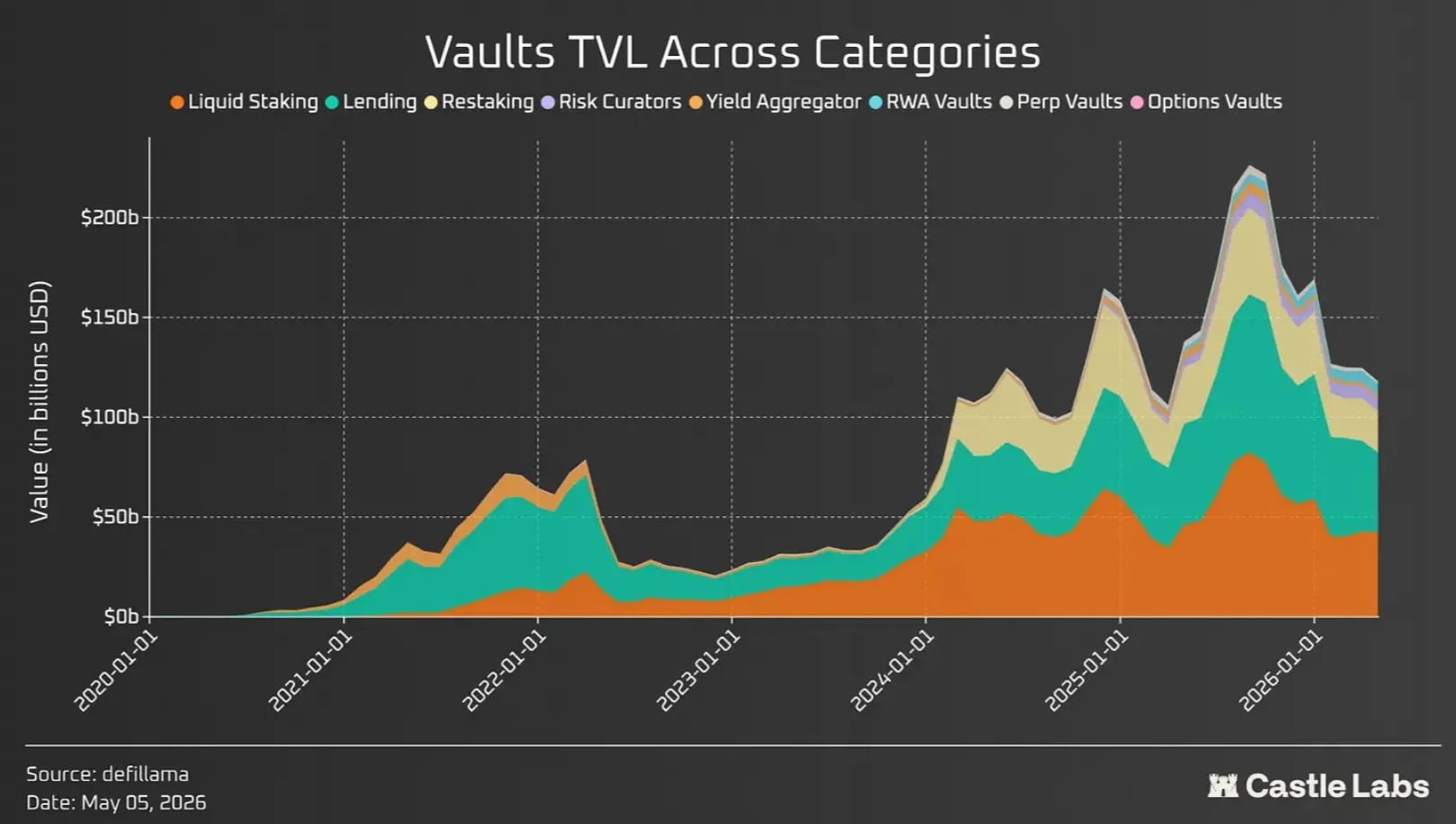
Author: Castle Labs Original title: DeFi Treasury 2026 Annual Report: 8 major tracks, who is rising and who is declining? Compiled by Jia Huan, ChainCatcher This article is an excerpt from our research on “financial treasurization”. Download the full report here Treasury Classification This section of this report provides a quantitative analysis of the treasury landscape to provide a comprehensive picture of the field and its evolution. We analyze the ecosystem by category and track TVL transfers from different treasurers and curators. We have broken down the concentration of curators and provided an outlook on major capital flows, putting the structural transformation that will define this year's treasury in a specific context. Treasury should not be viewed as a single, all-encompassing market, but should be assessed according to its different implementation methods, each with different parameters, risk vectors, and responses to stress tests. Aggregated data can only provide a partial picture, and there is an urgent need for a more detailed analytical perspective. Before starting the analysis, it is important to define the term “treasury” as the basis for our methodology. Our definition is based on the deployment path. Treasury is classified as a “tool for users to obtain active income strategies”. Any asset that is purely an off-chain tool package was excluded from our analysis. Maple's SyrupUSDC complies with treasury standards: users deposit stablecoins into agreements, which lend them to institutional borrowers, and accumulate annualized returns through credit activities that issue tokens. Lido stETH is a vault: users deposit ETH and the protocol earns staking profits, which are distributed through rebase tokens. Centrifuge JAAA is a treasury: users receive AAA-level CLO benefits through tokenized packages that generate revenue through their credit positions. BlackRock's BUIDL is not a treasury by this definition: it is a direct token offering representing a 1:1 claim to off-chain US Treasury funds. We applied this perspective to define eight structural categories: loan treasury, liquid pledge, repledge, risk curated vault, treasury infrastructure provider, yield optimizer RWA credit treasury, perpetual contract LP treasury, and options treasury. For the purposes of this analysis, we used risk curated treasury as an independent category to better understand its dynamics and growth. Before we dive into these categories one by one, let's focus on the overall performance of the vault. Current state of treasury ecology The total net TVL of all defined treasury categories is US$12.4 billion, down about 50% from the peak of US$241 billion around October last year. The downward trend after the October peak was driven by the “October Liquidation Event,” which triggered cascading liquidations across DeFi. Due to overlap, the treasury TVL figure is higher than the current DeFi TVL (approximately $86 billion). For example, liquid staking protocols like @LidoFinance have issued stETH, a rebase asset representing staked ETH earnings, which is used as collateral in lending agreements such as @Aave and @Morpho. If we move to category-level analysis, the overall situation changes dramatically. Recent events have led to an outflow of TVL and prompted the entire industry to conduct a broader reality test on safety and risk management (and hopefully shift to a safety-first approach). Categories such as borrowing, liquid staking, and repledging were the hardest hit because they had the greatest risk exposure to on-chain assets and drive the operation of the on-chain economy; while RWA treasury continued to show unrelated growth due to no risk exposure to crypto assets. Categories such as options vaults peaked in April 2022 and have been struggling ever since. As a result of the “October Liquidation Incident,” risk curator-led vaults were hit on a par with other major categories. Their TVL peaked around the end of October and then declined due to the Stream Finance crash. The three incidents (Stream Finance, Resolv, and Kelp hacks) between October 2025 and May 2026 provided a good stress-testing window, as these crashes/exploits had a cascading effect across DeFi. In the image below, we highlight the TVL history for these categories during this specific period. As before...

87d agoLuxurytracy

Binance will remove leveraged trading pairs such as LSK/USDC and HEI/USDC

According to news, Binance will remove the following leveraged trading pairs at 14:00 on May 15, 2026: full position leveraged trading pairs LSK/USDC, HEI/USDC, GMX/USDC, BIGTIME/USDC; leveraged trading pairs HEI/USDC and BIGTIME/USDC per position. Users are requested to note that the position-by-position leveraged lending business for the relevant trading pair will be suspended at 14:00 on May 13, and the removal process is expected to last about 3 hours.

103d ago
The line of defense that the crypto market has never built

The line of defense that the crypto market has never built

Author: Omer Goldberg, founder of Chaos Labs Original title: The Market Crypto Never Built Compiled and edited: bitPushNews I founded Chaos because I believe in two things: the future of finance is on the chain. In that future, no version allows on-chain systems to be less secure than the systems they replace. Five years later, these two points are still true. Chaos worked with partners such as Aave, Ethena, Kraken, PayPal, LayerZero, Jupiter, and GMX to achieve this vision, processing trillions of dollars in cumulative transaction volume and achieving zero bad debts. Every security incident follows the same script, but five years of deep cultivation in this field also means being able to observe everything that continues to go wrong up close. Every exploit (exploit) follows the same script. Some links broke down, millions of dollars disappeared, and the crypto Twitter (Crypto Twitter) community was furious. Everyone agreed this sucks! But then a few weeks passed, and we moved on to the next farce. As attention dissipated, nothing substantial changed. The temptation is that people tend to zoom in (Zoom in) to a single team, a single vulnerability, or a single missed check item. Sometimes this kind of analysis is really important; I've written many similar articles. But after observing the same cycle for years, the pattern is clear. These are not isolated failures. Our industry structure was built to produce these results. Motivational Charlie Munger once said, “Tell me the motivational mechanism and I can tell you the results.” In traditional finance and Web2 security, risk management becomes a**non-discretionary (mandatory) ** once you touch customer funds or critical systems. There are standards, audits, procurement requirements, insurance companies, and regulators. None of them are perfect, but collectively they form the bottom line. Cryptocurrency never built that layer. So, yes, cryptocurrencies have a security issue. However, this safety issue is a downstream product; upstream is a larger market incentive issue. Without that structure, growth looks like progress, and risk looks like cost. Rational decisions are not the same thing as good decisions, and they won't be the same thing until incentives change. How is the market established for a cloud security company with an annual revenue (ARR) of $5 million and rapid growth in the right niche? Buyers and investors will compete for it at a revenue valuation of 20 times. Google bought Wiz at a cost of $32 billion, with a projected revenue estimate of more than 30 times. These valuations didn't come out of thin air. They exist because buyers already exist; buyers exist because regulation created them. If you process payment data, PCI DSS will tell you what your responsibilities are. If you're a publicly traded company, SEC (US Securities and Exchange Commission) rules require you to disclose major cybersecurity incidents. Once this accountability mechanism is defined, budgets, procurement processes, and industry categories follow. Geniuses who could have developed games, social apps, or B2B software choose to build secure products because of the financial rewards. Accountability creates demand, and demand attracts talent, and talent is the core of truly making the system more secure. An efficient marketplace will attract the people most needed by the industry. The proof is that someone in the compliance stack will say, “But cryptocurrencies do have big security companies. What about Chainalysis and TRM?” That just proved my point. Check out why these businesses exist: If you're a US money services business (and most crypto companies are), you must comply with the Bank Secrecy Act (BSA), OFAC sanctions screening, and FinCEN's anti-money laundering requirements. The Department of Justice (DOJ) has fined OKX more than $500 million for anti-money laundering failures. Bittrex paid $29 million for allowing users to evade sanctions in Syria, Iran, and Cuba. And this enforcement is getting stronger, not weaker. The GENIUS Act included payment stablecoins in the BSA category, and FinCEN's new reporting framework means that every former employee is now financially motivated to report compliance flaws. Companies don't buy just one compliance solution. They'll buy two or three because when the Department of Justice or...

136d agoWendy#Aave #AI #Chaos #Ethena #GMX #Jupiter #Kraken #LayerZero #Paypal #transactions #crypto market #depths #spurring #viewpoints #hacks
[Comparative Daily News Picks] Wall Street Journal: US-Iran cease-fire brokering is at an impasse, Iran is unwilling to meet, and Qatar refuses to act as a mediator; J.P. Morgan: Q1 crypto capital flows fell to $11 billion, only one-third of last year; Institutions: The US labor market is still weak, with a 40% chance of falling into recession; Charles Schwab Crypto will launch a “Schwab Crypto” crypto trading account

[Comparative Daily News Picks] Wall Street Journal: US-Iran cease-fire brokering is at an impasse, Iran is unwilling to meet, and Qatar refuses to act as a mediator; J.P. Morgan: Q1 crypto capital flows fell to $11 billion, only one-third of last year; Institutions: The US labor market is still weak, with a 40% chance of falling into recession; Charles Schwab Crypto will launch a “Schwab Crypto” crypto trading account

Web3 news selected for you every day by Bituo Editor: [Wall Street Journal: US-Iran cease-fire brokerage is at an impasse, Iran is unwilling to meet, Qatar refuses to act as a mediator] According to the Wall Street Journal, according to officials and mediators familiar with the relevant situation, Qatar has refused to act as a key mediator of a potential cease-fire agreement between the US and Iran, making efforts to find a way out of negotiations more complicated. A relevant source revealed that Qatar told US officials last week that the country had no intention of playing a key role in the mediation or leading related work. Mediators said earlier on Friday local time that the latest round of efforts by countries in the region led by Pakistan to promote a cease-fire between the US and Iran has reached an impasse. The mediator said that Iran has officially informed the mediators that it is unwilling to meet with US officials in Islamabad for the next few days, and that the US request is unacceptable. The mediator also said that Turkey and Egypt are still working to find a solution to the problem and are considering new venues for talks, including Doha or Istanbul, the capital of Qatar, while also considering new proposals to break the impasse. Also, according to Iranian media Fars News, sources said that Iran has rejected the 48-hour cease-fire proposal proposed by the United States. [JPMorgan Chase: Q1 crypto capital flow fell to $11 billion, only one-third of last year's year] According to JPMorgan's analysis, digital asset capital flow in the first quarter of 2026 was about $11 billion, only about one-third of the same period last year, indicating a marked slowdown in market momentum. At the current pace of annualization, the annual capital flow may be around $44 billion, far below the historical high of about $130 billion in 2025. In terms of capital structure, the main sources of inflows this quarter were corporate balance sheet allocations (in particular, companies such as Strategy continued to buy Bitcoin) and cryptocurrency investment funds, while the participation of traditional investors (including institutions and retail investors) declined markedly. Furthermore, CME Bitcoin futures positions weakened, reflecting a negative shift in institutional demand; spot Bitcoin and Ethereum ETFs experienced capital outflows in January, and although there was a return in March, the overall situation is still weak. Analysts believe that the current market shows the structural characteristics of “a few large capital dominates” rather than extensive capital flows back. [Agency: The US labor market is still weak, with a 40% chance of falling into recession] In comparison, EY-Parthenon senior economist Lydia Boussour said that despite a strong rebound in the US employment data for March, the labor market is still weak. She believes that against the backdrop of an uncertain policy environment, enterprises are becoming more cautious, recruitment intentions are cooling down, and companies are increasingly inclined to protect profit margins and respond by increasing productivity rather than expanding employment. “Looking ahead, we expect the labor market to be largely frozen in 2026, characterized by selective recruitment, limited wage growth, and strategic staffing adjustments while the labor supply remains historically tight.” Boussour expects employment growth to be slightly below the break-even level, and the unemployment rate will gradually rise to around 4.7%. “Given the ongoing conflict in the Middle East, downside risks predominate, and the probability of a recession is 40%,” she added. [Schwab Crypto will launch a “Schwab Crypto” crypto trading account] In comparison, Schwab Wealth Management announced that it will launch a “Schwab Crypto” crypto trading account to allow users to directly trade Bitcoin and Ethereum. The account is built and provided by Charles Schwab Premier Bank, SSB, and is open to the entire United States except New York State and Louisiana. Carson Wealth Management previously stated that it will provide Bitcoin and Ethereum transaction services in early 2026. [ZachXBT Releases “Circle Does Not Act as File”: Slow Action to Freeze USDC Amid Many Major Security Incidents] In comparison, on-chain detective ZachXBT posted “Circle's Inaction File” on the X platform, accusing it of potential mistakes of over $420 million in compliance enforcement since 2022. According to it, stablecoin issuer Circle failed to freeze the funds involved in the case in a number of major security incidents in a timely manner, including Drift Protocol (2026 4 January, loss of $280 million), SwapNet (January 2026, loss of $16 million), Cetus Proto...

140d agoWendy#Compare Daily Picks

ZachXBT investigation report: Circle has repeatedly failed in compliance actions involving more than US$420 million

Comparing news, on-chain detective ZachXBT released an investigation report against Circle, saying that since 2022, the company has had poor compliance enforcement issues in a number of incidents involving illegal funds, involving a cumulative amount of more than US$420 million. According to the report, Circle, as the issuer of USDC, has always been known for being regulated and has a perfect compliance system. Its token contract also has the function of freezing and blocking addresses, and clearly reserves the right to restrict suspicious accounts in its terms of service. However, in many major security incidents, these mechanisms were not used in a timely and effective manner. The report highlights the attack on Drift Protocol on April 1, 2026, where approximately US$280 million of assets were stolen. The attackers transferred more than 232 million USDC from Solana to Ethereum within 6 hours through Circle's own cross-chain bridge CCTP, but no assets were frozen during this period. Similar situations have also occurred in attacks such as SwapNet, Cetus Protocol, and Mango Markets. In some cases, even though law enforcement agencies and industry experts have issued freeze requests, Circle has not acted in a timely manner, or even dealt with the assets after they have been transferred. Furthermore, the report also pointed out that in the money laundering investigation involving the hacker group Lazarus Group, Circle clearly lags behind other stablecoin issuers (such as Tether, Paxos, etc.). In some cases, the freeze operation was delayed for up to several months. Similar delays also occurred in the Ledger supply chain attack and the GMX attack. USDC stayed at the suspicious address for several hours or longer and was not frozen. ZachXBT said in the report that this disclosure did not deny the value of Circle's products or stablecoins themselves, but emphasized that its compliance decisions have caused real and significant losses to the industry. He pointed out that in the past three years, due to many untimely actions, the DeFi ecosystem's cumulative losses have reached nine digits of dollars, while $420 million is only a conservative statistic from public cases, and the actual scale may be higher. This article is sponsored by GENG, Build Your Fortune on GENG (https://geng.one)

141d agoburnking

Hyperliquid continues to seize CEX market share, and the market share of perpetual contracts is approaching 6%

Comparatively, according to The Block, the decentralized perpetual contract platform Hyperliquid continues to encroach on the market share of centralized trading platforms. In March, Hyperliquid's share of the total perpetual contract trading volume climbed to close to 6%, a significant increase from about 3.5% a year ago, and the monthly trading volume was close to US$200 billion. What is particularly noteworthy is that this increase in share occurred against the backdrop of an overall trading platform trading volume falling back from its peak in August 2025, indicating that Hyperliquid is actually seizing market share rather than simply benefiting from an increase in overall trading volume. Among on-chain competitors, dYdX and GMX have failed to keep up with Hyperliquid in terms of transaction volume growth or product expansion, and the latter has now become the clear leader in the decentralized perpetual contract space. The expansion of non-cryptographic assets is an increasingly important structural factor behind this trend. Commodities such as petroleum can now be traded 24/7 on Hyperliquid, and the share of non-crypto asset trading volume in the overall activity of the platform continues to increase. This highlights the structural advantages of decentralized platforms over traditional markets—traditional traders have to wait until the CME opens on Sunday evening to hedge their oil positions and have to take the risk of a shortfall over the weekend, while the 24-hour all-weather trading platform completely eliminates this risk. This article is sponsored by GENG, Build Your Fortune on GENG (https://geng.one)

142d agoburnking

Binance Updates Spot Small Currency Liquidity Improvement Plan to Assess Trading Pairs

According to the official announcement, Binance will update the assessed trading pairs of the Spot Small Currency Liquidity Improvement Plan with the aim of improving the liquidity and trading efficiency of some small currency trading pairs in the spot market. New assessed trading pairs: AAVE/USDT, MORPHO/USDT, ALGO/USDT, JUP/USDT, PLUME/USDT, LDO/USDT, DYDX/USDT, AGLD/USDT, JTO/USDT, SXT/USDT, HOLO/USDT, XAUT/USDT, PROVE/USDT, NEWT/USDT, KAIA/USDT, ACE/USDT, TREE/USDT, XTZ /USDT, ACT/USDT, ZIL/USDT, MET/USDT, CELO/USDT, RVN/USDT, 1INCH/USDT, CHR/USDT, IOTX/USDT, CGPT/USDT, YFI/USDT, SSV/USDT, WAL/USDT, LISTA/USDT, SOPH/USDT, BICO/USDT, QTUM/USDT, ERA/USDT, GMX/USDT removal assessment trading pairs: INIT/ USDT, A/USDT, HYPER/USDT, PARTI/USDT, ICP/USDT, ICP/USDT, KERNEL/USDT, CFX/USDT, W/USDT, IOTX/USDT, BMT/USDT, NFP/USDT, POL/USDT, HOME/USDT, INJ/USDT, AVA/USDT, LQTY/USDT will begin on April 6, 2026 at 08:00 (East 8th Zone Time) . The updated rebate rate for pending orders will take effect on April 14, 2026 at 08:00 (East 8th Zone Time).

144d ago