Outlier Venture · 105

Kaisar Network, a decentralized AI computing layer 1 network, has raised a total of 4 million dollars

Comparing news, Kaisar Network, a decentralized AI computing layer 1 network, announced that it has raised $4 million so far, of which $1 million is a strategic pre-seed round. Kaisar Network was incubated by Outlier Ventures and Borderless Capital, and investors include Merov Capital, StoneBlock, WM Capital, Arche Fund, Q42, Unicorn Ventures, etc. Kaisar announced that it will launch Token AI, which allows users to access decentralized GPU computing, AI credits, and proxy services.

113d ago

Encrypting VC money, how can AI projects be “manufactured” in batches?

Encrypting VC money, how can AI projects be “manufactured” in batches?

Author: Golem Original title: I picked 5 cryptographic AI projects that have raised millions of dollars and discovered... the popularity of AI has messed up the balance among VCs that invest in Web3. On February 28, when Paradigm announced that it was planning to raise a new fund of up to 1.5 billion US dollars in the field of AI and robotics, I analyzed that this was an industry signal that crypto capital would shift its focus from Web3 to AI. When the crypto industry had no good projects to invest in, AI became a new battleground for crypto capital. (Related Reading: When Openclaw's Founder Advised Young People to Stay Away From Crypto) But one thing I overlooked is that good projects in the AI industry aren't the turn for crypto VCs to invest in. Investors who choose good projects also often look at “qualifications” and resources. A well-known crypto VC like Paradigm may also be able to squeeze into the first-tier AI investment community. Other small crypto VCs with no fame in the traditional financial world can only stare at the door and watch the big guys eat meat. Can we just sit back and wait to die? Of course not. There are always more solutions than difficulties. Since you can't invest in a top-level AI project, then take a step back. Investing in AI-related projects in the crypto comfort zone is also considered to have bought a ferry ticket for the Zhang Era. However, as the online joke suggests, a Web3 company only needs to change all the “loading...” in the product to “thinking...” to transform into a startup company involved with AI. Amid the anxiety of crypto VC, some Crypto+AI projects can get millions of dollars in financing with just a white paper and a product without PMF. To illustrate this “industry abstraction,” I selected 5 examples of “paper AI projects” that have recently been funded. Derivio: A DEX that doesn't use meme tools is not a good AI trading platform. The most recent example is Derivio, an AI-native trading platform that announced the completion of 6 million US dollars in financing on March 18, and investors include many crypto VCs including YziLabs. However, the government also added a lowercase explanation to this financing, that is, 6 million US dollars is all the money it has raised so far, not the funds announced this time. It's rare to see ultra-early projects announcing cumulative financing amounts, without mentioning the amount of new financing. Are you embarrassed to say that VC has given too little? Or was the PR released to coincide with AI transformation? According to research, Derivio was an incubation project for the sixth quarter of Binance Labs (now YZiLabs) in 2023, when it was also a decentralized derivatives exchange on zkSync. In 2024, Derivio launched the Ethereum L2 Derivio Network, and it also claims to be fully compatible with the Solana Virtual Machine (SVM). It wanted to step on the development of both ecosystems, but unfortunately, it failed. Today, if you click on Derivio's website, what you see is not the K-line chart of transactions, or the usual DEX swap page, but Pump.fun's chain scan monitoring. Yes, you read that correctly. The main business model of this former centralized derivatives exchange and today's AI-native trading platform is to help Mr. P scan the chain. DEXs that don't use meme tools aren't good AI trading platforms. Plus, you can even buy tokenized US stocks on this platform. Well, as an AI-native trading platform, Derivio always has to have AI-related features, but after clicking Agent in the upper left corner, the page that pops up is “COMING SOON”... Although Derivio doesn't have anything right now, the vision it describes is still imaginative. It was written in the article “The Last Generation of Human Traders” published by the X platform that most trading terminals were designed for humans. Derivio is building the first full-stack trading terminal designed for AI, and has independently developed a high-performance data flow engine from 0 to 1 to reduce the delay from “on-chain event” alerts to “front-end AI processing” to close to the physical limit. After reading it, I also thought this was a great idea; it's not something the average person can do. So I checked with a recognizer and found that this article wasn't really written by a human; it was created by AI. Derivio was certainly ahead of its time, making A...

156d agoburnking#AI #DEX #MEME #Paradigm #VC #financing

Autonomous internet protocol development company Unicity Labs closes $3 million seed round

Unicity Labs, an independent internet protocol development company, announced the completion of a $3 million seed round, led by Blockchange Ventures, with participation from Middle Eastern communications application Tawasal and Outlier Ventures, an early-stage Web3 investor. The company plans to use the new funds to build a peer-to-peer encryption architecture that enables autonomous AI agents to discover services, verify counterparties, and trade at machine speed without the involvement of intermediaries or shared ledgers.

183d ago

AI re-staking and arbitrage execution agreement Nexton Solutions closes $4 million strategic financing led by Danal

In comparison, according to Chainwire, Nexton Solutions, a native AI repledge and arbitrage execution agreement, completed $4 million strategic financing, led by Korean payment company Danal, Amber Group, Value Systems, Metalabs Ventures, Vista Labs, Outlier Ventures, Kaia Foundation, TON Foundation, Ston.fi, PayProtocol and others participated. According to reports, the unified AI execution layer built by Nexton includes two core components: the Nexton-AI cross-DEX/CEX arbitrage routing engine, and the Nexton-RE automatic re-staking module. The platform provides full-chain revenue services through the Telegram native environment. Currently, the total hedging amount exceeds 3 million US dollars, the monthly active user base is 60,000, and the AI strategy achieves 70%-90% annualized revenue.

268d ago

Web3 community verification platform Me3 raised $3 million, with Outlier Ventures and others participating

In comparison, according to Bravenew, Me3, an AI-based Web3 community verification platform, announced the completion of a new round of financing of $3 million with the participation of Kakao Games, Outlier Ventures, Tokocrypto, Master Ventures, Maven Capital, and Marshland. The company aims to use AI models to address bots and fraud in Web3 community platforms such as Discord There is a problem where users defraud them of rewards, and the new funds will also support their token issuance plans.

302d ago

Depinsim closes $8 million strategic financing to launch an era where connectivity is value

According to the news, Depinsim, a decentralized communications and data infrastructure project, announced the completion of $8 million in strategic financing, led by Outlier Ventures, with DWF Labs and other well-known institutions participating. Depinsim is based on eSIM technology and is committed to creating a Free Mobile Internet Protocol that allows users to gain value from connectivity. By integrating eSIM communication, data mining, and blockchain incentive mechanisms, users can earn revenue by activating mining machines, completing tasks, or using traffic to recharge eSIM traffic or exchange stablecoin PINs to achieve a closed loop of “connection-revenue-reconnection” value. Depinsim is building a user-driven global connectivity economy, transforming communication networks from a single service to a decentralized system that can be shared and added value. Depinsim co-founder said, “Our goal is not to make the next crypto product, but to make every connection quantifiable as a value.”

302d ago
Who directed Astra Nova's flash crash and Binance takedown farce?

Who directed Astra Nova's flash crash and Binance takedown farce?

Author: Ding Deng, Odaily Planet Daily Original title: From 520 times overfunding to a 70% drop and the removal of Binance, the Astra Nova sell-off incident was analyzed. On October 18, the new coin Astra Nova (RVV) launched on Binance Alpha caused widespread controversy. Within a few hours of launch, it was discovered that the relevant wallet on the project side continued to sell tokens. The RVV price plummeted from a high of about $0.03 to $0.007, a drop of 76%. Since the launch of Binance, projects that blatantly “ship” are rare in the crypto industry. Why is Astra Nova such a model? AI, Saudi Arabia, and the opening statement of “Big Narrative,” Astra Nova claims to be headquartered in Riyadh, Saudi Arabia. It is an AI-driven Web3 entertainment ecosystem with a focus on games, NFTs, and creator tools. Established in 2020, it is positioned as “the Kingdom's first AI entertainment ecosystem”. The vision is to create a “digital entertainment kingdom for a new era” by integrating AI-generated content, blockchain, and player narratives. On October 16, Binance announced the launch of a pre-sale event for RVV tokens. The goal of the campaign was to raise 172.1 BNB, but it received 90,612 BNB, which was 520 times more than raised. For a while, RVV seemed to be a “star project.” Astra Nova also announced funding of $48.3 million, of which $41.6 million came from the latest strategic round. The parties involved allegedly included family offices and institutional investors from Saudi Arabia, the United Arab Emirates, and Bahrain. In the current financing environment, such numbers are quite attractive. However, crypto KOL @cryptobraveHQ found in the disclosed list of investors that no well-known crypto institutions participated, and the only one that earned the name was the crypto incubator Outlier Ventures. The cloak of “AI+ Middle East+ Big Finance” seems to cover up some kind of empty essence. The Astra Nova project, a precursor to the sudden change in airdrop rules and the collapse of trust, promised to fairly distribute 3% of tokens as airdrop rewards through a points system. Users can earn points by holding NFTs, staking, or participating in missions. The storm began an hour before it went live on October 18. The project side suddenly announced changes to the rules, and only the top 15,000 users in the leaderboard will receive airdrop rewards, deviating from the 3% token allocation plan that was previously widely advertised. Even, thousands of real users found themselves collectively “moving backwards” in the standings by about 15,000 — many loyal participants (including NFT holders and long-term stakers) who were originally in the top 500 were squeezed out of the list overnight without receiving any rewards. Questions quickly erupted in the community on the X platform, suspecting that the project party was manipulating the list and extracting airdrop shares through robot accounts. More seriously, the 7 NFTs+3 special edition rewards promised by the project side never came true. As questions grew louder, Astra Nova's Discord and Telegram groups were locked down one after another, and communication channels were almost interrupted. At the same time, users participating in the pre-sale were originally scheduled to unlock 50% of the tokens at TGE, but the project party temporarily changed the rules: 7 month cliff period (cliff) + 12 month vesting period (vesting). This change meant that users were unable to sell tokens in the short term, and funds were locked down for a long time, further triggering community dissatisfaction. Plummeting and the “hacking incident”: who took action? On October 18, Binance Alpha launched the RVV token and officially began trading. The initial supply of 10 billion pieces was unlocked, and the circulation supply was partially unlocked. Prices started to rise briefly, but soon became abnormal. Suspected team addresses began selling off in large numbers, and liquidity quickly dried up. Binance Alpha then urgently removed the token, citing “technical incompatibility” or “potential hacking risk,” which is arguably the fastest delisting rate in Binance's history. However, token futures contracts continue, causing retail investors to continue to liquidate their positions under high leverage. As a result, the community has criticized Binance for lax reviews. Under the shelling of the community, Astra Nova later issued a statement saying, “Third-party market maker accounts have been hacked.” Once the attackers took control of the account, they began selling assets. The team said that all exchange partners were notified as soon as the incident occurred and confirmed the intelligent integration of the project...

306d agoburnking#Astra Nova #Binance

Report: Web 3 financing reached $9.6 billion in the second quarter. Private equity performance was strong, and public funding declined sharply

Comparatively, according to Outlier Ventures, Q2 Web 3 startups received a total of $9.6 billion in financing in 2025, the second-highest quarterly scale in history. Capital is being concentrated on infrastructure projects at an accelerated pace, with median financing scale of $70 million to $112 million for validator liquidity, rollups, and computing power networks. At the same time, both Series A and seed round financing picked up, private token equity performance was strong, while public funding declined sharply.

356d ago
2025 Q2 Web3 Financing Inventory: Silent Expansion, Infrastructure Takes the Lead

2025 Q2 Web3 Financing Inventory: Silent Expansion, Infrastructure Takes the Lead

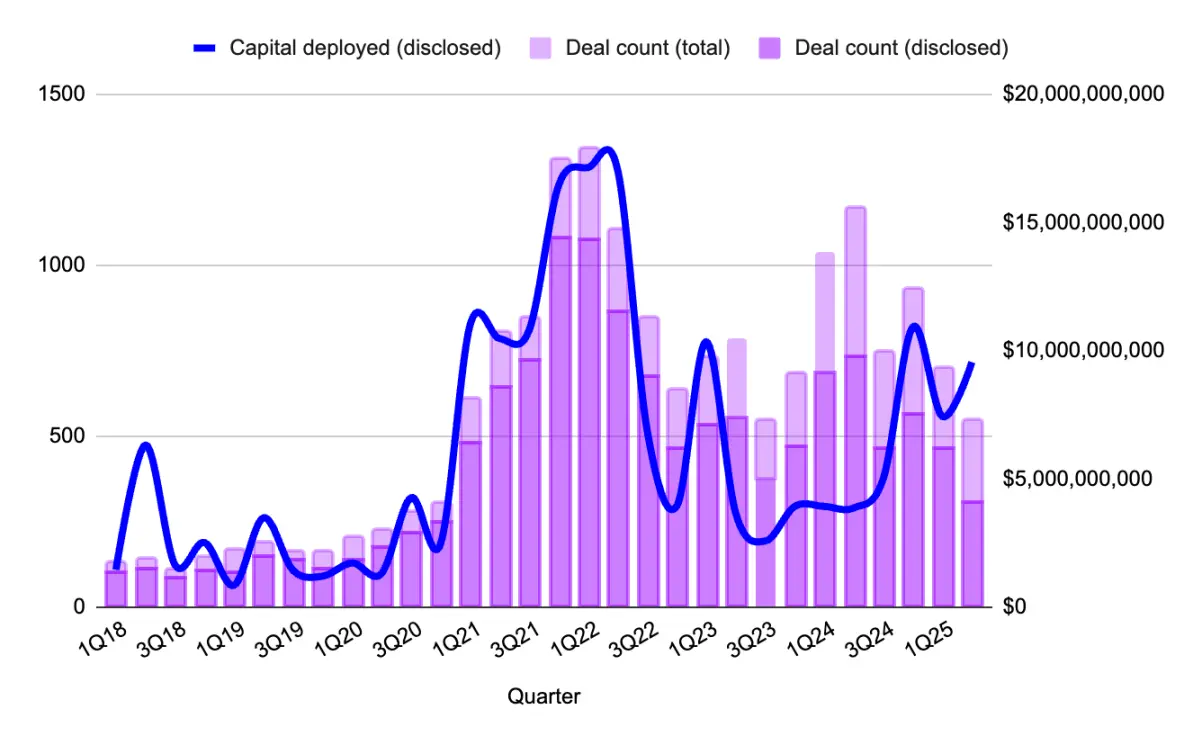
Author: Robert Osborne, Outlier, Ventures Compiled by: aidiDiaoJP, Foresight News Original title: Web3 Financing Trend Report for the 2nd Quarter of 2025: In a Year of Silent Execution, Infrastructure Remains Key Summary Web3 venture capital surged to $9.6 billion, the second-highest quarterly record, even though the number of disclosed transactions fell to only 306 rounds. Capital concentration has increased. Fewer companies raised more capital, and the median size of funding rounds increased at all stages. Series A funding reached $17.6 million, the highest level in more than two years. Seed round amounts have increased. The median seed round jumped to $6.6 million, reversing the decline in the first quarter and indicating increased capital confidence in the early stages. Private token sales remained steady, raising $4.1 billion in just 15 transactions. Public token sales fell 83%, and only 35 events raised $134 million. Infrastructure continues to dominate, with cryptocurrencies, mining and verification, and computing networks leading the way in terms of capital and investor interest. The consumer category is showing a hint of vitality, particularly in financial services and markets, but the scale of financing and the share of transactions is still relatively small. Funding trends this quarter show that this is no longer a game of casting a net, but a very thorough investment of faith. Market Overview: Capital Concentration At first glance, the numbers seem to contradict each other: total Web3 venture capital has surged, but the number of transactions has declined sharply. But in the context of the broader adjustments we've been tracking since 2024, the logic has become clear: investors are moving from broad coverage to deeper, more strategic bets, and the second quarter of 2025 consolidated this shift. Figure 1: Number of Web3 transactions and funding amounts by quarter, Source: Outlier Ventures, Messari recorded only 306 disclosed transactions this quarter (transactions for which funding details were published): this is the lowest level since mid-2023. However, the amount of financing soared to nearly $10 billion, nearly 30% higher than the previous quarter, but there were no large-scale outliers. Instead of a single oversized transaction that distorted data, we saw intensive funding rounds of between $50 million and $250 million, focused on strategic areas such as Rollup infrastructure, validator liquidity, etc. This quarter's financing was clearly characterized by fewer bets, larger rounds, and higher thresholds. The result is that the market feels smaller, yet more serious. In the post-hyperscale fund environment, investors aren't chasing every financing presentation; they are comprehensively considering narrative, agreement dependency, and distribution advantages. You're no longer funded because you have a future, but because you need it. The transactional phase of Web3 startup financing: Round A return After being overlooked for a year, Series A funding is back in focus. The median Series A funding climbed to $17.6 million, the highest level since early 2022, and 27 deals raised a total of $420 million. These are no longer “quasi-B-round” financings disguised as Series A; they are precise and careful capital allocations to companies with strong product market matching (PMF), which usually have growing revenues and perfect token mechanisms. Figure 2: Quarterly changes in the median size of pre-seed, seed round, and round A funding. Source: Outlier Ventures, Messari seed round also rebounded, the median seed round rose to $6.6 million, while the total number of transactions rose slightly. This shows that investors are returning to their interest in early stages of risk, at least in popular areas such as AI native infrastructure or validator tools. Meanwhile, the seed front round remained stable, with a median of $2.35 million, which confirms what we've seen over the past year: early projects are still there. Capital in 2024 is concentrated at both ends. On the one end is optimism in the early seed phase, and on the other end is the maturing period of round B and beyond. Round A was a place where beliefs died, but risk markets won't stand still forever. It will take time to build infrastructure, and it will take time to expand the scale. This moment has arrived. Infrastructure investment dominates Web3...

365d agoLuxurytracy#WEB3

Web3 developer education platform HackQuest completes $4.1 million Pre-A round of funding, co-led by Animoca Brands and Open Campus

In comparison, Web3 developer education platform HackQuest announced the completion of the $4.1 million Pre-A round of financing, co-led by Animoca Brands and Open Campus, with participation from Gate Ventures, Hash Global, HashKey Capital, Bytetrade Labs, StepN, and Outlier Ventures. Angel investors include Public Works founder Scott Moore, Signum Capital partner YY, Outlier Ventures ecosystem leader Riccardo, and Jambo co-founder James. HackQuest said the financing will be used to accelerate the construction of a developer platform and further expand its influence in the global developer community through the acquisition of high-quality platforms on the same track.

376d ago