


Metaverse Walkthrough Guide: Skyrocketing MANA, Million Dollar Land Auction, What's Happening in Decentraland?
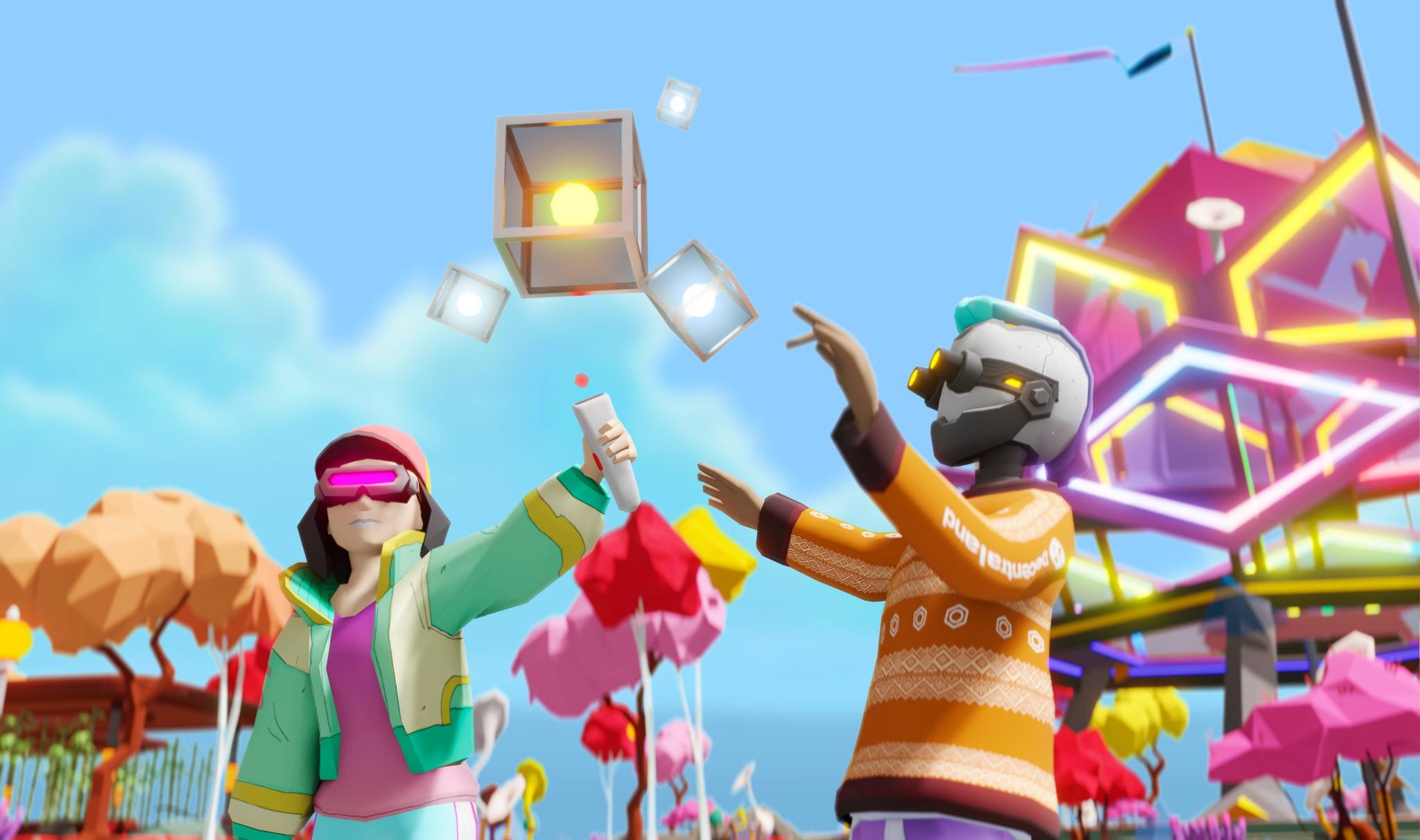
MANA, which has skyrocketed 66 times in a year, is the native token of the metaverse project Decentraland, which is based on Ethereum's decentralized 3D virtual reality platform, or the more common term — metaverse. Users develop and own land plots, art, and NFTs. Members can also participate in community governance by joining the platform's recently launched Decentraland DAO.
“Minecraft” (Minecraft) is a game most familiar to the public, and we can roughly think of Decentraland and The SandBox as a “Minecraft” chain game version, but of course, they created a brand new world. Decentraland allows players to create their own 3D worlds and sell goods to others; this production of value and transactions is the underlying architecture of its token economy system. Users can use the game currency MANA to buy land in these worlds and build various buildings on these lands. Any building you can imagine: parks, hotels, even casinos, etc. In addition to selling their creations, users can also experience being a chartered father/wife in a virtual world and rent Land to others to collect rent.

metaverse
Decentraland's Land is limited to 90,000 total sales to the public. Public spaces, squares, and roads in Decentraland are owned by developers, and users cannot buy or sell them. One of the main drivers of LAND value in Decentraland is scarcity. Just like in the real world, space in this metaverse is limited, which makes owning real estate within this metaverse potentially valuable. Each plot is exactly 16 x 16 meters (256 square meters) in size, represented by an ERC-721 NFT. Each plot of land can be found at a specific coordinate in the metaverse. Although every plot of land is the same shape and size, the difference in price between parcels can still be thousands of times greater.

governing
Decentraland is also one of a growing number of projects using decentralized autonomous organizational structures (DAOs) to complete governance decisions.
DAO is an abbreviation for decentralized autonomous organization. It is commonly known as a next-generation organizational structure that can disrupt a company. In theory, DAO is a community of like-minded people working for the common good, and the biggest difference from traditional company types is that DAO does not have a central authority figure (not a person with great authority, but a person with great power) to lead, and every participant in the DAO can make suggestions for the development of the community and vote for new proposals.
As a result, MANA token holders are largely involved in the development of the Decentraland world. By proposing policy updates and voting on specific details of upcoming LAND auctions, it directly affects the future development of the metaverse.

markets
In addition to providing a content creation platform in the virtual world, many Decentraland users have now realized the process of monetizing through their LAND through leasing, advertising, and payment experiences. Previously, most land-type NFT earnings were limited to turnover, hype, and Ponzi schemes. Similarly, other users earn revenue by creating and selling items on the Decentraland marketplace to earn MANA tokens, or by selling their own NFTs on third-party websites such as OpenSea.
Although Decentraland was developed as a 3D virtual world for spending and earning MANA, in actual use, Decentraland breaks down client-side barriers very well. As long as users have an internet connection and a terminal device (desktop, laptop), they can explore this metaverse. And the process is completely free. Decentraland doesn't currently support mobile logins, but given the huge user base Axie has acquired on mobile, it's only a matter of time before Decentraland finally opens up to mobile.
Project history and founders
Decentraland was founded by two Argentines, Ari Meilich and Esteban Ordano, but both have indicated that they will no longer participate in project management or development. But he is still contributing value to Decentraland as a project advisor.
Ariel Meilich previously worked as Decentraland's project manager from 2017 to 2020. He is considered a successful “serial entrepreneur” and has founded several other startups, including an online translation agency and a CRM (customer relationship management) platform. He also worked as an analyst at Charles River Ventures, an American venture fund based in Silicon Valley.
Esteban Ordano, on the other hand, is a former technology leader at Decentral. He is no stranger to the cryptocurrency field, has also worked as a software engineer at BitPay and worked as a consultant for Matic Network, etc. He also ran his own smart contract development company, Zeppelin Solutions, a blockchain technology infrastructure company headquartered in the US.
Although both founders are no longer leading the project, development of Decentraland is currently ongoing and is currently being led by the non-profit Decentraland Foundation.

Tokens MANA and LAND
Decentraland was launched after completing a $24 million initial coin offering (ICO) in 2017. The metaverse platform began beta in 2019 and opened to the public for testing in February 2020. Since then, users have created various ecosystems on their LAND, including interactive games, grand 3D modeling, and various other creative content.
Decentraland mainly uses two tokens. MANA and LAND. MANA is an ERC-20 token that needs to be destroyed to buy LAND (real estate NFTs). MANA tokens can also be used to pay for a series of avatars, character equipment, names, etc. on the Decentraland market, and more content will be developed to enrich the metaverse scene in the future.
According to information available online, during the initial coin offering (ICO) in 2017, a total of 40% of MANA circulation was used for sale to the public. Additionally, 20% was kept as a reward to the community, 20% was given to the development team and other early contributors, and the remaining 20% was held by the Decentraland treasury. Currently, tokens held by the project are no longer in circulation.
Why is MANA attracting so much traffic and money?
One important reason is that platforms like Decentraland have the potential to be an important springboard for the next phase of development in the gaming industry. They all use blockchain technology as the foundation for developing new games, and have a stable token economy model, which allows players to use their native tokens to buy virtual assets or items in these games, and also gives players the opportunity to earn the tokens they need by interacting with games. Furthermore, in the future, Decentraland may launch a token repurchase function, where users can sell their digital assets back to developers in exchange for assets outside of the game (other cryptocurrencies). In this way, game content creators will get funding from selling their creations, and players can also benefit from it.
Cryptocurrency has never been a game where you just print a bunch of coins and sell it for nothing; developers must build a complete ecosystem around it. It is also necessary to ensure that players, project participants, and developers have sufficient trust in the project and are willing to invest in it, whether time, energy, assets, or technology. That's why most of these projects focus on building and running a community first, rather than just being profitable. They understand that a strong community is far more valuable than the digital value of a token.
The initial small market capitalization of the game currency project, combined with network effects, is a prerequisite for creating a price miracle. At the same time, if the project has sufficient value and the community is strong enough, its demand, market capitalization, and corresponding cryptocurrency prices can only continue to grow.
Meta or Facebook rival Decentraland has attracted so much interest, and one of the main reasons is that it has the potential to completely change the rules of online gaming. With Decentraland, every player can be called a content creator, and it is up to the player to decide what kind of content appears on the platform. Users enjoy a portion of this world by purchasing scarce land NFTs and get natural platform user traffic. This may also be the reason why, for example, Barbados is planning to establish a digital embassy in Decentraland.
As previously reported, the Ministry of Foreign Affairs and Foreign Trade of the Caribbean island nation of Barbados (Barbados) has signed an agreement with Decentraland, a popular crypto metaverse project, to establish a digital embassy. The government is also finalizing cooperation agreements with Somnium Space, SuperWorld, and other metaverse platforms. Various projects will assist in identifying and purchasing land, constructing virtual embassies and consulates, developing facilities that provide services such as “electronic visas,” and building “transmitters” that allow users to transfer personal virtual avatars between different metaverses. With this, Barbados will become the first country in the world to recognize a digital sovereign land, and a virtual embassy is scheduled to launch in January 2022.
Facebook changed its name to Meta and brought the metaverse, the crypto branch, to the forefront of public opinion. Decentraland (MANA) is one of them. If Meta's Metaverse succeeds, then crypto-native projects like Decentraland (MANA) or Axie Infinity (AXS) will naturally benefit from it and take off on a new cusp.
Tim Sweeney, CEO of the famous gaming platform Epic Games, has predicted that the metaverse economy will be a tens of billion dollar market (which is probably too conservative). Nvidia CEO Jensen Huang believes that it will surpass the economy of the physical world, which is estimated to be close to $90 trillion (a huge market for Huang Lao and his Nvidia). Although there are many bubbles in the current metaverse market, in the long run, if you are willing to believe in the metaverse's narrative and future development space, joining now can still reap an unlimited future.
For more information, welcome to join:
Compare the Discord communityhttps://discord.gg/QSvv7MZ2tz
TG comparison: https://t.me/BitPushCommunity
Picture Source: Internet
Author: Chen Zou
This article is from Bitpush.News. The source must be indicated for reprinting
