Decentraland · 600
The “Everything Is Possible World Model”: How can a vague concept support the $10 billion financing narrative?

The “Everything Is Possible World Model”: How can a vague concept support the $10 billion financing narrative?

Author: Motion Detective BeatingOriginal title: Everything Is Possible World Model The term World Model is almost being sold out by investors. Li Feifei's World Labs completed financing of 1 billion US dollars in February this year, with a valuation of 5 billion US dollars. A year ago, it was only valued at 1 billion dollars. Yang Likun's new company, AMI Labs, raised around a billion dollars in seed round, setting the record for the largest seed round in the history of European AI startups. There were 25 cases of financing related to the World Model in the first quarter in China. Some companies took two consecutive rounds of 2.5 billion dollars in a month, and the valuation jumped from 5 billion to 10 billion dollars. What's even more surprising is that don't look at investor FOMO like this. Currently, the entire AI industry has yet to agree on what the four words “world model” actually mean. It's a word that hasn't even been defined, and it's already worth tens of billions. Every day they shouted slogans to find an anti-consensus, and in the end, they invested their money in the absence of consensus, and then called it an outlet. However, I recently heard from a few big VC investors that they could clearly see the bubble in this direction themselves, and it wasn't that no one had taken a picture of the table during the internal rehearsal session and discussed it back and forth. The conclusion was that they still had to vote. If you don't vote, next year's LP will ask you why you missed the world model; if you vote, even if you make a mistake in the end, it will be the whole industry's fault. However, when the money is hot enough, it is time to ask an impolite question. Since no one can say exactly what it is, what exactly is everyone voting for? First of all, let's be fair about the process. There was something really about this concept. In 2018, two researchers published a paper titled “World Models.” They let AI create a dream for themselves in a racing game. First, master the car in the dream, and then run back in the game. At the time, ChatGPT didn't exist, and this paper was only circulating in a small circle of researchers. Yang Likun has actually been adhering to this research direction for a long time. In the years when all of Silicon Valley bet money on the big language model, he repeatedly reiterated his view that by predicting the next word, machines would never be able to touch human intelligence, so it must be made to understand the physical world. I've been saying this for almost ten years, but the wind hasn't blown this way for him. People like him didn't turn away after hearing the wind; in their perception, there really is something about the world model. However, when “something really does” enter the venture capital industry, it usually has to go through a process first. This process will process a research direction into a term that can be wholesale. The venture capital community's favorite has never been a technical concept; it's the franchisability of a technical concept. The world model is a child of choice in this regard. It is more technological than the “metaverse,” sexier than “spatial intelligence,” broader than “embodied intelligence,” and fresher than “multi-modal.” Most importantly, it's very difficult to falsify. In BP, the harder it is to prove falsification, the more valuable it is, because not being able to falsify means that new investors can be found to take over in the next round. What the story earns is money that cannot be falsified. The world model was folded, and it had the current splendor. If you make a game, say you are a model of the world; if you make a short story, you say you are a model of the world; if you make a video tool, you say you are a model of the world; if you make a simulation robot, you say you are a model of the world. Further on, those who make advertising materials, educational courseware, metaphysics fortune-telling, and virtual people to chat with will be able to enter the world model circle as long as they dare to blow it. Earlier, at an event, I heard investors share in a round table. Each field of medicine, finance, and law can be viewed as an independent world. According to this usage, my car repair master downstairs also has a world model in his mind. It specifically predicts when the Third Ring Road will be blocked. The accuracy rate is higher than most assisted drivers I've ever used. Not long ago, I also saw a robotics company announce that it is building a model of the industrial world and a model of the home world at the same time. I realized that the world used to be countable terms; they can be sold individually. It's not that no one has anticipated this grand event; the identity of the person who anticipated it is quite special. In March of this year, on the day AMI Labs funded that billion dollars, the company's CEO told the media that I predict “world model” will be the next buzzword. Within six months, every company will call itself World Model to finance. He was right. The only thing that wasn't accurate was the time; it didn't take six months at all. Habitual narratives Chasing narratives has long been a habitual act of investors and entrepreneurs. On May 10, 2015, a listed company whose main business is floor tiles and real estate issued an announcement saying that it wants to become the first internet finance company in China, it wants to change its name to “Pitumpi”, and the English name is directly registered as P2P Financial Information Ser...
47d agoburnking#AI #financing

The Grayscale update plans to consider inclusion in the product token list, adding assets such as HYPE, STX, and VIRTUAL

Comparing news, Grayscale posted an article on its official website stating that it has updated the list of crypto assets to be considered for inclusion in future investment products. According to the latest list, the Currencies sector includes Bitcoin and XRP; Smart Contract Platforms adds Stacks, Sui, Toncoin, and Tron; the Financials sector plans to consider assets such as Ethena, Hyperliquid, and Jupiter; Consumer & Culture includes Dogecoin and Decentraland; assets to be considered in the AI field include Worldcoin, Virtuals Protocol, Story, and Grass; Utilities & Services include Chainlink, LayerZero, and Helium. Grayscale said the list is assessed on a quarterly basis to provide investors with diversified digital asset investment options.

133d ago
An Expensive Imagination: Metaverse Real Estate Wealth Evaporation

An Expensive Imagination: Metaverse Real Estate Wealth Evaporation

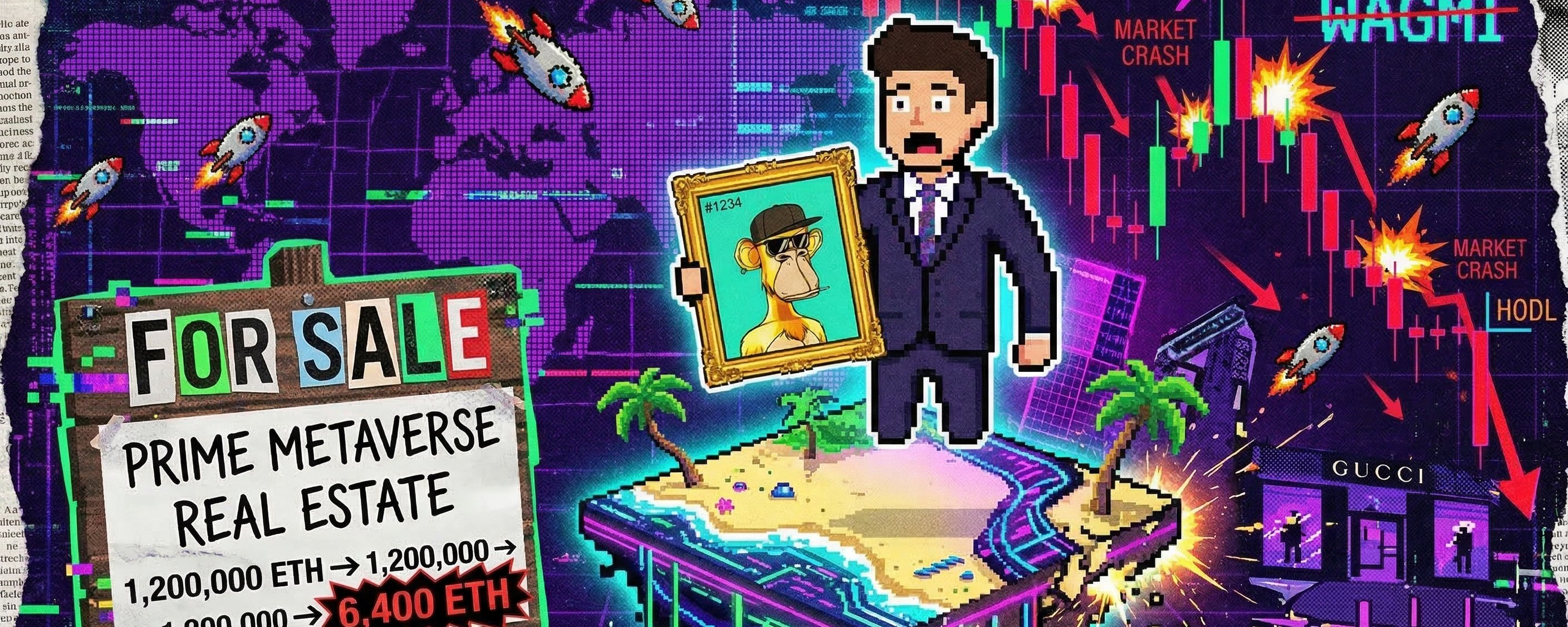
Author: @gothburz编译: Big Pliers | PanNews Lobster Original title: Metaverse Real Estate Victim's Statement: My 1.2 million has only $6,400 left “Diamond Hand,” meaning: even if the investment falls by 94%, you'll never take action. We have packaged this financial paralysis as a personality trait. My peak net worth is $1.2 million. But none of that money actually exists. I'm not talking about philosophical reasoning. I mean, they exist on some servers—and those servers are now shut down. I own 11 properties in the metaverse. Three in Decentraland, four in The Sandbox, two in Voxels, and one on Otherside. There's also a seaview villa at Horizon Worlds — I bought it for $214,000 because Mark Zuckerberg personally said it was “the next frontier.” Last week, this “frontier” closed its doors. It's now a mobile app. Last year, I sent the same message to a group of 340 people: “You have no idea how early we entered. “Then I stopped sending this kind of message. Not because I admitted my mistake, but because most of them blackmailed me. I entered metaverse real estate in November 2021. Everyone was buying it back then. Someone spent $450,000 just to be Snoop Dogg's neighbor in the game. In a video game. The virtual characters in that game don't have legs. Right, those avatars don't have legs. But I think that's a good sign. “Sooner or later, there will be legs,” I told everyone in the Discord group. “Legs are on the product roadmap. “Three hundred people immediately responded to Rocket's expression. I gave myself a title — “Digital Real Estate Tycoon.” I wrote it in my Twitter profile. I wrote it in my LinkedIn job section. I also went to a podcast to talk about this. That podcast had eleven listeners. Three are robots. What's left is my own small size. Combined, my virtual properties are larger than the apartment I actually live in. But in my real apartment, it's furnished. Location, location, or location. My most valuable asset is the plot next to a virtual Gucci store. In 2023, Gucci withdrew. That store is still there. No one went in. It's like some shopping center in Ohio — but the picture is worse; it doesn't even have a food court. I didn't sell it. Diamond hands. That's what we always say — “Diamond Hand.” It means: even if your investment falls by 94%, you'll never take action. We have packaged this financial paralysis as a personality trait. Someone in my Discord group spent $2.4 million to buy a 618 plot of estate in Decentraland. Prime location. There is a lot of traffic. I asked him what the term “traffic” means on a platform with only 38 daily active users. He said I don't understand this technology. It's true, I don't understand. But I kept buying more. We have a DAO — a decentralized autonomous organization. It means that everyone votes to make decisions. There are nine of us in total. The three never showed up. Both voted for anything, but never read the content of the proposal. The other four are me and my little one. We voted to “buy strategic land”. The full vote passed. I alone cast four votes. My portfolio peaked at $1.2 million. I told everyone. I made a spreadsheet. I'm predicting a 40x return in 2025. I did a BP. One page of the PPT says, “We are building a digital economy. “That page had a rocket expression. That's my entire financial model. In 2023, I spent $189,000 to buy a Bored Ape NFT. Now it's worth $1.4 million. I'm not talking about that ape. But I'm still using it for avatars. When someone asked me, I said “I've been bullish for a long time”. “Long term bullish” means: if I sell, I'll cry at a Panera bakery. My mom asked me what Bored Ape is. I said, “Digital art on the blockchain. “She asked why compared to her car...

155d agoLuxurytracy

Data: The crypto sector generally rebounded, the GameFi sector led a rise of nearly 7%, and BTC returned above $90,000

Comparatively, according to SosoValue data, the crypto market sector generally rebounded, with GameFi leading the 24-hour increase of 6.88%. Among them, Axie Infinity (AXS) rose 20.71%, The Sandbox (SAND) rose 13.04%, and Decentraland (MANA) rose 11.03%. Additionally, Bitcoin (BTC) rose 1.16% to surpass $90,000; Ethereum (ETH) rose 1.91% to surpass $3,000. Meanwhile, Mag7.ssi is up 1.76%, Defi.ssi is up 1.96%, and Meme.ssi is up 1.79%. In other sectors, the AI sector rose 3.72% in 24 hours; within the sector, Render (RENDER) rose 5.36%; the RWA sector rose 3.70%, and Pendle (PENDLE) rose 11.36%; the DeFi sector rose 3.14%, and River (RIVER) continued to rise sharply and rose 36.46%; the PayFi sector rose 3.12%, Telcoin (TEL) rose 24.98%; Meme sector rose 2.47%, PIPPIN (PIPPIN) rose 32.01%; the Layer 2 sector rose 2.40%, ImmutableX (IMX) rose 6.53%; the Layer 1 sector rose 1.81% and Canton Network (CC) rose 13.98%; the CeFi sector rose 1.27%, and Aster (ASTER) rose 4.41%. The crypto sector index, which reflects the sector's historical market, shows that the SSIGameFi, SSIAI, and SSIRWA indices rose 9.04%, 4.61%, and 3.90% respectively.

212d ago
Whales, bookmakers, national teams — the power reshuffle behind 6 replays of crypto bulls and bears

Whales, bookmakers, national teams — the power reshuffle behind 6 replays of crypto bulls and bears

Author丨ReginaHalf Source丨White55, Mars Finance Original Title丨Who Manipulates the Crypto Market? On January 3, 2009, the power change war behind the six bulls and bears, Bitcoin's genesis block was successfully unearthed, marking the first time blockchain technology was applied to the decentralized digital currency field, and the Bitcoin network was officially launched. Over the next decade, Bitcoin and the cryptocurrency market it led showed a significant long-term bullish trend. However, this journey was far from easy. The price trend showed sharp and characteristic cyclical fluctuations. During this period, it experienced many transitions from a frenzied bull market to a deep bear market. These fluctuations are not random, but are closely linked to a series of core events that profoundly influence the market pattern. Looking at Bitcoin's price trend from 2009 to 2025 (data source: The Block), it can be clearly divided into six major development stages based on its price range and trend. The iconic events at each stage and their profound impact on the industry ecosystem are as follows: Looking at Bitcoin's price trend from 2009 to 2024, it shows significant cyclicality. According to the Bitcoin price range and price trend, it can be divided into six major stages of development. The iconic events at each stage and their profound impact on shaping the industry's ecology are described as follows: 1. Phase 1 (2009-16): Early market exploration and technology foundation The beginning of Bitcoin's birth was only a testing ground for niche playthings and cryptography enthusiasts in the geek community. Its price remained low from 2009 to early 2013. However, in 2013, the price of Bitcoin experienced its first sharp fluctuation, soaring from about $20 at the beginning of the year to over $1,100 at the end of the year, then falling sharply. For the first time, this rollercoaster market brought Bitcoin into the global eye. Source: CoinGecko Why did Bitcoin's price suddenly soar in 2013? The driving factors behind it are as follows: 1. The banking crisis in Cyprus ignited safe-haven demand. In March 2013, the Cyprus government announced a tax on bank deposits in exchange for international aid. This aggressive measure sparked strong public protests, bank overcrowding, and severe market turmoil, and profoundly exposed the fragility of traditional financial systems and the potential risks of government decisions. In this context, Bitcoin's decentralized nature and its attribute of not being controlled by a single government made it widely regarded as a potential safe-haven asset for the first time. Although the circulation and application of Bitcoin was still in its early stages, the Cyprus crisis clearly demonstrated the shortcomings of the traditional system. This incident became a catalyst, and Bitcoin's value proposition as an alternative asset, particularly its potential safe-haven properties, received unprecedented market attention and initial recognition. The Cyprus crisis was not an exception; it occurred in the macro context of the continuing unfolding world sovereign debt crisis. At the time, many countries were in deep debt distress, triggering widespread market concerns about the stability of fiat currencies and wavering confidence in fiat currencies. This environment of ongoing uncertainty has created a breeding ground for non-traditional assets such as Bitcoin. In fact, looking back at 2013, Bitcoin's price jumped several times, and the timing was often closely linked to key risk events during the debt crisis or heightened market panic. This shows that widespread anxiety about the risks of the traditional financial system was a deep and continuing factor driving the surge in Bitcoin demand and price during that year. 2. The regulatory policy was initially approved against the backdrop of the rapid rise in the price of Bitcoin. The dynamics of regulatory policy are a weather vane for the future development of the industry. On November 18, 2013, the relevant parties of the US government held a special hearing on the risks and threats of Bitcoin and other virtual currencies, and publicly acknowledged the legality of Bitcoin for the first time. The clarity of regulatory attitudes instantly ignited market enthusiasm. On the day after the hearing (November 19), the BTC price on mt.gox, the world's largest Bitcoin exchange at the time, soared more than 114% from about $420 before the hearing, surged more than 114% in a single day, breaking through the $900 mark in one fell swoop, and hit a record high at the time soon thereafter. This surge, triggered by regulatory policies, clearly shows the huge impact of regulatory approval on market confidence and capital inflows. 3. Mainstream media widely reported that in 2013, Bitcoin completely “broke the circle” from the tech geek community and became the focus of mainstream media around the world. Major media outlets are scrambling to report on Bitcoin's soaring price, stories of early investors becoming rich, and its disruptive potential. This has greatly stimulated the public's investment interest and speculative enthusiasm. Numerous new investors poured into the market due to FOMO sentiment, forming a strong buyer power. However, with favorable regulations and high market sentiment...

387d agoWendy#DeFi #Ethereum #crypto market #Bitcoin #BEARISH #Bull market
A Long Run for Cryptography: Cycle Logic and Driving Mechanisms from 0 to Trillions

A Long Run for Cryptography: Cycle Logic and Driving Mechanisms from 0 to Trillions

Introduction On January 3, 2009, Bitcoin's genesis block was successfully unearthed, marking the first application of blockchain technology to the decentralized digital currency field, and the Bitcoin network was officially launched. Over the next decade, Bitcoin and the cryptocurrency market it led showed a significant long-term bullish trend. However, this journey was far from easy. The price trend showed sharp and characteristic cyclical fluctuations. During this period, it experienced many transitions from a frenzied bull market to a deep bear market. These fluctuations are not random, but are closely linked to a series of core events that profoundly influence the market pattern. Looking at Bitcoin's price trend from 2009 to 2025 (data source: The Block), it can be clearly divided into six major development stages based on its price range and trend. The iconic events at each stage and their profound impact on the industry ecosystem are as follows: Looking at Bitcoin's price trend from 2009 to 2024, it shows significant cyclicality. According to the Bitcoin price range and price trend, it can be divided into six major stages of development. The iconic events at each stage and their profound impact on shaping the industry ecosystem are described as follows: Phase 1 (2009-2016): Market Exploration and Technology Foundation At the beginning of Bitcoin's birth, it was only a testing ground for niche playthings and cryptography enthusiasts in the geek community. Its price remained low from 2009 to early 2013. However, in 2013, the price of Bitcoin experienced its first sharp fluctuation, soaring from about $20 at the beginning of the year to over $1,100 at the end of the year, then falling sharply. For the first time, this rollercoaster market brought Bitcoin into the global eye. Source: CoinGecko Why did Bitcoin's price suddenly soar in 2013? The driving factors behind it are as follows: 1. The banking crisis in Cyprus ignited safe-haven demand. In March 2013, the Cyprus government announced a tax on bank deposits in exchange for international aid. This aggressive measure has sparked strong public protests, bank overcrowding, and severe market turmoil, and has profoundly exposed the fragility of traditional financial systems and the potential risks of government decisions. In this context, Bitcoin's decentralized nature and its attribute of not being controlled by a single government made it widely regarded as a potential safe-haven asset for the first time. Although the circulation and application of Bitcoin was still in its early stages, the Cyprus crisis clearly demonstrated the shortcomings of the traditional system. This incident became a catalyst, and Bitcoin's value proposition as an alternative asset, particularly its potential safe-haven properties, received unprecedented market attention and initial recognition. The Cyprus crisis was not an exception; it occurred in the macro context of the continuing unfolding world sovereign debt crisis. At the time, many countries were in deep debt distress, triggering widespread market concerns about the stability of fiat currencies and wavering confidence in fiat currencies. This environment of ongoing uncertainty has created a breeding ground for non-traditional assets such as Bitcoin. In fact, looking back at 2013, Bitcoin's price jumped several times, and the timing was often closely linked to key risk events during the debt crisis or heightened market panic. This shows that widespread anxiety about the risks of the traditional financial system was a deep and continuing factor driving the surge in Bitcoin demand and price during that year. 2. The regulatory policy was initially approved against the backdrop of the rapid rise in the price of Bitcoin. The dynamics of regulatory policy are a weather vane for the future development of the industry. On November 18, 2013, the relevant parties of the US government held a special hearing on the risks and threats of Bitcoin and other virtual currencies, and publicly acknowledged the legality of Bitcoin for the first time. The clarity of regulatory attitudes instantly ignited market enthusiasm. On the day after the hearing (November 19), the BTC price on mt.gox, the world's largest Bitcoin exchange at the time, soared more than 114% from about $420 before the hearing, surged more than 114% in a single day, breaking through the $900 mark in one fell swoop, and hit a record high at the time soon thereafter. This surge, triggered by regulatory policies, clearly shows the huge impact of regulatory approval on market confidence and capital inflows. 3. Mainstream media widely reported that in 2013, Bitcoin completely “broke the circle” from the tech geek community and became the focus of mainstream media around the world. Major media outlets are scrambling to report on Bitcoin's soaring price, stories of early investors becoming rich, and its disruptive potential. This has greatly stimulated the public's investment interest and speculative enthusiasm. Numerous new investors poured into the market due to FOMO sentiment, forming a strong buyer power. However, in 2013, when regulations were favorable and market sentiment was high, why did the price of Bitcoin not continue to soar, but instead declined in 2014...

390d agoLuxurytracy#cryptocurrency

Decentralized lending protocol Exactly Protocol raised $2 million, with Bodhi Ventures and others participating

Comparatively, Exactly Protocol, a decentralized lending protocol based on the Ethereum mainnet, announced the completion of a $2 million round of funding. Bodhi Ventures, Newtopia, NXTP Ventures, and Kaszek Ventures, as well as Synthetix founder Kain Warwick and Decentraland co-founder Esteban Ordano, will participate. The new capital will support it in the future Within the month, Ethereum's second-tier network Optimism was launched, using an open source unmanaged DeFi protocol to provide borrowers and lenders with DeFi credit features that support floating and fixed interest rates.

522d ago
Web3 Gaming Weekly Report (1.13—1.19)

Web3 Gaming Weekly Report (1.13—1.19)

Review last week's blockchain gaming overview and check out the latest data reports from Footprint Analytics and ABGA. [1.13—1.19] Web3 Gaming Industry News Sony BSL (Sony BSL) announced the launch of its Ethereum L2 blockchain Soneium mainnet. Hyve Labs raised $2.75 million to drive Web3 gaming infrastructure development. Pixels founder: A PIXEL token staking feature will soon be launched. ARPG Spot Zero, developed by Tarta Games game studios, received $1,000,000 in grants from Arbitrum and Mantle. Ronin launched a $10 million ecosystem grant fund. [1.13—1.19] Web3 Game Ranking New Player Growth Weekly Top 10: Forgotten Runiverse, The Sandbox, SEED lead Forgotten RuniverseThe SandboxSeedPixelsPlayzap GamesPixudicattonTomtalKragnarok: Monster WorldDecentraland New Player Retention Weekly Top 10: Wild Forest, Eternals, LiveArt leads Wild ForesternalsLiveArtCrystal CavesPixelSaxie InfinityBalanceCattonBirdsGenopets Weekly Active Player Growth Top 10: Forgotten Runiverse, The Sandbox, Pixudi leads Forgotten RuniverseThe SandboxPixuDiseedPlayZap GameScattonTomTalkCrystal CavesFishing StarsLotana Coin Flip Please note: The above User (Users) data analysis is based on the chain analyzed by Footprint Analytics. Weekly Token Growth Top 10: Mist, ROCO Finance, Exeedme lead MistroCo FinanceExeedMetap FantasyBonkRuneMines of DalarniAdVision NetworkTheTan Arenabenji Bananas More Web 3 game data Browse Blockchain Gaming Weekly Exclusive Dashboard, Get more insights into blockchain game data. The content of this article is for industry research and communication purposes only, and does not constitute any investment advice. Markets are risky, and investments need to be cautious. About Footprint AnalyticsFootprint Analytics is a comprehensive blockchain data analysis platform that streamlines complex analysis for businesses and projects in the Web3 ecosystem. It provides customized solutions, eliminating the need for extensive expertise and infrastructure maintenance. The platform provides long-term growth tools designed to help gradually establish and manage communities, emphasizing sustainable growth and user loyalty. By combining powerful analytical tools and community management tools, Footprint Analytics enables projects to effectively use blockchain data for decision-making and growth strategies, covering various fields such as GameFi, NFTs, and DeFi. Official website | X/Twitter | blog...

579d agoFootprint Analytics#cryptocurrency

Decentraland: 2.0 is live, desktop client beta launched

In comparison, metaverse platform Decentraland announced that Decentraland 2.0 is live, and Decentraland's new desktop client beta is available on Mac and Window. Decentraland says the update lays the foundation for its expansion into VR, mobile devices, and other fields. New features in Decentraland 2.0 include: improved performance; an immersive environment; badges, daily quests, and mini-games; enhanced avatars and social interactions; creator center, and more.

669d agoWendy#Decentraland #metaverse
Bankless: Is the recent market too boring? “Bull Market Betting” at a glance in grayscale

Bankless: Is the recent market too boring? “Bull Market Betting” at a glance in grayscale

Source: Bankless Author: Jun Compiled: BitPushNews Mary Liu The crypto industry's “OG” and digital asset management giant Grayscale (Grayscale) has been very busy lately. Whenever Grayscale announces the launch of a new trust for a specific asset, the market usually reacts with a mixture of excitement and skepticism. It's like a double-edged sword: a signal of saturation for some, a beacon of hope for others. Some might interpret the launch of a new product as a sign that the asset market has reached saturation, or at least limited upside potential. But from another perspective, it's a sign of approval from mainstream players in the crypto space. It can lend legitimacy to assets, potentially attract institutional investors, and at least increase media exposure. Grayscale has been adding new investment products at a faster pace, showing their conviction that we are in the middle of a crypto bull market driven by a series of bullish signals: Bitcoin ETF inflows, long-awaited ETH ETF launches, increased stablecoin adoption, and steady growth in TVL in DeFi. As an understated giant in the industry, investors continue to keep an eye on the assets supported by Grayscale to explore the industry's potential racetrack. What assets have caught their attention recently? This article will find out. Grayscale Decentralized AI Fund (FIL, NEAR, RNDR, LPT, TAO) The Grayscale Decentralized AI Fund is a pioneering fund that invests exclusively in the native token of decentralized AI protocols. Currently, it includes Filecoin, Near, Render, Livepeer, and Bittensor. Grayscale Decentralized AI Fund shareholding details. Source: GrayScaleGrayScale points out concerns about a future dominated by centralized AI, and the potential of cryptocurrencies to create a fairer, more transparent ecosystem. They believe that while the cryptocurrency x AI sector is still in its early stages, it has great prospects. By harnessing the power of cryptocurrencies, we can build a fairer, more transparent, and more trustworthy AI ecosystem. Grayscale Dynamic Income Fund (SOL, CBETH, NEAR, etc.) Grayscale Dynamic Income Fund (GDIF) aims to take advantage of the growing staking rewards offered by various tokens such as SOL, ETH, NEAR, etc. The fund aims to maximize returns by strategically allocating capital to tokens with attractive staked returns. Grayscale is known for its diversified approach to investing in crypto. While they usually diversify across industries, GDIF marks a new frontier: diversifying across different types of tokens. This provides investors with a unique opportunity to gain beyond the underlying token's potential upside. Grayscale NEAR Trust (NEAR) Grayscale believes NEAR is a prominent player in the crypto space due to NEAR's strategic focus on artificial intelligence and chain abstraction. NEAR's vision for user-owned artificial intelligence is ambitious, but its active developer community, growing user base, and significant funding motivates it to achieve this goal. As the world continues to embrace artificial intelligence, NEAR is likely to become the platform of choice for developers and users. Grayscale Stacks Trust (STX) Stacks are Grayscale's bet on the promising Bitcoin L2 sector. Stacks provides a solution to Bitcoin's scalability and functionality challenges by building an L2 that supports smart contracts at the top level. This approach allows developers to build a wide range of applications on top of Bitcoin's blockchain. As the ecosystem around Bitcoin continues to evolve and more DeFi activity begins to emerge, the need for scalability and lower costs is only becoming more apparent, and Stacks provides a solution to this problem. Grayscale MakerDAO TrustMakerDAO is an OG DeFi project, and the native governance token MKR is the key to participating in this ecosystem. The launch of Grayscale MakerDAO Trust comes at a time when people are blue-chip...

730d agoWendy#2023 market #AI #Bittensor #CBeth #FIL #LPT #NEAR #RNDR #SOL #Sui #TAO #grayscale