


2022 Metaverse Annual Report: The trillion dollar market has begun, where is the next 100 billion company with a market capitalization? 丨Heart of the Metaverse & Ou Yi Research Institute
directories
rundown
1. Metaverse under discussion
The background to the birth of the metaverse
The history of the metaverse
Definition of the metaverse 2022
II. Metaverse infrastructure and theory
Fundamentals of metaverse theory
The metaverse hexagon principle
Fundamental Metaverse Technology
III. 2022 metaverse industry chain
Industry penetration map
The development of overseas metaverse giants
Metaverse application scenarios
IV. The top ten keywords of the year
Policy dividends, industrial metaverse, early access to giants, consumer-grade hardware, digital economy
Digital people, metaverse marketing, Web3, AIGC, educational metaverse
5. 2023 Prospects/Forecasts
Reviewing 2021's outlook and predictions
2023 outlook and forecast
6. Afterword
METAVERSE
rundown
Domestically, the term metaverse gradually transitioned from the familiar field of “eating melons” to the application stage in 2022 after reaching the top of the “Chinese Inventory 2021” and “Top Ten Internet Terms” in 2021.
In the 2022 Oxford Glossary of the Year, the metaverse ranked second, and usage increased nearly four times compared to last year; while the “2022 Science Hot Words” published by Baidu Boiling Point and Phoenix News Technology, the metaverse ranked among them。
On the one hand, the public is curious about the metaverse, and on the other hand, it is the crazy learning of the metaverse. These two phenomena clearly confirm the popularity of the metaverse in the past year. Although “one question three unknown” has transitioned to a “slight understanding” compared to 2021, the vast majority of people lamented “too far away” after this understanding.
We have to admit that after experiencing the ups and downs of 2022, the metaverse doesn't seem to have brought much surprise to the general public. Even because of the fall of Meta's stock price, the metaverse was cloaked as a “scam,” but these are more of the phenomena shown in the early stages of the industry and are not viewed from a development perspective.
As a result, we (MetaverseHub, the heart of the metaverse), as early participants and builders of the industry, have not only seen the metaverse go from no one's attention to much discussion, but have also seen everything from loud fanfare to full of suspicion, but all of these good and bad things have outlined the development context and future outline of the industry.
As industry observers, we have our own thoughts and understandings,
The upcoming 2022 has brought new life to the metaverse. Whether it is corporate support, capital support, or policy encouragement, the industry has quietly changed in the midst of silence。
Standing at the end of the year, we are once again jointly launching the 2022 Metaverse Annual Report by Ou Yi Research Institute, a well-known research institution that focuses on technology trends in the global blockchain industry and is deeply involved in the metaverse and Web3 direction. It will sort out and review the development overview of the industry over the past year from the five major sections of “Metaverse Under Discussion,” “Basic Metaverse Theory,” “2022 Metaverse Industry Chain,” “Top Ten Keywords of the Year,” and “2023 Outlook”.
METAVERSE
The metaverse is being discussed
◉The background to the birth of the metaverse
Philosopher Karl Theodor Jaspers said, “Modern science has brought the world into the laboratory, and modern technology has in turn brought the laboratory into the world. The 'eye' of science 'and the' hand 'of technology are increasingly building the world into an artificial technological world.”Over the past ten years, the Internet has provided an accelerator for human social development and provided a new form and foundation for economic development. Upgrades in storage, networking, and computing have promoted the formation of the experiential economy. Human history gradually transitioned from the agricultural economy, industrial economy, and service economy to the experiential economy, society gradually moved from the Internet era to the digital age. Web3, cloud computing, big data, the Internet of Things, supercomputers, brain-computer interfaces... Many emerging technologies have moved from science fiction to reality and reshaped our lives.
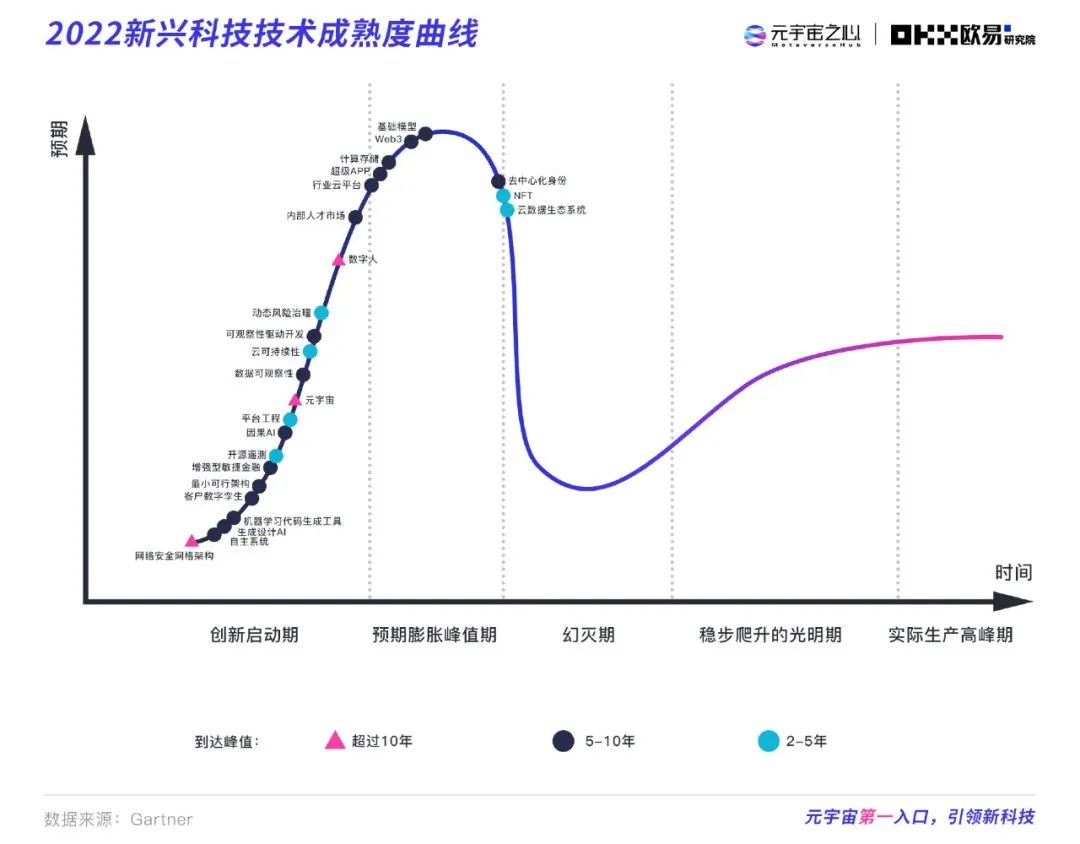
High-precision technologies such as virtual reality, augmented reality, and artificial intelligence have disappeared from Gartner's technical maturity curve and replaced by segmented tracks in related fields. This marks the gradual maturity of the new technology, which will be followed by explosive application growth.
Technology and the development of the times are interdependent and mutually reinforcing. And as technology becomes digital, or once it can be edited into computer code represented by 0 and 1, it can break free from Moore's Law and begin to accelerate exponentially.
We need a refined and highly general term to define this new era — the “metaverse” came into being。
◉The history of the metaverse
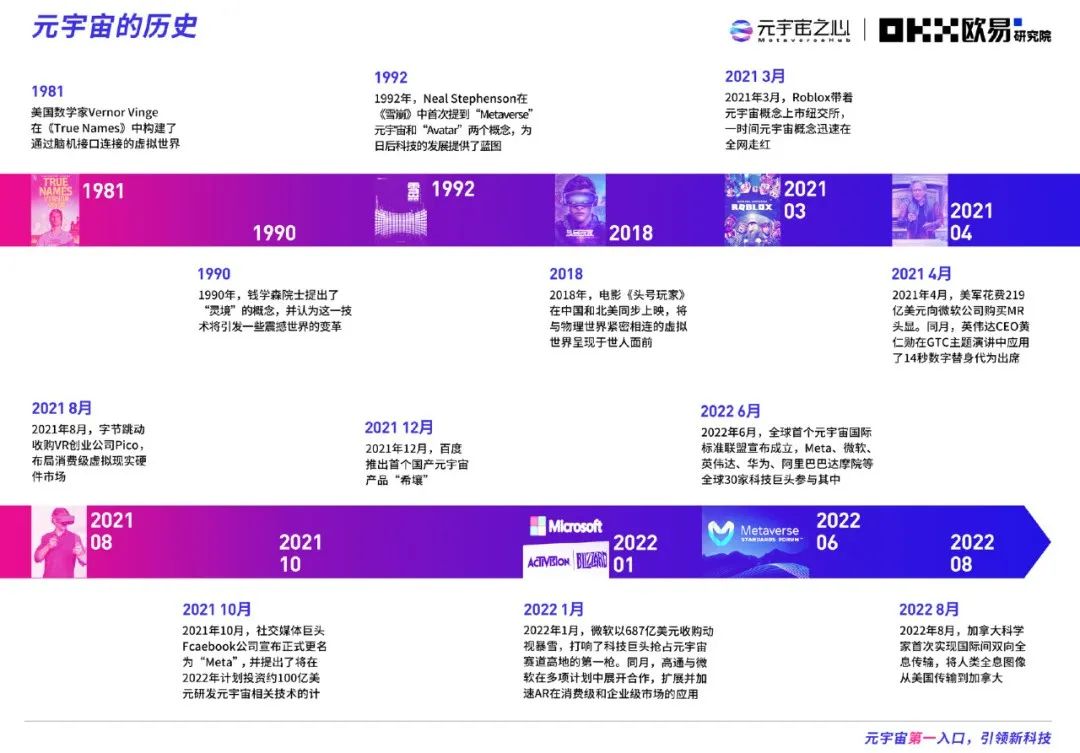
Metaverse isn't a new term.
In 1981, American mathematician Vernor Vinge built a virtual world connected through a brain-computer interface in “True Names.”
In 1990, Academician Qian Xuesen proposed the concept of a “spiritual state,” and believed that this technology would trigger some changes that would shock the world.
In 1992, Neal Stephenson first mentioned the two concepts of the “Metaverse” metaverse and “Avatar” avatar in “Avalanche,” providing a blueprint for the future development of technology.
In 2018, the movie “Number One Player” was screened simultaneously in China and North America, presenting a virtual world closely linked to the physical world to the world.
In March 2021, Roblox was listed on the NYSE with the metaverse concept, and the metaverse concept quickly became popular all over the Internet.
In April 2021, the US military spent 21.9 billion US dollars to buy MR headsets from Microsoft. In the same month, Nvidia CEO Hwang In-hoon used a 14-second digital stand-in to attend the GTC keynote, and no one was spotted after 4 months.
In August 2021, ByteDance acquired VR startup Pico to lay out the consumer-grade virtual reality hardware market.
In October 2021, social media giant Facebook announced that it would officially change its name to “Meta” and proposed plans to invest around $10 billion in developing metaverse-related technology in 2022.
In December 2021, Baidu launched the first domestically produced metaverse product “Xirang”.
In January 2022, Microsoft bought Activision Blizzard for $68.7 billion, setting off the first step for tech giants to seize the metaverse circuit. In the same month, Qualcomm and Microsoft collaborated on a number of plans to expand and accelerate the application of AR in consumer and enterprise markets.
In June 2022, the world's first metaverse international standards alliance was announced. Thirty global technology giants including Meta, Microsoft, Nvidia, Huawei, and Alibaba DAMO Academy participated.
In August 2022, Canadian scientists achieved international two-way holographic transmission for the first time, transmitting human holographic images from the US to Canada.
The metaverse has gradually become a new form and method of transformation in all walks of life, and has become an important strategic direction for the development of many enterprises. At the same time, the metaverse has also received great attention from governments around the world and has become a weather vane for national policies.
After two years of baptism, the metaverse has officially become a pillar industry in the digital economy era.
Bloomberg predicts that the metaverse market is expected to reach 800 billion US dollars in 2024; well-known consulting firm McKinsey predicts in its report that by 2030, the metaverse is expected to create a new market of 5 trillion US dollars; while Meta commissioned international economic consulting firm Analysis Group to compile the first metaverse white paper, it is believed that the potential market size of the metaverse may exceed 80 trillion US dollars. Perhaps a new blue ocean market is being shown to us.
◉Definition of the metaverse 2022
As the hottest emerging industry in the world, the metaverse has ushered in a new era of the Internet. Many well-known institutions, large enterprises, and authoritative organizations have entered the market one after another. Research on industry segmentation tracks is overlapping, the metaverse is popular, the opinions of many experts and scholars have yet to be unified, and the definitions of the metaverse are not uniform, and we need to keep exploring.
Over the past 30 years, people have continued to explore this virtual world that is similar but different from the real world. The metaverse is seen as the ultimate form of the next generation of the internet. Not only does it have huge potential to drive Web3 adoption, but it will also have a profound impact on the future of business, gaming, entertainment, work, and social media. So what exactly is the metaverse?
In 2021, the metaverse is still in its infancy, and different industries and leaders have different opinions on the metaverse concept. For example, Roblox, the “first stock in the metaverse,” stated in its prospectus that the metaverse should have eight major elements: identity, friends, immersion, low latency, diversity, ubiquity, economy, and civilization.
Meanwhile, Meta CEO Zuckerberg, who comprehensively lays out the metaverse, believes that the metaverse is a network composed of an immersive 3D digital world, and one day it will become the main way people live and spend time.
Matthew Ball, the father of metaverse commerce, even used a book to provide a comprehensive definition of the metaverse. He believes that the metaverse is a large-scale, interoperable real-time rendering 3D virtual world network that can be simultaneously and continuously experienced by an unlimited number of users, with personal presence and data continuity, such as identity, history, rights, objects, communication, and payments.
After experiencing an explosion, the metaverse is now gradually returning to calm, and people have realized that the metaverse does not belong to any company, nor does it belong to any giant enterprise. Defining the metaverse in 2022 is like trying to define the Internet in 1992. No matter how you define the metaverse, it is not complete.
It is only over time that people will have a general understanding of it。
METAVERSE
Metaverse infrastructure and theory
◉Fundamentals of metaverse theory
With the development of the metaverse industry, discussions on the theoretical foundations of the metaverse are constantly emerging. We have sorted out the mainstream opinions and simply explained the theoretical foundations of the metaverse based on the “Six Rational Framework”.
The “Six Principles” framework was proposed by the New Media Research Center of the School of Journalism and Communication of Tsinghua University. It includes six dimensions of mathematical thinking development, physical rule-making, geospatial creation, mental state regulation, logical judgment of matters, and maintenance of ethical order.
The development of mathematical thinking is an absolute rule for the operation and succession of the metaverse. In fact, the figurative “metaverse” that users can perceive is based on an abstract “metaverse” constructed from data elements. The abstract “metaverse” is first and foremost a “metaverse” in the mathematical sense. It is a homomorphic mapping and isomorphic model established by abstract algebra. Having a certain mathematical mindset is essential to understanding the metaverse.
Physical rulemaking is the logic of mechanical rules and space-time effects in the metaverse. The birth of physics changed our perception of the universe. The metaverse is in a sense a replica of the physical world. Although users can do many whimsical things in the metaverse that do not comply with the rules of physics, they still need to meet certain physical specifications.
Geospatial creation, on the other hand, provides an experiential spatio-temporal scenario for the metaverse. The metaverse breaks the limitations of time, space, and distance, and in a sense has unlimited geographic space. The future metaverse is mainly divided into two directions. One is a virtual world generated by digital twins that is completely consistent with the physical world, and the other is an editable world not found in the real world generated by code. Users can buy, rent land, and build buildings in the metaverse to create their own virtual geographic space.
Based on the above three theories, civilizations and social organization structures in the metaverse are the main points of our further attention.
Mental state regulation enables human-robot relationships and communication environments in the metaverse to shape perception and recognition. The immersive sense of interaction and presence brings users a physical sense of the environment, and requires users to enhance their recognition of virtual identity.
When it comes to virtual identity, logical judgment of events is particularly important in this dimension. Users need to cope with changes in social organization and operation caused by the interaction of virtual people, robots, and real people, and adapt to a new lifestyle combining fiction and reality.
The most important theoretical foundation is the maintenance of ethical order,The metaverse's mapping of the physical world, the protection of digital personality, the maintenance of social civilization, and the construction of a metaverse economic governance system all need to conform to the basic ethical order。
Of course, although this description of the framework is obscure and difficult to understand at first glance, it is detailed, has a taste of dialectical materialism, captures the essence of the metaverse, and the logic is also quite meticulous, so we can view it as the “theoretical foundation of the metaverse” for 2022.
◉The metaverse hexagon principle
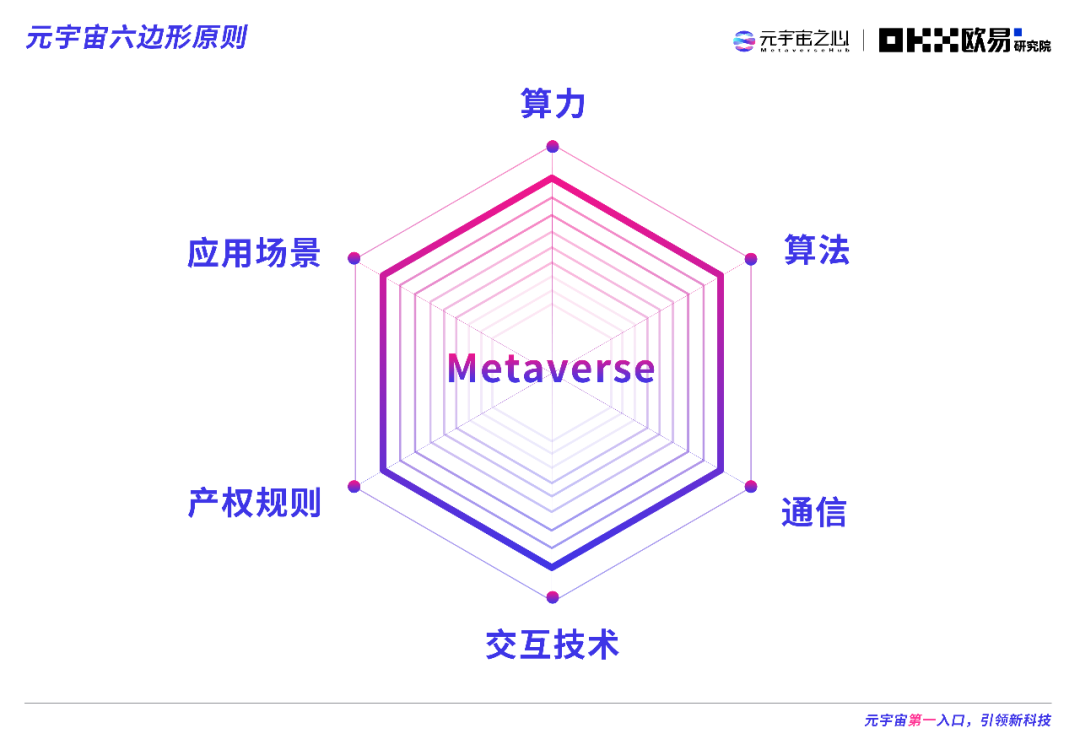
The metaverse is a product of the integrated development of multiple technologies. Currently, the formulation of one-stop metaverse solutions is inseparable from the metaverse hexagon principles, namely computing power, algorithms, communication, interaction technology, property rights rules, and application scenarios.
Arithmetic power: In the metaverse, computing power chips such as GPUs and CPUs provide computing power support. For a metaverse with massive amounts of data, computing power is an important cornerstone of the metaverse.
algorithms: The algorithm defines the basic rules and presentation methods of the metaverse, and implements functions such as physical models, AI, images, sound, and animation rendering. Intelligent algorithms can reduce the number of development times and lower the threshold for use.
tele: In order to ensure low latency and immersion in the metaverse, network communication technology such as 5G is essential. These technologies are technical guarantees that metaverse users can access the metaverse anytime, anywhere.
Interactive technology: As an interface between real people and the metaverse, technologies such as VR, AR, MR, and brain-computer have greatly promoted the immersion and realism of virtual space, bringing limitless possibilities for content creation in the virtual world.
property rightsrules: Based on the logical foundation of the metaverse, blockchain technology provides convenient and efficient authentication of ownership. Any digital asset will be owned by an individual, and no one can change the digital assets of others at will, let alone invade them arbitrarily.
Application scenarios: The metaverse will greatly facilitate the process of social development towards digitalization. This is a long-term and lengthy process. The metaverse is the crystallization of digital development. It has built a virtual world integrating social entertainment, study and life, work and production, and is closely integrated with the real world.
◉Fundamental Metaverse Technology
The technology involved in the metaverse is very complex; in fact, we can divide it into three categories: network and computing power technology, algorithm architecture technology, and immersive and interactive technology.
Network and computing power technology
The development of networking and computing power technology provides the possibility of high synchronization and low latency for the metaverse. Cloud computing and other technologies provide a computing power foundation for the metaverse and are responsible for big data analysis of long-term data. Edge computing is responsible for real-time, short-cycle data analysis, and can better support timely data processing. Advances in pervasive computing and artificial intelligence have promoted the development of ubiquitous intelligence in the metaverse. By adding a large number of semantic modifiers to content, semantic computation allows Internet data to become a machine-readable language, eventually making the Internet more and more intelligent, gradually moving into the Web3 era.
Algorithmic architecture technology
Algorithmic architecture technology is the foundation for the construction of the metaverse, including artificial intelligence, 3D engines, blockchain, big data, digital twins, and digital simulation technologies. Artificial intelligence provides efficient and useful tools for massive data processing in the metaverse, and has become a technical foundation for important components of the metaverse such as digital assistants and AIGC.
The 3D engine provides the necessary incubator for the implementation and application of the metaverse world, and provides users with the possibility to create a world. Blockchain has the characteristics of being decentralized, transparent, and immutable, providing a necessary gripper for the capitalization of data elements. Big data, digital twins, and digital simulation technology analyze and reinvent the physical world, making it possible for the metaverse to replicate all production lifestyles in the physical world.
Immersive and interactive technology
Immersive and interactive technology is mainly based on extended reality, naked eye 3D, PC/mobile, Internet of Things, sensing technology, and brain-computer interfaces. With the promotion of 5G technology and advances in technologies such as ultra-high-definition reality and cloud rendering, sound interaction, tactile interaction, and mobile interaction have gradually been upgraded. A fully immersive user experience in the metaverse era may still be a long way off, but the upgrading of relevant technology provides a foundation for related software and hardware iterations, and is an essential key technology for the metaverse.
METAVERSE
2022 metaverse industry chain
◉Industry penetration map
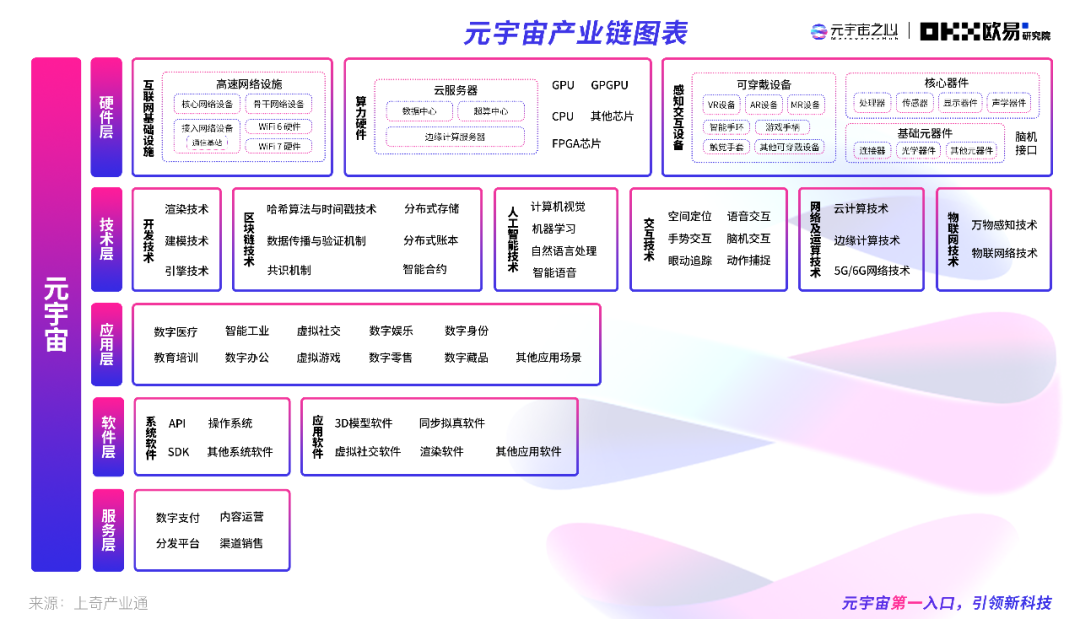
With the continuous expansion of the connotation and epitaxial extension of the metaverse, the metaverse industry chain has gradually formed and provided strong support for metaverse theory.
Currently, the metaverse is mainly divided into hardware layer, technology layer, software layer, service layer, and application layer。
The hardware layer is mainly based on Internet infrastructure, computing power hardware, and sensory interaction devices, with chips such as cloud servers, wearable devices, and GPUs as the core. It is the cornerstone of the metaverse industry and provides a necessary carrier for the development of the metaverse.
The technical layer is divided into development technology, blockchain technology, artificial intelligence technology, interactive technology, network and computing technology, and IoT technology, providing prerequisites for the implementation of metaverse application scenarios.
The software layer is divided into system software and application software, which together shape the soil for co-construction of the metaverse, create an “oasis” for the metaverse, and provide useful tools for service layer and application level construction.
The service layer is mainly composed of digital payments, distribution platforms, content operation, and channel sales. It is a gripper for metaverse content creation and metaverse economic development. Through the upgrading of the service layer, infrastructure in the metaverse era has been improved.
The application layer is an important part that users can perceive, including digital healthcare, smart industry, education and training, digital office, etc., breaking down the barriers between the physical world and the virtual world, and making the metaverse shine into reality.
◉The development of overseas metaverse giants
The development of the metaverse is inseparable from the help of related companies. Take Meta, Microsoft, Nvidia, Roblox, Apple, Amazon, Epic Games, and Unity as examples to take stock of the development of overseas metaverse giants to get a preliminary understanding of the current metaverse industry development pattern.
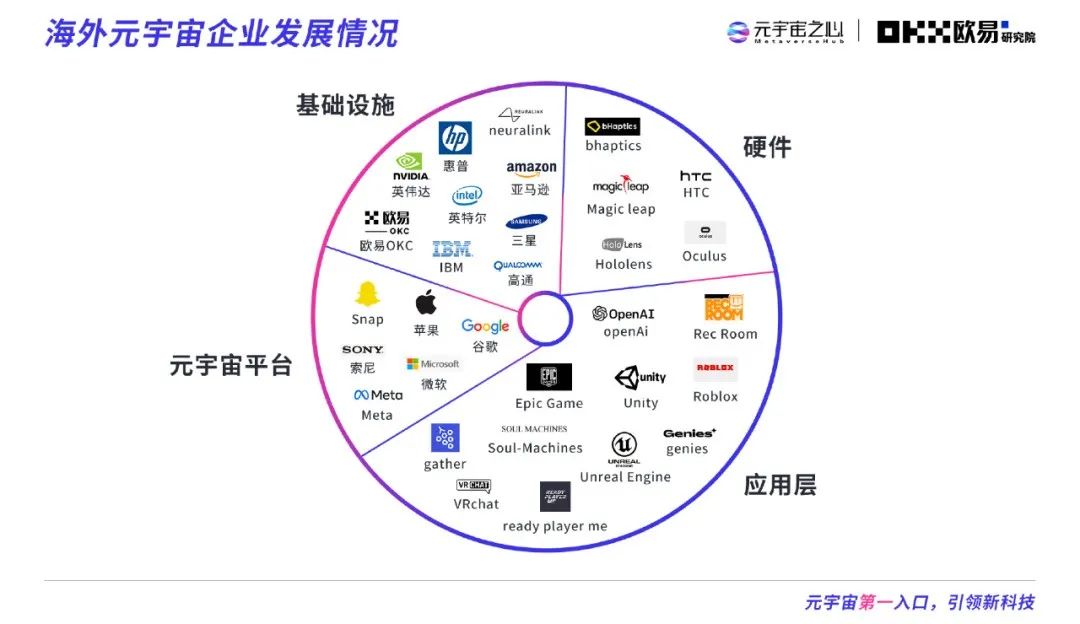
Meta
In October of last year, Facebook CEO Mark Zuckerberg announced that the company would change its name to Meta and set his sights on the metaverse, which he called “the successor to the mobile internet.” But 12 months later, after losing $15 billion in the metaverse business, the company hardly set off any further waves.
Meta's market capitalization fell 57% in 2022, about twice that of Amazon and Alphabet, and more than four times that of Apple. According to the Wall Street Journal's October report, Meta has less than 200,000 monthly active users on its Horizon Worlds metaverse platform, which is unsatisfactory.
Meta is gaining momentum as it enters 2022, but the turbulent economy has forced the company to stall its strategic approach to massively deploying the metaverseAt the beginning of October, Zuckerberg launched the Meta Quest Pro VR headset. The high price surprised most users. In particular, this “Pro” headset did not greatly improve the VR experience.
MicrosoftAt Microsoft Build 2022, Microsoft convened a panel of experts to discuss the company's metaverse strategy, which is primarily but not entirely focused on Microsoft's Teams collaboration platform.
Most people associate the metaverse with games, Facebook's parent company Meta, and its Quest VR headset, but Microsoft's CVP Alysa Taylor points out that there are “dozens” of definitions of the metaverse, and Microsoft's view of the metaverse is that it involves “the ability to connect the digital world to the physical world.” According to Microsoft, the metaverse must be a permanent digital representation of people, places, things, and processes.
It is worth noting thatMicrosoft's vision for the metaverse is more than just reconstructing physical space in a digital space; it also wants to apply artificial intelligence in the metaverse to gain insight based on generated data。
NvidiaAs early as last year's Nvidia GTC 2021 conference, Nvidia CEO Hwang In-hoon simulated Hwang In-hoon himself in a virtual environment through its 3D collaboration platform OmniVerse. To get closer to the digital space network and make full use of artificial intelligence,NVIDIA announced a broader plan in August 2022 to develop Universal Scenario Description (USD) as the foundation for an open metaverse and 3D internet。
“USD will enable 3D artists, designers, developers, and others to collaborate across diverse workflows and applications as they build virtual worlds,” said Rev Lebaredian, vice president of Omniverse and Simulation Technology at Nvidia.
Roblox
Roblox is also known as “the first stock in the metaverse”. Its listing with the metaverse concept not only detonated the technology industry, but also attracted capital and internet giants to enter the market.
Roblox is currently one of the most influential game creation platform companies in the world. In Roblox, everyone has their own digital identity to socialize. Unlike most platforms, the economic system built by Roblox connects content creators and consumers, and it is this kind of business model reform that has made Roblox a creative platform with metaverse characteristics.
In fact, Roblox is more than just a gaming platform, it's also an educational platform. It goes deep into the field of education to create digital classrooms, breaking the constraints of traditional education models. Perhaps in the future, Roblox is likely to become a standardized learning tool in the metaverse.
As these young audiences grow, Roblox wants to take their world experience to a new level, providing new ad types and brand content experiences, and improved visual elements.
apples
Apple's metaverse strategy has been a mystery since the metaverse boom began. But Apple's interest in the AR field is nothing new; as early as the late 80s, they had an early AR prototype.
In 2015, Apple clearly formed a small team dedicated to studying augmented reality, but Apple said they wanted to do something very different from Google, and they began the process by hiring new experts and acquiring companies with proven innovative technology.
Apple has developed a series of patents, including the recently popular VR interactive detection input system for finger gestures, which makes gesture-based control simple and natural when using VR/AR displays. Lidar sensors have appeared in all iPhone Pros, and this advanced technology is invaluable for mapping areas used in augmented reality.
Apple has also made great strides in creating custom ARM processors that are powerful enough for laptops but portable enough for mobile devices. Apple has essentially provided hardware related to the metaverse to ordinary people without even requiring explicit marketing or announcements, and this may lead to passive development of the Apple metaverse over time.
Furthermore, Apple's mobile devices have 70% of the market share among young Americans. This is an important part of corporate product promotion, providing a prerequisite for Apple to enter the metaverse market in the future.
AmazonsLike Apple, Amazon's metaverse strategy was not publicly disclosed. However, in 2022, Amazon has begun recruiting in related fields to seek senior product managers related to the game technology department with metaverse experience.
Other than that, what few people know is that Amazon recently released a metaverse game called Cloud Quest。
Technically speaking, Cloud Quest itself is a small Amazon metaverse, and the game uses a variety of advanced technologies and utilizes Amazon's AWS cloud computing infrastructure.
Also, Amazon recently launched an augmented reality tool called Amazon AR Room Decorator. AR Room Decorator is a large-scale upgrade to an old Amazon tool called Amazon VR View. This tool allows users to place the furniture they are interested in on Amazon in augmented reality in their homes to better decide whether they need to buy it.
Epic GamesEpic Games, the maker of Fortnite, is one of many companies exploring the gaming metaverse, and its metaverse platform was created even before the metaverse era began. Some time ago, it became popular all over the world due to the sale of NFT plots,
However, unlike the relatively poor metaverse based on blockchain technology, “Fortnite” has a thriving ecosystem and a large user base to participate in virtual activities。
In April 2022, Sony and Kirkbi, the owner of the LEGO Group, invested $2 billion in Epic Games to develop its metaverse, and Epic Games' valuation rose to $31.5 billion. These partnerships, Sony and LEGO, will enhance Epic Games' ability to expand to diverse age groups and incorporate a variety of experiences into its virtual world.
In December 2022, Epic Games revealed in a speech that they are developing Verse, a programming language dedicated to metaverse construction, to become an open platform for developers and creatives that supports real-time social 3D interaction, the digital economy does not dominate companies, and realizes Epic Games' ultimate metaverse vision.
Epic Games is a strong proponent of the metaverse and a pioneer of the subject. It has organized successful virtual concerts and film screenings within Fortnite to prove that such events can appeal to millions of people seeking new forms of entertainment. While many of these events were marketing initiatives showcasing Epic's technical prowess, they also showed consumer interest in using the virtual world. Epic's large user base enables it to test new experiences and develop attractive metaverse products in the future.
Unity
Unity was founded in 2004 under the name Over the Edge Entertainment. Its goal was to sell game engines and design tools to small customers and allow creators to access their own game development tools and libraries. Subsequently, Unity embedded a monetization tool for creators, and over time became an end-to-end platform centered on creators.
Unity rapidly expanded its metaverse program through an acquisition strategy, and Unity acquired more than 20 startups for more than $25 billion. These acquisitions not only helped them build a modern stack to develop virtual platforms, but also helped them integrate evolving technologies such as AI/ML, Datafication, intelligent photogrammetry, and AR/VR/MR into game engines. Unity has greatly influenced the metaverse's performance layer and maintains strong strategic partnerships with tech companies and startups to power the underlying layers of metaverse applications.
Unity has a strong foothold in the gaming and entertainment industry. With the advent of the metaverse, the creator economy has a new way of developing. The market for interactive real-time 3D/2D content in industries other than games is still in its infancy, and creators will play a key role in further promoting this technology. Unity is likely to become a leader in development in related fields over the next 10 years.
◉Metaverse application scenarios
After more than a year of development, the metaverse is no longer an empty building; there are many practical application scenarios. We have sorted them out and broadly divided them into the following aspects.
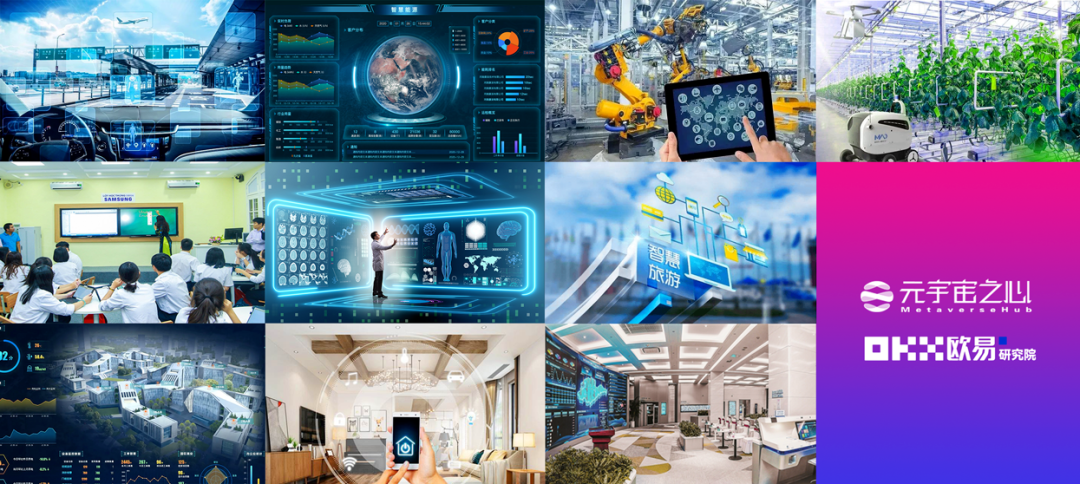
Intelligent transportation
As a large-scale, all-encompassing transportation and management system, an intelligent transportation system is a transportation management system integrating various technologies. Through various technologies such as digital twins, augmented reality, and virtual reality, the metaverse replicates the physical world and realizes overall planning in the virtual world. It can provide integrated vehicle-road solutions for smart transportation, build a visual smart road network, and promote the implementation of applications such as smart highways, smart navigation, smart traffic management, and smart connectivity. It effectively alleviates traffic congestion, increases the ability of road networks to pass through, reduces traffic accidents, reduces energy consumption, and reduces environmental pollution.
Smart energy
Smart energy refers to a new form of energy use that realizes source network load storage interaction, multi-energy collaboration and complementarity, and intelligent regulation of energy consumption requirements through extensive collection of energy usage information and online analysis of energy efficiency. Smart energy has achieved intelligent energy upgrading, and has established and perfected energy technology and energy system systems that meet the requirements of ecological civilization and sustainable development. The metaverse provides it with the necessary infrastructure such as the Internet of Things, artificial intelligence, networks, and computing technology. The entire process of digital energy transmission and utilization has laid the foundation for the upgrading of smart energy.
Smart manufacturing
The metaverse empowers industrial manufacturing, brings new experiences, efficiency and operating models, and provides a one-stop rational solution for intelligent manufacturing. Intelligent manufacturing includes intelligent manufacturing technology and intelligent manufacturing systems. Through cooperation between humans and intelligent machines, it expands, extends, and partially replaces human mental labor in the manufacturing process, and extends the concept of manufacturing automation to flexibility, intelligence, and highly integrated. Production processes, management decisions, management and services have been fully optimized in the process.
Smart agriculture and water conservancy
Agriculture and water conservancy are the foundation of people's livelihood. Smart agriculture and water conservancy have fully applied the achievements of modern information technology to achieve intelligent management such as visual remote diagnosis, remote control, and disaster warning in agriculture, as well as regionalization of water conservancy space, time serialization, process automation, intelligent application, integrated management, and scientific decision-making. The metaverse can provide a one-stop solution for smart agriculture and water conservancy, and realize intelligent management of smart agriculture and water resources through the integration of various technologies such as IoT technology, VR/AR, and wireless communication.
Smart education
As an innovative model and method of education, smart education optimizes and reforms educational ideas, ideas, forms, content and methods through technology, improving the quality and efficiency of education. The metaverse provides education with more interactive strategies and more realistic simulation scenarios, allows scholars to learn anywhere, and interact with data from learners around the world, reducing the cost of school rooms and science laboratories. At the same time, it also allows teachers to better understand individual differences and needs through technology, providing the foundation for smart education.
Smart healthcare
With the gradual upgrading of new technologies such as big data and intelligent hardware, new technologies such as digital medicine and surgical robots have been widely used clinically, and have become an important means of improving medical efficiency, promoting refinement, digitalization, and individualization of medical care. As a result, smart medical care was born. The metaverse has opened up barriers between the real world and the virtual world, realized the integration of high technology, promoted the development of many directions such as digital therapy, AI imaging, AI pharmaceuticals, and Internet medical care, and made medical services digitalized in the true sense of the word.
Smart cultural tourism
Smart cultural tourism has enriched the forms of cultural tourism expression, deepened the cultural value of IP, and provided a good starting point for “cultural and plastic tourism and travel to Zhangwen”. It is a new digital consumer industry that has benefited from the promotion of cultural digitalization strategies and the development of cutting-edge technologies such as blockchain, and has been continuously transformed and upgraded on the basis of traditional digital content and cultural products. The metaverse empowers smart cultural tourism, revitalizes existing cultural resources, and has launched a copyright library, cultural private network, and cultural big data system, which provides basic guarantees for the digital authorization of cultural resources, and also provides great convenience for the development of digital cultural products.
Smart community
Smart communities integrate various community service resources through intelligent technology and methods, and are built around many scenarios of construction, neighborhood, service, transportation, education, medical care, governance, and entrepreneurship. It is an important development direction for future communities. Smart communities are characterized by technological, ecological and humane services, which shape and enhance residents' happiness, improve work efficiency through smart government, improve people's lives with smart livelihood, build smart lives with smart families, and enhance community quality with smart communities. The metaverse provides digital twins, the Internet of Things, cloud computing, information communication, RFID and other related technologies, providing effective solutions for the smart community.
smart home
Smart home is a hot topic of public attention in recent years, and it is also part of the “14th Five-Year Plan”. The metaverse promotes the development of technical means such as sensor control, voice control, and remote control, and has played a positive role in promoting the development and popularization of products such as smart home appliances, smart lighting, smart security monitoring, smart speakers, new wearable devices, and service robots. It provides users with the convenience of life and uses technology to change their lives.
Smart government
Smart government is a new stage in the development of e-government. Through testing, integration, analysis, and intelligent response, a high degree of integration of the resources of various functional departments has been achieved, the efficiency of government business processing and management has been improved, functional supervision has been strengthened, and the government's transparency has been enhanced. The metaverse can break the boundaries between offline and online governance, provide an effective way to shape an efficient, agile, and convenient new type of government, build a livable urban environment for enterprises and the public, and ensure the sustainable development of cities.
METAVERSE
The top ten keywords of the year

◉Policy dividends
As a new circuit for the digital economy, the metaverse is attracting more and more regions to plan around the metaverse. If the participants in the metaverse in 2021 are still tech giants, led by Meta, then starting in 2022, various industries have made plans, and there are already countless companies that use the metaverse as their future development strategy.
More and more local governments are beginning to issue metaverse-related support opinions one after another. From the provincial level to the municipal level, from broad concepts to specific measures, the intensive publication of new industrial policies reflects the increasingly clear understanding of the metaverse concept in various regions.
In a sense, the metaverse and digitalization complement each other and are facets of each other。
Judging from digital-related development plans before the 13th Five-Year Plan, at that time, China mainly focused on infrastructure technology and carried out research and development of technologies such as digital warrants, cloud computing, virtual reality, and augmented reality. During the “13th Five-Year Plan” period, on the one hand, the policy accelerated research and development of key technologies, and on the other hand, accelerated the development of the digital economy, providing favorable conditions for the later emergence of the metaverse.
Meanwhile, during the “14th Five-Year Plan” period, the metaverse was included in the “14th Five-Year Plan” industrial plan by many domestic provinces, cities, and regions. According to incomplete statistics, up to now, more than 30 regions in China have issued supporting policy documents related to the metaverse, and there are more than 20 special policy documents for the metaverse.
Among them, more than 10 provincial administrative districts, including Beijing, Shenzhen, Shanghai, Wuhan, Nanjing, Hangzhou, and Chengdu, have released local support for the development and implementation of the metaverse in the form of industrial policies and action plans. As supporting industrial plans, these policy documents are of great significance in actively promoting the construction of the metaverse industry ecosystem.
Since this year, gaps in metaverse standards and regulatory systems have been filled one after another. Under the comprehensive support of multiple policies, related technologies such as virtual reality, augmented reality, artificial intelligence, and blockchain have made great strides, and metaverse applications are also accelerating.
It can be said that for the metaverse, where industrialization is still in its infancy, policy is undoubtedly the most important and powerful driver at the moment.
Industry prospects are compounded by policy dividends, and major industry leaders and investment funds are liberalizing and rushing into the market。
◉Industrial metaverse
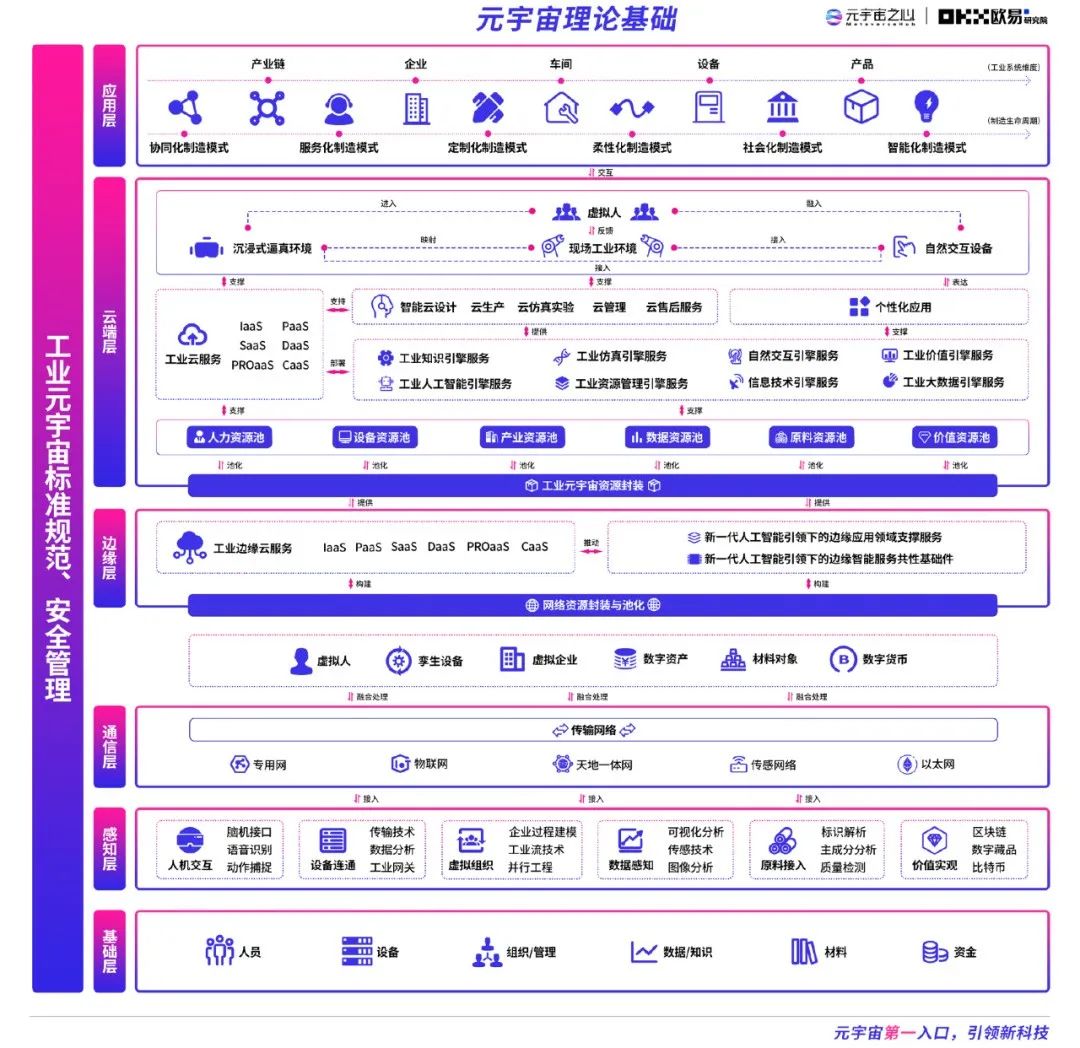
The industrial metaverse is centered on industrial products, based on an industrial Internet support system. It is a new application model and industrial ecosystem that is deeply integrated with metaverse-related technology and application models with the industrial economy. It is the implementation and expansion of the metaverse in the industrial field. It is a new type of vehicle for the integrated development of a new industrial digital space, a new industrial smart Internet system, the digital economy and the real economy.
Simply put, the industrial metaverse is a product production system that revolves around a combination of fiction and reality. The industrial metaverse uses digital twins, 3D engines and core technologies such as spatial computing, AI technology, blockchain, edge computing, and the Internet of Things, and has the characteristics of multi-party participation, interaction, openness, and collaboration. Its architecture includes a basic layer, a perception layer, a communication layer, an edge layer, a cloud layer, and an application layer.
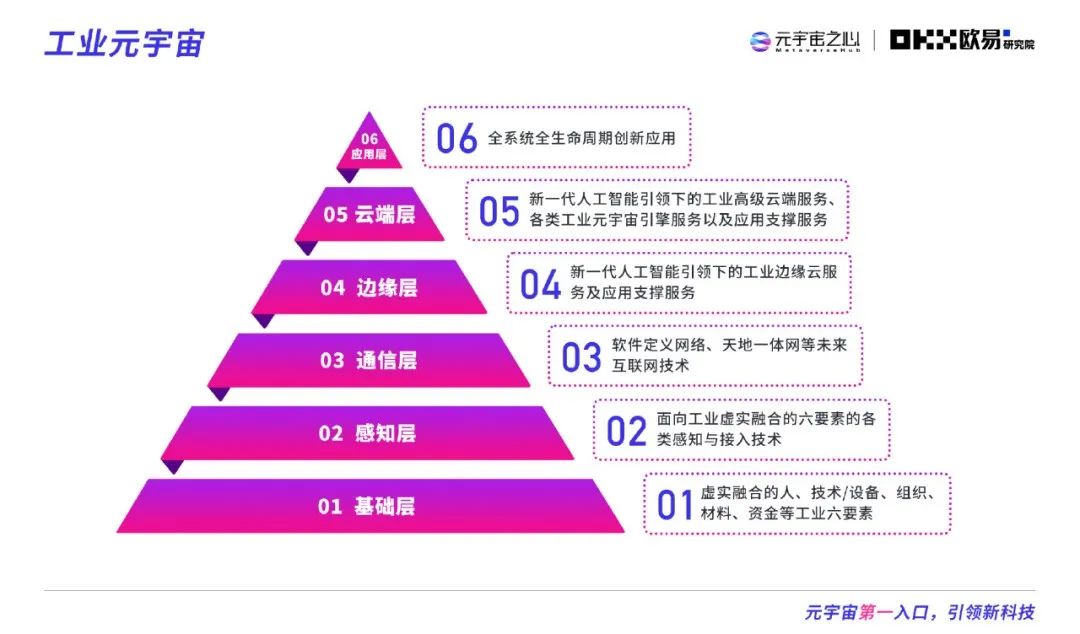
In the industrial metaverse scenario, every participating enterprise can invent and create based on mature technology and tools and obtain corresponding rights. Development and design groups can participate and interact with ideas regardless of the distance of time and place. The combination of virtual production and real production helps to achieve business collaboration and simultaneous production, and enables immersive experience of product functionality, performance, and quality in the factory. The upstream, middle and downstream industrial chains achieve seamless collaboration in the industrial metaverse, forming supply chain integration.
At the same time, consensus mechanisms and smart contract mechanisms can also achieve production standardization and business autonomy. Under this system, industrial technologies such as industrial digital twins, industrial intelligence, industrial spirituality, industrial blockchain, industrial networks, industrial metaverse platforms, and advanced computing were born.
The industrial metaverse deploys R&D processes, production processes, marketing processes, and after-sales processes in a real environment into a virtual space, optimizes and improves production and services through virtual space and real space activities, forms a new manufacturing and service system, and achieves the effects of cost reduction and efficiency, and collaborative operation.
In the future, technology based on the industrial metaverse will carry out comprehensive and full-chain transformation of traditional industries, improve all-factor production, and promote the transformation and upgrading of traditional industries. Production will be more intelligent, key points will continue to be optimized, park clusters will accelerate transformation and upgrading, multi-party collaborative platform operation will enable the three major value chains of “product, production, and circulation” to form a new industrial ecosystem, grasp the four directions of “intelligent transformation, key optimization, industrial upgrading, and strong chain repair” to build industrial applications, and achieve the five-point goal of “improving quality, reducing costs, increasing efficiency, seeking safety and innovation”.
◉Giants try it
In 2021, the “Metaverse Christmas World”, which Nvidia spent over 30 million dollars to build, was used as a model for the implementation of the metaverse, and also pushed the metaverse concept to the top of the wave. Entering 2022, although the market is gradually returning to rationality for the metaverse, the capital market's investment and financing activities around the metaverse are still active.
In addition to metaverse natives such as Roblox, Decentraland, and The Sandbox, international internet giants including Meta, Google, Microsoft, and Nvidia, as well as major domestic companies such as BAT and ByteDance, have all begun to accelerate the layout of the metaverse circuit.
According to McKinsey & Company statistics, in the first five months of 2022 alone, the entire metaverse market received more than 120 billion US dollars in investment capital from enterprises, venture capital firms, etc.. Citi also predicts in its metaverse report analysis that by 2030, the global metaverse market will likely reach $13 trillion in annual revenue.
When the metaverse becomes a trend, capital will naturally not be missed. The world's leading technology companies, which have been mired in long-term weak growth, see the metaverse concept as a development opportunity, and use their platforms and capital advantages to build up the metaverse.
Take China as an example. According to incomplete statistics, since October alone, 15 domestic listed companies have announced the development of metaverse businesses, including Zhongke Financial, Jihong Co., Ltd., Guomai Culture, China Mobile, and Ling Yunguang. Not long ago, Arco Technology, the first domestic metaverse brand service company, received 10 million angel round financing; the metaverse intelligent technology company Xingfan Technology completed nearly 10 million yuan in angel round financing; Luo Yonghao's AR startup Fine Line Technology announced the completion of about 50 million US dollars in angel round financing...
Of course, as Luo Qi, a senior researcher at the Ouyi Research Institute, currently the market is mostly a social application based on the concept of the metaverse. Essentially, it is still social; it only creates more virtual experience scenarios for users.
Perhaps in the future, driven by the entry of giants, there will inevitably be more small and medium-sized enterprises, and even some cross-industry giants willing to promote metaverse research and development, product launch, etc., and the metaverse ecosystem will continue to be filled。
◉Consumer-grade hardware
Although we can currently experience the three-dimensional world presented by the metaverse through computer or mobile phone software, a VR/AR headset is essential if we want to experience the metaverse in a more immersive way like the movie “Number One Player”.
2016 can be described as the first year of consumer-grade VR headsets. Oculus, which was acquired by Facebook (renamed Meta), launched the world's first consumer-grade VR headset, the Oculus Rift. Immediately after that, the HTC Vive, which was jointly developed by Valve and HTC, was also officially launched. Sony Interactive Entertainment SIE's PS VR was also launched in the same year. However, this type of headset requires a data cable to be connected to a computer before it can be used, and usage scenarios are limited, so sales of VR headsets at this stage are still at an unpopular stage.
It wasn't until 2019, when Oculus launched the new VR all-in-one Quest1, that this impasse was broken. By integrating the computing unit into the headset, the all-in-one computer freed itself from the constraints of data cables and computers and quickly opened up the user market, and the more mature version of Quest 2, launched in 2020, further amplified this advantage.
Since 2020, due to the impact of COVID-19, many online applications have grown significantly.
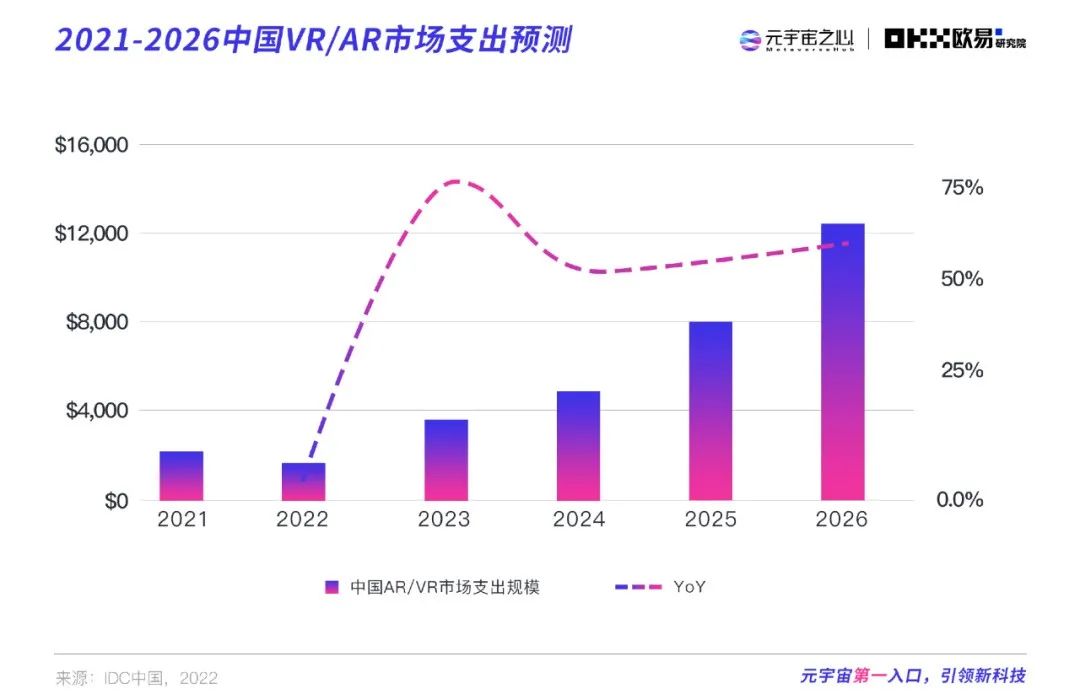
The metaverse boom that began in 2021 has also further boosted the VR consumer hardware market growth. Under the influence of various factors, 2022 has become a year of rapid growth for VR consumer headsets。
Quest 2 achieved total global sales exceeding 15 million in 2022, becoming the most successful VR consumer hardware so far. It also boosted Meta's size in the VR hardware market to an astonishing 90% or more, and has an absolute voice in the market.
Meanwhile, many domestic VR brands such as Pico, Adventure VR, and Dapeng VR have launched VR all-in-one headsets to compete for the domestic VR consumer market.
On the other hand, AR consumer hardware is a blue ocean. Since AR headsets need to project virtual content in a real environment and blend virtual content with the real world. This requires it to have hardware such as cameras and optical sensors to capture information about the surrounding environment and process and project it in real time. The technical requirements are much higher than VR headsets.
Currently, the most mature AR headset is the HoloLens series launched by Microsoft. Its price is close to 20,000 yuan. Obviously, it is not a consumer-grade product.
With the popularity of the metaverse concept in 2021, major tech companies began targeting the empty market of consumer-grade AR hardware。
Traditional mobile phone giants such as Apple and Samsung have already announced some news about their AR glasses in 2022. Other brands of AR glasses have also set up projects one after another. Nreal, Thunderbird Technology, etc. have already taken the lead in launching AR glasses, starting the first battle for the AR consumer market.
◉digital economy
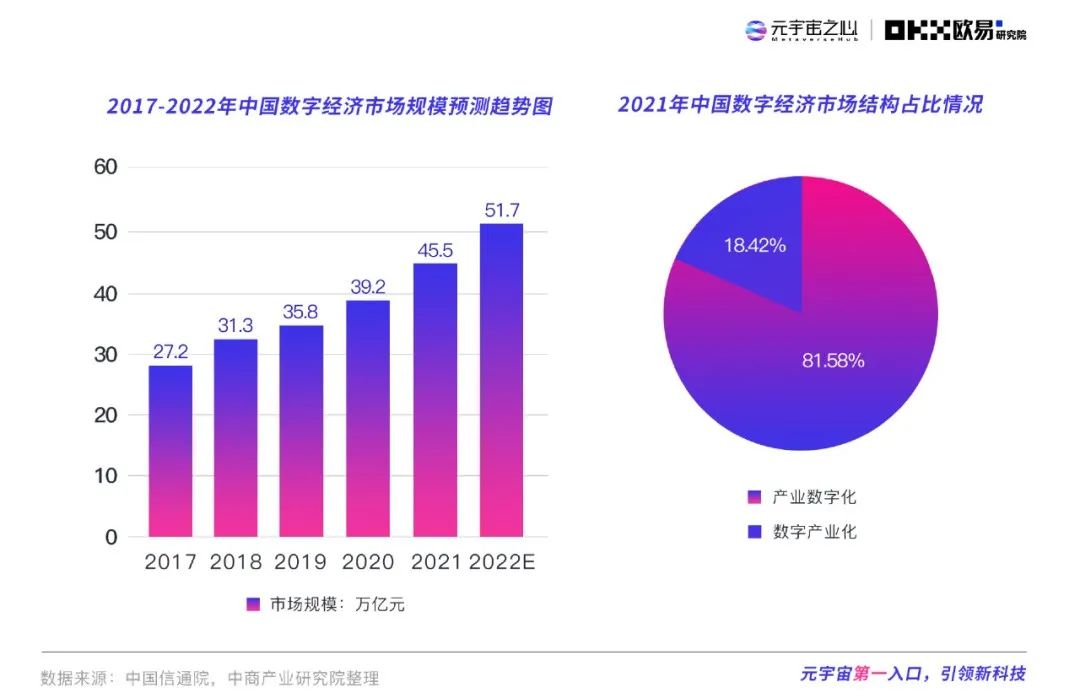
With the continuous development of emerging technologies such as big data, cloud computing, the Internet of Things, blockchain, artificial intelligence, and 5G communication, digital technology, products and services are rapidly penetrating from multiple directions, multiple levels, and multiple chains to traditional industries. As a new form of economy, the digital economy is simply “digital industrialization” + “industrial digitalization”.
Digital industrialization means that data, as an important factor of production, has formed a new momentum, spawned a more inclusive, shared, and open source economic form, and reshaped the economic development structure, thus becoming an important part of the social economy.
Among them, NFTs and digital collections, as representatives of digital industrialization, have also become the focus of public discussion in 2021 and 2022. Digital collections based on blockchain technology are the only digital documents generated for works and works of art. They bring revolutionary new forms to various fields such as sports, culture, and marketing, and help brands quickly enter immersive digital assets in the metaverse. According to incomplete statistics, there are currently more than 3,000 domestic digital collection platforms, and there are quite a few hundred disputes.
At the same time, virtual conferences have also become one of the highlights of this year. For example, NetEase Yaotai, the online event platform launched by NetEase, has hosted more than 200 online events in the past year, including the 2022 China International Big Data Industry Expo, the 2022 TEDx Bund Women's Conference, and Peking University Guanghua Carbon Neutrality Frontier Salon, all successfully held in Yaotai. With excellent technology and implementation, it has become one of the representatives of the digital economy.
Industrial digitalization, on the other hand, refers to the increase in value achieved by the digital economy through integration of production methods, product integration, service integration, competition rules integration, and industrial integration. The digital economy has brought transformative power to all walks of life and changed the structure of the real economy, thereby significantly improving production efficiency.
In the metaverse era, new technology clusters continue to be deeply integrated with the real economy, and social and economic life is gradually moving from the “explosion of production” of the industrial economy to the “explosion of transactions” of the digital economy
. Data has become the fuel for innovation and development of the digital economy and a key production factor for the transformation of human society to a “digital civilization.” The metaverse is a driving force and engine to further promote the development of the digital economy. The two are closely related and inseparable.
Currently, the digital economy has become an important engine for high-quality economic and social development in China. It is an important development direction during the “14th Five-Year Plan” period. The metaverse promotes high-quality development of the digital economy, and the future can be expected.
◉Digital people
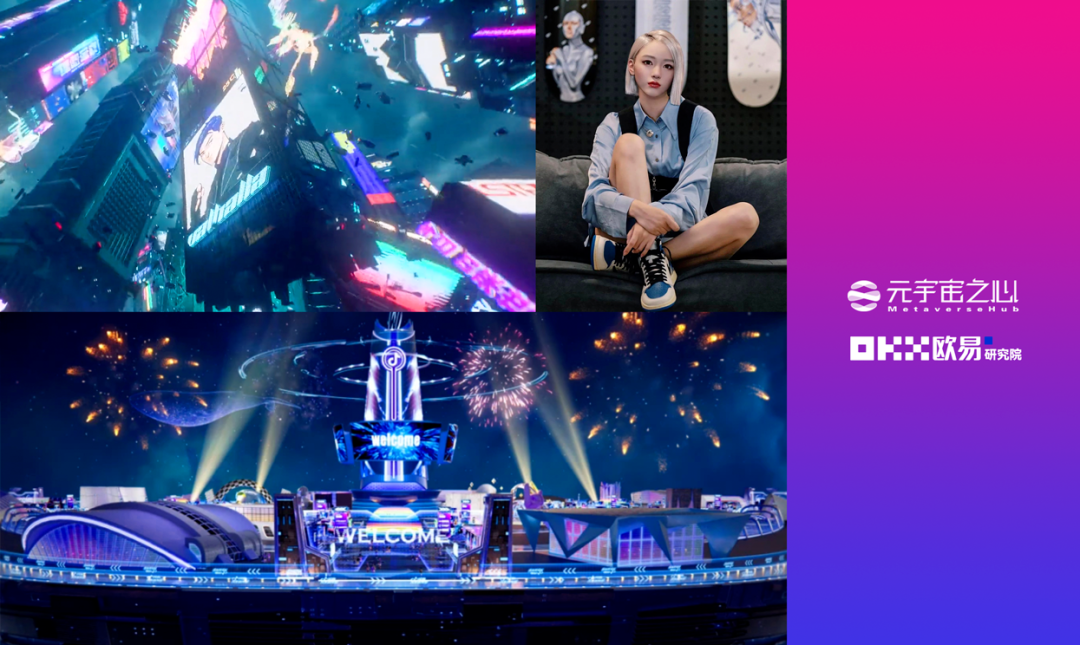
In recent years, digital people have become the focus of discussions on metaverse topics. Digital people, also known as virtual digital people and virtual people, are a digital form of human, which is what people now often call digital AI.
Fundamentally speaking, a digital human is an artificial intelligence physical system composed of hardware devices such as programmable chips and networks, and program code. It is equivalent to a digital robot with a brain, eyes, hands, and mouth.
Since the rise of the DID digital identity concept in 2021, digital people have continued this popularity and upgraded it to a more visual level of research.
Thanks to breakthroughs in deep learning algorithms, along with the rapid development of new technologies such as artificial intelligence, virtual reality, and augmented reality, the digital human industry is on the right track。
Currently, digital people have been applied in many industries, and many tech giants are scrambling to take their place. With the gradual maturity of the digital human industry chain, its commercialization process began to accelerate development, and digital people began to enter people's lives.
Judging from the overall development, China's digital human sector has now passed the embryonic period, entered a stage of rapid growth, and will show a rapid growth trend in the next 5 years.
According to QuestMobile data, the overall digital human market size in China in 2022 is 61.28 billion yuan, and the overall digital human industry is estimated to be 86 billion yuan. In the context of AIGC's enabling and superposition policies, the scale of the domestic digital human industry will continue to grow. According to qubit forecasts, the overall digital human market in China will reach 270 billion yuan by 2030.
On the basis of rapid iteration of technology, the digital human form will surely change even more in the future. However, the key to how far digital people can go depends on industrial applications. From virtual to virtual to virtual and real, the digital human industry has long since stopped in a single direction, but is moving towards more dimensions.
◉Metaverse marketing
Marketing is not only a sales act; it is also a process for enterprises to discover and explore consumer needs, so that consumers can understand the product and then buy the product. At the same time, marketing is also a way to create, spread, and deliver customer value and manage customer relationships in the context of the times. Any new form or technology that appears will attract the attention of many people, naturally bringing new value to marketing.
The metaverse has brought a new immersive experience to users, which means it has brought more novel marketing methods that can be expanded. Metaverse marketing came into being. According to a series of reports launched by Yuanchuang Shengjing, it only takes 1-3 years for the metaverse to mature in the field of marketing. In other words, the current metaverse is changing the rules of the traditional marketing game with a revolutionary attitude.
The metaverse has restructured the marketing content scenario. Through the digitalization of all production lifestyles in the real world, the relationship between “people,” “goods,” and “markets” has qualitatively changed. More and more brands are using virtual idols and brand IP to shape their brand “personalities” and narratives. Gucci, Balenciaga, Louis Vuitton, Burberry, Jacob & Co, and many other fashion industry leaders have laid out the brand framework in the metaverse in multiple fields.
At the same time, metaverse marketing has reshaped the concept of “what you see is what you get”, creating content that surpasses the real world in virtual spaces through trustworthy asset value and trustless identity authenticationIt breaks the barriers between the physical world and the real world, brings users an extraordinary immersive scene experience, and provides users with more room for imagination and fun about the brand.
For example, the Ou Yi NFT market includes the digital works of many famous artists, game developers, and celebrities from all walks of life, as well as the world's first high-standard 3D animated drama “Dragon Cage” NFT, antique enamel golden pheasant binaural bottle NFT, and the dynamic card NFT of the world's best MMA player Anderson Silva, which highlights the charm of metaverse marketing through a combination of technology and art.
As a multi-chain aggregation trading platform, the Ou Yi NFT market supports NFT transactions on 8 public chains including OKC, Ethereum, and BSC. It also supports one-click orders on other trading platforms. It has order depth on multiple platforms such as OpenSea and Magic Eden, and a complete NFT distribution plan, so it has attracted many celebrities and well-known IPs to join, and has also become a representative platform in the metaverse marketing field.
Also,Metaverse marketing also gives users the possibility to create value together with brands, and optimizes the customer loyalty system, so that users are no longer passive recipients of brand culture, but also shapers of brand culture。
◉Web3
On December 9, 2021, during a high-profile hearing in the US Congress, former Acting Director of the US Monetary Supervisory Authority Brian Brook shared the concept of Web3 with the public in the spotlight. Web1 is a readable internet, where users can only read the content provided by the website; Web2 is an interactive internet where users can upload and share content; while Web3 is a decentralized network where everyone can control their (digital) identity, assets, and data, and thus control their own destiny.
The Web3 concept brought new opportunities for development, and even led Congressman Patrick McHenry, who presided over the conference, to say “ensure that the Web3 revolution takes place in America.” This move has made the Web3 concept popular all over the world, and has also attracted the favor of many capitalists and institutions.
The key element of the metaverse is digital products. The Web3 concept, which uses blockchain technology as the underlying infrastructure, can give digital products the attribute of “assets” and has become one of the main development directions of the metaverse. This is why digital collectibles and NFT products continue to be popular in the metaverse industry this year.
Both Web3 and the metaverse have been well known since 2021, but the two different concepts have gradually come together this year. In fact, both are concepts of the future of the Internet, but the focus is different.
Web3 focuses on changes in ownership relationships. People can break the control of existing Internet oligarchs, truly own their own data and digital assets, and control their own destiny in a virtual network; while the metaverse focuses more on experience, constructs a rich virtual world through technology and allows users to perceive it in a new way, and gain an unprecedented sense of immersion.
However, the metaverse will never exist in just one company; the movie “Uncontrolled Gamer” fully demonstrates the consequences of a virtual world being held hostage by one company. Therefore, the decentralized metaverse will definitely be more popular, which coincides with the idea of Web3.
Web3 and the metaverse are not an either/or relationship. In fact, the two are a natural fit. Web3 is like the skeleton of the future Internet. The metaverse is the body of the future Internet, and the combination of the two may be more likely to be the shape of the future Internet.
As Jay Hao, CEO of OKX, commented earlier,”Web 3.0 represents the next phase of the internet. It is characterized by openness, sharing, and decentralization, and emphasizes that users have more control over their identity and data. The implementation of Web 3.0 requires the use of blockchain, AI, AR, VR and other technologies, and the metaverse is a transit point for Web 3.0. On the one hand, users can reconstruct social life, business activities, and entertainment methods in this land; on the other hand, it allows users to perceive Web 3.0 in advance, creating convenience for the end of Web 3.0.”
If you know Web3 users, you probably know that currently, a digital wallet is actually a digital identity for entering the Web3 world. On the one hand, you log in by holding your own private key, but this method is not friendly enough. Therefore, in the future, some apps such as OE will introduce an MPC private keyless login method to reduce the user entry threshold and achieve the effect of “sensing Web 3.0 in advance.”
Of course, starting in 2022, we can see many internet giants entering the metaverse and Web3 at the same time, and there are endless Web3 metaverse projects. The two words describing the future of the Internet have almost gone hand in hand and appeared at the same frequency this year.
Needless to say, this year was not only a year for Web3 to inspire everyone, but also the starting point for the integration of Web3 and the metaverse. There is no going back. Web3's important role in the metaverse also means that from now on, it will grow along with the development of the metaverse, and the two will complement each other and eventually achieve each other.
◉AIGC
On September 23, 2022, the official website of Sequoia USA published an article entitled “Generative AI: A New Creative World”. This article indicates that AIGC will represent the beginning of a new paradigm shift. On November 30, OpenAI launched ChatGPT, a new chatbot model based on AI technology, which surpassed 5 million users in less than a week after launch.
The popularity of ChatGPT has also refreshed people's understanding of AI production capabilities, and netizens at home and abroad are also curious about their continued rising enthusiasm. What exactly is AIGC?
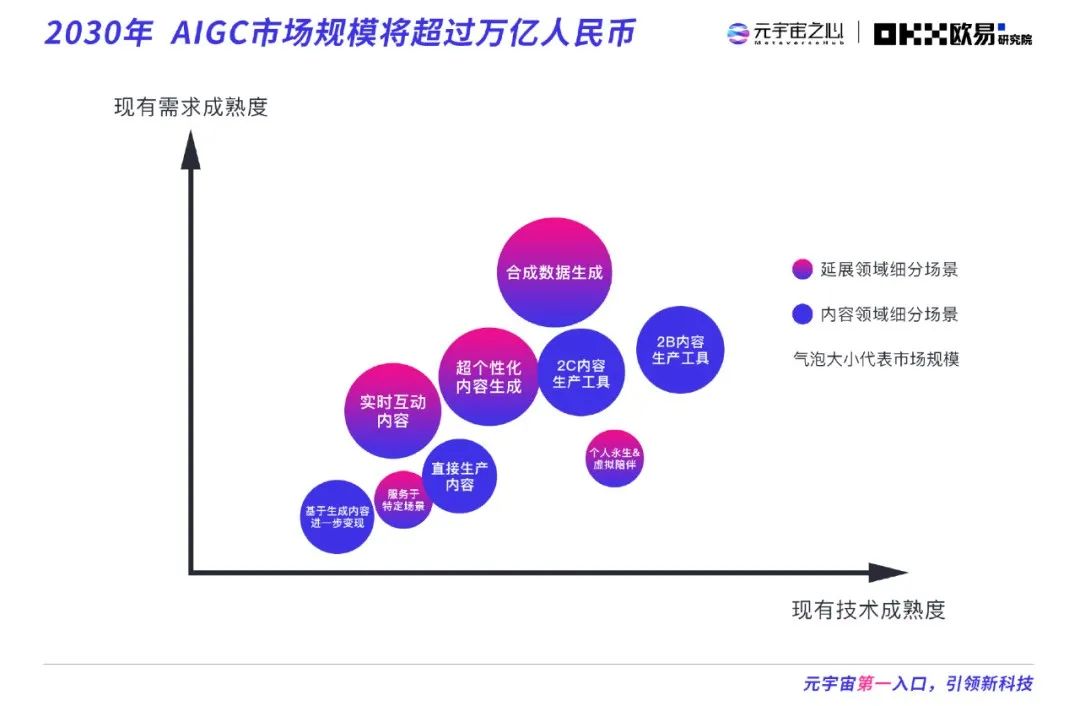
AIGC (AI-Generated Content) is a new production method for automatically generating content through artificial intelligence technology after PGC (Professional Generated Content) and UGC (User Generated Content).
The immersive and diverse metaverse ecosystem requires a large amount of content for users to continue to explore, but in the past, UGC and PGC methods clearly can no longer meet the needs of building a metaverse, and with artificial intelligence tools, everyone can become a creator. Currently, AIGC technology is widely used in text, images, audio, and games.
Diverse AIGC platforms have sprung up around the world, causing a round of storms. Jasper is an AI content platform that allows individuals and teams to use AI to create content. Less than two years after its establishment, it became a unicorn company valued at 1.5 billion US dollars; and Stability AI, which also stands in the latest ranks of unicorns, can generate images based on keywords in just a few seconds. Unlike other platforms, it democratizes technology through open source, providing developers with maximum freedom.
In addition to text and image creation, AIGC technology is also used in video creation. Earlier, Google also released two text-to-video tools, Imagen Video, which emphasizes video quality, and Phenaki, which focuses on video length.
As an important production tool for constructing virtual worlds, AIGC provides creators with unlimited imagination. As AI technology continues to be deployed, artificial intelligence production content will unlock the true potential of the metaverse.
◉Education metaverse
2021 is the first year of the metaverse, which not only made more people aware of this promising emerging industry, but also inspired all walks of life to experiment more in related fields. This year, metaverse education is gradually gaining prominence in the exploration of many schools, companies, and institutions.
As a virtual world parallel to the real world, the metaverse brings a new way of display and interaction, and education requires extensive display and effective interaction such as information presentation, explanation, and practice, which is naturally compatible with the metaverse.
Compared to static graphic teaching methods, the metaverse can present more three-dimensional and dynamic knowledge information. For example, when we study the structure of the human body, it is difficult to actually feel how the human body works by just looking at pictures and text, and if it is a three-dimensional, simulated, and dynamic image, it is easier for people to understand the mechanism of its operation.
At the same time, the metaverse adds a richer interactive dimension to information, and we can further interact in a virtual scene. Learning during operation is often the fastest, and the virtual scenarios provided by the metaverse are perfect for experiments or operation scenarios that require repeated practice. It is widely used in many aspects such as medicine, industrial design, physics, biology, and chemical experiments, and is free from many limitations such as scenarios and materials.
For example, a complete surgical process can be simulated in a virtual scene, so that medical students can quickly familiarize themselves with the operation process. It is possible to learn driving operations and master traffic rules in the metaverse, so that people can quickly master the skill of driving without the help of a coach or considering issues such as driving school buses and practice grounds.
Furthermore, metaverse education has successfully implemented the “edutainment and fun” policy, perfectly combining games with education. In the metaverse, many learning contents are digitized, and corresponding feedback mechanisms are designed to gamify education, thereby increasing students' enthusiasm for learning, positively motivating them, and better discovering students' problems from data analysis and making timely corrections.
So, from multiple perspectives,As a new technology, the metaverse will inspire new thinking for education. It will also force education practitioners to accept new technology with an inclusive and open mindset, and explore new educational methods and innovations in metaverse+ education from it. Metaverse education may become an important development direction for future educational changes.
METAVERSE
2023 Prospects/Forecasts
◉Reviewing 2021's outlook and predictions
Here's what we're at2021 Metaverse Annual ReportNow let's do a brief review and summary of the 2022 metaverse developments.
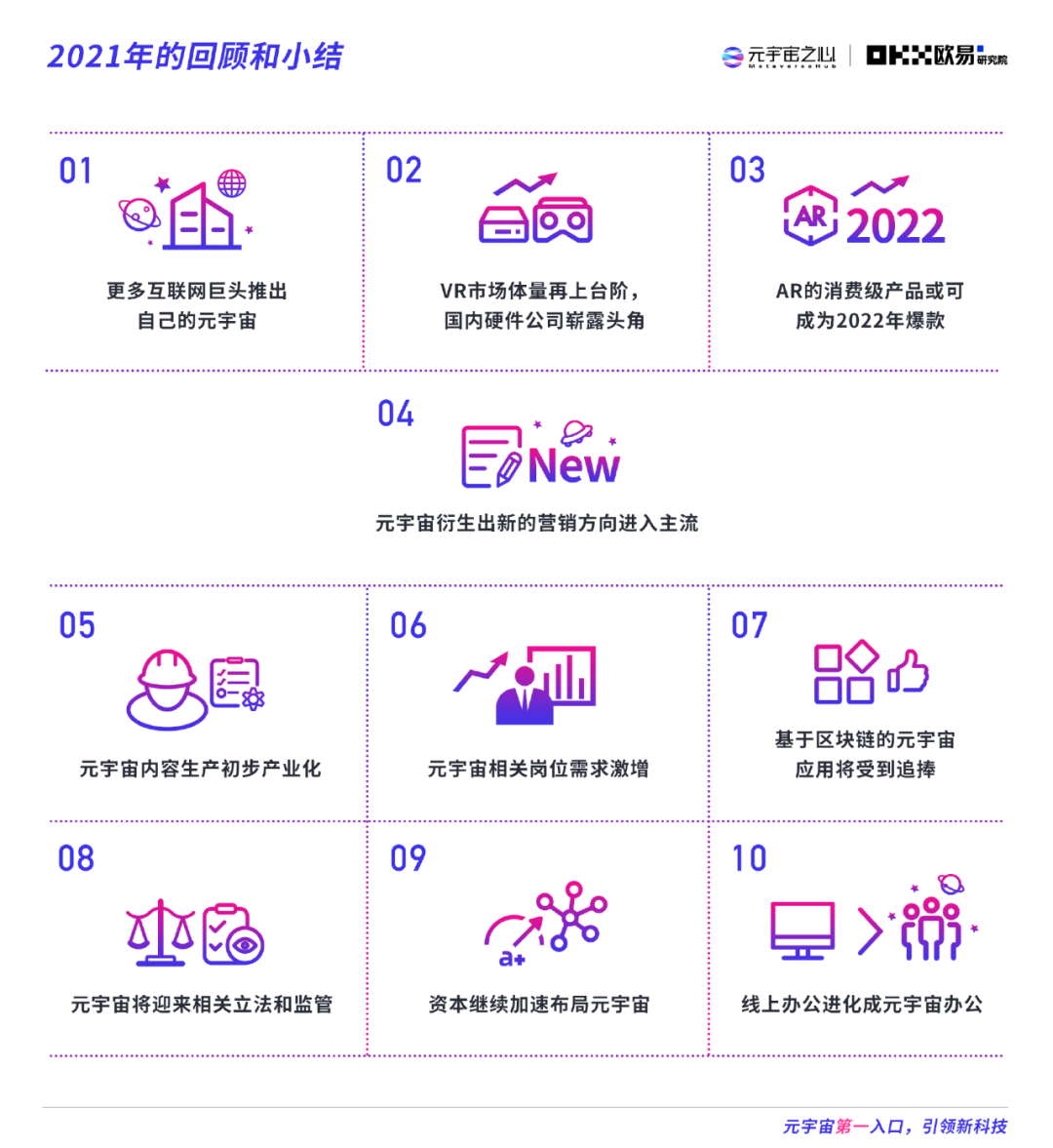
First, overall, with the exception of Articles 3 and 8, everything else was tested in 2022.
Second, there is Article 3. It seems that the popular AR products we anticipated have not actually appeared. Although excellent AR products such as Nreal and Thunderbird Innovation have appeared in China, they have not yet reached the level of popularity. Perhaps we are too optimistic about hardware development, and even Apple AR glasses, which were originally planned to be released in 2024, have now been reported to have encountered design problems.
As for Section 8, the legislation and regulation of the metaverse has not developed in the direction we expected, and not much legislation has even appeared on a global scale. There is some regulation of metaverse hype but not at the legislative level. Although there have also been widely discussed legal issues such as metaverse sexual abuse, the time has not yet reached the time to regulate legislation. Perhaps this will be a longer path. After all, many regulations on the Internet are slowly implemented when products become popular, and so is the metaverse.
When we looked back at the other 8 predictions or prospects, they all did correspond one by one. More Internet technology companies that can be seen with the naked eye have joined the metaverse circuit; marketing gameplay in the metaverse field has been accepted and tried out by more companies; many virtual people, metaverse virtual spaces, or popular products such as AIGC have appeared, making metaverse content initially standardized; at the same time, IDC, a world-renowned consulting agency, predicted in the fourth quarter that in 2022, global VR headsets will be shipped about 15.73 million units, an increase of 43.6% over the previous year. We have also seen PICO launch new products this year and go abroad.
In October, Zhilian Recruitment released the “2022 Metaverse Industry Talent Development Report”. The data shows a 16.6% year-on-year increase in metaverse-related recruitment positions from January to July 2022; according to the “2022 Global Blockchain Talent Report” produced by OE, OKX and LinkedIn, the total number of talents in the global blockchain field has now increased 76% year on year. Traditional financial companies such as Goldman Sachs, JPMorgan, and HSBS, as well as technology companies such as Google, Microsoft, and Facebook, are pouring in blockchain talents. Easy OKX is also planning to increase recruitment by 30% per year to reach a scale of 5,000 people. This move has surpassed many traditional technology companies.
Blockchain and metaverse are still topics we can't avoidAlthough the development of the industry entered a freezing period in the second half of the year, the popularity at the beginning of the year did attract many Fortune 500 companies to join spaces such as The Sandbox or Decentraland.
As for capital layout, according to the “2022 Metaverse Mid-Year Investment and Financing Report” jointly released by Sina VR and the Enterprise Research Institute, the total amount of global investment and financing for the metaverse circuit in the first half of 2022 reached RMB 32.24 billion, and the total number of investment incidents was 205, reaching 2.3 times and 3.2 times the total investment and financing amount for the full year of 2021, respectively.
Finally, with regard to the evolution of online offices into metaverse offices, people who are watching the development of conferences will probably find that many industry conferences this year were achieved through virtual space. On the one hand, due to the impact of the pandemic, digitalization is sweeping through more traditional industries, and this is just the beginning.
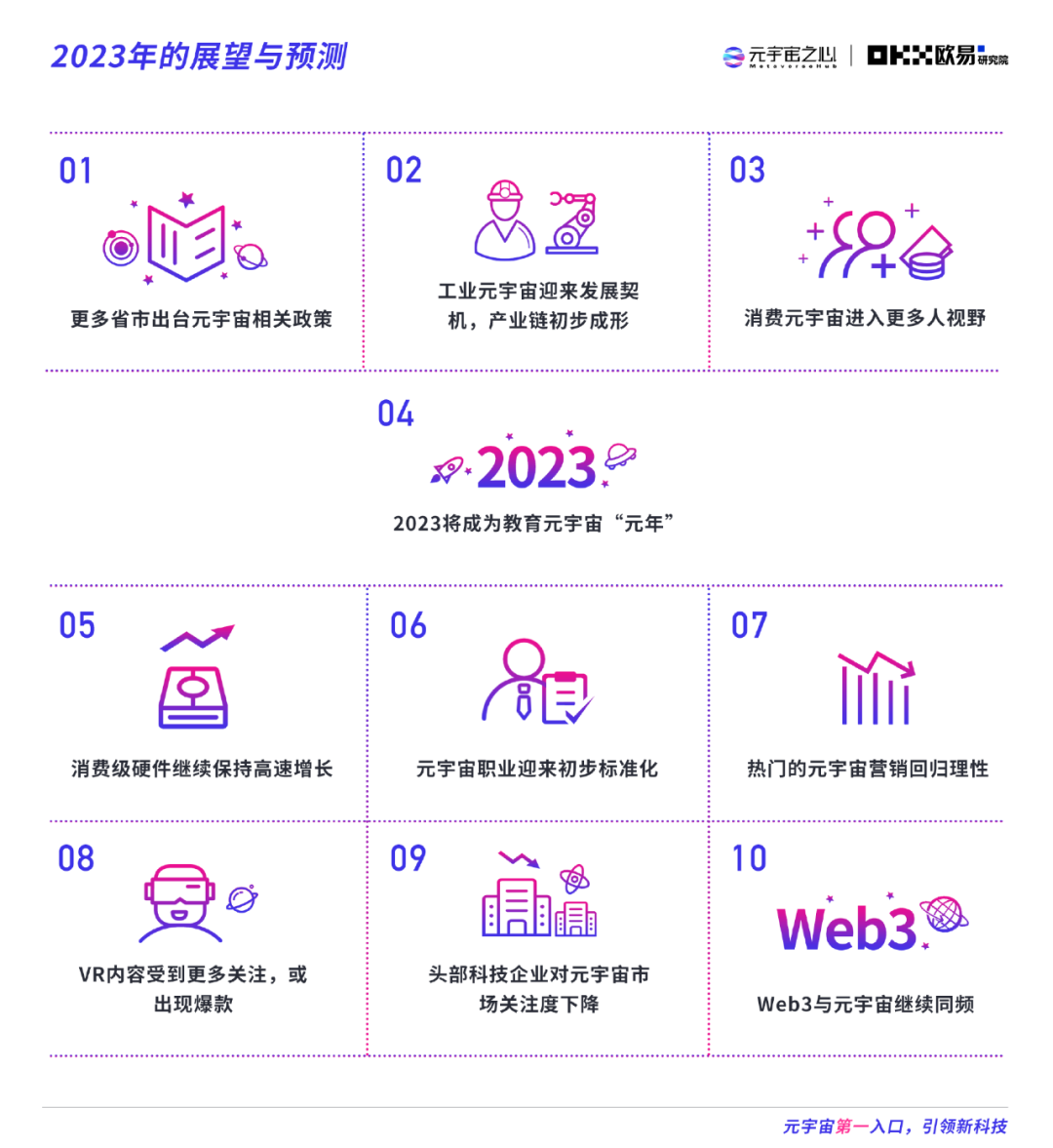
The above is a review of our predictions from last year and a summary of the current development of the metaverse. So, standing at the tail end of 2022, facing the upcoming 2023, what kind of expectations and concerns do we have?
◉2023 outlook and forecast
1. More provinces and cities have introduced metaverse-related policies
In line with the metaverse-related policies of various provinces and cities in China in 2022, we expect that policy trend will continue to strengthen in 2023, and even gradually move closer from some first- and second-tier cities to other cities. On the one hand, it stems from the development needs of the metaverse itself, and on the other hand, it is a need for digital economy construction. The metaverse itself can be well linked to the digital economy, so the policy continuity between the metaverse and the digital economy will greatly improve in 2023.
2. The industrial metaverse ushered in development opportunities, and the industrial chain took shape
With the 3-year industrial metaverse action plan announced by the Ministry of Industry and Information Technology in early November this year, 2023 is bound to set off a wave of industrial metaverse, and as overseas giants continue to invest in digital twins, technology leaders such as IBM, Microsoft, and Nvidia will continue to push the industrial metaverse one step forward, thus also bringing new growth points to the industry and forming an initial industrial chain.
3. The consumer metaverse enters the eyes of more people
In 2022, we have seen that the consumer metaverse has a preliminary model and gradually established a new transformation of “people, goods, and markets”. We expect more consumer brands to join the metaverse wave in 2023. At the same time, with the popularity of VR scenarios, there is a chance that it will bring new consumer experiences to the retail industry.
4. 2023 will be the “first year” of the education metaverse
Beginning in the second half of 2022, we have noticed that some education metaverses have begun to be mentioned. For example, the leading company in the industry, Jiangxi Kejun Industrial completed the latest round of financing of hundreds of millions of yuan in November, which is a strengthening agent for the development of the education metaverse. In 2023, we will see more applications of the education metaverse, and we will also see some colleges and universities starting to launch metaverse-related education courses. Both will usher in a small explosion in 2023.
5. Consumer hardware continues to grow rapidly
As described above, hardware such as VR/AR experienced double-digit growth in 2022. We expect this rapid growth to continue and further strengthen the growth of consumer-grade hardware as the chip and storage market recovers, but 2023 will not be a real year for products to explode, and some market education is still needed.
6. The metaverse profession ushered in initial standardization
When we talk about internet careers now, we can list a range of positions, but just as these occupations were just born 10 years ago, the metaverse will usher in initial standardization of occupations in 2023, such as metaverse product operators, metaverse designers, or metaverse content creators, and these occupations will gradually enter the public eye as the industry develops and become an anchor point for the next 10 years. Of course, at present, some Web3 companies have emerged in traditional career fields. This month, LinkedIn presented the “Mostin2022 Global Attractive Employer” award, and OKX made the list, becoming the only Web3 technology company on the list.
7. Popular metaverse marketing returns to rationality
The most popular and successful direction in the industry in 2022 is “metaverse marketing”. Whether it's digital people, digital collections, or various virtual experiences, they occupy another outlet in the metaverse, but as we wrote a related article at the beginning of the year, these marketing methods will gradually decline with public attention, and fall back from hype to a rational state. Of course, the return is not bad; on the contrary, it promotes the healthy development of the industry.
8. VR content has received more attention or is trending
Until now, we are still adhering to our previous view. If VR wants to be popular, popular products with VR content must first appear, just like “food stealing” and “mini games” that were popular on the internet in the early days. Only when such products are paid for by the market will usher in a real explosive growth of VR hardware. Otherwise, the logic of early tasting does not support the emergence of a trillion-level market, so we'll wait and see who will become popular VR content makers.
9. Leading technology companies are paying less attention to the metaverse market
Just as the direction of the metaverse fell short of expectations after Meta changed its name, we expect that in 2023, large technology companies will lose their attention on the metaverse itself, and instead will begin to pay attention to metaverse applications. They may stop widely referring to the metaverse and change to “digital twins,” “virtual reality fusion,” or simply VR/AR. This also means that the metaverse term, which has been popular for 2 years, may decline in 2023, but we have reason to believe that this decline will not affect the course of the industry.
10. Web3 continues to share the same frequency as the metaverse
Finally, the metaverse and Web3 will still appear at the same frequency, and the two may appear in a more ingenious way, and not only through a single scenario such as virtual land. As for what kind of story will happen, we can see one or two through the development of Web3 itself. Although it has already entered a “freezing period,” we expect this freezing period to pick up at the same time as the economic cycle changes, but there is still uncertainty about time.
METAVERSE
epilogue
More than half a month has passed since we began writing the report to the completion of the report. Imagine that the 2021 Metaverse Annual Report was the industry's first professional and universal annual report. Once launched, it was widely read and retweeted across the Internet. Now, looking at the 2021 report, there are still quite a few debatable points, but as industry participants and builders, we still chose to continue to launch the 2022 annual report, because the metaverse is on the rise, and we still need to work together.
2022 is still a year worth remembering. Whether it's the ongoing pandemic or the hot wave of digitalization, both have boosted many developments in the metaverse, from digital collections to digital people, from AIGC to the digital economy, or from digital spaces to virtual conferences, everything appeared just right. Despite the bubble, real value is beginning to show.
Over the past year, we've heard too many institutions predict the future metaverse market size, from 100 billion dollars to trillion dollars, or even tens of trillions of dollars. In fact, behind this is not only the extension of the Internet, but also the new context of technological development. After all, we cannot stand still. Even if the current environment changes, “natural selection” is still the truth, and survival of the fittest applies to both species and technology.
Finally, I'll end this report with a sentence from the bestselling book “Guns, Germs, and Steel,”The development of technology is accumulated over a long period of time, not by isolated heroic acts; technology is mostly used after being invented, rather than invented to meet some kind of foreseen need.”
Perhaps the demands we currently anticipate in various metaverse directions are also inaccurate, but it is this kind of inaccuracy that makes the future full of hope and opportunity.
Goodbye 2022, we will meet in the metaverse in the future.
