


Tiger Research: Overview of the Asian stablecoin market in 2026

Source: Tiger Research
Authors: Ryan Yoon, Ekko An
Compiled and organized by: bitPushNews
Countries in Asia are preparing for the stablecoin era. But the reality is that 99% of the market is still dominated by the US dollar. How will countries respond to this challenge?
1. Dollar hegemony in the stablecoin market
The stablecoin market has experienced rapid growth. As of February 2026, the total market capitalization was approximately $300 billion (rwa.xyz), reflecting an average annual growth rate of about 750% of the market since 2018. However, about 99% of this market is pegged to the US dollar.
Although the market is expanding, the dollar actually has a monopoly on it.
To understand this dominance, we need to observe the dynamics of US Treasury bonds.
Stablecoin issuers don't simply lock the deposited dollars into a deposit bank. They invest their reserves in safe assets, such as short-term treasury bonds, and earn interest income. As the stablecoin market grew, so did the size of treasury bonds purchased by these issuers. Today, stablecoin issuers as a group are the 17th largest US government debt holder in the world.
The United States has every reason to welcome this.
Geopolitical tension has prompted major holders such as China to reduce their holdings of treasury bonds, and the federal fiscal situation is becoming increasingly tight. The US government is more than $38 trillion in debt and will need to sell about $11 trillion in new treasury bonds in 2025 alone.
If demand is insufficient, interest rates will inevitably rise, and rising interest rates will push debt repayment costs to a level comparable to defense spending.
In this context, the US enacted the GENIUS Act in July 2025, which requires stablecoin reserves to be held in the form of US Treasury bonds. Washington is actively shaping the stablecoin narrative.
For the US government, stablecoins anchored to the US dollar are not only a new type of digital payment channel, but also a treasury bond distribution mechanism and a policy tool to maintain the hegemony of the US dollar.
2. Why Asia is still issuing local stablecoins
For Asia, the dollar-dominated stablecoin structure has the opposite meaning. The more USD-anchored stablecoins are used by local residents and businesses, the smaller the scale of domestic capital flows to the local financial system and the larger the scale of the US dollar's hegemonic infrastructure.
The core issue is not technology. It is the fear of losing monetary sovereignty. This anxiety is the most fundamental driving force behind the issuance of local stablecoins.
That being said, stablecoins do offer some clear technical advantages. They eliminate intermediaries, reduce transaction costs, and operate around the clock regardless of bank business hours. This benefit is particularly evident in cross-border payments, where transfers that would have taken several days can now be settled within minutes. For Asian economies that depend on trade, this means real cost savings and increased speed.
However, these advantages are a double-edged sword. Once the local stablecoin is placed on the blockchain, the exchange path to the US dollar stablecoin is simultaneously opened. Even if there are stablecoins denominated in won, users can exchange them for USDT with just a few clicks on a decentralized exchange (DEX). Instead, capital outflows are likely to accelerate. A tool designed to protect the local currency may counterintuitively strengthen the dollar.
That's why every jurisdiction, while allowing stablecoins, invests heavily in regulatory design. The strategy is to open doors to technology without relinquishing control over capital flows.
In this context, major Asian markets initially preferred central bank digital currencies (CBDCs) rather than private stablecoins. Central bank control over issuance and distribution can block exchange routes and capital flight at the source.
But reality is running faster than regulation. The adoption of US dollar stablecoins has begun, and there is a consensus that legislation alone cannot reverse this trend. Then there was a fundamental shift in thinking: instead of fearing the expansion of US dollar stablecoins, the real solution was to make the local currency more attractive within its own rights.
At this point, Asia's strategy has taken a turn. Instead of blocking US dollar stablecoins, jurisdictions have chosen to selectively adopt stablecoin technology while enhancing the competitiveness of their own currencies. Fears about capital outflows have not gone away. Every jurisdiction is establishing institutional guarantees, including issuance requirements and reserve regulation, to find a balance between openness and control.
That's why regulators in the region are speeding up efforts to strengthen local currency stablecoins. The problem isn't just a technology competition. It's about financial security.
What strategies are each jurisdiction actually pursuing? The following sections examine the cases of Japan, Singapore, Hong Kong, South Korea, and China.
3. Asian stablecoin landscape in 2026
3.1. Singapore
Since 2020, Singapore has recognized stablecoins as a regulated activity through the Payment Services Act (PS Act). In 2023, it finalized a special framework and added a separate category of “stablecoin issuance services” to the Payment Services Act.
The Singaporean strategy is unique in that it allows not only to issue stablecoins pegged to the Singapore dollar (SGD), but also stablecoins anchored to the US dollar and other G10 currencies. Countries like Japan and South Korea have huge local currency economies, and local currency stablecoins themselves are a goal. As a city-state with a population of only 6 million, Singapore cannot build a global ecosystem with SGD stablecoins alone.
As a result, Singapore chose to compete as a regulatory jurisdiction. Whether the stablecoin is anchored in the US dollar or the Singapore dollar, the goal is for it to be issued in Singapore under the supervision of the Monetary Authority of Singapore (MAS) to attract issuers, capital, and talent. This strategy is working. Companies such as StraitsX, Paxos, Ripple, and Circle have all obtained major payment institution (MPI) licenses. As of January 2026, around 6 to 8 core stablecoin operators are active here.
Governance: Systematic design from 2019
Singapore's stablecoin regulation is based on the Payment Services Act 2019 (Payment Services Act 2019), a single legislative framework governing seven major types of payment services, including remittance and digital payment tokens (DPT). It came into effect in 2020.
The key concept is DPT. Section 2 of the Payment Services Act defines DPT as “a cryptographically protected digital expression of value used as a medium of exchange.” Although the term “stablecoin” does not appear in the Act itself, MAS has always treated stablecoins as DPT in its guidelines and annual reports. As a result, stablecoin issuance has been a legally regulated activity since 2020 and is classified as a form of DPT service.
However, the Act's DPT regime focuses on operational resilience and customer asset protection: how to isolate and protect customer assets in the event of exchange hacking or operator bankruptcy, and how to ensure technical stability. It doesn't address the most fundamental risk of stablecoins: value stability.
TerraUSD's crash in May 2022 made this gap a reality. TerraUSD, which relies on algorithms to keep the dollar anchored, lost its anchor overnight. A wave of redemption requests followed, erasing tens of billions of dollars in value. This incident proved that as stablecoins are widely used for payments, a collapse in value can spread the impact beyond a single token to the wider financial system.
MAS was quick to respond. In August 2022, it launched a public consultation to formally launch a specific regulatory review of stablecoins. Public consultation is a process for regulators to formally solicit feedback from industry, experts, and the public before introducing a new framework.
After incorporating feedback from the process, MAS finalized and published its single-currency stablecoin (SCS) regulatory framework on August 15, 2023.
The core change is to separate stablecoin issuance from the existing DPT category and establish a “stablecoin issuance service” as an independent business type in the Payment Services Act. If DPT regulation represents broad operational regulation of crypto assets, then the SCS framework represents a value guarantee system for stable assets used as payment instruments.
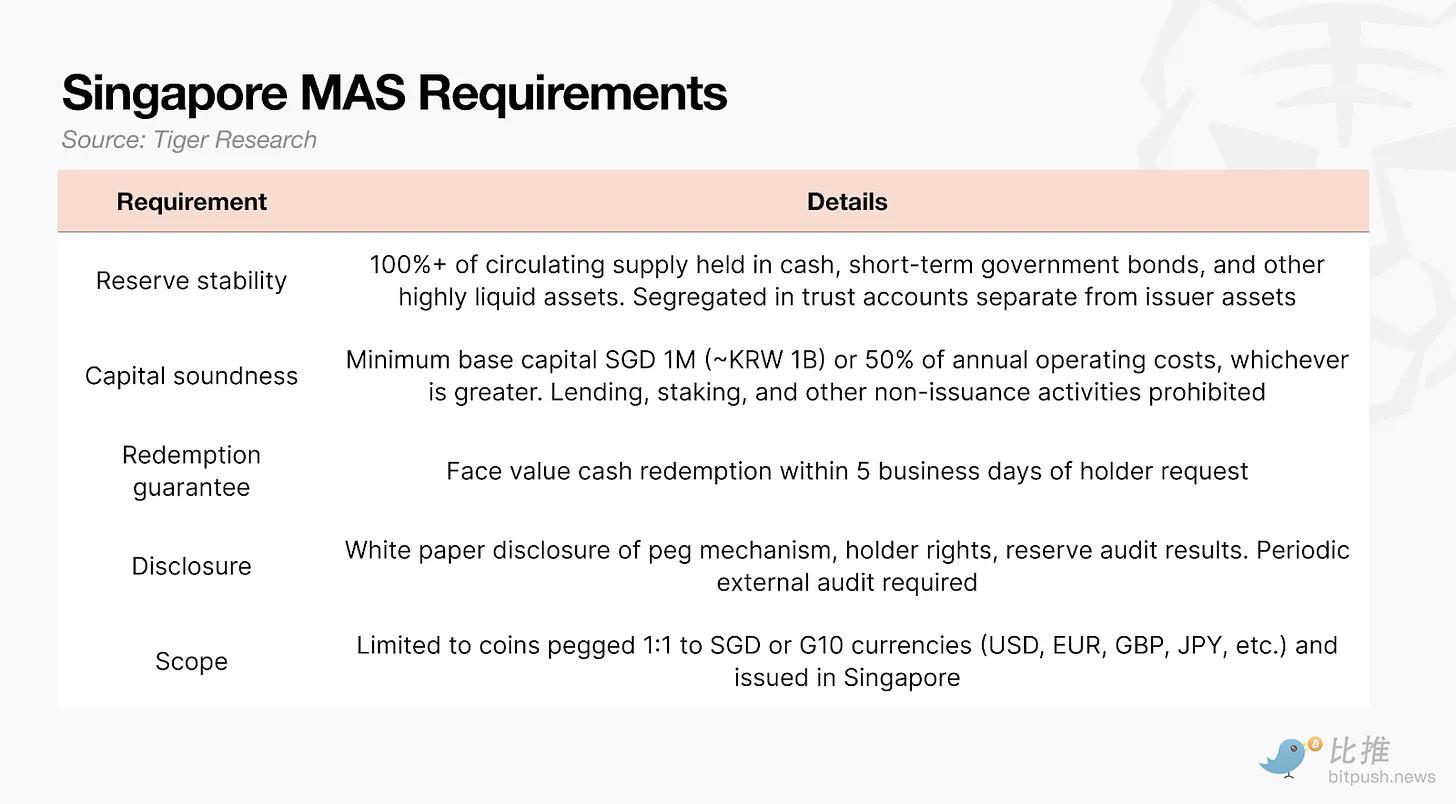
“MAS Regulation” tab
Only stablecoins that meet all SCS requirements can carry the official “MAS regulated stablecoin” label. Unauthorized use of this title is punishable by fines or criminal penalties, making it effectively a government-supported certification mark.
Offshore stablecoins can still be traded within Singapore, but they are only subject to existing DPT rules and cannot use the label. Users of such tokens do not receive the reserve and redemption protection provided by the SCS framework when operating.
The SCS framework has been finalized and published, and is expected to be legally enforced by mid-2026. In the current transition period, operators with MPI licenses are voluntarily complying with the requirements of the framework while issuing and operating stablecoins.
Case Study 1: StraitsX
The market reacted quickly after the framework was finalized. As of January 2026, 36 entities already hold MPI licenses for DPT services from MAS, of which 6 to 8 are directly involved in stablecoin issuance.
A leading example is StraitsX, a stablecoin brand created by Singaporean fintech group Xfers. It received MAS in-principle approval (IPA) in November 2023, and its three subsidiaries obtained official MPI licenses in July 2024. StraitsX currently issues XSGD (1:1 pegged to the Singapore dollar) and XUSD (pegged to the US dollar). 100% of the reserves are held in DBS escrow accounts and are subject to monthly external audits.
StraitsX stands out because it most specifically shows how regulated stablecoins work in everyday life. XSGD has been accepted as a payment method at Grab merchants and Alipay+ (Alipay+) stores in Singapore. Purpose-restricted currency built on XSGD was piloted for Amazon Vouchers and Grab payments under “Project Orchid,” a programmable currency program led by MAS.
Cross-border usage is expanding rapidly. In May 2025, a partnership with Ripple introduced XSGD natively to XRP Ledger (XRPL). XUSD is being used for peer-to-peer overseas remittance with Ant International and Grab, as well as on-chain SGD-USD exchange. With a cumulative transaction volume of $1.8 billion, StraitsX is becoming the treasury management infrastructure for ASEAN companies.
Case Study 2: US Dollar Stablecoin Issuers (Paxos, Ripple, Circle)
Global operators that handle US dollar stablecoins are also speeding up their entry into Singapore. Despite their different positioning, they all share one thing in common: they all use Singapore as their Asia Pacific (APAC) base.
Paxos Digital Singapore is a local subsidiary of Paxos (PYUSD, the global issuer behind PayPal's stablecoin). It obtained an IPA along with StraitsX in November 2023, and obtained an official MPI license in July 2024. A key element is its selection of DBS Bank (DBS) as its reserve custodian, a structure where major traditional banks directly manage crypto issuer reserves and aims to build institutional investor confidence. After the US and UAE, Singapore is Paxos' third issuance hub and plans to launch a Singapore-issued US dollar stablecoin in 2026. As the first foreign stablecoin issuer to receive an MPI license, Paxos is seen as a prime candidate for the “MAS Regulation” label.
Ripple (Ripple Markets APAC) expanded its existing MPI license to stablecoin services in December 2025. It natively issues RLUSD (a stablecoin pegged to the dollar) on XRP Ledger. Its core strength is direct integration with Ripple's existing cross-border payment network “On-Demand Liquidity” (ODL). The integration of StraitsX's XSGD into XRPL in May 2025 is also a product of this Ripple partnership. The main goal is cross-enterprise remittance and treasury management in the Asia-Pacific region.
Circle (the issuer of USDC) obtained an MPI license in Singapore in September 2024. However, since USDC was issued in the US, it is classified as a regular DPT and not part of the SCS framework. Circle's Singapore entity focuses on Asia-Pacific institutional settlement, cross-border remittance, and USDC-SGD liquidity pool provision, using Singapore as the base for its Asia-Pacific expansion. The “MAS Regulated” label is not applicable, but Circle represents a notable example of an offshore issuer participating in the Singapore market through an MPI license.
Other operators joining the stablecoin ecosystem as MPI include XREX, NIUM, Thunes Asia, HashKey, and dtcpay.
3.2. hongkong
Hong Kong enacted the Stablecoin Ordinance in August 2025, becoming the second major Asian jurisdiction to implement an independent stablecoin law after Japan.
Unlike Singapore, which embeds stablecoin provisions into the existing Payment Services Act, Hong Kong created a completely separate law. The scope also varies. While Singapore restrictions cover SGD and G10 currencies, Hong Kong has no restrictions on reference currencies. Stablecoins anchored in HKD, USD, EUR, or any other fiat currency fall under this regulatory framework.
Singapore's strategy is to attract global issuers by competing as a regulatory jurisdiction, while Hong Kong is leading the way with an open framework without currency restrictions and institutional clarity of independent legislation. By not specifying a reference currency, Hong Kong leaves room for local stablecoins based on multiple fiat currencies. This open structure also provides a legal path for large Chinese companies that are actually banned from issuing stablecoins in mainland China. The participation of a JD.com subsidiary in the sandbox illustrates this.
Regulation: From sandbox to independent law
Hong Kong's stablecoin regulation originated in a 2022 Hong Kong Monetary Authority (HKMA) discussion paper. In December 2023, the Financial Services and the Treasury Board (FSTB) conducted a joint public consultation with the HKMA, and announced findings and confirmed legislative direction in July 2024.
In parallel with Singapore in terms of time, they all initiated a regulatory review immediately after TerraUSD crashed in 2022. However, Hong Kong added an extra step: the stablecoin issuer sandbox was launched in March 2024. In July 2024, the HKMA selected three initial participants:
RD InnoTech (Hong Kong Blockchain Company)
JD Coin Chain Technology (JD subsidiary)
A consortium formed by Standard Chartered Bank, Animoca Brands and HKT (Hong Kong Telecom)
The official law, the Stablecoin Ordinance (Chapter 656), was passed by the Legislative Council on May 21, 2025 and came into effect on August 1, 2025.
The core regulatory goal is fiat stablecoins (FRS): tokens that anchor 1:1 value to fiat currencies such as the US dollar, Hong Kong dollar, or euro.
One notable feature is how to restrict unauthorized issuers. FRS issued without permission from the HKMA cannot be sold to retail investors in Hong Kong; distribution is limited to professional investors. This is more conservative than Singapore, where offshore stablecoins can circulate as normal DPT even without the “MAS regulation” label.
The regulatory structure is also divided into two bodies. The HKMA is responsible for overseeing stablecoin issuance, while the Securities and Futures Commission (SFC) oversees virtual asset exchanges. Distribution and distribution are governed by different regulatory bodies.
Since it came into effect on August 1, 2025, many organizations have expressed interest, but only 36 are known to have submitted formal applications. As of February 2026, no license has been granted. The HKMA only stated that it is “reviewing applications from various institutions” and that the first license is expected to be issued in the first half of 2026.
This is in stark contrast to Singapore. In Singapore, StraitsX and Paxos received in-principle approval shortly after the SCS framework was finalized in August 2023, and an official license was obtained in July 2024, and stablecoins are already in operation. Although the laws are in place in Hong Kong, there are no regulated stablecoins operating in the market.
Case Study: Three Sandbox Participants
The three Sandbox participants provided the clearest picture of Hong Kong's emerging stablecoin ecosystem without an official license being issued. However, most are still in beta, and there are limited public details about real-world use cases.
RD InnoTech: Proof of Concept for Digital Asset Transactions and Cross-border Trade Payments
JD Coin Chain Technology (JD.com): Supply chain finance and cross-border payment efficiency (goal is to reduce costs by 90%)
Standard Charter/Animoca Brands/HKT Foundation: Web3 Payments, Metaverse Economy and Telecom Payment Simulation
3.3. Japan
Japan is the first country in Asia to complete stablecoin regulation legislation. The revised Payment Services Act passed in 2022 came into effect in June 2023, giving stablecoins the legal status of an “electronic means of payment.”
The most unique feature of the Japanese model is the restriction on issuer status. Singapore is open to any MPI-licensed entity, whether a fintech startup or a global operator, while Japan limits issuance to three categories: banks, trust companies, and registered fund transfer service providers (FTSPs). All three categories are existing financial institutions that are already regulated by the Japan Financial Services Agency (FSA). In practice, this is equivalent to a bank-only model.
This structure is a well thought out choice. The underlying logic is to place stablecoins as an extension of the existing financial system rather than viewing them as a new type of financial innovation. By entrusting issuance to institutions that have met capital requirements and maintained internal control systems, regulators can reduce oversight costs while ensuring stability from the outset.
Regulation: Amendments to the Payment Services Act and dual regulatory structure
The starting point was the June 2022 amendments to the Payment Services Act. The law defines any digital asset that anchors the value 1:1 to fiat currency (such as yen) and guarantees the holder the right to redeem it in cash at any time as an “electronic means of payment.”
Stablecoins that maintain their value through cryptoasset collateral, such as MakerDAO's DAI (backed by Bitcoin, Ethereum, etc.), do not fall into this category and are classified as ordinary crypto assets.
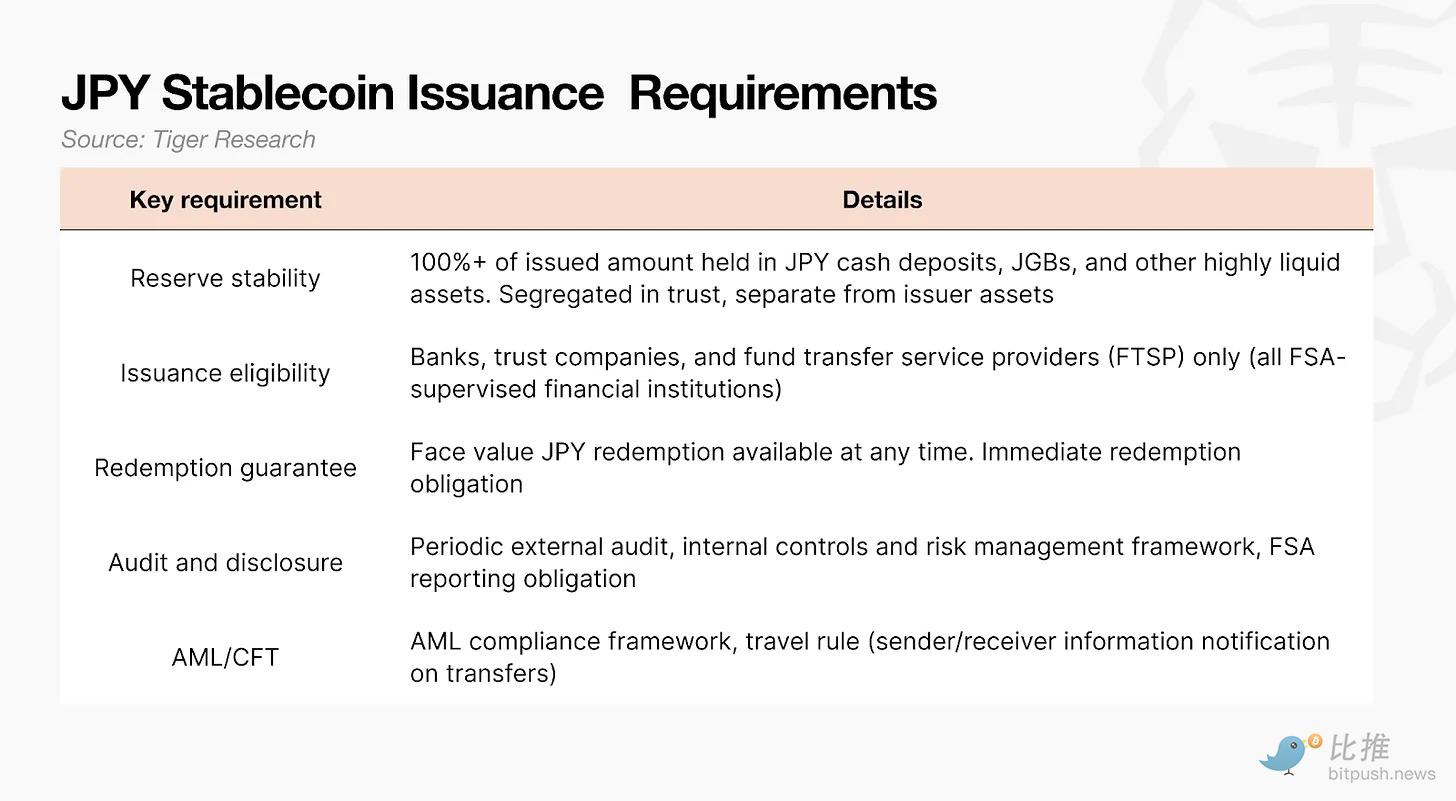
The type of issuer determines the legal nature and restrictions on use
Only banks, trust companies, and fund transfer service providers (FTSPs) licensed by the FSA can mint, destroy, and hold 100% of trust reserves. Notably, the legal classification and usage restrictions of stablecoins depend on their issuer:
Banks: classified as deposits; no transfer restrictions
Trust company: structured as a trust beneficiary right; no transfer restrictions
FTSPs: Treated as claims (debt instruments); daily issuance and exchange limit is 1 million yen (excluding peer-to-peer transfers)
Distribution (secondary market) is handled independently. Trading, exchanging, and hosting issued stablecoins requires separate registration as an “Electronic Payment Method Transaction Business Provider” (EPITB). For example, Binance Japan received EPITB registration to facilitate transactions and transfers between users of JPYC. Existing crypto exchanges can provide stablecoin trading services by increasing EPITB registrations.
2025 Reserve Rules Relaxed
A major regulatory deregulation occurred in 2025. Previously, all trust-based stablecoin reserves had to be held in the form of bank deposits. The amendments now allow up to 50% of reserves to be invested in low-risk assets: Japanese or US bonds with remaining maturities of three months or less, or term deposits that can be terminated early.
This change directly affects the issuer's revenue model. Just as issuers in Singapore and Hong Kong earn interest by investing their reserves in short-term US bonds, Japan now clearly allows the same operation by law. However, for Japanese yen stablecoin issuers, Japanese treasury bonds are a more rational choice due to currency mismatch risks and hedging costs. The aim is to improve issuers' economic efficiency and accelerate ecological growth.
For FTSPs like JPYC, the situation is different. FTSPs protect reserves through formal deposits, bank guarantees, or fiduciary agreements. Under the trust agreement option, cash, bank deposits, and treasury bonds are all permitted and there is no separate investment ratio cap. JPYC has announced plans to allocate 80% of its reserves to Japanese treasury bonds and 20% to bank deposits, enabling issuers to earn about 3-4% interest each year while maintaining compliance.
Case Study 1: JPYC
The pioneer in the Japanese yen stablecoin market was not a big bank, but a startup. JPYC Inc. registered as a fund transfer service provider with the FSA and officially launched JPYC — a stablecoin that is 1:1 anchored to the yen and classified as an electronic payment method in October 2025.
The operation process is as follows: the user deposits Japanese yen through the dedicated platform JPYC EX, and an equal amount of JPYC is minted and sent to the user's blockchain wallet. When it's time to redeem, the user returns the JPYC and receives the yen in their bank account. The reserves are fully supported by yen deposits and Japanese treasury bonds. Authentication uses electronic authentication based on an “Individual Number Card” (My Number Card, Japanese National ID).
The significance of JPYC is not only that it is the first private yen stablecoin regulated by the FSA, but also because it shows how the regulatory framework actually works in practice. A startup, not a bank, was the first to enter the market by using the FTSP license path. Within the broader framework of the bank-specific model, the FTSP registration window provides a viable entry point for non-bank operators.
Case Study 2: The Big Three and Progmat Coin
If startups are pioneers, then banks are driving the process of scaling up. At the end of 2025, Japan's top three giants — Mitsubishi UFG (MUFG), Sumitomo Mitsui (SMBC), and Mizuho (Mizuho) — announced a joint blockchain-based stablecoin program.
Its core infrastructure is Progmat Coin, developed by a MUFG affiliate. Progmat is a modular platform designed to allow banks to issue their own stablecoins and handle issuance, escrow, and settlement within a single architecture. The three banks plan to issue stablecoins anchored in yen and dollar on the platform. The FSA has approved the program as a pilot “Payments Innovation Project” to be tested starting November 2025.
The total assets of Japan's top three giants amount to tens of billions of yen. Their direct entry into the field of stablecoin issuance marks the transformation of blockchain-based payments from experiments outside the banking system to strategies within the banking system.
Another stand-alone project worth watching is DCJPY (digital currency yen). Unlike stablecoins, DCJPY tokenizes bank deposits themselves into “digital yen.” A number of banks, including GMO Aozora Net Bank, are participating with the goal of applying it to business-to-business settlements and supply chain finance. Japan is pursuing stablecoins and tokenized deposits in parallel, designing its digital payment infrastructure in multiple layers.
3.4. Korea
South Korea is the only major Asian jurisdiction that still lacks specific stablecoin laws. As a result, no KRW-anchored stablecoin has received regulatory approval as of February 2026.
However, activities outside the scope of regulation are already ongoing. KRWQ, issued by IQ and Frax, is providing won liquidity in the global DeFi market. BDACS's KRW1 is in the proof-of-concept phase, showcasing institutional-grade infrastructure. Within the regulated sector, major players such as the Naver Pay/Upbit Foundation and Kakao Bank are poised to launch stablecoins as soon as legislation is in place. This creates a unique situation: the market is ready to open the moment the law opens.
Regulation: The first phase is complete, the second phase is a real battle
The Digital Asset Basic Law (DABA) was passed in 2025 as a general framework for the virtual asset market, establishing asset definitions and classification, operator licensing systems, and allocation of supervisory powers. That was the first stage.
However, DABA does not include detailed stablecoin issuance rules. Issuer eligibility and reserve management requirements will be finalized through secondary regulations and supplementary legislation during 2026. The central debate in the second phase — how to broadly open issuer eligibility — is becoming more intense rather than abated.
The Financial Services Commission (FSC) takes an industrial policy view. It believes that any entity that meets capital and technical requirements should be eligible, including Internet-native banks, fintech companies, and consortiums, and should not be limited to traditional banks. The FSC believes that total issuance limits and rules-based supervision are sufficient risk controls, and warns that excluding private sector participants will delay industry innovation and integration into regulated systems.
The Bank of Korea (BOK) has drawn boundaries based on monetary and financial stability positions. Since stablecoins function very much like deposits, large-scale issuance by non-bank entities will impair the central bank's ability to manage the money supply through deposit reserve requirements. Therefore, BOK advocates a consortium model that requires banks to hold a majority share (50% + 1 share), a practice that fits closely with Japan's bank-exclusive model.
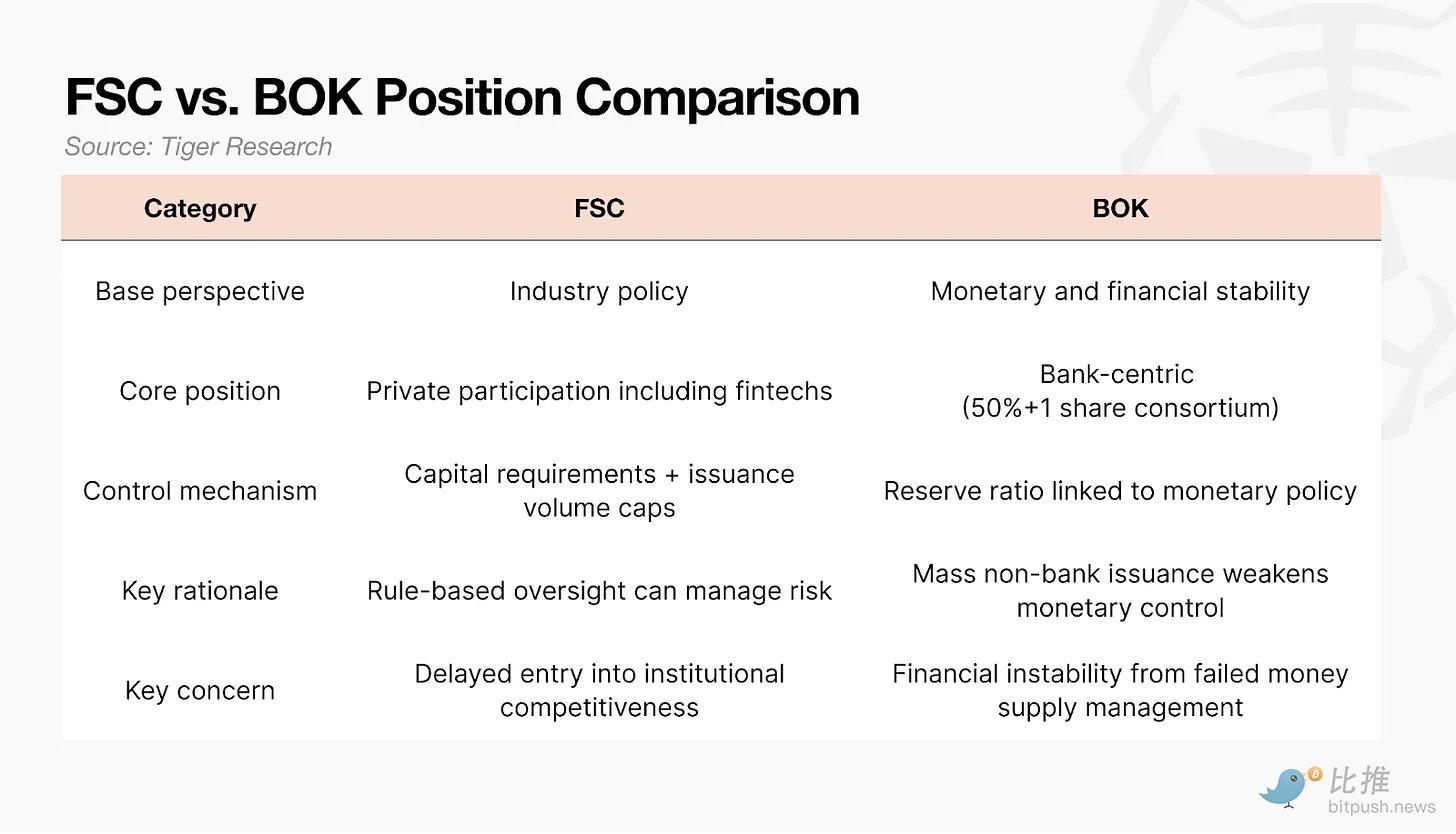
This debate is structured, not bureaucratic
This is not a simple inter-agency dispute over land. The scope of issuer qualifications will determine the basic structure of the market. Limiting issuance to banks would ensure stability but slow innovation. Opening up to fintech will increase competition, but it has not been proven whether non-bank issuers have adequate safety nets in the event of large-scale redemptions (bank overruns).
Debates are also in full swing in Congress. The substantive design of the second phase of legislation is being led by the Democratic Party's Digital Asset Working Group (TF). Since the ruling party holds a majority of seats in parliament, the working group's draft has significant weight in setting the direction of legislation, although the final bill needs to be agreed with financial regulators.
As of February 11, 2026, TF plans to hold a final meeting with members of the Advisory Committee on the 24th to determine the ruling party's proposal. TF's internal sentiment deviates from BOK's “50% +1 share” rule. TF Chairman Lee Chung-man said that the prevailing view favors designating issuers as ordinary companies under commercial law rather than requiring banks to hold 50% +1 ownership. Nine advisory committee members also raised constitutional concerns in a written opinion, arguing that retroactive restrictions on existing shareholding structures may conflict with shareholder capitalist principles.
Meanwhile, financial regulators have hinted that if they are unable to reach an agreement with the ruling party, they may pursue the “50% +1" rule through government-initiated legislation. Since government bills usually take longer to process than bills initiated by lawmakers, both sides are under pressure to negotiate. Where they find common ground will determine the structure of the Korean stablecoin market.
Case Study 1: Former Regulatory Release
Although no KRW stablecoin has received regulatory approval, projects outside the scope of regulation have proven technical viability.
KRWQ, co-developed by IQ and Frax, went live on the Base network in October 2025 as the first multi-chain KRW stablecoin. It uses Frax infrastructure (including BlackRock's BUIDL fund) to anchor the won 1:1. Minting and redemptions are limited to KYC-verified institutions such as exchanges and market makers. It does not sell to South Korean residents; the purpose is to provide KRW liquidity to the global DeFi market. The cumulative transaction volume during the first month of launch was over 1 billion won.
BDACS's KRW1 took a different approach. It holds 100% of its KRW reserves in Woori Bank's escrow account and is currently in the proof-of-concept (PoC) stage. Technical verification is carried out using internal funds only, so retail distribution and commercial transactions are not provided. However, the integration with Plume's mainnet provides an environment for developers and institutions to test KRW-based RWA payments and investments. The commercial launch is scheduled to take place after the Digital Assets Basic Law comes into effect.
Both projects are attempts to prove the viability of the KRW stablecoin technology through an offshore structure or PoC path before South Korea's regulations are finalized.
Case Study 2: Core Players Waiting for Legislation
On the regulated side, preparations for large operators have reached an advanced stage. A distinctive feature of the Korean market is that multiple players are ready to begin distribution as soon as legislation is enacted.
The most watched initiative is the Naver Pay-Upbit consortium. Naver Pay (a payment subsidiary of Korea's largest portal) and Upbit (operated by Dunamu, South Korea's largest crypto exchange) are planning to jointly issue a KRW stablecoin. Dunamu is developing a dedicated, compliance-friendly blockchain infrastructure called GIWA. The GIWA chain incorporates the authentication (Dojang) and transaction privacy (Bojagi) features required by financial institutions to support stablecoin issuance and distribution within a regulated system. Naver Financial's payment network and Naver's AI and IT infrastructure are layered on top of it.
Tech companies and exchanges aren't fighting alone. Traditional financial institutions, including Shinhan Bank (Shinhan Bank), Small and Medium Business Bank (IBK), Nonghyup Bank (NongHyup), and K Bank, are also forming their own consortiums. The final outcome of the “50% +1" rule debate is likely to change the structure and scope of participation of these consortiums, and these arrangements will remain in place until regulations are finalized.
3.5. PRC
China is the only jurisdiction covered by this report that has imposed a complete ban on private stablecoins. While Singapore, Hong Kong, Japan, and South Korea are debating the terms to allow private distribution, China has come to the conclusion that there is simply no reason to allow it. Instead, its strategy is to directly replace the stablecoin function with a digital yuan (e-CNY) issued by the central bank.
This strategy stems from the Chinese government's view of monetary sovereignty. As mentioned earlier, once the local currency stablecoin is placed on the blockchain, the exchange path to the US dollar opens. For China, which relies on capital controls as a core policy tool, this path will become an uncontrollable channel for capital flight. If the private sector issues a stablecoin anchored in the yuan, it is technically impossible to prevent the coin from being exchanged for USDT and eventually for the US dollar on offshore exchanges.
Regulation: One sentence says it all
China's stablecoin regulation does not require lengthy legislation. A notice issued jointly by ten government departments in 2021, including the People's Bank of China (PBoC), classified all virtual asset-related activities as “illegal financial activities.” As of February 2026, this position has not changed. Exchange operations, mining, and token issuance (ICOs) have all been banned, and stablecoins are no exception.
In February 2026, enforcement actions went one step further. The People's Bank of China and seven departments issued a new joint notice on “Further Preventing and Handling Risks Related to Virtual Currency”, which clearly prohibits the unauthorized issuance of stablecoins anchored to RMB at home and abroad. The key language indicates that stablecoins anchored to RMB perform a function similar to legal tender in circulation and pose a direct threat to monetary sovereignty. No entity or individual, whether at home or abroad, can issue such stablecoins without legal authorization from relevant departments.
Crucially, the notice also targets offshore issuance. Chinese companies that issue stablecoins anchored in RMB overseas, or tokenize renminbi-denominated assets through a real-world asset (RWA) structure on the blockchain, also fall within the scope of jurisdiction. Even tokens pegged to the yuan issued in Singapore or Hong Kong could result in mainland Chinese operators involved in the process facing penalties.
Offshore issued US dollar stablecoins (USDT, USDC, etc.) themselves are not classified as “illegal financial activities,” but integration into domestic payment infrastructure, including code scanning payments and online payment channels, is prohibited. In fact, there is no legal path for private stablecoins to enter China's financial system.
4. Ultimately, winning or losing comes down to speed
The problems facing the Asian market with stablecoins converge on one point: can their national currency have a place in future digital payments.
Singapore has assembled global issuers by positioning itself as a regulatory jurisdiction. Hong Kong has enacted laws but has yet to grant the first license. Japan has seen startups open the market just before banks, even within a conservative framework. South Korea has a huge player ready to go, but the debate over issuer eligibility is stalling. China, on the other hand, completely excluded the private sector and opted for direct state control. Even the leaders, Singapore and Japan, are only at the beginning of real-world application of local currency stablecoins.
Everyone agreed on the potential of stablecoins. The problem is time. The global stablecoin ecosystem is rapidly solidifying around the dollar. Infrastructure built on USD stablecoins as the base currency is rapidly emerging, such as Circle's on-chain forex platform ARC. These networks focus liquidity and use cases around the first currencies to join. Japan has entered the market through the JPYC, but South Korea, which does not have a KRW stablecoin, simply cannot participate. Joining a network after it's solidified and taking a position at the initial stage is essentially a different game.
The fact that local currency stablecoins from all over Asia account for less than 1% of the $300 billion market illustrates the problem. Most legislation will only take effect between 2023 and 2025, so this is to some extent expected. However, US dollar stablecoins have not stopped in this period. Its transaction volume has reached several times that of Visa, and use cases are increasingly expanding to B2B payments, cross-border remittance, and AI agent transactions.
As mentioned earlier, local stablecoins have the characteristics of a double-edged sword. The moment they go online, the exchange path to the US dollar opens. Without careful institutional design, the pursuit of speed alone could trigger capital outflows. That's why Asian jurisdictions are being cautious.
However, if prudence turns into delay, the position these currencies were meant to protect will disappear. Asia is building a highway for its currency. Some countries are still debating the blueprint. Some are installing guardrails and traffic lights. Even the leaders are still in test drive mode. Meanwhile, the dollar is already like a sports car speeding at full speed in the next driveway. No matter how well-repaired the road is, it's meaningless if there are no cars running on it.
Pursuing perfection isn't an option. Ultimately, winning or losing comes down to speed.
Twitter:https://twitter.com/BitpushNewsCN
Compare the TG exchange group:https://t.me/BitPushCommunity
Compare TG subscriptions:https://t.me/bitpush
