


Interpretation of 20,000 words | Stablecoins, the GENIUS Act, and the evolution of the US dollar financial structure

Source: Galaxy Research
By Thaddeus Pinakiewicz, VP of Galaxy Research
Compiled and organized by: bitPushNews
A regulated digital dollar: bringing stability to ordinary people, volatility to emerging markets, and short-term treasury bill buyers to the US
summary
If stablecoins are scaled up under the reserve constraints of the GENIUS Act, they will create continued demand for short-term US Treasury bonds, moderately reduce front-end yields, and directly feed global dollar demand into the US banking system.
Galaxy Research's comprehensive model shows that most of the stablecoin growth will come from the offshore market, which means that foreign capital will flow into the US banking infrastructure at a rate significantly faster than any domestic deposit migration. The net effect, perhaps somewhat counterintuitive, would be to strengthen rather than destabilize the dollar system.
We expect hundreds of billions of dollars of US domestic deposits to flow into stablecoin reserves, but trillions of dollars of foreign capital will enter the US banking system from overseas. We believe this will lead to a structural increase in demand for US Treasury bonds, which may reduce short-term treasury yields by 3-5 basis points, and save US taxpayers more than 3 billion US dollars a year. We predict that US credit creation will increase by 31 cents for every $1 stablecoin minted. Countries with weak institutions are most likely to be hurt by capital flows to GENIUS stablecoins.
What needs to be clear: banks will feel the pressure. Some low-cost deposits will migrate, marginal financing costs will rise, and net interest spreads for interest-sensitive business lines will be compressed. The likely outcome, however, is not a systemic credit contraction, but rather a redistribution of credit creation. Stablecoins don't destroy creditworthiness; they redistribute spreads on safe assets to different participants. Meanwhile, the US Treasury will gain a more structured buyer base in the most interest-sensitive part of the yield curve. And the dollar, which already dominates, will become easier to hold, transfer, and save globally.
When holding US credit is as simple as downloading an app, domestic savings in vulnerable jurisdictions can become uneasy.
These dynamics are likely to extend beyond the borders of the United States. Countries with weak monetary credibility, weak banking systems, or strict capital controls will face greater pressure. When holding US credit is as simple as downloading an app, domestic savings in vulnerable jurisdictions can become uneasy. GENIUS may not only strengthen the dollar system by improving it, but also strengthen the dollar system by reducing the competitiveness of other alternative systems.
According to this article, the impact of the GENIUS Act goes far beyond the level of stablecoins returning to the US and being regulated. It relates to the evolution of the dollar's economic financing structure: bank profit margins are being reduced, the Treasury's issuance flexibility has increased, the US financial system has received imported capital, and the weaker sovereign system is facing stronger competitive pressure.
The US is likely to benefit. Some banks sacrifice interest spreads. Some foreign banking systems lost deposits. Domestic and global consumers get more portable US credit claims.
backgrounds
Since its enactment on July 18, 2025, the GENIUS Act has prompted both careful analysis and more heated comments. The government described it as a strategic policy to formally establish and include dollar-denominated stablecoins within the US for regulation, expand global demand for the US dollar, and create a more structured buyer base for short-term US treasury bills. In this interpretation, the bill addresses financial infrastructure issues rather than speculative technical issues — it is about who issues digital dollars, what collateral supports these digital dollars, and who ultimately finances the operations of the US government.
Opposition has always been rather scattered. Much of the current banking industry's focus is on a narrower but significant issue: whether GENIUS compliant stablecoins should be allowed to pass interest (or rewards) to their holders. Banks believe that allowing interest-bearing stablecoins may encourage direct competition with demand deposits, which have long been a low-cost, sticky source of capital, supporting traditional loan businesses. Seen from this perspective, the core concern is financing stability: if deposits migrate to fully reserved, backed by US Treasury bonds, and in some form of benefit-sharing instruments, banks may face structurally higher financing costs or erosion of the deposit base. (GENIUS prohibits stablecoin issuers from sharing interest directly with holders, but allows exchanges to pay rewards for users to hold stablecoins on their platforms. Banks have been lobbying to ban such incentives in ongoing negotiations over the pending Clarity Act.)
The digital asset industry, on the other hand, believes that the analogy of loss of deposits has been exaggerated. They believe that interest-bearing stablecoins are similar to government money market funds: cash-like instruments that invest in short-term public debt, provide market returns, and have a limited level of intermediation. Money market funds have coexisted with the banking industry for decades. They have occasionally fallen below a dollar net worth, and this is a risk GENIUS is trying to control through reserve requirements and regulations, but they have not replaced community banks. According to crypto industry supporters, prohibiting interest transmission protection is a kind of financing subsidy rather than maintaining systemic stability.
This article does not elaborate on the details of the legislation; other agencies, including Galaxy Research, have provided sufficient institutional analysis. Instead, we'll outline the bill's key structural provisions as a background, and then focus on what really matters to the market: balance sheets, capital flows, and incentives. The core question is not whether stablecoins are beneficial or harmful in the abstract sense, but rather how they redistribute assets and liabilities within the broader financial system.
We focus on the possible financial and macroeconomic impacts of stablecoin growth under GENIUS in the US, while considering global distribution consequences. The analysis covers how stablecoin growth under GENIUS will affect short-term US Treasury bond demand and market pricing; where the capital for this increase will come from; whether it represents additional capital or deposit substitution; and what second-order effects it may have on bank financing costs, credit creation, and financial intermediation structures. Understanding these dynamics requires a comprehensive consideration of reserve requirements, stablecoin growth forecasts, deposit substitution modeling, and international capital flows. These components will be developed in the following system.
Treasury bond market impact: scale and mechanism
To assess how GENIUS is reshaping the US Treasury bond market, we started with the mechanical relationship between stablecoin growth and government debt demand. The Act requires reserve assets to meet strict standards: high credit quality, high liquidity, and short term. In fact, it should overwhelmingly steer reserve assets into short-term US Treasury bonds. The dominant offshore stablecoin issuer Tether has reported holding more than $120 billion in US short-term treasury notes, making it one of the largest holders of front-end government debt, and holds more than 90% of the world's US Treasury bonds. GENIUS formalized and incorporated this model into the US, embedding treasury demand into an asset class that has historically tried other investment portfolios — including commercial paper, gold, and other exposure to non-government instruments.
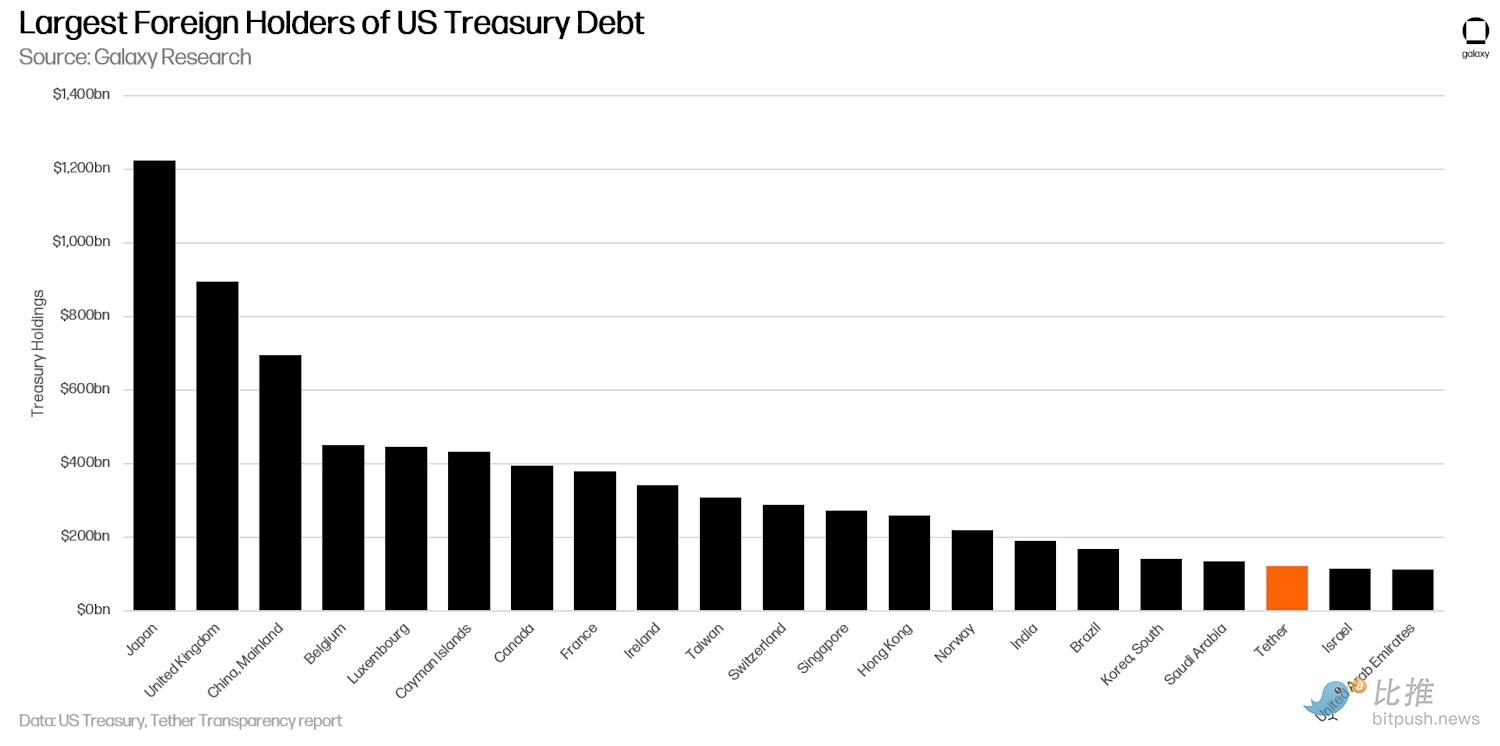
The implication is that stablecoin growth will more reliably translate into increased demand for US Treasury bonds than in the past. Each increase in the circulation of $1 in stablecoins requires the purchase of approximately $1 in short-term treasury notes in an equilibrium state and continued to be held on a rolling basis until that dollar is redeemed. Estimating its size requires three inputs: a stablecoin supply forecast for the next two to five years; an understanding of how stablecoin capital flows historically affect the treasury bond market; and a framework for converting total issuance into net incremental demand, while considering different reserve structures.
Stablecoin growth will more reliably translate into increased demand for US Treasury bonds than in the past.
Stablecoin growth forecast
The current stablecoin market capitalization is in the low range of hundreds of billions of dollars, but most institutional predictions now assume that GENIUS has created the conditions for a significant acceleration of expansion. Analysts at Citibank, Standard Chartered, Coinbase, and J.P. Morgan all point to significant growth over the next few years, but the analytical frameworks they are based on vary markedly. Some emphasize transaction growth, some emphasize substitution between competitive dollar instruments, and others rely more on statistical extrapolation of recent adoption rates. This methodological difference is important because it affects not only estimates of overall market size, but also the implied consequences for banks, treasury demand, and dollar intermediaries.
Citi's framework in its “Stablecoins 2030” paper models stablecoin growth through substitution between specific asset classes: trading deposits, savings products, money market funds, physical currencies, and offshore dollar holdings. This approach turns market size estimates into a funding source map, asking not only how large stablecoins might become, but also what forms of exposure to the US dollar they might replace. The first edition of the paper was published in April, and modelling revealed that the stablecoin supply range in 2028 was US$422 billion to US$2.3 trillion, and US$500 billion to 3.7 trillion by 2030. Citi revised the model in September. Even if the GENIUS Act was not passed, it raised its estimate of stablecoin market growth and reduced market substitution effects. The revised model predicts the benchmark stablecoin supply of $1.2 trillion in 2028 and $1.9 trillion in 2030.
Not all stablecoin growth is equivalent in an economic sense — $1 migrating from physical money means a different thing than $1 leaving commercial banks.
The importance of the Citi model lies in its structure: by distinguishing between domestic deposit substitution, migration from currency-like market products, and incremental offshore adoption, Citi provides a bridge between growth forecasting and downstream bank financing and credit effect analysis. This will become important later in this article because not all stablecoin growth is equivalent in the economic sense — the $1 that migrates from physical money has a different meaning than the $1 that leaves commercial bank demand deposits. Citi frames are the most useful tool for capturing this difference.
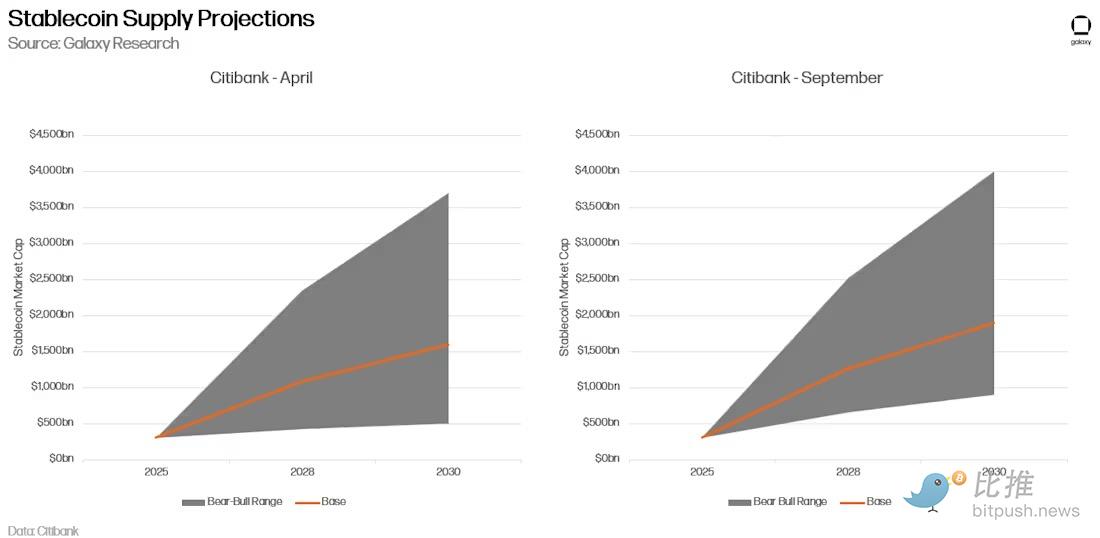
Standard Chartered's “Stablecoins, USD Hegemony and UST Bills” probably provides the most expansionary predictions, including the $2 trillion figure often quoted in US Treasury reviews. The Bank of England's argument begins with an observed momentum: prior to GENIUS, the stablecoin supply had grown at an annual rate of around 50%. After the announcement of GENIUS, Standard Chartered expects the annual growth rate to accelerate to around 100%, keeping pace with the continued expansion of trading activities related to crypto exchanges. Under this scenario, the total monthly stablecoin transaction volume will rise from about 700 billion US dollars to about 6 trillion US dollars by the end of 2028, increasing the share of stablecoins in foreign exchange spot activity from about 1% to about 10%. The key assumption in the Standard Chartered model was that the trading volume would need to expand linearly in sync with the stablecoin supply to provide support, and that the stablecoin circulation rate would generally remain the same (the team later softened this assumption). Combining these two assumptions means that the transaction growth shown in the modelling will require an increase in the outstanding stablecoin supply from about $230 billion to about $2 trillion to support related trading activities, which means that marginal stablecoin issuance will be around $1.6 trillion by 2030. The Bank of England's researchers did not list a bear or bull market scenario beyond their core predictions. As a result, the Standard Chartered model is more of a transaction-driven large-scale argument rather than a model of substitution between financial categories.
Coinbase's “New Framework for Stablecoin Growth” uses a random framework, extrapolates from past growth, and places more emphasis on the growth mechanism formed after 2024 under the leadership of a crypto-friendly president. It sees the current environment as a structural breakdown in which regulation, institutional legitimacy, and product integration have fundamentally changed adoption dynamics. This led to a stablecoin supply benchmark scenario of around $1.2 trillion by 2028, with a bear-bull market ranging from $975 billion to $1.4 trillion. Coinbase has the most optimistic bear market adoption scenario, with stablecoins growing at a CAGR of over 100% until 2028. Coinbase hasn't modeled growth after 2028, but based on extrapolations from its predictions, we estimate that the crypto exchange model will place the 2030 stablecoin supply between $1.4 trillion and $2.2 trillion.
J.P. Morgan's model is the most restrained and easiest of all major bank predictions. It is a conservative check and balance in this set of predictions. It assumes a steady monthly expansion of the stablecoin market of about 2% to 3%, and predicts the 2028 stablecoin supply range of 500 billion to 750 billion US dollars; if extrapolated to 2030, the range is 630 billion to 1.05 trillion US dollars.
Finally, BPI (the Bank Policy Institute, not the Bitcoin Policy Institute) uses an extremely bullish “demand” figure of $4 trillion to $6 trillion to frame the potential impact of yield stablecoins under GENIUS — the bullishness here is from the perspective of the crypto industry, not from the perspective of the industry organization. Based on the April 2025 US Treasury Borrowing Advisory Committee (TBAC) report, BPI's forecast takes a broad view of the addressable market and actually assumes that all non-interest-bearing current deposits may be exposed to stablecoin substitution. This gave rise to a headline figure of around $6.6 trillion in deposits at risk — more than 50% higher than the most optimistic predictions for the total crypto industry, and equivalent to about one-third of total US bank deposits.
The more serious predictions in the BPI analysis were then deduced through the Baumol-Tobin model, a simplified framework where consumers optimize between transaction balances and interest-bearing savings. The mechanical application of this setup could generate much larger outflow estimates — up to about $4 trillion if stablecoins were allowed to pass interest to token holders. These numbers are useful in direction as a stress test, but they should be treated with caution. The Baumol-Tobin framework relies heavily on assumptions, and empirical support is mixed when it is used as a literal forecasting tool rather than as an illustrative model of monetary demand.
Using Baumol-Tobin as a quantitative predictive tool for stablecoins is untenable because several of the model's core assumptions are unlikely to hold true. Stablecoins aren't just used as a medium of exchange; they also act as collateral for transactions, a cross-border store of value, and a savings instrument. Transaction costs are neither fixed nor stable; they change with network fees, congestion, and market structure. Similarly, stablecoin yield is not a clean, risk-free interest rate for a currency in the traditional sense; it is a type of return affected by interest rate and liquidity risk.
The BPI paper describes a deliberately harsh and most painful scenario, with the intention of emphasizing the upper bound of potential pressure on the banking system.
Contemporary micro/structural evidence from top economic journals supports the logic behind this model, but also suggests that once withdrawal/payment techniques, widespread marginal adoption, and preventative/random motivations are incorporated into the model, effective interest rate elasticity may be significantly lower than Baumol—Tobin's 0.5 benchmark. As BPI itself points out, random cash management models such as Miller—Orr mean lower interest rate sensitivity than Baumol—Tobin. Properly understood, however, this is not a reasonable benchmark scenario; it is a deliberately harsh and most painful scenario, intended to emphasize the upper bound of potential pressure on the banking system.
As a result, the premise of BPI is too broad to bear too much weight as a realistic prediction. Assuming that all stablecoin growth comes entirely from Bank of America deposits, or that every dollar of non-interest-bearing demand deposits will migrate to yield-based digital dollars, this is unbelievable. This view ignores other domestic sources of funding, and more importantly, the huge pool of international demand that has historically driven stablecoin adoption. To be fair, the US Treasury did not take the full $6.6 trillion figure as its expected result. Instead, its working market size assumption is Standard Chartered's $2 trillion forecast for 2028, while the larger figure is just an illustrative scenario.
Taken together, these frameworks provide a range of possible outcomes rather than a single definitive answer. Even lower-end predictions mean that stablecoins will continue to expand at an alarming rate, with annual supply increasing by around 40%; the most aggressive models assume growth to well over 100% per year. The 2028 stablecoin supply estimated from this is about US$420 billion to US$970 billion in a bear market scenario, US$625 billion to US$1.2 trillion in the benchmark scenario, and US$750 billion to US$2.5 trillion in a bull market scenario.
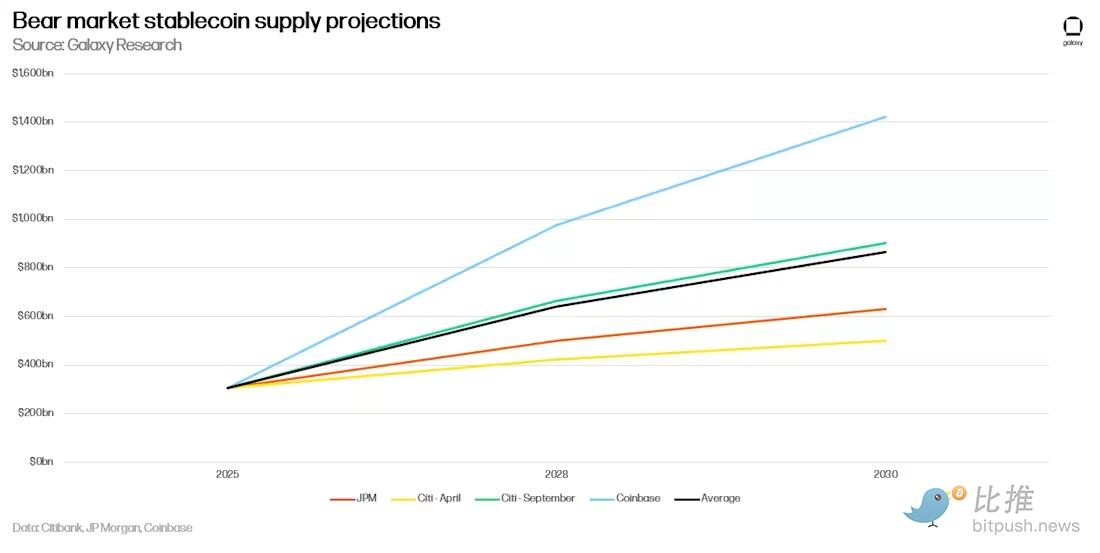
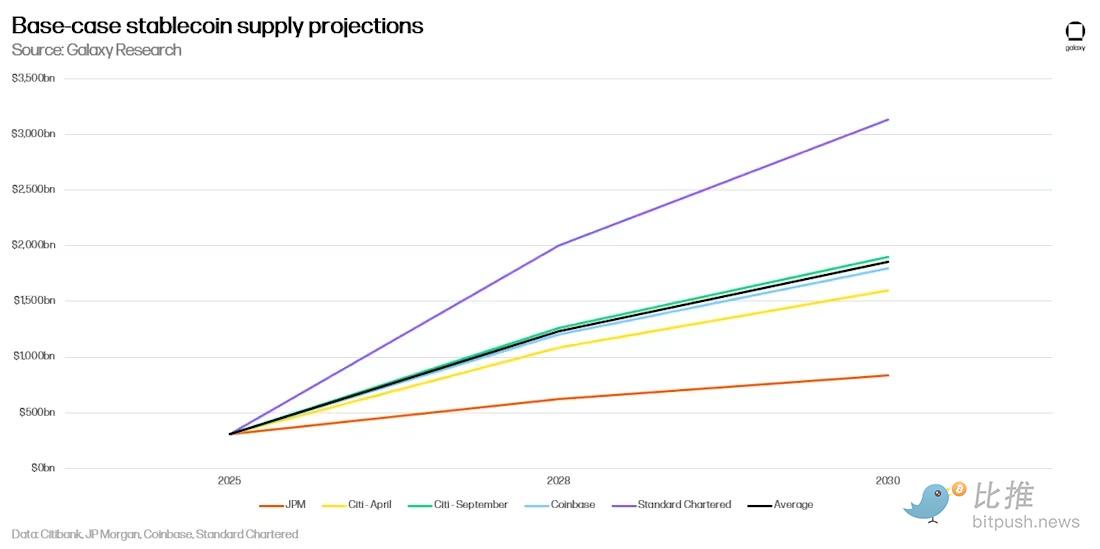
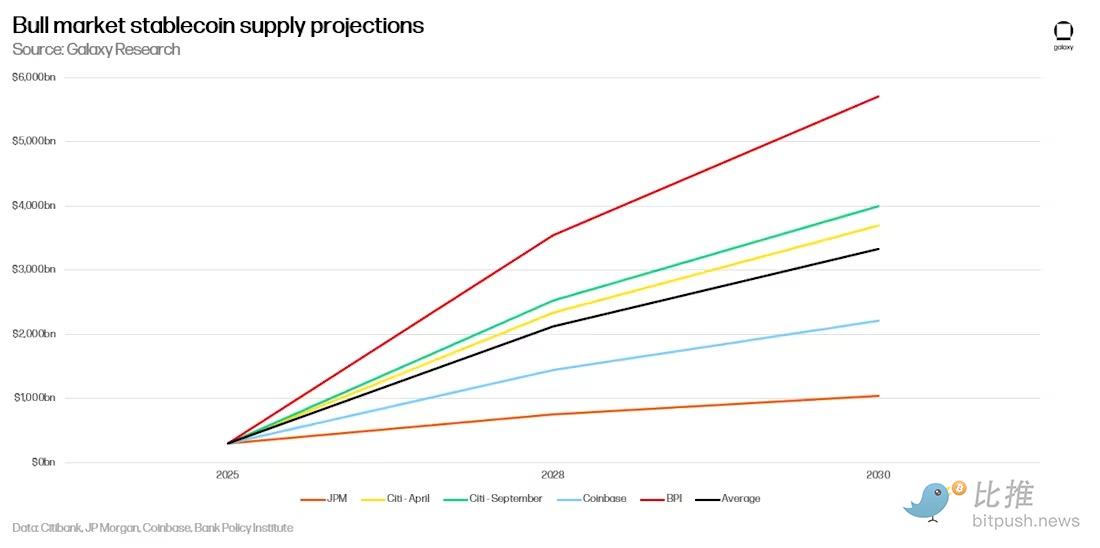
By 2030, this level of dispersion will be even more pronounced. The forecast range for a bear market scenario is about 500 billion US dollars to 1.4 trillion US dollars, the benchmark scenario is estimated to be 830 billion US dollars to 3.1 trillion US dollars, and the results for the bull market scenario are about 1 trillion to 4 trillion US dollars. To illustrate the rest of this article, we use the assumption that stablecoin supply is $1 trillion in 2028 and $1.5 trillion in 2030. These numbers are on the conservative end of the baseline scenario, and therefore provide a reasonable basis for further analysis.
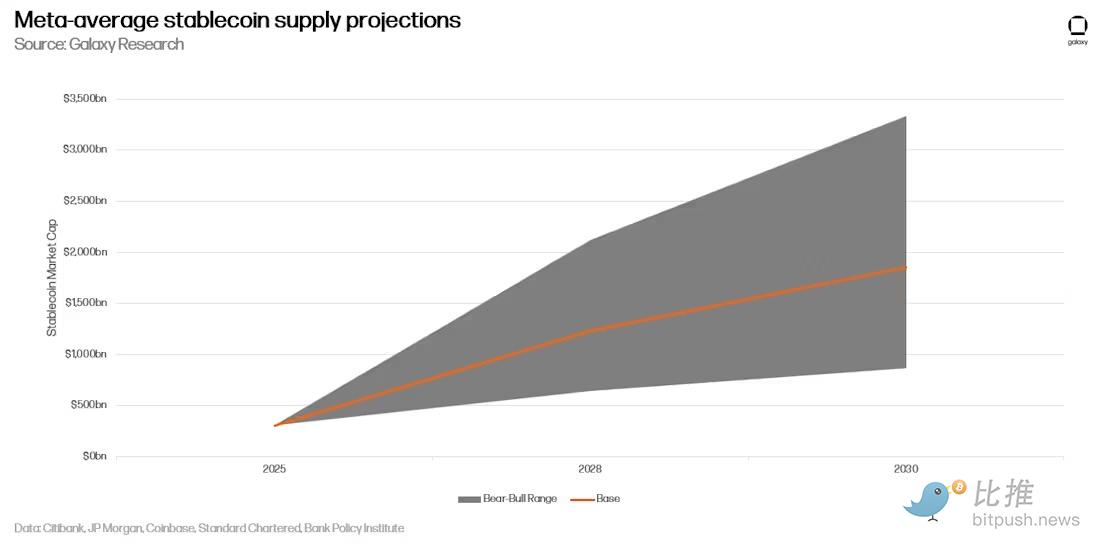
Whichever model is chosen, the common denominator is that GENIUS is viewed as a meaningful accelerator — whether by reducing regulatory uncertainty, expanding institutional participation, improving payment utility, or making stablecoins more credible as a global dollar product. But the methodology is important: a market expanding to $1 trillion through offshore adoption and trading means something very different to the economy than a market of the same size by replacing domestic bank deposits. That's why the analytical structure behind predictions is at least as important as the headline numbers.
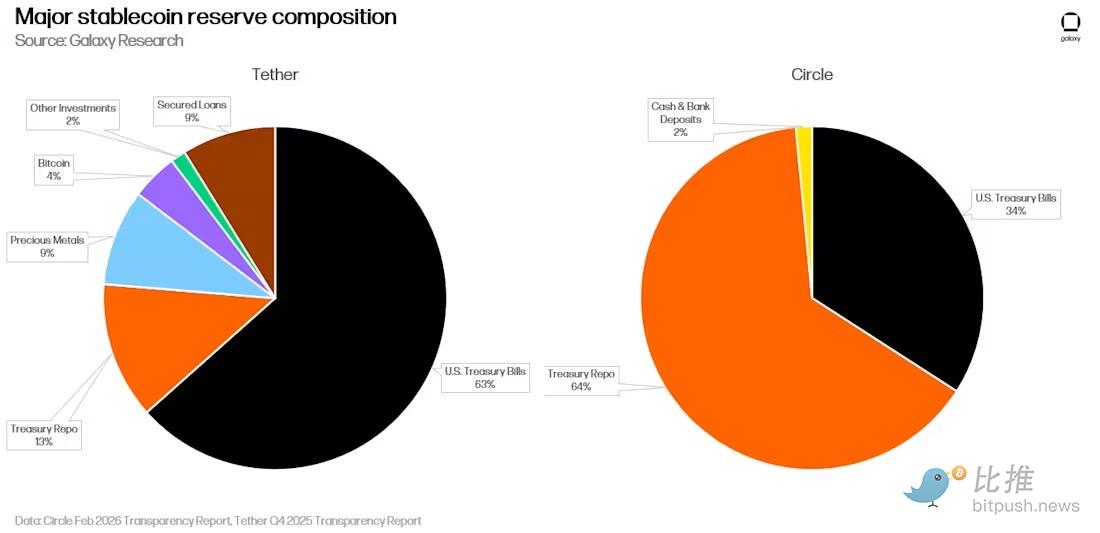
From the overall supply estimates above, how much increase can we expect to see in the US short-term treasury bill demand? Although part of the answer depends on stablecoin issuers' discretion in choosing reserves, the reserve composition requirements under GENIUS will structurally limit reserves to a few asset classes.
Today, the composition of reserves of different stablecoin issuers varies quite a bit. Circle's USDC holds the vast majority of its reserves — about 97% or more — in US Treasury bonds and cash equivalents, while Tether's USDT historically maintained a relatively loose mix, with significant exposure to Bitcoin, gold, secured loans, and commercial paper at various times. In the early years, Tether was highly biased towards riskier investments. In 2021, only about 25% of its portfolio was short-term treasury bonds, but now it is mature, with short-term treasury bills and cash equivalents accounting for nearly 75% of the portfolio.
The GENIUS Act aims to drastically reduce this reserve gap by replacing issuers' discretion with statutory reserve classifications. Section 4 of the Act requires approved payment stablecoin issuers (PPSI) to maintain identifiable reserves on at least a one-to-one basis and limit reserves to a strictly defined set of assets: US currency; funds held in the Federal Reserve Bank; current deposits held in depositary institutions; US short-term treasury notes or notes with a remaining period of 93 days or less; overnight US Treasury bonds that support repurchase and reverse repurchase positions; government money market funds that invest only in these instruments; and approved tokenized equivalents.
From an actual portfolio perspective, this means that new releases under Genius will be more like Circle's reserve structure rather than Tether's historical portfolio. Even if reserves do not exist in the form of direct holding of short-term treasury notes, the law will direct issuers to economically neighboring instruments: overnight US Treasury bond repurchases, reverse repurchases of US Treasury bonds, or government money market funds, which themselves hold the same narrow category of safe assets. Considering direct holdings of US Treasury bonds, as well as the permitted repurchase structure and US Treasury exposure embedded in the government's monetary fund, it is assumed that 85% to 95% of incremental reserves will end up in short-term government bonds, which is very consistent with this legal framework and current standards for US domestic stablecoins (USDC for Circle, USD1 for World Liberty).
Applying this to the above growth forecast means that there will be significant demand for US Treasury bonds in almost all forecast scenarios. Even the weakest bear market scenario would bring about $162 billion in incremental demand for short-term government bonds, while the most aggressive bull market scenario would mean demand close to $3.5 trillion. The indicative stablecoin supply we have adopted — $1 trillion in 2028 and $1.5 trillion in 2030 — means that short-term treasury bills will receive approximately $600 billion in additional structural demand by 2028, and $1.2 trillion by 2030.
The market is not facing occasional reallocations, but rather structurally embedded reserve requirements. As long as stablecoins remain outstanding, the corresponding safe asset stock must be held, rolled, and replenished. Then the next question is scale: how large is the expected buying compared to the current short-term treasury bill market, and how easy is it for the US Treasury to expand supply to accommodate it?
Eligible markets
Currently, about $6.8 trillion of short-term treasury bills are outstanding, of which approximately $4.8 trillion will expire within 93 days — this is a term bucket related to GENIUS collateral eligibility. This defines the actual investable universe. Regardless of the supply model chosen, stablecoin issuers will become one of the largest concentrated holders of government bonds under 93 days, falling behind money market funds (which have short-term holdings of about $2.6 trillion), but are likely to exceed the allocation of every foreign official and private institution within this period.
In addition to short-term treasury notes, there are also significant amounts of interest-bearing US Treasury bonds (medium-term notes and long-term bonds) that roll into the ≤93 day maturity window every month. The supply of these qualifying securities can be calculated directly from the US Treasury's Public Debt Monthly Statement (MSPD). At any point in time, approximately $600 billion to $700 billion was outstanding. The effective supply of US Treasury bonds that stablecoin issuers can obtain includes both the issuance of existing short-term treasury notes and the stock of these interest-bearing bonds that are nearing maturity. However, records have shown that there is a liquidity premium between running Chinese bonds and non-operating Chinese bonds, which means that stablecoin issuers may avoid short-term interest-bearing treasury bonds. Whether interest-bearing treasury bonds are included or not, stablecoins absorb a measurable portion of shortest-term government bonds.
A natural question is whether the market can absorb demand on this scale without significant distortions. The answer is probably yes, but not passively yes. The front end of the US Treasury bond curve was sometimes traded at extremely expensive levels, and short-term treasury yields occasionally fell below zero. At that time, demand for the safest and most liquid collateral overwhelmed available supply. If GENIUS compliant stablecoins generate large, price-insensitive reserve purchases, the same dynamic may reoccur on the margins: not because the treasury bond market stops working, but because front-end marginal buyers are less sensitive to yield and are more bound by regulation and product design. To put it bluntly, stablecoin issuers may sometimes have to pay the Treasury rather than the Treasury to get the privilege of parking their funds.
In practice, however, the Ministry of Finance is unlikely to let this demand go unmet. If structured embedded purchases are formed in short-term treasury bills and other very short-term government bonds, the Ministry of Finance will have strong incentives to issue more debt to this demand, especially if doing so reduces financing costs and increases flexibility in refinancing maturing debts. This is important because the government clearly has reason to prefer at least some of the additional financing to be completed on the short end of the curve, rather than focusing the adjustments on longer-term issuance. Short-term treasury bills are cheaper, easier to expand rapidly, and are more suitable for the period when demand is most concentrated on the front end. As long as stablecoin reserves grow to create a continuous buyer base for these periods, it may make financing methods that focus on short-term treasury bills more attractive than they were originally. This reinforces the Treasury's stated preference in its quarterly refinancing statement to meet expanded financing needs through short-term note issuance rather than locking in longer-term borrowing costs.
Importantly, this scenario is consistent with the broader direction of the Ministry of Finance's financing strategy. The Ministry of Finance has indicated that it is willing to increase financing through short-term treasury note issuance to avoid driving up mortgage costs through increased bond issuance. This position suggests that supply will expand to meet incremental demand, rather than let demand for stablecoin collateral drive up the price of US Treasury bonds and reduce yields. Therefore, the most likely outcome is not a short-term treasury bill market that has been in short supply for a long time, but a larger front-end market supported by increased issuance and a structured buyer base. The key implication is not that stablecoins will disrupt the short-term treasury bill market, but rather that they may help reshape the market, making the short end of the yield curve a more central channel for direct feedback into sovereign financing for digital dollars.
Yield impact
The expected flow of funds from GENIUS compliant stablecoin issuers is substantial compared to the addressable market. How much impact is this incremental demand expected to have on US Treasury yields? Both the Bank for International Settlements and Coinbase have studied the historical situation of drastic changes in stablecoin supply and their impact on the short end of the US Treasury curve. Their approach is largely similar: isolating high-standard stablecoin supply changes, reverting these changes to short-term US Treasury yield changes over the same period, and controlling broader interest rate fluctuations, liquidity conditions, and specific shocks to the crypto market.
According to these studies, researchers at both institutions estimated the short-term elasticity of short-term treasury note yields — that is, the response of stablecoin supply shocks to about 10- and 30-day yields. Measured in base points, the magnitude is moderate but measurable. Historically, weekly inflows of stablecoins with a standard deviation of two times (about $3.1 billion) will cause three-month short-term treasury note yields to tighten by 2.5-3.5 basis points, and by 5 to 8 basis points during periods when short-term treasury notes are scarce. One modelling difference is worth noting: the BIS framework suggests that continuous capital flows have a more lasting impact, while Coinbase introduces an autoregressive component, implying that the US Treasury bond market will return to average as prices are cleared and technical factors are adjusted. Which hypothesis dominates depends on whether stablecoin demand is episodic or structural. The structural requirements seem more reasonable under GENIUS, so we'll use this assumption below.
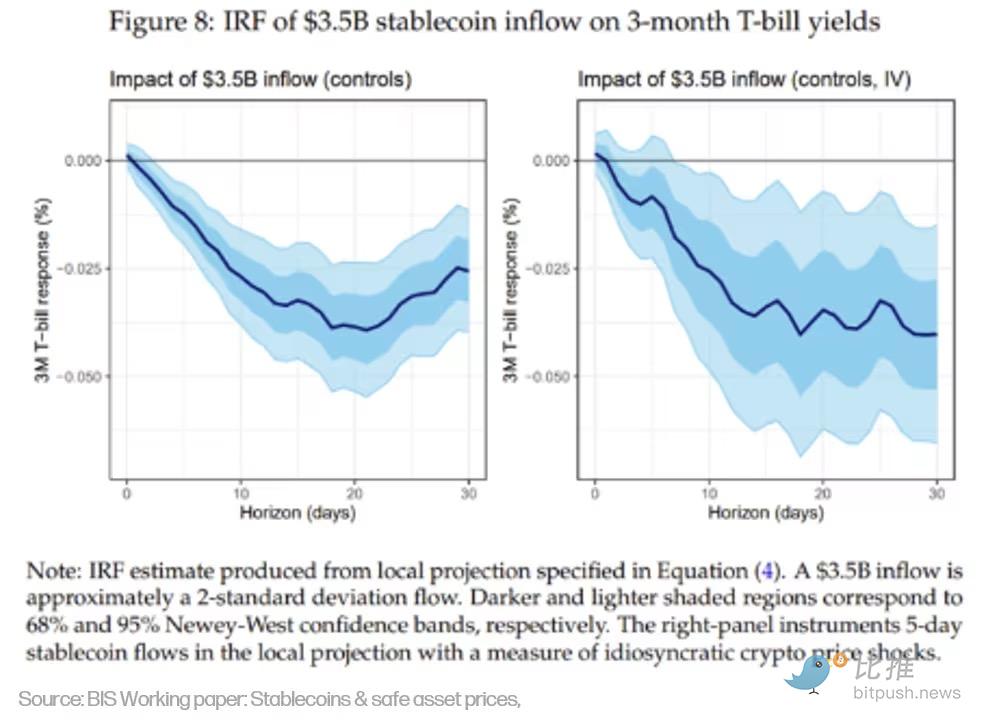
One important modelling difference is that future stablecoin growth under GENIUS should not only use historical reserve composition to map US Treasury bond demand. Compared to the composition observed in the early stablecoin cycle, the bill is likely to increase the proportion of US Treasury bonds and closely related government instruments held in reserves. To reflect this change, we have adjusted the model to reflect the expected higher US debt load for reserves in line with GENIUS regulations. Specifically, we applied a multiplier of about 1.2 times for US Treasury purchases implicit in the issuance of new stablecoins, representing an increase in marginal US Treasury bond collateral support compared to historical reserve portfolios.
Using our conservative supply assumptions — $1 trillion in 2028 and $1.5 trillion in 2030 — the implied impact is mild but measurable: by 2030, 30-day short-term treasury note yields will shrink by about 3.0 to 4.4 basis points, and close to 10 basis points during a period of tight supply in the secondary market. Under a more bullish scenario, particularly in the BPI deposit substitution framework, the impact rose to around 14 to 20 basis points.
The front end of the curve is still anchored by the Federal Reserve's policy interest rate, but interest spreads — short-term treasury bills versus overnight index swap (OIS) interest rates, short-term treasury bills versus general collateral (GC) repurchase rates — and the relative cost between nearby terms are shaped by capital flows, scarcity of collateral, and traders' balance sheets. A buyer who is not sensitive to structured prices, must hold short-term treasury notes, and cannot pursue returns through private credit or longer-term assets should continue to exert downward pressure on extremely short term premiums and maintain stronger demand for the highest-quality collateral in the system. Furthermore, these historically sensitive estimates may underestimate future effects. As long as stablecoins grow faster than qualified reserves support the growth of US Treasury instrument stocks, a given stablecoin supply shock will represent a larger share of demand shock compared to the investable market. We are not trying to quantify this second-order effect here, but in terms of direction, it means that the elasticity measured in the literature may be conservative.
At the same time, there is an important counterforce: if demand for reserves becomes structurally embedded, the Treasury is unlikely to passively allow continued scarcity formation. If demand for short-term treasury notes increases significantly, the government has the ability and incentives to expand supply at the front end, especially if this reduces marginal financing costs and supports refinancing flexibility. Therefore, the most reasonable outcome is not a permanent shortage of food in the short-term treasury bill market, but rather a dynamic adjustment: stronger stablecoin demand drives front-end valuations to become more expensive, while the issuance of front-end US Treasury bonds expands to absorb some of the pressure. The practical implication is that these yield effects should be viewed as directional and conditional. They are likely to capture the existence of a real compressive force, but may underestimate their overall impact under scarce mechanisms, or overestimate their lasting net impact if the Treasury responds by actively increasing supply.
This represents a gentle but not negligible change. As a background, 5 basis points on the Treasury's $6 trillion short-term treasury note portfolio is equivalent to reducing borrowing costs by 3 billion US dollars per year. After scaling up, GENIUS created long-lasting, inelastic purchases in the part of the US government's most frequently rolling debt, helping Washington borrow capital at a slightly cheaper cost.
Funding Sources and Deposit Trends
Stablecoin growth only tells half of the story: it shows how demand for US Treasury bonds changes when issuers reallocate reserves to short-term treasury notes under GENIUS restrictions. What is more important and more controversial is the supply side.
Every dollar purchased through an issuer that complies with GENIUS regulations must come from elsewhere on the financial system's balance sheet to replace its previous use, whether in bank deposits, monetary funds, or loans provided to the real economy. The key difference is whether this dollar represents new capital entering the US banking system — offshore savings, physical cash, foreign exchange — or a replacement from sources such as bank deposits and money market funds.
If these flows bring new deposits into the US banking system rather than simply reallocating existing deposits, the impact of stablecoin issuance is largely incremental. The banking system received $1; stablecoin issuers then reallocated it from deposits to short-term treasury notes. Stablecoins act as a conduit, first introducing new or former external dollars into the US financial system, and then introducing government financing. Even if part were to migrate to stablecoin-related reserves, the banking system's total deposit base would still grow.
If stablecoin growth were mainly funded by replacing existing bank deposits, the dynamics would be significantly different. In this case, the US banking system did not receive dollars; it actually replaced Bank A's $1 current deposit debt (stablecoin buyer's account) with Bank B's $1 deposit liability (treasury bond seller's account, assuming that it is a US domestic entity), while at the same time shifting the corresponding assets from private credit creation to holdings of US Treasury bonds linked to stablecoin reserves.
Deposit losses are likely to be heterogeneous among banks, and are difficult to predict accurately, but for banks that have experienced losses, the secondary effects are not difficult to determine. Banks that lose low-cost deposits must shrink their assets, replace those deposits with more expensive wholesale financing, or compete more actively on deposit interest rates.
Every path has consequences for credit creation. Shrinking assets means fewer loans. Replacing deposits with wholesale financing reduces net interest spreads and may create a weaker debt structure. Higher interest rate competition raises financing costs, which are passed on to borrowers and reduce profitability.
Modelling this redistribution and its impact on credit creation requires more in-depth exploration of the alternative frameworks used by Citi and some details in Standard Chartered's foreign/domestic sources estimates.
Alternative Modelling Frameworks
To answer the question of how much US bank deposit loss we can expect, we must go beyond the overall supply forecast and examine the sources of demand for stablecoins.
Citi's Stablecoins 2030 framework is inspiring. It doesn't view stablecoin growth as an exogenous variable, but rather models alternative behaviors — the tendency of investors and households to reconfigure between similar products based on relative returns, convenience, and regulatory treatment.
Genius compliant stablecoins are economically close to several major types of assets: trading deposits such as checking accounts; savings accounts; government money market funds (especially where interest transmission is permitted); physical currency; and marginally, foreign currency held by investors who want to gain exposure to the US dollar. Not all alternatives are equally important to bank financing. Transfers from physical money are largely irrelevant; banknotes do not finance bank loans. Transfers from non-interest-bearing demand deposits are highly relevant. The transfer from government money market funds represents an internal restructuring of the US Treasury bond buyer base and does not affect bank deposit financing. Transfers from commercial bank trading accounts directly increase bank financing costs.
In the best case, stablecoin creation could attract trillions of dollars of liquidity into the US banking system; in all but the worst-case scenarios, it would simply rearrange US credit creation rather than eliminate it. Although we use Citi's broad substitution and market share estimates to inform the model, the subcategories are largely unrelated except for two sources: Bank of America deposits, and all other sources. Under our benchmark model, approximately 70% of new stablecoin reserves must come from US domestic deposits for credit contraction to occur. Under the more unfavorable assumption that stablecoin reserves are less likely to be recycled by banks and the cost of financing wholesale deposits is higher, the inflection point of credit decline occurs when more than 45% of all new stablecoins come from US bank deposits. The economic question is whether there is more cash entering stablecoins away from low-cost deposit financing than new cash entering the system. This answer will determine the net effect on US credit conditions.
Distribution of regions and components
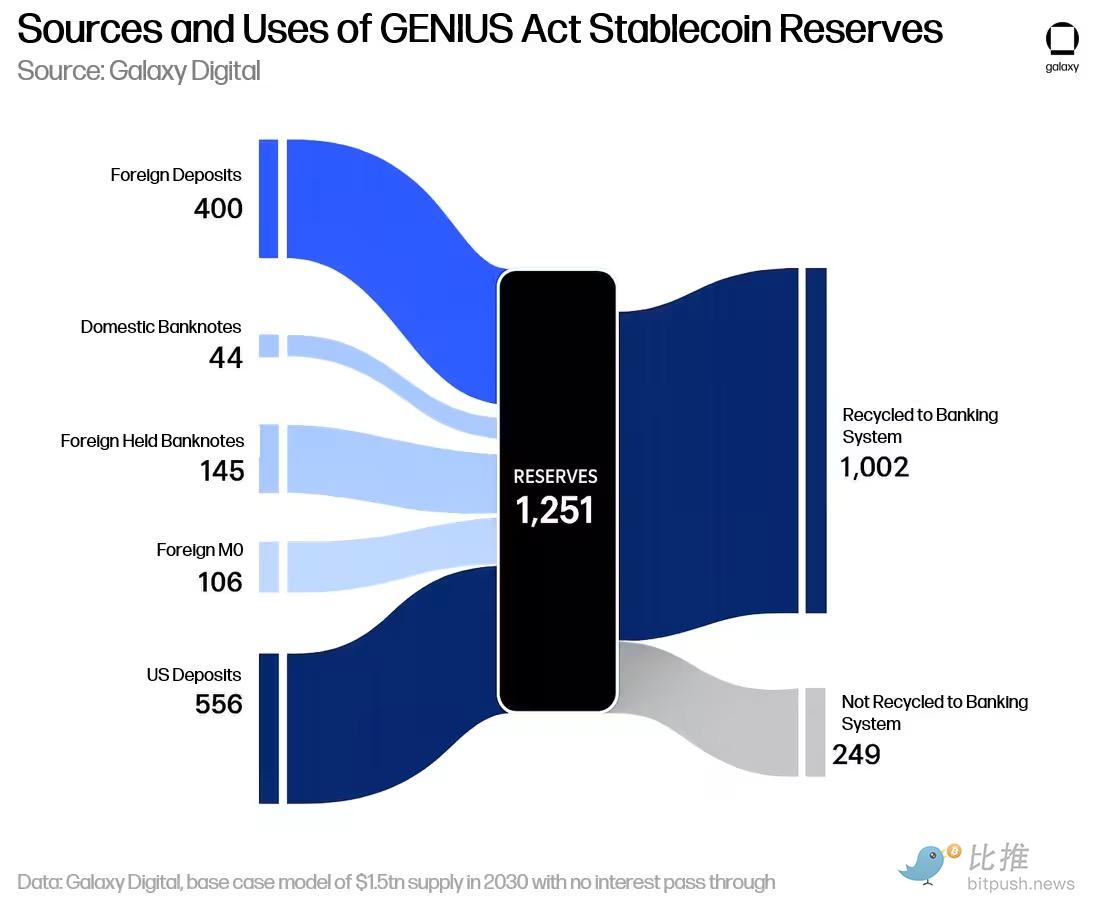
The geographical composition of stablecoin funding sources is a key factor in determining whether GENIUS will eventually become a boon for the US economy as a whole, or simply restructure the US lender structure. Citi's alternative framework is useful here because it estimates which asset pools are most likely to be converted to stablecoins. In Citi's benchmark setting, about one-third of the incremental stablecoin growth came from Bank of America deposits, and the rest came from other sources, including physical money (12%), money market funds (10%), and — crucially — foreign capital (33%).
This difference is important because not all stablecoin growth has the same balance sheet effect. If issuers are allowed to deliver most of the underlying income, the Citi framework allows deposits and money market funds to move more significantly, drawing on the historical analogy of market share achieved by high-quality and government money market funds. In this scenario, stablecoins are not only more competitive as a payment tool, but also more competitive as a savings tool because they combine transaction utility with market-linked returns.
Standard Chartered expanded the analysis by clarifying international components. Its framework assumes that around 70% of stablecoin demand comes from offshore markets, an estimate consistent with Citi's emphasis on foreign and domestic sources of growth. According to this interpretation, every dollar that leaves a US bank deposit may be offset by many dollars or even more from overseas, whether these funds come from remittance needs, capital fleeing from less stable jurisdictions, cross-border treasury management, or dollar savings in economies with limited banking channels.
This difference is decisive for credit modelling. If stablecoin growth is mainly domestic replacement, deposits will be transferred from traditional commercial banks to stablecoin issuers' reserve accounts without increasing the bank's total debt. If growth is mainly foreign inflows, then the new dollar is actually imported into the US banking system before being reallocated to US Treasury bonds. The former scenario implied pressure on profit margins and potential credit contraction; the latter scenario meant redistribution of profit margins from smaller US banks to global systemically important banks (GSIB).
Regulatory processing and credit developments
Federal Reserve economist Jessie Jiaxu Wang's research provides a useful framework for thinking about how stablecoin growth affects deposits, credit creation, and broader financial intermediation. The framework does not see stablecoins as a simple replacement for bank deposits, but rather splits the credit effect into several different inputs: the size of total migration from bank deposits; the lending capacity associated with these deposits; the proportion of stablecoin reserves being recycled back into the banking system; changes in the bank's total financing costs as deposit composition changes; and any exogenous capital entering the system from overseas or other non-bank sources. This structure is particularly useful here because it forces the analysis to shift from headline market size to the specific channels stablecoins can change banks' balance sheets.
The first input is the size of the total migration from bank deposits. This is the most prominent channel, but it's not necessarily the most important when viewed alone, because what matters is not only how many deposits left, but also what kind of deposits left. Not all deposits are economically equivalent. Retail deposits are generally cheaper and more sticky than wholesale deposits (including stablecoin reserves), support higher balance sheet leverage under liquidity coverage (LCR) requirements, and enjoy more favorable treatment under a net stable funding ratio (NSFR); NSFR imposes higher stable funding requirements on wholesale deposits compared to retail deposits. Wang stressed that even if total deposits do not drop drastically, changes in deposit composition may reduce the effective lending capacity of the system.
The second input is the deposit multiplier, or more accurately, the extent to which changes in deposits translate into changes in credit supply. This is not a textbook currency multiplier exercise, but rather an empirical relationship based on how to deal with financing shocks in banking practice. Wang cites research from Kundu, Park, and Vats (2025) who estimate that for every $1 drop in deposits, loans will be reduced by $1.26. This relationship allows the model to estimate the corresponding credit effects of a given bank deposit outflow. We used 1.26 in the study as the benchmark deposit multiplier, with a minimum value of 1 (assuming bank deposits create credit) and a high value of 1.5 for our pressure range, respectively. The deposit multiplier is a key model input because it determines not only the relative size of the decline in credit from bank deposits in the US, but also the size of the credit supply brought about by dollars entering the banking system from elsewhere. The net effect of these changes really determines the net credit impact of the GENIUS Act.
The third input is reserve recycling. Dollars entering stablecoins do not necessarily disappear from the financial system; a significant portion remains in bank deposits, escrow balances, brokerage treasury accounts, repurchase arrangements, or government monetary funds. Therefore, the relevant issue is not total deposit replacement, but net replacement after considering the proportion of reserves that continue to flow through banks and market intermediaries. Wang's framework emphasizes the importance of this parameter, but does not fix a single recycling estimate.
The fourth input is the change in total financing costs. Even if stablecoin reserves are kept somewhere within the banking system, they are not equivalent to traditional consumer deposits. Stablecoin-related deposits are concentrated in fewer institutions, may be more sensitive to interest rates, and are more likely to flow out quickly in stressful situations. Because of this, banks that rely on these funds for financing may need to hold more liquid assets and run shorter balance sheets to reduce term transitions and reduce net interest spreads. In other words, the question is not only whether the money remains in the system, but also whether it remains in the system in a form that supports credit creation as efficiently as before.
Taken together, these channels mean a meaningful but highly hypothetical credit effect. Wang's framework shows that for every $100 billion of net deposit lost that is not recycled back to the bank, bank loans may shrink by about $60 billion to $126 billion. This range is best understood as an upper limit estimate in a domestic alternative scenario: it helps define credit contraction risk, but it does not cover all financial flows into and through the banking system.
Therefore, a key modelling step is to specify more clearly the recycling of reserves. Wang's report did not directly estimate this parameter, but GENIUS drastically reduced the reserve asset menu, limiting it to bank deposits, short-term treasury bills, short-term government instruments, certain repurchase structures and closely related safe assets, which strongly suggests that most reserves should remain in the broader US financial system. Based on this, combined with our observations of Circle's USDC reserves, we assume that approximately 75% to 85% of stablecoin reserves will be effectively recycled to banks or market intermediaries.
Once reserve recycling is introduced, our model becomes more sensitive to funding sources. In a purely domestic substitution scenario, the impact on credit is still negative, but far milder than the upper limit: traditional bank outflows are partly offset by the fact that a large reserve base remains somewhere in the financial system and continues to support at least some intermediary activity. For every $100 billion transferred from traditional bank deposits, our model means that loan capacity shrinks by about $38 billion, even when considering partial reserve recycling.
When foreign inflows were added, the results changed even more markedly. According to the Standard Chartered Framework, about two-thirds to 70% of incremental stablecoin demand comes from offshore sources, which means that for every dollar that leaves a domestic bank deposit, more than one dollar may enter the US financial system from overseas. Under this arrangement, total deposits may rise even if the deposit structure becomes less beneficial to the bank's profitability. The Citigroup framework points in the same direction: even under higher substitution scenarios, only about one-third of the incremental growth came from US bank deposits, while most came from foreign demand and other non-deposit sources.
For every dollar that leaves a domestic bank deposit, more than one dollar may enter the US financial system from overseas.
This difference lies at the heart of this paper's conclusion. If, as in most aggressive bank lobbying scenarios, it is assumed that stablecoin growth is almost entirely funded by US demand deposit replacement, the impact on credit is negative and likely to be severe. But once GENIUS reserve recycling and offshore demand dominance are taken into account, the picture will change. Domestic savings are shrinking marginally, which will indeed reduce the supply of credit, but new inflows of foreign countries and recycling of reserves not only offset the contraction, but have surpassed it. The result was not a complete contraction of the US banking system, but rather growth and reorganization of its financing base: less reliance on cheap retail deposits, higher reliance on concentrated reserve balances, lower profit margins, and a greater role in the demand for imported dollars.
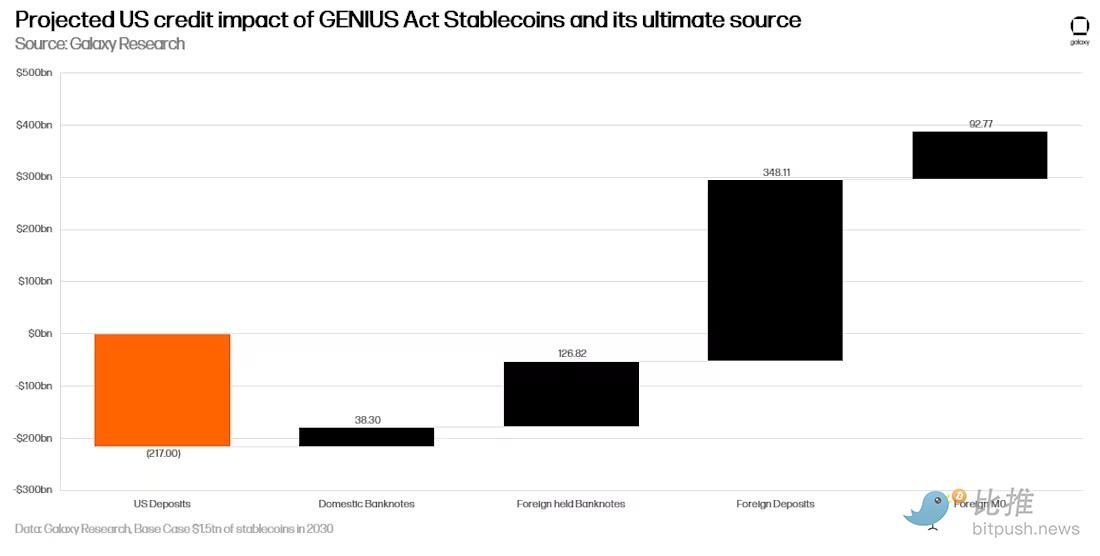
Using these estimates of foreign capital inflows into the US banking system, we have formed a more comprehensive view of the credit creation impact of the GENIUS Act. The shift in domestic deposit composition from retail to wholesale is still a drag on credit creation, reducing credit by 18 US dollars for every 100 US dollars increase in stablecoins; credit changes in physical banknotes entering the banking system will increase credit by 14 US dollars for every additional 100 US dollars of stablecoins after deducting the constituent effects; and crucially, dollars entering the US banking system from overseas will increase credit by 37 US dollars for every 100 US dollars increase in stablecoins. Taken together, even in the most pessimistic scenario, which includes delivering returns to stablecoin holders, the inflow of funds into GENIUS stablecoins will have a net incremental impact on the US credit and banking complex; our model predicts that every new GENIUS stablecoin is minted will generate about 32 cents of credit in the US. Multiply that by our modeled supply, and we predict that the GENIUS Act will expand the US credit supply by approximately $400 billion by 2030.
Balance sheet, leverage and comprehensive model results
Modern banks do not operate on a simple “deposit creates loan” mechanism; loans create deposits and are subject to capital ratios and regulatory requirements. From a leverage perspective, a $1 stablecoin reserve held as bank debt is not equivalent to a $1 retail deposit financing for a loan portfolio. As deposit financing migrates from ordinary retail accounts to centralized stablecoin issuer reserves, the composition of bank assets will change even if total liabilities remain stable. The revenue models of regional banks and community banks are highly dependent on net interest spreads generated by deposit-finance loans, and are therefore more sensitive than diversified institutions that earn fees from capital markets, consulting, and asset management activities.
Combining Standard Chartered's global distribution assumptions with Citi's segmented US alternative framework, we estimate that under GENIUS, about 30% to 40% of incremental stablecoin funding will come from US bank deposits, and the rest will be distributed between offshore inflows (40% to 30%) and non-depository domestic sources (such as physical money and money market funds, 20% to 30%). These ranges include interest-bearing stablecoin scenarios. Under this distribution, import deposits may surpass domestic deposit migration by a ratio of 2 to 1, which means that even if the bank's capital structure and cost structure change, total bank financing will still increase.
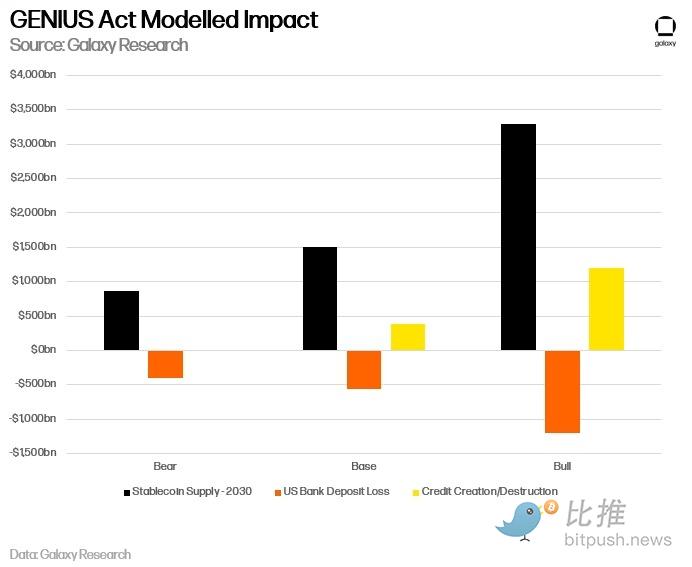
Once we consider the geographical distribution of funding sources, the regulatory treatment of centralized deposits and retail deposits, and the conversion of deposit liabilities to reserve support assets, we can establish a range of possible outcomes. Our comprehensive modelling shows:
Under a bear market scenario, GENIUS stablecoin supply will reach approximately US$630 billion in 2028 and reach US$860 billion by 2030, mainly driven by moderate domestic adoption. Approximately $400 billion was transferred from US commercial bank deposits, partially offset by $160 billion offshore adoption and physical currency conversion. The yield on 3-month short-term treasury notes in the treasury bond market was under marginal downward pressure of 1.5-2.2 basis points, expanding to a maximum of 5 basis points during the pressure period. As inflows replace rather than expand domestic liquidity, credit creation remains largely neutral. For every $100 billion stablecoin issued, US credit contracted by $3 billion, a net contraction of $15 billion. This is a manageable redistribution of balance sheet components rather than a systematic tightening.
Under the benchmark scenario, the stablecoin supply will expand to $1 trillion by 2028 and to $1.5 trillion by 2030, of which about $550 billion is domestic deposit migration, supported by 500 billion US dollars offshore adoption and 200 billion US dollars in physical currency conversion. Continued demand for US Treasury bonds reduces 3-month short-term treasury note yields by 3-5 basis points, up to 10 basis points under pressure, saving taxpayers up to $3 billion a year. For every $100 billion stablecoin issued, US credit expands by 32 billion US dollars, with a net expansion of 400 billion US dollars. Foreign demand exceeds and offsets US retail outflows.
Under the bull market scenario, along with revenue distribution and aggressive international adoption, stablecoin supply rose to $2.1 trillion in 2028 and $3.3 trillion by 2030. About $1.2 trillion was migrated from domestic deposits, but the US banking system still experienced a positive inflow of $1.8 trillion, of which $1.3 trillion of offshore capital entered the US market. US Treasury yields have shrunk significantly, up to 7-11 basis points, and up to 25 basis points under pressure, substantially reducing government financing costs, saving Uncle Sam more than 5 billion US dollars a year. For every $100 billion stablecoin issued, US credit expands by 41 billion US dollars, with a net expansion of 1.2 trillion US dollars, thereby strengthening the supply of credit and deepening the liquidity of the entire financial system.
Interest transmission is not an existential threat to the US banking industry. Even under aggressive adoption assumptions, GENIUS mainly redistributes profit margins rather than eliminating capacity. Banks facing deposit competition still have pricing power, balance sheet management tools, and diversified revenue streams. The entire system remains well-capitalized, has good liquidity, and can support credit growth commensurate with economic needs.
Second-order effects and distributive consequences
The first-order effect — demand for US Treasury bonds and deposit flows — is transmitted layer by layer to broader structural effects on fiscal policy, financial stability, and competitive dynamics within and outside the US financial system.
Treasury financing flexibility
If the stablecoin supply reaches $1 trillion to $2 trillion, and GENIUS pushes reserves to short-term treasury bills and adjacent high-quality liquid assets, then the front end of the curve will be embedded in stable buying. This will not rewrite monetary policy, but it will have a marginal impact — moderately reducing maturity premiums, reducing fluctuations in US Treasury issuance in the most interest-sensitive portion of issuance, and expanding fiscal flexibility during times of high demand for refinancing.
Banking profit margins are compressed but there is no systemic disturbance
The banking industry has the highest concentration of political rhetoric. Even if convenient interest transmission exists, the more likely outcome is not a systemic disturbance in the US financial system, but rather a compression of profit margins. Some deposits will migrate, especially those that are sensitive to interest rates and are not picky about convenience. However, the most alarming predictions often assume that once stablecoins are able to pay interest, all domestic demand deposits will become vulnerable. This assumption ignores conversion costs; the value of integrated banking relationships; and the reality that many depositors prioritize ease of use and reliable access to bundled banking services rather than maximizing transaction balance benefits.
A deeper insight is that stablecoins are not so much “killing banks” as banks are losing a hidden subsidy. Non-interest-bearing or low-interest deposits are cheap financing. They support free checking accounts, payment infrastructure, and bundled services that feel free because customers have hidden costs by forgoing interest. This advantage is eroded when alternatives emerge, particularly those backed by government securities rather than bank credit risk. Banks must compete, reprice services, or accept narrower profit margins.
Stablecoins are not so much “killing banks” as banks are losing a hidden subsidy.
Increased stability compared to historical monetary instruments
GENIUS is also trying to avoid replicating the stressful dynamics of monetary instruments of the past three decades. High-quality money market funds that invest in corporate debt have grown into deposit alternatives, and during the crisis, “cash-like” have been found to exist on a spectrum, and have repeatedly forced policymakers to activate support mechanisms to prevent crowding from becoming a systemic issue. The stablecoin law's reserve requirements, regular verification, and regulatory framework are designed to prevent similar vulnerabilities. Fully backed by short-term US Treasury bonds and cash equivalents, this means that stablecoins are structurally closer to government money market funds than uninsured deposits from high-quality monetary funds or partial reserve banks.
Will the crowd-out disappear? It won't. Stablecoins may still face a wave of redemptions — especially during periods of wider market pressure — and are still exposed to risks such as traditional T+ settlement friction, the operation of the repurchase market, and the soundness of reserve-holding banks. But GENIUS reduces the most dangerous failure mode: crowding driven by uncertainty about reserve adequacy or collateral quality. When holders know that reserves can be verified and that the vast majority are made up of government securities, the impulse to panic will subside substantially.
When holders know that reserves can be verified and that the vast majority are made up of government securities, the impulse to panic will subside substantially.
Winners and losers in the US
In the US, the distributive effect is less clear than the aggregate effect. Even if net credit creation remains generally stable, there will be winners and losers. Banks that rely most on net interest spreads — particularly regional banks and community institutions whose revenue is concentrated on deposit-financing loans — are more sensitive to deposit migration. Global systemically important banks (GSIB) and diversified financial institutions derive more revenue from capital markets, consulting, and asset management, protecting them from some of the impact of deposit competition. Standard Chartered published a follow-up study, “Stablecoins — Determining the Risk to US Bank Deposits,” to identify listed banks likely to be under the greatest pressure by screening the banks with the highest net interest spreads as a percentage of total revenue. Although this method is slightly crude, it provides powerful insight for those looking to lay out positions around GENIUS implementation.
History also complicates the intuition that “big banks are bound to win.” In the early days, most banks viewed crypto industry customers as toxic assets, so stablecoin relationships focused on regional institutions such as Silvergate and Silicon Valley Bank rather than money center banks. GENIUS also reserves some state-level issuance space. Issuance below certain thresholds can be carried out at the state level, which may enable smaller institutions to participate, but the $10 billion limit for state-level stablecoins is likely to prevent a real take-off scenario there. The more likely structural impact is continued centralization: large-scale stablecoin issuance benefits from network effects, expensive compliance infrastructure, and balance sheet capacity. If foreign inflows dominate, these deposits are likely to be concentrated in the largest and most internationally connected institutions.
Policy extension
Can this law be improved marginally? A reasonable enhancement would be to add federal home loan bank debt to the GENIUS Act stablecoin acceptable collateral list. Short-term FHLB debt funds advances from member banks. These advances act as liquidity backing based on high-quality collateral, usually correspond to mortgage-related assets, and are particularly valuable when liquidity is scarce. This makes it particularly relevant for community banks and regional banks, as these banks rely more on deposit financing and are therefore more susceptible to any deposit migration caused by stablecoin competition. Short-term FHLB debts are currently ineligible because they are not issued or guaranteed by the government; they are only issued by government backed enterprises (GSEs).
FHLB loans also played an important role in bank failures in 2023 — and were not honorable, particularly among crypto-related institutions. In the SVB case, part of the problem was the limited capacity of the FHLB market, which limited the bank's ability to obtain the required financing with high-quality collateral that was already qualified. Allowing GENIUS stablecoin issuers to have limited access to the FHLB market may help smooth deposit restructuring movements without seriously compromising reserve quality or creating moral risks, provided such access is properly regulated. Properly designed, this mechanism will not eliminate the competitive pressure stablecoins put on deposit-dependent banks, but it can help institutions most vulnerable to loss of deposits during the transition period.
Another reasonable improvement is to explicitly allow Ginnie Mae securities to be included in the Genius Act collateral framework, and these securities are backed by federally insured mortgages. Although Ginnie Mae is federally issued and fully guaranteed by the US government, they are not specifically included as qualifying reserve assets. Given its creditworthiness and policy relevance, its inclusion would be highly consistent with the Act's core intent, while allowing for moderate diversification of benefits within a risk-controlled structure. The open question is risk management: what percentage of reserves can be rationally allocated to Ginnie Mae without compromising liquidity or daily redemption capacity? A smaller, capped ratio might strike a careful balance between safety and portfolio breadth.
At the state level, smaller stablecoin systems can reasonably be tested around regulatory exemptions of less than $10 billion in supply, which may allow a higher concentration of exposure to Ginnie Mae or other less liquid securities under controlled conditions.
Global impact
Outside of the US, the impact was significant and clearly negative.
Countries with weak monetary credibility, weak banking systems, or strict capital controls are under greater pressure. The International Monetary Fund (IMF) has warned for years that stablecoins may accelerate currency replacement, increase capital flow volatility, and weaken monetary sovereignty, particularly in countries facing inflation, weak institutions, or lack of confidence in domestic policy frameworks. Standard Chartered's “Stablecoins — Stablecoins for EM” analysis of emerging markets also points in the same direction: in jurisdictions where dollars are scarce, stablecoins will shift deposits from local banks to digital dollar holdings, weakening domestic credit creation and complicating monetary policy transmission. What makes a country vulnerable is not any single variable, but the interplay of multiple weaknesses. The first is poor monetary credibility: when households and businesses expect inflation, depreciation, or any policy shift, they look for value storage tools other than domestic currencies, and stablecoins backed by dollars are often easier to obtain than formal foreign currency bank accounts. The second is the fragility of the banking system. In places where local banks are undercapitalized, operate inefficiently, or are not considered safe savings custodians, stablecoins provide more than just an alternative currency, but an alternative balance sheet. Third, there are capital controls or foreign currency access restrictions. In these systems, stablecoins are attractive precisely because they can bypass friction, delays, and discretion embedded in official channels, making capital more liquid than domestic authorities would like.
Other vulnerabilities reinforce the same pattern. Countries that are highly dependent on remittances, have poor domestic capital markets, limited access to global banking infrastructure, or have large informal savings sectors, are particularly exposed, as stablecoins resolve real frictions in payments and access to dollars. The same is true for economies with large current account or fiscal imbalances, where deposit flight can directly feed back into weakening exchange rates and financing pressure. Standard Chartered identifies emerging market exposure in clear banking terms: if consumers and businesses can hold functionally equivalent fully supported dollar claims outside of local banks, domestic institutions lose not only deposits, but also payment revenue, foreign exchange spreads, and part of their role in financial intermediation.
From the US perspective, this dynamic strengthens the dollar's central position. The world's easier access to dollar savings will expand the range of effective stakeholders in US monetary policy and deepen demand for dollar-denominated assets. From an emerging market perspective, it may complicate macroeconomic management, reduce minting tax revenue, and accelerate the dollarization of deposits — a model that often heralds broader financial pressure when local banks lose stable capital and policymakers lose control of marginal domestic currency demand.
Competitive pressure extends beyond deposits. If getting US credit and dollar savings were as simple as downloading an app, the financial systems of countries with weaker systems, higher intermediary costs, or more asymmetric information would face continuing structural disadvantages. In this sense, GENIUS may not only strengthen the dollar system by improving its function, but also strengthen the dollar system by marginally reducing the competitiveness of competitive currencies and banking systems. This broader logic is consistent with the government's interest in maintaining and expanding the dollar's central position, and may also help achieve what Federal Reserve Governor Stephen Miran called the goal of having other countries “pay their fair share” of the benefits provided by the US dollar as a leading global settlement asset.
conclusions
GENIUS is not so much a cryptocurrency law as a piece of legislation dealing with the evolution of the financial structure of the dollar economy. The impact will be transmitted through layers of the US Treasury bond market, bank balance sheets, and international capital flows, ultimately redistributing who earns returns from the dollar's liquidity supply. The distributive consequences are more important than the aggregate consequences: bank revenue shifts from deposit-finance loans to fee-paying services and capital market activity; regional banks lose interest spreads on low-cost deposits, while global systemically important banks absorb incremental foreign capital flows; emerging economies face accelerated dollarization of deposits, and the US Treasury receives structural demand in the part of the market that relies most on refinancing.
For policy makers, GENIUS is an experiment in managed innovation. It seeks to formalize the digital dollar under regulatory scrutiny, expand its utility, and capture the benefits of borderless, programmable money without replicating the fragility of unregulated monetary instruments. Its success depends on enforcement: how effective regulators are in monitoring the sufficiency of reserves, how smoothly stablecoin redemption mechanisms operate under pressure, and how foreign jurisdictions respond to greater competitive pressure on their domestic financial systems.
For banks, the challenge is strategic adaptation. Deposit concessions are still valuable, but their profitability is increasingly dependent on integrated service delivery, access to credit, and customer relationships rather than structured financing advantages. Institutions that compete solely on convenience will face erosion in profit margins. Institutions that use deposits to deepen customer relationships, expand credit, and provide overall financial services still have defensible economies. The institutions that will be in trouble are not those facing competition, but those that fail to adapt to competition.
For the dollar system, GENIUS represents a gradual evolution rather than a revolution. The dollar is already globally dominant; GENIUS makes it more accessible. Short-term US Treasury notes are already the safest asset in the world; GENIUS embeds structural requirements into them. Bank of America already mediates international capital; GENIUS guides more capital flows through a regulated digital track, making dollar value transfers faster, cheaper, and more transparent than traditional agency banking infrastructure. Unlike the Federal Reserve's FedNow payment system — which modernizes domestic dollar pipelines within the boundaries of the existing system — Genius expands programmable dollar access to the world with minimal restrictions, reaching users and markets that traditional banks have never served efficiently.
The net assessment is that the US financial system has costs but benefits. Domestic banks sacrificed profit margins, but retained a systemic central position. Foreign banking systems face increased competition and capital flight. Domestic and global consumers get more efficient and portable US credit claims. Treasury financing has become slightly cheaper and more stable. The dollar, which is backed by government credit and is now programmable, will be more deeply embedded in global finance.
This isn't a story about cryptocurrencies replacing traditional finance. This is a story about the evolution of the US financial system to absorb technological innovation while retaining its structural advantages. GENIUS will not disrupt the dollar economy; it will modernize the dollar economy's delivery mechanism, redistribute economic rents, and extend the US financial infrastructure to regions previously inaccessible to traditional banks.
The question is not whether stablecoins will reshape dollar finance, but rather who will get value from this reshaping and who will bear the cost of the adjustment.
Twitter:https://twitter.com/BitpushNewsCN
Compare the TG exchange group:https://t.me/BitPushCommunity
Compare TG subscriptions:https://t.me/bitpush
