


Flatbread, lost 60,000 dollars

The crypto market is facing an even more violent storm.
Bitcoin fell below the $60,000 mark for the first time since September 2024. This is also the first time since Trump won the election at the end of 2024 and the crypto market began a wild model.
According to Binance data, at 1:12 a.m. on June 6, Beijing time, Bitcoin dropped to a minimum of 59,786 US dollars, a 24-hour decline of 6.21%.
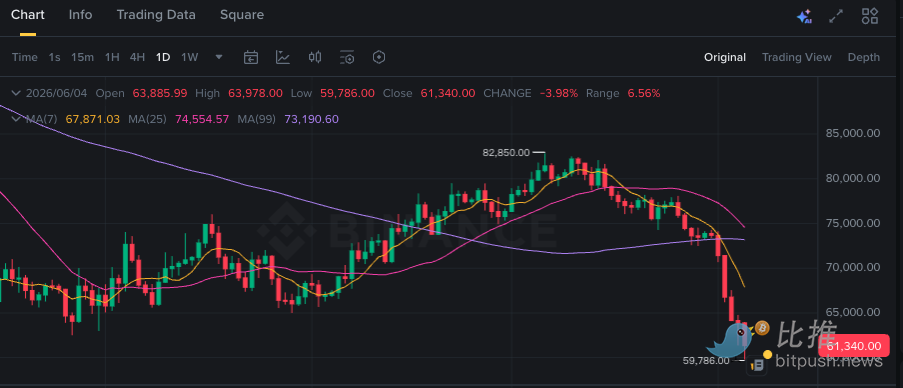
Recall that in October 2025, Bitcoin hit an all-time high of $126,080, and the market cheered. However, after just 4 days, a flash crash ended the carnival. Over the next half of the year, Bitcoin basically fluctuated sideways in the range of $65,000 to $80,000. Now falling below $60,000 means that Bitcoin has fallen by more than 51% from its all-time high, and the cumulative decline since 2026 is close to 30%.
Strategy's unexpected sell-off: a crack in faith
The most direct trigger for this round of decline came from Strategy (formerly MicroStrategy), Bitcoin's largest corporate holder. On June 1, the company revealed that it had sold part of its Bitcoin holdings. Although the $2.5 million sell-off amount was insignificant compared to its holdings of over $50 billion, it was of great symbolic significance. Founder Michael Saylor made a loud statement in 2022 that “we don't sell; we only buy and hold”.
Faith in this thing, once cracks appear, can easily be magnified.
Immediately after that, liquidity problems began to deepen.
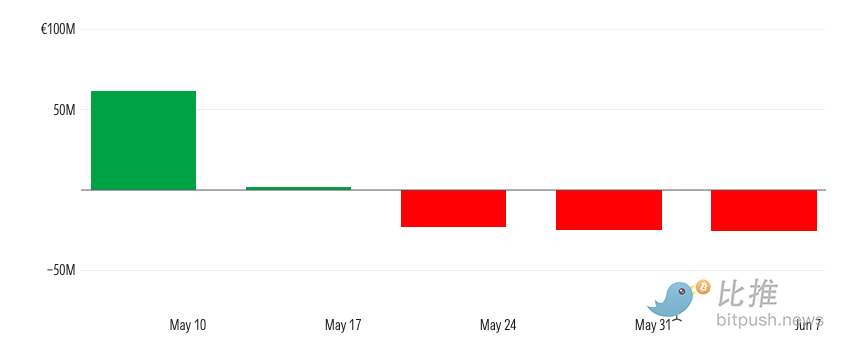
Spot Bitcoin ETFs were once the core driving force behind Bitcoin's previous bull market, but now they are a source of selling pressure. In May, the US spot Bitcoin ETF recorded a net outflow of US$2.43 billion; just four days before June, another US$1.4 billion was withdrawn. BlackRock's IBIT product alone had an outflow of 1.2 billion US dollars between June 1 and 4. The European market was also not spared, with WisdomTree's physical Bitcoin product outflow exceeding 7.3 million euros in a single week.
Matt Hougan, chief investment officer at Bitwise, said in a report this week: “Who else wants cryptocurrencies when the Nasdaq 100 Index is up 43% a year?” Investors are rotating their capital into artificial intelligence and technology stocks, and crypto assets have lost their appeal as the first choice for high-growth transactions. SpaceX's upcoming IPO plans to raise $86 billion, with a valuation close to $1.8 trillion, and also suck large amounts of retail capital out of the crypto market.
The decline triggered a chain stampede in the derivatives market. According to CoinGlass data, within 24 hours around June 4, about 1.8 billion US dollars of cryptocurrency positions in the entire market were forcibly closed. Of these, more than 1.5 billion US dollars were long positions, and Bitcoin bulls alone contributed 800 million US dollars. This was one of the biggest liquidations of the year.
Changes in the macroeconomic environment: non-agricultural data becomes a new trigger
The US non-farm payrolls data released on June 5 was stronger than expected, and market concerns about keeping interest rates high are once again heating up. The 10-year US Treasury yield is rising, and risk assets are under full pressure. Bitcoin was unable to stand alone in this macro context, and the final blow below $60,000 came just after that.
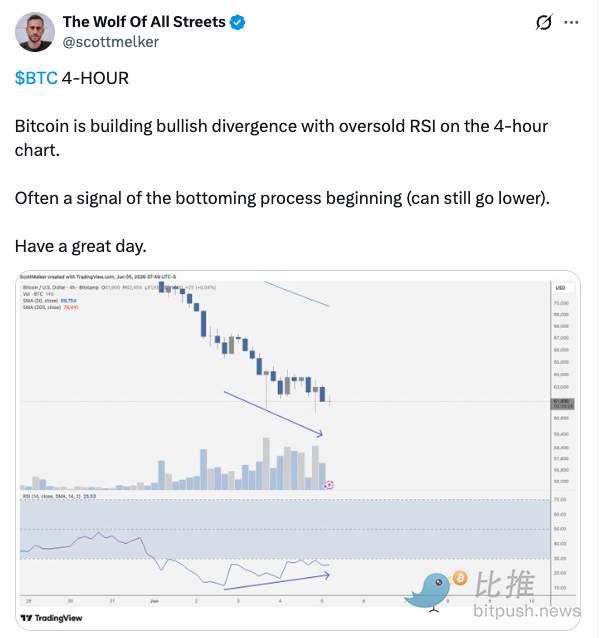
Looking at technical indicators, Bitcoin's RSI has fallen to 15.75, the lowest level since February this year. Bitcoin finally stabilized after falling from nearly $90,000 to around $60,000 at the time. Currently, the market is indeed extremely oversold, but overselling itself does not mean an immediate rebound — it remains to be seen whether market sentiment has bottomed out.
Regulatory uncertainty has added another layer of pressure. US lawmakers are still discussing the Clarity Act. Institutional investors are generally on the sidelines, and no one wants to rashly increase positions until the future is clear. Matt Hougan said the market can digest bad news, but it can't digest the ongoing uncertainty, which is currently affecting market sentiment across the industry.
Looking back, Bitcoin is less than 8 months from last year's high of $126,000 to now. The “bull market never ends” atmosphere at the time, but looking back now, it seems like a long time ago.
The market is just that. When it rises, everything is a reason; when it falls, everything is bad. Today's Bitcoin, in Hougan's words, has become a “contrarian bet”.
It's not that investing against the trend can't make money, but it requires patience, needs to be able to withstand fluctuations, and requires your own judgment on fundamentals.
For those who have been in this market for a long time, this kind of scene is no stranger. Bitcoin is tested like this every few years.
No one knows for sure. But one thing is certain — when you're in a panic, it never hurts to stay calm.
At any rate, the current market is reminding everyone that the crypto market has never changed its nature, and there is often only one night between revelry and panic.
Author: Bootly
This article is sponsored by GENG, Build Your Fortune on GENG (https://geng.one)
Twitter:https://twitter.com/BitpushNewsCN
Compare the TG exchange group:https://t.me/BitPushCommunity
Compare TG subscriptions:https://t.me/bitpush
