


Meta is selling computing power, why is the market panicking
On Wednesday, a Bloomberg news blew up the US stock market — Meta is building a cloud business and plans to sell excess AI computing power to external customers.

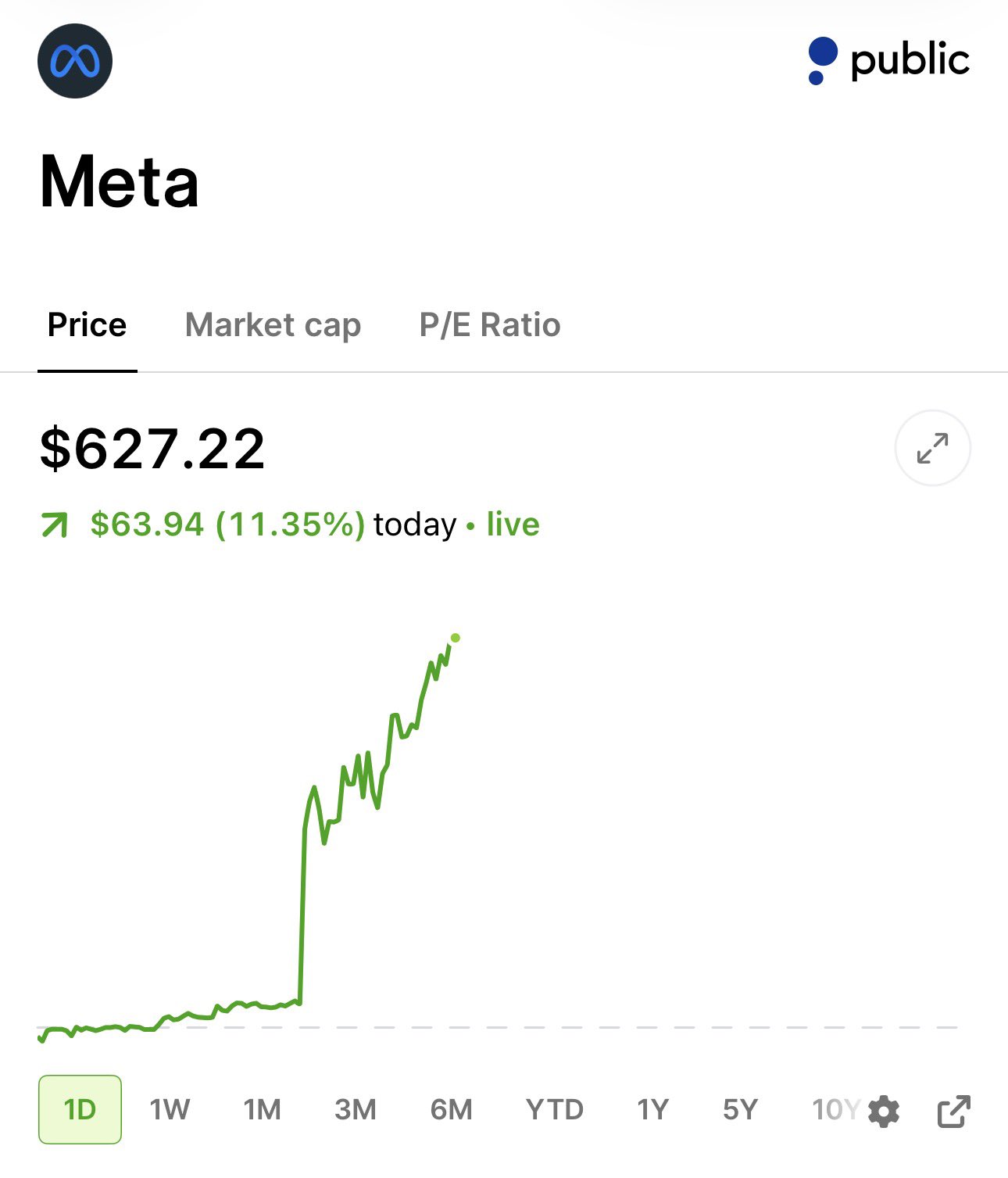
The stock price immediately reacted: Meta surged more than 10% intraday, the biggest one-day increase since January 29, 2026. However, hardware vendors such as Micron, Corning, and SanDisk collectively plummeted, reaching 6%, 11%, and 8%, respectively, while “computing power intermediaries” such as CoreWeave and Nebius fell by more than 10%.
What exactly is Meta going to do?
Actually, Meta's plans to enter cloud computing are not temporary.
As early as October 2023, Zuckerberg proposed this “alternative.” In April of this year, Meta raised its 2026 AI-related capital expenditure forecast to 125 billion to 145 billion US dollarsYuan. After the financial report, the stock price plummeted by more than 7%, and the market's patience with Xiao Za's “throw the money first, then talk” approach has been exhausted.
At the annual shareholders' meeting in May, Zuckerberg clearly stated that entering the cloud computing market is “definitely within the scope of consideration.” He also revealed a key message: “Almost every week, different external companies come to us hoping we can build an API service, or ask if they have computing power to sell, and are willing to buy it at a premium above our procurement costs.”
According to information obtained by Bloomberg, Meta is currently considering two main models in the direction of commercialization:
First, selling “model access” — similar to Amazon AWS's Bedrock service, developers pay to call AI models deployed on Meta infrastructure (including self-developed Muse Spark models), and Meta charges customers based on the number of API calls.
Second, selling “raw computing power” — leasing raw computing power directly to external customers. The model is similar to the approach of “new cloud” service providers such as CoreWeave.
The plan was incorporated into an internal top-level program called “Meta Compute,” which is co-led by three key players: Santosh Janardhan, head of Meta infrastructure, Daniel Gross, head of the AI department, and Dina Powell McCormick, president of Meta.
It's worth mentioning that Meta moves are not an exception. Musk's SpaceX has launched a similar operation this year, selling idle computing power to Anthropic and Google.
Two interpretations
The pessimistic side believes that this is the first domino card for “oversupply” of AI computing power.
Their reasoning is simple: if big model training really “eats up computing power,” why doesn't Meta keep it for itself and instead take it out? This shows that Meta's own R&D needs are no longer enough to fill its computing power warehouse, so they may have actually bought too many chips in the past two years.
What makes the market even more tense is that Meta, as one of the “weather vane” of the industry, if it takes the lead in bringing excess computing power to the market, it means that the tight logic that the entire AI hardware is “always out of stock” will have to be re-examined. If other major manufacturers (such as Google and Microsoft) follow suit, the order growth rate of upstream suppliers such as Samsung, SK Hynix, and TSMC will probably put the brakes on, and even face the risk of cutting orders. This is why hardware stocks such as Micron and SanDisk have been hit hard — the market is digesting the expectation that “peak demand has passed” ahead of schedule.
The optimists, on the other hand, think this is simply an overinterpretation.
The logic is exactly the opposite: Meta spent hundreds of billions of dollars to build a computing power pool, and now “return blood” with idle resources that cannot be used for a while. This is just a normal asset management operation; it has nothing to do with “shrinking demand.”
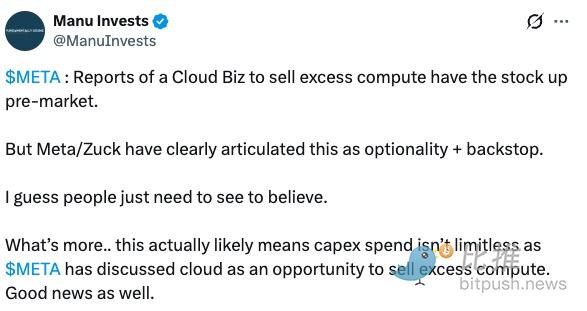
On the contrary, if the path of cloud leasing passes and can generate stable cash flow, Meta will be more motivated to continue to make major purchases of next-generation GPUs, optical modules, switches, and cooling systems — because the money earned from selling computing power can in turn support larger capital expenses. To put it bluntly, leasing is for better procurement, not the end point of procurement. If this logic works, then the decline in hardware stocks is an emotional “misslaughter”; in turn, it may be an opportunity to pick up bargains.
What do analysts think?
Judging from research reports, most institutional analysts are more inclined to make “optimistic” judgments.
Bank of America (BofA) reiterated Meta's “buy” rating in a Wednesday briefing and gave a very sophisticated perspective: enterprise-grade AI cloud services are equivalent to investing 100 billion dollars in insurance for Meta — even if the consumer AI business (such as advertising) falls short of expectations, corporate computing power leasing can cover the bottom, preventing profit margins from collapsing. BofA also estimates that the enterprise AI cloud market is expected to break through a trillion dollars by 2028, and Meta even cutting a very small piece of cake would be a huge increase for a company that originally only made money from advertising.
Newcomer Serenity (@aleabitoreddit) believes that the market has completely reversed “excess computing power.”
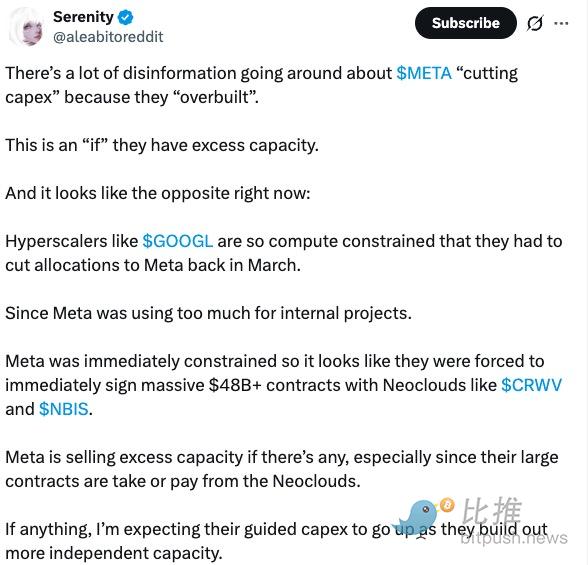
Serenity pointed out that Zuckerberg mentioned using an “if” (if) when renting computing power, which itself is a hypothetical condition, but is being hyped up by the market as an established fact. The reality is quite the opposite — computing power is extremely scarce. According to the Financial Times, since March 2026, Google has restricted Meta's access to the Gemini model due to insufficient computing resources, which has forced several internal Meta AI projects to be postponed. Even Google lacks the computing power to “cut” old customers. How can the entire market already be “surplus”?
Because of this, Meta urgently signed “take-or-pay” (take-or-pay) contracts with Nebius (up to about $27 billion for a five-year term) and CoreWeave ($21 billion), totaling $48 billion. Serenity's reasoning is very sharp: since Meta has signed so many rigidly paid rental contracts, its expenses are rigid, and there is no room to actively “cut orders.” On the contrary, in order to get rid of dependence on third parties and dilute costs, Meta is likely to continue to raise capital expenditure guidelines rather than lower them in the future.
D.A. Davidson's analyst Gil Luria pointed out the real “victim.” He said, “Meta's move is the same as SpaceX selling computing power this year.” However, he stressed that Meta's entry will not directly threaten hyperscale cloud giants such as Amazon, Microsoft, and Google; on the contrary, “pure renters” such as CoreWeave and Nebius will bear the brunt. Because in the past, these companies relied heavily on “wholesale” computing power from big manufacturers such as Meta and then retailing them. Now that big manufacturers have opened their own doors to do business, the space for intermediaries is naturally being drastically compressed.
Who benefits and who eats rice?
Looking at the interests of all parties, the contours of winners and losers are unusually clear.
The biggest winner: Meta itself.
Not only does it have an additional revenue channel, but more importantly, it has given investors a “reassurance pill”. You need to know that after spending $14 billion to extract Alexander Wang from Scale AI last year, Meta's performance in advancing the AI business was mediocre. With the AI commercialization process slower than expected, it has now at least added a revenue channel, and Meta finally has an opportunity to break away from the valuation shackles of “pure advertising companies” and take a step towards the enterprise service market.
The biggest losers: CoreWeave, Nebius and other “second landlords with computing power.”
Their survival is based on “big manufacturers disdain or are unable to scatter computing power.” Now Meta is personally out of business, which means that their most scarce resource — a stable source of computing power — may be cut off. What's more fatal is that these companies are highly leveraged and have extremely high financial costs. Once rental prices are suppressed by “big players” like Meta, their profit margins will be extremely compressed.
The most uncertain: the hardware industry chain (Micron, Corning, SanDisk, etc.).
Their fate depends on a critical question: will Meta's cloud business reduce its total procurement volume or increase its purchasing motivation? Currently, Meta's official capital expenditure guidelines for 2026 remain at 125 billion to 145 billion US dollars, and there is no sign of a reduction. If the “positive cycle” story of the “optimists” comes true, then today's sharp decline is a golden pit; but if the “pessimistic” prediction of “peaking demand” becomes a reality, then the high valuation of hardware stocks may have only just begun to collapse.
Zuckerberg put it bluntly at the shareholders' meeting in May: “The cloud business option gives us more confidence in continuing to build AI infrastructure.”
This statement breaks the essence - cloud leasing is an AI strategy “seat belt”. With this seatbelt, Meta dared to keep stepping on the accelerator in the computing power race. Seen from this perspective, what really can't sleep is probably the middleman who relies on “scarce computing power” to eat, because big manufacturers have already begun collecting their own rents.
Author: Seed.eth
Twitter:https://twitter.com/BitpushNewsCN
Compare the TG exchange group:https://t.me/BitPushCommunity
Compare TG subscriptions:https://t.me/bitpush
