


Is it worth 40 billion US dollars to predict the market?
Source: Fintech Blueprint
Author: Laurence Smith
Compiled and organized by: bitPushNews
Is it sports betting or a new type of financial market?
Kalshi is in the midst of a new round of funding.
Just seven weeks after completing the $1 billion Series F round at a valuation of $22 billion, the Financial Times reports that the forecasting market operator is in negotiations at a valuation of around $40 billion and is likely to complete settlement in the third quarter as soon as possible. This is definitely breaking news!
Additional background information: Kalshi's valuation in October last year was still $5 billion, reached $11 billion in December, and soared to $22 billion in May of this year. Achieving an 8x valuation reshaping in as little as 18 months is extremely rare. According to reports, the company is currently in negotiations with the bank on an IPO (initial public offering), and CEO Tarek Mansour said the IPO could take place after 2027.
Background and current situation
Many analysts talk about Kalshi and Polymarket, usually from a regulatory and market share perspective.
This time, we want to explore something more essential: by running very different economic machines, the two companies ended up reaching a similar end — with a huge institutional shareholder roster and multi-billion dollar monthly trading volume.
One company charges about 1% of fees, and annual bookkeeping revenue of $2 billion
Another company has not charged at all for the past five years and is also ambiguous with cryptocurrencies
Kalshi's business model is simple: it is an exchange regulated by the US Commodity Futures Trading Commission (CFTC), and charges about 1% of every matched transaction. There is no bookmaker risk, and the balance sheet is not affected by the outcome of the transaction — it is simply taxed on trading volume, which has always performed amazingly.
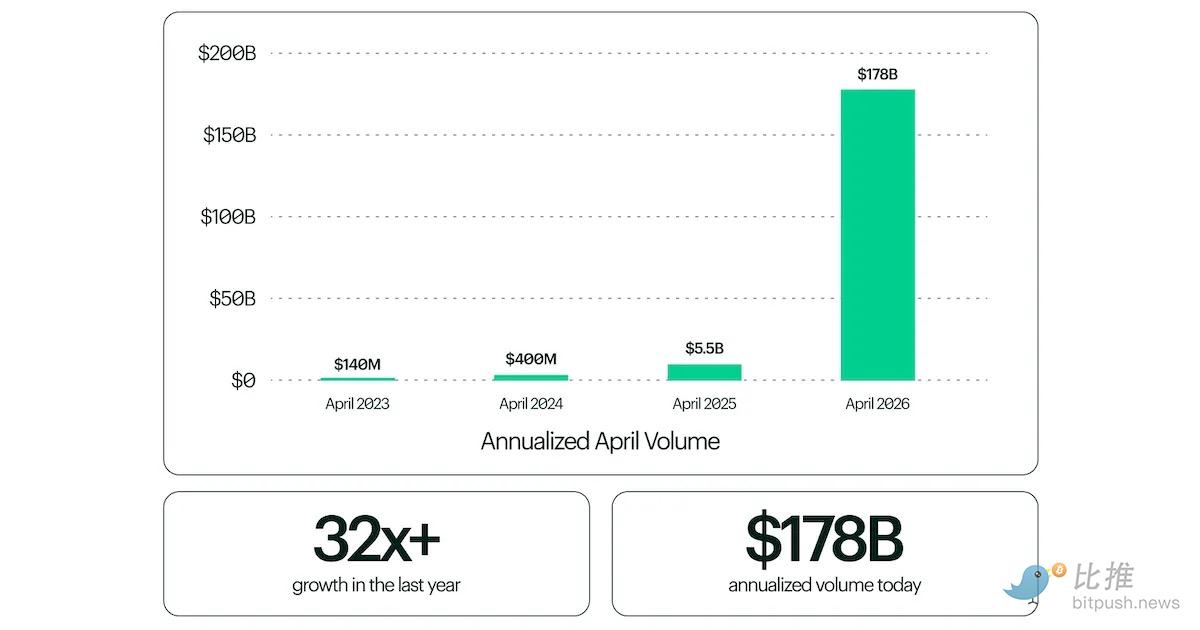
As of April 2026, its annualized transaction volume reached $178 billion, a 32-fold increase over the previous year, and the company's annualized revenue also surpassed $2 billion. Based on a $40 billion asking price valuation, this is approximately 20 times the market-sales ratio (P/S). Expensive, but not unjustifiably — Coinbase and Robinhood have traded at similar multiples.
The last time we reported on these two companies, Kalshi's valuation was double that of Polymarket. Since then, this valuation ratio has hardly changed. But the real core issue is the quality of revenue. Are these platforms just huge online casinos, or are they a new type of business that is more deeply connected to the information and financial markets?
For Kalshi, sports contracts account for around 65% of its trading volume, but that is also causing them trouble.
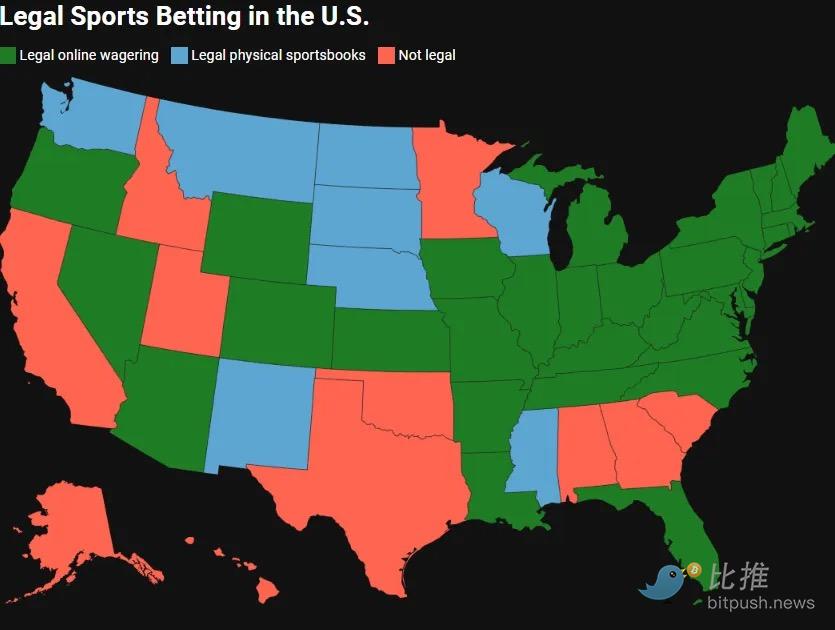
The Kentucky lawsuit alleges that 89% of Kalshi's 2025 trading volume came from sports, which is the type of contract the states are trying to ban. Arizona filed criminal charges in March, a Massachusetts judge banned Kalshi's sports market in January, and Nevada extended its ban.
The company's entire legal theory — that the incident contract is a swap (swap) contract subject to the exclusive jurisdiction of the CFTC — is currently undergoing judicial proceedings in more than 10 US states at the same time, and a federal judge in Michigan recently ruled that the sports prediction market is not a swap.
The dispute is heading to the Supreme Court, and the premise underpinning its overvaluation is that Kalshi must win this legal case.
 Kalshi has established a truly profitable market, but its economic benefits are entirely dependent on this legal classification. The 1% rate only makes sense if Kalshi remains the only federally approved compliant venue. However, DraftKings launched its own exchange this week, Robinhood has already entered the event contract space, and CME (CME) is also suing the CFTC over Kalshi's cryptocurrency perpetual contract.
A triumph in court would lead to competition, which in turn would eat away at this 1% rate; failure in court directly threatens the trading volume base on which the fee is based.
How to play Polymarket
Polymarket has taken the exact opposite strategy.
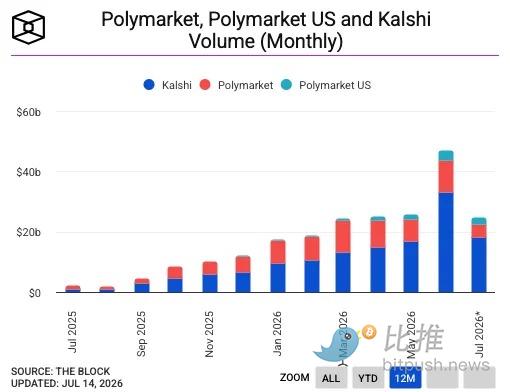
We analyzed this last October when the NYSE (NYSE) parent company Intercontinental Exchange (ICE) invested $200 million in Polymarket and acquired approximately 17% of its shares. At the time, Polymarket had around 300,000 monthly active users and a monthly trading volume of $1.3 billion, yet had almost no substantial revenue. That's a $9 billion valuation based on cultural relevance and future choices.
The five-year “zero fee” was a deliberate liquidity subsidy funded by venture capital funds, and it worked to a certain extent: in 2025, its trading volume reached $21.5 billion, accounting for almost half of the total predicted global market. This year, the switch for commercial monetization was finally turned on, and the balance relative to transaction volume has since been tilted back in favor of Kalshi.
In January of this year, Polymarket began levying taker fees (taker fees) for the high-frequency crypto market. By early February, the weekly fee revenue had exceeded $1.08 million. Currently, the full fee schedule (V2 version, effective March 30) covers most categories, and its US exchange charges a uniform 0.05% order fee and provides pending order (Maker) rebates. This has drastically reduced the price and sniper Kalshi's rate of about 1%.
This price war is at the core of its strategy: Polymarket's pricing is aimed at competing for market share rather than maximizing revenue in the short term. Independent models forecast revenue of approximately $100 million to $450 million.
Faced with a valuation of $15 billion, its market-sales ratio was over 30 times, even under the most optimistic scenario, and over 70 times at a normal benchmark. As a result, pure fee revenue does not fully support its valuation.
There are two other things that really support its valuation:
First, data.
Half of ICE's business is built on selling market data. As part of the investment, ICE became the exclusive global distributor of Polymarket event-driven data to institutional customers: including real-time probabilities of elections, Federal Reserve decisions, and geopolitical events, all transmitted through the same infrastructure that carries NYSE prices. The product was commercialized in February as “Polymarket Signals and Sentiment” (Polymarket Signals and Sentiment) — a standardized data stream and historical time series that hedge funds can directly plug into their own trading models.

Its core selling point is that a highly liquid market defeated polling agencies in the 2024 general election, and Polymarket can continue to export this value. Customers can only pay for such “signals” without placing a bet on the platform at all, which completely decouples data revenue from transaction volume.
Second, tokenization (tokenization).
The second mechanism that distinguishes Polymarket from its rivals is the POLY token, which is scheduled to be launched in 2026. The token will direct the flow of fees to stakers and allow companies to monetize their treasury positions, a value capture mechanism that Kalshi structurally cannot replicate.
Let's compare the three business mechanisms together:
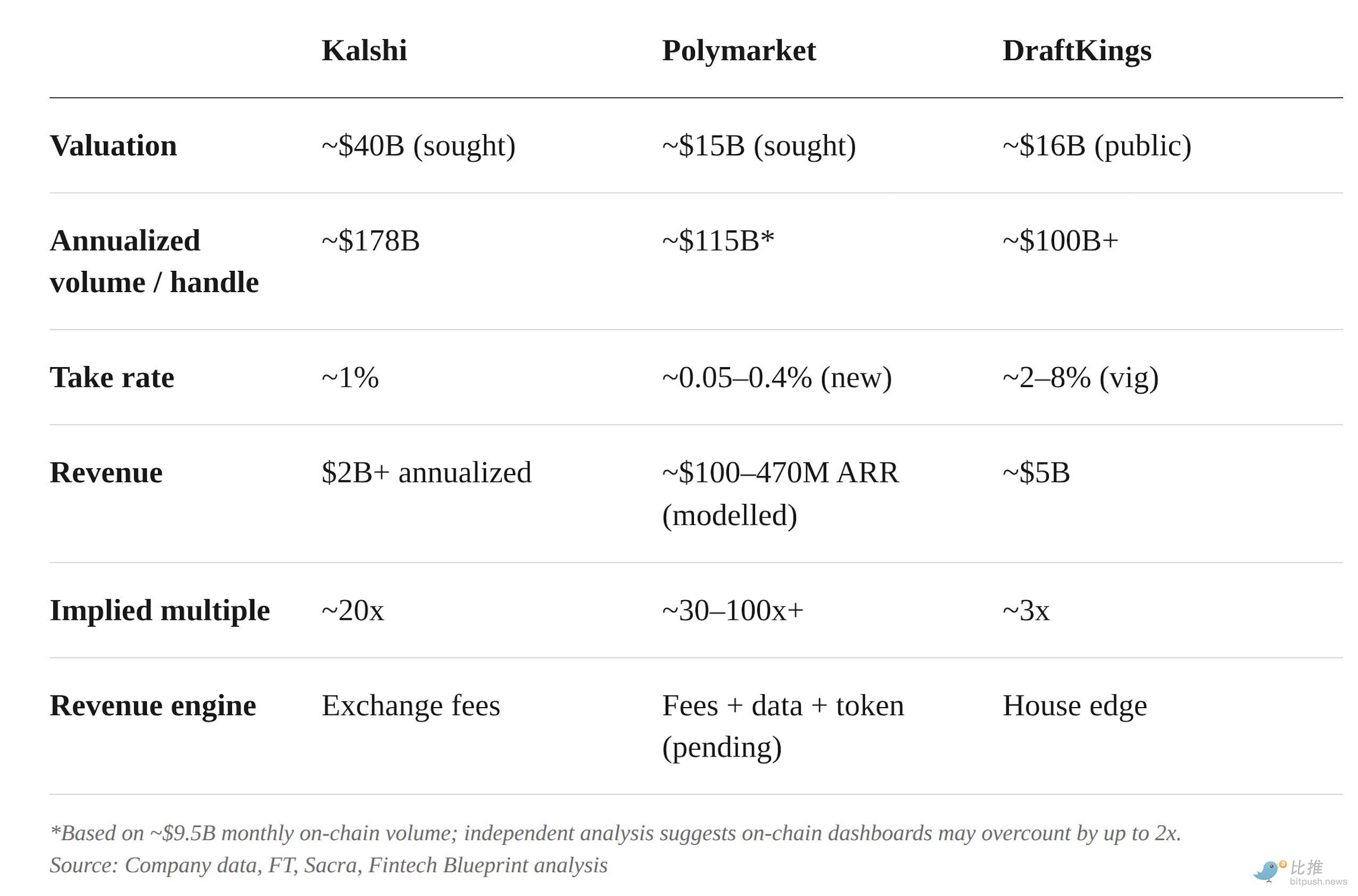
The established company DraftKings only triples market sales because the market knows very well what a sports betting company is and how much money it can make (after deducting state license fees, promotion costs, and bookmaker risk).
Kalshi sold at 20 times the market sales rate because it was positioned as an exchange and generated real money revenue. Exchanges get valuation multiples from exchanges, and bettors get valuation multiples from bettors, and more than a dozen states are currently in a court game with Kalshi.
However, in the case of the benchmark fee, the valuation of Polymarket, which has a market sales ratio of 70 times or more, is not based on processing fees at all. Its pricing is based on data services, token premiums, and the possibility of winning through trading volume as the least expensive exchange.
All of these high stakes still hinge on future outcomes we can't fully anticipate — Kalshi will have to wait for the Supreme Court's final ruling, and Polymarket will have to wait for the token to launch.
What is extremely ironic, yet logical, is that all of these two companies' products are themselves trading for “things that haven't happened yet.”
Twitter:https://twitter.com/BitpushNewsCN
Compare the TG exchange group:https://t.me/BitPushCommunity
Compare TG subscriptions:https://t.me/bitpush
