


The benefits of interest rate cuts have been exhausted, and the sword of volatility is about to fall!
Source: Web3 Practitioner
Original title: Interest rate cuts are in place, is the right time for the market to revel?
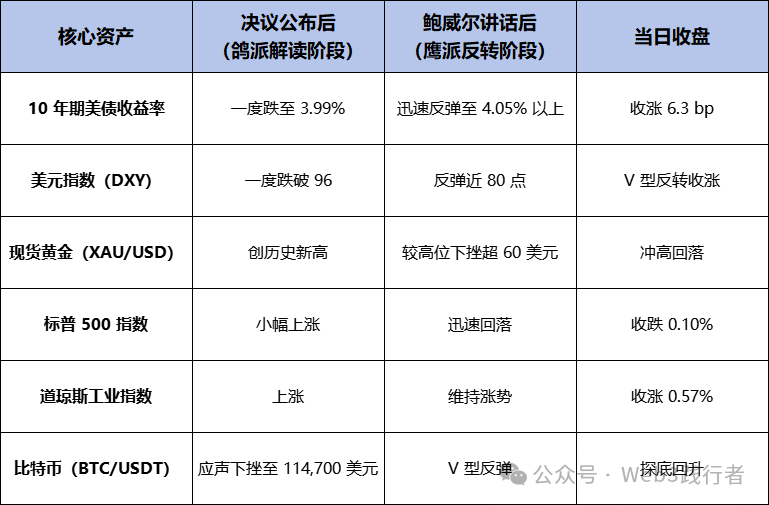
In the early morning of September 18, 2025, Beijing time, the Federal Reserve announced a 25 basis point cut in interest rates as scheduled. The initial reaction of the market was in line with classic expectations: US bond yields declined, the US dollar weakened, and risk assets generally rose. However, an hour later, Federal Reserve Chairman Jerome Powell (Jerome Powell) held a press conference, and the market trend was completely reversed — the US dollar index showed a V-shaped rebound, gold fell sharply from its historical high, and the rise and fall of US stocks were divided, and the overall situation was significantly confused.
The 25 basis point rate cut itself is not the core of the current market chaos. According to CME FedWatch tool data, the market's previous expectation for this interest rate cut was as high as 96%, which is almost a foregone conclusion. The real trigger was a deliberate but clearly broken image of “unity” behind monetary policy decisions. Among them, the only negative vote cast by White House “commissioner” Stephen Miran (Stephen Miran) was like a rift, piercing the illusion of “independence” promoted by the Federal Reserve as the core institution of the traditional financial system, and also unexpectedly gave a new value endorsement to Bitcoin as a decentralized asset.
I. The shift to “data dependency”: the logic of necessity to cut interest rates
Before analyzing the specificity of this meeting, it is necessary to clarify the central motive for the Federal Reserve to launch an easing policy at this time — the job market has sent clear signs of risk.
According to data from the US Department of Labor, in the three months up to August 2025, the average number of new non-farm payrolls per month in the US was only about 29,000, the lowest level since 2010 (non-pandemic impact period). Deeper employment indicators are also under pressure: the number of people applying for unemployment benefits for the first time has climbed to a peak of nearly four years, and the number of long-term unemployed (with an unemployment cycle exceeding 26 weeks) has also reached its highest value since November 2021. In fact, Powell already sent a signal at the Jackson Hole Global Central Bank Annual Meeting at the end of August 2025, clearly stating that “downside risks in the job market are rising,” which marks a significant shift in the Federal Reserve's policy focus from “fighting inflation” to the goal of “maintaining full employment.”

Although the market generally sees this interest rate cut as a clear move by the Federal Reserve's “dovish shift,” the existence of the three core suspense has made the impact of this meeting far exceed conventional monetary policy adjustments and push the market into a complicated situation.
II. Three major suspense: policy path uncertainty and political intervention
(1) Suspense 1: Divisive bitmap and vague path of interest rate cuts
The core concerns of the market focus on “the Federal Reserve will cut interest rates a few more times for the rest of the year.” Since interest rate cuts of 25 basis points have been fully priced by the market, the “Dot Plot” (Dot Plot) reflecting future interest rate paths has become a key guideline. On the surface, the median bitmap shows that Fed policymakers expect to cut interest rates twice within 2025, with a cumulative margin of 50 basis points, which seems to give a clear direction.
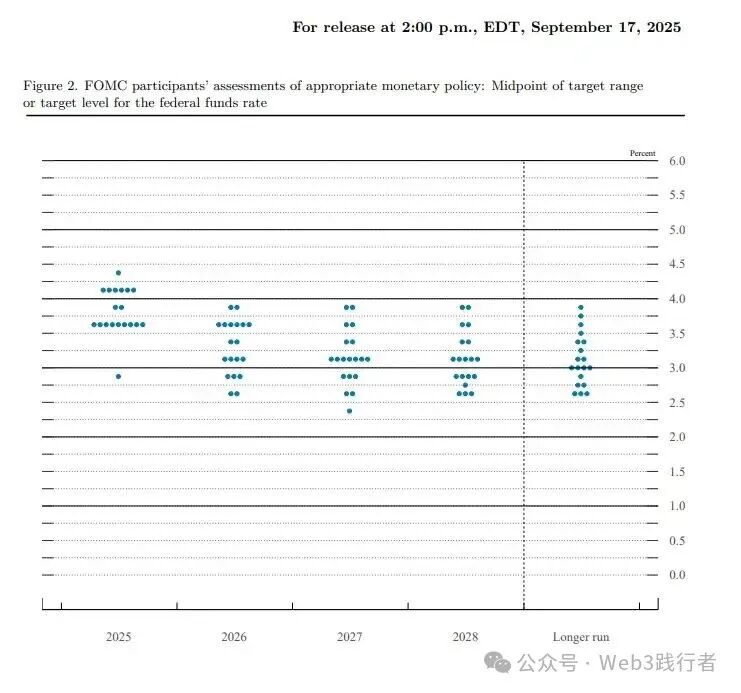
However, in-depth analysis shows that there are serious differences within decision makers: out of 19 voting committee members, 9 support two more cuts during the year, and 9 others think at most once, and some voting committees even advocate interest rate hikes; even more extreme, one forecast (the market generally believes from Milan) suggests that interest rates should be cut by 125 basis points during the year. Goldman Sachs economists have previously warned that even if the bitmap points to two interest rate cuts, the “decision-making level is less divided” market expectations are too optimistic. This marked split in predictive distribution greatly weakens the effectiveness of bitmaps as policy guidelines.
The vagueness of official policy signals is in stark contrast to aggressive pricing in the market. According to CME (CME) interest rate futures data, after the meeting, traders quickly raised the probability of continuing to cut interest rates in October and December 2025 to over 70%. This means that in the future, the market will face two possible paths: first, the Fed will adhere to a cautious stance and clash with aggressive market expectations, triggering a new round of market fluctuations; second, the Fed will compromise under the dual effects of political pressure and market expectations to begin an easing cycle that exceeds expectations. Regardless of the path, “uncertainty” will be the main tone of the market in the coming months.
(2) Suspense 2: Powell's “Balance Technique” and Policy Setting Dilemmas
Faced with internal differences and external pressure, Powell defined this interest rate cut as a “risk management (risk management) operation.” The core logic of this set of statements is to “balance both ends”: internally, by acknowledging the weakness of the job market, providing reasonable support for interest rate cuts; externally, it emphasizes that the risk of inflation still exists, suggesting that subsequent easing will remain cautious in response to aggressive pressure from the White House.
However, this “all-encompassing” balance strategy has instead caused the market to fall into a “split in policy interpretation.” As Powell said at the end of the press conference, “There is currently no risk-free policy path” — excessive interest rate cuts may exacerbate a rebound in inflation, and insufficient amounts may also trigger dissatisfaction in the White House. This core contradiction has not been resolved.
(3) Suspense 3: Unprecedented political intervention and the crisis of the Federal Reserve's independence
The central potential risk of this meeting is the direct erosion of the independence of central banks by executive power — an “elephant in the room” (an obvious problem that has been deliberately avoided) has finally surfaced.
Trump's chief economic adviser Stephen Milan only officially took office the day before this FOMC meeting and immediately obtained the right to vote. The market generally believes that this is a targeted arrangement adopted by the White House to push for “drastic interest rate cuts.” Meanwhile, Trump's attempt to fire Federal Reserve Governor Lisa Cook (Lisa Cook) was temporarily halted by the court, but related lawsuits are still ongoing. These events are no accident; they are a clear sign that the executive power directly interferes with the central bank's decisions, and Milan's only negative vote in this meeting is the ultimate expression of this kind of intervention.
While Wall Street is still struggling with bitmap differences and conflicting economic forecasts (cutting interest rates while raising future inflation expectations), the cryptocurrency market interprets a deeper macro-narrative from it: On January 3, 2009, Satoshi Nakamoto left the inscription “The Times 03/Jan/2009 Chancellor on Brink of Second Bailout for Banks” in the Bitcoin Genesis block. Its core criticism was the fragility of the centralized financial system in the midst of the crisis Sexuality and flexibility of rules.
Today, 16 years later, Milan's intervention pushes this torture of the system from the economic level to the political level — when the monetary policies of the world's most important central banks are no longer based solely on economic data, but are directly influenced by short-term political agendas, the long-term credit base of fiat currencies has been weakened. In contrast, Bitcoin's “code is law” and “rules before power” characteristics, its fixed total volume limit of 21 million units, predictable distribution pace, and decentralized nature that is not controlled by a single entity have formed a unique “oasis of certainty” in the current macroeconomic chaos.

3. Short-term risk: market game after “boots land”
Although macro logic supports Bitcoin's long-term value, judging “whether to start a market carnival” requires a clear distinction between long-term narratives and short-term transaction logic. The V-shaped reversal of the market after the interest rate cut was implemented just highlights the reality of short-term risks.
First, this interest rate cut is a “fulfillment of excessive expectations” — when the probability of an event is set to 96% by the market, it is difficult for the event itself to constitute an additional benefit; instead, it becomes a window for speculative capital to “settle in profit”, in line with the classic market rule of “buy the rumor, sell the news” (buy the rumor, sell the news) (buy the rumor, sell the news). Second, the vagueness of Powell's “risk management style” statement and the serious differences in the bitmap failed to send a clear signal to the market to “start a new easing cycle,” causing speculative bullish sentiment that had previously rushed to frustrate.
Bitcoin's price trend more intuitively reflects the market's entanglement: when the resolution was announced at 2 a.m. on September 18, 2025, the initial reaction of the market was disappointing, and the Bitcoin price quickly fell to around $114,700, showing a typical “sell in the news” market; however, unlike the continued decline in gold and mainstream US stocks, as Powell's speech progressed, the market interpreted a more dovish signal. Bitcoin immediately began a V-shaped rebound, breaking through $117,000, showing a differentiated trend from traditional risk assets.
This phenomenon shows that in the short term, Bitcoin is still classified by the market as a “high beta risk asset,” and its price fluctuations are highly correlated with macro-liquidity expectations. Therefore, market fluctuations may further intensify in the short term in the future, and any employment data or inflation data contrary to mainstream expectations may trigger a sharp correction in risky assets, including cryptocurrencies.
4. Conclusion: The core point of view beyond the bitmap
Taken together, “does the implementation of interest rate cuts mean the beginning of a market carnival” requires separate answers from the two dimensions of short-term transactions and long-term value:
From a short-term trading perspective, the answer is no. The current policy path of the Federal Reserve is full of uncertainty, and the benefits of cutting interest rates for the first time have been fully realized.Being cautious and wary of fluctuations is a more rational choice。
Starting from a long-term value investment and macro-narrative perspective, this event is just the beginning. Every intervention by the executive power in the independence of the central bank, and every contradiction and struggle in monetary policy decisions, is a realistic endorsement of the decentralized financial system, and also accumulates support for the long-term value proposition of crypto assets. Compared to a bitmap that predicts chaotic differences, what is more noteworthy is the ongoing “power game” within the Federal Reserve —The final outcome will not only determine the dollar's credit direction, but will also largely define the central role of crypto assets in the next round of the macro cycle.
Twitter:https://twitter.com/BitpushNewsCN
Compare the TG exchange group:https://t.me/BitPushCommunity
Compare TG subscriptions:https://t.me/bitpush
