


Token-maxxing for all, an arms race that no one dares to stop
Source: Late LatePost
Late Columnist 丨 Meng Xing, Partner of Wuyuan Capital
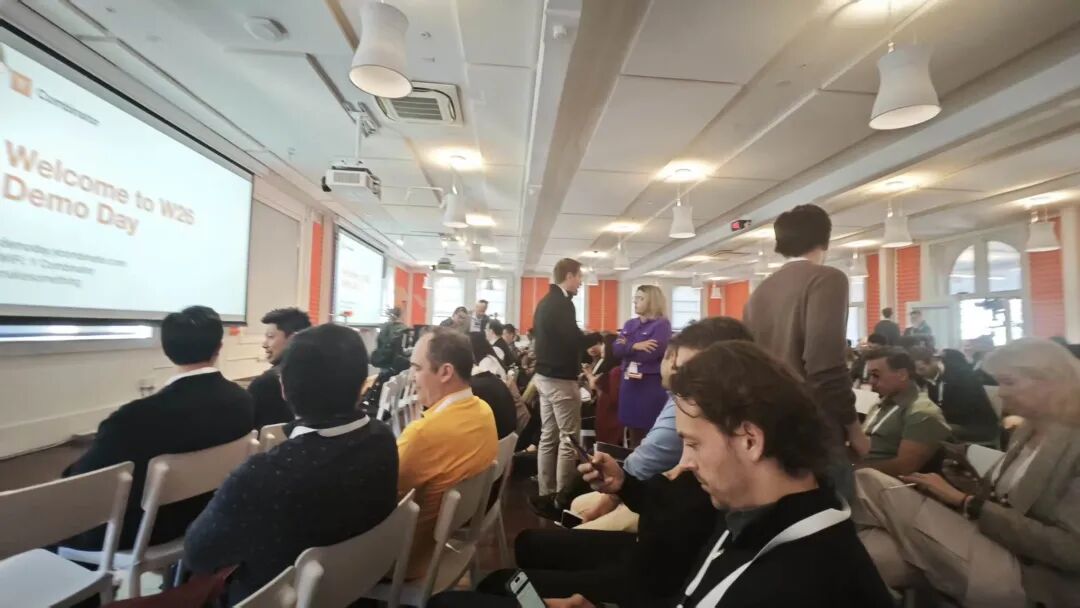
On the morning of March 24, 2026, I was sitting in the audience at YC W26 batch Demo Day, and when I heard the 5th company take the stage roadshow, I decided not to take notes anymore.
It's not that it's unimportant, but I realized that the stuff I wrote down might be out of date next month.
The work of more than 100 companies this year is actually highly concentrated: about 80% are vertical agents, such as helping lawyers sort out documents, helping customer service distribute work orders, and helping HR screen resumes.
If I had seen these projects in October of last year, I'd probably think they were “quite thoughtful.” But the problem is, in these five months, the world has changed.
Claude Code has gone from being a more developer-friendly tool to an interface that almost anyone can use directly. After Opus 4.6 came out, the entire Vibe Coding threshold was pushed to the floor.
Those vertical agents, before business barriers were formed, today an ordinary engineer, or even myself, could do it in a weekend; they have lost their investment value.
The first YC project cycle is three months. This batch of entrants in December, plus early screening, is equivalent to a “good company” selected 5 months ago. Five months, at the current rate of AI iteration, is enough for a few rounds of paradigm shift.
I first started my business in 2012, when I got YC's Fly Out (field test invitation). At that time, YC almost excelled at the accelerator circuit, and the companies selected often represented the “next direction.” However, the competitive landscape is changing, and YC feels the opposite in recent years, gradually becoming a lagging indicator (lagging indicator).
YC's batch system, from application, screening, recruitment, polishing, and road shows, has been in operation for more than ten years in the mobile internet era, and has been very successful. But this set of rhythms is designed for a slower world.
Back in the venture capital industry for a year and a half, I visited Silicon Valley about once every quarter, the last time was in October of last year. In the past, every time I visited, I felt that it was changing very fast, but most of this kind of “fast” was perceived on a monthly basis.
This time, you have to press “Week”.
At dinner one day, a friend doing post-training (post-training) casually said:
“I discovered that Silicon Valley itself couldn't keep up with itself.”
Token-maxxing for all: an arms race no one dares to stop
If someone told me six months ago that Meta's tens of thousands of engineers are all writing code with competitors' products, I'd think he was kidding.
But it's true. Everyone uses Claude Code throughout Meta. This isn't a startup, not an experimental team, but a trillion-dollar company.
Code security is no longer needed, token budgets have exploded, rankings have rolled up, and the whole of Silicon Valley is spending money on AI at no cost. But what about after you've smashed it?
Let's talk about code security first. Half a year ago, this was completely unimaginable, because code is the company's core asset, how could you let an outside company's API touch it? Meta thought the same way at first; they made something called myclaw internally to try to solve this problem. A Meta friend told me that they made a coding product, but “it's not easy to use, no one uses it.” After no one used it, the company had to relax: as long as there was no customer data involved, they loved using Claude Code.
Then, various departments began holding internal meetings on “how to become an AI native organization” to conduct training and assessments. Code safety and usage safety, these red lines, which were natural in the past, have all been relegated to the back, so let's catch up with efficiency first and then talk about it.
For security reasons, Google prohibits most employees from using competitors' tools like Claude Code or Codex, with the exception of DeepMind, where several teams responsible for the Gemini model and internal applications all use Claude Code.
Google itself isn't without effort: they launched an internal coding tool, Antigativity, and in February of this year, they also claimed that about 50% of the company's new code has already been written by AI.
But even so, the people at DeepMind still use Claude Code. One important reason DeepMind dared to do this is that Anthropic made a private deployment for them. After all, Anthropic's reasoning and training originally ran mostly on Google Cloud's TPU, and both sides have this foundation of trust. But Meta and other tech giants don't have this kind of relationship; they are actually putting code security aside. Everyone is betting on the same thing: speed up first.
Code security is only a flag on the first side; the second side is the token budget.
Among the AI-native startups that Palo Alto talks about, an engineer's annual token budget is about 200,000 US dollars. This number itself isn't unusual; what's unusual is that it means that the AI costs for a top engineer are close to an engineer's salary. It seems that the company is using AI to cut people and save money. In fact, the total cost may not have dropped at all; it just replaced human costs with token costs.
Meta is also the most extreme when it comes to this. They created an internal token consumption ranking: who uses the most, who gets on the list, and those at the end may get laid off, so Meta employees are even rolling up an unofficial title called “Token Legend.”
But at the same time, Meta laid off two successive rounds this year, adding up to tens of thousands of people. While all employees rushed for tokens with Claude Code, large-scale layoffs.
These two things are not contradictory; they are two sides of the same thing.
I visited a C-wheel company. The technical director opened Slack and showed me that all agents were running, more than a dozen Cursor agents were running in parallel in the background, and another Claude Code window was opened to schedule. The most popular anxiety in the programmer community today is: if I don't know what my dozen agents are going to do before going to bed, I'm very panicked.
But has productivity really increased that much at the same time? Since the end of last year, CTOs of many top inference engines and database companies have been very excited to tell me about “100 times engineer” and “10 times more efficient”. What used to take 60 people to do in 1 year can now be done by 2 people plus Claude Code in a week.
I was excited with them at first, but then when I calmed down, I asked the question: OK, the efficiency has increased 100 times, so the company's revenue has increased 100 times? Or has the product line expanded 100 times? You can't improve it “100 times”; in the end, how many people can be optimized?
I didn't get a positive answer. The truth is that the 100-fold increase in efficiency, when applied to the company's revenue growth, only reflects 50% or 1x.
Where's the gap? No one can make it clear yet.
“After using so many tokens, the company should have genetically mutated into a different kind of company. But I don't know what actually happened.”
A founder with a ToB sales background told me that his team of 16 people, two sales people, achieved an ARR of 30 million dollars from zero in 12 months, all of which was made with AI coding. You do see cases like this once in a while. But most of the time, what I see is that startups come up with more stuff, but these things don't have a product-market fit (PMF, product market match).
It's now very popular in Silicon Valley to try out 100 methods using vibe coding to see which one works, rather than just trying 10. But who can seize the next trend? It's still hard to say.
One counterexample that struck me the most came from within Anthropic. I asked an Anthropic friend, what was the most painful scene of using an agent yourself? He said it was oncall (immediate response).
A typical scenario for the Oncall task is: if Claude's API suddenly becomes slow to respond, a model inference node hangs, and the user reports an abnormal prompt output, Oncall engineers need to quickly locate the root cause of the problem, determine whether it is a code bug, a computing power allocation problem, or an exception in the model itself, and then decide how to fix it.
Anthropic itself is the most powerful coding agent company in the world. This scenario couldn't be any closer to their core competency, and as a result, their internal oncall agent was still not easy to use.
This is the real state of affairs in April 2026: steam engines have been invented, but sometimes they don't run as fast as horse-drawn carriages. The point is that everyone knows that steam engines will eventually run faster, so they are all frantically throwing money: they don't care about code security, the token budget has exploded, and the rankings have risen. As for when exactly did steam power actually beat horse-drawn carriages? No one knows, but no one dares to stop and wait for that day.
Because the cost of stopping is probably greater than burning the wrong token.
Also, token consumption is likely not to increase linearly. This reminds me of my previous experience with autonomous driving: in 2021, we were in Shanghai, where we achieved 5 hours of continuous autonomous driving for the first time. At the time, I thought it was a major breakthrough. Until then, the test fleet may have slowly increased to 10, 15, and 20 cars; but after that inflection point, it soon reached 100 or 1000 cars. Today's coding agents are in a similar phase.
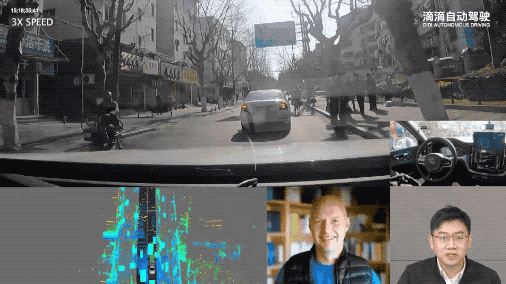
In Shanghai in 2021, for the first time, Didi Autonomous Driving achieved continuous driving for 5 hours without takeover. This is a landmark event for autonomous driving in China. The picture shows a conversation between Meng Xing, then COO of Didi Autonomous Driving Company, and Sebastian Thrun, Google's “father of driverless cars,” 2021.
METR is a research organization in California that specializes in evaluating AI coding capabilities. They proposed a metric last year: measuring how long an AI agent can complete a task with a 50% success rate (based on the completion time of human experts). When it was first released in March 2025, the Claude 3.7 Sonnet figure was still 50 minutes; by the end of 2025, Claude Opus 4.6 had reached 14.5 hours. Over the past two years, the doubling cycle of this indicator has been reduced from 7 months to 4 months. Once the agent's reliability reaches the next level, token consumption is not a matter of increasing 50% each year; it is an order of magnitude overnight.
There is a prediction that was shared by friends. By the end of this year, many companies (including big tech companies) will actually only need 20% people.
After the xAI team avalanche, rocket builders started making models
At a steakhouse in Mountain View after 9 p.m., a friend who had worked with Musk for a long time sat across from me. After talking for more than three hours, I later recalled that he didn't seem to have said a single good thing about Musk during the whole process.
One detail: I asked him, you've been working at xAI for three years, how is your daily rhythm? He said that he has mostly stayed at the company for the past three years, so his home was not furnished much, and he didn't even buy a bed. I slept in the same kind of sleeping pod (sleeping bunker) at the company, similar to a youth hostel. I said that now you have a huge amount of equity, and you've all left your job; why don't you buy a bed. He laughed.
xAI's work intensity is famous in Silicon Valley, but now the early team is about 90% gone. They have an ex-employee group and are adding people every day.
The trigger was Tony Wu's departure, then a chain reaction. In the words of an insider, “Other companies may need to leave their executive team after half a year; xAI only needs a month.” Some people sensed Musk's dissatisfaction in October of last year, but they didn't expect to clean it all up so quickly.
Now Musk is starting to transfer people from SpaceX and Tesla to take over xAI, and “the people who make rockets are starting to make models.”
Musk's dissatisfaction comes from the fact that he has spent countless money and computing power. As a result, Grok has never been able to enter the front line, but why? This is a question that every person I meet xAI asks. The answer is actually simpler than I thought. A friend said it very directly: the team is very strong and the work is extremely hard, but the way the manufacturing industry is managed is probably not suitable for big model companies.
I've been autonomous driving for eight years, and I have some feelings about it. When Musk used to do SpaceX and Tesla, he essentially did system engineering: the link was very long, involving software, hardware, and the supply chain. Every piece had room for innovation, but in the end, it was an end-to-end engineering problem.
What he is good at is identifying key leverage points in this kind of long chain and then compressing the timeline to the limit to overcome it. Rocket engine cascades and reused landings are all products of this kind of thinking.
But at xAI, he doesn't do anything like systems engineering. He has now done three things: first smash the world's largest GPU cluster (even today people joke that xAI was originally a Neo Lab, but now it's more like a Neo Cloud, providing computing power to Cursor), then set a pulse-like deadline for the team, and then shoot some product features himself. This is grasping a few points, not making a complete plan.
Everyone who does autonomous driving knows that in the early stages, “who leads whom” between the software team, the infra team, and the hardware team becomes a core conflict. All three directions require someone at the CTO level to make decisions, yet no one understands these three areas at the same time. A good practice is that although the founders don't understand everything, they know how to balance resources and determine phased priorities. During this period, software was prioritized, and the next stage was promoted to INFRA. This is called having an overall plan.
The problem with xAI is that it doesn't have this overall plan, only sprints. If the pressure isn't that great, smart people can actually heal themselves. Give them time, and all directions will find their own rhythm of collaboration. However, Musk's ultra-high-pressure management, combined with inadequate overall planning, dissipated as soon as the pressure dissipated. Leaders in every direction maintain their own priorities, and no one is responsible for overall coordination.
One reason why SpaceX and Tesla have been so successful is that in these two industries, Musk has hardly met rivals of the same level; he has competed with himself. But AI is different; AI is a level of fierce competition where even OpenAI can be stolen by Anthropic.
A friend at Top Lab said last year that there were two things he didn't expect: the first was that competition was so fierce, and the second was that there were so few opportunities for application innovation in the AI era, and they were all eaten up by models.
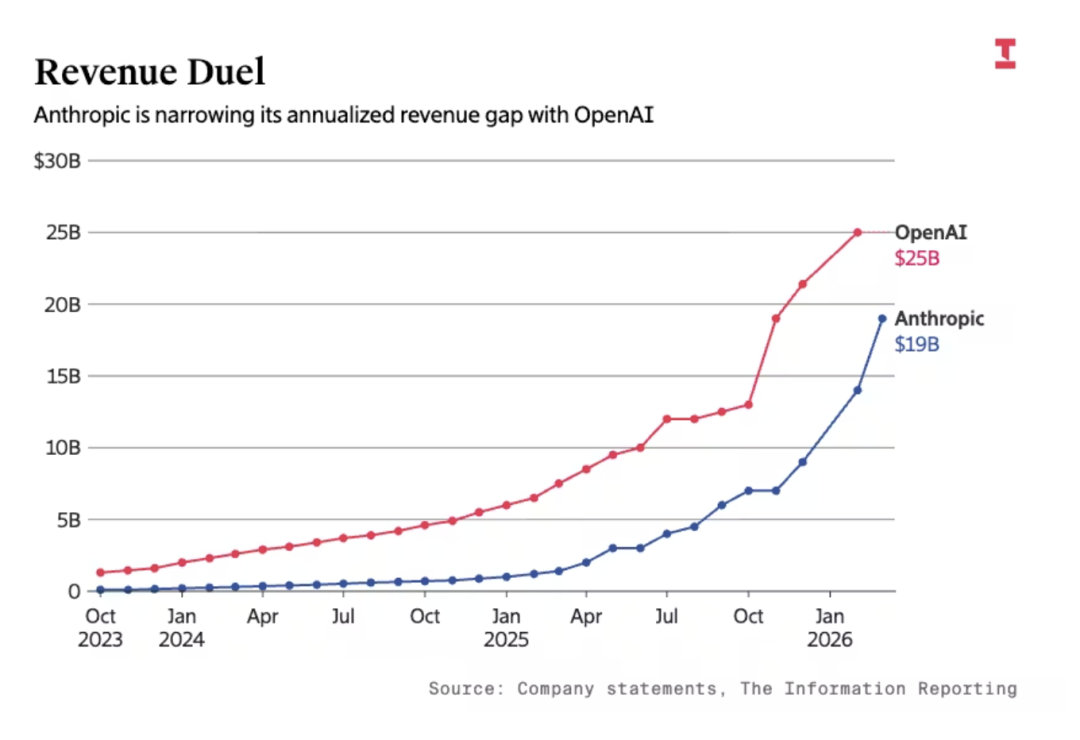
The rise of Anthropic is the most dramatic reversal in the AI industry in the past year. It also completely changed the focus of the battlefield: a year ago, everyone was still counting the number of users and video generation on the C side, but now the battleground that determines victory or loss (in stages) is ToB and coding.
Of course, the story of xAI is also a “what happens if money comes too fast and too much”.
I think the friends who left xAI today won't regret their decision to join back then. xAI can be described as the myth of making wealth the fastest in Silicon Valley. It only took xAI a year from the first round of multi-billion dollar financing to today's merger with SpaceX to become a $250 billion giant. Almost all of xAI's 11 cofounders have become Billionaires, and the core engineers also have tens of millions to 100 million US dollars, which is really too much money in Silicon Valley. Today, if they start a business again, they will be fully motivated to do what they are interested in rather than making quick money.
Anxious Engineers, More Anxious Worries
Chatting with engineers, I now have a strange tacit agreement: everyone admits they don't write much code, but they all pretend that this isn't a big deal because they'll be armed by AI and kill engineers who aren't AI enabled.
Today, 80% of software engineers' core skills have been replaced by models, and the reason they remain is that models are occasionally stupid and require people to watch. But “watching” the thing itself may soon be unnecessary.
More aggressive: Today's so-called “AI native organization” sounds very sexy—it allows each department to sort out the workflow, and online and write the parts that can be involved by AI into skills. But essentially, you're distilling yourself from human flesh: you turn your abilities into machine skills, and the company gets your skills, and has actually completed AI. Whether to lay off employees as a result is a moral question. This is what Meta is doing today.
Although everyone is token-maxxing today, you can still feel a sense of anxiety that pervades the bottom of Silicon Valley.
What I didn't expect even more was that this sense of anxiety was spreading to people in the past.
Talents are the top talent in the pyramid. It does not refer to “researchers” in general, but rather the group of people responsible for model training and algorithm innovation in big model companies (OpenAI, Anthropic, DeepMind, etc.). The difference between them and engineers (engineers) is that engineers “make things”, write code, deploy, and optimize performance; engineers “think out something” more upstream: put forward new training methods, design model architectures, and run experiments to verify hypotheses.
Now, even the process itself is being automated. This is what DeepMind's students are doing — using models to train models, and it's also the self-evolving AI that sparked the Silicon Valley fire this year. Engineers (engineers) were eliminated this year, and engineers will begin to be replaced by the end of the year.
This is not a new concept anymore. Andrej Karpathy's auto research (automated research) started. Today, various AI scientist tools and harness frameworks are moving in this direction. However, most closed loops currently only reach the “paper sending” level — AI helps you run experiments and write papers, but in the end, people are still making decisions.
Companies like OpenAI, Anthropic, and Google want to be more aggressive: they want to go directly to the model upgrade itself in a closed loop, not just detailed improvements, but let AI find the next paradigm breakthrough on its own. If this thing can be done, it's really replacing cheating. Google DeepMind did this internally more than a year ago, letting the model decide what experiments to run next, evaluate which path is more promising, and then follow that path. This is how the model is training its next generation.
Moreover, sanctions were more motivated to be adjudicated for a very cruel reason — because it was expensive. There are probably only a few thousand people around the world, and their annual salary can easily be millions, tens of millions, or even hundreds of millions of dollars.
“The future may be where 10 people do the work of 100 people, get 20 payments, and then 90 people lose their jobs.”
And the real layoffs are bigger than the numbers on the face. Many companies are not the first to slay their financial statements; it is the outsourced service provider. This means that India and the Philippines, countries that once undertook customer service, data labeling, and financial back-office in Europe and the US, are probably the first to be hit. The “service ladder” that some developing countries rely on to upgrade their economies may be being removed by AI.
The whole of Silicon Valley is watching Meta. If its experiment succeeds — revenue loss and efficiency actually improves, other big companies will quickly follow suit, and layoffs will become the norm in the industry. Moreover, layoffs have a cruel self-acceleration mechanism: in the beginning, people were afraid to be judged, for fear of hurting morale; once it became the norm, the faster the layoffs, and the less distressed they were.
However, while old jobs are being laid off, new ones are also popping up.
Many startups are starting to recruit a new role called an “AI builder” — merging product managers, front-end engineers, and back-end engineers into one. Another type is a complex job that combines data scientists and machine learning engineers, and integrated content traders that combine writing, delivery, and operation.
Silicon Valley companies are in high demand for these new roles, but the core challenge is: no one knows how to recruit them. You can't screen it out with a resume, because this character didn't exist before, and this person's abilities are probably all hidden in his own project; you can't even find out if you write code on site, because the core ability is a combination of “aesthetics + ability to use AI.” Therefore, there are already startups doing this: automatically generate a simulated environment based on the employer's needs, and allow interviewers to complete tasks on site using AI tools. It's a bit like the previous coding test (programming test), but it's a completely new kind of test.
At a time when AI can do anything, human value is changing from “what it will do” to judging “what is worth doing and what not.”
With two valuations in one round of financing, Nvidia has to win chips on every “card table”
I've mentioned so many people who have been replaced — engineers, entrepreneurs, financial practitioners. But one character not only wasn't replaced, but instead became more and more like the boss behind the scenes in this shuffle.
In this seemingly distributed world of innovation, the bottom layer is actually extremely centralized.
This center is Nvidia.
I thought the scarcity of cards had abated in the past year. It did slow down for a while. In mid-2025, some Neo Cloud (a “new cloud service provider” that emerged during the AI wave) did not have smooth financing, some business growth was weak, and some companies even sold out at that point in time. But on this visit, I discovered that scarcity is back, and it's even more outrageous than the last time.
A specific signal: if you can provide a stable API service today and achieve 99th level stability, you can sell two to three times the price of an official API.
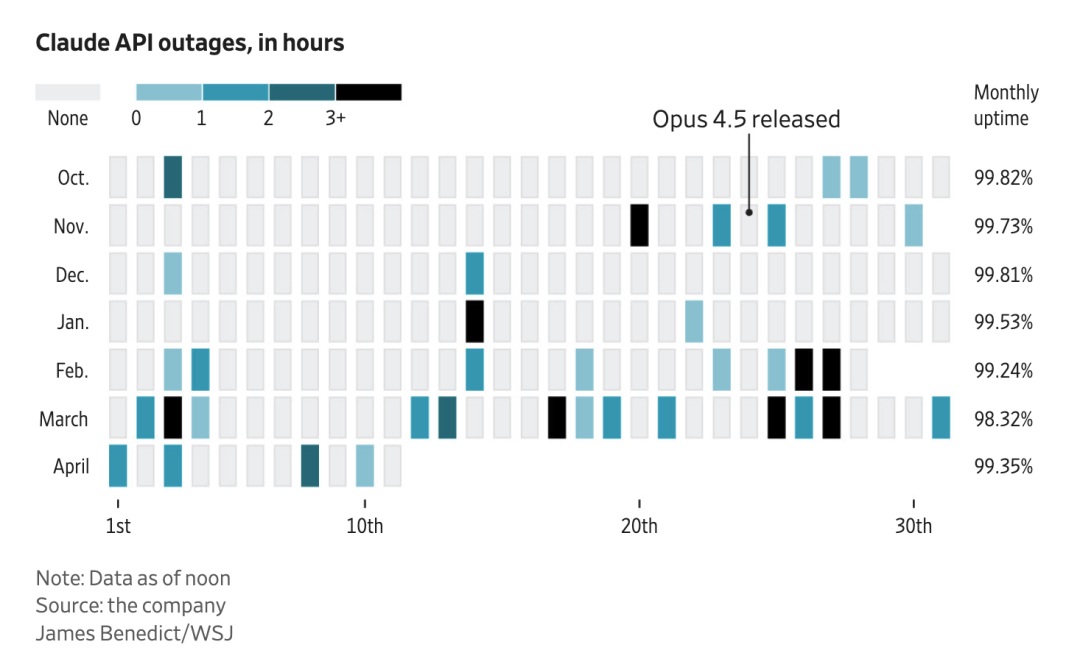
After Anthropic's demand skyrocketed, API outages are increasing, which is a bit of a problem for many Agent products built on top of Claude
I used to do a router (routing service) business, which was “I'm cheaper than the official one, so I have traffic.” Now the logic has completely reversed: stability itself has become a scarce resource. A number of startups have made quite a bit of money from this, and now a mini version of Coreweave/Nebius is springing up in Silicon Valley.
Moreover, the computing power bottleneck this time is not just a GPU allocation problem. Elad Gil recently wrote a judgment I agree with: the production capacity expansion cycle of upstream memory manufacturers (Hynix, Samsung, Micron) will take at least two years. This means that until 2028, no AI company will be able to significantly bridge the gap with heap computing power. Computational power constraints objectively reinforce the oligarchy pattern in the big model market — it's not that anyone doesn't work hard; it's that the physical world's manufacturing cycle is just that slow.
The power structure behind it is clear: it is up to Nvidia to decide who has the card who is good and who has the card. Nvidia is behind CoreWeave, Lambda, and Nebius that went on sale today.
Nvidia's layout is deeper than I have understood before. Reflection's investors and I mentioned that when this Neo Lab first came out for financing, it was for coding, then the founder went to meet Hwang In-hoon. Hwang In-hoon told him, “Don't do coding, you come out and make an “American DeepSeek”, make an American open source model, and I'll give you money for a card. Reflection has made a 180-degree transformation.
As a result, the US capital market has also developed some structures that were rare before: the same round of financing, with two valuation levels. Investors with good relationships and early entrants are in the undervalued category; bosses like Nvidia, who are not bad at money, and investors who arrive late have been squeezed into the overvalued tier. This kind of structure has also recently begun to appear in China.
However, no matter how Nvidia wanted to control distribution, it couldn't come up with something that didn't exist.
Across American society, protests against data centers are escalating. Today, around 100 data center projects across the US are being blocked, and 40 of them will be directly aborted. Maine just passed a bill completely banning data center construction. A town approved a $6 billion data center project. As a result, half of the members were voted out overnight. The sole purpose of the new recruits was to reverse that decision.
Computing power isn't enough, not because the product isn't good enough, there aren't enough users, or because the physical world can't keep up with the digital world's appetite.
This is another level of “not keeping up.”
Silicon Valley's valuation system is being rewritten
Let's look at a number first.
The US GDP is around $30 trillion. Both OpenAI and Anthropic currently have revenue run rates (annualized revenue) of around $30 billion, which means that the two companies each account for 0.1% of the US GDP. If both companies hit 100 billion by the end of the year, plus cloud services and other AI revenues, AI will account for about 1% of the US GDP. It only took a few years to go from almost zero to 1%.
This speed is unprecedented. But strangely enough, the faster the growth, the less investors know how to price it — in the face of such rapid growth, Silicon Valley's valuation framework is collapsing.
This time, I had a few rounds of in-depth discussions with many friends in the secondary market. One word that came up over and over was “re-rationalization” (rational return to valuation).
Investing in AI in the past few years, everyone's valuation logic is based on future cash flow: it doesn't matter if you lose money today; I'll bet on your ARR in three or five years. But now, something is wrong with this framework.
The problem lies in DCF (Discounted Cash Flow), the most basic valuation model. If you do DCF normally, you forecast the cash flow for the next 10 years and then add a terminal value (final value), that is, assuming that the company will continue to operate steadily later, and package the remaining value in one package. Typically, terminal values account for 70%-80% of the total valuation.
But now two things have changed at the same time: first, you can probably only predict 3 years instead of 10 years, because you can't see clearly what the industry will look like in 3 years (sometimes even 1 year); second, it's even harder to calculate terminal value. It presupposes that the company will eventually continue to operate steadily, but if AI can disrupt everything at any time, the “stable operation” hypothesis doesn't hold true.
I talked to a second-tier investor friend about an analogy: a company that isn't on the main AI channel today is more like waiting for a “nuclear bomb.” You know it will definitely be disrupted, but you just don't know when. Then the focus of your assessment should not be “what would happen if it wasn't disrupted,” but “how fast you can respond when disrupted.” This is an entirely different valuation logic.
SaaS was the first to be repriced by Wall Street. When Snowflake was in 2023, it took almost 100 years to pay back in terms of free cash flow, but now valuations are falling short. ServiceNow and Workday are also in the same trend; this is just the beginning.
Or even the other way around, the only ones that are really suitable to use DCF for valuation are probably the leading model companies, because relatively speaking, their future seems to grow steadily in a positive direction; they won't be “bombed,” but rather look at how wide the border can be widened.
In the past, the rhetoric of startups recruiting people was “the salary is a little lower, but you are given options, the future is worth a lot of money.” But the premise of this rhetoric is that the company is still alive and worth the money 15 to 20 years later. If that premise doesn't hold up, the most rational response from employees will be — “Don't give me options, just raise my cash.”
This, in turn, will change the company's cost structure and financing logic.
The VC side is also suffering. In the past 3 to 6 months, almost every fund in Silicon Valley has invested in at least one Neo Lab. Researchers from famous AI labs have raised hundreds of millions of dollars with their own ideas. But now, everyone feels a bit impulsive and a bit expensive afterwards. But why did they still vote? Because if this company actually makes it, it will grow so fast that you think the original valuation was very cheap.
An investor friend put it bluntly: anyway, zero to 100, or zero to zero, instead of investing in an expensive A round to earn “hard money,” it's better to bet on a ticket to Neo Lab, which has endless possibilities.
In the past, people thought 1 dollar ARR was 1 dollar ARR, whether you were making a model, an application, or an infra. But now, that equality has been broken.
Being a vertical agent has the lowest multiplier (about 5 times), being a general agent has a higher multiple (about 10 times), and the highest for models (20-30 times ARR, such as Anthropic 30B ARR, 800B US dollar valuation, 26.7 times). A year ago, I thought it would be fine to calculate the valuation by multiplying ARR by a uniform multiple, but today this algorithm is completely wrong.
The lime tree and AI assassination list
Silicon Valley is experiencing a deep security crisis.
On this trip to Silicon Valley, I heard my friends seriously discussing the same thing over and over again: buying bitcoins, building bunkers, and installing bulletproof glass for the home. None of them were kidding.
It's true that lime trees are popular in Silicon Valley these days because these trees have 4 inch spikes on their branches, and anyone who tries to climb over them will pay a price.
The Wall Street Journal even reported on a $15 million “fortress mansion”: a circle of lime trees in a concrete flower pot, a ditch behind the grove, a laser intrusion detection system behind the trench, a 3-inch solid steel plate with 13 locks, and a safety shelter with a 2,000-pound door hidden inside. Even the landscape design was fortified.
The company that provides home security for CEOs recorded the highest level of growth since 2003. In particular, after the UNH CEO was shot and killed on the streets of Manhattan, this trend suddenly accelerated.
Then, gunfire rang out at the AI boss's door.
At 4 a.m. on April 11, a 20-year-old boy in a Champion hoodie flew from Texas to California, carrying a kerosene can, standing in front of Sam Altman's $27 million mansion, ignited a petrol bomb and threw it in.
An hour and a half later, he showed up at OpenAI's headquarters, picked up his chair and smashed the glass door, and shouted at the security guard, “I'm going to burn this place down and kill everyone inside.”
The FBI found a document from him. The title is “Your Last Warning.” It lists the names and home addresses of several AI company CEOs and investors.
Two days later, in the early hours of Sunday morning, Altman's home was attacked again: a Honda car paused in front of the door, the co-pilot stuck his hand out the window, shot the house, and fled.
This is not an isolated incident. At the end of March, there was already a large-scale anti-AI parade in downtown San Francisco. Crowds held “Stop the AI Race” (Stop the AI Race) and “Don't Build Skynet” (Don't Build Skynet) signs and delivered speeches outside the offices of Anthropic, OpenAI, and XAI. Senator Bernie Sanders warned in Congress: “Humans may actually lose control of this planet.”
Talking to xAI's friends, it is said that Musk is also very worried that he will be shot. This is an open secret in the community.
The fear behind it is actually quite simple: if AI takes over most of production and people are no longer necessary participants in the operation of the economy, then all past social contracts about “how much you contribute and how much you should share” will all come to naught. All that's left is a minimal power structure: Whoever controls the GPU and power controls everything. The classes are not being pulled apart; they are being crushed: very few people on one side and everyone else on the other.
“The most popular campaign theme in the US election two years from now is definitely the relationship between AI and society. There will even be a Lourdes movement in the AI era.”

Inflation in the US is still very serious. I've lived in California for many years, and I've never seen an oil price with the letter 7. Coinciding with Citrini's Global Intelligence Crisis (AI Doomsday Report) at the end of February, the scenario suggests an economic crisis that could occur in 2028 because AI was “too successful”...
Epilogue
On the flight back to Beijing, I looked through my notes for half a month and found that the same words were written from beginning to end: “Can't keep up.”
YC can't keep up, Meta's code security rules can't keep up, xAI's management can't keep up, computing power can't keep up, the valuation framework can't keep up, society's psychological tolerance... so much so that Silicon Valley itself can't keep up with itself.
But the last thing I want to say is that an Anthropic friend mentioned that Dario Amodei said internally: With the help of AI, cancer has been overcome in a sense, not that it has disappeared, but it may become a chronic disease that won't die. However, treatment is still too expensive, and it will take time to spread.
I'm not sure if Dario's statement “cancer has been overcome” is too optimistic, but in Silicon Valley this time, the entrepreneurial direction we saw the most was AI4S and AI for Biotech. Many people from big model companies don't understand medical treatment, but they want to use AI technology to change the industry.
I've seen so much “not being able to keep up” in the past half month, which is really unsettling. However, if AI actually turns cancer into a chronic disease within a few years and makes materials science fast forward by 20 years, then this “failure to keep up” may be the biggest acceleration in human development history.
My baby is 2 years old, and they may have a second child next year. What kind of world will their generation face, I have absolutely no imagination to build it right now.
But I hope that in a world where they grew up, there will be more people being cured by AI instead of more Molotov cocktails and gunfire hitting the doorsteps of AI practitioners.

Paul Graham wrote in Cities and Ambition (Ichii Ambition) in 2008: “Although people in Silicon Valley respect wisdom very much, the signal that Silicon Valley sends is that you should be more influential, which is not exactly the same message that New York sends. Of course, influence is important in New York, but New York highly respects “one billion dollars,” even if you only inherited it. But in Silicon Valley, apart from a few real estate agents, no one cares about this at all. What really matters in Silicon Valley is how much impact you have had on the world. People care about Larry and Sergey not because of their wealth, but because they control Google, which affects almost everyone.” Today, AI is taking this atmosphere to a new peak.
Twitter:https://twitter.com/BitpushNewsCN
Compare the TG exchange group:https://t.me/BitPushCommunity
Compare TG subscriptions:https://t.me/bitpush
