


The disappearance of 10-year funds

Source: The Odin Times
Author: Dan Gray
Compiled and organized by: bitPushNews
Benchmark venture capital funds taught in business school programs and thousands of limited partnership agreements (LPAs) usually last for ten years. Capital is collected and invested in the startup portfolio during the first three to five years; in the remaining five years, funds are recovered as these companies are sold or listed. The limited partner (LP) recovers the principal amount, and any returns the general partner (GP) manages to generate, then the fund is liquidated and closed.
It was a textbook version of venture capital, but today, it's largely gone.
In April 2026, Robert Bartlett and Paolo Ramella of Stanford Law School published a paper exploring the impact of extended liquidity periods on venture capital. This article is called“The Disappearance of the Ten-Year Fund” (The Disappearance of the Ten-Year Fund)The paper used quarterly cash flow, net asset value (NAV), and portfolio company-related data from PitchBook covering funds established between 1995 and 2014.
Their study found that the ten-year period (which theoretically anchors fund accounting, performance reporting, fundraising cycles, and LP expectations) no longer corresponds to the underlying economic conditions of the venture capital market.
“In the later stages of the fund's existence, unrealized net asset value (Unrealized NAV) rose sharply in all years of the fund, particularly in the venture capital sector. Many funds continue to allocate funds even after 20 years.”
For funds from 2010 to 2014, the net asset value (NAV) reported by medium venture capital funds in year 10 still exceeded their total paid-up capital. When the vehicle should theoretically be finalized, such a large percentage of the fund's value was still unrealized.
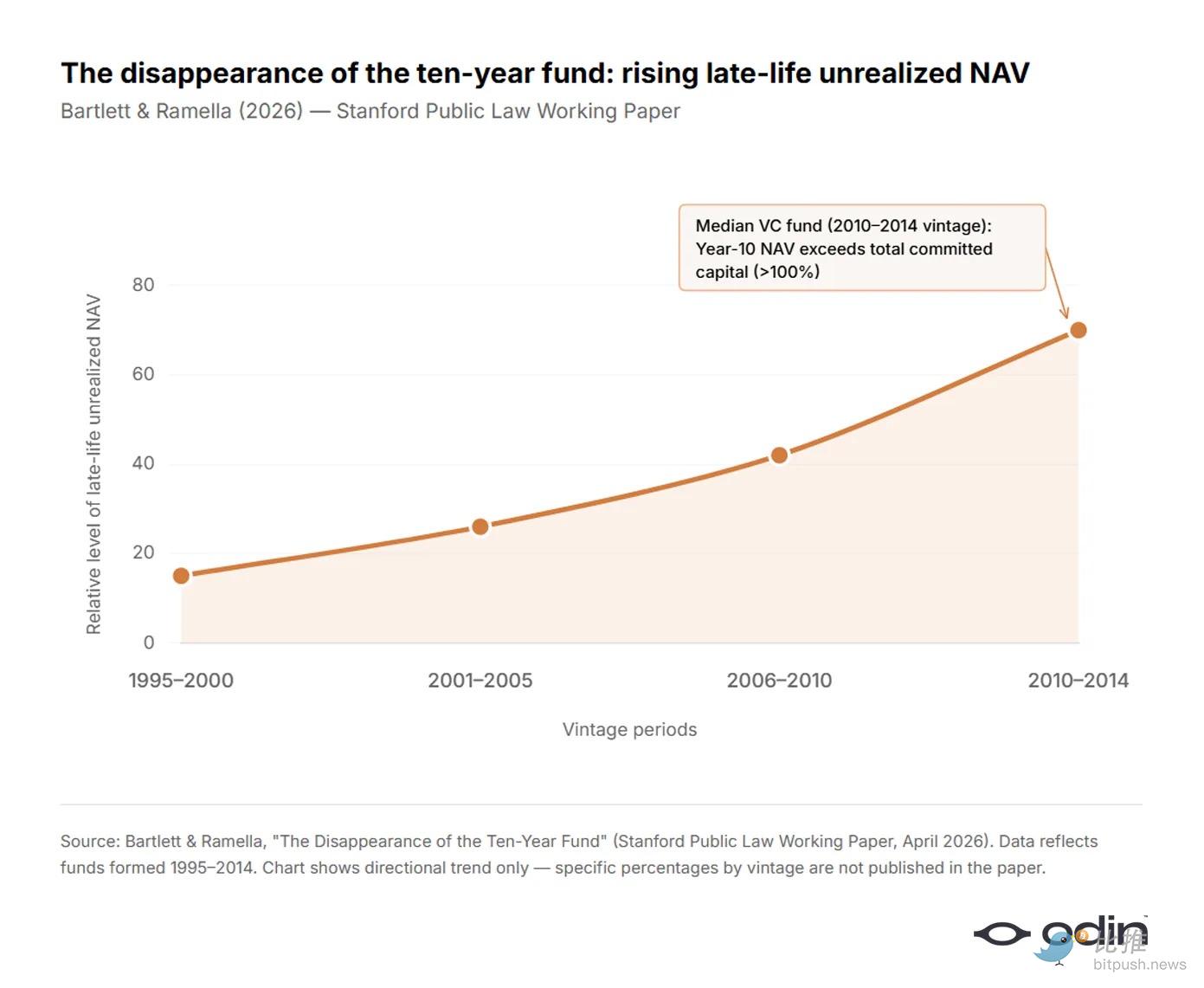
Bartlett and Ramella observed that the extension of fund terms was not because modern funds were slower to convert net asset value into cash than their predecessors; there was no significant change in the speed of distribution after the liquidity incident. The core reason is that portfolio companies have been privatized for longer and have become larger.
“Higher net asset values in the later stages mainly reflect greater value creation: portfolio companies holding these funds reached significant increases in valuation in the 10th year and showed more extreme 'right tail' (excess returns) results.”
From a time value perspective, the impact of extended liquidity periods on venture capital performance is clearly negative. If significant amounts of value remain unrealized by year 10, then the medium-term internal rate of return (IRR) must mix actual allocations with valuation predictions. As the liquidity period lengthens, these indicators will drift downward unless the unrealized portion increases in value at an unusually rapid rate.
This downward drift is systematic, more evident in venture capital than in private equity (PE), and has been more prominent in recent years of annual funds, where the late-stage net asset value of these funds expanded the most.
“When evaluating managers (especially venture capital managers), investors should expect IRR to shrink even more when significant amounts of value remain in net asset value, even if the current medium-term IRR looks strong... These findings challenge the use of 10-year fund structures and interim performance indicators as reliable guides for measuring the exit timing, risk, and performance of private equity funds.”
So if the ten-year structure is functionally inoperative, why is the industry still using it?
Parkinson's law
Industry practitioners have been vaguely aware of the current situation of extended deadlines for many years. In some ways, this is the same as Parkinson's Law (Parkinson's Law):
“Jobs automatically expand and take up all available time.”
In the context of venture capital, this can be rephrased as:
“The foundation automatically expands to absorb all the capital available for management.”
This reflects a shift in goals: from a fiduciary responsibility relationship that delivers the best results to a service relationship that manages large-scale capital to meet the large LP groups that need to allocate funds under the “venture capital” label.
As a result, Silicon Valley Bank (SVB)'s “State of the Market Report for the First Half of 2026” describes a venture capital market that has split into two fundamentally separate industries, although they still operate within the same distribution pool. At one end is a large-scale growth round led by mega-funds (Mega-funds); at the other end, there is a shrinking, self-disciplined group of early-stage investors. In 2025, 33% of the nation's venture capital went to the top 1% of valuations, compared to just 12% in 2022. The “mega fund sector” with more than $500 million in financing accounts for a market share far surpassed its peak in 2021.
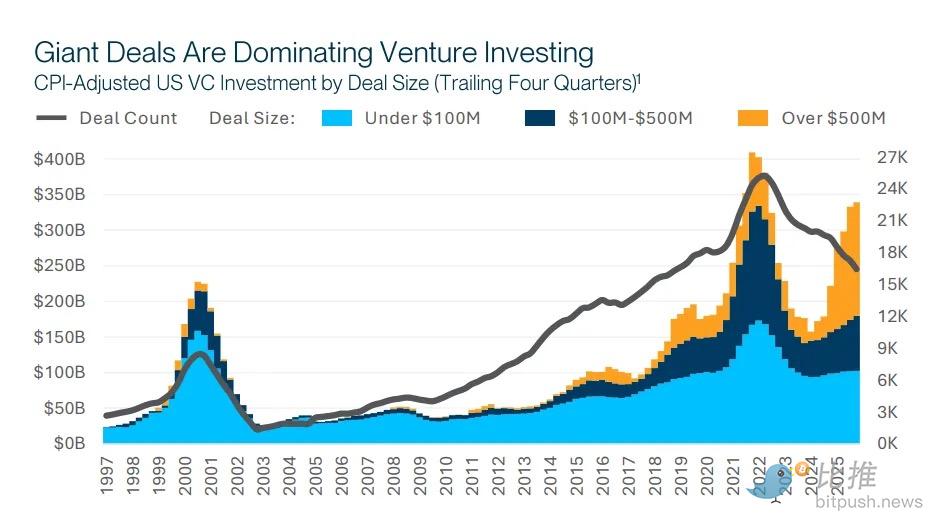
“Market Status Report for the First Half of 2026”
Within this distorted market, fund delays have become the norm for LPs. Top funds usually take 16 to 20 years to fully return capital. A large portion of the funds from 2010 to 2015 remained active, with substantial net asset value on the books.
The traditional “harvest period” has been replaced by an “extended growth period”, which has created room for downstream capital from larger funds. Companies in modern portfolios often continue to expand in scale even after the 10-year mark, and the expansion is astonishing.
Therefore, the point of contention is not that capital is trapped or that there is no output at all, but rather that it caused the investment span to exceed expectations when the LP was initially signed, and the final performance was put a huge question mark.
paper tiger
If the 10-year structure has been removed from the reality of venture capital, why hasn't it been replaced? The answer is that it performs several functions unrelated to actual fund results.
The LP compares funds by year and uses these reference points for portfolio construction decisions. Cash flow models for pensions, endowments, and sovereign wealth funds are built around predictable distribution plans. Thus, even if the underlying funds routinely break these plans, these timelines provide an illusion of standardization, making comparisons possible.
Ten-year funds are easy to understand for the board of directors, trustees, and anyone who has to explain such assets to non-professionals. Investment tools with an indefinite perspective can be more uncertain and therefore harder to defend, even if they are closer to the truth. The industry continues to write 10-year LPAs, in part because change is painful and raises too many other difficult questions.
Subsequent funds are usually raised three to four years after the previous fund closes. The implicit assumption is that when new instruments begin to be invested, the previous fund will approach the early allocation phase. However, when pioneering funds hold large amounts of unrealized net asset value after the scheduled end date, an embarrassing overlap occurs. GP was asking LPs to be assessed based on interim performance indicators, and as Bartlett and Ramella demonstrated, these metrics were mechanically pushed up by these unrealized positions.
normalization of deviations
“Normalization of deviance (normalization of deviance) is a term first coined by sociologist Diane Vaughan when reviewing the Space Shuttle Challenger disaster. Vaughan points out that the cause of the disaster was that NASA officials repeatedly chose to fly the space shuttle when the O-ring design was dangerously flawed. Vaughan described this phenomenon as people within the organization becoming so numb to abnormal behavior that they no longer think it's wrong. This numbness is subtle and sometimes lasts for years, because disasters don't break out until the other critical factors come together.”
-- “When Mistakes Feel So Right: Normalizing Deviations,” by Mary R. Price and Teresa C. Williams
While maintaining this comfortable status quo is in the interests of the most profitable managers, it is not without costs.
First, the GP and LP relationship began with a lie, which isn't a good precedent. If both parties did not expect this to be a 10-year fund and then sign a contract that clearly recognizes this structure, it is questionable whether other contractual obligations are also viewed as a “rough guide.”
Long-standing unrealized positions coexist with subsequent fundraising, putting pressure on the LP model. GP also oversees old assets and markets new tools, leverages overlapping resources, reports on overlapping metrics, and benefits from overlapping management fee streams.
Another concern is the so-called “re-risking trap” (re-risking trap). A giant fund with billions of dollars in dry powder (capital to be invested) pushes the company to carry out larger, higher-valued financing, and bet on power-law returns that can support its scale. This model allows risk to stay high for a long time far beyond the traditional venture capital curve. A company that could have been profitable through an early exit of $200 million is now being forced to go through Series E funding to pursue multi-billion dollar results, because for a $5 billion fund, no smaller amount can have a real impact. Small and medium-sized managers who could have profiably withdrawn at a lower threshold have also been involved in the same long-term game, even though their fund's economic model, shareholding ratio, and investor expectations are completely different.
Permanent capital
“Ironically, innovation in the venture capital industry hasn't kept pace with the companies we serve. Our industry is still plagued by the rigid 10-year fund cycle that began in the 1970s. When chips are shrinking and software is flying to the cloud, venture capital is still using “floppy disks” in the commercial sector. Once upon a time, a ten-year cycle made sense, but the assumptions it was based on no longer hold, leading to a premature break in meaningful relationships and misplaced the company with its investment partners.”
—— Roelof Botha, Sequoia Capital
The restructuring of Sequoia Capital (Sequoia Capital) in 2021 was the most public acknowledgement by the top institutions in the market that the 10-year fund has become a liability. By moving to an open structure, Sequoia can hold post-IPO positions indefinitely, fund new investments through internal circulation rather than cyclical LP promises, and provide LPs with semi-annual redemptions rather than fixed allocations. This model is similar to a hedge fund grafted onto a venture capital franchise. The reason it works is because Sequoia's past performance allows it to innovate without frightening LPs.
Other large companies have taken similar actions. Andreessen Horowitz and General Catalyst are registered as investment advisors (RIAs), expanding the flexibility to hold open market securities and pursue non-traditional asset classes. In practice, the architecture of giant companies has abandoned the ten-year deadline. What remains of the LPA is just a “degenerate organ” retained due to routine and regulatory familiarity.
The biggest investors that entered the venture capital sector on a large scale during the 2015-2022 boom were sovereign wealth funds, pensions, family office platforms, and cross-border funds, all of which operated indefinitely or for an extremely long period of time. This capital went to giant funds, which invested it in extremely highly valued large-scale financing. Companies that have received these funds have no reason to rush to go public and are more capable of expanding in a private state. The ten-year framework designed for the era of small funds and rapid exit is no longer able to support a market that has surpassed it.
For an institution of this size, the logical response is the Sequoia model: permanent capital, an open structure, and an indefinite vision, which matches the underlying economics of holding power law winners and continuing to compound them.
Agile capital
The same logic doesn't apply to small funds, where the analysis went in the opposite direction; instead, regulated 10-year funds were beneficial.
This part is about the “law of large numbers,” and part is about the “shareholding ratio.” A small fund that focuses on early rounds and is moderately valued can turn an extraordinary exit into an event sufficient to pay back the entire fund, which large funds cannot. In order for a $1 billion fund to generate real returns, managers need to create $3 billion or more of realized value, which requires many big results or a truly astronomical result. Mathematical pressure pushes big funds into a “re-risking trap,” while small funds are being disciplined to generate the best return on venture capital in history.
A paper published in The European Journal of Finance (The European Journal of Finance) by Guanrou Deng et al. 2025 illustrates this. Using a serial investment allocation model calibrated from PitchBook's late-stage venture capital data, the authors deduced the relationship between portfolio return and investment period length. The result is an S-shaped curve.
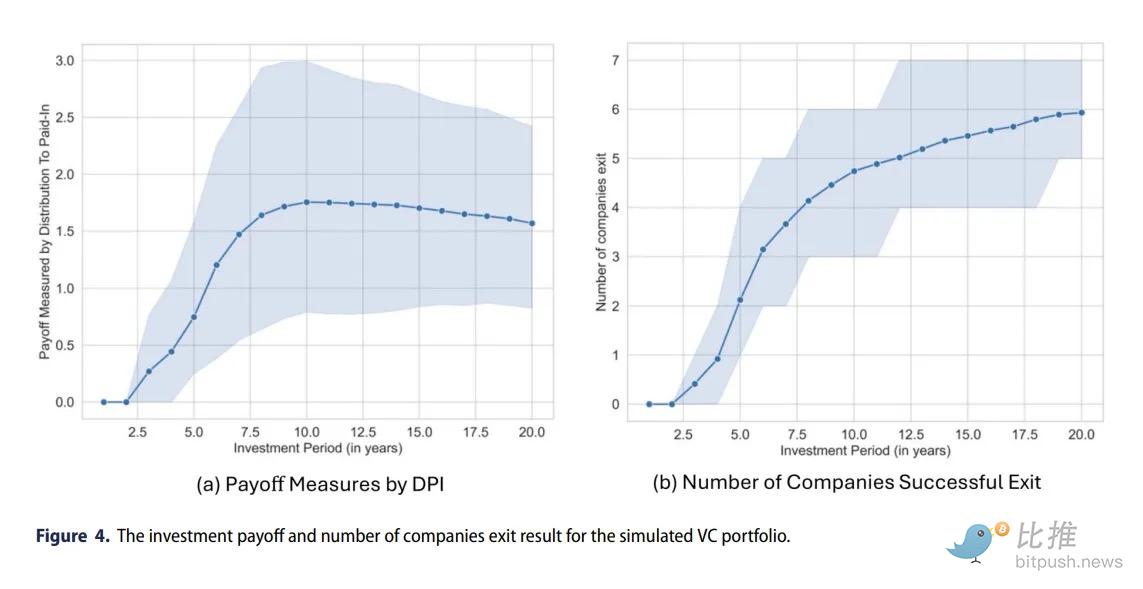
“Optimizing Investment Periods and Strategies for Late-stage Venture Capital Financing Portfolios” by Guanrou Deng, Maurizio Fiaschetti, Piero Mazzarisi & Francesca Medda
“The best returns are achieved when VC funds end in about 10 years... After more than 10 years, the curve flattens, and returns may even decline, indicating that the benefits of holding investments for too long are declining... Our conclusion that a 10-year investment period is still valid for GM VC funds is true.”
In their model, the first to four years are flat, and the combination is in the early stages of construction. The fourth to decade saw most of the increase in returns, as the company matured and successfully exited with compound interest. After ten years, the curve flattens out and is likely to decline. Holding for a longer period of time does not reliably generate additional returns; instead, it mechanically reduces IRR through the loss of time value recorded by Bartlett and Ramella.
The peak fell between the 8th and 10th year, which is consistent with the average exit length of successful venture capital firms in the PitchBook sample and the “pre-internet bubble” IPO trend. For a small fund that operates independently and has a clear insight into when each position is sold, a ten-year term seems like an ideal goal.
Baton
If small funds are to provide liquidity within a ten-year window, the question becomes how to turn paper earnings into cash in that time.
One long-term answer is that small funds proactively steer companies towards IPOs more quickly. This means trading between portfolio companies' top-line growth (and false book appreciation) and stronger economic benefits to cultivate companies with high capital efficiency, rational valuations, and ready for open market scrutiny.
The short-term answer is the secondary market. In a paper published in the “Vanderbilt Law Review” (Vanderbilt Law Review) in 2012, Darian Ibrahim put forward basic arguments more than a decade before the current liquidity crisis occurred.
“The secondary market provides new liquidity paths for initial investors, provides buyers with access to previously untapped asset classes, and brings governance benefits to trading companies. The realization of these benefits in venture capital should result in a net increase in the total volume of entrepreneurial activity. Given the surpluses that entrepreneurial activity creates for society, the secondary venture capital market should be encouraged by academic research and policy makers.”
-- “New Exit Methods in Venture Capital” by Darian M. Ibrahim
Ibrahim observed that the direct trading market for private startup stocks was already operating as a kind of “pressure relief valve” prior to the current cycle. Late-stage VCs often buy preferred shares from early VCs in larger funding rounds. One of his respondents estimated that 60-70% of late-stage venture capital financing rounds include a second-tier transaction component. Early investors can obtain some of the liquidity, the company can remain private, and late-stage capital can be entered without being bound by the early fund's maturity clock.
The elegance of this relationship is that it aligns each participant's natural term with the company lifecycle stage they are best at underwriting. Early funding brought an appetite for differentiation, qualitative expertise, and pricing discipline during the seed phase and round A phase. The late-stage fund brought large-scale capital, quantitative expertise, and patience to hold onto the long pre-IPO window. A round C or D round 2 deal is a natural point where these two parties meet, and both parties seem to benefit from it.
For a small fund operating over a ten-year period, the implications are very direct: focus on the early stages of when pricing advantages actually exist, consider whether to reserve subsequent capital for the company to round B, and consider Series C or D as the default decision point for partial or full secondary sales to multi-stage and cross-border investors.
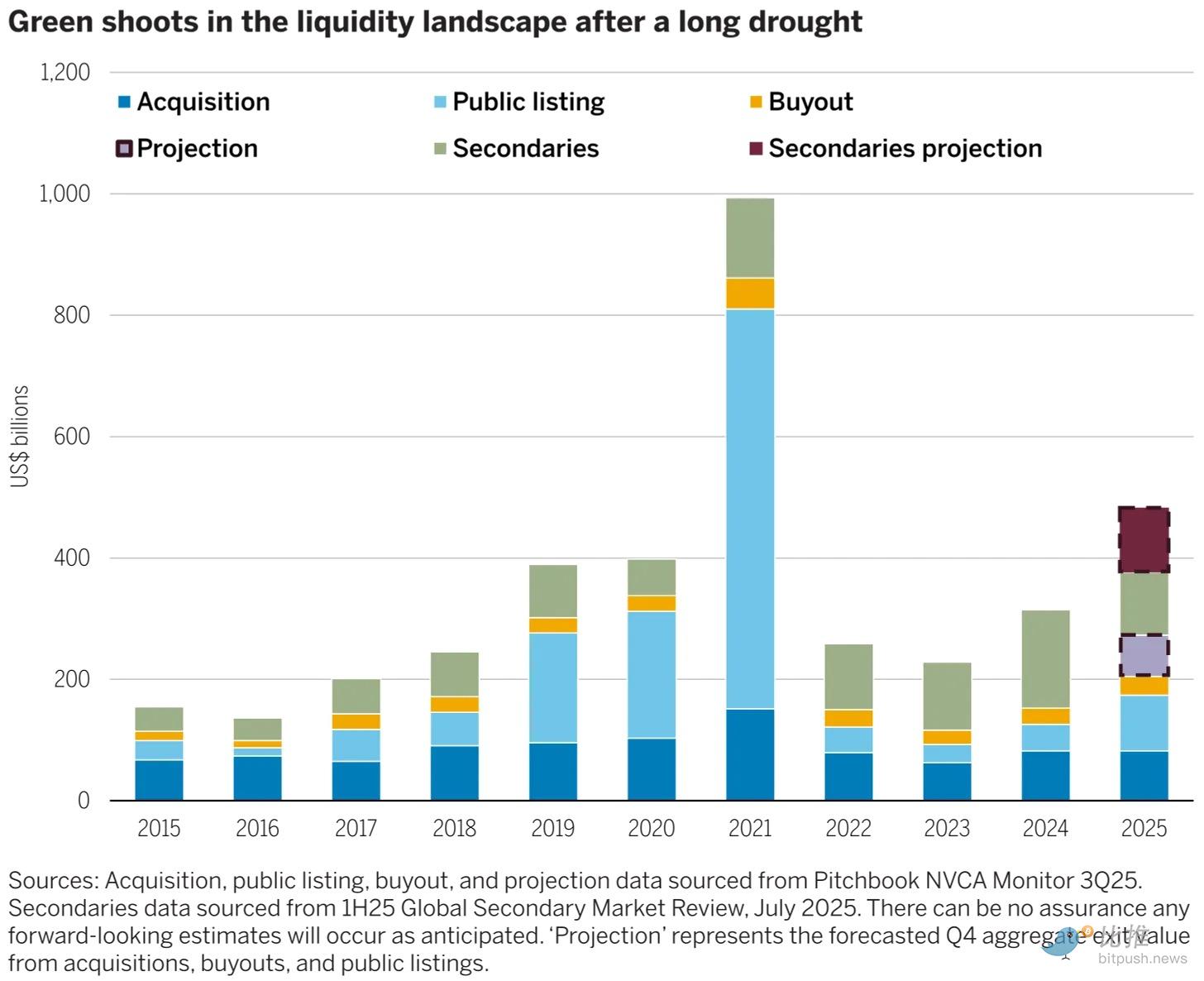
2026 Venture Capital Outlook: 5 Key Trends
The secondary market is no longer the kind of marginal market Ibrahim described in 2012. Wellington (Wellington) estimates that the venture capital secondary market will reach about $160 billion in 2025 and is expected to become a mainstream liquidity tool. Ibrahim foresaw that the conditions were ripe, although important questions about transparency and efficiency remained.
collective conservatism
“We speculate that venture capitalists and their investors often fall into what is called 'collective conservativism'. We investigated this speculation by analyzing formal terms in limited partnership agreements. “When investors accept suboptimal form clauses, it's not because they believe standardized terms are sufficient to align the interests of investors and fund managers, but simply because they think peers (including competitors) are more likely to include these terms in the LPA.”
-- “Conservatism and Innovation in Venture Capital Contracts” by Joseph A. McCahery and Erik P. M. Vermeulen
The strangest characteristic of the current venture capital market is that it has become so clearly divided, yet it still offers a single standard fund investment product. Capital has been stratified, strategies have been stratified, exit has been stratified, and the underlying companies have also been stratified. Due to huge inertia, the fund structure has remained the same on paper, although the market reality is quite different.
This can largely be explained by the reluctance of venture capital firms to propose novel concepts to their LPs and risk being rejected. In fact, the way venture capital imitates LP expectations to structure and strategy has clear similarities to the “catering” phenomenon in the GP's relationship with the founder, and is likely to have the same negative consequences for performance. However, as LPs became increasingly uneasy about the reality of the market, an opportunity for change had clearly arisen.
The arguments put forward by Bartlett and Ramella are very detailed, and their data can trace fund-level results to the exit of individual portfolio companies. However, their conclusion did not call for the abolition of the ten-year structure. Instead, they emphasized that it is no longer a reliable description of industry practice, and that performance assessments, fund design, and LP expectations need to be re-examined accordingly.
Embrace differences
What the industry needs now is a differentiated fund product that matches the reality of the fragmented market and LP needs.
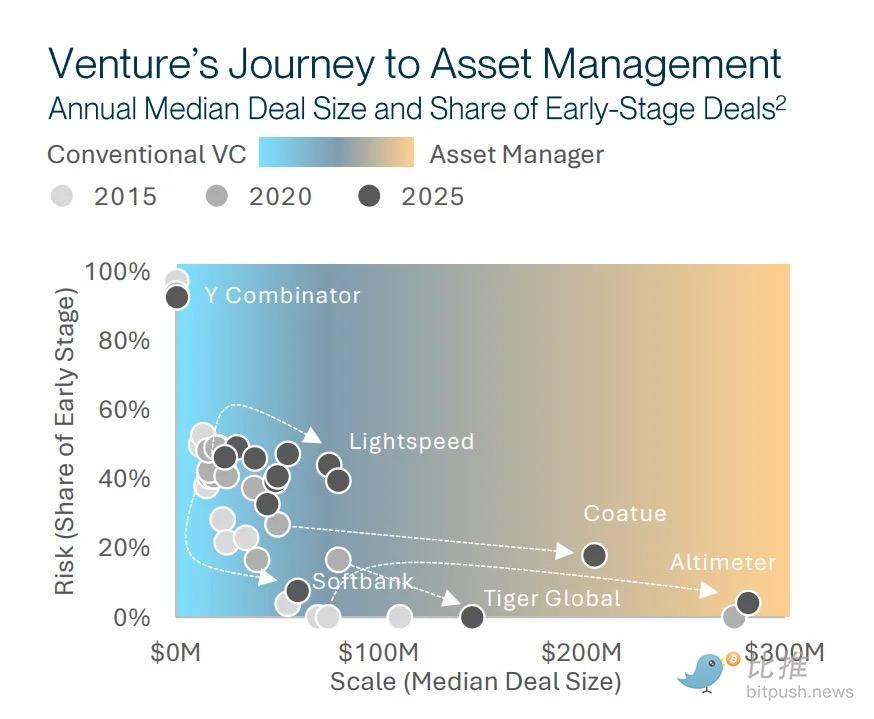
“Market Status Report for the First Half of 2026”
Mega funds and platform managers with the size, brand, and track record of performance that can require permanent capital should pursue the path pioneered by Sequoia. The companies they support have remained privatized for a longer period of time and are larger, which is enough to justify the holding period. Here, the ten-year structure is fictional, and the honest approach is to move to a more rational arrangement.
Small funds should move in the opposite direction. They should use the ten-year period to reinforce “discipline” as a competitive characteristic that will be appreciated by the LP community. This type of fund should have a clear goal: complete or majority exit in the tenth year, focus on the early stages with a structured shareholding advantage, and use round C or D round 2 transactions as the default handover point to large investors.
The logic of the ten-year cycle of small-scale fund revival is consistent with the logic of Bartlett and Ramella's discovery of structural collapse: the modern private equity market creates more value in fewer companies and at a slower pace. This logic supports an extreme period of time to be at the top and hold power-law winners; it also supports a short-term period of self-discipline in the early stages, where capital efficiency and risk management are paramount.
LPs are also under pressure to choose a clear strategy. As annual payment obligations grow, endowments and pensions have begun to question whether the “indefinite vision” embedded in giant fund holdings meets their cash flow needs. A small-scale fund product that aims to achieve real liquidity within ten years is becoming an increasingly attractive proposition.
All in all, ten-year funds disappeared during a period when the venture capital market was struggling with “poor capital digestion.” Now that this problem has been solved through targeted strategic segmentation, there is an opportunity to bring it back.
Essentially, for small and emerging managers, the opportunity lies in finally being able to fulfill a promise that the venture capital industry has ignored for more than a decade.
Twitter:https://twitter.com/BitpushNewsCN
Compare the TG exchange group:https://t.me/BitPushCommunity
Compare TG subscriptions:https://t.me/bitpush
